WB SET 2018 Question Paper 2 Sociology
Finished viewing? Save it for later —
Download WB SET 2018 Question Paper 2 Sociology (PDF · 20 pages)About WB SET 2018 Question Paper 2 Sociology
WB SET 2018 Question Paper 2 Sociology is available here for free download. Published by Default for Govt Jobs Exams, this question paper can be viewed online or downloaded as a PDF (20 pages). Candidates preparing for Govt Jobs Exams can use WB SET 2018 Question Paper 2 Sociology to understand the exam pattern, the type of questions asked, and the overall difficulty level.
Frequently Asked Questions
How can I download WB SET 2018 Question Paper 2 Sociology?
Open this page and click the Download button to save WB SET 2018 Question Paper 2 Sociology as a PDF. It is completely free on AglaSem Docs.
Is WB SET 2018 Question Paper 2 Sociology free to download?
Yes. WB SET 2018 Question Paper 2 Sociology can be viewed online and downloaded as a PDF free of cost on AglaSem Docs.
How many pages does WB SET 2018 Question Paper 2 Sociology have?
WB SET 2018 Question Paper 2 Sociology contains 20 pages, which you can read online or download together as a single PDF.
Where can I find more Govt Jobs Exams study material?
You can find more Govt Jobs Exams question papers, sample papers, syllabus, and answer keys on AglaSem Docs.
WB SET 2018 Question Paper 2 Sociology – Text
Read the full text of this question paper below — useful to quickly search, copy and reference the content online without downloading the PDF.
📄 View text version (19 pages)
Page 1
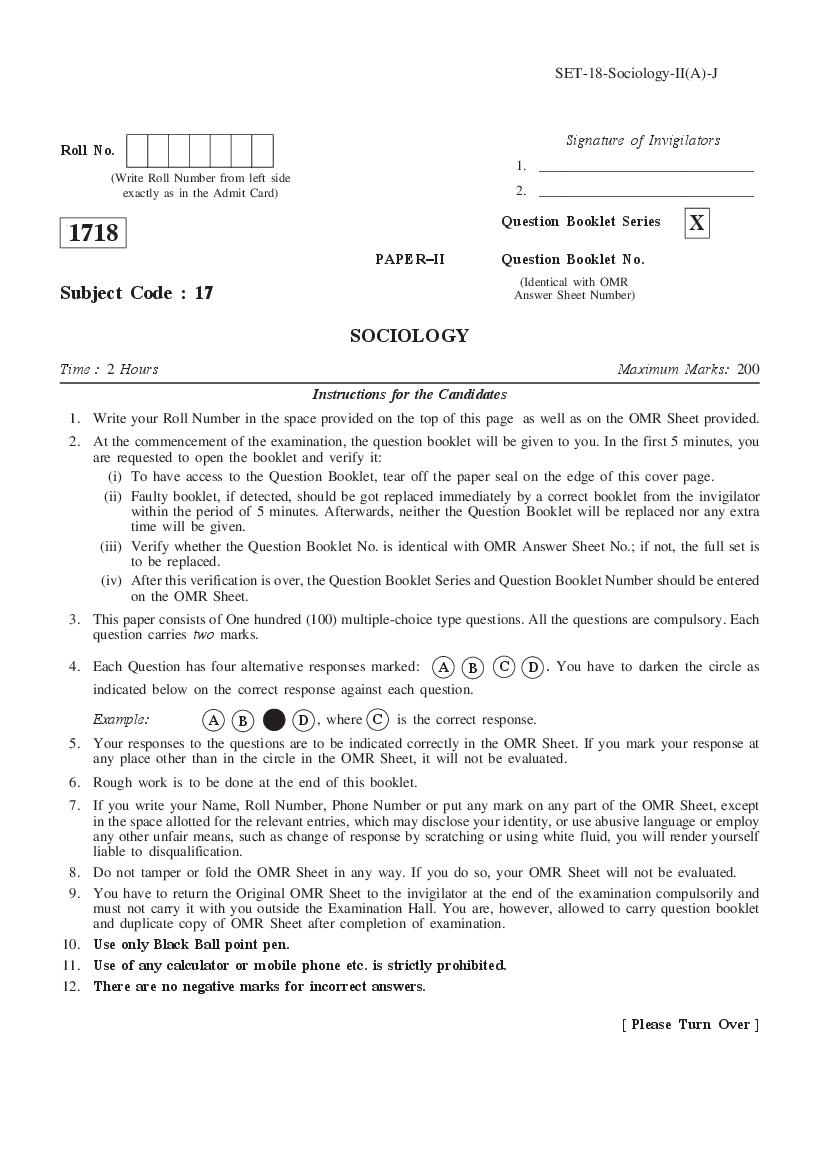
Signature of Invigilators
Roll No.
1. _______________________________
(Write Roll Number from left side
exactly as in the Admit Card) 2. _______________________________
Question Booklet Series X
1718
PAPER–II Question Booklet No.
(Identical with OMR
Subject Code : 17 Answer Sheet Number)
SOCIOLOGY
Time : 2 Hours Maximum Marks: 200
Instructions for the Candidates
1. Write your Roll Number in the space provided on the top of this page as well as on the OMR Sheet provided.
2. At the commencement of the examination, the question booklet will be given to you. In the first 5 minutes, you
are requested to open the booklet and verify it:
(i) To have access to the Question Booklet, tear off the paper seal on the edge of this cover page.
(ii) Faulty booklet, if detected, should be got replaced immediately by a correct booklet from the invigilator
within the period of 5 minutes. Afterwards, neither the Question Booklet will be replaced nor any extra
time will be given.
(iii) Verify whether the Question Booklet No. is identical with OMR Answer Sheet No.; if not, the full set is
to be replaced.
(iv) After this verification is over, the Question Booklet Series and Question Booklet Number should be entered
on the OMR Sheet.
3. This paper consists of One hundred (100) multiple-choice type questions. All the questions are compulsory. Each
question carries two marks.
4. Each Question has four alternative responses marked: A B C D . You have to darken the circle as
indicated below on the correct response against each question.
Example: A B C D , where C is the correct response.
5. Your responses to the questions are to be indicated correctly in the OMR Sheet. If you mark your response at
any place other than in the circle in the OMR Sheet, it will not be evaluated.
6. Rough work is to be done at the end of this booklet.
7. If you write your Name, Roll Number, Phone Number or put any mark on any part of the OMR Sheet, except
in the space allotted for the relevant entries, which may disclose your identity, or use abusive language or employ
any other unfair means, such as change of response by scratching or using white fluid, you will render yourself
liable to disqualification.
8. Do not tamper or fold the OMR Sheet in any way. If you do so, your OMR Sheet will not be evaluated.
9. You have to return the Original OMR Sheet to the invigilator at the end of the examination compulsorily and
must not carry it with you outside the Examination Hall. You are, however, allowed to carry question booklet
and duplicate copy of OMR Sheet after completion of examination.
10. Use only Black Ball point pen.
11. Use of any calculator or mobile phone etc. is strictly prohibited.
12. There are no negative marks for incorrect answers.
[ Please Turn Over ]
Page 3
SOCIOLOGY
PAPER II
1. Sustainable development is that kind of 4. Mark the correct option which is a viable
development which meets: sociological explanation of poverty; in capitalist
societies: People are poor because they
(A) the needs of the future generations without
compromising the ability of present (A) are afraid of work.
generations to meet their own needs. (B) suffer from low intelligence and shiftlessness.
(C) come from problem families.
(B) the needs of the present generation without
compromising the ability of future (D) suffer from chronic irregularity of work and
generations to meet their own needs. low wages.
(C) the needs of the future generations by
compromising the ability of present 5. Mark the pair which does not find a place in the
generations. inventory of ‘pattern variables’ depicted by Talcott
parsons.
(D) the needs of the present generation by
compromising the ability of future (A) Self-orientation vs. collective orientation
generations to meet their own needs. (B) Quietism vs. agressivism
(C) Affectivity vs. affective neutrality
(D) Universalism vs. particularlism
6. According to R.K. Merton,
2. The Sovereign, Socialist, Secular, Democratic
Republic of India has chosen the path of development (A) under all circumtances, anticipatory
which may be described as: socialzation is functional for the individual.
(A) Socialist (B) anticipatory socialization is functional in a
closed social structure.
(B) Capitalist
(C) anticipatory socialization is functional only
(C) Gandhian
within a relatively open social structure with
(D) Mixed social mobility.
(D) anticipatory socialization does not have any
connection with the effectiveness of social
control.
3. Which one of the following factors is not relied 7. Mark what is, according to Emile Durkheim, not
on in construction of Human Development Index? functional for human/social organism:
(A) life expectancy at birth (A) Parturition
(B) net national income (B) Religion
(C) mean years of schooling (C) Crime
(D) expected years of schooling (D) Class conflict
Page 4
8. A number of people organised for a specific 12. According to Dahrendorf, Imperatively
purpose is known as: Coordinate Associations are based on:
(A) Community (A) hierarchy of positions based on quanta of
income/wealth possessed by the incumbents
(B) Association
of those positions.
(C) Society
(B) hierarchy of positions determined by
(D) Institution ownership or non-ownership of the means
of production.
(C) hierarchy of positions sanctified by the
traditional status-system.
(D) hierarchy of authority positions.
9. That Indian sociology lies at the confluence of
sociology and indology has been avered by:
13. The sociologist who sought to intregrate conflict
(A) D.P. Mukerji theory and structural functionalism was
(B) G.S. Ghurye (A) Randall Collins
(C) Radhakamal Mukerjee (B) Lewis Coser
(D) Louis Dumont (C) Andre Gunder Frank
(D) Lawrence Hazelrigg
14. On his renunciation of Hinduism Ambedkar
embraced
10. The Indian pioneer in sociology who draw our
attention to the role played by tradition in promoting (A) Sikhism
stability and change in Indian society was: (B) Christianity
(A) G.S. Ghurye (C) Jainism
(B) D.P. Mukerji (D) Buddhism
(C) Louis Dumont
(D) N.K. Bose 15. The developement of Indian civilization has been,
according to N.K. Bose, the result of:
(A) a pattern of cultural pluralism under relatively
peaceful conditions.
(B) the repeated experience of different battles
11. The list of needs of a social system as envisaged and wars suffered by Indian communities
by Talcott Parsons does not mention: pining for peace.
(A) Adaptation (C) the absence of distinct ethnic collectivities
from the socio-cultural scenario of India.
(B) Latency
(D) diversity of cultures accompanied by the
(C) Assimilation
economic organization for interdependence
(D) Integration of communities in India.
Page 5
16. Mark the statement form the following which is 20. The main purpose of the relative deprivation
not correct: approach has been to:
David Hardiman has applied subaltern purspective
(A) measure the poverty of those below the
(A) to contest the denial of initiatives to the poverty line.
tribals relating to their life.
(B) detemine the quanta of privileges enjoyed
(B) to criticize the denial of decision making by the rich.
capacity to the tribals in solving their
(C) assess the deprivation of section of
problems.
population as compared to the others.
(C) to refute the charge that the tribals lack in the
(D) assess the minimum food requirements.
ability to decide what is good for them.
(D) to explicate the efficacy of the process of
sanskritization in the tribal world.
17. Mark the correct statement. 21. Which one of the following issues has not been
raised by the women’s organizations in the
(A) Secularism is a sine qua non for building a post-independence period?
strong nation of India.
(A) lack of maternity benefits.
(B) Secularism does not have any relation with
nation-building. (B) wage discriminations between men and
women.
(C) Secularism will impede nation-building in
India. (C) lack of provision of childcare.
(D) Secularism can never be realized in India. (D) replacements of male workers by trained
18. Mark the correct statement. female workers.
In world-systems theory
(A) The world is viewed as a single, though
conflict ridden, economic system. 22. Match List I with List II and select the correct
(B) The world is see as advancing towards answer from the codes given below the lists:
internationalism.
List I (Books) List II (Methods)
(C) The world is seen as advancing towards (a) Street Corner Society (i) Case study
greater cultural homogeneity.
(b) American Soldier (ii) Questionnaire
(D) The world is viewed as increasingly (c) Social mobility and (iii) Observation
progressing to greater political unity.
class structure in
19. Which one of the following is not a charateristic
Modern Britain
of a community?
(d) La Vida (iv) Interview
(A) Historical heritage
Codes:
(B) Specific locality (a) (b) (c) (d)
(C) A small patches of localities spread over (A) (iii) (ii) (i) (iv)
many areas (B) (iii) (iv) (ii) (i)
(D) A social, religious, occupational or other (C) (iv) (ii) (i) (iii)
groups sharing common features (D) (ii) (iv) (iii) (i)
Page 6
23. The British land tenure system where ownership 27. Match List I with List II and select the correct
right of land was handed over directly to the individual answer from the codes given below the lists:
cultivator and made him accountable to revenue payment
was known as: List I (Villages) List II (Sociologists)
(a) Bisipara (i) M.N. Srinivas
(A) Zamindari system
(b) Rampura (ii) T.S. Epstein
(B) Mahalwari system
(c) Shamirpet (iii) F.G. Bailey
(C) Ryotwari system (d) Wangala (iv) S.C. Dube
(D) Customary system Codes:
(a) (b) (c) (d)
(A) (iii) (ii) (i) (iv)
(B) (iv) (iii) (ii) (i)
(C) (i) (ii) (iii) (iv)
24. The concept of “depeasantisation” was developed
(D) (iii) (i) (iv) (ii)
by:
(A) K. Marx
(B) K. Kautsky 28. The campaign “annihilation of class enemies”
was part of which of the following peasant movements
(C) V. Lenin in India?
(D) F. Engels (A) Telengana Movement
(B) Naxalbari Movement
(C) Moplah Rebellion
(D) Deccan Riot
25. The term “foot loose labour” in India developed
by:
(A) Dipankar Gupta 29. The dominant features of globalization usally
does not include
(B) Partha Chatterjee
(A) Global capitalism
(C) Jan Breman
(B) Strengthening of nation-state
(D) Gail Omvedt
(C) Global governance
(D) Global civil society
26. Who of the following is not associated with the 30. Who of the following Indian sociologists used
mode of production debate in Indian agriculture? participant observation as the main tool of his research?
(A) Utsa Patnaik (A) G.S. Ghurye
(B) Ashok Rudra (B) D.N. Dhanagare
(C) A.R. Desai (C) I. Karve
(D) Paresh Chottopadhyaya (D) M.N. Srinivas
Page 7
31. Who of the following made the distinction 35. Given are two statements one labelled as
between participant and non-participant observation in Assertion (A) and the other as Reason (R):
his book ‘Social Discovery’? Assertion (A): Educational Sector’s increasingly being
(A) W.H. Whyte opened up to profit-making and trade without concern
for social Justice.
(B) B. Malinowaski
Reason (R): With New Economic policy there is
(C) Edward Lindman increasing penetration of private capital into educational
(D) Thomas Znanieeki sector accompanied by gradual decline of public
expenditure.
In the context of the above two statements, which among
the following is correct?
(A) Both (A) and (R) are correct and (R) is the
32. Identify the incorrect pair of the following: correct explanation of (A).
(A) Cluster sampling – Non-probablity sampling (B) Both (A) and (R) are correct and (R) is not the
(B) Random sampling – Probablity sampling correct explanation of (A).
(C) Quota sampling – Non-probablity sampling (C) (A) is true, but (R) is false.
(D) Stratified Random Sampling – Probablity (D) (A) is false, but (R) is true.
sampling
36. In which year the first Policy relating to Science
33. Who of the following considered socialisation as and Technology was introduced by the Government of
a process by which a value consensus is produced in India?
society? (A) 1956
(A) G.H. Mead (B) 1984
(B) D. Cooper (C) 1958
(C) S. Freud (D) 1961
(D) T. Parsons
37. When the Indian parents teach their daughter
34. Who of the following analysed the relationship how to cope up in mother-in-laws house after her mariage,
between symbols and socialisation? it is an example of:
(A) C.H. Cooley (A) Resocialization
(B) G.H. Mead (B) Anticipatory socialization
(C) Sigmund Freud (C) Adult socialization
(D) R.K. Merton (D) Desocialization
Page 8
38. Which type of sampling would be appropriate to 42. Who of the following considered social structure
study the impact of demonetisation on SCs, STs, women as emprically observable phenomena?
and various land owning groups in a village?
(A) B. Malinowski
(A) Random Sampling
(B) A.R. Radcliffe-Brown
(B) Multi-stage Sampling
(C) E. Durkheim
(C) Stratified-Random Sampling
(D) S.F. Nadel
(D) Snowball Sampling
43. Match Series I with Series II and find out the
39. Which one of the following is not associated with
correct answer from the codes given below:
Michel Foucault’s idea?
Series I (Book) Series II (Authors)
(A) Genealogy of power (a) The theory of Social (i) C. Levi-Strauss
(B) History of the present Structure
(C) Informationalism (b) Character and Social (ii) S.F. Nadel
Structure
(D) Archaeology of knowledge (c) Structure and Function (iii) H. Gerth and C.W.
in Primitive Society Mills
(d) The Savage Mind (iv) E. Durkheim
(v) A.R. Radciffe-
Brown
40. “Deconstructive perspective” in sociology was Codes:
developed by:
(a) (b) (c) (d)
(A) A. Giddens (A) (ii) (iii) (v) (i)
(B) J. Habermas (B) (iii) (iv) (ii) (i)
(C) M. Foucault (C) (v) (i) (iii) (iv)
(D) (ii) (iii) (iv) (i)
(D) J. Derrida
41. The two aspects of structure, according to Anthony 44. Who among the following advocated the terms
Giddens are: ‘Logical and non-Logical action’?
(A) Statuses and roles (A) G.H. Mead
(B) Language and power (B) C.H. Cooley
(C) Knowledge and power (C) V. Pareto
(D) Rules and Resources (D) Talcott Parsons
Page 9
45. Which of the following is not a type of social 49. Which one of the following statement is incorrect?
action as advocated by Max Weber?
(A) Radical feminism is a critique of patriarchy.
(A) Traditional action
(B) Liberal feminism locates the origin of
(B) Non-Logical action patriarchy in the emergence of property
relations.
(C) Rational action
(C) Socialist feminism emphasises on capitalist
(D) Divine action
patriarchy.
(D) Psychoanalytic feminism attempts to explain
patriarchy by reformulating theories of Freud
and his intellectual heirs.
46. Who of the following wrote the book ‘The Theory
of Social and Economic Organization’?
(A) Talcott Parsons 50. Which one of the following is correct?
(B) Edmund Husserl (A) Gender is a biological constract.
(C) Max Webber (B) Gender is a political construct.
(D) Ralph Linton (C) Gender is a social construct.
(D) Gender is an economic construct.
51. Match Series I with Series II and find out the
47. Who introduced first the term White-collar crime?
correct answer from the codes given below:
(A) John Braithwate
Series I Series II
(B) Edwin Sutherland (Name of the Book) (Name of the Author)
(C) Howard Becker (a) Character and Social (i) Greth and Mills
(D) R.K. Merton Structure
(b) Social Change (ii) M. Ginsberg
(c) The idea of progress: (iii) W. F. Ogburn
A Revaluation
(d) Cultural Patterns and (iv) Margeret Mead (Ed).
48. The concept of ‘environmental criminology’ is Technical Change
primarily linked to the ideas for: Codes:
(A) reforming offenders (a) (b) (c) (d)
(A) (iv) (i) (ii) (iii)
(B) changing environments
(B) (i) (ii) (iii) (iv)
(C) changing justice system (C) (ii) (iii) (iv) (i)
(D) controlling offenders (D) (i) (iii) (ii) (iv)
Page 10
52. Which of the following is not a characteristic of 56. Which of the following policy framework does
the scientific method? not put ecological and environmental pollution as
agenda?
(A) Objectivity
(A) UNEP
(B) Subjectivity
(B) The First Citizien’s Report
(C) Verifiability
(C) The Stockholm Conference, 1972
(D) Prediction
(D) The UN declaraction, 1975
57. Identify the most correct argument of
53. Who among the following discussed the role of ecofeminism from the following:
values in social research? (A) Nature is seen as interior to culture in
(A) Auguste Comte patriarchal thought and women are seen as
inferior to men.
(B) Max Weber
(B) Women and ecology are interdependent.
(C) Herbert Spencer
(C) Women is a symbol of nature.
(D) Karl Marx
(D) Oppression of woman is closer to nature.
58. In which year the first census was conducted in
the British provinces of India?
54. Who observed, “Theory without data is empty
and data without theory are blind”? (A) 1901
(A) Alvin Gouldner (B) 1881
(B) Talcott Parsons (C) 1921
(C) C. Wright Mills (D) 1867
(D) R. K. Merton
59. Which one of the following statements on
‘revolution’ is most correct?
(A) Revolution is not a gradual process of social
change.
55. Who has written the book. “Only One Earth”?
(B) Revolution is a political process.
(A) Barbara Ward
(C) Revolution is a historical process.
(B) Darryl D’ Monte
(D) Revolution is a radical process of
(C) Surendra Lawrence
fundamental changes in social and political
(D) Madhab Gadgil structure.
Page 11
60. Who is regarded as a co-founder of the 64. As per 2011 census female sex ratio (number of
‘voluntaristic theory of action’? female to per 1000 male) in West Bengal is:
(A) R. K. Merton (A) 909
(B) Vilfredo Pareto (B) 919
(C) Max Weber (C) 929
(D) Robert E. Park (D) 947
65. A primary group is represented by which set of
following characters?
(A) Formality, Physical and emotional
proximity, non-primordiality, continuty
(B) Informality, virtual presence, primodiality,
61. Which of the following statements is incorrect? inderfference, rationality
(A) Corruption is a social evil. (C) Formality, primordiality, physical and
(B) Corruption is an antisocial activity. emotional proximity, discontinuity
(C) Corruption is considered as a crime. (D) Emotional and physical proximity,
(D) Corruption is a legitimate way of life. primordiality, informality, continuity and
intimacy.
66. Polygynous family is respresented by
(A) A man and an woman living together
(B) A woman living with many women
(C) Many men living with many women
62. Who among the following has advocated the (D) A man living with many women
dialectial theory of social change?
(A) Max Weber 67. Select the correct set of match/ matches from the
(B) Herbert Spencer given choices:
(C) Karl Marx (1) Levirate : A man is to marry the sister of his
deceased wife.
(D) Auguste Comte
(2) Sororate : A man has to marry the wife of his
deceased brother.
(3) Martriarchy: Rule, authority and ownership of
property are in the hand of mother.
(4) Matriliny : The descent of the family is passing
through mother.
(5) Patriarchal : Rule, authority are in the hand of the
63. Which of the following is not a cause of drug eldest married man of the family.
addiction? Correct choice:
(A) Disorganized family (A) 1, 3, 4 and 5
(B) Easy availability of synthetic drugs in market (B) 2, 3 and 4
(C) Tension and Loneliness (C) 1, 4, and 5
(D) Economic development (D) 3, 4 and 5
Page 12
68. What is the population density of India as per 72. Which one of the following sets of alternative is
2011 census? correct with regard to participant observation?
(A) 1000 (per Sqr Km) 1. It entails data collection through participation in
the daily life of informants in their natural setting.
(B) 812 (per Sqr Km)
2. It involves integration and observation of the
(C) 501 (per Sqr Km) researcher to understand the interpretation and meaning
(D) 382 (per Sqr Km) of activities of the people.
3. It help discover the gap between what people talk
and think.
69. Which one of the following denotes features of 4. It involves both verbal and non-verbal
caste system? observation.
(A) Hierarchy, endogamy, occupational 5. It is an effective tool for ethnographic research.
specialisation, purity and pollution. Select the correct choice:
(B) Equality, sexual division of labour, exogamy (A) 1 and 2
and non-primordiality. (B) 2, 3 and 4
(C) Hierarchy, exogamy, spatial mobility, (C) 1, 3 and 5
endogamy, purity and pollution. (D) 1, 2, 3, 4 and 5
(D) Universalism, occupational mobility,
endogamy, purity and pollution.
73. Which one of the following states of India has the
highest density of population?
70. Select correct alternative on the class system (A) Bihar
from the choices provided below: (B) West Bengal
1. Class is a closed system like the caste. (C) Andhra Pradesh
2. Class is an open system unlike the caste.
(D) Uttar Pradesh
3. Class is founded on economic inequality and
unequal distribution of power and authority.
4. Class division is historically universal. 74. The method of data collection in which a
5. Class division sharpened with the advancement researcher participate in the daily life of the informant in
of industrialisation in society. their natural settings through verbal and non-verbal
Select the correct choice: interaction is known as
(A) 1, 2 and 3 are true, but 4 and 5 are false. (A) Non participant observation method
(B) 2, 3 and 4 are true, but 1 and 5 are false. (B) Participant observation method
(C) 2, 3 and 5 are true, but 1 and 4 are false. (C) Survey method
(D) 3, 4 and 5 are true, but 1 and 2 are false. (D) Interview method
71. Which one of the following is not a methodological 75. Which of the following is not an example of an
typology of case study? ethnic group?
(A) Exploratory (A) Religion
(B) Explanatory (B) Language
(C) Open-ended (C) Political Elite
(D) Descriptive (D) Indigeneity
Page 13
76. Oral-history approach is most suitable to the 80. The state of inability of a person or a household
study of the evolution of life-situation of which one of to provide basic necessities of life is measured as:
the following social group? (A) Situational poverty
(A) Industrial working class (B) Absolute poverty
(B) Urban agglomeration (C) Relative poverty
(C) Peasant society (D) Transitional poverty
(D) Indigenous people
81. Over the decades female sex ratio in India has
shown:
77. Select the incorrect statement on content analysis (A) A declining trend
as a research technique: (B) An increasing trend in the developed regions
(A) It bridges gaps between qualitative and of the country.
quantitative method. (C) An increasing trend across the country.
(B) It allows the researcher to go deep into the (D) An increasing trend in urban areas and
cognitive and perceptual constructs of the declining trend in rural areas.
subject.
(C) It widers gap between the qualitative and 82. Match Series I with Series II and find out the
quantitative method. correct answer from the codes provided below:
(D) The scope of content analysis can be extented Series I Series II
to all social universe. (a) August Camte (i) Organic Solidarity
(b) Emile Durkheim (ii) Positive stage
(c) Harbert Spencer (iii) Capitalism
78. What proportion of women workforce in India is
(d) Max Weber (iv) Tribly Compound
engaged in the informal sector?
(e) Karl Marx (v) Rational capital
(A) Around 60%
(B) Around 70% Codes:
(C) Around 80% (a) (b) (c) (d) (e)
(D) Around 92% (A) (ii) (i) (iv) (v) (iii)
(B) (i) (ii) (iii) (iv) (v)
(C) (ii) (iii) (iv) (v) (i)
(D) (v) (iv) (iii) (ii) (i)
79. Which one of the following are the typical feature
of organised sector?
(A) Job security, social security, fixed wage, 83. To Karl Marx social relation of production:
legal protection, presence of trade unionism. (A) exist and function autonomously in all social
(B) Job insecurity, lack of legal protection and situation.
social security. (B) condition the economic arrangement of
(C) Job security, lack of legal protection, seasonal society.
variation of wage and presence of trade (C) get conditioned by the economic
unionism. arrangement of society.
(D) Job security, gender based wage variation, (D) condition the historical processes of social
lack of legal protection. formation.
Page 14
84. What is the per square km population density of 88. Which one of the following is appropriate for the
West Bengal as per 2011 census? understanding of ‘sociology of development’?
(A) 1500 (A) It is concerned with the application of social
(B) 1429 theory and analysis to societies.
(C) 1229 (B) It is concerned with the application of cultural
theory and analysis of developed world.
(D) 1029
(C) It is concerned with the application of
political theory and analysis of urbanized
societies.
(D) It is concerned with the application of
religious theory and analysis of simple
societies.
85. Infant mortality rate in India in 2016:
(A) has declined to 34 per 1000 live birth.
(B) has increased to 84 per 1000 live birth.
(C) has remained unchanged for last five years.
(D) has remained unchanged for rural areas, but
increased for urban areas.
86. According to Marx, relations of production 89. Match List I with List II :
constitute relationships between List I (Authors) List II (Books)
(A) people and people (a) R. F. Bales (i) The Origin of the
(B) people and things Family
(C) things and things (b) Z. Bauman (ii) The Authoritarian
Personality
(D) ideology and utopia
(c) F. Engels (iii) Thinking
Sociologically
(d) T. Adorno et al. (iv) Family,
Socialization and
Interaction Process
Select the corrent answer from the below code:
87. Who wrote the book ‘Consensus and Codes:
Controversy’? (a) (b) (c) (d)
(A) G. Marshall (A) (i) (ii) (iii) (iv)
(B) R. K. Merton (B) (ii) (i) (iv) (iii)
(C) S. E. Finer (C) (iii) (iv) (ii) (i)
(D) T. Parsons (D) (iv) (iii) (i) (ii)
Page 15
90. Which one of the following indicates the meaning 94. Among the Pandits of Kashmir, a woman’s
of research design? identity as wife overrides her other identities such as:
(a) How the research strategy addresses the (a) Daughter and mother
specific aims and objectives of the study. (b) Daughter and sister
(b) Planning for the application of methods of (c) Mother and ‘Amanat’
data collection and analysis.
(d) ‘Amanat’ and asset
(c) Strategy for setting out the broad outline and
key features of the study. Find out the correct combination from the above:
(d) A plan comensurate with available resources (A) (a) is true.
and time. (B) (a) and (b) are true.
Select correct one from the code below: (C) (a), (b), and (c) are true.
Codes: (D) (a), (b), (c) and (d) are true.
(A) Both (a) and (b) are correct.
(B) Both (c) and (d) are incorrect.
(C) (a), (b), (c) and (d) are correct.
(D) (a), (b), (c) and (d) are incorrect.
91. Marriage is ‘essentially a rearrangement of social 95. Morbidity rates indicate the following options:
structure’. Who has made the statement? (a) Prevalence rate
(A) B. Malinowski
(b) Mortality rate
(B) D. Mandelbaum
(C) M. Marriott (c) Incidence rate
(D) A. R. Radcliffe-Brown (d) Rate of accidents per thousand population
Find the correct answer:
92. Correlational analysis of statistical data (A) (a) is true, (b) is false.
represents:
(B) (c) is true, (d) is false.
(A) A degree of association
(C) Both (a) and (c) are true.
(B) A degree of variation
(D) Both (b) and (d) are true.
(C) Extent of associated options from alternatives
(D) Extent of variations among the alternatives
provided through data
93. Which one of the following is the correct meaning
of ‘Mode’?
96. ‘We can understand the world by careful use of
(A) It is the average value of a statistical
reason, this guarantees the undoubtability of our
distribution.
knowledge’.
(B) It is the highest value of a statistical Who among the following has given this view?
distribution.
(A) Immanuel Kant
(C) It indicates the middle value of a statistical
distribution. (B) Edmund Husserl
(D) Statistics always accepts modal value as the (C) Antonio Gramsci
most authentic one. (D) Pierre Bourdien
Page 16
97. Sampling error is the result of mistakes made in 99. ‘Observation is the essential procedure of all
the sampling procedure due to the following: sciences and one of the elementary processess of human
(a) Procedural fault thought’. Who among the following has made the
(b) Chance selection of different individuals statement?
(c) Chance selection of an individual (A) L. T. Hobhouse
(d) Unethical practice made by the researcher (B) Evans-Pritchard
during selection (C) Macfarlane
Find the correct answer from the following: (D) A. Beteille
(A) (a) is correct, (b) is incorrect.
(B) (c) is correct, (d) is incorrect. 100. The sample size may depend on which one of the
(C) (d) is correct, (a) is incorrect. following conditions:
(D) (b) is correct, (c) is incorrect. (a) The heterogeneity of the population.
(b) Proportion of attribute to be examined.
(c) The confidence limit set up for assumption.
98. A null hypothesis is accepted or rejected depends (d) Estimate the homogeneity of population.
on: Find out the correct ones from the following:
(A) Adopted significance level (A) (a) and (b) are correct.
(B) Rejected level of significance (B) (a), (b) and (c) are correct.
(C) Suitable level of significance (C) (a), (b), (c) and (d) are correct.
(D) Prefered level of significance (D) (c) and (d) are correct.
Page 17
ROUGH WORK
Page 18
ROUGH WORK
Page 19
ROUGH WORK
Page 20
ROUGH WORK
Document Details
| Board / Org | Default |
| Exam | Govt Jobs Exams |
| Type | Question Paper |
| Pages | 20 |
| Updated | 30 Apr 2026 |