JNUEE 2021 Question Paper M.Tech Nano Science Nano Electronics
Finished viewing? Save it for later —
Download JNUEE 2021 Question Paper M.Tech Nano Science Nano Electronics (PDF · 25 pages)About JNUEE 2021 Question Paper M.Tech Nano Science Nano Electronics
JNUEE 2021 Question Paper M.Tech Nano Science Nano Electronics is available here for free download. Published by NTA for Jawaharlal Nehru University Entrance Examination, this question paper can be viewed online or downloaded as a PDF (25 pages). Candidates preparing for Jawaharlal Nehru University Entrance Examination can use JNUEE 2021 Question Paper M.Tech Nano Science Nano Electronics to understand the exam pattern, the type of questions asked, and the overall difficulty level.
Frequently Asked Questions
How can I download JNUEE 2021 Question Paper M.Tech Nano Science Nano Electronics?
Open this page and click the Download button to save JNUEE 2021 Question Paper M.Tech Nano Science Nano Electronics as a PDF. It is completely free on AglaSem Docs.
Is JNUEE 2021 Question Paper M.Tech Nano Science Nano Electronics free to download?
Yes. JNUEE 2021 Question Paper M.Tech Nano Science Nano Electronics can be viewed online and downloaded as a PDF free of cost on AglaSem Docs.
How many pages does JNUEE 2021 Question Paper M.Tech Nano Science Nano Electronics have?
JNUEE 2021 Question Paper M.Tech Nano Science Nano Electronics contains 25 pages, which you can read online or download together as a single PDF.
Where can I find more Jawaharlal Nehru University Entrance Examination study material?
You can find more Jawaharlal Nehru University Entrance Examination question papers, sample papers, syllabus, and answer keys on AglaSem Docs.
JNUEE 2021 Question Paper M.Tech Nano Science Nano Electronics – Text
Read the full text of this question paper below — useful to quickly search, copy and reference the content online without downloading the PDF.
📄 View text version (25 pages)
Page 1
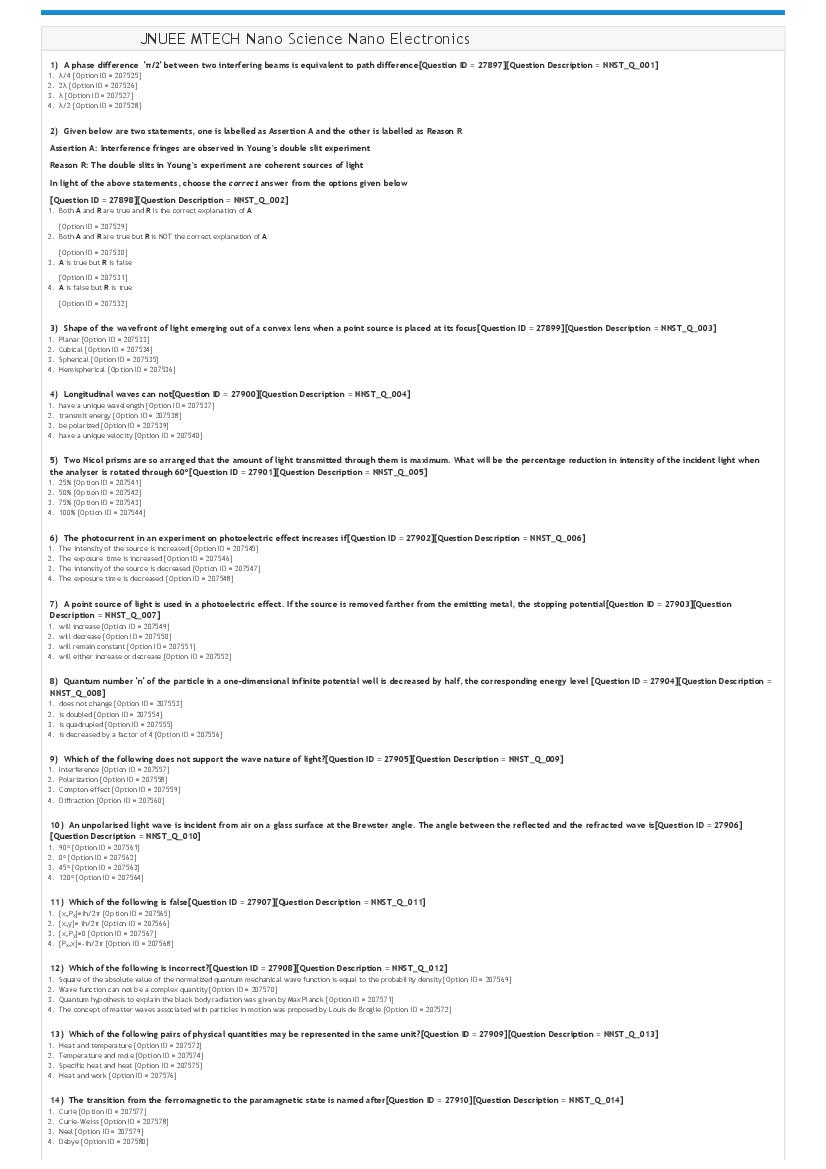
1) A phase difference 'π/2' between two interfering beams is equivalent to path difference[Question ID = 27897][Question Description = NNST_Q_001]
1. λ/4 [Option ID = 207525]
2. 2λ [Option ID = 207526]
3. λ [Option ID = 207527]
4. λ/2 [Option ID = 207528]
2) Given below are two statements, one is labelled as Assertion A and the other is labelled as Reason R
Assertion A: Interference fringes are observed in Young’s double slit experiment
Reason R: The double slits in Young’s experiment are coherent sources of light
In light of the above statements, choose the correct answer from the options given below
[Question ID = 27898][Question Description = NNST_Q_002]
1. Both A and R are true and R is the correct explanation of A
[Option ID = 207529]
2. Both A and R are true but R is NOT the correct explanation of A
[Option ID = 207530]
3. A is true but R is false
[Option ID = 207531]
4. A is false but R is true
[Option ID = 207532]
3) Shape of the wavefront of light emerging out of a convex lens when a point source is placed at its focus[Question ID = 27899][Question Description = NNST_Q_003]
1. Planar [Option ID = 207533]
2. Cubical [Option ID = 207534]
3. Spherical [Option ID = 207535]
4. Hemispherical [Option ID = 207536]
4) Longitudinal waves can not[Question ID = 27900][Question Description = NNST_Q_004]
1. have a unique wavelength [Option ID = 207537]
2. transmit energy [Option ID = 207538]
3. be polarized [Option ID = 207539]
4. have a unique velocity [Option ID = 207540]
5) Two Nicol prisms are so arranged that the amount of light transmitted through them is maximum. What will be the percentage reduction in intensity of the incident light when
the analyser is rotated through 60o [Question ID = 27901][Question Description = NNST_Q_005]
1. 25% [Option ID = 207541]
2. 50% [Option ID = 207542]
3. 75% [Option ID = 207543]
4. 100% [Option ID = 207544]
6) The photocurrent in an experiment on photoelectric effect increases if[Question ID = 27902][Question Description = NNST_Q_006]
1. The intensity of the source is increased [Option ID = 207545]
2. The exposure time is increased [Option ID = 207546]
3. The intensity of the source is decreased [Option ID = 207547]
4. The exposure time is decreased [Option ID = 207548]
7) A point source of light is used in a photoelectric effect. If the source is removed farther from the emitting metal, the stopping potential[Question ID = 27903][Question
Description = NNST_Q_007]
1. will increase [Option ID = 207549]
2. will decrease [Option ID = 207550]
3. will remain constant [Option ID = 207551]
4. will either increase or decrease [Option ID = 207552]
8) Quantum number 'n' of the particle in a one‐dimensional infinite potential well is decreased by half, the corresponding energy level [Question ID = 27904][Question Description =
NNST_Q_008]
1. does not change [Option ID = 207553]
2. is doubled [Option ID = 207554]
3. is quadrupled [Option ID = 207555]
4. is decreased by a factor of 4 [Option ID = 207556]
9) Which of the following does not support the wave nature of light?[Question ID = 27905][Question Description = NNST_Q_009]
1. Interference [Option ID = 207557]
2. Polarization [Option ID = 207558]
3. Compton effect [Option ID = 207559]
4. Diffraction [Option ID = 207560]
10) An unpolarised light wave is incident from air on a glass surface at the Brewster angle. The angle between the reflected and the refracted wave is[Question ID = 27906]
[Question Description = NNST_Q_010]
1. 90o [Option ID = 207561]
2. 0o [Option ID = 207562]
3. 45o [Option ID = 207563]
4. 120o [Option ID = 207564]
11) Which of the following is false[Question ID = 27907][Question Description = NNST_Q_011]
1. [x,Px]=ih/2π [Option ID = 207565]
2. [x,y]= ih/2π [Option ID = 207566]
3. [x,Py]=0 [Option ID = 207567]
4. [Px,x]=‐ih/2π [Option ID = 207568]
12) Which of the following is incorrect?[Question ID = 27908][Question Description = NNST_Q_012]
1. Square of the absolute value of the normalized quantum mechanical wave function is equal to the probability density [Option ID = 207569]
2. Wave function can not be a complex quantity [Option ID = 207570]
3. Quantum hypothesis to explain the black body radiation was given by Max Planck [Option ID = 207571]
4. The concept of matter waves associated with particles in motion was proposed by Louis de Broglie [Option ID = 207572]
13) Which of the following pairs of physical quantities may be represented in the same unit?[Question ID = 27909][Question Description = NNST_Q_013]
1. Heat and temperature [Option ID = 207573]
2. Temperature and mole [Option ID = 207574]
3. Specific heat and heat [Option ID = 207575]
4. Heat and work [Option ID = 207576]
14) The transition from the ferromagnetic to the paramagnetic state is named after[Question ID = 27910][Question Description = NNST_Q_014]
1. Curie [Option ID = 207577]
2. Curie‐Weiss [Option ID = 207578]
3. Neel [Option ID = 207579]
4. Debye [Option ID = 207580]
Page 2
NNST_Q_015]
1. 0 [Option ID = 207581]
2. √x [Option ID = 207582]
3. x/2 [Option ID = 207583]
4. 2x [Option ID = 207584]
16) Which of the following is true about the transmission probability T of a particle incident on a potential barrier of Width L [Question ID = 27912][Question Description =
NNST_Q_016]
1. T increases as L decreases [Option ID = 207585]
2. T increases as L increases [Option ID = 207586]
3. T does not depend on L [Option ID = 207587]
4. T is proportional to square of L [Option ID = 207588]
17) Type‐I superconductor have[Question ID = 27913][Question Description = NNST_Q_017]
1. Higher critical fields than type‐II [Option ID = 207589]
2. Two critical fields [Option ID = 207590]
3. lower critical fields than type‐II [Option ID = 207591]
4. same critical field as that of type‐II [Option ID = 207592]
18) Heat and work are equivalent. This means[Question ID = 27914][Question Description = NNST_Q_018]
1. when we supply heat to a body we do work on it [Option ID = 207593]
2. the temperature of a body can be increased by doing work on it [Option ID = 207594]
3. when we do work on a body we supply heat to it [Option ID = 207595]
4. a body kept at rest may be set into motion along a line by supplying heat to it [Option ID = 207596]
19) Number of lattice point(s) in the rhombohedral unit cell is [Question ID = 27915][Question Description = NNST_Q_019]
1. 8 [Option ID = 207597]
2. 2 [Option ID = 207598]
3. 1 [Option ID = 207599]
4. 4 [Option ID = 207600]
20) Magnitude of Electric field due to two oppositely charged infinite plane sheets with a uniform surface charge density σ, at a position outside the sheets is[Question ID = 27916]
[Question Description = NNST_Q_020]
1. σ/(2ϵ0) [Option ID = 207601]
2. σ/ϵ0 [Option ID = 207602]
3. 0 [Option ID = 207603]
4. 2σ/ϵ0 [Option ID = 207604]
21) Consider the following statements:
statements A: An emf can be induced by moving a conductor in a magnetic field.
statements B: An emf can be induced by changing the magnetic field.
Choose the correct answer from the options given below:
[Question ID = 27917][Question Description = NNST_Q_021]
1. Both A and B are true
[Option ID = 207605]
2. A is true but B is false
[Option ID = 207606]
3. B is true but A is false
[Option ID = 207607]
4. Both A and B are false
[Option ID = 207608]
22) In a diatomic one‐dimensional lattice, the energy separation between the optic and the acoustic modes is proportional to [Question ID = 27918][Question Description =
NNST_Q_022]
1. The force constant [Option ID = 207609]
2. Amplitudes of vibration [Option ID = 207610]
3. Ratio of the masses [Option ID = 207611]
4. The lattice constant [Option ID = 207612]
23) Electromagnetic waves are produced by[Question ID = 27919][Question Description = NNST_Q_023]
1. a static charge [Option ID = 207613]
2. a moving charge [Option ID = 207614]
3. an accelerating charge [Option ID = 207615]
4. chargeless particles [Option ID = 207616]
24) The desirable properties for making permanent magnets are[Question ID = 27920][Question Description = NNST_Q_024]
1. high retentivity and high coercive force [Option ID = 207617]
2. high retentivity and low coercive force [Option ID = 207618]
3. low retentivity and high coercive force [Option ID = 207619]
4. low retentivity and low coercive force [Option ID = 207620]
25) Paramagnetic materials when placed in a magnetic field, get[Question ID = 27921][Question Description = NNST_Q_025]
1. Feebly attracted [Option ID = 207621]
2. Feebly repelled [Option ID = 207622]
3. Strongly repelled [Option ID = 207623]
4. Strongly attracted [Option ID = 207624]
26) The resistance of a material in superconducting state becomes[Question ID = 27922][Question Description = NNST_Q_026]
1. Infinite [Option ID = 207625]
2. Finite [Option ID = 207626]
3. Zero [Option ID = 207627]
4. Arbitrary [Option ID = 207628]
27) The transducers used in microphones are made of[Question ID = 27923][Question Description = NNST_Q_027]
1. Dielectrics [Option ID = 207629]
2. Insulators [Option ID = 207630]
3. Paraelectrics [Option ID = 207631]
4. Piezoelectrics [Option ID = 207632]
28) Which of the follwoings bond is the weakest bond?
[Question ID = 27924][Question Description = NNST_Q_028]
1. Ionic bond
[Option ID = 207633]
2. Metallic bond
[Option ID = 207634]
3. Van der Waals bond
[Option ID = 207635]
4. Covalent bond
[Option ID = 207636]
Page 3
NNST_Q_029]
1.
[Option ID = 207637]
2.
[Option ID = 207638]
3. a=4R/3 [Option ID = 207639]
4. None of these [Option ID = 207640]
30) Which of the following materials normally exist(s) in amorphous forms?[Question ID = 27926][Question Description = NNST_Q_030]
1. Copper [Option ID = 207641]
2. Window glass [Option ID = 207642]
3. Quartz [Option ID = 207643]
4. Sugar [Option ID = 207644]
31) A plane cuts intercepts a, 3b and 2c along the crystallographic axes in a crystal. The Miller indices of plane
[Question ID = 27927][Question Description = NNST_Q_031]
1. (123)
[Option ID = 207645]
2. (132)
[Option ID = 207646]
3. (623)
[Option ID = 207647]
4. None of these
[Option ID = 207648]
32) The free electron theory of metals was initiated by[Question ID = 27928][Question Description = NNST_Q_032]
1. Pauli [Option ID = 207649]
2. Sommerfield [Option ID = 207650]
3. Lorentz and Drude [Option ID = 207651]
4. Fermi‐Dirac [Option ID = 207652]
33) In a semiconductor, the energy gap between valence band and conduction band is nearly[Question ID = 27929][Question Description = NNST_Q_033]
1. 1 eV [Option ID = 207653]
2. 4 eV [Option ID = 207654]
3. 0 eV [Option ID = 207655]
4. 10 eV [Option ID = 207656]
34) Electronic polarisation [Question ID = 27930][Question Description = NNST_Q_034]
1. is independent of temperature [Option ID = 207657]
2. increases with temperature [Option ID = 207658]
3. decreases with increase in temperature [Option ID = 207659]
4. none of these [Option ID = 207660]
35) The extensively used nano particles in cancer diagnosis are......[Question ID = 27931][Question Description = NNST_Q_035]
1. Tungsten Nanoparticles [Option ID = 207661]
2. Gold Nanoparticles [Option ID = 207662]
3. Cellulose Nanoparticles [Option ID = 207663]
4. Lead Sulphide Nanoparticles [Option ID = 207664]
36) Which one of the followings is the stronger reducing agent?[Question ID = 27932][Question Description = NNST_Q_036]
1. NaBH4 [Option ID = 207665]
2. LiAlH4 [Option ID = 207666]
3. Ascorbic Acid [Option ID = 207667]
4. Sodium Citrare [Option ID = 207668]
37) Most electronegative element in the periodic table is:[Question ID = 27933][Question Description = NNST_Q_037]
1. O [Option ID = 207669]
2. Cl [Option ID = 207670]
3. F [Option ID = 207671]
4. Ar [Option ID = 207672]
38) The crystallization technique to purify an impure organic compound is based on the principle of:[Question ID = 27934][Question Description = NNST_Q_038]
1. Differential adsorbing tendency of compound and impurity on a particular adsorbent. [Option ID = 207673]
2. Differential solubility behaviour of a compound and impurity in a suitable solvent [Option ID = 207674]
3. Differential boiling points of a compound and impurity [Option ID = 207675]
4. Differential behavior of compound and impurity to change its state on heating [Option ID = 207676]
39) The decreasing order of basicity of the amines (A to D) in aqueous solution follows the trend
A. NH3
B. (CH3) 3N
C. CH3NH2
D. (CH3) 2NH
Choose the correct answer from the options given below
[Question ID = 27935][Question Description = NNST_Q_039]
1. A > B > C > D
[Option ID = 207677]
2. B > D > C > A
[Option ID = 207678]
3. A > C > D > B
[Option ID = 207679]
4. D > C > B > A
[Option ID = 207680]
40) Lactose is composed of [Question ID = 27936][Question Description = NNST_Q_040]
1. β‐D‐galactose and β‐D‐glucose units joined through glycosidic linkage
[Option ID = 207681]
2. α‐D‐glucose and β‐D‐glucose units joined through peptide linkage
[Option ID = 207682]
3. Two α‐D‐glucose units joined through glycosidic linkage
[Option ID = 207683]
4. β‐D‐galactose and β‐D‐glucose units joined through peptide linkage
[Option ID = 207684]
41) Which one of the following statements is incorrect?[Question ID = 27937][Question Description = NNST_Q_041]
Page 4
2. Water is a good solvent for recording UV spectra of water‐soluble compounds [Option ID = 207686]
3. Water is a good solvent for recording IR spectra of water‐soluble compounds. [Option ID = 207687]
4. Hydrogen bonding in hydroxy compounds leads to broadening of spectral bands attributable to O‐H stretching vibrations. [Option ID = 207688]
42) After solving, the correct answer following the significant figures rule is (313.44 cm ‐ 209.1 cm) × 8.2234 cm[Question ID = 27938][Question Description = NNST_Q_042]
1. 858.0 cm2 [Option ID = 207689]
2. 857.9 cm2 [Option ID = 207690]
3. 858.02 cm2 [Option ID = 207691]
4. 857.98 cm2 [Option ID = 207692]
43) Which of the following is an intensive property?[Question ID = 33118][Question Description = NNST_Q_043]
1. Heat capacity [Option ID = 207693]
2. Enthalby [Option ID = 207694]
3. Density [Option ID = 207695]
4. Volume [Option ID = 207696]
44) Which one is an example of Green Synthesis among the following[Question ID = 33119][Question Description = NNST_Q_044]
1. Grignard reaction [Option ID = 207697]
2. Diels‐Alder reaction [Option ID = 207698]
3. Friedel‐Craft’s acylation [Option ID = 207699]
4. Synthesis of malachite green [Option ID = 207700]
45) How many signals does the aldehyde (CH3) 3CCH2CHO have in 1H NMR and 13C NMR spectra?
[Question ID = 33120][Question Description = NNST_Q_045]
1. five 1H signals and six 13C signals
[Option ID = 207701]
2. three 1H signals and four 13C signals
[Option ID = 207702]
3. five 1H signals and four 13C signals
[Option ID = 207703]
4. three 1H signals and six 13C signals
[Option ID = 207704]
46) Which is the main product upon photo‐chlorination of methylbutane with Cl2?[Question ID = 33121][Question Description = NNST_Q_046]
1.
[Option ID = 207705]
2.
[Option ID = 207706]
3.
[Option ID = 207707]
4.
[Option ID = 207708]
47) Which is least reactive towards an electrophile?
[Question ID = 27976][Question Description = NNST_Q_047]
1.
[Option ID = 207917]
2.
[Option ID = 207918]
3.
[Option ID = 207919]
4.
[Option ID = 207920]
48) Which is impossible as a resonance contributor of anthracene?[Question ID = 27977][Question Description = NNST_Q_048]
1.
[Option ID = 207921]
2.
[Option ID = 207922]
3.
[Option ID = 207923]
4.
Page 5
49) Which of the following statement is wrong?
[Question ID = 33122][Question Description = NNST_Q_049]
1. In the epoxidation of an alkene with a peroxy acid, the peroxy acid is electrophilic.
[Option ID = 207709]
2. The addition of bromine to cyclohexene is stereospecific but the product is a racemate.
[Option ID = 207710]
3. Hydroboration‐oxidation of a terminal alkyne gives a ketone as the main product.
[Option ID = 207711]
4. Hydrogenation of an internal alkyne over the Lindlar catalyst gives a cis alkene.
[Option ID = 207712]
50) Which one of the following has normal spinel structure?[Question ID = 33123][Question Description = NNST_Q_050]
1. MgAl2O4 [Option ID = 207713]
2. Fe3O4 [Option ID = 207714]
3. NiFe2O4 [Option ID = 207715]
4. NiAl2O4 [Option ID = 207716]
51) Find out the correct statement (s) using the following reaction:
Zn + 2HCl → ZnCl2 + H2
A. Zinc is acting as an oxidant
B. Chlorine is acting as a reductant
C. Hydrogen ion is acting as an oxidant
D. Zinc is acting as a reductant
Choose the correct answer from the options given below
[Question ID = 33124][Question Description = NNST_Q_051]
1. A and B only
[Option ID = 207717]
2. B and C only
[Option ID = 207718]
3. C and D only
[Option ID = 207719]
4. A and D only
[Option ID = 207720]
52) If two liquids A and B form minimum boiling azeotrope at some specific composition then................................[Question ID = 33125][Question Description = NNST_Q_052]
1. A–B interactions are weaker than those between A–A or B–B. [Option ID = 207721]
2. vapour pressure of solution decreases because a greater number of molecules of liquids A and B can escape from the solution. [Option ID = 207722]
3. vapour pressure of solution decreases because a smaller number of molecules of only one of the liquids escape from the solution. [Option ID = 207723]
4. A–B interactions are stronger than those between A–A or B–B. [Option ID = 207724]
53) Molar conductivity of ionic solution depends on ___________.
A. temperature.
B. distance between electrodes.
C. concentration of electrolytes in solution.
D. surface area of electrodes.
Choose the correct answer from the options given below:
[Question ID = 33126][Question Description = NNST_Q_053]
1. A and B only
[Option ID = 207725]
2. A and C only
[Option ID = 207726]
3. C and D only
[Option ID = 207727]
4. A and D only
[Option ID = 207728]
54) Given below are two statements, one is labelled as Assertion A and the other is labelled as Reason R
Assertion A: Order of the reaction can be zero or fractional
Reason R: We cannot determine order from balanced chemical equation.
In light of the above statements, choose the correct answer from the options given below
[Question ID = 33127][Question Description = NNST_Q_054]
1. Both A and R are true and R is the correct explanation of A
[Option ID = 207729]
2. Both A and R are true but R is NOT the correct explanation of A
[Option ID = 207730]
3. A is true but R is false
[Option ID = 207731]
4. A is false but R is true
[Option ID = 207732]
55) Which one of the following elements does not form hydride by direct heating with dihydrogen?[Question ID = 33128][Question Description = NNST_Q_055]
1. Be [Option ID = 207733]
2. Mg [Option ID = 207734]
3. Sr [Option ID = 207735]
4. Ba [Option ID = 207736]
56) Which of the following statements are correct?
A. S–S bond is present in H2S2O 6.
B. In peroxosulphuric acid (H2SO5) sulphur is in +6 oxidation state.
C. Iron powder along with Al2O 3 and K2O is used as a catalyst in the preparation of NH3 by Haber’s process
D. Change in enthalpy is positive for the preparation of SO3 by catalytic oxidation of SO2
Choose the correct answer from the options given below:
Page 6
1. A and B only
[Option ID = 207737]
2. A and C only
[Option ID = 207738]
3. C and D only
[Option ID = 207739]
4. A and D only
[Option ID = 207740]
57) Which of the following are peroxoacids of sulphur?[Question ID = 33130][Question Description = NNST_Q_057]
1. H 2SO5 and H2S 2O8 [Option ID = 207741]
2. H 2SO5 and H2S 2O7 [Option ID = 207742]
3. H 2S 2O7 and H2S 2O8 [Option ID = 207743]
4. H 2S 2O6 and H2S 2O7 [Option ID = 207744]
58)
[Question ID = 33131][Question Description = NNST_Q_058]
1. Lovastatin [Option ID = 207745]
2. Atorvastatin [Option ID = 207746]
3. Rosuvastatin [Option ID = 207747]
4. Lipitor [Option ID = 207748]
59) The active species donated by NaBH4 during the reduction of ketone or aldehyde is
[Question ID = 33132][Question Description = NNST_Q_059]
1. hydrogen molecule
[Option ID = 207749]
2. hydride ion
[Option ID = 207750]
3. proton
[Option ID = 207751]
4. hydrogen atom
[Option ID = 207752]
60) Which statement is CORRECT amongst the followings?[Question ID = 33133][Question Description = NNST_Q_060]
1. The number of irreducible representations is equal to classes of symmetry operations [Option ID = 207753]
2. The number of irreducible representations is equal to the order of the symmetry point group [Option ID = 207754]
3. The irreducible representations contained in any point group are always of one dimension [Option ID = 207755]
4. A symmetry point group may not contain a totally symmetric irreducible representation [Option ID = 207756]
61) The light pink color of [Co(H2O) 6]2+ and the deep blue color of [CoCl4]2‐ are due to[Question ID = 33134][Question Description = NNST_Q_061]
1. MLCT transition in the first and d‐d transition in the second [Option ID = 207757]
2. LMCT transition in both [Option ID = 207758]
3. d‐d transition in both [Option ID = 207759]
4. d‐d transition in the first and MLCT transition in the second [Option ID = 207760]
62) Low oxidation state complexes are often air‐sensitive, but are rarely water sensitive because
[Question ID = 33135][Question Description = NNST_Q_062]
1. Air is reducing in nature while water is inert
[Option ID = 207761]
2. Both air and water are oxidizing in nature
[Option ID = 207762]
3. Both air and water are not a π‐acceptor
[Option ID = 207763]
4. Complexes with low oxidation states will easily lose electrons to O2 but not bind to a π‐donor molecule like H2O
[Option ID = 207764]
63) For a gaseous reversible reaction, which of the following expressions is correct?
[Question ID = 33136][Question Description = NNST_Q_063]
1. Kp = Kx (p) Δ n
[Option ID = 207765]
2. Kp =Kc + nRT
[Option ID = 207766]
3. Kc =Kp (RT)Δ n
[Option ID = 207767]
4. Kp = Kc (RT/n)
[Option ID = 207768]
64) Hydrolysis of ester is
[Question ID = 27939][Question Description = NNST_Q_064]
1. Pseudo1st order reaction
[Option ID = 207769]
2. 1st order reaction
[Option ID = 207770]
3. 2nd order reaction
[Option ID = 207771]
4. zero order reaction
[Option ID = 207772]
65) The correct symmetry elements in methane are[Question ID = 27940][Question Description = NNST_Q_065]
Page 7
2. C3, C2σ [Option ID = 207774]
3. C4, C6σ [Option ID = 207775]
4. C2, C4, C6 [Option ID = 207776]
66) The critical micelle concentration (cmc) is the characteristic of[Question ID = 27941][Question Description = NNST_Q_066]
1. All the chemical complexes [Option ID = 207777]
2. Surfactants [Option ID = 207778]
3. Dyes [Option ID = 207779]
4. Oxides [Option ID = 207780]
67) Which of the following statement about the photochemical reactions is true?
A. The presence of light is the primary requirement for reactions to take place
B. The overall order of such reactions is 3
C. ΔG for the photochemical spontaneous reactions is +ve or –ve.
Choose the correct answer from the options given below:
[Question ID = 27942][Question Description = NNST_Q_067]
1. A only
[Option ID = 207781]
2. B only
[Option ID = 207782]
3. B and C only
[Option ID = 207783]
4. A and C only
[Option ID = 207784]
68) Diseases that spread from one person to another are called _______.[Question ID = 27943][Question Description = NNST_Q_068]
1. Communicable diseases [Option ID = 207785]
2. Degenerative diseases [Option ID = 207786]
3. Non‐communicable diseases [Option ID = 207787]
4. None of the above [Option ID = 207788]
69) Which of the following statements is true about proteins?[Question ID = 27944][Question Description = NNST_Q_069]
1. Proteins are polymers of glucose [Option ID = 207789]
2. Proteins are polymers of amino acids [Option ID = 207790]
3. Proteins are polymers of peptide bonds [Option ID = 207791]
4. Proteins are polymers of disulfide bridges [Option ID = 207792]
70) Which of the following vitamins are called fat‐soluble vitamins?[Question ID = 27945][Question Description = NNST_Q_070]
1. vitamin B [Option ID = 207793]
2. vitamin E [Option ID = 207794]
3. vitamin C [Option ID = 207795]
4. vitamin B2 [Option ID = 207796]
71) Which of the following is an example of Epimers?[Question ID = 27946][Question Description = NNST_Q_071]
1. Glucose and Ribose [Option ID = 207797]
2. Glucose and Galactose [Option ID = 207798]
3. Galactose, Mannose and Glucose [Option ID = 207799]
4. Glucose, Ribose and Mannose [Option ID = 207800]
72) Haemoglobin has[Question ID = 27947][Question Description = NNST_Q_072]
1. Primary structure [Option ID = 207801]
2. Secondary structure [Option ID = 207802]
3. Tertiary structure [Option ID = 207803]
4. Quaternary structure [Option ID = 207804]
73) Night blindness and xerophthalmia are generally conditions associated with the deficiency of which vitamin?[Question ID = 27948][Question Description = NNST_Q_073]
1. Vitamin B [Option ID = 207805]
2. Vitamin K [Option ID = 207806]
3. Vitamin B2 [Option ID = 207807]
4. Vitamin A [Option ID = 207808]
74) Mode of DNA replication is[Question ID = 27949][Question Description = NNST_Q_074]
1. Conservative and bidirectional [Option ID = 207809]
2. Semiconservative and unidirectional [Option ID = 207810]
3. Semiconservative and bidirectional [Option ID = 207811]
4. Conservative and unidirectional [Option ID = 207812]
75) _________ stimulates the production of gastric juice in the stomach [Question ID = 27950][Question Description = NNST_Q_075]
1. Gastrin [Option ID = 207813]
2. Enterokinase [Option ID = 207814]
3. Rennin [Option ID = 207815]
4. Digestin [Option ID = 207816]
76) Lysosomes are known as “suicidal bags” because of[Question ID = 27951][Question Description = NNST_Q_076]
1. Parasitic activity [Option ID = 207817]
2. Presence of food vacuole [Option ID = 207818]
3. Hydrolytic activity [Option ID = 207819]
4. Catalytic activity [Option ID = 207820]
77) In the ABO system, blood group ‘O’ is characterized by the[Question ID = 27952][Question Description = NNST_Q_077]
1. presence of antigen O [Option ID = 207821]
2. presence of both antigen A and antigen B [Option ID = 207822]
3. absence of both antigen A and antigen B [Option ID = 207823]
4. presence of antigen A and absence of antigen B [Option ID = 207824]
78) If a blood type ends in + (positive) that means[Question ID = 27953][Question Description = NNST_Q_078]
1. your attitude is positive [Option ID = 207825]
2. you are positive for an Rh protein [Option ID = 207826]
3. you are positive you know your blood type [Option ID = 207827]
4. + sign at the end is insignificant [Option ID = 207828]
79) Which of the following diseases are related to corona virus?[Question ID = 27954][Question Description = NNST_Q_079]
1. MERS [Option ID = 207829]
2. SARS [Option ID = 207830]
3. Both 1 and 2 [Option ID = 207831]
4. Neither 1 nor 2 [Option ID = 207832]
80) Which of these is a characteristic of prokaryotic cells?[Question ID = 27955][Question Description = NNST_Q_080]
1. Absence of cell organelles only [Option ID = 207833]
Page 8
3. Presence of 70S ribosomes only [Option ID = 207835]
4. All of these [Option ID = 207836]
81) The most common stains used in Gram staining is[Question ID = 27956][Question Description = NNST_Q_081]
1. crystal violet and methylene blue [Option ID = 207837]
2. crystal violet and safranin [Option ID = 207838]
3. crystal violet and carbol fuschin [Option ID = 207839]
4. safranin and methylene blue [Option ID = 207840]
82) Chemical messengers secreted by ductless glands are called ‐‐‐‐‐‐‐‐‐‐‐‐‐‐‐‐‐‐‐‐‐.[Question ID = 27957][Question Description = NNST_Q_082]
1. Lymph [Option ID = 207841]
2. Platelets [Option ID = 207842]
3. Plasma [Option ID = 207843]
4. Hormones [Option ID = 207844]
83) In the pancreas, which are the cells that secrete insulin to decrease the blood level of glucose[Question ID = 27958][Question Description = NNST_Q_083]
1. delta [Option ID = 207845]
2. alpha [Option ID = 207846]
3. beta [Option ID = 207847]
4. None of these [Option ID = 207848]
84) Which of the following immunity is present from our birth?[Question ID = 27959][Question Description = NNST_Q_084]
1. Innate Immunity [Option ID = 207849]
2. Active immunity [Option ID = 207850]
3. Passive immunity [Option ID = 207851]
4. Acquired immunity [Option ID = 207852]
85) Cells Involved in Innate Immunity are_________.[Question ID = 27960][Question Description = NNST_Q_085]
1. Phagocytes only [Option ID = 207853]
2. Macrophages only [Option ID = 207854]
3. Natural Killer Cells only [Option ID = 207855]
4. All of the above [Option ID = 207856]
86) Mycobacterium leprae causes leprosy, Corynebacterium causes diphtheria and Vibrio comma causes ‐‐‐‐‐‐‐‐‐‐‐‐‐‐‐‐‐‐‐‐‐‐‐‐‐‐‐ [Question ID = 27961][Question Description =
NNST_Q_086]
1. Tetanus [Option ID = 207857]
2. Influenza [Option ID = 207858]
3. Cholera [Option ID = 207859]
4. Typhoid [Option ID = 207860]
87) It is an oxygen carrying protein of red colour concentrated in red blood cells.[Question ID = 27962][Question Description = NNST_Q_087]
1. Insulin [Option ID = 207861]
2. Haemoglobin [Option ID = 207862]
3. Gastrin [Option ID = 207863]
4. Actin [Option ID = 207864]
88) The instrument used to measure blood pressure is[Question ID = 27963][Question Description = NNST_Q_088]
1. E.C.G. [Option ID = 207865]
2. Stethoscope [Option ID = 207866]
3. Sphygmomanometer [Option ID = 207867]
4. Arm band [Option ID = 207868]
89) Ring worm is a disease caused by[Question ID = 27964][Question Description = NNST_Q_089]
1. Fungus [Option ID = 207869]
2. Bacteria [Option ID = 207870]
3. Tape worm [Option ID = 207871]
4. Round worm [Option ID = 207872]
90) Different strains of viruses can be identified by[Question ID = 27965][Question Description = NNST_Q_090]
1. Fluorescence Microscopy [Option ID = 207873]
2. Electron Microscopy [Option ID = 207874]
3. PCR [Option ID = 207875]
4. Observing symptoms of disease in the patient [Option ID = 207876]
91) The enzymes involved in feedback inhibition are called[Question ID = 27966][Question Description = NNST_Q_091]
1. Allosteric enzymes [Option ID = 207877]
2. Holoenzymes [Option ID = 207878]
3. Apoenzymes [Option ID = 207879]
4. Coenzymes [Option ID = 207880]
92) In somatic cell cycle, DNA synthesis takes place in[Question ID = 27967][Question Description = NNST_Q_092]
1. G1 phase [Option ID = 207881]
2. G2 phase [Option ID = 207882]
3. S phase [Option ID = 207883]
4. Prophase of mitosis [Option ID = 207884]
93) Which of the following blood cells play an important role in blood clotting?[Question ID = 27968][Question Description = NNST_Q_093]
1. Thrombocytes [Option ID = 207885]
2. Neutrophils [Option ID = 207886]
3. Leucocytes [Option ID = 207887]
4. Erythrocytes [Option ID = 207888]
94) Which of the following is not a polysaccharide?[Question ID = 27969][Question Description = NNST_Q_094]
1. Lactose [Option ID = 207889]
2. Starch [Option ID = 207890]
3. Glycogen [Option ID = 207891]
4. Dextrin [Option ID = 207892]
95) Lipids are insoluble in water because lipid molecules are[Question ID = 27970][Question Description = NNST_Q_095]
1. Hydrophilic [Option ID = 207893]
2. Neutral [Option ID = 207894]
3. Zwitter ions [Option ID = 207895]
4. Hydrophobic [Option ID = 207896]
96) Which of the following factor is not responsible for the actual change in free energy (ΔG)?[Question ID = 27971][Question Description = NNST_Q_096]
1. Temperature [Option ID = 207897]
2. Pressure [Option ID = 207898]
3. Initial concentration of reactant and products [Option ID = 207899]
4. pH [Option ID = 207900]
97) Which of the following is purine nucleotide?[Question ID = 27972][Question Description = NNST_Q_097]
1. Adenine [Option ID = 207901]
2. Cytosine [Option ID = 207902]
3. Thymine [Option ID = 207903]
4. Uracil [Option ID = 207904]
Page 9
1. Malaria [Option ID = 207905]
2. AIDS [Option ID = 207906]
3. Mumps [Option ID = 207907]
4. Tuberculosis [Option ID = 207908]
99) Nucleotides in RNA are joined by[Question ID = 27974][Question Description = NNST_Q_099]
1. 3’5’ phosphodiester bond [Option ID = 207909]
2. 3’4’ phosphodiester bond [Option ID = 207910]
3. 3’2’ phosphodiester bond [Option ID = 207911]
4. 3’6’ phosphodiester bond [Option ID = 207912]
100) Which of the following is NOT the function of plasma membrane?[Question ID = 27975][Question Description = NNST_Q_100]
1. Intercellular interactions [Option ID = 207913]
2. Responding to external stimuli [Option ID = 207914]
3. Energy transduction [Option ID = 207915]
4. Assisting in chromosome segregation [Option ID = 207916]
101) Si is doped with boron to a concentration of 4 x 10¹⁵ atom/cm3. Assume the intrinsic carrier concentration of Si to 1.5 x 1010 cm‐3 and VT = 26 mV at 300° K compared to
undoped Si, then the Fermi level of doped silicon[Question ID = 27978][Question Description = NNST_Q_101]
1. goes down by 0.25 eV [Option ID = 207925]
2. goes up by 0.325 eV [Option ID = 207926]
3. goes down by 0.325 eV [Option ID = 207927]
4. goes up by 0.25 eV [Option ID = 207928]
102) The resistivity of a uniformly doped n‐type silicon sample is 0.6 Ω‐cm. If the electron mobility is 1,250 cm2/V‐s and charge of an e‐ is 1.6 x 10‐19 C, then the donor impurity
concentration (ND) in the sample is
[Question ID = 27979][Question Description = NNST_Q_102]
1. 5.34 x 10¹⁵ atoms/cm3
[Option ID = 207929]
2. 8.33 x 10¹² atoms/cm3
[Option ID = 207930]
3. 8.33 x 10¹⁵ atoms/cm3
[Option ID = 207931]
4. 5.8 x 10¹² atoms/cm3
[Option ID = 207932]
103) The neutral base width of a bipolar transistor biased in the active region is 0.8 mm . The maximum e‐ concentration and diffusion constant in base are 1015/cm3 and Dn = 30
cm2/s, respectively. Assume negligible recombination in base, then the collector current density is
[Question ID = 27980][Question Description = NNST_Q_103]
1. 600 A/cm2
[Option ID = 207933]
2. 30 A/cm2
[Option ID = 207934]
3. 6 A/cm2
[Option ID = 207935]
4. 60 A/cm2
[Option ID = 207936]
104) If a donor impurity is added to intrinsic Si, the resistivity at room temperature is observed to be 8 Ω‐cm. Find the ratio of donor atoms to the intrinsic Si atoms (per unit
volume):
Given (µn = 1,350) .
[Question ID = 27981][Question Description = NNST_Q_104]
1. 1.9 x 10‐12
[Option ID = 207937]
2. 2.1 x 10‐14
[Option ID = 207938]
3. 9.91 x 10‐13
[Option ID = 207939]
4. 1.14 x 10‐14
[Option ID = 207940]
105) What is the Hall voltage in a n‐type Ge with donor density = 1018/cm3, B = 0.6 wb/m2, J= 400 A/m2, and with a thickness = 4 mm?
[Question ID = 27982][Question Description = NNST_Q_105]
1. 5.3 µV [Option ID = 207941]
2. 7.8 µV [Option ID = 207942]
3. 2.08 µV [Option ID = 207943]
4. 7.08 µV [Option ID = 207944]
106) Calculate the drift velocity of electron and holes, respectively, in a 1 mm length of silicon bar at room temperature, if the applied voltage is 10 V.[Question ID = 27983]
[Question Description = NNST_Q_106]
1. 1,300 cm/s, 500 cm/s [Option ID = 207945]
2. 500 cm/s, 1,300 cm/s [Option ID = 207946]
3. 500 m/s, 1,300 m/s [Option ID = 207947]
4. 1,300 m/s, 500 m/s [Option ID = 207948]
107) Find the magnitude of the Hall voltage in a n‐type silicon bar, with majority carriers concentration of 1013 donors/cm3. Assume d = 5 mm, Bz= 0.2 Wb/m2 and Ex = 5 V/cm.
[Question ID = 27984][Question Description = NNST_Q_107]
1. 65 V [Option ID = 207949]
2. 6.5 V [Option ID = 207950]
3. 0.65 V [Option ID = 207951]
4. 65 mV [Option ID = 207952]
108) A p‐type silicon semiconductor bar with resistivity 300,000 Ω‐cm is placed in a transverse magnetic field of 0.1 Wb/m2 and d = w = 6 mm. If the measured values of current
flowing through it and the Hall voltage are 10 µA and 60 mV, respectively, find the mobility of holes.[Question ID = 27985][Question Description = NNST_Q_108]
1. 1,200 cm2/Vs
[Option ID = 207953]
2. 2,400 cm2/Vs
[Option ID = 207954]
3. 1,800 cm2/Vs
[Option ID = 207955]
4. 1,500 cm2/Vs
[Option ID = 207956]
Page 10
1. 10 Ωcm [Option ID = 207957]
2. 12.6 Ωcm [Option ID = 207958]
3. 16.2 Ωcm [Option ID = 207959]
4. 1.26 Ωcm [Option ID = 207960]
110) Find the punch through voltage of a NPN silicon transistor of alloy type. If the width of the base region is 2 µm and resistivity of base is 1 Ohm ‐cm.[Question ID = 27987]
[Question Description = NNST_Q_110]
1. 38 volts [Option ID = 207961]
2. 10 volts [Option ID = 207962]
3. 28 volts [Option ID = 207963]
4. 18 volts [Option ID = 207964]
111) A Si sample is doped with 1 donor atom per 2 X 10⁸ silicon atoms. Assume effective mass of electron is same as its true mass. Find the temperature at which Fermi level
coincides with conduction band edge.[Question ID = 27988][Question Description = NNST_Q_111]
1. 14° K
[Option ID = 207965]
2. 14°C
[Option ID = 207966]
3. 0.14° K
[Option ID = 207967]
4. 0.14°C
[Option ID = 207968]
112) Find the intrinsic carrier concentration of Ge at 400° K[Question ID = 27989][Question Description = NNST_Q_112]
1. 1.732 x 10¹⁵ per cm3
[Option ID = 207969]
2. 1.732 x 10¹³ per cm3
[Option ID = 207970]
3. 2.5x 10¹³ per cm3
[Option ID = 207971]
4. 2.5 x 10¹⁵ per cm3
[Option ID = 207972]
113) A specimen of germanium at 300 K for which the density of carriers is 2.5 x 1013 cm‐3, is doped with impurity atom for 106 germanium atoms. All the impurity atoms may be
assumed ionized. The resistivity of doped material is 0.039 Ω‐cm. Carrier mobility for germanium at 300 K is 3,600 cm2/V‐S. For the doped material, find the electron and hole
densities.
[Given q = 1.602 x 10‐19 C.]
[Question ID = 27990][Question Description = NNST_Q_113]
1. nn = 1.45 x 10¹⁶/cm3 & Pn = 4.4 x10¹⁰/cm3
[Option ID = 207973]
2. nn = 4.45 x 10¹²/cm3 & Pn = 1.4 x10¹²/cm3
[Option ID = 207974]
3. nn = 4.45 x 10¹⁶/cm3 & Pn = 1.4 x10¹⁰/cm3
[Option ID = 207975]
4. nn = 0.45 x 10¹⁶/cm3 & Pn = 0.4 x10¹⁰/cm3
[Option ID = 207976]
114) The resistivities of the two sides of an abrupt silicon P‐N junction are 9.6 Ω‐cm on p‐side and 100 Ω‐cm on n‐side. Find contact potential.[Question ID = 27991][Question
Description = NNST_Q_114]
1. 0.5 volts [Option ID = 207977]
2. 0.6 volts [Option ID = 207978]
3. 0.55 volts [Option ID = 207979]
4. 0.65 volts [Option ID = 207980]
115) What is the change in voltage at 300°K for a 10‐fold increase in current for a Si diode operating in the conducting region?[Question ID = 27992][Question Description =
NNST_Q_115]
1. 0.24 volts [Option ID = 207981]
2. 0.36 volts [Option ID = 207982]
3. 0.48 volts [Option ID = 207983]
4. 0.12 volts [Option ID = 207984]
116) An ideal silicon P‐N junction has a reverse saturation current of 0.1 µA at a temperature of 125°C. The dynamic resistance for 0.8 volts forward bias at 105°C is [Question ID =
27993][Question Description = NNST_Q_116]
1. 1.2 Ω [Option ID = 207985]
2. 12.2 Ω [Option ID = 207986]
3. 24 Ω [Option ID = 207987]
4. 1.8 Ω [Option ID = 207988]
117) For a Si P+N junction, ND = 1015 /cm3 and Vo = 0.5 volts. If the applied reverse voltage is 10 volts. Find the value of electric field at the junction.[Question ID = 27994]
[Question Description = NNST_Q_117]
1. ‐5.62 kV/cm [Option ID = 207989]
2. ‐56.81 kV/cm [Option ID = 207990]
3. +5.62 kV/m [Option ID = 207991]
4. ‐56.24 kV/m [Option ID = 207992]
118) For a silicon P‐N junction with NA = ND = 1021 atoms per m3 and ni = 9.8 x 10¹⁵ atoms per m3. Calculate transition capacitance, if the area is 1 mm2 and the junction is reverse
biased with 10 volts.[Question ID = 27995][Question Description = NNST_Q_118]
1. 10 pF [Option ID = 207993]
2. 20 pF [Option ID = 207994]
3. 8 pF [Option ID = 207995]
4. 12 pF [Option ID = 207996]
119) For a silicon P+N Junction, if the diffusion capacitance is 1 nF and diffusion length is 2.6 µm, then the current flowing through the junction is
[Question ID = 27996][Question Description = NNST_Q_119]
1. 1 mA [Option ID = 207997]
2. 2 mA [Option ID = 207998]
3. 10 mA [Option ID = 207999]
4. 0.01 mA [Option ID = 208000]
120) The zero voltage barrier height of an alloy silicon P+N junction is 0.6 volts, given ND = 5 x 10¹⁶ per cm3. Calculate the width of depletion layer for an applied forward voltage of
0.5 volts.
[Question ID = 27997][Question Description = NNST_Q_120]
1. 2 nm [Option ID = 208001]
2. 51.52 nm [Option ID = 208002]
3. 2 µm [Option ID = 208003]
Page 11
121) If the reverse saturation current in a silicon P‐N junction is 1 nA. Find the applied voltage for a forward current of 0.5 µa[Question ID = 27998][Question Description =
NNST_Q_121]
1. 0.39 volts [Option ID = 208005]
2. 0.25 volts [Option ID = 208006]
3. 0.32 volts [Option ID = 208007]
4. 0.42 volts [Option ID = 208008]
122) Calculate the factor by which the reverse saturation current of a Germanium diode is multiplied, when the temperature is increased from 25 to 100° C.[Question ID = 27999]
[Question Description = NNST_Q_122]
1. 90 [Option ID = 208009]
2. 181 [Option ID = 208010]
3. 120 [Option ID = 208011]
4. 150 [Option ID = 208012]
123) The transition capacitance of an abrupt P‐N junction is 10 pF at 4 volts. Find the decrease in capacitance for a 0.5 volt increase in bias.[Question ID = 28000][Question
Description = NNST_Q_123]
1. 0.91 pF [Option ID = 208013]
2. 9.428 pF [Option ID = 208014]
3. 10 pF [Option ID = 208015]
4. 0.57 pF [Option ID = 208016]
124) Static and dynamic resistances of a P‐N junction Germanium diode, if the temperature is 300° K and I0 = 1 µA, for an applied forward bias of 0.2 volts.[Question ID = 28001]
[Question Description = NNST_Q_124]
1. 91.324 Ω, 11.872 Ω [Option ID = 208017]
2. 11.36 Ω, 88 Ω [Option ID = 208018]
3. 11.36 Ω, 44 Ω [Option ID = 208019]
4. 44 Ω, 11.36 Ω [Option ID = 208020]
125) Zener breakdown occurs in a Ge at a field intensity of 2 x 10⁷ V/m. Find Zener breakdown voltage, Vz, for pure Ge.[Question ID = 28002][Question Description = NNST_Q_125]
1. 2.3 kV [Option ID = 208021]
2. 23 volts [Option ID = 208022]
3. 14.166 kV [Option ID = 208023]
4. 230 volts [Option ID = 208024]
126) If the diode breakdown voltage is 7 volts and its reverse saturation current is 10 nA, then the current “I” shown is ___.
Assume VD = 0.7 volts under Forward Bias.
[Question ID = 28003][Question Description = NNST_Q_126]
1. 1.2 mA [Option ID = 208025]
2. 1.5 mA [Option ID = 208026]
3. 2 mA [Option ID = 208027]
4. 1.15 mA [Option ID = 208028]
127)
Assume the transistor is in active region. If VCE = 4 volts, find the value of RB.
[Question ID = 28004][Question Description = NNST_Q_127]
1. 100 kΩ
[Option ID = 208029]
2. 106 kΩ
[Option ID = 208030]
3. 104 kΩ
[Option ID = 208031]
4. 98 kΩ
[Option ID = 208032]
128)
Page 12
[Question ID = 28005][Question Description = NNST_Q_128]
1. 5000 [Option ID = 208033]
2. 5100 [Option ID = 208034]
3. 4900 [Option ID = 208035]
4. 490 [Option ID = 208036]
129)
The value of Re for which the transistor just comes out from saturation regio is?.
[Question ID = 28006][Question Description = NNST_Q_129]
1. 742 Ω
[Option ID = 208037]
2. 7.42 Ω
[Option ID = 208038]
3. 472 Ω
[Option ID = 208039]
4. 4.72 Ω
[Option ID = 208040]
130)
[Question ID = 28007][Question Description = NNST_Q_130]
1. 8.8 volts
[Option ID = 208041]
2. 0.2 volts
[Option ID = 208042]
3. 11.8 volts
[Option ID = 208043]
4. 3.8 volts
[Option ID = 208044]
131)
[Question ID = 28008][Question Description = NNST_Q_131]
1. 1.57 mA
Page 13
2. 3.15 mA
[Option ID = 208046]
3. 1.22 mA
[Option ID = 208047]
4. 0.68 mA
[Option ID = 208048]
132)
Find the minimum value of β that will saturate the transistor, neglecting the junction voltages.[Question ID = 28009][Question Description = NNST_Q_132]
1. 50 [Option ID = 208049]
2. 70 [Option ID = 208050]
3. 49 [Option ID = 208051]
4. 51 [Option ID = 208052]
133)
[Question ID = 28010][Question Description = NNST_Q_133]
1. 2.5 volts
[Option ID = 208053]
2. 2.4 volts
[Option ID = 208054]
3. 2.6 volts
[Option ID = 208055]
4. 10 volts
[Option ID = 208056]
134) The p‐channel D‐MOSFET with a negative VGS is operating in
[Question ID = 28011][Question Description = NNST_Q_134]
1. the depletion mode.
[Option ID = 208057]
2. the enhancement mode.
[Option ID = 208058]
3. cut‐off region.
[Option ID = 208059]
4. saturation region
[Option ID = 208060]
135) Consider a process technology for which Lmin = 0.5 mm, to x = 10 nm, µn = 500 cm2/Vs, and VT = 0.7 V.
For an MOSFET with W/L= 5, calculate the values of VGS and VDS(min) to operate the transistor in the saturation region with a DC current ID = 80 µA.
[Question ID = 28012][Question Description = NNST_Q_135]
1. VGS = 1.13 V, VDS = 0.43 V
[Option ID = 208061]
2. VGS = 0.43 V, VDS = 1.13 V
[Option ID = 208062]
3. VGS = 2.25 V, VDS = 1.55 V
[Option ID = 208063]
4. None of the above
[Option ID = 208064]
136) A n‐channel JFET has IDSS = 1 mA and Vp = ‐ 4 V. Its transconductance gm (mA/V) for an applied gate to source voltage VGS of ‐3 V is ___ [Question ID = 28013][Question
Description = NNST_Q_136]
1. g m = 0.125 mA/V
[Option ID = 208065]
2. g m = 0.25 mA/V
Page 14
3. g m = 0.15 mA/V
[Option ID = 208067]
4. g m = 0.015 mA/V
[Option ID = 208068]
137) For a given JFET, IDSS = 15 mA, VP = ‐4V, VDS = 10 V. The value of resistance Rs for a drain current of IDS = 7 mA is ___. [Question ID = 28014][Question Description =
NNST_Q_137]
1. 18.05 Ω [Option ID = 208069]
2. 81.05 Ω [Option ID = 208070]
3. 189.05 Ω [Option ID = 208071]
4. 181.05 Ω [Option ID = 208072]
138) The strength of current in a 2H inductor changes at a rate of 3 A/s. The voltage across it and the magnitude of energy stored in the inductor after 4 secs are:[Question ID =
28015][Question Description = NNST_Q_138]
1. VL=6V, WL=144J
[Option ID = 208073]
2. VL=1.5V, WL=12J
[Option ID = 208074]
3. VL=6V, WL=77J
[Option ID = 208075]
4. VL=1.5V, WL=144J
[Option ID = 208076]
139) For the network shown in the figure, find Vs when I0 = 0.5 A
[Question ID = 28016][Question Description = NNST_Q_139]
1. Vs = 22 V
[Option ID = 208077]
2. Vs = 20 V
[Option ID = 208078]
3. Vs =‐22 V
[Option ID = 208079]
4. Vs = +70 V
[Option ID = 208080]
140) Determine the parallel resistance between points A and B of the circuit shown in figure
[Question ID = 28017][Question Description = NNST_Q_140]
1. 8 Ω [Option ID = 208081]
2. 6 Ω [Option ID = 208082]
3. 4.8 Ω [Option ID = 208083]
4. 3 Ω [Option ID = 208084]
141) Obtain the Thevenin’s equivalent of the following network
[Question ID = 28018][Question Description = NNST_Q_141]
Page 15
[Option ID = 208085]
2. Vth = 2.4 V, Rth = 1.2 kΩ
[Option ID = 208086]
3. Vth = 8 V, Rth = 10 kΩ
[Option ID = 208087]
4. None of the above
[Option ID = 208088]
142) For the circuit shown in the figure, determine the Thevenin equivalent between the output terminals.
[Question ID = 28019][Question Description = NNST_Q_142]
1.
[Option ID = 208089]
2.
[Option ID = 208090]
3.
[Option ID = 208091]
4.
[Option ID = 208092]
143)
For the circuit shown in the figure, find the value of maximum power. [Question ID = 28020][Question Description = NNST_Q_143]
1. 41.33 W [Option ID = 208093]
2. 50 W [Option ID = 208094]
3. 75 W [Option ID = 208095]
4. ‐30 W [Option ID = 208096]
144) Find the efficiency of the circuit given for RL = 50 Ω
[Question ID = 28021][Question Description = NNST_Q_144]
1. 99% [Option ID = 208097]
2. 91% [Option ID = 208098]
3. 80% [Option ID = 208099]
4. 87% [Option ID = 208100]
145)
[Question ID = 28022][Question Description = NNST_Q_145]
1. 25 V
Page 16
2. 50 V
[Option ID = 208102]
3. 49 V
[Option ID = 208103]
4. 45 V
[Option ID = 208104]
146)
[Question ID = 28023][Question Description = NNST_Q_146]
1. 100 V
[Option ID = 208105]
2. 120 V
[Option ID = 208106]
3. 125 V
[Option ID = 208107]
4. 150 V
[Option ID = 208108]
147)
The Thevenin’s equivalent impedance Zth between the nodes P and Q in the following circuit is ?
[Question ID = 28024][Question Description = NNST_Q_147]
1. 1
[Option ID = 208109]
2. 1+S+1/S
[Option ID = 208110]
3. 2+S+1/S
[Option ID = 208111]
4.
[Option ID = 208112]
148)
The Norton’s equivalent circuit at terminals PQ has a current source and a Norton’s resistance of[Question ID = 28025][Question Description = NNST_Q_148]
1. 10 A, 3.33 Ω [Option ID = 208113]
2. 100 A, 85/12 Ω [Option ID = 208114]
3. 100 A, 3.33 Ω [Option ID = 208115]
4. 500 A, 3.33 Ω [Option ID = 208116]
149)
[Question ID = 28026][Question Description = NNST_Q_149]
1. 1000 W [Option ID = 208117]
2. 500 W [Option ID = 208118]
3. 625 W [Option ID = 208119]
4. 2000 W [Option ID = 208120]
150) The value of resistance R, connected across the terminals A and B, which will absorb the maximum power is
Page 17
1. 4 kΩ [Option ID = 208121]
2. 4.11 kΩ [Option ID = 208122]
3. 8 kΩ [Option ID = 208123]
4. 9 kΩ [Option ID = 208124]
151)
[Question ID = 28028][Question Description = NNST_Q_151]
1. 8 VAR
[Option ID = 208125]
2. 16 VAR
[Option ID = 208126]
3. 28 VAR
[Option ID = 208127]
4. 35 VAR
[Option ID = 208128]
152)
[Question ID = 28029][Question Description = NNST_Q_152]
1. 2 A, 12 Ω [Option ID = 208129]
2. 0 A, 20 Ω [Option ID = 208130]
3. 0.5 A, 20 Ω [Option ID = 208131]
4. 0 A, 12 Ω [Option ID = 208132]
153)
[Question ID = 28030][Question Description = NNST_Q_153]
1. 0 A
[Option ID = 208133]
2. 12 A
[Option ID = 208134]
3. – 6 A
[Option ID = 208135]
4. 6 A
[Option ID = 208136]
154)
Page 18
1. Thevenin’s theorem [Option ID = 208137]
2. Maximum power transfer theorem [Option ID = 208138]
3. Milliman’s theorem [Option ID = 208139]
4. Superposition theorem [Option ID = 208140]
155)
[Question ID = 28032][Question Description = NNST_Q_155]
1. 1.6 A [Option ID = 208141]
2. 1.3 A [Option ID = 208142]
3. – 1.5 A [Option ID = 208143]
4. 0.8 A [Option ID = 208144]
156)
[Question ID = 28033][Question Description = NNST_Q_156]
1. Vx=5.e‐4tV [Option ID = 208145]
2. Vx=12.e‐0.25tV [Option ID = 208146]
3. Vx=5.e‐.25tV [Option ID = 208147]
4. Vx=15.e‐0.71tV [Option ID = 208148]
157) The time constant for the following figure is
[Question ID = 34970][Question Description = NNST_Q_157]
1. 1 s
[Option ID = 208149]
2. 1.5 s
[Option ID = 208150]
3. 2/3 s
[Option ID = 208151]
4. 4 s
[Option ID = 208152]
158)
Page 19
1.
[Option ID = 208153]
2.
[Option ID = 208154]
3.
[Option ID = 208155]
4.
[Option ID = 208156]
159) The circuit shown below is ___
[Question ID = 34972][Question Description = NNST_Q_159]
1. Critically damped [Option ID = 208157]
2. Undamped [Option ID = 208158]
3. Under damped [Option ID = 208159]
4. Over damped [Option ID = 208160]
160) In the following circuit, 20 V source has been applied for a long time. The switch is opened at t = 1 ms.
At t = 3 ms, the value of Vc(t) is
[Question ID = 34973][Question Description = NNST_Q_160]
1. 1.314 V
[Option ID = 208161]
2. 1.128 V
[Option ID = 208162]
3. 16.13 V
[Option ID = 208163]
4. None of the above
[Option ID = 208164]
161)
[Question ID = 34974][Question Description = NNST_Q_161]
1. 8% [Option ID = 208165]
2. 12% [Option ID = 208166]
3. 16% [Option ID = 208167]
4. 25% [Option ID = 208168]
162) What is the function of demodulation?[Question ID = 34975][Question Description = NNST_Q_162]
1. Modulates signal [Option ID = 208169]
2. Demodulates signal [Option ID = 208170]
Page 20
4. None of the above [Option ID = 208172]
163) An angle‐modulated signal is given by
s(t)=cos(2π(2*106t + 20 sin(200t) + 50 sin(250t)))
The maximum frequency and phase deviations of s(t) are
[Question ID = 34976][Question Description = NNST_Q_163]
1. 70, 15 kHz
[Option ID = 208173]
2. 140π , 15 kHz
[Option ID = 208174]
3. 70, 16.5 kHz
[Option ID = 208175]
4. 140π , 16.5 kHz
[Option ID = 208176]
164) Consider the amplitude modulated signal s(t) = 40 cos(2πfc t) + 20 sin(2πfmt)cos(2πfc t)
The AM signal gets added to noise with power spectral density Sn (f) given below.
The ratio of average sideband power to mean noise power would be:
[Question ID = 34977][Question Description = NNST_Q_164]
1. 25∕WNo
[Option ID = 208177]
2. 50∕WNo
[Option ID = 208178]
3. 100∕WNo
[Option ID = 208179]
4. 200∕WNo
[Option ID = 208180]
165) A phase modulated signal is given by s(t) = 2 cos(π x 106t) + 5 cos(1000πt)
The maximum frequency deviation of s(t) is
[Question ID = 34978][Question Description = NNST_Q_165]
1. 5 Hz
[Option ID = 208181]
2. 5000 Hz
[Option ID = 208182]
3. 500 Hz
[Option ID = 208183]
4. 2500 Hz
[Option ID = 208184]
166) The amplitude modulation scheme is working with the modulation index of 0.8. Power efficiency of this modulation scheme is[Question ID = 34979][Question Description =
NNST_Q_166]
1. 24% [Option ID = 208185]
2. 48% [Option ID = 208186]
3. 12% [Option ID = 208187]
4. 18% [Option ID = 208188]
167) The noise power in FM demodulation using frequency discriminator is proportional to the message band width (W) by_____[Question ID = 34980][Question Description =
NNST_Q_167]
1. W [Option ID = 208189]
2. W 2 [Option ID = 208190]
3. W 3 [Option ID = 208191]
4. √W [Option ID = 208192]
168) A 1 kHz sinusoidal signal is ideally sampled at 1500 samples/sec and sampled signal is passed through an ideal low‐pass filter with cut‐off frequency 800 Hz. The output signal
has the frequency?[Question ID = 34981][Question Description = NNST_Q_168]
1. 0 Hz [Option ID = 208193]
2. 0.75 kHz [Option ID = 208194]
3. 0.5 kHz [Option ID = 208195]
4. 0.25 kHz [Option ID = 208196]
169) Which of the following Analog modulation scheme requires the minimum transmitted power and minimum channel bandwidth?[Question ID = 34982][Question Description =
NNST_Q_169]
1. VSB [Option ID = 208197]
2. DSB‐SC [Option ID = 208198]
3. SSB [Option ID = 208199]
4. AM [Option ID = 208200]
170) A carrier is phase modulated (PM) with frequency deviation of 10 kHz by a single tone frequency of 1 kHz. If the signal tone frequency is increased to 2 kHz, assuming that
phase deviation remains unchanged, the bandwidth of the PM signal is[Question ID = 34983][Question Description = NNST_Q_170]
1. 21 kHz [Option ID = 208201]
2. 22 kHz [Option ID = 208202]
3. 42 kHz [Option ID = 208203]
4. 44 kHz [Option ID = 208204]
171) Consider the amplitude modulated AM signal Ac cos wc t+2 coswmt cos wc t
For demodulating the signal using envelope detector, the minimum value of Ac should be
[Question ID = 34984][Question Description = NNST_Q_171]
1. 2
Page 21
2. 1
[Option ID = 208206]
3. 0.5
[Option ID = 208207]
4. 0
[Option ID = 208208]
172) Noise with double‐sided power spectral density of K over all frequencies is passed through a RC low‐pass filter with 3 dB cut‐off frequency of fc. The noise power at the filter
output is[Question ID = 34985][Question Description = NNST_Q_172]
1. K [Option ID = 208209]
2. K fc [Option ID = 208210]
3. Kπ fc [Option ID = 208211]
4. ∞ [Option ID = 208212]
173) For 8085 microprocessor, the following program is executed.
MVI A, 05H;
MVI B, 05H;
PTR: ADD B;
DCR B;
JNZ PTR;
ADI 03H;
HLT;
At the end of program, accumulator contains
[Question ID = 34986][Question Description = NNST_Q_173]
1. 17H
[Option ID = 208213]
2. 20H
[Option ID = 208214]
3. 23H
[Option ID = 208215]
4. 05H
[Option ID = 208216]
174) An instruction used to set the carry Flag in a computer can be classified as;[Question ID = 34987][Question Description = NNST_Q_174]
1. data transfer [Option ID = 208217]
2. arithmetic [Option ID = 208218]
3. logical [Option ID = 208219]
4. program control [Option ID = 208220]
175) The total of memory accesses involved (inclusive of the op‐code fetch) when an 8085 processor executes the instruction LDA 2003 is[Question ID = 34988][Question
Description = NNST_Q_175]
1. 1 [Option ID = 208221]
2. 2 [Option ID = 208222]
3. 3 [Option ID = 208223]
4. 4 [Option ID = 208224]
176) If Coulomb’s force F = 2ax + ay + az and N is acting on a charge of 10 C, find the electric field intensity[Question ID = 28034][Question Description = NNST_Q_176]
1. 0.2ax + 0.1ay+ 0.1az [Option ID = 208225]
2. 2ax + ay+ az [Option ID = 208226]
3. 20ax + 10ay+ 10az [Option ID = 208227]
4. 0.2449 [Option ID = 208228]
177) Determine the force per unit length between two long parallel wires separated by 5 cm in air and carrying currents of 40 A in the same direction.
[Question ID = 28035][Question Description = NNST_Q_177]
1. 6.4 N/m
[Option ID = 208229]
2. 6.4*10‐6 N/m
[Option ID = 208230]
3. 6.4*10‐3 N/m
[Option ID = 208231]
4. 6.4*10‐9 N/m
[Option ID = 208232]
178) In the field of a charge Q at the origin, the potentials at A (4, 0, 0) and B (1/2, 0, 0) are VA = 15 V, VB = 60 V, respectively. Then, potential at C (2, 0, 0) is[Question ID =
28036][Question Description = NNST_Q_178]
1. 35 V [Option ID = 208233]
2. 45 V [Option ID = 208234]
3. 30 V [Option ID = 208235]
4. 40 V [Option ID = 208236]
179) The parallel plate capacitor shown in the figure has movable plates. The capacitor is charged so that the energy stored in it is E when the
plate separation is d. The capacitor is then isolated electrically and plates are moved such that the plate separation becomes 2d
At this new plate separation, what is the energy stored in the capacitor, neglecting fringing effects?[Question ID = 35212][Question Description = NNST_Q_179]
1. 2E [Option ID = 208317]
2. √2 E [Option ID = 208318]
3. E [Option ID = 208319]
4. E/2 [Option ID = 208320]
180) Identify which one of the following will not satisfy the wave equation
[Question ID = 28037][Question Description = NNST_Q_180]
1. 50.ej(w‐2z)
Page 22
2. cos(w(10Z+2t))
[Option ID = 208238]
3. cosx.cost
[Option ID = 208239]
4. cos(y3+5t)
[Option ID = 208240]
181)
[Question ID = 28038][Question Description = NNST_Q_181]
1. 4.14 m
[Option ID = 208241]
2. 6.54 m
[Option ID = 208242]
3. 2.07 m
[Option ID = 208243]
4. 3.27 m
[Option ID = 208244]
182)
[Question ID = 28039][Question Description = NNST_Q_182]
1. 0 watt
[Option ID = 208245]
2. 3.334 watts
[Option ID = 208246]
3. 6.67 watts
[Option ID = 208247]
4. 13.34 watts
[Option ID = 208248]
183) The inconsistency of continuity equation for time varying fields was corrected by Maxwell and the correction applied[Question ID = 28040][Question Description =
NNST_Q_183]
1.
[Option ID = 208249]
2. Gauss’s Law I [Option ID = 208250]
3.
[Option ID = 208251]
4.
[Option ID = 208252]
184) Which one of the following set of equations is independent in Maxwell’s equations?[Question ID = 28041][Question Description = NNST_Q_184]
1. Two curl equations [Option ID = 208253]
2. Two divergence equations [Option ID = 208254]
3. Both curl and divergence equation [Option ID = 208255]
4. Two curl equations combined with the continuity equation [Option ID = 208256]
185) The depth of penetration of a wave in a lossy dielectric increase with increasing [Question ID = 28042][Question Description = NNST_Q_185]
1. Conductivity [Option ID = 208257]
2. Permeability [Option ID = 208258]
3. Wavelength [Option ID = 208259]
4. Permittivity [Option ID = 208260]
186)
[Question ID = 28043][Question Description = NNST_Q_186]
1. 0
[Option ID = 208261]
2. 0.3
[Option ID = 208262]
3. 0.5
[Option ID = 208263]
4. 0.8
[Option ID = 208264]
187) A parallel plate air‐filled capacitor has plate area of 10‐4 m2 and a plate separation of 10‐2 m. It is connected to a 1 V, 3.6 GHz source. Then the magnitude of displacement
current is
[Question ID = 28044][Question Description = NNST_Q_187]
1. 20 mA
[Option ID = 208265]
2. 200 mA
[Option ID = 208266]
3. 20 A
[Option ID = 208267]
4. 2 A
[Option ID = 208268]
188) Refractive index of glass is 1.5. Find the wavelength of a beam of light with a frequency of 1014 Hz in glass. Assume velocity of light is 3 x 10⁸ m/s in vacuum.[Question ID =
28045][Question Description = NNST_Q_188]
1. 3 μm [Option ID = 208269]
2. 3 mm [Option ID = 208270]
Page 23
4. 1 μm [Option ID = 208272]
189)
[Question ID = 28046][Question Description = NNST_Q_189]
1. 3 [Option ID = 208273]
2. 4 [Option ID = 208274]
3. 5 [Option ID = 208275]
4. 6 [Option ID = 208276]
190) How many number of NOR gates are required to implement F(A, B, C) = A + BC?[Question ID = 28047][Question Description = NNST_Q_190]
1. 3 [Option ID = 208277]
2. 4 [Option ID = 208278]
3. 5 [Option ID = 208279]
4. 2 [Option ID = 208280]
191) The Boolean expression F is independent of ......
[Question ID = 28048][Question Description = NNST_Q_191]
1. a [Option ID = 208281]
2. b [Option ID = 208282]
3. c [Option ID = 208283]
4. none of these [Option ID = 208284]
192)
[Question ID = 35213][Question Description = NNST_Q_192]
1.
[Option ID = 208321]
2.
[Option ID = 208322]
3.
[Option ID = 208323]
4.
[Option ID = 208324]
193)
[Question ID = 28049][Question Description = NNST_Q_193]
1. NAND [Option ID = 208285]
2. NOR [Option ID = 208286]
3. OR [Option ID = 208287]
4. AND [Option ID = 208288]
194) In a 7400 TTL NAND gate, Vcc = +5V and a 5 kΩ load is connected to its output. Find the output voltage
a) When both the inputs are +5V and
b) When both the inputs are 0 V [Question ID = 28050][Question Description = NNST_Q_194]
1. 0.1 V, 4.09 V [Option ID = 208289]
2. 4.8 V, 2.6 V [Option ID = 208290]
3. 4.09 V, 2.26 V [Option ID = 208291]
4. 0.1 V, 3 V [Option ID = 208292]
195)
Page 24
1.
[Option ID = 208293]
2.
[Option ID = 208294]
3.
[Option ID = 208295]
4.
[Option ID = 208296]
196) Find the number of product terms in the minimized sum‐of‐product expression obtained through the following K‐map (where ‘d’ denotes don’t care states).
[Question ID = 35207][Question Description = NNST_Q_196]
1. 2
[Option ID = 208297]
2. 3
[Option ID = 208298]
3. 4
[Option ID = 208299]
4. 5
[Option ID = 208300]
197) The full form of the abbreviations TTL and CMOS in reference to logic families are[Question ID = 35208][Question Description = NNST_Q_197]
1. Triple Transistor Logic and Chip Metal Oxide Semiconductor [Option ID = 208301]
2. Tristate Transistor Logic and Chip Metal Oxide Semiconductor [Option ID = 208302]
3. Transistor Transistor Logic and Complementary Metal Oxide Semiconductor [Option ID = 208303]
4. Tristate Transistor Logic and Complementary Metal Oxide Semiconductor [Option ID = 208304]
198) If X = 1 in the logic equation [X+Y{Ȳ+(Z̄+XȲ}]{X̄+Z̄(X+Y)}=1,then
[Question ID = 35209][Question Description = NNST_Q_198]
1. Y=Z
[Option ID = 208305]
2. Y==Z̄
[Option ID = 208306]
3. Z=1
[Option ID = 208307]
4. Z=0
[Option ID = 208308]
199)
Page 25
1.
[Option ID = 208309]
2. Y= (A+B)C [Option ID = 208310]
3.
[Option ID = 208311]
4. Y=AB+C [Option ID = 208312]
200)
[Question ID = 35211][Question Description = NNST_Q_200]
1.
[Option ID = 208313]
2.
[Option ID = 208314]
3.
[Option ID = 208315]
4.
[Option ID = 208316]
Document Details
| Board / Org | NTA |
| Exam | Jawaharlal Nehru University Entrance Examination |
| Type | Question Paper |
| Pages | 25 |
| Updated | 22 Jul 2026 |