HP Board 12th Class Model Question Paper 2027 Economics
Finished viewing? Save it for later —
Download HP Board 12th Class Model Question Paper 2027 Economics (PDF · 9 pages)About HP Board 12th Class Model Question Paper 2027 Economics
HP Board 12th Class Model Question Paper 2027 Economics is available here for free download. Published by Himachal Pradesh Board for Class 12, this sample paper can be viewed online or downloaded as a PDF (9 pages). Candidates preparing for Class 12 can use HP Board 12th Class Model Question Paper 2027 Economics to understand the exam pattern, the type of questions asked, and the overall difficulty level.
Frequently Asked Questions
How can I download HP Board 12th Class Model Question Paper 2027 Economics?
Open this page and click the Download button to save HP Board 12th Class Model Question Paper 2027 Economics as a PDF. It is completely free on AglaSem Docs.
Is HP Board 12th Class Model Question Paper 2027 Economics free to download?
Yes. HP Board 12th Class Model Question Paper 2027 Economics can be viewed online and downloaded as a PDF free of cost on AglaSem Docs.
How many pages does HP Board 12th Class Model Question Paper 2027 Economics have?
HP Board 12th Class Model Question Paper 2027 Economics contains 9 pages, which you can read online or download together as a single PDF.
Where can I find more Class 12 study material?
You can find more Class 12 question papers, sample papers, syllabus, and answer keys on AglaSem Docs.
HP Board 12th Class Model Question Paper 2027 Economics – Text
Read the full text of this sample paper below — useful to quickly search, copy and reference the content online without downloading the PDF.
📄 View text version (10 pages)
Page 1
HP Board 12th Class
Model Question Paper
2027 Economics
EXAM YEAR TYPE SUBJECT
HP Board Class 12 2027 Question Paper Economics
Notes · Sample Papers · Previous Year Papers · Mock Tests
Page 2
.co s e m
s em l a
a ag
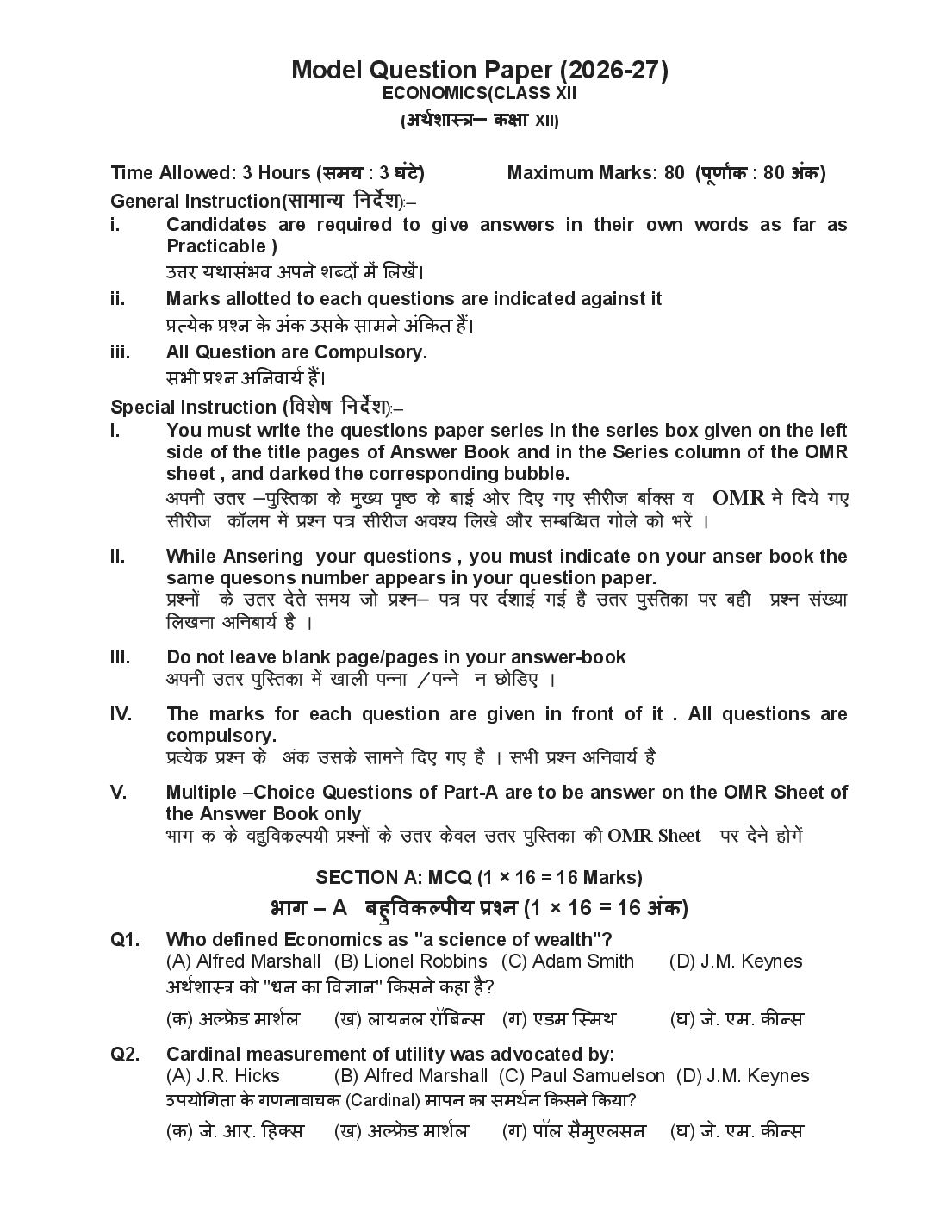
Model Question Paper (2026-27)
ECONOMICS(CLASS XII
(अथशा – क ा XII)
Time Allowed: 3 Hours (समय : 3 घंटे) Maximum Marks: 80 (पण
ू ाक : 80 अंक)
General Instruction(lkekU; funsZ”k½%&
i. Candidates are required to give answers in their own words as far as
Practicable )
m
उ र यथासंभव अपने श द म लख।
om . co
ii.
. c
Marks allotted to each questions are indicated against it
e m
m
येक न के अंक उसके सामने अं कत ह।
e l as
iii.
l as
All Question are Compulsory.
ag
ag
सभी न अ नवाय ह।
Special Instruction (fo”ks’k funsZ”k½%&
I. You must write the questions paper series in the series box given on the left
side of the title pages of Answer Book and in the Series column of the OMR
sheet , and darked the corresponding bubble.
viuh mrj &iqfLrdk ds eq+[; i`’B ds ckbZ vksj fn, x, lhjht ckZDl o OMR es fn;s x,
lhjht dkWye esa iz”u i= lhjht vo”; fy[ks vkSj lEcfO/kr xksys dks Hkjsa A
II.
m
While Ansering your questions , you must indicate on your anser book the
o
c
nZ. ”kkbZ xbZ gS mrj iqLfrdk ij cgh iz”u la[;k
same quesons number appears in your question paper.
iz”uksa ds mrj nsrs le; tks iz”u& i= ij
e m
fy[kuk vfuck;Z gS A
a s
l in your answer-book
g
viuh mrj iqfLrdk esa [kkyh iUuka @iUus u NksfM, A
III. Do not leave blank page/pages
IV. The marks for each question are given in front of it . All questions are
compulsory.
izR;sd iz”u ds vad mlds lkeus fn, x, gS A lÒh iz”u vfuok;Z gS
V. Multiple –Choice Questions of Part-A are to be answer on the OMR Sheet of
the Answer Book only
Òkx d ds ogqfodYi;h iz”uksa ds mrj dsoy mrj iqfLrdk dh OMR Sheet ij nsus gksxsa
m
m .co
.co m
SECTION A: MCQ (1 × 16 = 16 Marks)
भाग – A बहु वक पीय s e न (1 × 16 = 16 अंक)
s em Q1. Who defined Economics as "a science of wealth"? gla
g la a (D) J.M. Keynes
a (A) Alfred Marshall (B) Lionel Robbins (C) Adam Smith
अथशा को "धन का व ान" कसने कहा है ?
(क) अ े ड माशल (ख) लायनल रॉ ब स (ग) एडम ि मथ (घ) जे. एम. क स
Q2. Cardinal measurement of utility was advocated by:
(A) J.R. Hicks (B) Alfred Marshall (C) Paul Samuelson (D) J.M. Keynes
उपयो गता के गणनावाचक (Cardinal) मापन का समथन कसने कया?
(क) जे. आर. ह स (ख) अ े ड माशल (ग) पॉल सैमुएलसन (घ) जे. एम. क स
m . c
c. o s e m
s em
For more Question Papers, Sample Papers, Notes & Syllabus visit
gl a
Page 1 of 9
Page 3
(A) Downward to the right (B) Upward to the right (C) Horizontal (D) Vertical
गफेन व तुओं क मांग व कैसी होती है ?
(क) दा ओर नीचे क ओर ढलान वाल (ख) दा ओर ऊपर क ओर ढलान वाल
(ग) ै तज (घ) ऊ वाधर
Q4. If price elasticity of demand is greater than one, a fall in price will lead to:
(A) Fall in Total Revenue (B) Rise in Total Revenue
(C) No change in Total Revenue (D) Zero Total Revenue
य द मांग क मू य लोच एक से अ धक हो, तो मू य म कमी होने पर:
(क) कुल आय म कमी होगी (ख) कुल आय म व ृ ध होगी
(ग) कुल आय म कोई प रवतन नह ं होगा (घ) कुल आय शू य हो जाएगी
Q5. Which cost is zero when output is zero in the short run?
(A) Total Fixed Cost (B) Total Variable Cost
(C) Total Cost (D) Marginal Cost
अ पकाल म उ पादन शू य होने पर कौन-सी लागत शू य होती है ?
(क) कुल ि थर लागत (ख) कुल प रवतनशील लागत
(ग) कुल लागत (घ) सीमांत लागत
Q6. Under Perfect Competition , which of the following is correct?
(A) AR = MR (B) AR > MR
(C) AR < MR (D) AR and MR have no relation
पूण तयो गता म न न ल खत म से कौन-सा कथन सह है ?
(क) AR = MR (ख) AR > MR
(ग) AR < MR (घ) AR और MR का कोई संबंध नह ं
Q7. Formula for GDP Deflator is:
(A) NNP fc= (NNP cp/ Prince Index of Current Year )X100
(B) NNP fc= ( Prince Index of Current Year / NNP cp )X100
(C)NNP fc= (NNP cp x Prince Index of Current Year)X100
(D) None of the above
GDP ड लेटर का सू या है ?
(क) NNPfc = (NNPcp / मू य सूचकांक) × 100 (ख) NNPfc = (मू य सूचकांक /
NNPcp) × 100
(ग) NNPfc = (NNPcp × मू य सूचकांक) × 100 (घ) उपरो त म से कोई नह ं
Q8. If the consumption function is C = 50 + 0.75Y, the value of MPS is:
(A) 0.25 (B) 0.75 (C) 50 (D) 1
य द उपभोग फलन C = 50 + 0.75Y है , तो MPS का मान होगा:
(क) 0.25 (ख) 0.75 (ग) 50 (घ) 1
Q9. If the consumption function is C = 50 + 0.75Y, the value of MPC is:
(A) 0.25 (B) 0.75 (C) 50 (D) 1
For more Question Papers, Sample Papers, Notes & Syllabus visit Page 2 of 9
Page 4
.co s e m
s em य द उपभोग फलन C = 50 + 0.75Y है , तो MPC का मान g
l a
a aहोगा:
(क) 0.25 (ख) 0.75 (ग) 50 (घ) 1
Q10. An increase in Bank Rate by the RBI will:
(A) Increase credit creation (B) Decrease credit creation
(C) Have no effect on credit (D) First increase then decrease credit
RBI वारा बक दर म व ृ ध करने पर:
(क) साख सज
ृ न बढ़े गा (ख) साख सज
ृ न घटे गा
m
(ग) कोई भाव नह ं पड़ेगा
om
(घ) पहले बढ़े गा फर घटे गा
. co
. c
Q11. Which of the following is an invisible item in the Balance of Payments? em
em
(A) Import of machinery (B) Receipts from foreign tourists
l as
as
(C) Export of gold
l (D) Import of crude oil
ag
g
भुगतान संतुलन म न न म से कौन-सी अ य मद है ?
a
(क) मशीन का आयात (ख) वदे शी पयटक से ाि तयाँ
(ग) सोने का नयात (घ) क चे तेल का आयात
Q12. One Rupee Note is printed in India by ___________
(A) Finance Ministery (B) P.N.B.
(C) R.B.I. (D) S.B.I.
भारत म एक पये का नोट कसके वारा जार कया जाता है ?
m
(क) व मं ालय
(ग) भारतीय रजव बक m (घ) भारतीय टे ट बक .co
(ख) पंजाब नेशनल बक
s e
l a
(B) 0 ag
Q13. MPC+MPS=___________
(A) 1 (C) -1 (D) None of Above .
MPC + MPS =
(क) 1 (ख) 0 (ग) –1 (घ) इनम से कोई नह ं
Q14. Trade Balance is ____________
(A) Import – Export (B) Export - Import
(C) Export + Import (D) None of Above
यापार संतुलन (Trade Balance) है :
m
.co
(क) आयात – नयात (ख) नयात – आयात
m (ग) नयात + आयात
.co s e m
(घ) इनम से कोई नह ं
s em Q15. Fiscal Deficit
g l a
g la (A) Total Expenditure –( Revenue Reciept+Capital
a
Receipt)
a (B) Total Expenditure –( Revenue Reciept+Capital Receipt(Except borrowing))
(C)Total Expenditure –Total Receipt
(D) None of the above
m . c
c. o s e m
s em
For more Question Papers, Sample Papers, Notes & Syllabus visit
gl a
Page 3 of 9
Page 5
(क) कुल यय – (राज व ाि तयाँ + पूंजीगत ाि तयाँ)
(ख) कुल यय – (राज व ाि तयाँ + उधार को छोड़कर पूंजीगत ाि तयाँ)
(ग) कुल यय – कुल ाि तयाँ
(घ) इनम से कोई नह ं
Q16. Assertion (A): NNP at Factor Cost is known as National Income.
Reason (R): NNP at Factor Cost includes Net Factor Income from Abroad.
(A) Both A and R are true and R is the correct explanation of A
(B) Both A and R are true but R is not the correct explanation of A
(C) A is true but R is false
(D) A is false but R is true
कथन (A): साधन लागत पर शु ध रा य उ पाद (NNPfc) को रा य आय कहते ह।
कारण (R): NNPfc म वदे श से ा त शु ध साधन आय शा मल होती है ।
(क) A और R दोन स य ह तथा R, A क सह या या है ।
(ख) A और R दोन स य ह, पर तु R, A क सह या या नह ं है ।
(ग) A स य है , R अस य है ।
(घ) A अस य है , R स य है ।
SECTION B:
(Micro Economics)
Q17 What do you mean by Perfect Competition Market? Explain it Four characteristics 4
पूण तयो गता बाजार से या अ भ ाय है ? इसक चार वशेषताओं क या या क िजए।
Or (अथवा)
Explain increase and decrease in demand with help of diagram.,
मांग म व ृ ध एवं मांग म कमी को च स हत समझाइए।
Q18 Attempt any two questions : 2X5=10
I) How we can measure of elasticity with help expenditure method. Explain with
help of diagram.
यय व ध क मदद से हम लोच को कैसे माप सकते ह? इसे डाय ाम क मदद से
समझाएं।
II) What is meant by returns to scale ? Explain the increasing returns to scale with
the help of diagram?
पैमाने के तफल (Returns to Scale) से या अ भ ाय है ? बढ़ते तफल को च स हत
समझाइए।
III) Explain with diagram the impact on equilibrium price when demand remains
constant but supply for a commodity changes .
जब मांग ि थर रहे तथा पू त म प रवतन हो, तो संतुलन मू य पर या भाव पड़ता है ? च
स हत प ट क िजए।
For more Question Papers, Sample Papers, Notes & Syllabus visit Page 4 of 9
Page 6
.co s e m
s em l a
a Q 19. Attempt any three questions:
ag 3X2=6
I) What is meant by consumer’s Equilbrium ? How consumber equilibrium is
attained in case of one good?
उपभो ता संतुलन या है ? एक व तु क ि थ त म उपभो ता संतुलन कैसे ा त करता है ?
II)Distinguish between AC and MC . How AC and MC help in determined
equilibrium level of out ? . show with diagram.
AC और MC के बीच अंतर बताइए। AC और MC आउटपुट के संतुलन तर को तय करने
m
म कैसे मदद करते ह? इसे डाय ाम के साथ दखाइए।
om . co
. c em
III) Distinguish between returns to factor and returns to scale?
me
साधन तफल (Returns to Factor) तथा पैमाने के तफल (Returns to Scale) म अंतर l as
l as ag
g
बताइए।
Iv)aif price of milk remains constant demand milk rise 4 kg to 5 kg whether it is
expansion in demand or increase in demand explain you concept with substantive
with a suitable example .
य द दध
ू का मू य ि थर रहे तथा उसक मांग 4 कलो ाम से बढ़कर 5 कलो ाम हो जाए, तो यह
मांग का व तार है या मांग म व ृ ध? उदाहरण स हत प ट क िजए।
Q20. Attempt any four questions 4 × 3 = 12
m
.co
(I) Define Production Possiblity Curve .What are main characteristics.
m
e
उ पादन संभावना व (PPC) क प रभाषाaदsिजए तथा इसक मु य वशेषताएँ ल खए
g l demand :
a
(II) Calulate thePrice Elasticity of
The price of commodity X falls by 10% and its quantity demanded rises by 20%.
Calculate price elasticity of demand and comment on the nature of the commodity.
मांग क मू य लोच ात क िजए: कसी व तु का मू य 10% घटता है तथा उसक मांग 20% बढ़
जाती है ।
III)
Units of Output TC dqy ykxr TFC dqy fLFkj MC flekar ykxr AC vkSlr ykxr
(mRiknu dh
m
ykxr
.co
bZdkb;ka
m
.co
0 10
e m
e m
1
2
20
30
las
las 3 40
ag
ag
IV) What is effect of Ceiling Price ? Explain with diagram.
अ धकतम मू य (Ceiling Price) का भाव च स हत समझाइए।
m . c
c. o s e m
s em
For more Question Papers, Sample Papers, Notes & Syllabus visit
gl a
Page 5 of 9
Page 7
Column-I Column-II
1 TR ΔTR/ ΔQ
2 MR PXQ
3 AR TR/Q
SECTION -C
(Macro Economics)
Q21. What is Meant by Barter System of Exchange? What are the drawbacks of Barter
System.
व तु व नमय णाल से या अ भ ाय है ? इसक मख ु क मय का वणन क िजए। 4
Or
Explain the concept of deficit budget. Write its merits and demerits
घाटे के बजट क अवधारणा प ट क िजए तथा इसके गण ु एवं दोष ल खए।
Q22. Attempt Any two Questions कोई दो कर 2X5=10
(I) Explain in details the income method to measure the National Income
measured .
रा य आय मापन क आय व ध का व तार से वणन क िजए।
(II) Given Consumption Function C= 100+0.75Y where C = Consumption
Expenditure and Y= National Income and Investment Expenditure is 1000 Cr
Calculate : (i) Equilibrium Level of National Income (ii)Consumption expenditure
at equilibrium level of Income .
उपभोग फलन C = 100 + 0.75Y तथा नवेश यय = 1000 करोड़ है ।
(i) संतल
ु न रा य आय ात क िजए।
(ii) संतल
ु न आय तर पर उपभोग यय ात क िजए।
(III)Explain the qualitative and quantitative function of R.B.I. to control credit in
economy
अथ यव था म साख नयं ण हे तु RBI के गण ु ा मक एवं मा ा मक उपाय क या या क िजए।
Q23 Attempt Any three Questions कोई rhu कर 3X2=6
If Income is 1000 crore and consumtion 400 crore Find out the Average
Propensity to save (APS)
य द आय 1000 करोड़ तथा उपभोग 400 करोड़ है , तो औसत बचत व ृ (APS) ात क िजए।
(II) Explain the regressive tax
तगामी कर (Regressive Tax) क या या क िजए।
(III) What is meant by Capital Account of the payment ? Explain it
भुगतान संतुलन के पूंजी खाते (Capital Account) का अथ समझाइए।
(IV) Calculate the Fiscal Deficit from the following data
न न आँकड़ से राजकोषीय घाटा ात क िजए।
For more Question Papers, Sample Papers, Notes & Syllabus visit Page 6 of 9
Page 8
.co s e m
s em l a
a ag
Items
ensa Crores करोड़ पये
Revenue Receipt 1423563
राज व ाि तयाँ
Revenue Expenditure 1734561
m
राज व यय
om . co
. c e m
Capital Receipt
e m 590845
l as
पज s
ूं ीगत ाि तयाँ
l a ag
ag
Capital Expenditure 279847
पज
ूं ीगत यय
Recoveries of loan and other 56571
receipt
ऋण वसल
ू एवं अ य ाि तयाँ
24. Attempt Any Four Questions कोई pkj कर 4x3=12
m
m .co
I) From the following data, calculate NNP at Market Price:
न न आँकड़ से बाजार मू य पर शु ध रा य उ पाद (NNPmp) ात क िजए:
s e
a
GDP at MP = Rs 5000 Crore, Depreciation ास = Rs 400 Crore, Net Factor
l
Income from Abroad वदे श सेaशgु ध साधन आय = (-) Rs 100 Crore, Net Indirect
Taxes “kqn vizR;{k dj = Rs 300 Crore
II) Distinguish betweet Direct Tax and Indirect Tax
य कर तथा अ य कर म अंतर प ट क िजए।
III) Explain the main objectives of budget
बजट के मख ु उ दे य क या या क िजए।
IV)Distinguish between Spot Market and Forward Market
m
हािजर बाजार (Spot Market) तथा वायदा बाजार (Forward Market) म अंतर बताइए।
m V) Match the following .co
m .co मलान क िजए:
s em
s e Column-I त भ-I
g la त भ-II
Column-II
g la a
a 1
2
APC+APS
K
Δ C/ΔY
1
3 MPC 1/1-MPC
m . c
c. o s e m
s em
For more Question Papers, Sample Papers, Notes & Syllabus visit
gl a
Page 7 of 9
Page 9
Question Paper/ Test
Subject: Economics Marks: 80
Class: 12th Time: 3 Hours
Weightage to Objective
Objective Knowledge Understand Application Analyse Evaluation Creation Total
Percentage 11.25 46.25 22.50 20.00 - - 100%
of Marks
Marks 9 37 18 16 - - 80
Weightage to form of question:
Forms of E/LA SA VSA O(MCQ) Total
Questions
No. of Questions 06 08 06 16 36
Marks allotted 28 24 12 16 80
Estimated time
Weightage to Major Content Areas:
S. No Unit/ Sub-Units Marks
Introductory Micro Economics
1. Chapter-1: Introduction (Micro & Macro) 04
2. Chapter-2: Theory of consumer behaviour 12 + 07 (Extra)
3. Chapter 3: Production and costs 06 + 07 (Extra)
4. Chapter 4: The theory of the firm under perfect competition 09
5. Chapter 5: Market equilibrium 09
Introductory Macro Economics
6. Chapter 2: National Income Accounting 10
7. Chapter 3: money and banking 05 +05 (Extra)
8. Chapter 4: determination of income and employment 13
9. Chapter-5: government budget and the economy 06 +09 (Extra)
10. Chapter 6: Open Economy Macroeconomics 06
Total 80 + 28 (Extra)
Schemes of Sections Three Sections A, B & C
Pattern of Option Internal & External Both
Index of Abbreviations:
(E/LA: Essay/ Long Answer; SA: Short Answer; VSA: Very Short Answer; O: Objective)
For more Question Papers, Sample Papers, Notes & Syllabus visit Page 8 of 9
Page 10
m .co
FORMAT OF BLUEPRINT
Subject : Economics
c. o Max Marks: 80 Class : 12th
s e m
Unit/ : Annual
e m Time : 3 Hours
la
Paper
l as ag
ag
S. Objective Knowledge Understanding Application Analysis Total Row
No Form of Questions Wise
Content unit Sub unit/Marks E/LA SA VSA O E/LA SA VSA O E/LA SA VSA O E/LA SA VSA O
4/5 3 2 1 4/5 3 2 1 4/5 3 2 1 4/5 3 2 1
1 Chapter-1: Introduction (Micro & Macro) - - - 1 - 1 - - - - - - - - - - 4
2 Chapter 2: Theory of consumer behaviour - - - 2 (1) - 1 1 - (1) 1 - 1 - - - 12(7)
3 Chapter 3: Production and costs - - - 1 (1) - (1) - - 1 - - - - 1 - 6(7)
4 Chapter 4: The theory of the firm under - - - 1 - 1 - 1 1 - - - - - - - 9
perfect competition
5 Chapter 5: Market equilibrium - - - 1 - 1 - - - - - - 1 - - - 9
6 Chapter 2: National Income Accounting - - - - 1 - -
m
1 - 1 - - - - - 1 10
om .co e m
7 Chapter 3: money and banking - - - 1 1 - - - (1) - - - - - - - 5(5)
. c 8 Chapter 4: Determination of income and - - - 2 1 -
e m 1 1 - 1 - - - - - - 13
l as
em 9
employment
Chapter-5: Government Budget and the - - - - (1)
las
(1) 1 1 - - (1) - - 1 - - 6(9)
ag
10
economy
Chapter 6: Open Economy - - - - - ag - 1 1 - 1 - - - - - - 6
Macroeconomics
Sub Total - - - 9 3(3) 3(1) 4(1) 6 1(1) 4(1) 1(1) - 2 1 1 1
Marks - - - 9 14(13) 9(3) 8(2) 6 4(5) 12(3) 2(2) - 10 3 2 1 Marks (QS)
80
Total Column-wise 9 37(18) 18(10) 16 80(28)
(Marks Total) (Marks Total) (Marks Total) (Marks Total)
m
m .co
Notes: (Marks) (within the bracket). This shows extra questions (Not counted in marks)
Summary: - Essay (E)/ CBQ
m .co No. 06 Marks 28
s e m
Pattern of Options: Internal & External
s e
Short Answer (SA) No. 08 Marks 24
g l a
g l a
Very Short Answer (VSA)
Objective (O)
No.
No.
06
16
Marks
Marks
12
16 a
Scheme of Sections :- A, B, & C
a
For more Question Papers, Sample Papers, Notes & Syllabus visit Page 9 of 9
Document Details
| Board / Org | Himachal Pradesh Board |
| Exam | Class 12 |
| Type | Sample Paper |
| Pages | 9 |
| Language | english |
| Updated | 17 Nov 2026 |