Karnataka 2nd PUC Physics Electric Charges and Fields MCQ with Answers
Finished viewing? Save it for later —
Download Karnataka 2nd PUC Physics Electric Charges and Fields MCQ with Answers (PDF · 28 pages)About Karnataka 2nd PUC Physics Electric Charges and Fields MCQ with Answers
Karnataka 2nd PUC Physics Electric Charges and Fields MCQ with Answers is available here for free download. Published by Karnataka Board for Class 12, this question bank can be viewed online or downloaded as a PDF (28 pages). Candidates preparing for Class 12 can use Karnataka 2nd PUC Physics Electric Charges and Fields MCQ with Answers to understand the exam pattern, the type of questions asked, and the overall difficulty level.
Frequently Asked Questions
How can I download Karnataka 2nd PUC Physics Electric Charges and Fields MCQ with Answers?
Open this page and click the Download button to save Karnataka 2nd PUC Physics Electric Charges and Fields MCQ with Answers as a PDF. It is completely free on AglaSem Docs.
Is Karnataka 2nd PUC Physics Electric Charges and Fields MCQ with Answers free to download?
Yes. Karnataka 2nd PUC Physics Electric Charges and Fields MCQ with Answers can be viewed online and downloaded as a PDF free of cost on AglaSem Docs.
How many pages does Karnataka 2nd PUC Physics Electric Charges and Fields MCQ with Answers have?
Karnataka 2nd PUC Physics Electric Charges and Fields MCQ with Answers contains 28 pages, which you can read online or download together as a single PDF.
Where can I find more Class 12 study material?
You can find more Class 12 question papers, sample papers, syllabus, and answer keys on AglaSem Docs.
Karnataka 2nd PUC Physics Electric Charges and Fields MCQ with Answers – Text
Read the full text of this question bank below — useful to quickly search, copy and reference the content online without downloading the PDF.
📄 View text version (28 pages)
Page 1
DEPARTMENT OF SCHOOL EDUCATION (PRE-UNIVERSITY)
18TH CROSS, MALLESHWARAM, BENGALURU – 560 012
CHAPTERWISE MULTIPLE CHOICE QUESTIONS FOR COMPETITIVE EXAM
SUBJECT: PHYSICS - II PUC
NAME OF THE CHAPTER: ELECTRIC CHARGES AND FIELDS
SYNOPSIS
1. General observation on charged objects:
❑ Like charges repel, unlike charges attract.
❑ Deficiency of electrons on a body gives it positive charge, surplus of electron on it gives it
negative charge.
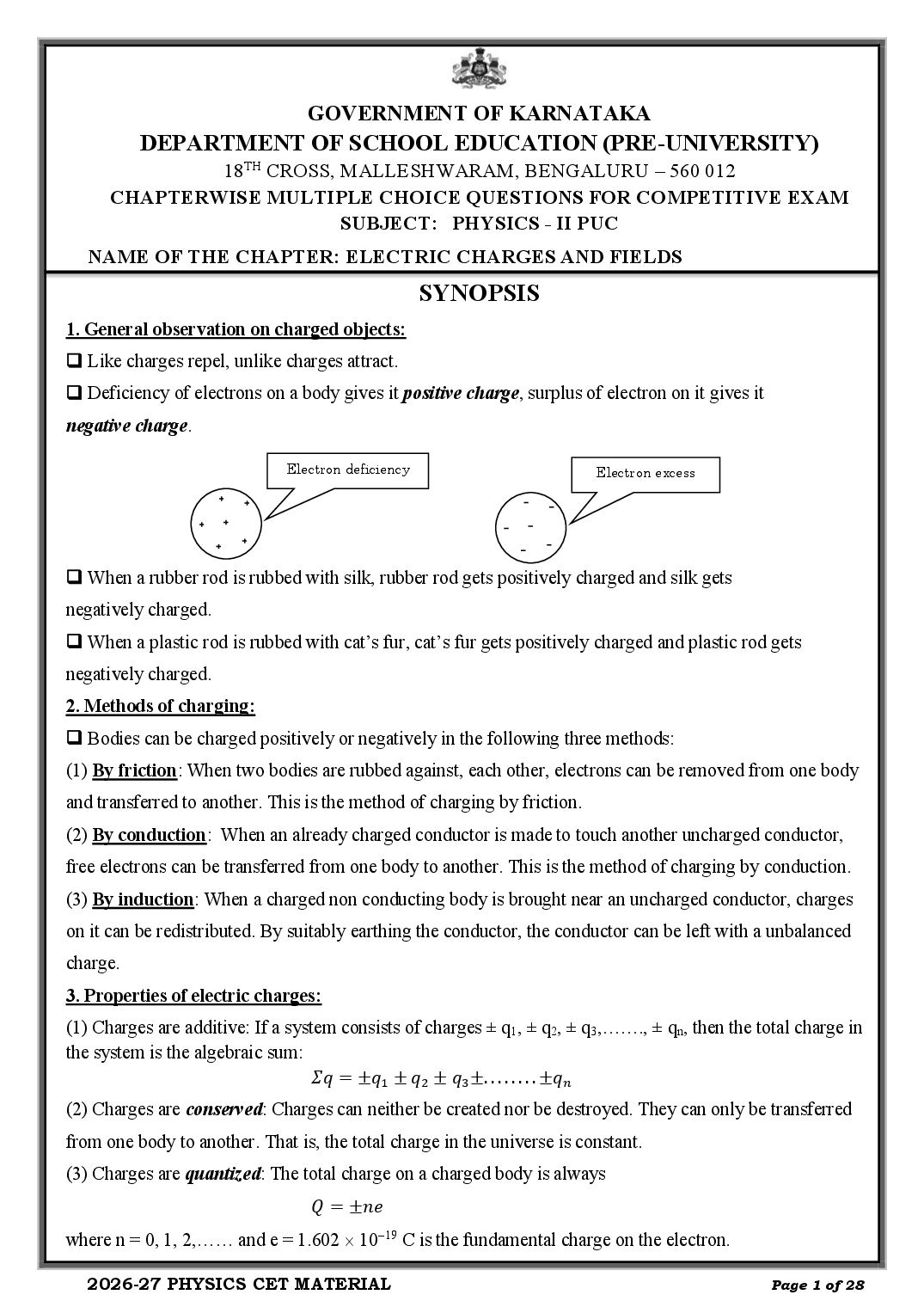
Electron deficiency Electron excess
❑ When a rubber rod is rubbed with silk, rubber rod gets positively charged and silk gets
negatively charged.
❑ When a plastic rod is rubbed with cat’s fur, cat’s fur gets positively charged and plastic rod gets
negatively charged.
2. Methods of charging:
❑ Bodies can be charged positively or negatively in the following three methods:
(1) By friction: When two bodies are rubbed against, each other, electrons can be removed from one body
and transferred to another. This is the method of charging by friction.
(2) By conduction: When an already charged conductor is made to touch another uncharged conductor,
free electrons can be transferred from one body to another. This is the method of charging by conduction.
(3) By induction: When a charged non conducting body is brought near an uncharged conductor, charges
on it can be redistributed. By suitably earthing the conductor, the conductor can be left with a unbalanced
charge.
3. Properties of electric charges:
(1) Charges are additive: If a system consists of charges ± q1, ± q2, ± q3,……., ± qn, then the total charge in
the system is the algebraic sum:
𝛴𝑞 = ±𝑞1 ± 𝑞2 ± 𝑞3 ±. . . . . . . . ±𝑞𝑛
(2) Charges are conserved: Charges can neither be created nor be destroyed. They can only be transferred
from one body to another. That is, the total charge in the universe is constant.
(3) Charges are quantized: The total charge on a charged body is always
𝑄 = ±𝑛𝑒
where n = 0, 1, 2,…… and e = 1.602 10−19 C is the fundamental charge on the electron.
2026-27 PHYSICS CET MATERIAL Page 1 of 28
Page 2
A rupee coin has a net charge of + 16 nC on it. Then the number of electrons in it are
(A) 1 1010 in excess. (B) 1 1010 deficient. (C) 1 1011 in excess. (D) 1 1011 deficient.
Answer (D)
Example Solved:
According to the quantization of charge : q = ne
𝑞 16×10−9
Or : n = 𝑒 = 1.6×10−19 = 1 × 10¹¹ .
EXAMPLE 2
A small conducting sphere A has an initial charge +2Q. Another uncharged but identical conductor B is
touched to A and then touched to a third identical conductor having initial charge – Q. When equilibrium is
reached the
(A) charge on A is +Q/2. (B) charge on B is zero.
(C) charge on C is – Q/2. (D) total charge of B and C is Q.
Answer (B)
Example Solved:
Between A and B, the charge conservation implies : QAinitial + QBinitial = 2Qf.
Hence : + 2Q + 0 = 2Qf → Qf = Q.
That is charge on A after equilibrium is : QA = Q.
After the touching of B with C, charge conservation : 2Qf/ = Q + (– Q) = 0
Hence after the equilibrium is reached, : QfB = QfC = 0
4. Coulomb’s Law:
❑ The force of electrostatic attraction or repulsion between two point charges is directly proportional to the
magnitude of product of the two charges and inversely proportional to the square of the separation distance
between them.
|𝑞1 𝑞2 |
𝐹=𝑘 𝑟2 −F r F
𝟏 |𝒒𝟏 𝒒𝟐 | q1 q2
Or 𝑭 = 𝟒𝝅𝜺
𝟎 𝒓𝟐
❑ If a medium of relative permittivity ( − also called dielectric constant) K (where K > 1) exists in the space
between the two charges, the force becomes
𝟏 |𝒒𝟏 𝒒𝟐 | r
𝑭 = 𝟒𝝅𝜺 𝑲 −F F
𝟎 𝒓𝟐 q1 q2
K
EXAMPLE 3
Two small spheres having charges q each separated by a distance d in air exert forces of F on each other. If
the charge on one of the sphere is increased to 1.5 times and the distance of separation is made 0.5 d the
force between the two spheres now
(A) increases to 4F (B) increases to 1.5 F
(C) increases to 6 F (D) decreases to F/6.
Answer (C)
2026-27 PHYSICS CET MATERIAL Page 2 of 28
Page 3
|𝑞1 𝑞2 |
The force between the two charges is given by : 𝐹=𝑘
𝑟2
𝑞1 𝑞2
Or : 𝐹 ∝ 𝑟2
𝐹𝑛𝑒𝑤 𝑞 ×𝑞 𝑟 2
Or : = 𝑞1,𝑛𝑒𝑤 ×𝑞2,𝑛𝑒𝑤 × (𝑟 𝑜𝑙𝑑 )
𝐹 1,𝑜𝑙𝑑 2,𝑜𝑙𝑑 𝑛𝑒𝑤
𝐹𝑛𝑒𝑤 𝑞×1.5𝑞 𝑑 2
Thus : = × (0.5𝑑)
𝐹 𝑞×𝑞
Hence : Fnew = 6F
5: Electric field
𝑭 ⃗
❑ The electric field intensity 𝐸⃗ at a point in external field is ⃗𝑬 = 𝒒 .
𝟎
Where 𝐹 is the electrostatic force acting on a negligibly small test charge q0.
❑ The electric field intensity at a point in space due to a fixed point charge q is
⃗ = 𝟏 𝒒𝟐 𝒓̂.
⃗𝑬
𝟒𝝅𝜺 𝒓 𝟎
𝑟Ƹ
r E
q P
where r is the distance from the charge to the point.
❑ The electric field (or electric field intensity) at a point due to point charges qi at distance ri from it is given
by superposition principle:
𝒏
𝟏 𝒒𝒊
⃗𝑬 = ∑ 𝟐 𝒓̂𝒊
𝟒𝝅𝜺𝟎 𝒓𝒊
𝒊=𝟏
EXAMPLE 4
Two charges +q and +Q are placed distance d apart. The null point/s is/are (ignoring points at infinity)
𝑄
(A) one, at a distance of x = 𝑑 (1−√ ) from q.
𝑞
𝑄 𝑄
(B) two, at a distances of x = 𝑑 (1 + √ 𝑞 ) and x = 𝑑 (1−√ 𝑞 ) from q.
𝑄
(C) one, at a distance of x = 𝑑 (1−√𝑞 ) from Q.
𝑄 𝑄
(D) two, at a distances of x = 𝑑 (1 + √ 𝑞 ) and x = 𝑑 (1−√ 𝑞 ) from Q.
Answer (A)
Example Solved:
The null point is the one where : total electric field is zero. x d−x
Thus, if P is that point, : Eq = EQ. P
1 𝑞 1 𝑄 q EQ Eq Q
Or : 4𝜋𝜀 𝑥 2 = 4𝜋𝜀 (𝑑−𝑥)2 d
0 0
𝑄
Solving for x we get : x = 𝑑 (1 − √ 𝑞 )
2026-27 PHYSICS CET MATERIAL Page 3 of 28
Page 4
❑ The electric field lines are imaginary curves or straight lines so that at EA EB
a point on them, the net electric field is along the tangent drawn to them A B
at that point.
❑ For uniform electric fields, the electric field lines are equidistant parallel E
lines.
❑ No two electric field lines can interest.
❑ The electric field lines diverge from isolated positive point charges, and converge on the negative point
charges.
+Q −Q
❑ Electrostatic field lines can never form closed loops.
❑ Where the electric field line density is strong, the Electric field is
electric field is strong there. If the electric field lines are weaker here.
weakly populated, the electric field is weak there.
Electric field is
stronger here.
EXAMPLE 5
In which of the following diagrams, electrostatic field lines are NOT correctly shown?
(4)
(1) (2) (3)
Answer (3)
Example Solved:
The field lines shown in choice (3) cannot represent electrostatic field.
❑ The electrostatic force acting on a charged particle having charge q at a point in external electric field is
⃗𝑭 = 𝒒𝑬
⃗⃗
❑ If m is the mass of that particle, its acceleration (if uniform field exists) or its initial acceleration (if non
uniform electric field exists) is given by
⃗
𝑭 ⃗
𝒒𝑬
⃗ = =
𝒂 𝒎 𝒎
2026-27 PHYSICS CET MATERIAL Page 4 of 28
Page 5
A proton having mass 1.6 10−27 kg is released in a uniform electric field of 2 kNC-1. Its speed after it
moves by 1 mm is
(A) 2 km/s (B) 20 km/s (C) 200 km/s (D) 2000 km/s
Answer (B)
Example Solved:
𝑞𝐸 1.6×10−19 ×2×103
The acceleration of the proton is :𝑎= 𝑚 = = 2 × 10¹¹ 𝑚/𝑠 2
1.6×10⁻²⁷
Hence the speed gained by it is found using : v2 = v02 + 2ax
Or : v2 = 02 + 2 (2 1011)(1 10−3) → v2 = 4 108
Or : v = 20 km/s.
EXAMPLE 7
A charged particle of mass m and charge q is held at rest in an external uniform electric field E at a height h
from the surface of the earth where h is comparable with RE, the radius of the earth. The electric field E is
(g is the acceleration due to gravity at the surface of Earth)
𝑚𝑔𝑅 2
(A) vertically upwards and has a magnitude 𝑞(ℎ+𝑅)2.
𝑚𝑔𝑅 2
(B) vertically downwards and has a magnitude 𝑞(ℎ+𝑅)2 .
𝑚𝑔 2ℎ
(C) vertically upwards and has a magnitude 𝑞 (1 − 𝑅 )
𝑚𝑔 2ℎ
(D) vertically downwards and has a magnitude 𝑞 (1 − 𝑅 )
Answer (B)
Example Solved:
𝑔𝑅 2 qE
The acceleration due to gravity at the height h is given by : 𝑔/ = (ℎ+𝑅)2
mg/
The charge will be held at rest at height h if : mg/ = qE h
𝑚𝑔𝑅 2
Or : (ℎ+𝑅)2 = 𝑞𝐸
𝑚𝑔𝑅 2
Or :E=
𝑞(ℎ+𝑅)2
7. Electric Dipoles and Electric Fields due to the dipoles:
❑ Two equal but unlike charges form an electric dipole.
p
❑ The dipole moment of the dipole is 𝑝 = (2𝑎𝑞)𝑝Ƹ − → +
p
❑ The SI unit of p is Cm (coulomb.metre). 2a
2026-27 PHYSICS CET MATERIAL Page 5 of 28
Page 6
Two point charges 1 nC and – 1 nC are placed at ( − 0.5 nm, 0) and ( 0.5 nm, 0). The electric dipole
moment of the system is (in Cm)
(A) 10−18 𝑖Ƹ (B) 10−18 𝑗Ƹ (C) − 10−18 𝑖Ƹ (D) 10−81 𝑖Ƹ
Answer (A) y
Example Solved:
𝒊Ƹ
The electric dipole moment is : 𝑝 = (2a q) 𝑖Ƹ x
−1 nC
Or : 𝑝 = (1 10−9 1 10−9) 𝑖Ƹ +1 nC
1 nm
= (1 10−8 Cm) 𝑖Ƹ
𝟏 ⃗𝒓
𝟐𝒑
⃗⃗ 𝒂𝒙 =
❑ The electric field at a point on the axis of a dipole is: 𝑬 𝟒𝝅𝜺 (𝒓𝟐 −𝒂𝟐 )𝟐 𝟎 ෝ
𝒑
Eax
❑ When the point is very far away from the dipole, i.e., r >> a, −q p +q
2a
⃗ 𝒂𝒙 = 𝟏 𝟐𝒑⃗𝟑
⃗𝑬 r
𝟒𝝅𝜺 𝒓 𝟎
❑ The electric field at a point on the equatorial plane of a dipole is: Eeq
𝟏 ⃗
𝒑 r p
⃗𝑬
⃗ 𝒆𝒒 = −
𝟒𝝅𝜺𝟎 (𝒓 + 𝒂𝟐 )𝟑/𝟐
𝟐
−q +q
❑ When the point is very far away from the dipole, i.e., r >> a: 2a
𝟏 𝒑 ⃗
⃗𝑬𝒆𝒒 = −
𝟒𝝅𝜺𝟎 𝒓𝟑
EXAMPLE 9
The magnitude of electric field due to a dipole at a distance d ( d >> dipole length) on its axis is same as the
magnitude of electric field at a distance of d − x on its equatorial plane. Then x is
1 1
23 √2 23 √2
(A) ( 1 ) 𝑑 (B) ( )𝑑 (C) ( 1 ) 𝑑 (D) ( )𝑑
23 +1 √2+1 23 −1 √2−1
Answer (C)
Example Solved:
It is given that : Eax,d = Eeq, d − x
1 2𝑝 1 𝑝
Or : 4𝜋𝜀 𝑑3 = 4𝜋𝜀 (𝑑−𝑥)3
0 0
1
23
Solving the above relation, we get : 𝑥=( 1 )𝑑
23 −1
EXAMPLE 10
The electric field due to a dipole and a point charge vary with distance r as shown in (assume r > > dipole
length)
E E E E
Dipole Point charge Point charge Point charge
Point charge Dipole Dipole Dipole
r r r r
(A) (B) (C) (D)
Answer (3)
2026-27 PHYSICS CET MATERIAL Page 6 of 28
Page 7
1
It is known that : 𝐸𝑝𝑜𝑖𝑛𝑡 𝑐ℎ 𝑎𝑟𝑔 𝑒 ∝ 2
𝑟
1
and : 𝐸𝑑𝑖𝑝𝑜𝑙𝑒 ∝ 𝑟 3
Hence the fall of E due to the dipole must be : faster than the fall of E due to point charge.
8. Electric Dipole in external electric field:
❑ The net electrostatic force on a dipole in an external electric field is : ZERO.
❑ The net torque acting on an electric dipole in an external uniform electric field is
𝜏 = 𝑝 × 𝐸⃗
Whose magnitude is 𝜏 = 𝑝𝐸 𝑠𝑖𝑛 𝜃
The direction of the torque is given by the right hand clasp rule.
+q qE
E
qE
−q
𝒅𝑬
❑ The electrostatic force acting on a dipole in a non- uniform external electric field is 𝑭 = 𝒑 𝒅𝒙.
❑ Hence an electric dipole experiences both a net force and a net torque in an external non uniform electric
field.
EXAMPLE 11
An electric dipole having dipole moment 𝑝is immersed (in an orientation other than = 0) in an external
uniform electric field E. If I is the moment of inertia of the dipole about its center of mass, the maximum
angular acceleration of the dipole is
𝑝𝐸 𝑝𝐸 3𝑝𝐸 𝑝2 𝐸 2
(A) 𝐼 (B) 2𝐼 (C) 2𝐼 (D) 2𝐼
Answer (A)
Example Solved:
The torque on the dipole is given by : = pE sin
This torque is maximum for = 90 and that torque is : max = pE
Hence using the Newton’s second law : max = Imax
𝜏 𝑝𝐸
Hence : 𝛼𝑚𝑎𝑥 = 𝑚𝑎𝑥 = 𝐼
𝐼
9. Continuous charge distributions:
𝛥𝑄
❑ If ΔQ is the charge lying over the length Δl, the line charge density is 𝜆 = 𝛥𝑙 .
SI unit of line charge density is Cm-1.
𝛥𝑄
❑ If ΔQ is the charge lying over the surface of surface area ΔS, the surface charge density is 𝜎 = 𝛥𝑆 .
SI unit of surface charge density is Cm-2.
𝛥𝑄
❑ If ΔQ is the charge lying over volume ΔV, the volume charge density is 𝜌 = 𝛥𝑉 .
SI unit of volume charge density is Cm-3.
2026-27 PHYSICS CET MATERIAL Page 7 of 28
Page 8
A right circular cone having radius a and height b is filled with uniform charge density ρ. The total charge
in it is
(A) 2ρa2b/3 (B) ρa2b/3 (C) 3ρa2b/4 (D) ρa2b
Answer (B)
Example Solved:
𝜋𝑎2 𝑏
The volume of a right circular cone is : ΔV = 3
b
𝛥𝑄
By definition of the volume charge density 𝜌 = 𝛥𝑉 we have : ΔQ = ρΔV a
𝜋𝜌𝑎2 𝑏
Hence the total charge in it is : ΔQ = 3
EXAMPLE 13
Four flat surfaces A, B, C and D have uniform surface charge densities each. The surface having largest
charge on it is
(A) A (B) B (C) C (D) D
Answer (C)
Example Solved:
The areas of the four surfaces is : ΔSA = a2, ΔSB = 2a2, 2a
A
ΔSC = a2, a
C
ΔSD = ½ a a = ½ a 2
B
− 2a −a a 2a
The area of the circular surface C is : largest −a
D
𝛥𝑄
Since for all surfaces is same, : ΔQ ΔS { since𝜎 = 𝛥𝑆 }
− 2a
The charge in the surface : C is largest.
10. Electric Flux:
S
❑ If E is the electric field, the electric flux through a surface of area S is E
𝛷𝐸 = 𝐸⃗ ∘ 𝑆 = 𝐸𝑆 𝑐𝑜𝑠 𝜃
where is the smaller angle between E and S vectors.
EXAMPLE 14
̂ ) exists in a region. The electric flux through a square surface of area S and
An electric field of ⃗𝑬= E0(𝒋Ƹ + 𝒌
parallel to x – y plane at z = a is
(A) E0S (B) 2E0S (C) 3E0S (D) zero
Answer (A)
Example Solved:
The given electric field is : ⃗𝑬= 0𝒊Ƹ+E0𝒋Ƹ +E0𝑘̂
The area vector is ̂
: ⃗𝑺 = 𝟎𝒊Ƹ + 𝟎𝒋Ƹ + 𝑺𝒌
2026-27 PHYSICS CET MATERIAL Page 8 of 28
Page 9
= (0𝒊Ƹ+E0𝒋Ƹ +E0𝑘̂) . (0𝑖Ƹ + 0𝑗Ƹ + 𝑆𝑘̂)
= E0S
11. Gauss’ Law:
❑ According to Gauss’ law, the total electric flux through any closed surface is (1/0) times the total charge
enclosed by it.
𝟏
That is ⃗ ∘ 𝜟𝑺
𝜱𝑬 = ∑ 𝑬 ⃗ = × 𝒒𝒆𝒏𝒄 .
𝜺 𝟎
EXAMPLE 15
Charges +1 C, − 2.5 C, + 4C and – 5.5 C and are at (0, 0, 0), (0, 2m, 3m) and (3m, 0, 4 m) and (− 6m, 0,
6m) respectively. The total electric flux through a cube whose center is at the origin and whose side length
is 10 m is
(A) 8/0 (B) 5/0 (C) 2.5/0 (D) − 2.5/0
Answer (C)
Example Solved:
Since the side length of the square is : 10 m,
Charges : +1 C, − 2.5 C and + 4C lie inside it.
Charge : − 5.5 C lies outside the cube.
Hence the total charge enclosed by the cube : qenc = + 1 − 2.5 + 4 = 2.5 C.
𝑞 2.5
Hence by Gauss’ law total flux through the cube : ΦE = 𝜀𝑒𝑛𝑐 = 𝜀 .
0 0
EXAMPLE 16
A small charge Q lies at the origin of an x – y – z coordinate system. The electric flux through the flat
surface of a hemisphere lying in the upper four octants of x – y – z space and whose radius and center are R
and (0, 0, δ) where δ → 0+ respectively is
(A) Q/40 (B) Q/20 (C) − Q/20 (D) Q/20
Answer (D)
Example solved:
z
Imagine now, that the : lower hemisphere is also present
The total electric flux through entire sphere : Q/0.
Hence on removing the lower hemisphere, x
electric flux through upper half becomes : Q/20 y Q
Thus the total flux through the flat surface : Q/20
2026-27 PHYSICS CET MATERIAL Page 9 of 28
Page 10
❑ Gauss’ law can be applied to find the electric field due to symmetric charge distributions:
By so doing, we get the electric field due to
𝝀
(i) uniformly charged infinite wire at a perpendicular distance r as 𝑬 = 𝟐𝝅𝜺 𝒓.
𝟎
where is the uniform line charge density on the wire.
𝝈
(ii) uniformly charged infinite sheet of charge as 𝑬 = 𝟐𝜺 .
𝟎
(iii) uniformly charged conducting sphere:
𝑬 = 𝟎 inside
𝟏 𝑸
and 𝑬 = 𝟒𝝅𝜺 𝒓𝟐 outside.
𝟎
E
P P P
r E E
R
Electric field due to
Electric field due to Electric field due to
conducting sphere
infinite charged wire infinite charged sheet
EXAMPLE 17
The electric field due to an infinite wire at a perpendicular distance d from it is same as the electric field
due an infinite sheet of uniform charge at any point. Then the ratio of the line charge density of the wire to
the surface charge density of the sheet is equal to
(A) 2/(d) (B) 1/(d) (C) 2d (D) d
Answer (D)
Example solved:
𝜆
The electric field due to infinite charged wire : 𝐸𝑤𝑖𝑟𝑒 = 2𝜋𝜀 𝑑
0
𝜎
The electric field due to infinite sheet of charge : 𝐸𝑠ℎ𝑒𝑒𝑡 = 2𝜀
0
Since : 𝐸𝑤𝑖𝑟𝑒 =Esheet,
𝜆 𝜎
We get : 2𝜋𝜀 𝑑= 2𝜀
0 0
𝜆
Or : 𝜎 = 𝜋𝑑
EXAMPLE 18
A point charge q and mass m is released near a very large sheet of charge having a uniform surface charge
density . The velocity gained by the charge after a time t is
𝑞𝜀 𝑡
0 𝑞𝜎𝑡 𝑞𝜎𝑡 𝑞𝜎𝑡 2
(A) 2𝑚𝜎 (B) 2𝑚𝜀 (C) 𝑚𝜀 (D) 2𝑚𝜀
0 0 0
Answer (B)
2026-27 PHYSICS CET MATERIAL Page 10 of 28
Page 11
The force on the charge near the charged sheet : F = qE = q/20.
Hence its acceleration is : a = F/m = q/2m0
The velocity gained after time t : v = v0 + at
Or : v = 0 + (q/2m0)t → v = qt/2m0
EXAMPLE 19
The electric field due to a uniformly charged conducting sphere of radius 10 cm, at a distance 10 cm from
its surface is 900 MN/C. The surface charge density of the sphere is (Take 0 = 9 10−12 SIU)
(A) 32.4𝑚𝐶/𝑚2 (B) 32.4𝜇𝐶/𝑚2 (C) 32.4𝐶/𝑚2 (D) 324𝑚𝐶/𝑚2
Answer (A)
Example Solved:
1 𝑄
The electric field due to the sphere at a point outside is : 𝐸 = 4𝜋𝜀 𝑟 2
0
𝑄 𝜀 𝐸𝑟 2
Hence we may write : 𝜎 = 4𝜋𝑅2 = 0𝑅2
9×10−12 ×9×108 ×0.22
Or :𝜎= = 32.4𝑚𝐶/𝑚2
0.12
******
2026-27 PHYSICS CET MATERIAL Page 11 of 28
Page 12
PRACTICE QUESTIONS
1. A body can be negatively charged by
(a) Giving excess of electrons to it (b) Removing some electrons from it
(c) Giving some protons to it (d) Removing some protons from it
Identify the correct option among the following
(A) (a) and (b) are correct (B) (a) and (b) are correct
(C) (a) and (c) are correct (D) (a) and (d) are correct
2. When a body is connected to earth, electrons flow from the earth to the body. This means the body is
(A) Unchanged (B) Charged positively
(C) Charged negatively (D) An insulator
3. A glass rod rubbed with silk is used to charge a gold leaf electroscope and the leaves are observed to
diverge. The electroscope thus charged is exposed to X-rays for a short period. Then
(A) The divergence of leaves will not be affected
(B) The leaves will diverge further
(C) The leaves will collapse
(D) The leaves will melt
4. A soap bubble is given a negative charge, then its radius
(A) increases (B) decreases
(C) remains unchanged (D) nothing can be predicted as information is insufficient
5. When 1016 electrons are removed from a neutral metal plate, the electric charge on metal plate is
(A) +10–16 mC (B) +1016 mC (C) +1.6 mC (D) –1.6 mC
6. If 1010 electrons are acquired by a body every second, the time needed to charge it to –1 C is nearly:
(A) 2 hours (B) 2 months (C) 2 years (D) 20 years
7. An object A when rubbed with another object B is found to have a negative charge of 4.8 × 10 –7 C. The
increase in the mass of the object A is
(A) 4.56 × 10 –18 kg (B) 2.73 × 10 –18 kg (C) 10.92 × 10 –18 kg (D) 2.73 × 10 –19 kg
8. The dimensions of [E0] are (where E is electric field and 0 is absolute permittivity of vacuum)
(A) [AMLT–2 ] (B) [A M T–2 ] (C) [A T L–2 ] (D) [A T M L–2 ]
9. In an experiment, an oil drop is held stationary under a constant electric field of 4 × 10⁴ N/C. If the oil
drop has 16 extra electrons and the density of oil is 1.26 g/cm3, then the radius of the drop is
(A) 1.25 × 10⁻⁶ m (B) 3.49 × 10⁻⁶ m (C) 2.91× 10⁻⁶ m (D) 4.41 × 10⁻⁶ m
10. A static electric charge produces
(A) electric field only (B) magnetic field only
(C) Both magnetic and electric fields (D) neither magnetic field nor electric field
11. The Coulomb’s law is given by 𝐹 = 𝑘(|𝑞1 𝑞2 | 𝑟 𝑛 ), where n is (symbols have their usual meanings)
(A) −2 (B) 2 (C) 1/2 (D) −1/2
2026-27 PHYSICS CET MATERIAL Page 12 of 28
Page 13
𝑞1 and 𝑞2 separated by a distance r ? (𝐹12 - Force on 𝑞1 due to 𝑞2 and 𝐹21 – Force on 𝑞2 due to 𝑞1 )
13. Which one of the following graphs correctly represents the relationship between the force F between two
point charges and the distance r between them (x - axis is F and y - axis is r)?
14. Two point charges of +2 𝜇𝐶 and + 4 𝜇𝐶 are separated by a distance of r in vacuum. If the force exerted
by +2 𝜇𝐶 on +4 𝜇𝐶 is F, then the force exerted by +4 𝜇𝐶 on +2 𝜇𝐶 is
(A) 4𝐹 (B) 2𝐹 (C) 𝐹 (D) 𝐹/2
15. A charge +𝑞1 exerts some force on a second charge +𝑞2 separated by certain finite distance d. If a third
charge 𝑞3 is brought near 𝑞2 , the force exerted by 𝑞1 on 𝑞2
(A) decreases (B) increases (C) remains unchanged
(D) increases if 𝑞3 is positive and decreases if 𝑞3 is negative
16. Two balls carrying charges of +8𝜇𝐶 and −5𝜇𝐶 attract each other with a force 𝐹. If charge of −3𝜇𝐶 is
added to both, the force between the balls will be
(A) 𝐹, attractive (B) 𝐹, repulsive (C) 2𝐹, attractive (D) 2𝐹, repulsive
17. Two equally charged identical metal spheres A and B, separated by a distance r, repel each other with a
force F. A third identical but uncharged sphere C is touched first with A and then with B for some time
and removed. The magnitude of the new force between A and B is
1 3 𝐹
(A) 𝐹 (B) 8 𝐹 (C) 8 𝐹 (D) 2
18. An attractive force of 10 N is acting between two charges of +2𝜇𝐶 and −2𝜇𝐶 placed at some distance.
If the charges are mutually touched and placed again at the same distance, the new force would be
(A) 10 𝑁 (B) 𝑧𝑒𝑟𝑜 (C) 20 𝑁 (D) 5 𝑁
19. A certain charge Q is divided at first into two parts 𝑞1 and 𝑞2 . Later the charges are placed at a certain
𝑄
distance. If the force of interaction between two charges is maximum, then 𝑞 =…
1
(A) 2 (B) 0.5 (C) 4 (D) 1
2026-27 PHYSICS CET MATERIAL Page 13 of 28
Page 14
Statement-II: Charged particle at rest can only produce electric field.
(A) Both statements I and II are wrong
(B) Statement I is correct but statement II is wrong
(C) Statement I is wrong but statement II is correct
(D) Both statements I and II are correct
21. The magnitudes of two point charges is doubled and the distance between is halved. The force of
interaction between them becomes
1 1
(A) 4 times (B) 4 times (C) 16 times (D) 16 times
22. The distance between two point charges is increased by 10%. The force of interaction (nearly)
(A) decreases by 10% (B) increases by 10%
(C) decreases by 20% (D) decreases by 17%
23. Two equal point charges of 1 𝜇𝐶 each are located at points (𝑖Ƹ + 𝑗Ƹ − 𝑘̂) m and (2𝑖Ƹ + 3𝑗Ƹ + 𝑘̂) m. What is
the magnitude of electrostatic force between them?
(A) 10+3 𝑁 (B) 10−6 𝑁 (C) 10−9 𝑁 (D) 10−3 𝑁
24. Two small metal spherical balls each carrying a charge of 10 μC are suspended by two light threads each
of length 1 m, from a hook. It is found that in equilibrium, threads are separated by an angle of 60°
between them. The tension in the threads is
(A) 1.8 𝑁 (B) 18 𝑁 (C) 180 𝑁 (D) 0.18 𝑁
25. Two positive charges are placed with a fixed separation. A slab of dielectric material is introduced
between them. As a result the repulsion between charges
(A) decreases and becomes attractive (B) decreases and remains repulsive
(C) increases and becomes attractive (D) increases and remains repulsive
26. Electrostatic force between two point charges placed at a distance of r in vacuum is F. What distance
apart these charges be placed in a medium of dielectric constant 2, so that the force between them still
remains F?
𝑟 𝑟
(A) 2𝑟 (B) √2𝑟 (C) (D) 2
√2
27. A charge q is placed at the centre of the line joining two equal charges Q. The system of three charges
will be in equilibrium if q is equal to
𝑄 𝑄 𝑄 𝑄
(A) − 4 (B) − 2 (C) + 2 (D) + 4
28. Four charges, each equal to −1 𝜇𝐶, are placed at the corners of a square and a charge +𝑞 is placed at its
centre. If the system is in equilibrium, the value of q (in μC) is
1 1 1 1
(A) − 4 (1 + 2√2) (B) 4 (1 + 2√2) (C) − 2 (1 + 2√2) (D) 2 (1 + 2√2)
29. Three charges are placed at the vertices of an equilateral triangle of
side a as shown in the figure. The force experienced by the charge
placed at the vertex A in a direction parallel to BC is
𝑄2 𝑄2
(A) 4𝜋𝜀 𝑎2 (B) 8𝜋𝜀 𝑎2
0 0
𝑄2
(C) 𝑧𝑒𝑟𝑜 (D) 2𝜋𝜀 𝑎2
0
2026-27 PHYSICS CET MATERIAL Page 14 of 28
Page 15
falls nor rises. The charge on the drop (take 𝑔 = 10 𝑚 𝑠 −2) is
(A) 30 𝜇𝐶 (B) 30 𝐶 (C) 30 𝑚𝐶 (D) 30 𝑛𝐶
31. Two small balls, each carrying a charge q are suspended by equal insulated string of length 𝑙 𝑚 from the
hook of a stand. This arrangement is placed in a gravity-free space. The tension in each string will be
1 𝑞2 1 𝑞2 1 𝑞 1 𝑞
(A) 4𝜋𝜀 × 4𝑙2 (B) 4𝜋𝜀 × 𝑙2 (C) 4𝜋𝜀 × 4𝑙2 (D) 4𝜋𝜀 × 𝑙2
0 0 0 0
32. The bob of a simple pendulum is made of a tiny insulating sphere of mass 2 g and carries a charge of + 5
μC. The time-period of the pendulum in the absence of any electric field is 3 s. When a vertical uniform
electric field is switched on, the time-period of the pendulum becomes 6 s. The value of the electric field
is (take g = 10 m s-2):
(A) 3 kN/C in the downward direction. (B) 3 kN/C in the upward direction.
(C) 12 kN/C in the downward direction. (D) 12 kN/C in the upward direction.
33. Which of the fundamental physical quantities are needed to define electric field at a point in space?
(A) Mass, length and time (B) Mass, length, time and charge
(C) Mass, length, time and electric current (D) Length, time and electric current
34. When two identical point charges are placed at the two vertices of an equilateral triangle of side a, the
electrostatic force between them is F. The magnitude of electric field at the third vertex (k = 1/4πεo) is:
3𝑘𝐹 𝑘𝐹 𝑘𝐹 3𝑘𝐹
(A) √ 2𝑎2 (B) 2√𝑎2 (C) √𝑎2 (D) √ 𝑎2
35. A – 3 μC point charge is placed at the point (2 m, 3 m, 3 m). The electric field due to the charge at the
point (1 m, 1 m, 1 m) is:
(A) −(𝑖Ƹ + 2𝑗Ƹ + 2𝑘̂) × 103 N/C (B) (𝑖Ƹ + 2𝑗Ƹ + 2𝑘̂) × 103 N/C
(C) (3𝑖Ƹ + 6𝑗Ƹ + 6𝑘̂) × 103 N/C (D) −(3𝑖Ƹ + 6𝑗Ƹ + 6𝑘̂) × 103 N/C
36. Two charges + 5 μC and – 20 μC are placed at positions x = 0 cm and x = 15 cm respectively. The position
at which the net electric field is zero is:
(A) x = – 5 cm (B) x = 5 cm (C) x = 7.5 cm (D) x = – 15 cm
37. Four charges + q, + q, – q, – q are placed at 12-hour mark, 3-hour mark, 6-hour mark and 9-hour mark of
a circular round clock. The resultant electric field at the centre of the clock would point towards:
(A) 1:30 mark (B) 7:30 mark (C) 10:30 mark (D) 4:30 mark
38. A particle of mass m and charge + q is released in a uniform electric field of magnitude E. The charge
travels a distance of s in a time t. Then, which one of the following statements is wrong?
𝑞𝐸𝑡
(A) The velocity of the charge at the end of t seconds is 𝑚 in the direction of the field.
(B) The work done by the electric field in moving the charge is 𝑞𝐸𝑠.
2𝑞𝐸𝑠
(C) The speed of the charge at time t is √ 𝑚 .
𝑞2𝐸2 𝑡
(D) The instantaneous power delivered to the charge by the electric field at time t is .
2𝑚
2026-27 PHYSICS CET MATERIAL Page 15 of 28
Page 16
x -coordinate is as shown below: 𝐸
𝑥
𝑞1 𝑞2
𝑥=0 𝑎 𝑥
𝑥= 𝑥=𝑎
2
From the graph, we can infer that:
(A) 𝑞1 > 0, 𝑞2 < 0 and |𝑞1 | = |𝑞2 | (B) 𝑞1 > 0, 𝑞2 < 0 and |𝑞1 | ≠ |𝑞2 |
(C) 𝑞1 < 0, 𝑞2 > 0 and |𝑞1 | = |𝑞2 | (D) 𝑞1 < 0, 𝑞2 > 0 and |𝑞1 | ≠ |𝑞2 |
40. A charged particle is projected in the direction of a uniform electric field. Then:
(A) the speed of the charge will increase. (B) the speed of the charge will decrease.
(C) the speed of the charge may decrease first and then increase.
(D) the speed of the charge may increase first and then decrease.
41. An electron moving with the speed 5 ×10⁶ m/s is shot parallel to the electric field of intensity 1 × 10³ N/C.
The distance travelled by the electron before it has the same speed again is:
(A) 14 cm (B) 1.4 cm (C) 14 mm (D) 0.7 cm
42. Five point charges each having charge q are placed at the corners of a regular q q
hexagon as shown in the figure. The net electric field at the centre of the hexagon
is 𝐸⃗ . What charge must be placed at the remaining sixth corner to make the net q
electric field at the centre O to be 6𝐸⃗ ?
(A) 6q (B) 7q (C) – 5q (D) 5q q q
43. Seven identical point charges each of charge q are placed at seven vertices of a cube of side a. The
magnitude of the electric field at the eighth corner is E. If the charges are placed at the corners of a cube
of side b, the magnitude of the electric field at the eighth vertex would be:
𝐸𝑎2 𝐸𝑏 2 𝐸𝑎3
(A) E (B) 𝑏2 (C) 𝑎2 (D) 𝑏3
44. Two positive charges Q1 and Q2 are separated by a distance ‘d’. The electric field at the location of Q1 is
𝐸⃗1 and the electric field at the location of Q2 is 𝐸⃗2 . Which of the following expressions is zero?
(A) 𝑄1 𝐸⃗1 + 𝑄2 𝐸⃗2 (B) 𝑄1 𝐸⃗1 − 𝑄2 𝐸⃗2 (C) 𝑄1 𝐸⃗2 + 𝑄2 𝐸⃗1 (D) 𝑄1 𝐸⃗2 − 𝑄2 𝐸⃗1
45. An electron is fired with an initial velocity in the direction of a uniform electric field. Then the electron:
(A) speeds up without change in the direction of motion.
(B) slows down without change in the direction of motion.
(C) changes its direction of motion only.
(D) changes its speed as well as its direction of motion.
2026-27 PHYSICS CET MATERIAL Page 16 of 28
Page 17
electric field of intensity E is applied, the bob of the pendulum is displaced, and the string makes an angle
of with the vertical. The charge to mass ratio q/m of the bob is:
𝐸 𝑔 tan 𝜃 𝐸 𝑔 cot 𝜃
(A) 𝑔 tan 𝜃 (B) (C) 𝑔 cot 𝜃 (D)
𝐸 𝐸
47. An electron of mass m and charge e is fired perpendicular to a uniform electric field of intensity E with
an initial velocity u. If the electron traverses a distance x in the field in the direction of firing, the
transverse displacement y it suffers is given by:
𝑒𝐸𝑥 2 𝑒𝐸𝑥 2 2𝑒𝐸𝑥 2 𝑒𝐸𝑥 2
(A) 𝑦 = 2𝑚𝑢2 (B) 𝑦 = 𝑚𝑢2 (C) 𝑦 = 𝑚𝑢2 (D) 𝑦 = 4𝑚𝑢2
48. An electron (mass - m) is projected into a uniform electric field E with an initial speed u. The angle
between the initial velocity of the charge and the electric field is θ. The charge travels in a parabolic path
as shown. Which one of the following statements is wrong? Ignore gravity.
⃗
E
D
⃗
u
θ
C
A B
2𝑚𝑢 sin 𝜃
(A) The time taken by the electron to reach B from A is .
𝑞𝐸
𝑚𝑢2 sin 2𝜃
(B) The distance AB is .
𝑞𝐸
𝑚𝑢2 sin2 𝜃
(C) The distance CD is .
2𝑞𝐸
(D) The speed of the electron at B is greater than u.
49. In a region of a uniform horizontal electric field of strength E, a pendulum bob is pulled to make the
string horizontal and is released. The bob has mass m and charge q. If the bob comes to momentary rest
when the string is vertical, the value of E is:
𝑚𝑔 𝑚𝑔 𝑚𝑔 2𝑚𝑔
(A) 2𝑞 (B) 𝑞 (C) (D)
√2𝑞 𝑞
50. The figure shows trajectories of three charged particles in a uniform
electrostatic field produced by two charged parallel plates. The initial y
speed of all the particles is the same. Which of the following statements x
is correct?
(A) Particle 3 may be a neutron. (B) Particle 1 may be an α - particle.
(C) Particle 2 may be a proton (D) Particle 3 may be a proton.
51. Identify the WRONG statement among the following.
(A) An electric dipole is a system of two equal and opposite charges separated by a small distance.
(B) The net charge of an electric dipole is zero.
(C) The electric dipole moment vector is directed from negative to positive charge of the dipole.
(D)The electric dipole moment vector is directed from positive to negative charge of the dipole.
2026-27 PHYSICS CET MATERIAL Page 17 of 28
Page 18
distance of 5 mm. What is the magnitude of the dipole moment?
(A) 10−4 C m (B) 2 × 10⁻⁸ Cm (C) 4 × 10⁻⁸ C m (D) 1.6 × 10⁻⁸ C m
53. The electric dipole moment of a system with an electron and a proton 4.3 nm apart is:
(A) 6.88 x 10⁻²⁸ C-m (B) 2.56 x 10⁻²⁹ C-m (C) 3.72 x 10⁻¹⁴ C-m (D) 11 x 10-46 C-m
54. An electric dipole has a dipole moment p. If the length of the dipole is doubled and the magnitude of the
charges is made 1/4th the initial value, then the new dipole moment is:
(A) p (B) 2p (C) p/4 (D) p/2
55. The angle between the dipole moment and electric field at any point on the axial line of an ideal dipole
is:
(A) 90° (B) 45° (C) 0° (D) 180°
56. The electric field due to a dipole of length 10 cm and having charges of magnitude 500 μC, at a point on
the axis at a distance 20 cm from the nearer charge in air is:
(A) 6.25 × 10⁷ NC −1 (B) 9.28 × 10⁷ NC−1 (C) 13.1 × 10⁷ NC−1 (D) 6.25 × 10⁹ NC −1
57. The angle between the dipole moment and electric field at any point on the equatorial plane of the dipole
is
(A) 90° (B) 45° (C) 0° (D) 180°
58. 𝐸⃗𝑎𝑥 and 𝐸⃗𝑒𝑞 represent electric fields at a point on the axial and equatorial line of a dipole. If the points
are at a distance 𝑟 from the centre of the dipole, for 𝑟≫𝑎 (where 2a is the length of the dipole)
(A) 𝐸⃗𝑎𝑥 = −𝐸⃗𝑒𝑞 (B) 𝐸⃗𝑎𝑥 = −2𝐸⃗𝑒𝑞 (C) 𝐸⃗𝑎𝑥 = 𝐸⃗𝑒𝑞 (D) 𝐸⃗𝑒𝑞 = −2𝐸⃗𝑒𝑞
59. The electric field at a point A on the axial line of an electric dipole at a large distance r from the centre
of the dipole is 3 × 10⁴ NC −1. The electric field at a point B on the equatorial line of the dipole at same
distance r from its centre is
(A) 6 × 10⁴ NC −1 (B) 1.5 × 10⁴ NC −1 (C) 0.6 × 10⁴ NC −1 (D) 0.15 × 10⁴ NC −1
60. An electric dipole is placed in a uniform electric field. The dipole moment vector of the dipole is neither
along nor opposite to the field direction. Then the electric dipole experiences:
(A) both force and torque (B) a force but no torque
(C) a torque but no force (D) neither a force and nor a torque
61. An electric dipole consisting of two opposite charges of 2 × 10⁻⁶ C each separated by a distance of 3 cm
is placed in an electric field of 2√2 x 10⁵ N/C. If the dipole moment is making an angle 45° with the
electric field, the torque on the dipole will be
(A) 12 × 10-1 N m (B) 12 × 10-3 N m (C) 24 × 10-1 N m (D) 24 × 10-3 N m
62. An electric dipole placed in a uniform electric field with its dipole moment vector making an angle 30°
with the direction of electric field experiences a torque of 4 × 10 – 4 N m. The maximum torque that can
act on this dipole in same electric field is:
(A) 8 × 10⁻⁴ Nm (B) 10−3 Nm (C) 2 × 10⁻⁴ Nm (D) 4 × 10⁻³ Nm
2026-27 PHYSICS CET MATERIAL Page 18 of 28
Page 19
(A) net force in the direction of increasing field (B) net force in the direction of decreasing field
(C) net zero force and non-zero torque (D) net zero force and net zero torque
− 2q
64. The dipole moment of the given system is:
(A) 3qa along the perpendicular bisector of q - q line.
a a
(B) √2 qa along the perpendicular bisector of q - q line.
(C) 2 qa along the perpendicular bisector of q - q line
q a q
(D) √3 qa along the perpendicular bisector of q – q line.
65. The electric field due to an electric dipole at a distance r from its centre in axial position is E. If the dipole
is rotated through an angle of 90° about its perpendicular axis, the electric field at the same point will be:
𝐸 𝐸
(A) E (B) 4 (C) 2 (D) 2E
66. Two electric dipoles having same length are placed y
as shown in the diagram. If the centre of both the
2q −2q
dipoles are at a distance r (r >>a) and the electric
field produced by the dipole containing the charges
x
−q +q O
± q at O is of magnitude E, the magnitude of the
resultant electric field at O will be
3
(A) zero (B) 2 E (C) 2 𝐸 (D) 3E
67. An electric dipole, when held at 60° with respect to a uniform electric field of 107 NC–1 experiences a
torque of 12 × 10–20 N–m. What is the value of dipole moment?
(A) 1.4 × 10⁻²⁶ C–m (B) 8 × 10–27 C–m (C) 3 × 10–26 C–m (D) 1.3 × 10⁻²⁷ C–m
68. An electric dipole is placed at an angle of 30° with an electric field intensity 2 ×10⁵ N/C. It experiences
a torque equal to 4 N-m. The charge on the dipole, if the dipole length is 2 cm is:
(A) 8 mC (B) 2 mC (C) 5 mC (D) 7 μC
69. There exists a non-uniform electric-field along x-axis as
−q
shown in the figure. The field increases at a uniform rate along
E
positive x-axis. A dipole is placed inside the field as shown. +q
For the dipole which one of the following statements is
correct?
(A) Dipole moves along positive x-axis and undergoes a clockwise rotation.
(B) Dipole moves along negative x-axis and undergoes a clockwise rotation.
(C) Dipole moves along positive x-axis and undergoes an anticlockwise rotation.
(D) Dipole moves along negative x-axis and undergoes an anticlockwise rotation.
2026-27 PHYSICS CET MATERIAL Page 19 of 28
Page 20
rotated in a uniform electric field with the angle between electric field vector and dipole moment vector
changing from 00 to 1800?
O O O O
(A) (B) (C) (D)
71. Which among the curves shown in figure below can possibly represent electrostatic field lines?
72. A metallic hollow sphere is placed in a uniform electric
field. The electric field lines follow the path shown in the
adjacent figure as
(A) 1 (B) 2 (C) 3 (D) 4
73. Match the following: Quantity SI unit
i) Linear charge density a) C/m2
ii) Surface charge density b) C/m
iii) Volume charge density c) N/C
iv) Electric field d) C/m3
(A) i – a, ii – c, iii – b, iv – d (B) i – c, ii – a, iii – d, iv – b
(C) i – d, ii – a, iii – c, iv – b (D) i – b, ii – a, iii – d, iv – c
74. A solid conducting sphere of radius a has a net positive charge +2Q. A conducting
spherical shell of inner radius b and outer radius c is concentric with the solid
a
sphere and has a net charge –Q. The surface charge density on the inner and outer
surfaces of the spherical shell will be b
c
2𝑄 𝑄 𝑄 𝑄
(A) − 4𝜋 𝑏2 , 4𝜋 𝑐 2 (B) − 4𝜋 𝑏2 , 4𝜋 𝑐 2
𝑄 𝑄 𝑄
(C) 0, 4𝜋 𝑐 2 (D) 4𝜋 𝑏2 , 4𝜋 𝑐 2
75. In the absence of other conductors, the surface charge density of a spherical charged conductor
(A) is directly proportional to both charge on the conductor and its surface area.
(B) is inversely proportional to the charge and directly proportional to the surface area.
(C) is directly proportional to the charge and inversely proportional to the surface area.
(D) is inversely proportional to both charge and the surface area.
2026-27 PHYSICS CET MATERIAL Page 20 of 28
Page 21
ratio of the surface density of charge of each small drop with that of the big drop is:
(A) 1:4 (B) 4:1 (C) 1:64 (D) 64:1
77. Which of the following properties of electric field lines is WRONG?
(A) Field lines are continuous curves without any breaks.
(B) Two field lines cannot cross each other.
(C) Electrostatic field lines start at positive charges and end at negative charges.
(D) Electric field lines form closed loops. P
78. The adjacent figure shows the electric field lines emerging from a charged
A r B
body. If the magnitude of electric fields at A and B are 𝐸𝐴 and 𝐸𝐵
respectively and the displacement between A and B is r then
(A) 𝐸𝐴 > 𝐸𝐵 (B) 𝐸𝐴 < 𝐸𝐵
𝐸𝐵 𝐸𝐵
(C) 𝐸𝐴 = (D) 𝐸𝐴 =
𝑟 𝑟2
79. The figure shows some of the electric field lines corresponding to an A B C
electric field. The figure suggests
(A) 𝐸𝐴 > 𝐸𝐵 > 𝐸𝐶 (B) 𝐸𝐴 = 𝐸𝐵 = 𝐸𝐶
(C) 𝐸𝐴 = 𝐸𝐶 > 𝐸𝐵 (D) 𝐸𝐴 = 𝐸𝐶 < 𝐸𝐵
80. Three positive charges of equal value q are placed at the vertices of an equilateral triangle. The resulting
electric field lines should be sketched as in
81. Consider two concentric spherical surfaces 𝑆1 and 𝑆2 with radii R and 2R respectively both centered on
the origin and a charge q is at the origin. The relation between flux 𝜙1 through 𝑆1 and 𝑆2 through S2 is:
𝜙
(A) 𝜙1 = 𝜙2 (B) 𝜙1 = 2𝜙2 (C) 𝜙1 = 4𝜙2 (D) 𝜙1 = 22
82. A positive charge q is at the center of an imaginary closed spherical surface of radius R and the flux
through the surface is 𝜙𝐸 . Now three additional charges are added along the x axis: −2𝑞 𝑎𝑡 𝑥 =
𝑅 𝑅 3𝑅
− 2 , 5𝑞 𝑎𝑡 𝑥 = 2 𝑎𝑛𝑑 4𝑞 𝑎𝑡 𝑥 = 2 . The flux through the surface is now
(A) 2𝜙𝐸 (B) 3𝜙𝐸 (C) 6𝜙𝐸 (D) 4𝜙𝐸
83. Consider a uniform electric field 𝐸⃗ = (3 𝑖Ƹ + 4 𝑗Ƹ ) × 103 NC−1 . The flux of this field through a square of
10 cm on a side whose plane is parallel to the xz plane is…………… Nm2 C −1
(A) 30 (B) 20 (C) 40 (D) zero
2026-27 PHYSICS CET MATERIAL Page 21 of 28
Page 22
𝐸⃗
closed spherical surface in a uniform R
𝐸⃗
electric field and (b) the closed 2R
cylindrical surface shown in Figure are
(a) (b)
respectively
(A) zero, 2𝜋𝑅 2 𝐸 (B) zero, zero (C) 4𝜋𝑅 2 𝐸 , zero (D) 4𝜋𝑅 2 𝐸 , 16𝜋𝑅 2 𝐸
85. Five charges 𝑞1 , 𝑞2 , 𝑞3 , 𝑞4 , and 𝑞5 are fixed at their positions as shown in the figure below. S is a
𝑞
Gaussian surface. The Gauss’s law is given by ∮ 𝐸⃗ . ⃗⃗⃗⃗
𝑑𝑠 = 𝜀 . Which of the following statements is correct?
0
(A) 𝐸⃗ on the LHS of the above equation will have a contribution from 𝑞1 , 𝑞5 and 𝑞3 𝑆
𝑞1
while q on the RHS will have a contribution from 𝑞2 and 𝑞4 only. 𝑞2
(B) 𝐸⃗ on the LHS of the above equation will have a contribution from all charges 𝑞4
while q on the RHS will have a contribution from 𝑞2 and 𝑞4 only. 𝑞5 𝑞3
(C) 𝐸⃗ on the LHS of the above equation will have a contribution from all charges while q on the RHS
will have a contribution from 𝑞1 , 𝑞3 and 𝑞5 only.
(D) Both 𝐸⃗ on the LHS and q on the RHS will have contributions from 𝑞2 and 𝑞4 only.
86. If ∮ 𝐸⃗ . ⃗⃗⃗⃗
𝑑𝑠 = 0 over a surface, then
(i) the electric field inside the surface and on it is zero.
(ii) the electric field inside the surface is necessarily uniform.
(iii) the number of flux lines entering the surface must be equal to the number of flux lines leaving it.
(iv) all charges must necessarily be outside the surface.
The correct statements are
(A) i and iii (B) iii (C) iii and iv (D) ii and iii
87. An electric dipole is placed at the centre of a sphere. Consider the following statements.
Statement I: The electric flux through the sphere is zero
Statement II: The electric field on the surface of the sphere is zero
(A) Statement I is correct but statement II is incorrect
(B) Statement I is incorrect but statement II is correct
(C) Both the statements are correct
(D) Both the statements are incorrect
𝑑 𝑄
88. In Figure, a charged particle is at a distance 2 directly above
𝑑
the center of a square of side d. What is the magnitude of the 2
electric flux through the square?
𝑑
𝑄 𝑄
(A) 𝜋𝜀 (B) 2𝜀 𝑑
0 0
𝑄 𝑄
(C) 𝜀 (D) 6𝜀
0 0
2026-27 PHYSICS CET MATERIAL Page 22 of 28
Page 23
right. The flux of the electric field vector through the shaded side (right) is
𝑞 𝑞
(A) 8𝜀 (B) 𝜀 𝑞
0 0
𝑞 𝑞
(C) 24𝜀 (D) 6𝜀
0 0
90. In a cuboid of dimension 2𝐿 × 2𝐿 × 𝐿 , a charge q is placed at the center of the surface S having area of
4𝐿2 . The flux through the surface opposite to S is
𝑞 𝑞 𝑞 𝑞
(A) 6𝜀 (B) 12𝜀 (C) 3𝜀 (D) 2𝜀
0 0 0 0
91. The electric field in the region shown in the figure is 𝐸⃗ =
(800 √𝑥 𝑖Ƹ ) NC−1 .The charge enclosed by the cube of side 10
cm is close to
(A) 9.2 pC (B) 2.5 Pc
(C) 25 𝑝𝐶 (D) zero
92. An electron revolves around an infinite cylindrical wire having uniform linear charge density
+5 × 10⁻⁹ C m−1 in circular path under the influence of attractive electrostatic field. The velocity of
16
electron with which it is revolving is [Take charge to mass ratio of electron = × 1011 C/kg ]
9
(A) 2000 km/s (B) 6000 km/s (C) 4000 km/s (D) 1000 km/s
93. In Figure, short sections of two very long parallel lines of charge are shown,
𝑦
fixed in place, separated by L= 8.0 cm. The uniform linear charge densities
𝐿𝑖𝑛𝑒 1 𝐿𝑖𝑛𝑒 2
are +6 μC/m for line 1 and −2μC/m for line 2. Where along the x axis
shown is the net electric field from the two lines zero?
𝑥
(A) 8 cm (B) −8 cm
𝐿/2 𝐿/2
(C) 2 cm (D) 4 cm
94. Figure shows, in cross section, three infinitely large nonconducting
sheets on which charge is uniformly spread. The net electric field at
point P is:
2𝜎 2𝜎
(A) 𝜀 𝑘̂ (B) − 𝜀 𝑘̂
0 0
4𝜎 4𝜎
(C) 𝜀 𝑘̂ (D) − 𝜀 𝑘̂
0 0
95. A negatively charged particle with specific charge 8.85 × 10¹⁰ C−kg −1
is shot directly away from a uniformly charged plastic sheet at speed
200 km/s. The sheet is nonconducting, flat, and very large. Figure gives
the particle’s vertical velocity component 𝑣 versus time t until the return
to the launch point. The sheet’s surface charge density is ….μCm−2
(A) 4 (B) 2 (C) 8 (D) 5
2026-27 PHYSICS CET MATERIAL Page 23 of 28
Page 24
𝜎
from a silk thread that makes an angle θ with a large uniformly charged non conducting
𝜃
sheet. The surface charge density 𝜎 of the sheet is:
2ε0 mg tan θ ε mg tan θ
(A) (B) 0 𝑚, 𝑞
q q
ε mg tan θ 2ε0 mg tan θ
(C) 0 2q (D) 3q
97. An infinitely long thin non-conducting wire is parallel to the z-axis and carries a
uniform line charge density 𝜆 .It pierces a thin non-conducting spherical shell of
radius R in such a way that the arc PQ subtends an angle 120° at the centre O of
the spherical shell, as shown in the figure. The electric flux through the sphere is
√3𝑅𝜆 √2𝑅𝜆
(A) (B)
𝜀0 𝜀0
√3𝑅𝜆
(C) (D) zero
𝜀0
98. Figure shows the electric field due to uniformly charged spherical
3𝑅
shell of radius R. The magnitude of electric field at a distance 2
from the surface of the sphere is ………× 104 NC−1
(A) 10 (B) 8
(C) 15 (D) 20
99. Figure shows two nonconducting spherical shells fixed in place. Shell 1 𝑦
−2
has uniform surface charge density +8.85 μCm on its outer surface 𝑆ℎ𝑒𝑙𝑙 1
and radius 3 cm; shell 2 has uniform surface charge density 𝑆ℎ𝑒𝑙𝑙 2
−2
+4 μCm on its outer surface and radius 2.0 cm; the shell centers are 𝑥
separated by L =10 cm. The magnitude of net electric field at x = 9 cm
𝐿
is ……× 105 N/C
(A) 3 (B) 1
(C) 4 (D) 8
100. A short electric dipole is placed near an infinite uniformly
charged fixed straight wire as shown in the figure. Then,
(A) the net force on the dipole will be zero
(B) the dipole moves towards left with uniform acceleration
(C) torque on the dipole will be zero
(D) the dipole moves towards left with non-uniform acceleration
*******
2026-27 PHYSICS CET MATERIAL Page 24 of 28
Page 25
1. When a soap bubble is charged [KCET-2020]
(A) its radius may increase or decrease (B) the radius remains the same
(C) its radius decreases (D) its radius increases
2. The electric field lines on the left have twice the separation on those on the right as shown in the figure.
If the magnitude of the field at A is 40 𝑉/𝑚, what is the force on 20 𝜇𝐶 charge kept at B? [KCET-2020]
(A) 8 × 10⁻⁴ 𝑁 (B 16 × 10−4 𝑁 (C)
(C) 1 × 10⁻⁴ 𝑁 (D) 4 × 10⁻⁴ 𝑁
1
3. An infinitely long thin straight wire has uniform charge density of 4 × 10⁻² 𝐶𝑚−1 . What is the magnitude
of electric field at a distance 20 cm from the axis of the wire? [KCET-2020]
(A) 4.5 × 10⁸ 𝑁𝐶 −1 (B) 2.25 × 10⁸ 𝑁𝐶 −1 (C) 9 × 10⁸ 𝑁𝐶 −1 (D) 1.12 × 10⁸ 𝑁𝐶 −1
4. A point charge ‘q’ is placed at the corner of a cube of side ‘a’ as shown in the figure. What is the electric
flux through the face ABCD? [KCET-2020]
𝑞 𝑞
(A) 24𝜀 (B) 6𝜀
0 0
𝑞
(C) 72𝜀 (D) 0
0
5. Electric field due to infinite, straight uniformly charged wire varies with distance ‘r’ as [KCET-2021]
1 1
(A) 𝑟 (B) 𝑟 (C) 𝑟 2 (D) 𝑟 2
6. A 2 gram object, located in a region of uniform electric field 𝐸⃗ = (300 𝑁 𝐶 −1 )𝑖Ƹ carries a charge Q. The
object released from rest at 𝑥 = 0 has kinetic energy of 0.12 𝐽 at 𝑥 = 0.5 𝑚. Then Q is [KCET-2021]
(A) 400 μC (B) -400 μC (C) 800 μC (D) -800 μC
7. A copper rod AB of length L is rotated about end A with a constant angular velocity ω. The electric field
at a distance 𝑥 from the axis of rotation is [KCET-2021]
𝑚𝜔 2 𝑥 𝑚𝜔𝑥 𝑚𝑥 𝑚𝑒
(A) (B) 𝑒𝐿 (C) 𝜔2𝐿 (D) 𝜔2𝐿
𝑒
8. Which of the following statements is false in the case of polar molecules? [KCET-2021]
(A) Centers of positive and negative charges are separated in the absence of external electric field
(B) Centers of positive and negative charges are separated in the presence of external electric field
(C) Do not possess permanent dipole moments
(D) Ionic molecule HCl is the example of polar molecule
9. A tiny spherical oil drop carrying a net charge q is balanced in still air, with a vertical uniform electric
81
field of strength 7 𝜋 × 105 𝑉/𝑚. When the field is switched off the drop is observed fall with terminal
velocity 2 × 10⁻³ 𝑚/𝑠. Here 𝑔 = 9.8 𝑚 𝑠 −2 , viscosity of air is 1.8 × 10⁻⁵ 𝑁𝑠/𝑚2 and the density of the
oil is 900 𝑘𝑔 𝑚−3. The magnitude of q is [KCET-2022]
(A) 3.2 × 10⁻¹⁹ 𝐶 (B) 0.8 × 10⁻¹⁹ 𝐶 (C) 1.6 × 10⁻¹⁹ 𝐶 (D) 8 × 10⁻¹⁹ 𝐶
2026-27 PHYSICS CET MATERIAL Page 25 of 28
Page 26
Neglecting the effect of gravity, the kinetic energy of the charged particle after ‘t’ seconds is [KCET-2022]
𝐸𝑞𝑚 𝐸 2 𝑞 2 𝑚2 2𝐸𝑡 2 𝐸2𝑞2 𝑚
(A) (B) (C) 𝑚𝑞 (D)
𝑡 2𝑡 2𝑡 2
11. Four charges +q, +2q, +q and -2q are placed at the corners of a square at the corners of a square ABCD
respectively. The force on a unit positive charge kept at the center O is [KCET-2022]
(A) along the diagonal AC (B) zero
(C) perpendicular to AD (D) along the diagonal BD
12. An electric dipole with dipole moment 4 × 10⁻⁹ 𝐶𝑚 is aligned at 30° with the direction of a uniform
electric field of magnitude 5 × 10⁴ 𝑁𝐶 −1 the magnitude of the torque acting on the dipole is [KCET-2022]
(A) 10 × 10−3 𝑁𝑚 (B) 10−4 𝑁𝑚 (C) 10−5 𝑁𝑚 (D) √3 × 10⁻⁴ 𝑁𝑚
13. A positively charged glass rod is brought near uncharged metal sphere, which is mounted on an insulated
stand. If the glass rod is removed, the net charge on the metal sphere is [KCET-2023]
(A) zero (B) 1.6 × 10⁻¹⁹ 𝐶 (C) positive charge (D) negative charge
14. A cubical Gaussian surface has side of length 𝑎 = 10 𝑐𝑚. Electric field lines are parallel to x-axis as
shown. The magnitudes of electric fields through surfaces ABCD and
EFGH are 6 𝑘𝑁𝐶 −1 and 9 𝑘𝑁𝐶 −1 respectively. Then the total charge
enclosed by the cube is [KCET-2023]
(A) 1.35 𝑛𝐶 (B) −1.35 𝑛𝐶
(C) 0.27 𝑛𝐶 (D) −0.27 𝑛𝐶
15. Electric field at a point distance ‘r’ from an infinitely long uniformly charged straight conductor having
linear charge density λ is 𝐸1 . Another uniformly charged conductor having same linear charge density λ
is bent into a semicircle of radius ‘r’. The electric field at its centre is 𝐸2 , Then [KCET-2023]
𝐸
(A) 𝐸2 = r1 (B) 𝐸1 = 𝐸2 (C) 𝐸1 = 𝜋𝑟𝐸2 (D) 𝐸2 = 𝜋𝑟𝐸1
16. In the situation shown in the diagram, magnitude of 𝑞 ≪ |𝑄| and 𝑟 ≫ 𝑎. The net
force on the free charge –q and net torque on it about O at the instant shown are
respectively [𝑝 = 2𝑎𝑄 is the dipole moment] [KCET-2023]
1 𝑝𝑞 1 𝑝𝑞 1 𝑝𝑞 1 𝑝𝑞
(A) 4𝜋𝜀 𝑟 2 𝑘̂ , 4𝜋𝜀 𝑟 3 𝑖Ƹ (B) − 4𝜋𝜀 𝑟 2 𝑘̂ , − 4𝜋𝜀 𝑟 3 𝑖Ƹ
0 0 0 0
1 𝑝𝑞 1 𝑝𝑞 1 𝑝𝑞 1 𝑝𝑞
(C) 4𝜋𝜀 𝑟 3 𝑖Ƹ , + 4𝜋𝜀 𝑟 2 𝑘̂ (D) 4𝜋𝜀 𝑟 3 𝑖Ƹ , − 4𝜋𝜀 𝑟 2 𝑘̂
0 0 0 0
17. A body has charge of −3.2 𝜇𝐶. The number of excess electrons it has is [KCET-2024]
(A) 5.12 × 1025 (B) 5 × 10¹² (C) 2 × 10¹³ (D) 5.12 × 10¹³
18. A point charge A of +10 𝜇𝐶 and another point charge B of +20 𝜇𝐶 are kept 1 m apart in free space. The
electrostatic force on A due to B is ⃗⃗⃗
𝐹1 and the electrostatic force on B due to A is ⃗⃗⃗
𝐹2 . Then [KCET-2024]
(A) ⃗⃗⃗ ⃗⃗⃗2
𝐹1 = −2𝐹 (B) ⃗⃗⃗ ⃗⃗⃗2
𝐹1 = −𝐹 ⃗⃗⃗1 = −𝐹
(C) 2𝐹 ⃗⃗⃗2 (D) ⃗⃗⃗
𝐹1 = ⃗⃗⃗
𝐹2
19. A uniform electric field 𝐸 = 3 × 10⁵ 𝑁 𝐶 −1 is acting along the positive Y-axis. The electric flux through
a rectangle of area 10 cm x 30 cm whose plane is parallel to the Z-X plane is: [KCET-2024]
(A) 12 × 103 𝑉 𝑚 (B) 9 × 10³ 𝑉 𝑚 (C) 15 × 103 𝑉 𝑚 (D) 18 × 103 𝑉 𝑚
2026-27 PHYSICS CET MATERIAL Page 26 of 28
Page 27
moment 2aq is (Given 𝜀0 =permittivity of free space): [KCET-2024]
𝑞 2𝑞 8𝜋𝑟 2 𝑞
(A) zero (B) 𝜀 (C) 𝜀 (D)
0 0 𝜀0
21. A metallic sphere of radius R carrying a charge q is kept at certain
distance from another metallic sphere of radius R/4 carrying a charge Q.
What is the electric flux at any point inside the metallic sphere of radius
R due to the sphere of radius R/4? [KCET-2025]
𝑄 𝑄 𝑞 𝑞 𝑄
(A) 𝜀 (B) 𝜀 − 𝜀 (C) zero (D) 𝜀 − 𝜀
0 0 0 0 0
22. You are given a dipole of charge +𝑞 and −𝑞 separated by a distance of 2R.
A sphere of radius R passes through the centre of the dipole as shown below
and sphere B of radius 2R passes through the charge +𝑞. Then the electric
flux through the sphere A is [KCET-2025]
𝑞 𝑞
(A) − 𝜀 (B) 𝜀
0 0
2𝑞
(C) 𝑧𝑒𝑟𝑜 (D) 𝜀
0
23. Charges are uniformly spread on the surface of a conducting sphere. The electric field from the centre of
the sphere to a point outside the sphere varies with distance r from the centre as [KCET-2025]
r r r r
(A) (B) (C) (D)
24. Which of the following is a correct statement? [KCET-2025]
(A) Gauss’s law is true for any closed surface (B) Gauss’s law is true for any open surface
(C) Gauss’s law is not applicable when charges are not symmetrically distributed over a closed surface
(D) Gauss’s law does not hold good for a charge situated outside the Gaussian surface
25. A point charge is placed in a moving train. A passenger A sitting in the train and a person B on the ground
observe the fields due to this charge. Then [KCET-2026]
(A) A observes both electric and magnetic fields (B) B observes both electric and magnetic fields
(C) A observes only magnetic field (D) B observes only electric field
26. What will be the total electric flux through the faces of the cube as given in the
figure with side of length ‘a’, if a charge Q is placed at B, mid-point of an edge of
the cube (see figure)? [KCET-2026]
𝑄 𝑄
(A) 8𝜀 (B) 3𝜀
0 0
𝑄 𝑄
(C) 4𝜀 (D) 2𝜀
0 0
2026-27 PHYSICS CET MATERIAL Page 27 of 28
Page 28
Match the entries of List-I with that of List-II. [KCET-2026]
List - I List - II
(a) Net flux through 𝑆1 (i) −2𝑄/𝜀0
(b) Net flux through 𝑆2 (ii) −𝑄/𝜀0
(c) Net flux through 𝑆3 (iii) zero
(A) a – ii , b – i , c – iii (B) a – iii , b – ii , c – i
(C) a – i , b – ii , c – iii (D) a – ii , b – iii , c – i
KEYS ANSWERS TO PRACTICE QUESTIONS
1 2 3 4 5 6 7 8 9 10
D B B A C D B C A A
11 12 13 14 15 16 17 18 19 20
A D D C C A C B A A
21 22 23 24 25 26 27 28 29 30
D D A A B C A B A D
31 32 33 34 35 36 37 38 39 40
C B C D B D B D A C
41 42 43 44 45 46 47 48 49 50
A C B A D B A D B D
51 52 53 54 55 56 57 58 59 60
D C A D C A D B B C
61 62 63 64 65 66 67 68 69 70
B A A D C B A B D D
71 72 73 74 75 76 77 78 79 80
C D D A C A D A C C
81 82 83 84 85 86 87 88 89 90
A D C A B B A D C A
91 92 93 94 95 96 97 98 99 100
A C A B C A A B B D
KEY ANSWERS TO PREVIOUS YEAR QUESTIONS
1 2 3 4 5 6 7 8 9 10
D D B D B C A C D D
11 12 13 14 15 16 17 18 19 20
D B A C B D C B B A
21 22 23 24 25 26 27
C A B A B C D
2026-27 PHYSICS CET MATERIAL Page 28 of 28
Document Details
| Board / Org | Karnataka Board |
| Exam | Class 12 |
| Type | Question Bank |
| Pages | 28 |
| Updated | 24 Sep 2026 |