DUET Question Paper 2019 for M.Phil Ph.D Linguistics
Finished viewing? Save it for later —
Download DUET Question Paper 2019 for M.Phil Ph.D Linguistics (PDF · 12 pages)About DUET Question Paper 2019 for M.Phil Ph.D Linguistics
DUET Question Paper 2019 for M.Phil Ph.D Linguistics is available here for free download. Published by NTA for DUET, this question paper can be viewed online or downloaded as a PDF (12 pages). Candidates preparing for DUET can use DUET Question Paper 2019 for M.Phil Ph.D Linguistics to understand the exam pattern, the type of questions asked, and the overall difficulty level.
Frequently Asked Questions
How can I download DUET Question Paper 2019 for M.Phil Ph.D Linguistics?
Open this page and click the Download button to save DUET Question Paper 2019 for M.Phil Ph.D Linguistics as a PDF. It is completely free on AglaSem Docs.
Is DUET Question Paper 2019 for M.Phil Ph.D Linguistics free to download?
Yes. DUET Question Paper 2019 for M.Phil Ph.D Linguistics can be viewed online and downloaded as a PDF free of cost on AglaSem Docs.
How many pages does DUET Question Paper 2019 for M.Phil Ph.D Linguistics have?
DUET Question Paper 2019 for M.Phil Ph.D Linguistics contains 12 pages, which you can read online or download together as a single PDF.
Where can I find more DUET study material?
You can find more DUET question papers, sample papers, syllabus, and answer keys on AglaSem Docs.
DUET Question Paper 2019 for M.Phil Ph.D Linguistics – Text
Read the full text of this question paper below — useful to quickly search, copy and reference the content online without downloading the PDF.
📄 View text version (12 pages)
Page 1
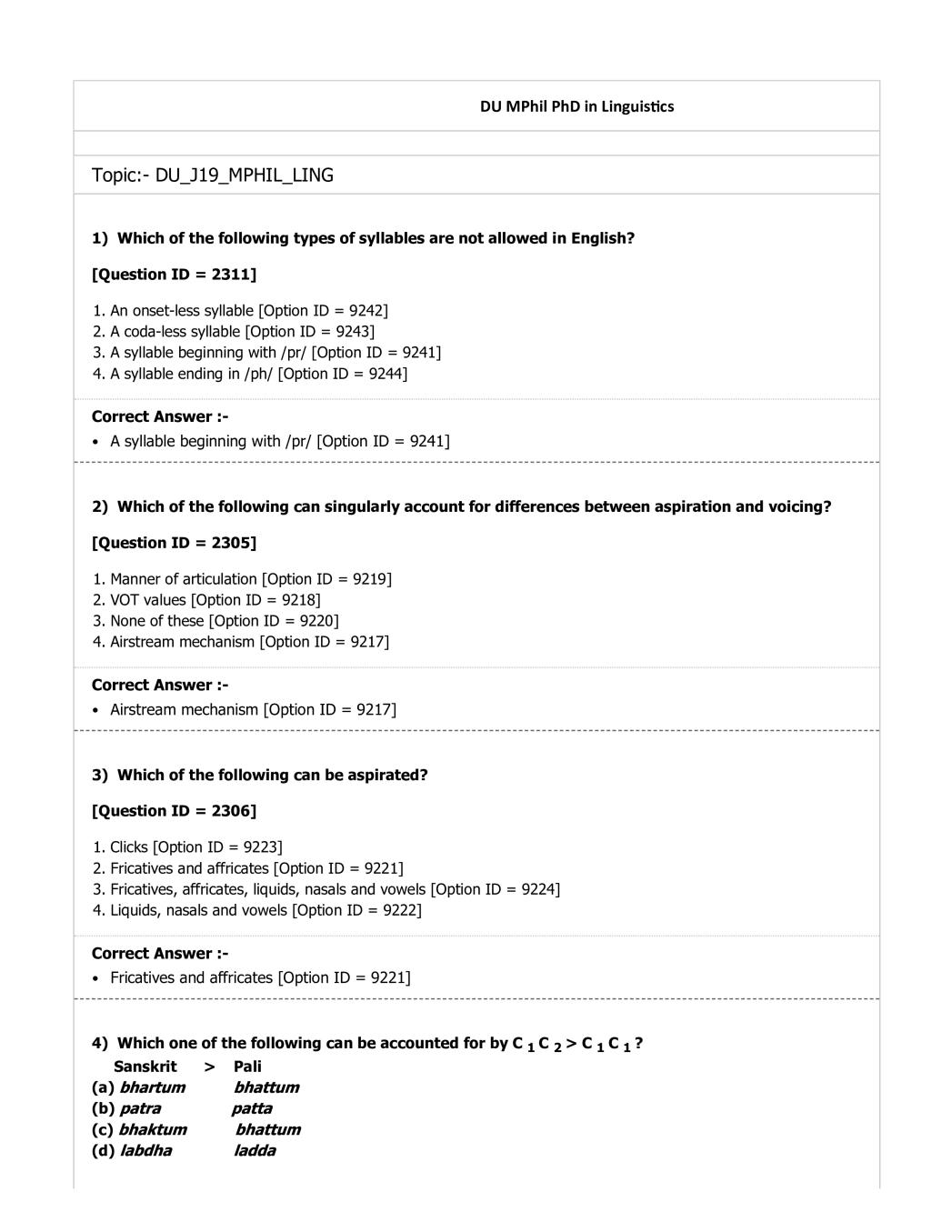
Topic:- DU_J19_MPHIL_LING
1) Which of the following types of syllables are not allowed in English?
[Question ID = 2311]
1. An onset-less syllable [Option ID = 9242]
2. A coda-less syllable [Option ID = 9243]
3. A syllable beginning with /pr/ [Option ID = 9241]
4. A syllable ending in /ph/ [Option ID = 9244]
A syllable beginning with /pr/ [Option ID = 9241]
2) Which of the following can singularly account for differences between aspiration and voicing?
[Question ID = 2305]
1. Manner of articulation [Option ID = 9219]
2. VOT values [Option ID = 9218]
3. None of these [Option ID = 9220]
4. Airstream mechanism [Option ID = 9217]
Airstream mechanism [Option ID = 9217]
3) Which of the following can be aspirated?
[Question ID = 2306]
1. Clicks [Option ID = 9223]
2. Fricatives and affricates [Option ID = 9221]
3. Fricatives, affricates, liquids, nasals and vowels [Option ID = 9224]
4. Liquids, nasals and vowels [Option ID = 9222]
Fricatives and affricates [Option ID = 9221]
4) Which one of the following can be accounted for by C 1 C 2 > C 1 C 1 ?
Sanskrit > Pali
(a)bhartum bhattum
(b)patra patta
(c)bhaktum bhattum
(d)labdha ladda
Page 2
1. D [Option ID = 9328]
2. B [Option ID = 9326]
3. A [Option ID = 9325]
4. C [Option ID = 9327]
A [Option ID = 9325]
5) ‘Changes from above’ are the result of the following: [Question ID = 2338]
1. Contact and borrowing from an external norm [Option ID = 9350]
2. Speakers’ nonawareness of the new forms [Option ID = 9352]
3. The fact that changes from below are rare [Option ID = 9351]
4. Prestige of the upper classes [Option ID = 9349]
Prestige of the upper classes [Option ID = 9349]
6) For the set {r l z m ŋ}, which of the following distinctive features is true of only one sound?
[Question ID = 2309]
1. [-sonorant] [Option ID = 9233]
2. [-coronal] [Option ID = 9234]
3. [-strident] [Option ID = 9235]
4. [-lateral] [Option ID = 9236]
[-sonorant] [Option ID = 9233]
7) Aspiration on a speech waveform shows up [Question ID = 2304]
1. Prior to the release [Option ID = 9214]
2. Post release of the oral closure [Option ID = 9213]
3. Before the closure period [Option ID = 9216]
4. During the closure period [Option ID = 9215]
Post release of the oral closure [Option ID = 9213]
8) In a(n) ____________ observation, the researcher stands apart and does not participate
[Question ID = 2296]
1. Participant [Option ID = 9182]
2. Unstructured [Option ID = 9181]
3. Structural [Option ID = 9183]
4. Nonparticipant [Option ID = 9184]
Unstructured [Option ID = 9181]
Page 3
[Question ID = 2308]
1. Coronals [Option ID = 9231]
2. Velars [Option ID = 9229]
3. Sibilants [Option ID = 9232]
4. Dentals [Option ID = 9230]
Velars [Option ID = 9229]
10) The word self-destruct is derived from self-destruction by a process known as [Question ID =
2317]
1. Backformation [Option ID = 9268]
2. Coinage [Option ID = 9266]
3. Folk etymology [Option ID = 9267]
4. Shortening [Option ID = 9265]
Shortening [Option ID = 9265]
11) In the phrases, my work
and I work, the two uses of work are related to each other by the
process of [Question ID = 2313]
1. Inflection [Option ID = 9250]
2. Affixation [Option ID = 9251]
3. Suppletion [Option ID = 9252]
4. Zero derivation [Option ID = 9249]
Zero derivation [Option ID = 9249]
12) In the sentence The minority party may win the election, the word may is [Question ID = 2319]
1. A modal of possibility [Option ID = 9274]
2. A modal of necessity [Option ID = 9276]
3. A modal of ability [Option ID = 9275]
4. A future auxiliary [Option ID = 9273]
A future auxiliary [Option ID = 9273]
13) Articulatory phonetics is the study of [Question ID = 2301]
1. Physical properties of speech [Option ID = 9202]
2. Speech organs [Option ID = 9201]
3. Phonemes [Option ID = 9203]
4. Physical production of speech sounds [Option ID = 9204]
Speech organs [Option ID = 9201]
Page 4
1. John Rickford [Option ID = 9346]
2. Theory of accommodation [Option ID = 9347]
3. Howard Kurath [Option ID = 9345]
4. Allen Bell [Option ID = 9348]
Howard Kurath [Option ID = 9345]
15) The primary pathway in the brain connecting Broca’s and Wernicke’s areas is called [Question
ID = 2341]
1. Brain stem [Option ID = 9363]
2. Cortex [Option ID = 9364]
3. Arcuate fasciculus [Option ID = 9361]
4. Corpus callosum [Option ID = 9362]
Arcuate fasciculus [Option ID = 9361]
16) The statement that the speech community is conceptually and analytically prior to the individual
can be attributed to [Question ID = 2336]
1. Humboldt [Option ID = 9344]
2. Labov [Option ID = 9342]
3. Labov and Weinreich [Option ID = 9341]
4. Weinreich [Option ID = 9343]
Labov and Weinreich [Option ID = 9341]
17) If a language uses the same case marker on the intransitive subject and the direct object of a
transitive verb, but a different case marker on the transitive subject, it is
[Question ID = 2315]
1. An ergative-absolutive language [Option ID = 9258]
2. A split-intransitive language [Option ID = 9259]
3. A nominative-accusative language [Option ID = 9257]
4. None of these [Option ID = 9260]
A nominative-accusative language [Option ID = 9257]
18) Consider the following pair of sentences:
(i)The car had enough diesel this morning.
The car no longer has enough diesel.
(ii)
The relation of sentence (ii) to sentence (i) is best described as one of [Question ID = 2320]
1. Pragmatic presupposition [Option ID = 9280]
2. Semantic presupposition [Option ID = 9278]
Page 5
4. Entailment [Option ID = 9277]
Entailment [Option ID = 9277]
19) A “dead” language is so called because [Question ID = 2300]
1. It was once a living language [Option ID = 9200]
2. It was always a fossilized language [Option ID = 9197]
3. It is an artificial language that was specially created [Option ID = 9199]
4. It is a language used only by dead people [Option ID = 9198]
It was always a fossilized language [Option ID = 9197]
20) F2 correlates with [Question ID = 2303]
1. None of these [Option ID = 9212]
2. Frontness/backness of the vowel [Option ID = 9210]
3. Height of a vowel [Option ID = 9209]
4. Height and frontness of the vowel [Option ID = 9211]
Height of a vowel [Option ID = 9209]
21) Careful and casual speech refers to [Question ID = 2339]
1. Styles of speech [Option ID = 9353]
2. Markers and indicators [Option ID = 9355]
3. Social stratification [Option ID = 9354]
4. Speech styles and social stratification [Option ID = 9356]
Styles of speech [Option ID = 9353]
22) The verbs to burgle, to edit, to letch
have been created from the nouns, burglar, editor, lecher.
The change involved in the creation of these words is called [Question ID = 2329]
1. Backformation [Option ID = 9313]
2. Blending [Option ID = 9316]
3. Hypercorrection [Option ID = 9315]
4. Folk etymology [Option ID = 9314]
Backformation [Option ID = 9313]
23) Grimm’s law and Verner’s law refer to [Question ID = 2330]
1. Neogrammarian controversy [Option ID = 9319]
2. Consonant changes in Germanic [Option ID = 9317]
3. Spontaneous deaspiration and spirantization [Option ID = 9320]
Page 6
Consonant changes in Germanic [Option ID = 9317]
24) Identify the type of aphasia where speech is fluent but no informational value is present.
[Question ID = 2342]
1. Broca’s aphasia [Option ID = 9365]
2. Conduction aphasia [Option ID = 9368]
3. Wernicke’s aphasia [Option ID = 9366]
4. Global aphasia [Option ID = 9367]
Broca’s aphasia [Option ID = 9365]
25) The set of fibres connecting the two hemispheres of the brain is called [Question ID = 2343]
1. Somatosensory area [Option ID = 9372]
2. Angular gyrus [Option ID = 9371]
3. Arcuate fasciculus [Option ID = 9369]
4. Corpus callosum [Option ID = 9370]
Arcuate fasciculus [Option ID = 9369]
26) The sentence: *Mitasha, I wanna top the list, is ungrammatical because [Question ID = 2327]
1. EPP is not respected [Option ID = 9305]
2.Mitasha cannot get case [Option ID = 9308]
3. The embedded clause is verbless [Option ID = 9306]
4. The trace left behind by NP-movement blocks contraction [Option ID = 9307]
EPP is not respected [Option ID = 9305]
27) A problem with identifying lift and elevator as exact synonyms lies in [Question ID = 2322]
1. Dialectal difference [Option ID = 9285]
2. Non-identity of reference [Option ID = 9286]
3. Difference of social style [Option ID = 9288]
4. Compounding of forms [Option ID = 9287]
Dialectal difference [Option ID = 9285]
28) In the following data from Proto-Germanic and Old English, consider the changes affecting
<d>. The pronunciation of <d> is given in square brackets.
PGmc fadar [ð] do: [d] de:diz [d… ð]
OE fadar [d] do:n [d] dæ:d [d…d]
Page 7
The changes can be best described as
[Question ID = 2334]
1. Allophonic merger [Option ID = 9336]
2. Allophonic split [Option ID = 9334]
3. Phonemic merger [Option ID = 9335]
4. Phonemic split [Option ID = 9333]
Phonemic split [Option ID = 9333]
29) A language with two or more parents is called a [Question ID = 2333]
1. Mixed language [Option ID = 9329]
2. Proto language [Option ID = 9331]
3. Sign language [Option ID = 9332]
4. Surrogate [Option ID = 9330]
Mixed language [Option ID = 9329]
30) Which of the following is a control predicate? [Question ID = 2325]
1. Believe [Option ID = 9300]
2. Forget [Option ID = 9299]
3. Know [Option ID = 9298]
4. Judge [Option ID = 9297]
Judge [Option ID = 9297]
31) Which of the following linguists made the biggest contribution to the field of pragmatics?
[Question ID = 2299]
1. John Searle [Option ID = 9194]
2. Ferdinand de Saussure [Option ID = 9195]
3. Leonard Bloomfield [Option ID = 9196]
4. Michael Halliday [Option ID = 9193]
Michael Halliday [Option ID = 9193]
32) Hindi has the words mər ‘die’ and mɑr ‘kill’. The second Hindi word is an example of [Question
ID = 2316]
1. A lexical causative [Option ID = 9261]
2. A morphological causative [Option ID = 9262]
3. An inflectional morpheme. [Option ID = 9264]
4. An analytical causative [Option ID = 9263]
Page 8
33)
[Question ID = 2323]
1. [Option ID = 9291]
2. [Option ID = 9292]
3. [Option ID = 9289]
4. [Option ID = 9290]
[Option ID = 9289]
34) Who among the following authors proposed the construct ‘India as a linguistic area’? [Question
ID = 2298]
1. P. B. Pandit [Option ID = 9189]
2. M.B. Emeneau [Option ID = 9192]
3. George Cardona [Option ID = 9190]
4. Paul Kiparsky [Option ID = 9191]
P. B. Pandit [Option ID = 9189]
35) For the set {m n ŋ}, which of the following distinctive features is true of all these sounds?
[Question ID = 2310]
1. [+sonorant] [Option ID = 9239]
2. [+high] [Option ID = 9240]
3. [+delayed release] [Option ID = 9237]
4. [+coronal] [Option ID = 9238]
[+delayed release] [Option ID = 9237]
36) Scales that allow participants to select a ‘don’t know’ or ‘no opinion’ response are called
[Question ID = 2294]
1. Balanced [Option ID = 9175]
2. Multidimensional [Option ID = 9173]
3. Unbalanced [Option ID = 9176]
4. Unforced choice [Option ID = 9174]
Page 9
37) A small-scale trial run of a particular component is known as [Question ID = 2295]
1. Both pre and pilot testing [Option ID = 9180]
2. Lab experiment [Option ID = 9178]
3. Pre testing [Option ID = 9179]
4. Pilot testing [Option ID = 9177]
Pilot testing [Option ID = 9177]
38) The relation between be and was is one of [Question ID = 2314]
1. Affixation [Option ID = 9255]
2. Suppletion [Option ID = 9256]
3. Zero derivation [Option ID = 9253]
4. Vowel change [Option ID = 9254]
Zero derivation [Option ID = 9253]
39) The ungrammaticality of the sentence It seems Janaki to be the best student is due to
[Question ID = 2326]
1. Theta theory [Option ID = 9301]
2. Binding theory [Option ID = 9302]
3. Control theory [Option ID = 9304]
4. Case theory [Option ID = 9303]
Theta theory [Option ID = 9301]
40) How many total NP adjuncts and VP adjuncts are there in the following sentence?
The girl with the red hair heartlessly mocked the little boy with the blue balloon in the park at 4pm.
[Question ID = 2324]
1. 5 NP adjuncts and 3 VP adjuncts [Option ID = 9296]
2. 2 NP adjuncts and 2 VP adjuncts [Option ID = 9293]
3. 3 NP adjuncts and 2 VP adjuncts [Option ID = 9295]
4. 3 NP adjuncts and 3 VP adjuncts [Option ID = 9294]
2 NP adjuncts and 2 VP adjuncts [Option ID = 9293]
41) Logically speaking, the (grammatical) sentence A house is a house is a(n) [Question ID = 2318]
1. Explicature [Option ID = 9272]
2. Contradiction [Option ID = 9269]
3. Tautology [Option ID = 9270]
4. Implicature [Option ID = 9271]
Page 10
42) A monotonic pattern of socio-economic classes suggests [Question ID = 2335]
1. Social class is not a salient factor [Option ID = 9339]
2. Change has reached completion [Option ID = 9338]
3. Absence of variation and presence of change [Option ID = 9340]
4. Stable variation [Option ID = 9337]
Stable variation [Option ID = 9337]
43) A change from below refers to: (i) an internally motivated change; (ii) speakers are not aware
of the new form(s) that they are using; (iii) it is introduced by the influential members of the highest
strata; (iv) a change introduced as a result of contact and borrowing.
[Question ID = 2340]
1. Both (iii) and (iv) [Option ID = 9359]
2. Both (i) and (ii) [Option ID = 9357]
3. All of these [Option ID = 9360]
4. All except (iv) [Option ID = 9358]
Both (i) and (ii) [Option ID = 9357]
44) One of the authors of the book, Sound Patterns of English, is [Question ID = 2297]
1. Bruce Hayes [Option ID = 9187]
2. Paul Kiparsky [Option ID = 9186]
3. Morris Halle [Option ID = 9185]
4. Michael Kenstowicz [Option ID = 9188]
Morris Halle [Option ID = 9185]
45) If an English speaker pronounces the word fifth as [fift] instead of [fifθ], the phonological
process displayed is called [Question ID = 2307]
1. Dissimilation [Option ID = 9226]
2. Insertion [Option ID = 9228]
3. Assimilation [Option ID = 9227]
4. Metathesis [Option ID = 9225]
Metathesis [Option ID = 9225]
46) The scope(s) of the sentence every student knows two languages is best captured by
[Question ID = 2321]
Page 11
2. ∀ > ∃ [Option ID = 9282]
3. Ǝ > ∀ and Ǝ > ∀ [Option ID = 9283]
4. All of these [Option ID = 9284]
∃ > ∀ [Option ID = 9281]
47) The primary distinction between two sets of liquid sounds is primarily based on
[Question ID = 2302]
1. Both the direction of air flow and the degree of constriction [Option ID = 9208]
2. Place of articulation [Option ID = 9206]
3. The direction of the air flow [Option ID = 9205]
4. Degree of constriction [Option ID = 9207]
The direction of the air flow [Option ID = 9205]
48) The words Ptolemy and psychologyhave been borrowed from Greek. The English pronunciation
of the highlighted letters differs from that in Greek because
[Question ID = 2312]
1. English does not allow syllables to begin with [p] [Option ID = 9248]
2. English does not allow syllables to begin with two consonants [Option ID = 9245]
3. English does not allow syllables to begin with a stop followed by an obstruent [Option ID = 9246]
4. English does not allow syllables to begin with a stop followed by a sonorant [Option ID = 9247]
English does not allow syllables to begin with two consonants [Option ID = 9245]
49) The following can be best considered as an example of
Skt. > early MIA > late MIA stage I > late MIA stage II
Mata mada maya maa
‘thought’
[Question ID = 2331]
1. Syllable simplification [Option ID = 9323]
2. Progressive phonological weakening [Option ID = 9321]
3. Syncope [Option ID = 9324]
4. Degemination [Option ID = 9322]
Progressive phonological weakening [Option ID = 9321]
50) The sentence I believe that will stay at home, is ungrammatical because
[Question ID = 2328]
Page 12
2. PRO cannot be in the subject position of a tensed clause [Option ID = 9310]
3. PRO cannot be in the subject position [Option ID = 9309]
4. PRO receives a θ-role from the embedded predicate [Option ID = 9312]
PRO cannot be in the subject position [Option ID = 9309]
Document Details
| Board / Org | NTA |
| Exam | DUET |
| Type | Question Paper |
| Pages | 12 |
| Updated | 30 Apr 2026 |