CUSAT CAT 2021 Question Paper 3 Year LLB
Finished viewing? Save it for later —
Download CUSAT CAT 2021 Question Paper 3 Year LLB (PDF · 38 pages)About CUSAT CAT 2021 Question Paper 3 Year LLB
CUSAT CAT 2021 Question Paper 3 Year LLB is available here for free download. Published by Cochin University for CUSAT Common Admission Test, this question paper can be viewed online or downloaded as a PDF (38 pages). Candidates preparing for CUSAT Common Admission Test can use CUSAT CAT 2021 Question Paper 3 Year LLB to understand the exam pattern, the type of questions asked, and the overall difficulty level.
Frequently Asked Questions
How can I download CUSAT CAT 2021 Question Paper 3 Year LLB?
Open this page and click the Download button to save CUSAT CAT 2021 Question Paper 3 Year LLB as a PDF. It is completely free on AglaSem Docs.
Is CUSAT CAT 2021 Question Paper 3 Year LLB free to download?
Yes. CUSAT CAT 2021 Question Paper 3 Year LLB can be viewed online and downloaded as a PDF free of cost on AglaSem Docs.
How many pages does CUSAT CAT 2021 Question Paper 3 Year LLB have?
CUSAT CAT 2021 Question Paper 3 Year LLB contains 38 pages, which you can read online or download together as a single PDF.
Where can I find more CUSAT Common Admission Test study material?
You can find more CUSAT Common Admission Test question papers, sample papers, syllabus, and answer keys on AglaSem Docs.
CUSAT CAT 2021 Question Paper 3 Year LLB – Text
Read the full text of this question paper below — useful to quickly search, copy and reference the content online without downloading the PDF.
📄 View text version (36 pages)
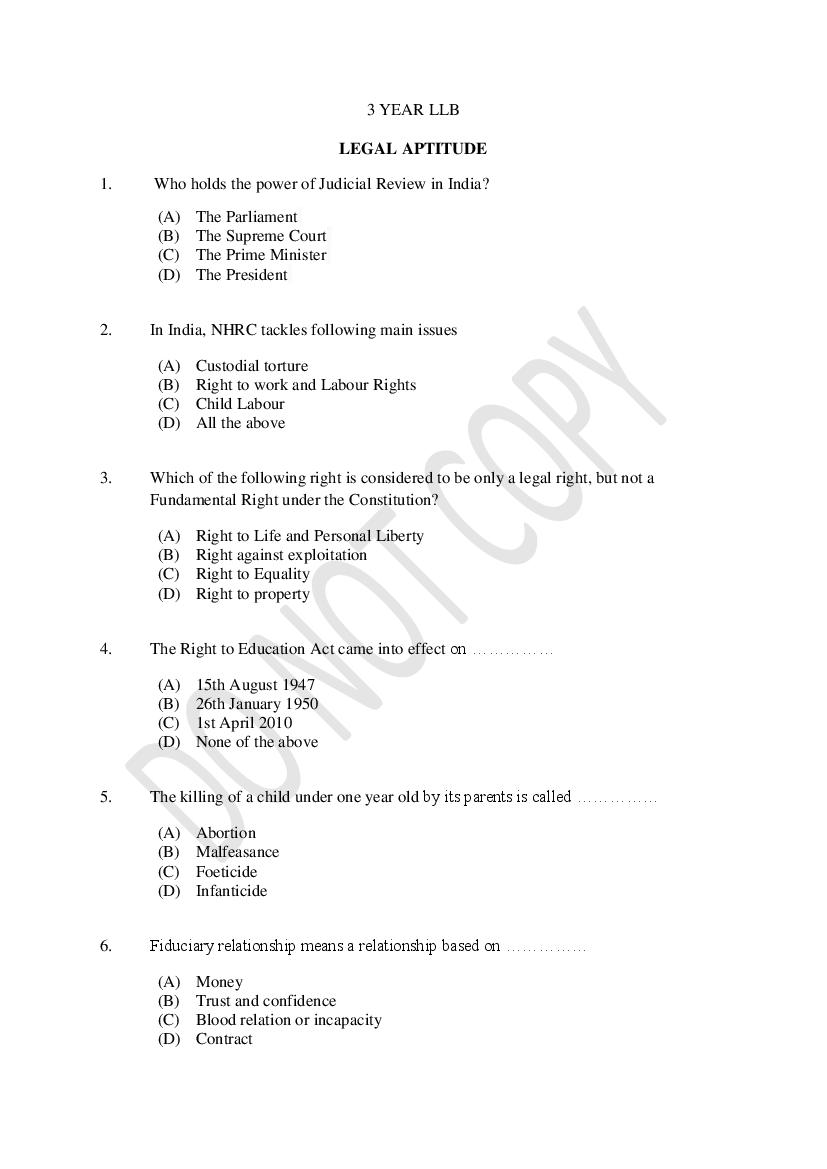
Page 1
LEGAL APTITUDE
1. Who holds the power of Judicial Review in India?
(A) The Parliament
(B) The Supreme Court
(C) The Prime Minister
(D) The President
2. In India, NHRC tackles following main issues
(A) Custodial torture
(B) Right to work and Labour Rights
(C) Child Labour
(D) All the above
3. Which of the following right is considered to be only a legal right, but not a
Fundamental Right under the Constitution?
(A) Right to Life and Personal Liberty
(B) Right against exploitation
(C) Right to Equality
(D) Right to property
4. The Right to Education Act came into effect on ……………
(A) 15th August 1947
(B) 26th January 1950
(C) 1st April 2010
(D) None of the above
5. The killing of a child under one year old by its parents is called ……………
(A) Abortion
(B) Malfeasance
(C) Foeticide
(D) Infanticide
6. Fiduciary relationship means a relationship based on ……………
(A) Money
(B) Trust and confidence
(C) Blood relation or incapacity
(D) Contract
Page 2
(A) Respondent
(B) Undertrial
(C) Defendant
(D) Accomplice
8. The protection and improvement of environment including forests and wild life of
the country is
(A) Directive Principle of State Policy
(B) Fundamental National Policy
(C) Fundamental Duty of a Citizen
(D) Both Directive Principle of State Policy and Fundamental Duty of a Citizen
9. Name the first woman advocate in India?
(A) Cornelia Sorabji
(B) Anna Chandy
(C) Monica David
(D) None of the above
10. What is meant by ‘un-liquidated damage’?
(A) Fixed damages
(B) Non stipulated damages
(C) Heavy damages
(D) Exemplary damages
11. What is Escheat?
(A) One succeeding to the property of his aunt
(B) Property goes to Government if nobody is the owner of it
(C) A legal dispute
(D) None of the above
12. What is the other name for Sarada Act?
(A) Child Marriage Restraint Act
(B) Hindu Marriage Act
(C) Gains of Learning Act
(D) Dowry Prohibition Act
Page 3
(A) Handwritten Will
(B) Will bearing a watermark
(C) Will bearing a hologram
(D) Will that cannot be modified
14. Who is known as the first law officer of India?
(A) Chief Justice of India
(B) Attorney General of India
(C) Law Secretary
(D) Law Minister of India
15. The National Consumer Day is observed every year on ……………
(A) 15th March
(B) 24th December
(C) 26th December
(D) 24th April
16. In which country the concept of Public Interest Litigation (PIL) originated?
(A) United Kingdom
(B) France
(C) United States of America
(D) Australia
17. Which one of the following is not enumerated in the Constitution of India as a
fundamental duty of citizens of India?
(A) To safeguard public property
(B) To protect and improve the natural environment
(C) To develop the scientific temper and spirit of inquiry
(D) To promote international peace and security
Page 4
Constitution of India is available only to the citizens of India?
(A) Article 19
(B) Article 20
(C) Article 21
(D) Article 22
19. What was the basis of States Reorganization Act, 1956?
(A) Language
(B) Natural resources
(C) Size of the states
(D) River water dispute
20. What is meant by conscription?
(A) A legally recognised place of residence in a country
(B) Sudden forcible seizure of Government
(C) Compulsory enlisting of citizens for the services of the state
(D) None of the above
21. Who was the first woman judge appointed to the Supreme Court of India?
(A) Justice Smt. Gyan Subha Mishra
(B) Justice Smt. Fathima Beevi
(C) Justice Smt. Leila Seth
(D) Justice Smt. Ranjana Desai
22. In which of the following case did the Supreme Court allow passive euthanasia under
exceptional circumstances?
(A) Gain Kaur v. State of Punjab
(B) Aruna Shanbaug v. Union of India
(C) Shrada v. Union of India
(D) Seema v. Ashwini Kumar
23. Diplomatic staff enjoys complete immunity from
(A) Civil Jurisdiction
(B) Criminal Jurisdiction
(C) Both (A) and (B)
(D) None of the above
Page 5
(A) 12
(B) 14
(C) 16
(D) 18
25. An examination of dead body is
(A) Ante Mortem
(B) Cremation
(C) Autopsy
(D) Morgue
26. In the year 2002, the Competition Act was enacted replacing
(A) Trade Marks Act
(B) Copy Right Act
(C) Contract Act
(D) MRTP Act
27. Public holidays are declared under
(A) Criminal Procedure Code
(B) Civil Procedure Code
(C) Constitution of India
(D) Negotiable Instruments Act
28. Offence which can be compromised between the parties is known as
(A) Non-compoundable offence
(B) Cognizable offence
(C) Compoundable offence
(D) Non-cognizable offence
29. What is a caveat?
(A) A warning
(B) An injunction
(C) Writ
(D) Certiorari
Page 6
(A) Burden of proof
(B) Double conviction
(C) Double jeopardy
(D) Corpus delicti
31. Registration of marriage under Hindu Marriage Act 1955 is
(A) Compulsory
(B) Optional
(C) Subject to the discretion of marriage registrar
(D) None of the above
32. One of the following cannot be taken as an intellectual property
(A) Patents
(B) Copyright
(C) Know-how
(D) Discovery
33. ……………is a general pardon.
(A) Remission
(B) Reprieve
(C) Amnesty
(D) Suspension
34. Defamation infringes a person’s right to
(A) Reputation
(B) Pride
(C) Privilege
(D) Status
35. The Right to Information Act, 2005 deals with
(A) Right to information and obligations of public authorities
(B) Central Information Commission
(C) State Information Commission
(D) All of the above
Page 7
(A) Judge
(B) Lawyer
(C) Proctor
(D) Prosecutor
37. The great Hindu law-giver was
(A) Kapil
(B) Banabhatta
(C) Kautilya
(D) Manu
38. The sources of International law are:
(A) Treaties
(B) Customs
(C) General principles of law
(D) All of the above
39. Conspiracy needs, at least …………… persons.
(A) one
(B) two
(C) three
(D) five
40. Section …………… of the Indian Penal Code punishes a murderer.
(A) 299
(B) 300
(C) 301
(D) 302
41. The Fundamental Rights in our Constitution are inspired by the Constitution of
(A) USA
(B) UK
(C) Switzerland
(D) Russia
Page 8
(A) Written Constitution
(B) Single Citizenship
(C) Double set of Government
(D) Fundamental Rights
43. In India, the Judiciary is
(A) Independent
(B) Under the Parliament
(C) Under the President
(D) Under the Prime Minister
44. When a person is prosecuted for committing a criminal offence,
the burden of proof is on
(A) Court
(B) Police
(C) Victim’s family
(D) Prosecution
45. Delinquent child is one who
(A) has no legs
(B) no education
(C) has no parents
(D) has committed an offence
46. Burden of proof means
(A) Take allegation
(B) Contradict statement
(C) Prove an allegation
(D) Clean judgement
47. The writ of mandamus will not lie against
(A) The President of India
(B) The Parliament
(C) Local authorities
(D) Courts and Tribunals
Page 9
(A) T.M.A. Pai foundation V. Union of India
(B) Ashok Kumar Thakur V. Union of India
(C) Indira Sawhney V. Union of India
(D) None of the above
49. Who among the following in the legislature decides whether the bill
is a money bill or not?
(A) Speaker of Legislative Assembly
(B) Chief Minister
(C) Chairman of Legislative Council
(D) Leader of Majority party
50. The disputes regarding the election of the President of India is decided by the
(A) Rajya Sabha
(B) Supreme Court
(C) Lok Sabha
(D) Election Commission
Page 10
51. Choose the number pair/group which is different from others.
(A) 40 : 50
(B) 30 : 36
(C) 8 : 10
(D) 28 : 35
52. Arrange the given words in the sequence in which they occur in the dictionary and
choose the correct sequence.
1. Economic
2. Earlier
3. Each
4. Edition
5. Eager
(A) 3, 4, 1, 5, 2
(B) 2, 1, 3, 5, 4
(C) 3, 2, 4, 1, 5
(D) 3, 5, 2, 1, 4
53. Assume that there are three statements followed by several conclusions. You have to
take the given statements to be true, even if they seem to be at variance from commonly-
known facts and then decide which of the given conclusion/s logically follows.
Statements: I. All Pens are Tables.
II. Some tables are rulers.
III. Some rulers are chalk.
Conclusion: I. Some tables are chalk.
II. Some pens are chalk.
III. Some rulers are pens.
IV. Some chalk are rulers.
(A) Only IV follows
(B) Only II and I follows
(C) Only III follows
(D) Only I, II and III follows
54. In certain code TEACHER is written as VGCEJGT. The code of CHILDREN will be
(A) EKNJFTGP
(B) EJKNFTGP
(C) KNJFGTP
(D) None of the above
Page 11
marks of half of the students is found to be 45. The mean marks of the
remaining students is ……………
(A) 60
(B) 85
(C) 70
(D) 65
56. Which of the following statements are mutually contradictory?
(i) All flowers are not fragrant.
(ii) Most flowers are not fragrant.
(iii) None of the flowers is fragrant.
(iv) Most flowers are fragrant.
Choose the correct answer from the code given below:
(A) (i) and (ii)
(B) (i) and (iii)
(C) (ii) and (iii)
(D) (iii) and (iv)
57. 'No man is mortal' is contradictory to
(A) Some man is mortal
(B) Some man is not mortal
(C) All men are mortal
(D) No mortal is man
58. Which of the following statements is/are absolutely impossible?
(i) A man giving birth to his own grandchild
(ii) A woman attending her own funeral
(iii) The Sun not rising in the East some day
(iv) Cars running without petrol
Choose the correct answer:
(A) (i) and (ii)
(B) (iii) and (iv)
(C) (ii)
(D) (i)
Page 12
B is related to C as ...............
(A) Brother
(B) Son
(C) Uncle
(D) Father-in-law
60. One day Ramesh left home and walked 10 km towards south, turned right and walked
5 km, turned right and walked 10 km and turned left and walked 10 km. How many
km will he have to walk to reach his home straight?
(A) 10
(B) 20
(C) 15
(D) 30
61. If the 2nd half of English alphabet is written in the reverse sequence, which will be the
6th letter at right from the 18th letter from left?
(A) X
(B) P
(C) O
(D) N
62. Find the next number in the sequence:
3, 6, 9, 30, 117......
(A) 192
(B) 352
(C) 388
(D) 588
63. 42 : 20 : : 64 :
(A) 32
(B) 33
(C) 31
(D) 34
Page 13
(A) IHG
(B) CAB
(C) JKL
(D) GHI
65. CUP : LIP :: BIRD : ?
(A) GRASS
(B) FOREST
(C) BEAK
(D) BUSH
66. Team X has scored more goals than Team Y
Team Z has scored fewer goals than Team Y
Team X has scored fewer goals than Team Z
If the first two statements are true, the third statement is
(A) True
(B) False
(C) Uncertain
(D) None of the above
67. Madhubala started early in the morning on the road towards the Sun. After some time
she turned to her left. Again after some time she turned to her right. After moving
some distance she again turned to her right and began to move. At this time, in what
direction was she moving?
(A) South
(B) North-West
(C) North-East
(D) East
68. If SPIDER is written as PSDIRE in a certain code, how would COMMON be written
in that code?
(A) OCMMON
(B) OCMOMN
(C) OCMMNO
(D) OCOMMO
Page 14
my mother-in-law." How is the woman's husband related to the
man in the photograph?
(A) Grandson
(B) Son
(C) Son-in-law
(D) Uncle
70. What date was Tuesday in March 2011?
(A) 2
(B) 7
(C) 15
(D) 30
71. One morning after sunrise, Joshua was standing facing a pole. The shadow of the pole
fell exactly to his right. Which direction was Joshua facing?
(A) West
(B) South
(C) East
(D) Data is inadequate
72. Arrange the following in the meaningful order
1. Community
2. Member
3. Family
4. Country
5. Locality
(A) 2,3,5,1,4
(B) 2,3,5,4,1
(C) 2,3,1,5,4
(D) 2,3,4,1,5
Page 15
2. No man is fool.
3. All girls are men.
CONCLUSION: 1. Some boys are men
2. Some boys are fools
3. Some boys are not fools
4. No girl is fool
(A) 1 and 2 follow
(B) 3 and 4 follow
(C) 2 and 4 follow
(D) 1, 3 and 4 follow
74. People abuse substances such as drugs, alcohol, etc., for varied and complicated
reasons, but it is clear that our society pays a significant cost. In a way, drug-abuse that you
find today is similar to the abuse of alcohol in the pre-independence era, when many people
went on drinking despite prohibition. A noticeable difference is that the use of drug has
never been a socially accepted practice among the middle-class people.
The above statement implies that:
(A) Drinking and drug-abuse cannot be controlled by making it unlawful, as the
change in people must come from within
(B) Drinking was commonly accepted despite the prohibition
(C) There is no difference between drug abuse and alcohol abuse
(D) None of the above
75. STATEMENTS: Firecrackers and fireworks are made up of mainly of gunpowder,
which is a mixture of charcoal, sulphur and potassium or sodium nitrate and other
chemical additives, including heavy metals. Government data showed that 35% of
firecracker-related injuries in 2012 were the children between 5 and 10 years of age.
Schools have been instructed to watch out for their children bursting crackers inside
the premises. Despite the principal’s repeated warnings, a child was caught exploding
crackers secretly in the school.
COURSES OF ACTION:
1. All the crackers should be taken away from the child and he should be warned
not to do it again.
2. The child should be severely punished for his wrong act.
(A) only 1 follows
(B) only 2 follows
(C) neither 1 nor 2 follow
(D) both 1 and 2 follow
Page 16
76. Some people believe that in emotional maturity,
men are inferior …………… women.
(A) than
(B) to
(C) from
(D) against
Page 17
(A) towards
(B) against
(C) with
(D) upon
78. Some orthodox persons are averse …………… drinking liquor.
(A) against
(B) for
(C) towards
(D) to
79. At one's fingertips
(A) to take revenge
(B) matter of shame
(C) complete knowledge
(D) None of the above
80. Apple pie order
(A) in random order
(B) related to fruits packing
(C) related to dry fruit packing
(D) in perfect order
81. At one’s wit’s end
(A) perplexed
(B) clear up
(C) explain
(D) enlighten
Directions (Question No. 82 to 86): Fill in with appropriate word
82. Fill in with appropriate word
The river overflowed its …………… and flooded the area.
(A) edges
(B) fronts
(C) limits
(D) banks
Page 19
I have always appreciated his …………… knowledge and scholarship.
(A) highest
(B) flexible
(C) profound
(D) elemental
84. Fill in with appropriate word
Sundar held …………… to the books passionately.
(A) on
(B) in
(C) off
(D) away
85. Fill in with appropriate word
As the bridge gave away, the traffic was ……………
(A) held
(B) held up
(C) held in
(D) held down
86. Fill in with appropriate word
Since it is raining, we have to …………… the match till Sunday.
(A) cancel
(B) paly
(C) put off
(D) hold
87. One who knows many languages?
(A) Panacea
(B) Popular
(C) Polyglot
(D) None of the above
Page 20
The boys were playing cricket
(A) Cricket has been played by the boys
(B) Cricket had been played by the boys
(C) Cricket was played by the boys
(D) Cricket was being played by the boys
Page 21
a. were still trapped inside
b. bogies
c. the wrecked
d. some of the passengers
The proper sequence should be:
(A) abcd
(B) bacd
(C) dbac
(D) dacb
Directions (Question No. 90 and 91): Choose the correct word
90. The miser gazed …………… at the pile of gold coins in front of him.
(A) avidly
(B) admiringly
(C) thoughtfully
(D) earnestly
91. He was sent to the prison for his ……………
(A) sin
(B) vice
(C) crime
(D) guilt
Page 22
I said to him, “why are you working so hard?”
(A) I asked him why he was working so hard
(B) I asked him why was he working so hard
(C) I asked him why he has been working so hard
(D) I asked him why has he been working so hard
93. Our teacher teaches English …………… Mathematics.
(A) across
(B) besides
(C) beside
(D) both
94. …………… water was in a jug so the crow survived
(A) A little
(B) A few
(C) Many
(D) Little
95. His appearance is unsmiling but ……………
(A) his heart is full of compassion for others
(B) he look very serious on most occasions
(C) people are afraid of him
(D) he is full of jealousy towards his colleagues
96. Find the synonym of the word ‘Delineate’?
(A) Expand
(B) Portray
(C) Explain
(D) Argue
97. Find the synonym of the word ‘Obscene’?
(A) Objectionable
(B) Indecent
(C) Displeasing
(D) Condemnable
Page 23
(A) Unison
(B) Substantial
(C) Cohesive
(D) Disagreement
99. Find out the antonym of the word ‘Serene’?
(A) Placid
(B) Indignant
(C) Profound
(D) Disturbed
100. Pick out the appropriate tense of verb given in the bracket.
Chandar …………… (work) in this company for ten years by next year.
(A) will be working
(B) had been working
(C) will have worked
(D) will have been working
Page 24
Directions: Read the paragraph and answer the questions below from the alternatives.
I did that thing recently where you have to sign a big card- which is a horror unto itself,
especially as the keeper of the big card was leaning over me at the time. Suddenly I was on
the spot , a rabbit in the headlights, torn between doing a fun message or some sort of in-joke
or a drawing. Instead overwhelmed by the myriad options available to me, I decided to just
write:”good luck, best Joel”. It was then that I realized, to my horror, that I had forgotten how
to write. My entire existence is “tap letters into my computer”. My shopping lists are hidden
in the notes function of my phone. If I need to remember something I send an e-mail to
myself. A pen is something I chew when I’m struggling to think. Paper is something I pile
beneath the laptop to make it a more comfortable height for me to type on. A poll of 1,000
teens by the stationers, Bic found that one in 10 don’t own a pen, a third have never written a
letter, and half of 13 to 19 years- old have never been forced to sit down and write a thank
you letter. More than 80% have never written a love letter, 56% don’t have letter paper at
home. And quarters have never known the unique torture of writing a birthday card. The most
a teen ever has to use a pen is on an exam paper.
Bic, have you heard of mobile phones? Have you heard of e-mail, Facebook and snap
chatting? This is the future. Pens are dead. Paper is dead. Handwriting is relic.
“Handwriting is one of the most creative outlets we have and should be given the same
importance as other art forms such as sketching, painting and photography”.
101. When confronted with signing big card, the author felt like “a rabbit in the headlight”.
What does this phrase mean?
(A) A state of confusion
(B) A state of Pleasure
(C) A state of Anxiety
(D) A state of pain
102. According to the author, which one is not the most creative outlet of pursuit?
(A) Handwriting
(B) Photography
(C) Sketching
(D) Reading
103. The entire existence of author revolves round:
(A) Computer
(B) Mobile phone
(C) Typewrite
(D) (A) and (B)
Page 25
(A) 800
(B) 560
(C) 500
(D) 100
105. What is the main concern of the author?
(A) That the teens use social networks communication
(B) That the teens use mobile phones
(C) That the teens use computer
(D) That the teens have forgotten the art of hand writing
Page 26
Understanding where you are in the world is a basic survival skill, which is why we, like
most species come hard-wired with specialized brain areas to create cognitive maps of our
surroundings. Where humans are unique, though with the possible exception of honeybees, is
that we try to communicate this understanding of the world with others. We have a long
history of doing this by drawing maps- the earliest versions yet discovered were scrawled on
cave walls 14,000 years ago. Human cultures have been drawing them on stone tablets,
papyrus, paper and now computer screen since.
Given such a long history of human map- making, it is perhaps surprising that it is only
within the last few hundred years that north has been consistently considered to be at the top.
In fact, for much of human history, north almost never appeared at the top, according to Jerry
Brotton, a map historian…. “north was rarely put at the top for the simple fact that north is
where darkness comes from”, he says. “West is also very unlikely to be put at the top because
west is where the sun disappears.”
Confusingly, early Chinese maps seem to buck this trend. Brotton, says, even though they did
have compass at the time, that isn’t the reason that they placed north at the top. Early Chinese
compasses were actually oriented to pint south, which was considered to be more desirable
than deepest darkest north. But in Chinese maps, the emperor, who lived in the north of the
country was always put at the top of the map, with everyone else, his loyal subjects, looking
up towards him. “In Chinese culture the emperor looks south because it’s where the winds
come from, it’s a good direction. North is not very good but you are in a position of
subjection to the emperor, so you look up to him” says Brotton.
Given that each culture has a very different idea of who, or what, they should look up to its
perhaps not surprising that there is very little consistency in which way early maps pointed.
In ancient Egyptian times the top of the world was east, the position of sunrise. Early Islamic
maps favoured south at the top because most of the early Muslim cultures were north mecca,
so they imagined looking (south) towards it. Christian maps from the same era (called Mappa
Mundi) put east at the top, towards the Garden of Eden with Jerusalem in the Centre.
So when did everyone get together and decide that north was the top? It’s tempting to put it
down to European explores like Christopher Colombus and Fedinand Megellan, who were
navigating by the North Star. But Brotton argues that these early explorers didn’t think of the
world like that at all. “when Colombus describes the world is in accordance with east being at
the top”, he says. “Colombus says he is going towards paradise, so his mentality is from a
medieval mappa mundi. “We have got to remember, adds Brotton, that at the time, “no one
knows what they are doing and where they are going”.
106. Which one of the following best describes what the passage is trying to do?
(A) It questions an explanation about how maps are designed
(B) It corrects the misconception about the way maps are designed
(C) It critiques a methodology used to create maps
(D) It explores some myths about maps
Page 28
(A) North was the source of darkness
(B) South was favoured by some emperor
(C) East and south were more important for religious reasons for civilizations
(D) East was considered by some civilisations to be a more positive direction
108. According to the passage, early Chinese maps placed north at the top because
(A) the Chinese invented the compass and were aware of magnetic north
(B) they wanted to show respect to the emperor
(C) the Chinese emperor appreciated the winds from the south
(D) north was considered the most desirable direction
109. It can be inferred from the passage that European explores like
Colombus and Megellan
(A) Set the precedent of north-maps
(B) Navigated by the compass
(C) Used an eastward orientation for religious reasons
(D) Navigated with the help of early maps
110. Which one of the following about the northern orientation of modern maps is asserted
in the passage?
(A) The biggest contributory factor was the understanding of magnetic north
(B) The biggest contributory factor was the role of European explorers
(C) The biggest contributory factor was the influence of Christian maps
(D) The biggest contributory factor is not stated in the passage
Directions: Read the passage and answer the questions:
The Indians as a group are not cohesive. There is a lack of ‘coordination’ among individuals,
groups, institutions and States. This lack of ‘coordination’ may be traced to selfishness, lack
of trust and the inability to find joy in working together as a team for a common goal. This
leads to divisiveness, asking for criticism, with the result images are tarnished and the main
purpose is defeated. This phenomenon is visible among the bureaucrats, the politicians, the
intellectuals, the business community and the sports fraternity, all those who matter and who
give a poor account of themselves as a group despite individual brilliance. This contrast in
human behavior can perhaps be traced to age- old beliefs, religious tolerance, poverty and the
diversity in day-to-day living conditions.
Page 29
(A) There is a lack of coordination between individuals
(B) There is a lack of coordination among individuals, groups and States
(C) There is lack of coordination between individuals and States
(D) There is a lack of coordination among individuals, groups institutions and
states
112. What does lack of coordination lead to?
(A) Divisiveness
(B) Divisiveness and asking for criticism
(C) Asking for criticism
(D) Nothing in particular
113. Which word in the passage means loss of brightness or dull?
(A) Brilliance
(B) Phenomenon
(C) Visible
(D) Tarnish
114. To what can the contrast in human behavior be traced?
(A) Age-old beliefs and diversity in day-to-day life
(B) Age-old beliefs and religious tolerance
(C) Age-old beliefs, religious tolerance, poverty and diversity in day-to-day living
(D) Nothing in particular
115. What does ‘goal’ in this passage means?
(A) The place where the ball has to pass in football match
(B) The object of ambition
(C) A point scored by a particular team in a football match
(D) The poles fitted at the end of a football field
Page 30
In 776 BC the First Olympic Games were held at the foot of Mount Olympus to honour the
Greek’s chief God, Zeus. The Greeks emphasized physical fitness and strength in their
education of youth. Therefore contests in running, jumping, discus and javelin throwing,
boxing and horse and chariot racing were held in individual cities, and the winners competed
every four years at mount Olympus. Winners were greatly honored by having poems sung
about their deeds. Originally these were held as games of friendship, and any wars in
progress were halted to allow the games to take place. The Greeks attached so much
importance to these games that they calculated time in four year cycles called Olympiads
dating from 776 BC.
116. Where were the First Olympic Games held? At the foot of
(A) Mount Olympus
(B) Mount Olympiad
(C) Mount Orels
(D) Mount of Greeks
117. Why were the Olympic games held?
(A) To stop wars
(B) To crown the best athletes
(C) To honour Zeus
(D) To sing songs about athletes
118. Approximately how many years ago did these games originate?
(A) 776 years
(B) 2279 years
(C) 1207 years
(D) 2781 years
119. Which of the following contests was not held?
(A) Discus throwing
(B) Skating
(C) Boxing
(D) Running
120. The values connected with Olympic games were
(A) physical fitness, education of youth and friendship
(B) health contests and singing
(C) running, jumping, throwing and boxing
(D) four-year cycle, war-time, young age and friendship
Page 31
Faith in progress is deep within our culture. We have been taught to believe that our lives are
better than the lives of those who came before us. The ideology of modern economics
suggests that material progress has yielded enhanced satisfaction and well-being. But much
of our confidence about our own well-being comes from the assumptions that our lives are
easier than those of earlier generations. The lives of the so- called primitive peoples are
thought to be harsh-their existence dominated by the incessant quest for food. In fact,
primitives did very little work. By contemporary standards we’d have to judge them very
lazy. The key to understanding by the stone-age people failed to act like us increasing their
work effort to get more things- is that they had limited desires. In the race between wanting
and having, they had kept their wanting low-and, in this way ensured their own kind of
satisfaction. They were materially poor by contemporary standards, but in at least one
dimension-time-we have to count them richer.
121. What is the basis for progress and growth according to the writer?
(A) Faith in progress is deep-rooted in our culture
(B) We have been taught that progress is necessary
(C) Material progress has given us strength
(D) We have assumed to progress
122. What does the writer attribute to modern economics?
(A) That our lives are easier than before
(B) That progress is a natural process
(C) That material progress leads to higher satisfaction well-being
(D) That it forces us to assume progress
123. What is the writer’s image of the primitive people?
(A) Their lives was harsh
(B) They did not work
(C) They were lazy
(D) Search for food was their primary focus in life
124. What is the key to understanding the primitive people’s behavior
according to the passage?
(A) They had no desires
(B) They had everything needed
(C) They had limited desires
(D) They kept their wants high
Page 32
(A) They have a low degree of wants
(B) They are the masters of their time owing to their contentedness
(C) They are materially poor
(D) They are highly satisfied
Page 33
126. Yellow revolution in Indian economy indicates
(A) Milk
(B) Fish
(C) Oil seed production
(D) Fertilizers
127. Which traditional desserts is prepared and distributed to the staff of the finance
ministry before the printing of budget begins?
(A) Gulab Jamun
(B) Kheer
(C) Halwa
(D) Rabri
128. The longest case decided by Supreme Court in 2019.
(A) Adhaar Case
(B) Ayodhya Case
(C) Triple Talaq Case
(D) Sabarimala case
129. …………… of the Indian Constitution was struck down by the central government
which took away the special status of Jammu and Kashmir.
(A) Article 370
(B) Article 371
(C) Article 371A
(D) Article 371B
130. Name the half humanoid robot introduced by ISRO Gaganyaan space craft.
(A) Sophie
(B) Vyommitra
(C) Alexa
(D) SonyAibo
131. The ‘Lonar Lake’ that has been declared as ‘Ramsar Wetland’, is
located in which state?
(A) Odisha
(B) Uttar Pradesh
(C) Madhya Pradesh
(D) Maharashtra
Page 34
which state?
(A) Maharashtra
(B) Karnataka
(C) Tamil Nadu
(D) Andhra Pradesh
133. The first official crypto currency ‘Petra’ was introduced by which country?
(A) Chile
(B) Colombia
(C) Peru
(D) Venezuela
134. Who was the first woman recipient of Bharat Ratna?
(A) Fatima beevi
(B) Indira Gandhi
(C) Razia sultan
(D) N. Lumsden
135. Chipko movement was against
(A) building multi-purpose dam
(B) hydroelectric project
(C) deforestation
(D) testing of missiles
136. Which State provided separate reservation for Muslims and Christians in the State
Backward Classes List in 2007?
(A) Andhra Pradesh
(B) Tamil Nadu
(C) Bihar
(D) Kerala
137. Which of the following dances is not a classical dance?
(A) Kathakali
(B) Garba
(C) Odissi
(D) Manipuri
Page 35
(A) health services in rural areas
(B) good sanitation at cheap rates
(C) low cost accommodation
(D) low cost credit
139. The largest gland in the human body is
(A) thyroid
(B) pancreas
(C) liver
(D) endocrine
140. The Green Revolution in India has been identified with …………….
(A) Dr. Manmohan
(B) Dr. Montek Singh Ahluwalia
(C) Mr. Rajendra Singh
(D) Dr. M.S. Swaminathan
141. What is the meaning of 'Gilt Edged Market'?
(A) Market in Government securities
(B) Market of smuggled goods
(C) Market of auctioned goods
(D) Market of Gold products
142. Blue Revolution refers to
(A) forest development
(B) fishing
(C) poultry farming
(D) horticulture
143. Who authored the book “Law, Justice and Judicial Power – Justice P N Bhagwati’s
Approach”?
(A) Mool Chand Sharma
(B) Rupinder Singh Suri
(C) Shashi Tharoor
(D) Soli Sorbjee
Page 36
following states?
(A) Karnataka
(B) Andhra Pradesh
(C) Kerala
(D) Telangana
145. Which major tech-company announced that it has planned to cut more than half of
carbon emissions across its supply chain, by 2030?
(A) IBM
(B) Microsoft
(C) Google
(D) Infosys
146. The toll-free number ‘8884333331’ for Missed Call Alert facility of users, was
launched for which application?
(A) UMANG
(B) NPS
(C) BHIM
(D) FASTag
147. Which country fined Facebook $ 1.6 million for improper sharing of
user data?
(A) USA
(B) Brazil
(C) India
(D) Russia
148. Who is the Chief of Indian Army?
(A) V.K. Singh
(B) Praveen Bakshi
(C) Dalbir Singh Suhag
(D) Manoj Mukund Naravane
149. ‘Hand-in-Hand’ is a joint military exercise between India and ………….
(A) China
(B) Japan
(C) Singapore
(D) South Korea
Page 37
(A) New type of flowering species
(B) Artificial Intelligence Ship
(C) Solar Probe
(D) Vaccine Delivery Robot
Page 38
Subject Name: 619 THREE YEAR LLB
SI No. Key SI No. Key SI No. Key SI No. Key SI No. Key
1 B 31 B 61 B 91 C 121 D
2 D 32 D 62 D 92 A 122 C
3 D 33 C 63 C 93 B 123 B
4 C 34 A 64 A 94 A 124 C
5 D 35 D 65 C 95 A 125 B
6 B 36 D 66 B 96 C 126 C
7 D 37 D 67 A 97 B 127 C
8 D 38 D 68 C 98 D 128 B
9 A 39 B 69 A 99 D 129 A
10 B 40 D 70 C 100 D 130 B
11 B 41 A 71 B 101 A 131 D
12 A 42 D 72 C 102 D 132 D
13 A 43 A 73 D 103 D 133 D
14 B 44 D 74 B 104 D 134 B
15 B 45 D 75 B 105 D 135 C
16 C 46 C 76 B 106 B 136 B
17 D 47 B 77 C 107 B 137 B
18 A 48 C 78 D 108 C 138 B
19 A 49 A 79 C 109 C 139 C
20 C 50 B 80 D 110 D 140 D
21 B 51 B 81 A 111 D 141 A
22 B 52 D 82 D 112 B 142 B
23 C 53 A 83 C 113 D 143 A
24 B 54 B 84 A 114 C 144 A
25 C 55 B 85 B 115 B 145 B
26 D 56 D 86 C 116 A 146 D
27 D 57 A 87 C 117 C 147 B
28 C 58 A 88 D 118 D 148 D
29 A 59 C 89 D 119 B 149 A
30 C 60 C 90 A 120 A 150 B
Document Details
| Board / Org | Cochin University |
| Exam | CUSAT Common Admission Test |
| Type | Question Paper |
| Pages | 38 |
| Language | english |
| Updated | 22 Jul 2026 |