Karnataka 2nd PUC Physics Electromagnetic Waves MCQ with Answers
Finished viewing? Save it for later —
Download Karnataka 2nd PUC Physics Electromagnetic Waves MCQ with Answers (PDF · 8 pages)About Karnataka 2nd PUC Physics Electromagnetic Waves MCQ with Answers
Karnataka 2nd PUC Physics Electromagnetic Waves MCQ with Answers is available here for free download. Published by Karnataka Board for Class 12, this question bank can be viewed online or downloaded as a PDF (8 pages). Candidates preparing for Class 12 can use Karnataka 2nd PUC Physics Electromagnetic Waves MCQ with Answers to understand the exam pattern, the type of questions asked, and the overall difficulty level.
Frequently Asked Questions
How can I download Karnataka 2nd PUC Physics Electromagnetic Waves MCQ with Answers?
Open this page and click the Download button to save Karnataka 2nd PUC Physics Electromagnetic Waves MCQ with Answers as a PDF. It is completely free on AglaSem Docs.
Is Karnataka 2nd PUC Physics Electromagnetic Waves MCQ with Answers free to download?
Yes. Karnataka 2nd PUC Physics Electromagnetic Waves MCQ with Answers can be viewed online and downloaded as a PDF free of cost on AglaSem Docs.
How many pages does Karnataka 2nd PUC Physics Electromagnetic Waves MCQ with Answers have?
Karnataka 2nd PUC Physics Electromagnetic Waves MCQ with Answers contains 8 pages, which you can read online or download together as a single PDF.
Where can I find more Class 12 study material?
You can find more Class 12 question papers, sample papers, syllabus, and answer keys on AglaSem Docs.
Karnataka 2nd PUC Physics Electromagnetic Waves MCQ with Answers – Text
Read the full text of this question bank below — useful to quickly search, copy and reference the content online without downloading the PDF.
📄 View text version (8 pages)
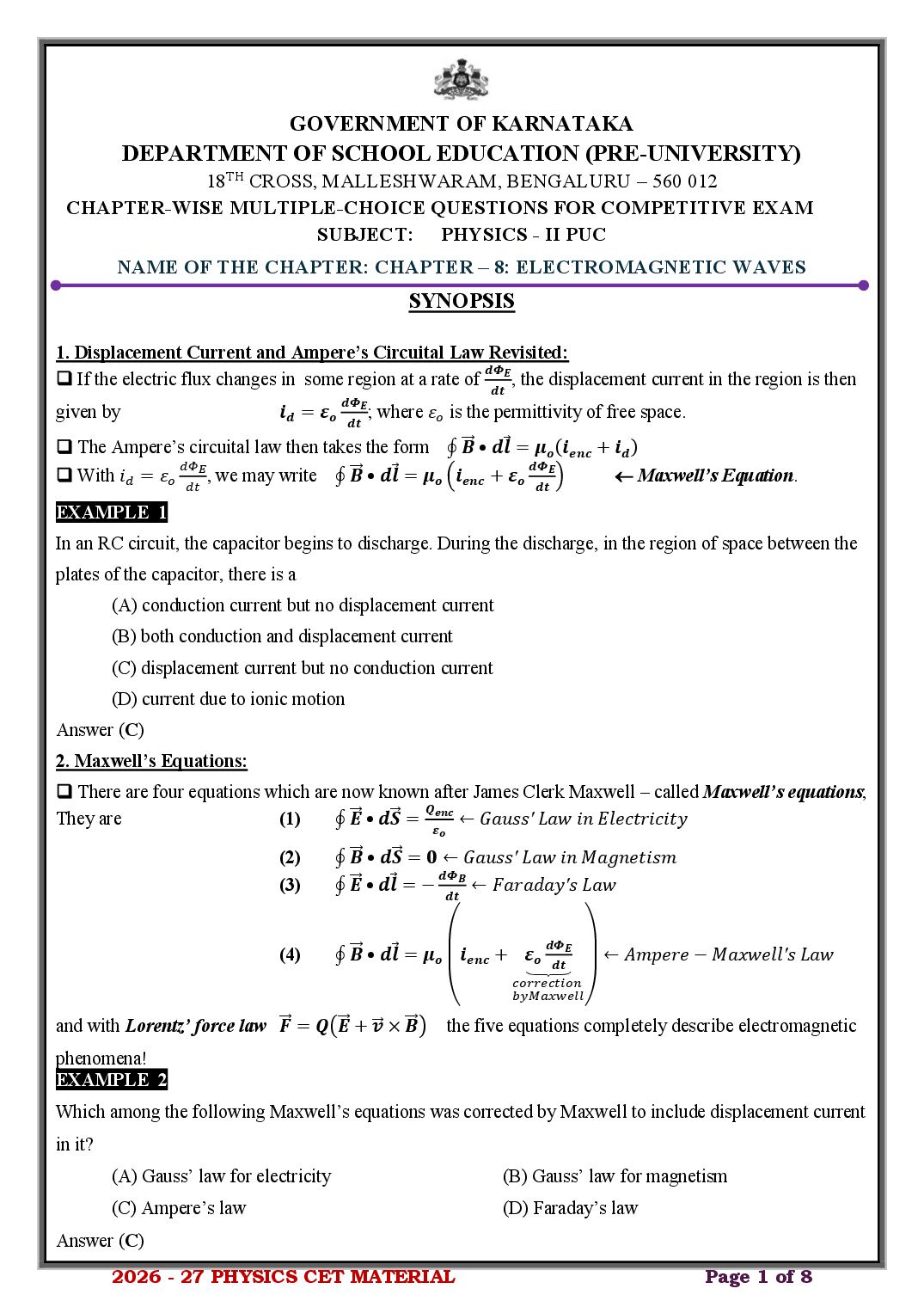
Page 1
DEPARTMENT OF SCHOOL EDUCATION (PRE-UNIVERSITY)
18TH CROSS, MALLESHWARAM, BENGALURU – 560 012
CHAPTER-WISE MULTIPLE-CHOICE QUESTIONS FOR COMPETITIVE EXAM
SUBJECT: PHYSICS - II PUC
NAME OF THE CHAPTER: CHAPTER – 8: ELECTROMAGNETIC WAVES
SYNOPSIS
1. Displacement Current and Ampere’s Circuital Law Revisited:
𝒅𝜱
❑ If the electric flux changes in some region at a rate of 𝒅𝒕𝑬, the displacement current in the region is then
𝒅𝜱
given by 𝒊𝒅 = 𝜺𝒐 𝒅𝒕𝑬; where 𝜀𝑜 is the permittivity of free space.
❑ The Ampere’s circuital law then takes the form ∮ ⃗𝑩
⃗ • 𝒅𝒍 = 𝝁𝝄 (𝒊𝒆𝒏𝒄 + 𝒊𝒅 )
𝑑𝛷𝐸
❑ With 𝑖𝑑 = 𝜀𝑜 , we may write ∮ ⃗𝑩⃗ • 𝒅𝒍 = 𝝁𝝄 (𝒊𝒆𝒏𝒄 + 𝜺𝒐 𝒅𝜱𝑬) Maxwell’s Equation.
𝑑𝑡 𝒅𝒕
EXAMPLE 1
In an RC circuit, the capacitor begins to discharge. During the discharge, in the region of space between the
plates of the capacitor, there is a
(A) conduction current but no displacement current
(B) both conduction and displacement current
(C) displacement current but no conduction current
(D) current due to ionic motion
Answer (C)
2. Maxwell’s Equations:
❑ There are four equations which are now known after James Clerk Maxwell – called Maxwell’s equations;
They are (1) ∮𝑬 ⃗ = 𝑸𝒆𝒏𝒄 ← 𝐺𝑎𝑢𝑠𝑠′ 𝐿𝑎𝑤 𝑖𝑛 𝐸𝑙𝑒𝑐𝑡𝑟𝑖𝑐𝑖𝑡𝑦
⃗⃗ • 𝒅𝑺
𝜺 𝒐
(2) ∮ ⃗𝑩
⃗ • 𝒅𝑺
⃗ = 𝟎 ← 𝐺𝑎𝑢𝑠𝑠′ 𝐿𝑎𝑤 𝑖𝑛 𝑀𝑎𝑔𝑛𝑒𝑡𝑖𝑠𝑚
(3) ⃗ • 𝒅𝒍 = − 𝒅𝜱𝑩 ← 𝐹𝑎𝑟𝑎𝑑𝑎𝑦′𝑠 𝐿𝑎𝑤
∮ ⃗𝑬 𝒅𝒕
𝒅𝜱
(4) ⃗⃗ • 𝒅𝒍 = 𝝁𝝄 𝒊𝒆𝒏𝒄 + 𝜺𝒐 𝑬
∮𝑩 ← 𝐴𝑚𝑝𝑒𝑟𝑒 − 𝑀𝑎𝑥𝑤𝑒𝑙𝑙′𝑠 𝐿𝑎𝑤
⏟ 𝒅𝒕
𝑐𝑜𝑟𝑟𝑒𝑐𝑡𝑖𝑜𝑛
( 𝑏𝑦𝑀𝑎𝑥𝑤𝑒𝑙𝑙)
and with Lorentz’ force law ⃗𝑭 = 𝑸(𝑬
⃗ +𝒗
⃗ × ⃗𝑩
⃗) the five equations completely describe electromagnetic
phenomena!
EXAMPLE 2
Which among the following Maxwell’s equations was corrected by Maxwell to include displacement current
in it?
(A) Gauss’ law for electricity (B) Gauss’ law for magnetism
(C) Ampere’s law (D) Faraday’s law
Answer (C)
2026 - 27 PHYSICS CET MATERIAL Page 1 of 8
Page 2
❑ Any oscillating charge or accelerating charge emits electromagnetic waves or radiations.
❑ An electromagnetic wave consists of time and space variable alternating magnetic and electric fields
which are perpendicular to the direction of its propagation.
❑ While the electric field varies along the y direction in y – z plane, the magnetic field varies along the x
direction in the x – z plane.
❑ The equations for electric and magnetic fields of an electromagnetic wave as functions of t and z are
𝑬 = 𝑬𝒐 𝒔𝒊𝒏(𝝎𝒕 − 𝒌𝒛) and 𝑩 = 𝑩𝒐 𝒔𝒊𝒏(𝝎𝒕 − 𝒌𝒛). y
→
❑ Where E 0 = amplitude of electric field of the EM wave and B0 E
x z
is the amplitude of magnetic field of that wave.
c
❑ The term 𝜔 is the angular frequency of the EM wave which is
given by 𝝎 = 𝟐𝝅𝝂 and is the frequency of the EM wave.
→ →
k
❑ The term k is called the propagation constant or angular wave B
number of the EM wave which is given by
𝟐𝝅
𝒌 = 𝝀 while is the wavelength of the EM wave.
𝟏 𝝎
❑ The EM wave velocity is given by 𝒄 = 𝝀𝝂 = = 𝒌.
√𝜺𝒐 𝝁𝝄
𝑬
❑ The relation between the amplitudes of electric and magnetic fields is 𝑩𝒐 = 𝒄𝒐.
*In all the above relations c = 3 108 m/s = velocity of light in vacuum.
EXAMPLE 3
The electromagnetic wave travelling in free space has its electric field vibrations changing with time
according to the equation E = (9 kNC−1) sin (1.57 107x − t). Where x and t are in meters. Then the
frequency of the wave is
(A) 13.3 1015 Hz (B) 7.5 1015 Hz (C) 13.3 10−15 Hz (D) 7.5 10−15 Hz
Answer (B)
Example Solved:
Comparing the given equation with the standard equation : E = Eo sin (kx − t),
we get : k = 2/ = 1.57 107 = 4 10−7 m−1
Hence the frequency of the wave is : = c/ = 3 108/4 10−7 = 7.5 1015 Hz
4. Electromagnetic Waves – Their Energy Density and Momentum:
❑ The EM waves carry energy and momentum with them. Their energy density is
𝟏 𝟏
𝒖𝑬𝑴 = 𝒖𝑬 + 𝒖𝑴 = 𝟐 𝜺𝒐 𝑬𝟐𝒐 + 𝟐𝝁 𝑩𝟐𝒐 .
𝝄
𝑬𝟐𝒐
❑ The intensity of EM waves is 𝑰 = 𝟐𝝁 𝒄
𝝄
𝑷
❑ The intensity of EM waves from point source varies with distance r as per 𝑰 = 𝟒𝝅𝒓𝟐 where P is the power
of the source of EM waves.
❑ The momentum delivered to a surface when an electromagnetic wave of total energy U strikes it is
𝑼
𝒑𝑬𝑴 = 𝒄 ← for complete absorption
𝟐𝑼
and 𝒑𝑬𝑴 = ← for complete reflection
𝒄
2026 - 27 PHYSICS CET MATERIAL Page 2 of 8
Page 3
The time-average of energy of a sinusoidal electromagnetic wave is
(A) dominantly electrical
(B) slightly more electrical than magnetic
(C) equally divided between the electric and magnetic fields
(D) slightly more magnetic than electrical
Answer (C)
5. Electromagnetic Spectrum:
❑ Electromagnetic waves are arranged either according to their frequencies, or their wavelengths or even
their energies. This arrangement is often called electromagnetic spectrum.
❑ We arrange these electromagnetic waves in increasing order of their frequencies (or equivalently in
decreasing order of their wavelengths as 1/ )
Radio waves, whose wavelengths range from more than 104 m to about 0.1 m, are the result of charges
accelerating through conducting wires.
❑ They are generated by such electronic devices as LC oscillators and are used in radio and television
communication systems.
Microwaves have wavelengths ranging from approximately 0.3 m to 10− 4 m and are also generated by
electronic devices.
❑ Because of their short wavelengths, they are well suited for radar systems and for studying the atomic and
molecular properties of matter.
❑ Microwave ovens are an interesting domestic application of these waves.
Infrared waves have wavelengths ranging from approximately 10−3 m to the longest wavelength of
visible light, 7 10−7 m.
❑ These waves, produced by molecules and room-temperature objects, are readily absorbed by most
materials.
❑ The infrared (IR) energy absorbed by a substance appears as internal energy because the energy agitates
the object’s atoms, increasing their vibrational or translational motion, which results in a temperature
increase.
Visible light, the most familiar form of electromagnetic waves, is the part of the electromagnetic
spectrum the human eye can detect.
❑ Light is produced by the rearrangement of electrons in atoms and molecules. The various wavelengths of
visible light, which correspond to different colors, range from red ( ≈ 7 10−7 m) to violet ( ≈ 4 10−7
m).
❑ The sensitivity of the human eye is a function of wavelength, being a maximum at a wavelength of about
5.5 10−7 m.
Ultraviolet waves cover wavelengths ranging from approximately 4 10−7 m to 6 10−10 m.
❑ The Sun is an important source of ultraviolet (UV) light, which is the main cause of sunburn. Sunscreen
lotions are transparent to visible light but absorb most UV light. The higher a sunscreen’s solar protection
factor, or SPF, the greater the percentage of UV light absorbed.
2026 - 27 PHYSICS CET MATERIAL Page 3 of 8
Page 4
eye.
❑ Most of the UV light from the Sun is absorbed by ozone (O3) molecules in the Earth’s upper atmosphere,
in a layer called the stratosphere. This ozone shield converts lethal high-energy UV radiation to IR radiation,
which in turn warms the stratosphere.
X-rays have wavelengths in the range from approximately 10−8 m to 10−12 m.
❑ The most common source of x-rays is the stopping of high-energy electrons upon bombarding a metal
target.
❑ X-rays are used as a diagnostic tool in medicine and as a treatment for certain forms of cancer. Because
x-rays can damage or destroy living tissues and organisms, care must be taken to avoid unnecessary
exposure or overexposure.
❑ X-rays are also used in the study of crystal structure because x-ray wavelengths are comparable to the
atomic separation distances in solids (about 0.1 nm).
Gamma rays are electromagnetic waves emitted by radioactive nuclei and during certain nuclear
reactions.
❑ High-energy gamma rays are a component of cosmic rays that enter the Earth’s atmosphere from space.
They have wavelengths ranging from approximately 10−10 m to less than 10−14 m.
❑ Gamma rays are highly penetrating and produce serious damage when absorbed by living tissues.
Consequently, those working near such dangerous radiation must be protected with heavily absorbing
materials such as thick layers of lead.
EXAMPLE 5
The frequency of which type of electromagnetic waves in the following is largest?
(A) Gamma rays (B) Microwaves
(C) Radio waves (D) Visible light
Answer (A)
**************************************************
2026 - 27 PHYSICS CET MATERIAL Page 4 of 8
Page 5
1. From Maxwell’s hypothesis, a changing electric field gives rise to
(A) an electric field (B) an induced emf (C) a magnetic field (D) a magnetic dipole.
2. The conduction current and displacement current are equal when the source is
(A) an ac (B) a dc (C) either an ac or a dc(D) neither an ac nor a dc
3. The correct expression for the displacement current in vacuum is
𝑑Φ 𝑑Φ 𝑑Φ 𝑑Φ
(A) 𝑑𝑡E (B) 𝜀0 𝑑𝑡E (C) 𝜇0 𝑑𝑡E (D) 𝜇0 𝜀0 𝑑𝑡E
4. Electromagnetic waves can be produced by:
(A) An accelerated charged particles
(B) A charged particles moving with constant speed
(C) A charge at rest
(D) A charge either at rest or moving with constant velocity.
5. Which of the following statement is NOT true about the properties of electromagnetic waves?
(A) They do not require any material for their propagation
(B) both electric and magnetic field vectors attain the maxima and minima at the same time
(C) the energy in electromagnetic wave is divided equally between electric and magnetic fields
(D) both electric and magnetic field vectors are parallel to each other.
6. "An electromagnetic wave is transverse in nature". It means, it has an oscillating
(A) electric field
(B) magnetic field
(C) electric field and magnetic field
(D) electric field and magnetic field mutually perpendicular to each other and perpendicular to the
direction of propagation of the wave
7. In electromagnetic waves, the phase difference between magnetic and electric field vectors is
(A) zero (B) (C) /2 (D) /4
8. If 𝐸⃗ and 𝐵⃗ represent electric and magnetic field vectors of the electromagnetic wave then direction of
propagation of electromagnetic wave is along
(A) 𝐸⃗ ⃗
(B) 𝐵 (C) 𝐵⃗ × 𝐸⃗ (D) 𝐸⃗ × 𝐵
⃗
9. A plane electromagnetic wave travels along positive y-axis in vacuum, its electric and magnetic field
vectors are
(A) Ex, Bz (B) Ey, Bz (C) Ez, Bx (D) Ey, Bx
10. The ratio of contributions made by the electric field and magnetic field components to the intensity of an
electromagnetic wave is (where the symbols have their usual meaning)
(A) c : 1 (B) c2 : 1 (C) 1 : 1 (D) √𝑐 : 1
11. In vacuum, the physical property which remains same for microwave of wavelength 1 mm and UV
radiation 1600 Å is
(A) Wavelength (B) Frequency (C) Speed (D) Energy
12. In vacuum, the wavelength of the electromagnetic wave of frequency 5 × 10¹⁹ Hz is
(A) 6 × 10–12 m (B) 3 × 10⁻⁸ m (C) 1.6 × 10¹¹ m (D) 15 × 1027 m
13. For an electromagnetic wave propagating along x –axis Emax = 30 V/m, the maximum value of magnetic
field is:
(A) 10-8 T (B) 60 T (C) 10-7 T (D) 30 T
14. One requires 11 eV of energy to dissociate a carbon monoxide molecule into carbon and oxygen atoms.
The minimum frequency of the appropriate electromagnetic radiation to achieve the dissociation lies in
(A) visible region (B) infrared region
(C) ultraviolet region (D) microwave region
2026 - 27 PHYSICS CET MATERIAL Page 5 of 8
Page 6
particular point in space and time 𝐸⃗ = 6.3 𝑗̂ V/ m. What is 𝐵
⃗ at this point?
(A) 2.1 × 10⁻⁸ 𝑗̂ T (B) 2.1 × 10⁸ 𝑘̂ T (C) 2.1 × 10⁻⁸ 𝑖̂ T (D) 2.1 × 10⁻⁸ 𝑘̂ T
16. Proper arrangement of Gamma rays, Microwaves, IR waves and UV rays in ascending order of frequency
is
(A) Gamma rays, UV rays, IR rays, Microwave
(B) Microwave, IR rays, UV rays, Gamma rays
(C) UV rays, Gamma rays, Microwave, IR rays
(D) IR rays, UV rays, Microwave, Gamma rays
17. The velocity of electromagnetic radiation in a medium of permittivity ε0 and permeability μ0 is given by
𝜀 1
(A) √𝜇0 𝜀0 (B) √𝜇0 (C) (D) 𝜇0 𝜀0
0 √ 𝜇0 𝜀 0
18. Properties of electromagnetic radiation are identified by their:
(A) colour (B) use (C) speed (D) frequency or wavelength
19. The magnitude of the electric and the magnetic fields in an electromagnetic wave are related as (where
the symbols have their usual meaning)
𝐵 𝐸 𝑐 𝑐
(A) 𝐸0 = 𝑐0 (B) 𝐵0 = 𝑐0 (C) 𝐵0 = 𝐸 (D) 𝐸0 = 𝐵
0 0
20. Which of the following are transported by electromagnetic waves:
(A) charge and momentum (B) frequency and wavelength
(C) energy and momentum (D) wavelength and energy
21. Which one of the following statements is correct?
(A) X-rays are suitable for radar system and aircraft navigation.
(B) Water molecules readily absorb infrared radiation and their thermal motion increases.
(C) Microwaves are produced in Geiger tube.
(D) Gamma radiations are generated by bombarding a metal target by high energy electrons.
22. Assertion: Electromagnetic radiation exerts pressure.
Reason: Electromagnetic waves carry momentum and energy.
(A) Both assertion and reason are true and reason is the correct explanation of assertion.
(B) Both assertion and reason are true but reason is not the correct explanation of assertion.
(C) Assertion is true but reason is false.
(D) Both assertion and reason are false.
23. Assertion: Dipole oscillation produces electromagnetic waves.
Reason: Accelerated charge produce electromagnetic waves.
(A) Both assertion and reason are true and reason is the correct explanation of assertion.
(B) Both assertion and reason are true but reason is not the correct explanation of assertion.
(C) Assertion is true but reason is false.
(D) Both assertion and reason are false.
24. Match the following:
Electromagnetic waves Application
(a) Ultraviolet rays (1) To detect fracture of bones
(b) X-rays (2) Remote Sensing
(c) Microwaves (3) Water purification
(A) (a) – (1), (b) – (2), (c) – (3) (B) (a) – (3), (b) – (1), (c) – (2)
(C) (a) – (2), (b) – (3), (c) – (1) (D) (a) – (3), (b) – (2), (c) – (1)
2026 - 27 PHYSICS CET MATERIAL Page 6 of 8
Page 7
Electromagnetic waves Frequencies
(a) Ultraviolet rays (1) 3 × 10¹¹ to 4.3 × 10¹⁴ Hz
(b) γ - rays (2) 7.5 × 10¹⁴ to 3 × 10¹⁷ Hz
(c) IR waves (3) 3 × 10¹⁹ to > 1024 Hz
(A) (a) – (3), (b) – (1), (c) – (2) (B) (a) – (1), (b) – (2), (c) – (3)
(C) (a) – (2), (b) – (3), (c) – (1) (D) (a) – (3), (b) – (2), (c) – (1)
KEY ANSWERS
1 2 3 4 5 6 7 8 9 10 11 12 13
C A B A D D A D C C C A C
14 15 16 17 18 19 20 21 22 23 24 25
C D B C D B C B A A B C
2026 - 27 PHYSICS CET MATERIAL Page 7 of 8
Page 8
1. A light beam of intensity 20 𝑊/𝑐𝑚2 is incident normally on a perfectly reflecting surface of sides
25𝑐𝑚 × 15𝑐𝑚. The momentum imparted to the surface by the light per second is [KCET-2020]
(A) 1 × 10⁻⁵ 𝑘𝑔 𝑚 𝑠 −1 (B) 5 × 10⁻⁵ 𝑘𝑔 𝑚 𝑠 −1
(C) 1.2 × 10⁻⁵ 𝑘𝑔 𝑚 𝑠 −1 (D) 2 × 10⁻⁵ 𝑘𝑔 𝑚 𝑠 −1
2. Suppose that the electric field amplitude of electromagnetic wave is 𝐸0 = 120 𝑁 𝐶 −1 and its frequency is
𝑓 = 50 𝑀𝐻𝑧. Then which of the following value is incorrectly computed? [KCET-2021]
(A) magnetic field amplitude is 400 nT
(B) angular frequency of EM wave is 𝜋 × 108 𝑟𝑎𝑑/𝑠
(C) proportional constant (angular wave number) is 2.1 rad/s
(D) wavelength of the EM wave is 6 m
3. The source of electromagnetic waves can be a charge [KCET-2021]
(A) moving with a constant velocity (B) moving in a circular orbit
(C) at rest (D) moving parallel to the magnetic field
4. Which of the following radiations of electromagnetic waves has the highest wavelength? [KCET-2022]
(A) IR-radiations (B) Microwaves (C) X-rays (D) UV-rays
5. Which of the following radiations is deflected by electric field? [KCET-2022]
(A) γ-rays (B) α-particles (C) X-rays (D) neutrons
6. The ratio of the magnitudes of electric field to the magnetic field of an electromagnetic wave is of the
order of [KCET-2023]
(A) 105 𝑚 𝑠 −1 (B) 10−5 𝑚 𝑠 −1 (C) 108 𝑚 𝑠 −1 (D) 10−8 𝑚 𝑠 −1
7. Electromagnetic waves are incident normally on a perfectly reflecting surface having surface area A. If I
is the intensity of the incident electromagnetic radiation and c is the speed of light in vacuum, the force
exerted by the electromagnetic wave on the reflecting surface is [EX] [KCET-2024]
2𝐼𝐴 𝐼𝐴 𝐼𝐴 𝐼
(A) 𝑐 (B) 𝑐 (C) 2𝑐 (D) 2𝐴𝑐
8. Match the following types of waves with their wavelength ranges [KCET-2025]
(A) i – a, ii – d, iii – b, iv – c Waves Wavelength Ranges
(B) i – c, ii – a, iii – d, iv – b i. Microwaves (a) 700 nm to 400 nm
(C) i – d, ii – b, iii – c, iv – a ii. Visible light (b) 1 nm to 10-3 nm
(D) i – b, ii – c, iii – a, iv – d iii. Ultraviolet rays (c) 0.1 m to 1 mm
9. What range of electromagnetic spectrum iv. X-rays (d) 400 nm to 1 nm
is considered as light? [KCET-2026]
(A) 1 mm to 700 nm (B) 400 nm to 1 nm (C) 400 nm to 700 nm (D) 1 nm to 10−3 nm
KEY ANSWERS
1 2 3 4 5 6 7 8 9
B C B B B D A B C
2026 - 27 PHYSICS CET MATERIAL Page 8 of 8
Document Details
| Board / Org | Karnataka Board |
| Exam | Class 12 |
| Type | Question Bank |
| Pages | 8 |
| Updated | 24 Sep 2026 |