MAHA SET 2025 Paper II Philosophy Set A Question Paper
Finished viewing? Save it for later —
Download MAHA SET 2025 Paper II Philosophy Set A Question Paper (PDF · 36 pages)About MAHA SET 2025 Paper II Philosophy Set A Question Paper
MAHA SET 2025 Paper II Philosophy Set A Question Paper is available here for free download. Published by Maharashtra Exams for MAHA SET, this question paper can be viewed online or downloaded as a PDF (36 pages). Candidates preparing for MAHA SET can use MAHA SET 2025 Paper II Philosophy Set A Question Paper to understand the exam pattern, the type of questions asked, and the overall difficulty level.
Frequently Asked Questions
How can I download MAHA SET 2025 Paper II Philosophy Set A Question Paper?
Open this page and click the Download button to save MAHA SET 2025 Paper II Philosophy Set A Question Paper as a PDF. It is completely free on AglaSem Docs.
Is MAHA SET 2025 Paper II Philosophy Set A Question Paper free to download?
Yes. MAHA SET 2025 Paper II Philosophy Set A Question Paper can be viewed online and downloaded as a PDF free of cost on AglaSem Docs.
How many pages does MAHA SET 2025 Paper II Philosophy Set A Question Paper have?
MAHA SET 2025 Paper II Philosophy Set A Question Paper contains 36 pages, which you can read online or download together as a single PDF.
Where can I find more MAHA SET study material?
You can find more MAHA SET question papers, sample papers, syllabus, and answer keys on AglaSem Docs.
MAHA SET 2025 Paper II Philosophy Set A Question Paper – Text
Read the full text of this question paper below — useful to quickly search, copy and reference the content online without downloading the PDF.
📄 View text version (37 pages)
Page 1
MAHA SET 2025
Paper II Philosophy
Set A Question Paper
EXAM YEAR TYPE
MAHA SET 2025 Question Paper
Notes · Sample Papers · Previous Year Papers · Mock Tests
Page 2
m .co s e m
l a
ag
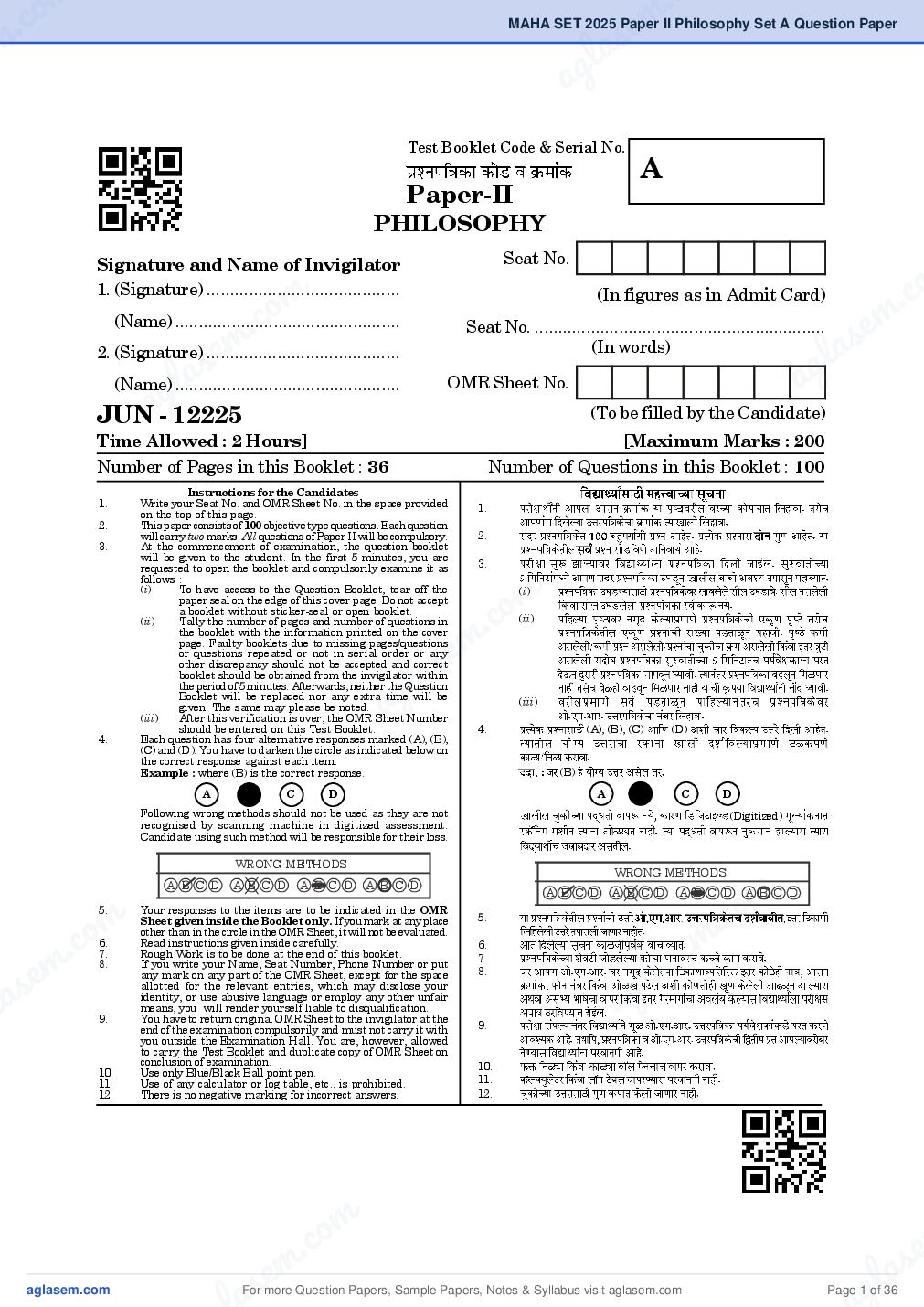
Test Booklet Code & Serial No.
A
Paper-II
PHILOSOPHY
Signature and Name of Invigilator Seat No.
m
1. (Signature) .........................................
. co
c. o
(In figures as in Admit Card)
(Name) ................................................
e m
em
Seat No. ..............................................................
(In words)
l as
la s
2. (Signature) .........................................
ag
g
(Name) ................................................
JUNa- 12225
OMR Sheet No.
(To be filled by the Candidate)
Time Allowed : 2 Hours] [Maximum Marks : 200
Number of Pages in this Booklet : 36 Number of Questions in this Booklet : 100
Instructions for the Candidates
1. Write your Seat No. and OMR Sheet No. in the space provided 1.
on the top of this page.
2. This paper consists of 100 objective type questions. Each question
will carry two marks. All questions of Paper II will be compulsory. 2.
3. At the commencement of examination, the question booklet
will be given to the student. In the first 5 minutes, you are
requested to open the booklet and compulsorily examine it as 3.
m
follows :
c. o
(i) To have access to the Question Booklet, tear off the (i)
paper seal on the edge of this cover page. Do not accept
a booklet without sticker-seal or open booklet.
(ii) Tally the number of pages and number of questions in (ii)
the booklet with the information printed on the cover
e m
s
page. Faulty booklets due to missing pages/questions
or questions repeated or not in serial order or any
l a
other discrepancy should not be accepted and correct
ag
booklet should be obtained from the invigilator within
the period of 5 minutes. Afterwards, neither the Question
Booklet will be replaced nor any extra time will be (iii)
given. The same may please be noted.
(iii) After this verification is over, the OMR Sheet Number
should be entered on this Test Booklet. 4. (A), (B), (C) (D)
4. Each question has four alternative responses marked (A), (B),
(C) and (D). You have to darken the circle as indicated below on
the correct response against each item.
Example : where (B) is the correct response. (B)
A C D A C D
Following wrong methods should not be used as they are not (Digitized)
recognised by scanning machine in digitized assessment.
Candidate using such method will be responsible for their loss.
CORRECT METHOD WRONG METHODS
CORRECT METHOD WRONG METHODS
C D A B C D A B C D A B C D A B C D
m
.co
C D A B C D A B C D A B C D A B C D
m
5. Your responses to the items are to be indicated in the OMR
.co
Sheet given inside the Booklet only. If you mark at any place 5.
other than in the circle in the OMR Sheet, it will not be evaluated.
e m
s
6. Read instructions given inside carefully. 6.
m la
7. Rough Work is to be done at the end of this booklet.
e
7.
8. If you write your Name, Seat Number, Phone Number or put
s
8.
g
any mark on any part of the OMR Sheet, except for the space
la a
allotted for the relevant entries, which may disclose your
identity, or use abusive language or employ any other unfair
means, you will render yourself liable to disqualification.
9. You have to return original OMR Sheet to the invigilator at the
end of the examination compulsorily and must not carry it with 9.
you outside the Examination Hall. You are, however, allowed
to carry the Test Booklet and duplicate copy of OMR Sheet on
conclusion of examination. 10.
10. Use only Blue/Black Ball point pen.
11. Use of any calculator or log table, etc., is prohibited. 11.
12. There is no negative marking for incorrect answers. 12.
m
.co s e
s em
For more Question Papers, Sample Papers, Notes & Syllabus visit
gl a
Page 1 of 36
Page 3
For more Question Papers, Sample Papers, Notes & Syllabus visit Page 2 of 36
Page 4
m .co s e m
l a
ag
Philosophy
Paper II
om . co
. c II
e m
em
Time Allowed : 120 Minutes] [Maximum Marks : 200
l as
l as
Note : This paper contains Hundred (100) multiple choice questions. Each question
carrying Two (2) marks. Attempt All questions.
ag
ag (100) (2)
1. Match the pairs : 1.
System of philosophy
(i) (i)
(ii)
(ii)
(iii) Advaita- Vedanta (iii)
(iv) Nyaya (iv)
The theory of Error accepted
m
by the system
c. o(a)
(a) Anirvacan iyakhyati
e m (b)
(b) Vipar itakhyati
l as (c)
ag
(c) Anyathakhyati (d)
(d) Akhyati
Choose the correct option : (i) (ii) (iii) (iv)
(i) (ii) (iii) (iv) (A) (d) (c) (b) (a)
(A) (d) (c) (b) (a) (B) (b) (d) (a) (c)
(B) (b) (d) (a) (c) (C) (a) (b) (d) (c)
(C) (a) (b) (d) (c) (D) (b) (a) (c) (d)
(D) (b) (a) (c) (d)
2. “By knowing one combination of 2.
clay, everything made of clay is
known. Name and form is just
m
.co
linguistic expression and a
m
.co
transformation. Clay is the truth”
This metaphor of clay is used for
e m
e m explaining Brahman as the material
las
las cause in the following Upanisad :
(A)
(A)
ag
(B)
(B) (C)
(C)
(D)
(D) Chandogya
3
m
.co s e
s em
For more Question Papers, Sample Papers, Notes & Syllabus visit
gl a
Page 3 of 36
Page 5
(A) Consciousness is identical with (A)
matter
(B)
(B) Only matter exists,
consciousness does not
(C)
(C) Consciousness emerges from
matter (D)
(D) Matter and consciousness
produce each other 4.
4. The correct order of the first four
links in the 12 linked chain of
Dependent Origination is : (A)
(A)
(B)
(B)
(C)
(C)
(D)
(D)
5.
5. The specific sense in which the term
karma is used in Jainism is :
(A) Volition, mental action (A)
(B) A sort of minute particle of (B)
matter
(C)
(C) Motion
(D) Action ejoined or prohibited by (D)
religious scriptures
4
For more Question Papers, Sample Papers, Notes & Syllabus visit Page 4 of 36
Page 6
m .co s e m
l a
ag
6. `
According to the Sankhya system in
6.
`
Sankhyakarika , the group of eleven
co
consisting of five sense organs, five
om .
motor organs and manas arises
. c
directly from :
e m
e m as a whole l as
l as
(A) Ahamkara
.
(B) Tamasa (Bhutadi) part of
(A)
ag
g
a Ahamkara
. (B)
(C) Rajasa (Taijasa) part of
(C)
Ahamkara
.
(D) Sattvika (Vaikrta)
. part of (D)
Ahamkara
. 7.
7. `
`Isvara according to the Yogasutra
~
m
c. o(A)
of Patanjali is the Purusa
, :
m
(A) Who possesses all good qualities
e
all
l s
and is the object of worship by
a (B)
ag the
(B) Who is identical with
(C)
individual souls of all beings
(C) Untouched by afflictions,
actions, their fruitions and (D)
latent impressions
(D) Omniscient and omnipotent 8.
creator of the world
m
.co
8. According to the early Nyaya
m
.co
definition of perception, perceptual
knowledge arises from the contact
e m
e m between :
(A)
las
las (A) Sense organ and object (B)
ag
(B) Self and object
(C)
(C) Mind and object
(D) Self and sense organ (D)
5
m
.co s e
s em
For more Question Papers, Sample Papers, Notes & Syllabus visit
gl a
Page 5 of 36
Page 7
, the relation 9.
called Samavaya does not obtain
between : (A)
(A) Substance and its qualities
(B)
(B) Two atoms of a substance
(C)
(C) Parts and whole
(D)
(D) Particulars and universals
10. According to 10.
Prabhakara -
Mimamsa . absence of a pot from the (A)
floor :
(A) Does not exist, only the empty (B)
floor exists
(B) Exists and can be known
through perception (C)
(C) Exists and can be known
through non-apprehension (D)
(D) Exists and can be known
through inference
11. Match the following and mark the 11.
correct code : I
List I (a)
(a) Theory of atoms (b)
(b) Change is unreal (c)
(c) Earth is cylindrical (d)
(d) Homo Mensura
II
List II
(i)
(i) Parmenides
(ii) Protagoras (ii)
(iii) Democritus (iii)
(iv) Anaximander (iv)
Codes :
(a) (b) (c) (d) (a) (b) (c) (d)
(A) (iii) (ii) (iv) (i) (A) (iii) (ii) (iv) (i)
(B) (iii) (i) (iv) (ii) (B) (iii) (i) (iv) (ii)
(C) (i) (iii) (ii) (iv) (C) (i) (iii) (ii) (iv)
(D) (iv) (ii) (iii) (i)
(D) (iv) (ii) (iii) (i)
6
For more Question Papers, Sample Papers, Notes & Syllabus visit Page 6 of 36
Page 8
m .co s e m
l a
ag
12. ....... said that “an unexamined life 12.
is not worth living”
om (A) . co
(A) Socrates
. c e m
em
(B) Aristotle (B)
l as
(C) l as (C) ag
a g Zeno
(D)
(D) Sophists
13.
13. Choose the correct code :
According to Plato parts of soul are :
(i) reason (i)
(ii) spirit (ii)
m
(iii) super-ego c. o(iii)
e m
(iv) appetite
l as (iv)
Codes :
(A) (i) (ii) (iii)
ag
(A) (i) (ii) (iii)
(B) (ii) (iii) (iv) (B) (ii) (iii) (iv)
(C) (i) (ii) (iv) (C) (i) (ii) (iv)
(D) (i) (iii) (iv) (D) (i) (iii) (iv)
14. Aristotle believed that there are ..... 14.
m
m levels of reality.
.co
m .co (A) Three (A)
s e m
s e g la
la a
(B) Four (B)
(C) Two (C)
(D) One (D)
7
m
.co s e
s em
For more Question Papers, Sample Papers, Notes & Syllabus visit
gl a
Page 7 of 36
Page 9
of the greater good.’ ‘Evil is a
privation’ of good ? These are the
view of :
(A)
(A) St. Anselm
(B)
(B) St. Augustine
(C) St. Aquinas (C)
(D) St. Paul (D)
16. In Descartes method of doubt, these 16.
are .......... steps.
(A) One (A)
(B) Three (B)
(C) Two
(C)
(D) Four
(D)
17. Being a real unit, each monad
contains : 17.
(A) The whole infinity of existence
(B) Physical characteristics (A)
(C) Mind as well as body (B)
(D) Many windows (C)
18. According to Hume, an example of (D)
a judgement concerning relations of 18.
ideas is ...............
(A) “The sun will rise tomorrow” (A)
(B) “All bachelers are unmarried” (B)
(C) “Real is rational and rational is (C)
real”
(D) “This flower is yellow” (D)
8
For more Question Papers, Sample Papers, Notes & Syllabus visit Page 8 of 36
Page 10
m .co s e m
l a
ag
19. Berkeley’s thesis concerning 19.
universals is : (A)
m
(A) Theory of ideas
. co
c. o
(B)
(B) Conceptualism
e m
e m (C)
l as
(D) l as
(C) Nominalism
(D)
ag
ag philosophical methodology is : 20.
Family rresemblance
20. Kant’s
(A)
(A) Analytic
(B)
(B) Scientific
(C)
(C) Practical
(D) Critical (D)
21. Match the pairs : 21.
m
List-I
m .co I
Purusarthas
s e
(a) Dharma
l a (a)
(b) Artha
ag (b)
(c) Kama (c)
(d) Moksa (d)
List-II II
Nature of the goal
(i) Material (i)
(ii) Spiritual (ii)
m
.co
(iii) Ethical (iii)
m (iv) Hedonistic
m .co (iv)
s e(d)m
la (iii)
(a) (b) (c) (d)
s e (a) (b)
g
(c)
la a (iv)
(A) (iv) (i) (ii) (iii) (A) (iv) (i) (ii)
(B) (i) (iii) (ii) (iv) (B) (i) (iii) (ii)
(C) (iii) (i) (iv) (ii) (C) (iii) (i) (iv) (ii)
(D) (iv) (i) (iii) (ii) (D) (iv) (i) (iii) (ii)
9
m
.co s e
s em
For more Question Papers, Sample Papers, Notes & Syllabus visit
gl a
Page 9 of 36
Page 11
22. The concept of Pancamahayajna 22.
includes : (A)
(A) mere study of scriptures
(B)
(B) mere offerings
(C)
(C) scriptural study and offerings
(D)
(D) devotion to the Abstract
23.
23. As stated in the Bhagavad g ita and
g itarahasya ,
Lokasamgraha is
possible : (A)
(A) only once in a lifetime (B)
(B) only after death (C)
(C) by meditation (D)
~
(D) and promoted even by Jnani
24.
24. Moksa , according to Carvakas, is
(A)
nothing but :
(A) Life as well as death (B)
(B) Death as well as freedom (C)
(C) Freedom as well as Bliss
(D)
(D) Death as well as birth
25.
25. The concept of ‘Sanyama’ in the
Yoga- sutras excludes :
(A) Dharana (A) Dharana
(B) Dhyana (B) Dhyana
(C) Samadhi (C) Samadhi
(D) Pratyahara (D) Pratyahara
10
For more Question Papers, Sample Papers, Notes & Syllabus visit Page 10 of 36
Page 12
m .co s e m
l a
ag
26. Yogasutras regard Samadhi as the 26.
co
pen-ultimate goal and the ultimate
goal is :
. c om e m .
e m (A)
l as
as
(A) Kaivalya
lMoksa ag
g
a
(B)
(B)
(C)
(C) Apavarga
(D) Nirvana (D)
27. As stated in the Dhammapada, for 27.
the sustenance of the society,
m
relationships cannot be based on : c. o(A)
e m
(A) Enmity
l as
ag
(B)
(B) Non-co-operation
(C)
(C) Anarchy
(D) Absurdity (D)
28. In Indian Philosophy, we find that 28.
the law of karma is rejected :
m
.co
(A)
m (A) Only by Carvakas
m .co (B)
s e m
s e (B) by no school whatsoever
g la
la (C) by all heterodox schools
(C) a
(D)
(D) only by atheistic schools
11
m
.co s e
s em
For more Question Papers, Sample Papers, Notes & Syllabus visit
gl a
Page 11 of 36
Page 13
Bhagavad- g ita , is carried on by :
(A) Brahma (A)
(B) Nirguna Brahman (B)
(C) Apurva (C)
(D) Lord
(D)
30. Which one is not included in
30.
Triratna ?
(A)
(A) Samyak Bhava
(B)
(B) Samyak Darshana
(C)
(C) Samyak Charitra
(D) Samyak Jnana (D)
31. In Kant’s moral philosophy, ......... is 31.
not a moral postulate.
(A) Freedom of will (A)
(B) Faith in the existence of devil (B)
(C) Imortality of soul (C)
(D) Faith in the existence of God (D)
32. Etymologically, the meaning of the 32.
term ‘right’ is ...........
(A) According to law (A)
(B) According to desire (B)
(C) Elder person’s advice (C)
(D) According to religious law (D)
12
For more Question Papers, Sample Papers, Notes & Syllabus visit Page 12 of 36
Page 14
m .co s e m
l a
ag
33. The study of ultimate objectives and 33.
outcome is ...........
co
(A)
(A) Deontology
. c om (B)
e m .
e m
(B) Business Ethics
l as
l as
(C) Teleology
(C)
ag
(D)g Naturalism
a (D)
34. According to Kant, there are ......... 34.
categorical imperatives.
(A)
(A) Two
(B)
(B) Three
(C)
(C) Four
(D) Six
m (D)
c. o
35. “The ethical theory connot account 35.
for the fact and disagreement in em
l as
ag
ethics” is ..............
(A)
(A) Super-naturalism
(B)
(B) Objectivism
(C) Non-naturalism (C)
(D) Subjectivism (D)
36. Those offences against society which 36.
are recognised by national law, and
m
.co
which are liable to punishment are
m known as .............
m .co s e m
e la
(A) Crime (A)
las (B) Sin (B) ag
(C) Misbehaviour (C)
(D) Non-moral actions (D)
13
m
.co s e
s em
For more Question Papers, Sample Papers, Notes & Syllabus visit
gl a
Page 13 of 36
Page 15
maintains the view that pleasure is
the ultimate good ?
(A)
(A) Hedonism
(B)
(B) Deontological theories
(C)
(C) Eudamonia ethics
(D)
(D) Emotivism
38. Whom according to the following 38.
philosophers, man should carry out
activities yielding the maximum
pleasure, without making
qualitative distinction ? (A)
(A) Mill (B)
(B) Spencer
(C)
(C) Bentham
(D) Kant (D)
39. Ethical subjectivism is .......... 39.
(A) A cognitivist theory (A)
(B)
(B) A non-cognitivist theory
(C)
(C) A kind of emotivism
(D)
(D) Prescriptivism
40. The term “metaethics” was coined 40.
by :
(A) Moore (A)
(B) Russell (B)
(C) Ayer (C)
(D) Wittgenstein (D)
14
For more Question Papers, Sample Papers, Notes & Syllabus visit Page 14 of 36
Page 16
m .co s e m
l a
ag
41. The universal religion, according to 41.
Swami Vivekananda, is attained by
what is called :
(A) Dharma co
m (A) . co
. e m
(B) N it ie m (B)
l as
(C) l as ag
ag Samnyasa
Yoga (C)
(D)
(D)
42. Life is joy, according to Tagore,
42.
because of :
(A) Brahman
(A)
(B) Finite-infinite
(B)
(C) J ivana-devata (C)
(D) God
o m
. c (D)
43. “Love, sacrifice,
m
sincerity, 43.
e
spontaneity and innocence
as
constitute religious life” l is
maintained not onlyag by (A)
J. Krishnamurti but also by :
(A) K. C. Bhattacharya (B)
(B) Rabindranath Tagore (C)
(C) S. Radhakrishnan
(D)
(D) Mahatma Gandhi
44.
44. Intuition is not the property of
m
m intellect, as maintained by Iqbal, but
.co
m .co of the : (A)
s e m
s e (A) Head
g la
la
(B)
(B) Soul
(C)
a
(C) Heart
(D) Complete system (D)
15
m
.co s e
s em
For more Question Papers, Sample Papers, Notes & Syllabus visit
gl a
Page 15 of 36
Page 17
ultimate human destiny is :
(A) Universal redemption (A)
(B) Individual redemption (B)
(C) Unintelligible (C)
(D) Incorrigible (D)
46. Match the pairs : 46.
List-I
(a) Mahatma Gandhi (a)
(b) K.C. Bhattacharya (b)
(c) S. Radhakrishnan (c)
(d) J. Krishnamurti (d)
List-II
(i) Swaraj in ideas (i)
(ii) Hind-Swaraj
(ii)
(iii) Freedom from the known
(iii)
(iv) Idealist view of life
(iv)
(a) (b) (c) (d)
(a) (b) (c) (d)
(A) (ii) (iv) (iii) (i)
(A) (ii) (iv) (iii) (i)
(B) (iv) (i) (ii) (iii)
(B) (iv) (i) (ii) (iii)
(C) (ii) (i) (iv) (iii)
(C) (ii) (i) (iv) (iii)
(D) (ii) (iv) (i) (iii)
(D) (ii) (iv) (i) (iii)
16
For more Question Papers, Sample Papers, Notes & Syllabus visit Page 16 of 36
Page 18
m .co s e m
l a
ag
47. “One caste, one Religion, One God 47.
for human being”. This principle
om . co
. c
was recommended by :
(A)
e m
em
(A) Dr. Ambedkar
l as
as ag
(B)gl
(B)
Pt. Deendayal Upadhyaya
a (C)
(C) Sree Narayan Guru
(D) Mahatma Gandhi (D)
48. According to Gandhi : 48.
(A) Ahimsa is the means and Truth
(A)
is the end m
c. o(B)
(B) Ahimsa is the end and Truth
e m
is the means
l as
ag are
(C) Ahimsa and Truth, both
(C)
means to a higher goal
(D) Ahimsa and Truth, both are
(D)
ends in themselves
49. The principle of Pandit Deendayal 49.
m
m Upadhyaya is recognized as :
.co
m .co (A) Ekatma Manav Darshan (A)
s e m
s e g la
la
(B)
(B) Ekatma Rashtra Darshan
a
(C) Ekatma Vedanta Darshan (C)
(D) Ekatma Bharatiya Darshan (D)
17
m
.co s e
s em
For more Question Papers, Sample Papers, Notes & Syllabus visit
gl a
Page 17 of 36
Page 19
biographer, noted him as the father
of :
(A)
(A) Religious revolution
(B)
(B) Indian social revolution
(C) Indian educational revolution (C)
(D) Indian economic revolution (D)
51. In Russell’s metaphysics, material 51.
objects are :
(A) Ideas (A)
(B) Illusion (B)
(C) Constructed (C)
(D) Not constructed (D)
52. In Wittgenstein’s Tractatus, simple 52.
objects are :
(A) Non-existing entities (A)
(B) Existing entities (B)
(C) Abstract entities (C)
(D) Linguistic entities (D)
53. According to Later Wittgenstein, the
53.
task of logical analysis is :
(A) To describe the world
(B) To discover elementary (A)
proposition
(B)
(C) To re-construct the logical
structure of language (C)
(D) To look at the grammatical
forms of language (D)
18
For more Question Papers, Sample Papers, Notes & Syllabus visit Page 18 of 36
Page 20
m .co s e m
l a
ag
54. According to Ryle, the error 54.
regarding categories can be avoided
by identifying the :
(A) Difference o
m . co
. c in linguistic form of (A)
e m
m
e in logical form of
expressions
l as
as
lexpressions
(B) Difference (B)
ag
ag (C)
(C) Difference in the meaning of
expressions (D)
(D) Mistake in the application of
syntactical rules
55. Moore uses the phrase ‘things which 55.
are to be met with in space’ :
m
(A) To defend the philosophy of
m .co
common sense
s e (A)
(B) To refute idealism
l a
ag
(B)
(C) To prove an external world
(C)
(D) To explain the distinction
between sense and reference (D)
56. According to Husserl, the task of 56.
Phenomenology is :
(A)
(A) To describe facts
m
.co
(B) To analyze presuppositions of (B)
m
m .co knowledge
(C)
s e m
s e (C) To intuit the relation between
g la
la object the intentional act
(D)
a
(D) To explain how object is
constituted in knowing act
19
m
.co s e
s em
For more Question Papers, Sample Papers, Notes & Syllabus visit
gl a
Page 19 of 36
Page 21
Christianity turns out to be :
(A) Unreasonable life of faith (A)
(B) Rational way of life
(B)
(C) Truly ethical way of life
(C)
(D) Reasonable life of faith
58. Merleau Ponty’s phenomenology is (D)
an attempt : 58.
(A) To explore the basic structure
of pre-given world
(A)
(B) To explore the basic structure
of world of sense-data (B)
(C) To explore the basic structure
of world accessed in privileged (C)
way
(D) To explore the basic structure
(D)
of world accessed in objective
way
59. According to William James, 59.
religious beliefs are justified because
they are :
(A)
(A) Grounded in experience and are
verifiable (B)
(B) Grounded in experience but are
not verifiable
(C)
(C) Grounded in reason and can be
deduced from the belief in God
(D) Grounded in reason but cannot (D)
be deduced from the belief in
God
20
For more Question Papers, Sample Papers, Notes & Syllabus visit Page 20 of 36
Page 22
m .co s e m
l a
ag
60. Who among the following said that 60.
co
‘Nothing counts as justification
m .
c. o to what we
unless by reference
s e m
s em ?
already accept’
g l a
(A)gl
a (A)
a
a William James
(B)
(B) Richard Rorty
(C)
(C) Frederick Nietzsche
(D)
(D) Immanuel Levinas
61.
61. The component principles of Foreign
m
policy, according to Kautilya are :
c. o(A)
e m
(A) Five
l as
ag
(B) Six (B)
(C) Two (C)
(D) One (D)
62. According to Kautilya, the factor 62.
regarded as most important in the
m
.co
structure of state.
m (A) Kosa
.co
(A)
e m
e m (B)
las
las (B) Guru
ag
(C) Swami (C)
(D) Bhumi (D)
21
m
.co s e
s em
For more Question Papers, Sample Papers, Notes & Syllabus visit
gl a
Page 21 of 36
Page 23
emphasizes upon :
(A)
(A) economic equality
(B)
(B) equal opportunity
(C)
(C) welfare of all
(D) social equality (D)
64. The number of administrative 64.
departments according to Kautilya
are :
(A)
(A) Seven
(B)
(B) Eight
(C) Nine (C)
(D) Ten (D)
65. Which of the following statements
65.
is true with reference to Gandhi’s
understanding of swadeshi ?
(A)
(A) Swadeshi is swadharma applied
to one’s immediate environment
(B) Swadeshi and satyagraha are (B)
not linked together
(C) Swadeshi and ahimsa are not
(C)
linked together
(D) The law of swadeshi is not
natural, it must be cultivated (D)
with perseverance
22
For more Question Papers, Sample Papers, Notes & Syllabus visit Page 22 of 36
Page 24
m .co s e m
l a
ag
66. The punishment for the offence, 66.
according to Kautilya, should be :
(A) Tikshna
om
(A)
. co
(B) Mrudu
. c (B)
e m
e m (C)
l as
(D) l as
(C) Yatharha
ag
g Avyakhyeya
a of the following is not
67. Which 67.
(D)
characteristic of a Satyagrahi
according to Gandhi ?
(A)
(A) a satyagrahi does not inflict
pain on the adversary
(B)
(B) a satyagrahi does not seek the
destruction of the adversary
m
(C) a satyagrahi may resort to c. o(C)
e m
firearms only to deter the
l as
ag
adversary
(D) a satyagrahi does not renounce (D)
truth even unto death
68. According to Bhishma, the
68.
important things in the life of an
individual are :
(A) First king, then wife and lastly
property
m
.co
(A)
m
.co
(B) First property, then wife and
e m
e m
lastly king (B)
las
las (C) First wife, then property and
lastly king (C) ag
(D) First king, then property and
(D)
lastly wife
23
m
.co s e
s em
For more Question Papers, Sample Papers, Notes & Syllabus visit
gl a
Page 23 of 36
Page 25
among the dharmas is :
(A)
(A) Nitidharma
(B)
(B) Brahmanadharma
(C)
(C) Rajadharma
(D)
(D) Mokshadharma
70. According to Kamandaka : 70.
(A) Both king and state are (A)
protected by God
(B)
(B) King is responsible for the
security of the state (C)
(C) King is responsible for the
stability of state (D)
(D) King is responsible for security
and stability of the state
71.
71. According to Will Kymlicka, one of
the most pressing global issues of
constitutional design concerns the
status and treatment of :
(A) Ethnocultural minorities (A)
(B) Women and people of other
(B)
gender
(C)
(C) People of lower races and castes
(D) Jews (D)
24
For more Question Papers, Sample Papers, Notes & Syllabus visit Page 24 of 36
Page 26
m .co s e m
l a
ag
72. Radical Feminism holds that men as 72.
co
group dominate women through :
m .
c. o
(A) Patriarchy
(A)
s e m
s em
(B) Masculinity
g l a
g a
lMale
(B)
a
a
(C) violence and power (C)
(D) Patriarchal codes of state (D)
73. Rousseau calls the public person, so 73.
formed by the union of all other
persons as : (A)
m
(A) Contractual society
c. o(B)
e m
(B) Republic state
l as
ag
(C)
(C) Sovereign state
(D) Body politic (D)
74. Charles Taylor argues that the 74.
development of the modern notion
of identity has given rise to a politics
m
.co
of :
m (A) Recognition (A)
m .co s e m
s e (B)
g la
la
(B) Difference
(C)
a
(C) Reconciliation
(D) Emotionalism (D)
25
m
.co s e
s em
For more Question Papers, Sample Papers, Notes & Syllabus visit
gl a
Page 25 of 36
Page 27
of justice is based in .......... principles.
(A) End result (A)
(B) End state (B)
(C) Historical (C)
(D) Unhistorical (D)
76. Marx envisions a communist society 76.
as one where human beings will be
undistorted by :
(A) Only possessiveness (A)
(B) Only Acquisitiveness (B)
(C) Possessiveness and Acquisitiveness (C)
(D) Exchange (D)
77. Denise Thompson is of the view that 77.
the characterization of feminism into
liberal, socialist, radical etc.
disguises the relations of :
(A) Society (A)
(B) Men vs women (B)
(C) Matriarchy (C)
(D) Power involved (D)
26
For more Question Papers, Sample Papers, Notes & Syllabus visit Page 26 of 36
Page 28
m .co s e m
l a
ag
78. In the Universalism vs 78.
om
particularism debate, MacIntyre
. co
. c e m
e m
attempts to steer clear from the
l as
l as
charge of : ag
ag (A)
(A) Theologism
(B)
(B) Nihilism
(C)
(C) Absolutism
(D)
(D) Relativism
m
. co
79. Amartya Sen argues that the 79.
e m
l as
g
capability approach does not propose
a
any specific formula and merely
points to ............ in judging and
comparing overall individual
advantages. (A)
m
m (A) Actual opportunity
.co
.co m
(B)
m s e
s e (B) Informational focus
g la
la (C) Ends
(C)
a
(D)
(D) Justice
27
m
.co s e
s em
For more Question Papers, Sample Papers, Notes & Syllabus visit
gl a
Page 27 of 36
Page 29
(A) Bourgeois society
(A)
(B) Middle class society
(B)
(C) Asiatic society
(C)
(D) Industrial society (D)
81. An argument in which the 81.
conclusion follows necessary from the
premises is a ............
(A)
(A) Valid deductive argument
(B)
(B) Invalid deductive argument
(C) Inductive argument (C)
(D) Simple enumeration (D)
82. Which of the following is incorrect 82.
with reference to the law of
indentity ?
(A) P P (A) P P
(B) Everything is modification of
(B)
itself
(C) Everything is what it is (C)
(D) Everything is identical with (D)
itself
28
For more Question Papers, Sample Papers, Notes & Syllabus visit Page 28 of 36
Page 30
m .co s e m
l a
ag
83. A proposition that does not contain 83.
any other proposition as a
co
component, is called :
. c om
(A) Simple proposition (A)
e m .
m
(B) Compound proposition
e
(B)
l as
as
(C) Complex proposition
l
(C)
ag
ag
(D) Complicate proposition
84. If ‘I’ proposition is false, the truth
(D)
84. ‘I’ ‘A’, ‘E’
value of ‘A’, ‘E’ and ‘O’ propositions
are respectively : ‘O’
(A) T, F, T (A) T, F, T
(B) F, F, T (B) F, F, T
(C) F, T, T (C) F, T, T
(D) T, T, F (D) T, T, F
m
.co
85. Which of the codes given below
85.
contains only the correct statements ?
e m
(i) Venn diagram is a method of
testing the validity of
l as (i)
categorical syllogism
(ii) Venn diagram is not a method
ag
(ii)
of testing the invalidity of
categorical syllogism
(iii)
(iii) In Venn diagram method the
three overlapping circles are
drawn to represent two premises
and a conclusion (iv) ‘S’, ‘P’, ‘M’
m
.co
(iv) The three circle are label as S,
m
.co
P, M
e m
m
Codes :
s
e gla
(A) (i), (ii), (iii)
las (A) (i), (ii), (iii)
(B) (i), (iii), (iv) (B) (i), (iii),a(iv)
(C) (i), (ii), (iv) (C) (i), (ii), (iv)
(D) (ii), (iii), (iv) (D) (ii), (iii), (iv)
29
m
.co s e
s em
For more Question Papers, Sample Papers, Notes & Syllabus visit
gl a
Page 29 of 36
Page 31
the following argument :
(p q) . (r s)
(p q) . (r s)
p r
p r
q r
q r
(A)
(A) Conjunction
(B) Disjunctive Syllogism (B)
(C) Addition (C)
(D) Constructive Dilemma (D)
87. Which of the following is a
87.
Tautology ?
(A) [(r s) . (s t)] (r t)
(A) [(r s) . (s t)] (r t)
(B) [(r . s) . (s . t)] (r t)
(B) [(r . s) . (s . t)] (r t)
(C) [(p q) . q] p (C) [(p q) . q] p
(D) (p q) (~ p ~ q) (D) (p q) (~ p ~ q)
88. A method of obtaining propositions 88.
from propositional functions is/are :
(A) Generalization and enumeration
(A)
(B) Instantiation only
(B)
(C) Enumeration only
(C)
(D) Both Generalization and
Instantiation (D)
30
For more Question Papers, Sample Papers, Notes & Syllabus visit Page 30 of 36
Page 32
m .co s e m
l a
ag
89. Identify the fallacy committed in the
89.
om
following argument :
. co
. c e m
e m
“If Hume is an atheist, then Spinoza
l as
l as
is an atheist also. Spinoza is an ag
ag
atheist. Therefore, Hume is also an
atheist.”
(A) Fallacy of composition (A)
(B) Fallacy of Affirming the
m(B)
concequent
c. o
e m
(C) Fallacy of Denying
l as
the
(C)
antecedent
ag
(D) Fallacy of Division (D)
90. Correct symbolization of the 90.
following statement is ..........
(Cx, Vx)
“Only citizens are voters”. (Cx, Vx)
m
.co
(A) (X) (Cx Vx)
m (A) (X) (Cx Vx)
m .co (B) (X) (Cx . Vx)
s e m
s e (B) (X) (Cx . Vx)
g l a
la (C) (x) (Cx . Vx) a . Vx)
(C) (x) (Cx
(D) (X) (Vx Cx) (D) (X) (Vx Cx)
31
m
.co s e
s em
For more Question Papers, Sample Papers, Notes & Syllabus visit
gl a
Page 31 of 36
Page 33
best reason against ethical theories
and for the need of applied ethics ?
(A) Theoretical ethics is inadequate
to solve problems of day-to-day (A)
life
(B) Theoretical ethics depends on
how well one can know (B)
universal moral laws
(C) Theoretical ethics is highly
abstract, reductionist and (C)
deductive in nature
(D) Theoretical ethics is ambiguous (D)
92. Ethical dilemmas arise in the use 92.
of technologies primarily because :
(A) Technologies are useful to
(A)
humans
(B) Technologies are value neutral (B)
(C) The way in which technologies (C)
are used may be ethically
problematic
(D) Technologies shape our (D)
understanding of the world
32
For more Question Papers, Sample Papers, Notes & Syllabus visit Page 32 of 36
Page 34
m .co s e m
l a
ag
93. The ethics of Information 93.
co
Technology comprises of :
m .
(A) the studyc. o of methods of (A)
s e m
s em information
generating
g l a
la
(B)g the study of issues arising out
a
a (B)
of the use of information and
development of electronic
technologies
(C) the study of who has right to (C)
m
.co
information
(D) the study of who has right to e m (D)
s
technology of information la
ag
94. Is it morally acceptable for a 94.
physician to do things to a patient
for their benefit without their
informed consent ? This question
represents the issue of :
m
m (A) confidentiality (A)
.co
m .co s e m
s e (B) honesty
(B)
g la
la (C) deceit (C) a
(D) paternalism (D)
33
m
.co s e
s em
For more Question Papers, Sample Papers, Notes & Syllabus visit
gl a
Page 33 of 36
Page 35
thought holds that it is particular
cases and decisions about particular
cases that are foundational for
bioethics rather than principles ?
(A)
(A) Casuistry
(B)
(B) Feminist ethics
(C)
(C) Virtue ethics
(D)
(D) Deontology
96. One of the premises in an argument 96.
against euthanasia is :
(A) deliberate killing is always (A)
wrong
(B) deliberate killing of innocent (B)
persons is always wrong
(C) killing is always wrong
(C)
(D) deliberate killing is not always
(D)
wrong
97. The belief that human beings should
97.
look after the world as guardians,
in the way God wants them to is
known as :
(A) Biocentrism (A)
(B) Ecocentrism (B)
(C) Anthropocentrism (C)
(D) Theocentrism (D)
34
For more Question Papers, Sample Papers, Notes & Syllabus visit Page 34 of 36
Page 36
m .co s e m
l a
ag
98. The value that something has for 98.
what it is, independent of whether
om . co
anyone values it or not is known
. c e m
as :
e m (A)
l as
l as
(A) Intrinsic value ag
g
a Instrumental value
(B)
(B)
(C)
(C) Subjective value
(D) Aesthetic value (D)
99. What ethical principle is violated 99.
when an organization fails to secure
m
.co
and protect individuals personal
information ?
e m
(A) Autonomy
l as (A)
(B) Confidentiality ag (B)
(C)
(C) Freedom
(D) Non-maleficence (D)
100. One of the most systematized 100.
modalities of philosophical counseling
m
.co
is :
m (A) Existential therapy (A)
m .co s e m
s e (B) Logic-based therapy (B)
g la
la (C) Rational emotive behavior
(C)
a
therapy
(D) Cognitive behavior therapy (D)
35
m
.co s e
s em
For more Question Papers, Sample Papers, Notes & Syllabus visit
gl a
Page 35 of 36
Page 37
36
For more Question Papers, Sample Papers, Notes & Syllabus visit Page 36 of 36
Document Details
| Board / Org | Maharashtra Exams |
| Exam | MAHA SET |
| Type | Question Paper |
| Pages | 36 |
| Updated | 17 Nov 2026 |