Karnataka 2nd PUC Physics Magnetism and Matter MCQ with Answers
Finished viewing? Save it for later —
Download Karnataka 2nd PUC Physics Magnetism and Matter MCQ with Answers (PDF · 13 pages)About Karnataka 2nd PUC Physics Magnetism and Matter MCQ with Answers
Karnataka 2nd PUC Physics Magnetism and Matter MCQ with Answers is available here for free download. Published by Karnataka Board for Class 12, this question bank can be viewed online or downloaded as a PDF (13 pages). Candidates preparing for Class 12 can use Karnataka 2nd PUC Physics Magnetism and Matter MCQ with Answers to understand the exam pattern, the type of questions asked, and the overall difficulty level.
Frequently Asked Questions
How can I download Karnataka 2nd PUC Physics Magnetism and Matter MCQ with Answers?
Open this page and click the Download button to save Karnataka 2nd PUC Physics Magnetism and Matter MCQ with Answers as a PDF. It is completely free on AglaSem Docs.
Is Karnataka 2nd PUC Physics Magnetism and Matter MCQ with Answers free to download?
Yes. Karnataka 2nd PUC Physics Magnetism and Matter MCQ with Answers can be viewed online and downloaded as a PDF free of cost on AglaSem Docs.
How many pages does Karnataka 2nd PUC Physics Magnetism and Matter MCQ with Answers have?
Karnataka 2nd PUC Physics Magnetism and Matter MCQ with Answers contains 13 pages, which you can read online or download together as a single PDF.
Where can I find more Class 12 study material?
You can find more Class 12 question papers, sample papers, syllabus, and answer keys on AglaSem Docs.
Karnataka 2nd PUC Physics Magnetism and Matter MCQ with Answers – Text
Read the full text of this question bank below — useful to quickly search, copy and reference the content online without downloading the PDF.
📄 View text version (13 pages)
Page 1
DEPARTMENT OF SCHOOL EDUCATION (PRE-UNIVERSITY)
18TH CROSS, MALLESHWARAM, BENGALURU – 560 012
CHAPTER-WISE MULTIPLE-CHOICE QUESTIONS FOR COMPETITIVE EXAM
SUBJECT: PHYSICS - II PUC
NAME OF THE CHAPTER: MAGNETISM AND MATTER
SYNOPSIS
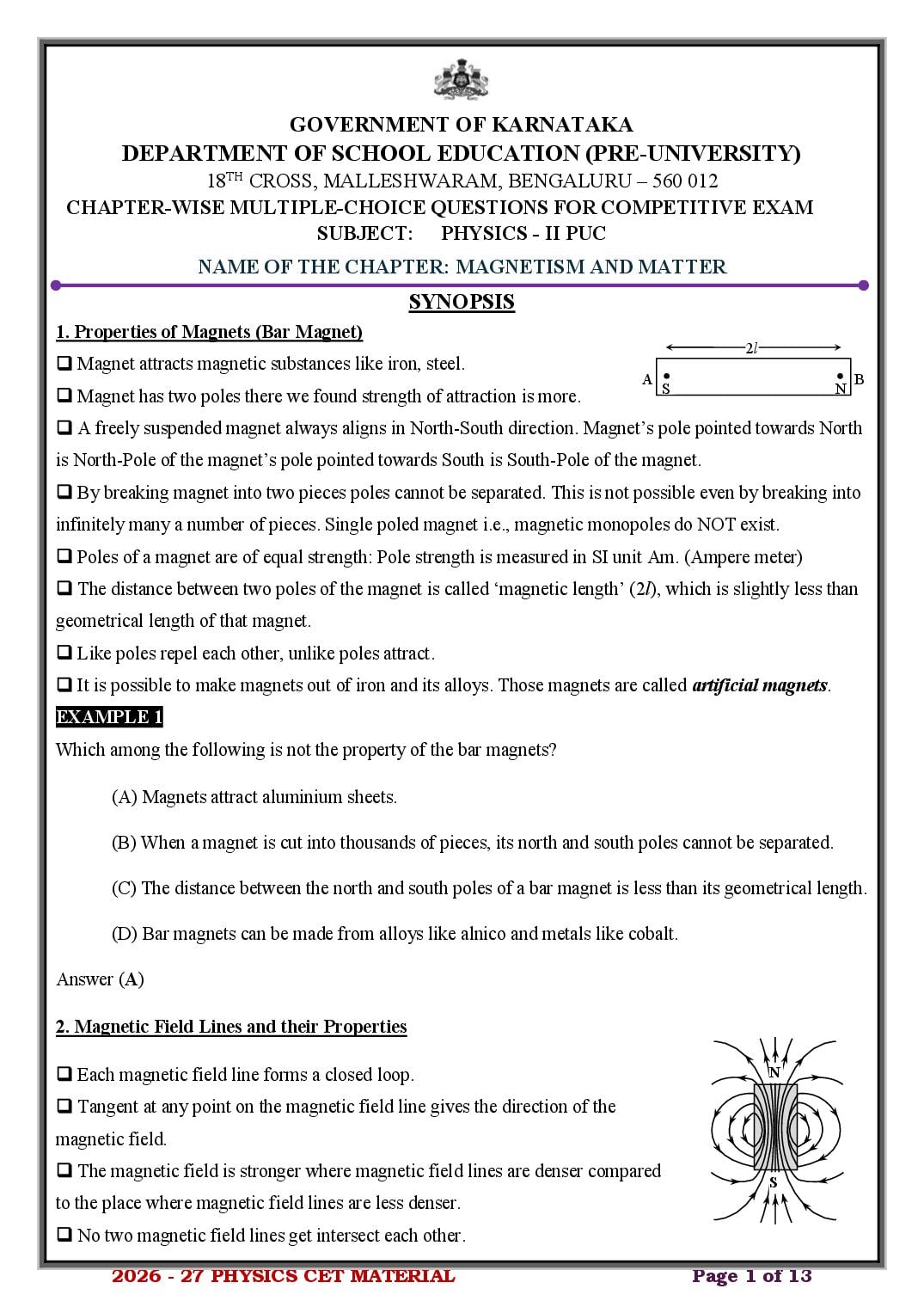
1. Properties of Magnets (Bar Magnet)
2l
❑ Magnet attracts magnetic substances like iron, steel.
A B
S N
❑ Magnet has two poles there we found strength of attraction is more.
❑ A freely suspended magnet always aligns in North-South direction. Magnet’s pole pointed towards North
is North-Pole of the magnet’s pole pointed towards South is South-Pole of the magnet.
❑ By breaking magnet into two pieces poles cannot be separated. This is not possible even by breaking into
infinitely many a number of pieces. Single poled magnet i.e., magnetic monopoles do NOT exist.
❑ Poles of a magnet are of equal strength: Pole strength is measured in SI unit Am. (Ampere meter)
❑ The distance between two poles of the magnet is called ‘magnetic length’ (2l), which is slightly less than
geometrical length of that magnet.
❑ Like poles repel each other, unlike poles attract.
❑ It is possible to make magnets out of iron and its alloys. Those magnets are called artificial magnets.
EXAMPLE 1
Which among the following is not the property of the bar magnets?
(A) Magnets attract aluminium sheets.
(B) When a magnet is cut into thousands of pieces, its north and south poles cannot be separated.
(C) The distance between the north and south poles of a bar magnet is less than its geometrical length.
(D) Bar magnets can be made from alloys like alnico and metals like cobalt.
Answer (A)
2. Magnetic Field Lines and their Properties
❑ Each magnetic field line forms a closed loop. N
❑ Tangent at any point on the magnetic field line gives the direction of the
magnetic field.
❑ The magnetic field is stronger where magnetic field lines are denser compared
S
to the place where magnetic field lines are less denser.
❑ No two magnetic field lines get intersect each other.
2026 - 27 PHYSICS CET MATERIAL Page 1 of 13
Page 2
Among the four points indicated in the following diagram, at which point is the •B
magnetic field strength greatest?
•D •A •C
(A) A (B) B (C) C (D) D
Answer (D)
Example Solved:
The magnetic field is stronger where magnetic field lines are denser compared to the place where magnetic
field lines are less denser. Hence at D, the magnetic field lines are densest and thus the magenetic field must
be greatest there.
3. Bar Magnet as an Equivalent Solenoid:
❑ A bar magnet has the same configuration of magnetic field N N
lines as an thin and long solenoid carrying certain current as
shown in the figure.
❑ If 𝑚
⃗⃗ is the magnetic dipole moment of the solenoid an axial S S
distance of x from its center, then for x >> length of the
Bar Magnet Solenoid
⃗⃗⃗
𝝁𝒐 𝟐𝒎
solenoid, its magnetic field at that point is ⃗𝑩
⃗ =
𝟒𝝅 𝒓𝟑
⃗⃗ is the magnetic dipole moment of the bar magnet its magnetic field at a point a distance of x away
❑ If 𝑀
⃗⃗⃗
from its center along its axis is ⃗ = 𝝁𝒐 𝟐𝑴
⃗𝑩 𝟑
𝟒𝝅 𝒓
❑ This is because, a bar magnet is equivalent to a current carrying solenoid.
EXAMPLE 3
If M is the magnitude of the magnetic dipole moment of the bar magnet and d is the separation between its
poles, then the pole strength of the magnet (or the magnetic charge) is
(A) M/d (B) M/2d (C) 2M/d (D) d/2M
Answer (A)
Example Solved:
By the analogy of the electric dipole moment : M = Qm d Qm = M/d
4. Torque on and Potential Energy of a Magnetic Dipole in a Uniform Magnetic Field
❑ If 𝑚
⃗⃗ is the magnetic dipole moment of the bar magnet (or magnetic needle)
→
m
⃗ as shown, then the torque acting on it is
in a uniform external magnetic field 𝐵
N
⃗ =𝒎
𝝉 ⃗⃗
⃗⃗⃗ × 𝑩 →
→ B
whose magnitude is 𝝉 = 𝒎𝑩 𝒔𝒊𝒏 𝜽 S
where 𝜃 is smaller angle between 𝑚 ⃗.
⃗⃗ and 𝐵
2026 - 27 PHYSICS CET MATERIAL Page 2 of 13
Page 3
⃗⃗ is the magnetic dipole moment of the bar magnet (or magnetic needle) in a uniform external
⃗ as shown, then the potential energy of the dipole in it is
magnetic field 𝐵
⃗⃗⃗ ∘ ⃗𝑩
𝑼 = −𝒎 ⃗ = −𝒎𝑩 𝒄𝒐𝒔 𝜽
EXAMPLE 4
A magnetic dipole placed in a uniform external magnetic field at an angular position experiences a torque
and possesses a potential energy of magnitude of U. Then the ratio of U to is
(A) sec (B) cosec (C) tan (D) cot
Answer (D)
Example Solved:
The torque acting on the dipole is : = mB sin
The PE of the dipole in the same angular position is : U = mB cos
𝑈 𝑚𝐵 𝑐𝑜𝑠 𝜃
Hence the required ratio is : = = 𝑐𝑜𝑡 𝜃
𝜏 𝑚𝐵 𝑠𝑖𝑛 𝜃
❑ If 𝑚
⃗⃗ is the magnetic dipole moment of the bar magnet (or magnetic needle) in a uniform external
⃗ as shown, then for small angle oscillation, its period of oscillation is
magnetic field 𝐵
𝑰
→
m
𝑻 = 𝟐𝝅√ →
𝒎𝑩
N B
where I is the moment of inertia of the bar magnet about its pivot point as S
shown.
EXAMPLE 5
The frequency of oscillation of a magnetic needle pivoted about its centre of mass and having magnetic
dipole moment M in a uniform magnetic field of strength B is . The moment of inertia of the needle about
its pivot point is
4𝜋2 𝑚𝐵 𝑚𝐵 𝑚𝐵
(A) (B) 4𝜋 2 𝜈 2 𝑚𝐵 (C) (D)
𝜈2 4𝜋2 𝜈 2 2𝜋𝜈
Answer (C)
Example Solved:
𝐼
The period of oscillation of the magnetic needle is : 𝑇 = 2𝜋√
𝑚𝐵
Hence the frequency of oscillation of the magnetic needle is
1 1 𝑚𝐵 1 𝑚𝐵 𝑚𝐵
:𝜈= = √ ⇒ 𝜈2 = ⇒𝐼=
𝑇 2𝜋 𝐼 4𝜋2 𝐼 4𝜋2 𝜈 2
2026 - 27 PHYSICS CET MATERIAL Page 3 of 13
Page 4
❑ The total magnetic flux through a closed surface is always zero!
𝜱𝑩 = ∑ ⃗𝑩 ⃗ = 𝟎 ⇔ 𝜱𝑩 = ∮ ⃗𝑩
⃗ ∘ 𝜟𝑺 ⃗ =𝟎
⃗ ∘ 𝒅𝑺
❑ This means that for every one magnetic field line entering this closed surface
there is in one exiting it!
❑ Which means that magnetic monopoles do not exist! Magnetic flux
through this closed
EXAMPLE 6 surface is zero
Gauss’ law for magnetism suggests
(A) the net charge in any given volume is non zero.
(B) that the line integral of a magnetic field around any closed loop must be zero.
(C) the magnetic field of a current element is directly proportional to the strength of the current.
(D) that every magnetic field line that exits a closed surface must enter it at some point on it.
Answer (D)
6. Magnetisation (M) and Intensity of Magnetisation (H), Magnetic Susceptibility () and Magnetic
Permeability ()
❑ The magnetisation (M) is defined as the magnetic moment developed per unit volume of the material.
𝑡𝑜𝑡𝑎𝑙 𝑚𝑎𝑔𝑛𝑒𝑡𝑖𝑐 𝑑𝑖𝑝𝑜𝑙𝑒 𝑚𝑜𝑚𝑒𝑛𝑡 ∑ ⃗𝒎
⃗⃗
⃗𝑴
⃗⃗ = =
𝑇𝑜𝑡𝑎𝑙 𝑣𝑜𝑙𝑢𝑚𝑒 𝑽
❑ Magnetic intensity (H) is defined as the ratio of magnetic field to the permeability of free space.
⃗𝑩
⃗
⃗𝑯
⃗⃗ =
𝝁𝒐
❑ Magnetic susceptibility of a material is defined as the ratio of the magnetisation (M) to the intensity of
𝑴
magnetizing field (H). 𝝌=
𝑯
❑ Magnetic permeability is defined as the ratio of the magnetic flux density (B) to the intensity of
𝑩
magnetising field (H) 𝝁=
𝑯
EXAMPLE 7\
If B0 is the magnetic field in the interior of an air filled solenoid and M is the magnetisation produced when
a soft iron core is inserted into it, the total magnetic field inside it is
(A) B0 + M (B) B0 − M (C) B0 − 0M (D) B0 + 0M
Answer (D)
2026 - 27 PHYSICS CET MATERIAL Page 4 of 13
Page 5
❑ Diamagnetic materials: The materials which are weakly magnetised in the direction opposite to the
direction of applied magnetic field are known as diamagnetic materials.
Examples: Gold, silver, copper, zinc, lead, air, water, bismuth, mercury, diamond, glass, silicon, helium,
sodium, nitrogen (at STP), glass, quartz, alcohol, argon, hydrogen, etc
❑ Meissner Effect: The phenomenon of excluding magnetic field from interior of superconductor during its
transition to the superconducting state is called the Meissner Effect.
❑ Paramagnetic materials: The materials which are feebly magnetised in the direction of applied magnetic
field are known as paramagnetic materials.
Examples: Aluminium, chromium, manganese, platinum, calcium, antimony, magnesium, tungsten,
sodium, oxgen, (at STP), chloride, etc
Temperature Dependence of Paramagnetism
❑ The paramagnetic susceptibility depends not only on the nature of the material but also on its
temperature.
❑ The relation between the magnetization M of a paramagnetic material and its absolute temperature T was
discovered by Pierre Curie and is known as Curie’s law.
Statement of Curie’s law (NOT REQUIRED FOR KCET)
❑ “The magnetic susceptibility of a paramagnetic material is inversely proportional to its absolute
temperature”.
That is, the magnetization M of a paramagnetic material is directly proportional the intensity of magnetic
field 𝑴∝𝑩
𝟏
and it is inversely proportional to its absolute temperature 𝑴∝
𝑻
𝟏
❑ Curie’s law for magnetization can also be expressed as 𝑚𝑎𝑔𝑛𝑒𝑡𝑖𝑐 𝑠𝑢𝑠𝑐𝑒𝑝𝑡𝑖𝑏𝑖𝑙𝑖𝑡𝑦 𝝌 ∝
𝑻
❑ This is known as Curie’s law. The constant of proportionality C is called the Curie constant for a given
paramagnetic material.
❑ Ferromagnetism: The phenomenon in which certain materials like iron acquire strong magnetic moments
along an applied magnetic field and strongly attracted by magnets is called ferromagnetism.
❑ A ferromagnetic material has a strong tendency to move from weaker to stronger regions of magnetic
field.
Examples: Iron (Fe), Nickel (Ni), Cobalt (Co), Steel, Gadolinium and their alloys.
Temperature Dependence of Ferromagnetism (NOT REQUIRED FOR KCET)
❑ The susceptibility decreases steadily with the rise of temperature, till a critical temperature called the
Curie temperature − TC is reached. At the curie temperature ferromagnetism disappears and the substance
becomes paramagnetic. The susceptibility of a ferromagnetic substance above its curie temperature is
inversely proportional to the excess of temperature (T− TC) above the Curie temperature.
𝑪
❑ That is 𝝌= ; ferromagnetic subs tan c e becomes paramagnetic above 𝑇𝐶
𝑻−𝑻𝑪
2026 - 27 PHYSICS CET MATERIAL Page 5 of 13
Page 6
If the temperature of a block of paramagnetic material in an applied magnetic field is reduced from 300 K to
100 K, what is the percentage change in its magnetic susceptibility?
(A) 33.3 % (B) 66.7 % (C) 200 % (D) 300 %
Answer (B)
Example Solved:
1 𝜒2 𝑇 𝜒2 𝑇 𝜒2 −𝜒1 𝑇 −𝑇2
By the Curie’s law :𝜒∝ ⇒ = 1⇒ −1= 1−1⇒ × 100 = 1 × 100
𝑇 𝜒1 𝑇2 𝜒1 𝑇2 𝜒1 𝑇2
𝜒2 −𝜒1 300−100
Hence : × 100 = × 100 = 66.7%
𝜒1 300
2026 - 27 PHYSICS CET MATERIAL Page 6 of 13
Page 7
1. Which of the following statement is incorrect regarding magnetic field lines?
(A) The tangent to the field line at a given point represents the direction of the net magnetic field B at
that point.
(B) Magnetic field lines do not form a closed loop.
(C) The larger the number of field lines crossing per unit area, the stronger is the magnitude of the
magnetic field
(D) The magnetic field lines do not intersect each other.
2. Below are the two statements related to magnetic flux and magnetic field lines.
Statement-I : The net magnetic flux through any closed surface is zero.
Statement-II: The number of magnetic field lines leaving the surface is balanced by the number of
lines entering it.
(A) Both the statements I and II are correct and II is the correct explanation for I.
(B) Both the statements I and II are correct and II is not the correct explanation for I.
(C) Statement I is wrong but the statement II is correct.
(D) Statement I is correct but the statement II is wrong.
3. The magnetic field lines due to a bar magnet are correctly shown in
(A) (B) (C) (D)
4. A closely wound solenoid of 800 turns and area of cross section 2.5 × 10⁻⁴ m2 carries a current of 3.0 A.
What is its associated magnetic moment?
(A) 0.6 Am2 (B) 0.3 Am2 (C) 6000 Am2 (D) 7.5 × 10⁻⁴ Am2
5. The dipole moment of a short bar magnet is 1.25 Am2. The magnetic field on its axis at a distance of 0.5m
from the centre of the magnet is
(A) 1 10–6 T (B) 2 10–5 T (C) 2 10–6 T (D) 20 T
6. Two equal short bar magnets are kept as shown in the figure. The direction
S
of resultant magnetic field, indicated by arrow head at the point P P
• S N
(mid point of line joining the centres of two magnets) is approximately
N
(A) (B) (C) (D)
2026 - 27 PHYSICS CET MATERIAL Page 7 of 13
Page 8
arranged as shown in the figure. Their length is S
P
negligible in comparison to the separation between S N
them. A magnetic needle is placed between the
N
magnets at point P which gets deflected through an d1 d2
angle under the influence of magnets. The ratio of
distance d1 and d2 will be
1/ 3 −1/ 3 1/ 3 −1/ 3
(A) (2 tan ) (B) (2 tan ) (C) (2cot ) (D) (2cot )
8. Two identical short bar magnets, each having magnetic moment M, are placed a distance of 2d apart with
axes perpendicular to each other in a horizontal plane. The magnetic field at a point midway between them is
𝜇 𝑀 𝜇 𝑀 2𝜇0 𝑀 𝜇 𝑀
(A)(√2) 0 (B)(√3) 0 (C)( ) 3 (D)(√5) 0
4𝜋 𝑑 3 4𝜋 𝑑 3 𝜋 𝑑 4𝜋 𝑑 3
9. A magnetic needle is kept in a non-uniform magnetic field. It experiences
(A) A force and a torque (B) A force but not a torque
(C) A torque but no force (D) Neither a force nor a torque
10. The pole strength of a bar magnet is 48 Am and the distance between its poles is 25 cm. The moment of
the couple by which it can be placed at an angle of 30o with the uniform magnetic field 0.15 T will be
(A) 12 Nm (B) 0.9 Nm (C) 18 Nm (D) 1.8 Nm
11. The effective length of a magnet is 31.4 cm and its pole strength is 0.5 Am. If it is bent in the form of a
semicircle, then its magnetic moment will be
(A) 0.1 Am2 (B) 0.01 Am2 (C) 0.2 Am2 (D) 1.2 Am2
12. A bar magnet of length l and dipole moment M is bent in the form of arc of 60o. New dipole moment is
(A) M/3 (B) 2M/ (C) 3M/ (D) M
13. A magnet of length 10 cm and pole strength 40 Am is placed at an angle of 45o in an uniform magnetic
field of 2 10–4 T, the torque acting on it is
(A) 5.6 10–4 Nm (B) 5.6 10–3 Nm (C) 6.5 10–4 Nm (D) 6.5 10–5 Nm
14. A magnet of magnetic moment 50iˆ Am 2 is placed along the x-axis in a magnetic field B = (0.5iˆ + 3.0j)T.
ˆ
The torque acting on the magnet is
(A)175 k̂ Nm (B) 150 k̂ Nm (C)75 k̂ Nm (D) 25 37 kˆ Nm
15. Potential energy of a magnetic dipole with its magnetic moment aligned at an angle θ to the external
uniform magnetic field is maximum (most unstable orientation of dipole) when
(A) θ = 0o (B) θ = 90o (C) θ =180o (D) θ = 45o
16. The work done in rotating a magnet of magnetic moment 2 Am2 in a magnetic field of 5 10–3 T from the
direction along the magnetic field to opposite direction to the magnetic field, is
(A) 0 (B) 2 10–2 J (C)10–2 J (D)10 J
2026 - 27 PHYSICS CET MATERIAL Page 8 of 13
Page 9
it is rotated through an angle of 180o , then work done is
(A) zero (B) mB (C) 2mB (D) –2mB
18. A magnet of magnetic moment M is rotated through 360° in a magnetic field B, the work done will be
(A) MB (B) 2MB (C) 2MB (D) Zero
19. The work done in turning a magnet of magnetic moment m by an angle of 90o from the magnetic meridian
is n times the corresponding work done in turning it through an angle of 60o. The value of n is
(A) 1 (B) 2 (C) ½ (D) ¼
20. Below are two statements related to diamagnetism:
Statement-I : Diamagnetic materials do not have permanent magnetic moment.
Statement-II : The resultant magnetic moment of individual electrons cancel each other.
(A) Both statements I and II are correct and II statement is not the correct explanation for I
(B) Both statements I and II are correct and II statement is the correct explanation for I
(C) Statement I is wrong and statement II is correct.
(D) Statement I is correct and statement II is wrong
21. In Column-I, different angles between dipole moment m and uniform magnetic field B are listed and in
Column-II magnetic potential energy of a magnetic dipole in the uniform magnetic field are listed.
Match the following: Column-I Column-II
(A) i-a, ii-d, iii-b, iv-c (i) 0 (a) – ½ mB
(B) i-d, ii-a, iii-b, iv-c (ii) 60o (b) 0
(C) i-d, ii-a, iii-c, iv-b (iii) 90o (c) mB
(D) i-a, ii-d, iii-c, iv-b (iv) 180o (d) –mB
22. Assertion: When a magnetic dipole is placed in a uniform magnetic field, a torque acts on the dipole.
Reason: Force would also act on dipole if magnetic field were uniform.
(A) Both Assertion and Reason are true and the Reason is correct explanation of the Assertion.
(B) Both Assertion and Reason are true but Reason is not correct explanation of the Assertion.
(C) Assertion is true but Reason is false.
(D) Assertion is false but the Reason is true.
23. Assertion: Gauss’s law is not applicable in magnetism.
Reason: Magnetic mono-poles do not exist.
(A) Both Assertion and Reason are true and the Reason is correct explanation of the Assertion.
(B) Both Assertion and Reason are true but Reason is not correct explanation of the Assertion.
(C) Assertion is true but Reason is false.
(D) Assertion is false but the Reason is true.
2026 - 27 PHYSICS CET MATERIAL Page 9 of 13
Page 10
with north pole of one touching the south pole of other, the magnetic moment of this system is
(A) ml (B) 2m l (C) m l /2 (D) 2ml
25. For an isotropic medium B, 0, H and M are related as (where B, 0, H and M have their usual meaning
in the context of magnetic material)
(A) (B − M) = 0 H (B) M = 0 (H + B)
(C) B = o (H + M) (D) H = 0 (B + M)
26. A magnetic material is placed in a uniform magnetic field as shown in the adjacent
figure. The magnetic material can be
(A) Paramagnetic (B) Diamagnetic
(C) Hard ferromagnetic (D) Soft ferromagnetic
27. The magnetic susceptibility of a diamagnetic substance
(A) Increases with temperature.
(B) Decreases with temperature.
(C) Does not vary with temperature.
(D) First decreases and then increases with the increase in temperature.
28. In which of the following materials, the magnetic permeability is independent of temperature?
(A) diamagnetic (B) paramagnetic (C) hard ferromagnetic (D) soft ferromagnetic
29. A solenoid has a core of a material with relative permeability 400. The windings of the solenoid are
insulated from the core and carry a current of 2 A. If the number of turns is 1000 per metre, the values of
magnetic intensity and magnetic field are
(A) 2 ×10³ A/m and 1 T (B) 1 ×10³ A/m and 2 T
(C) 4 ×10³ A/m and 2 T (D) 8 ×10³ A/m and 1 T
30. A closely wound solenoid of 2000 turns and area of cross-section 1.6 cm2, carrying a current of 4.0 A, is
suspended through its centre allowing it to turn in a horizontal plane. What are the force and torque on the
solenoid if a uniform horizontal magnetic field of 0.075 T is set up at an angle of 30° with the axis of the
solenoid?
(A) 0 and 0.048 Nm (B) 0 and 0.096 Nm
(C) 0.2 N and 0.048 Nm (D) 0.4 N and 0.096 Nm
31. Identify the property exhibited by diamagnetic substances:
(A) They are repelled by a magnet.
(B) Their susceptibility varies inversely as absolute temperature.
(C) Their susceptibility value is positive.
(D) They have very high value of susceptibility.
2026 - 27 PHYSICS CET MATERIAL Page 10 of 13
Page 11
magnetic substance. Then for a paramagnetic substance.
(A) r < 1, < 0 (B) r < 1, > 0 (C) r > 1, < 0 (D) r > 1, > 0
33. The metal at very low temperatures is a superconductor, also perfect diamagnet. The condition is
(A) r = 0 and χ = –1 (B) r = 1 and χ = 0
(C) r = –1 and χ = 0 (D) r = 0 and χ = 1
34. Identify the paramagnetic substance among the following.
(A) Iron (B) Aluminium (C) Nickel (D) Hydrogen
35. Which among the following is a not a diamagnetic material?
(A) Bismuth (B) Copper (C) Lead (D) Iron
36. The relative permeability of iron is 5500, then its magnetic susceptibility and absolute permeability are
respectively
(A) 5499, 9.6 10–4 H/m (B) 5501, 9.6 10–4 H/m
(C) 5499, 6.9 10–3 H/m (D) 5501, 6.9 10–7 H/m
37. A circular coil of 100 turns has an effective radius of 5 cm and current of 0.1 A. If the plane of the coil is
initially perpendicular to the magnetic field, how much work is done to turn it through 180o in a uniform
field of 1.5 T
(A) 0.2355 J (B) 0.5523 J (C) 0.5235 J (D) 0.3255 J
38. A short magnetic needle is pivoted in a uniform magnetic field of strength 1 T. When another magnetic
field of 3 T is applied to the needle in a perpendicular direction, the needle deflects through an angle ,
then =
(A) 30 (B) 45 (C) 60 (D) 90
39. Identify the WRONG statement from the following.
(A) The individual atoms (or ions or molecules) of a paramagnetic material do not possess a
permanent magnetic dipole moment of their own.
(B) At high enough temperature, a ferromagnet becomes a paramagnet.
(C) Superconductors exhibits both perfect conductivity and perfect diamagnetism.
(D) The primary origin of magnetism lies in intrinsic spin of electron.
40. Match the following Column-I with Column-II.
(A) i-a, ii-d, iii-b, iv-c Column-I Column-II
(B) i-d, ii-a, iii-b, iv-c (i) Magnetisation (a) [M1 L0 T–2 A–1]
(C) i-d, ii-a, iii-c, iv-b (ii) Magnetic field (b) [M1 L1 T–2 A–2]
(D) i-a, ii-d, iii-c, iv-b (iii) Magnetic permeability (c) [M0 L0 T0 A0]
(iv) Magnetic susceptibility (d) [M0 L–1 T0 A1]
2026 - 27 PHYSICS CET MATERIAL Page 11 of 13
Page 12
1 2 3 4 5 6 7 8 9 10
B A D A C C C D A B
11 12 13 14 15 16 17 18 19 20
A C A B C B A D C B
21 22 23 24 25 26 27 28 29 30
B C D B C B C A A A
31 32 33 34 35 36 37 38 39 40
A D A B D C A C A B
2026 - 27 PHYSICS CET MATERIAL Page 12 of 13
Page 13
1. A paramagnetic sample shows a net magnetization of 8 𝐴 𝑚−1 when placed in an external magnetic field
of 0.6 T at a temperature of 4 K. When the same sample is placed in an external magnetic field of 0.2 T at
a temperature of 16 K. The magnetization will be [KCET-2020]
2 32
(A) 𝐴 𝑚−1 (B) 6 𝐴 𝑚−1 (C) 2.4 𝐴 𝑚−1 (D) 𝐴 𝑚−1
3 3
2. A long cylindrical wire of radius R carries a uniform current I flowing through it. The variation of magnetic
field with distance r from the axis of the wire is shown by [KCET-2020]
3. In a permanent magnet at room temperature [KCET-2020]
(A) the individual molecules have non-zero magnetic moment which are all perfectly aligned
(B) domains are partially aligned
(C) domains are perfectly aligned
(D) magnetic moment of each molecule is zero
4. Earth’s magnetic field always has a horizontal component except at [KCET-2021]
(A) equator (B) magnetic poles (C) a latitude of 60° (D) an altitude of 60°
5. Which of the field pattern given below is valid for electric field as well as for magnetic field? [KCET-2021]
(A) (B) (C) (D)
6. Which of the following statements is true in respect of diamagnetic substance? [KCET-2025]
(A) susceptibility is small and negative (B) they are feebly attracted by magnets
(C) permeability is greater than 1000 (D) susceptibility decreases with temperature
KEY ANSWERS
1 2 3 4 5 6
A C B B C A
2026 - 27 PHYSICS CET MATERIAL Page 13 of 13
Document Details
| Board / Org | Karnataka Board |
| Exam | Class 12 |
| Type | Question Bank |
| Pages | 13 |
| Updated | 24 Sep 2026 |