Karnataka 2nd PUC Physics Moving Charges and Magnetism MCQ with Answers
Finished viewing? Save it for later —
Download Karnataka 2nd PUC Physics Moving Charges and Magnetism MCQ with Answers (PDF · 22 pages)About Karnataka 2nd PUC Physics Moving Charges and Magnetism MCQ with Answers
Karnataka 2nd PUC Physics Moving Charges and Magnetism MCQ with Answers is available here for free download. Published by Karnataka Board for Class 12, this question bank can be viewed online or downloaded as a PDF (22 pages). Candidates preparing for Class 12 can use Karnataka 2nd PUC Physics Moving Charges and Magnetism MCQ with Answers to understand the exam pattern, the type of questions asked, and the overall difficulty level.
Frequently Asked Questions
How can I download Karnataka 2nd PUC Physics Moving Charges and Magnetism MCQ with Answers?
Open this page and click the Download button to save Karnataka 2nd PUC Physics Moving Charges and Magnetism MCQ with Answers as a PDF. It is completely free on AglaSem Docs.
Is Karnataka 2nd PUC Physics Moving Charges and Magnetism MCQ with Answers free to download?
Yes. Karnataka 2nd PUC Physics Moving Charges and Magnetism MCQ with Answers can be viewed online and downloaded as a PDF free of cost on AglaSem Docs.
How many pages does Karnataka 2nd PUC Physics Moving Charges and Magnetism MCQ with Answers have?
Karnataka 2nd PUC Physics Moving Charges and Magnetism MCQ with Answers contains 22 pages, which you can read online or download together as a single PDF.
Where can I find more Class 12 study material?
You can find more Class 12 question papers, sample papers, syllabus, and answer keys on AglaSem Docs.
Karnataka 2nd PUC Physics Moving Charges and Magnetism MCQ with Answers – Text
Read the full text of this question bank below — useful to quickly search, copy and reference the content online without downloading the PDF.
📄 View text version (22 pages)
Page 1
DEPARTMENT OF SCHOOL EDUCATION (PRE-UNIVERSITY)
18TH CROSS, MALLESHWARAM, BENGALURU – 560 012
CHAPTER-WISE MULTIPLE-CHOICE QUESTIONS FOR COMPETITIVE EXAM
SUBJECT: PHYSICS - II PUC
NAME OF THE CHAPTER: MOVING CHARGES AND MAGNETISM
SYNOPSIS
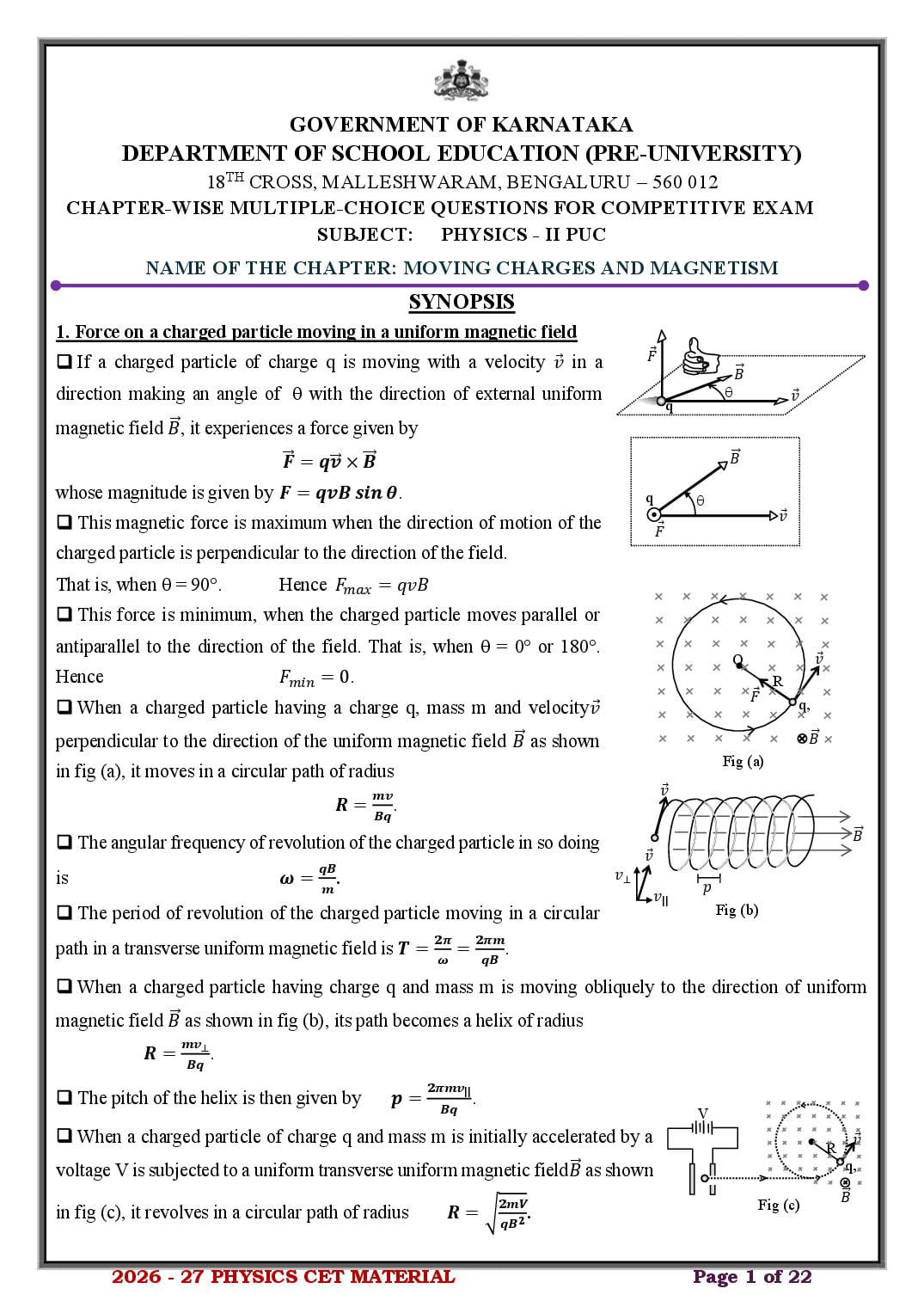
1. Force on a charged particle moving in a uniform magnetic field
❑ If a charged particle of charge q is moving with a velocity 𝑣⃗ in a 𝐹⃗
⃗⃗
𝐵
direction making an angle of with the direction of external uniform 𝑣⃗
q
⃗⃗, it experiences a force given by
magnetic field 𝐵
⃗𝑭⃗ = 𝒒𝒗
⃗⃗ × ⃗𝑩
⃗⃗ ⃗⃗
𝐵
whose magnitude is given by 𝑭 = 𝒒𝒗𝑩 𝒔𝒊𝒏 𝜽. q
𝑣⃗
❑ This magnetic force is maximum when the direction of motion of the 𝐹⃗
charged particle is perpendicular to the direction of the field.
That is, when = 90. Hence 𝐹𝑚𝑎𝑥 = 𝑞𝑣𝐵
❑ This force is minimum, when the charged particle moves parallel or
antiparallel to the direction of the field. That is, when = 0 or 180.
O 𝑣⃗
Hence 𝐹𝑚𝑖𝑛 = 0. R
𝐹⃗
❑ When a charged particle having a charge q, mass m and velocity𝑣⃗ q,
m
⃗⃗ as shown
perpendicular to the direction of the uniform magnetic field 𝐵 𝐵⃗⃗
Fig (a)
in fig (a), it moves in a circular path of radius
𝒎𝒗 𝑣⃗
𝑹 = 𝑩𝒒 .
⃗⃗
𝐵
❑ The angular frequency of revolution of the charged particle in so doing
𝑣⃗
𝒒𝑩
is 𝝎 = 𝒎. 𝑣⊥
𝑝
𝑣||
❑ The period of revolution of the charged particle moving in a circular Fig (b)
𝟐𝝅 𝟐𝝅𝒎
path in a transverse uniform magnetic field is 𝑻 = = .
𝝎 𝒒𝑩
❑ When a charged particle having charge q and mass m is moving obliquely to the direction of uniform
⃗⃗ as shown in fig (b), its path becomes a helix of radius
magnetic field 𝐵
𝒎𝒗
𝑹 = 𝑩𝒒⊥.
𝟐𝝅𝒎𝒗||
❑ The pitch of the helix is then given by 𝒑= .
𝑩𝒒 V
❑ When a charged particle of charge q and mass m is initially accelerated by a 𝑣⃗
R
⃗⃗ as shown
voltage V is subjected to a uniform transverse uniform magnetic field𝐵 q,
m
⃗⃗
𝐵
𝟐𝒎𝑽 Fig (c)
in fig (c), it revolves in a circular path of radius 𝑹 = √ 𝒒𝑩𝟐 .
2026 - 27 PHYSICS CET MATERIAL Page 1 of 22
Page 2
A proton and an electron are subjected to the same magnitude of transverse magnetic field. If their respective
speeds are in the ratio of 1:4, then their radii are in the ratio
(A) 1 : 1840 (B) 1840 : 1 (C) 460:1 (D) 1 : 460
Answer (C)
Example solved:
The electron and proton are subjected to the same mag field, : B is same
The magnitude of their charges are : q = e and its is same.
𝑚𝑣
Hence from : 𝑅 = 𝐵𝑞 ⇒ 𝑅 ∝ 𝑚𝑣
𝑅𝑝 𝑚𝑝 𝑣𝑝 1840𝑚𝑒 1 460
Thus finally :𝑅 =𝑚 ×𝑣 = ×4= 1 .
𝑒 𝑒 𝑒 𝑚𝑒
EXAMPLE 2
A charged particle in motion is subjected to an oblique uniform magnetic field. If p is the pitch of the particle
2𝜋𝑅
and R is the radius of its trajectory such that 𝑝 = √3, then the angle between the initial velocity of the
particle and the magnetic field is
(A) 0 (B) 30 (C) 60 (D) 90
Answer (C)
𝑣⃗
Example solved:
𝑚𝑣⊥ 2𝜋𝑚𝑣|| 𝑣⊥
The expression for the pitch and radius :𝑅= 𝑎𝑛𝑑𝑝 = ⃗⃗ ⊥
𝑣
𝐵𝑞 𝐵𝑞 𝐵
𝑚𝑣⊥
𝑅 2𝜋𝑅 𝑣 𝑣||
𝐵𝑞 𝑣||
Hence the ratio of R and p is thus :𝑝= 2𝜋𝑚𝑣|| ⇒ = 𝑣⊥ = 𝑡𝑎𝑛 𝜃
𝑝 ||
𝐵𝑞
𝑣 2𝜋𝑅
From the diagram shown tan = 𝑣⊥, so : = 𝑡𝑎𝑛 𝜃 ⇒ 𝑡𝑎𝑛 𝜃 = √3 ⇒ 𝜃 = 60°
|| 𝑝
EXAMPLE 3
The voltage required to accelerate an alpha particle and then to make it move in the circular path in a uniform
transverse magnetic field is V. The voltage required to accelerate a deuteron and then to make it move in
circular path in identical uniform transverse field is 16 V. Then the radii of their respective circular paths are
in the ratio of
1 4 1 16
(A) 4 (B) 1 (C) 2 (D) 1
Answer (C)
Example solved:
2𝑚𝑉 𝑚𝑉
Radius of the circular path and the accelerating potential are related as : 𝑅 = √ 𝑞𝐵2 ⇒ 𝑅 ∝ √ 𝑞
𝑅 𝑚 𝑉 𝑞
Hence : 𝑅𝛼 = √𝑚𝛼 × 𝑉𝛼 × 𝑞𝑑
𝑑 𝑑 𝑑 𝛼
𝑅 4𝑚𝑝𝑟𝑜𝑡 𝑉 𝑒 1
Finally : 𝑅𝛼 = √2𝑚 × 16𝑉 × 2𝑒 = 4
𝑑 𝑝𝑟𝑜𝑡
2. Lorentz Force
❑ If a moving charged particle having a charge q is subjected simultaneously to a an electric field 𝐸⃗⃗ and a
⃗⃗, it experiences both electric and magnetic force given by
magnetic field 𝐵
⃗⃗ = 𝒒𝑬
𝑭 ⃗⃗⃗ + 𝒒𝒗 ⃗⃗⃗ 𝑭
⃗⃗ × 𝑩 ⃗⃗ = 𝒒(𝑬
⃗⃗ + 𝒗 ⃗⃗⃗).
⃗⃗ × 𝑩
where q is the charge on the particle and v is its speed. The above expression is called Lorentz’ force.
2026 - 27 PHYSICS CET MATERIAL Page 2 of 22
Page 3
y
along the +y axis and uniform magnetic field along the +z axis, it moves undeviated
wit uniform motion. This device is called a velocity selector. 𝐸⃗⃗
𝑣⃗
❑ The velocity of the particle moving undeviated in a velocity selector is z ⃗⃗
𝐵
x
𝑬
𝒗 = 𝑩.
EXAMPLE 4
A charged particle having a charge of 10 C and mass 0.1 milli gram is passing through a region of mutually
perpendicular electric and magnetic fields of magnitudes 2 kV/m and 0.04 T respectively. If the particle passes
through this region undeviated, the kinetic energy of the particle is
(A) 25 𝐽 (B) 1250𝐽 (C) 500𝐽 (D) 125𝐽
Answer (D)
Example solved:
𝐸 2×10³
The velocity of the charged particle is : 𝑣 = 𝐵 ⇒ 𝑣 = 4×10−2 = 5 × 10⁴ 𝑚/𝑠
1 1
The kinetic energy of the particle is thus : 𝐾 = 2 𝑚𝑣 2 ⇒ 𝐾 = 2 × 1 × 10−7 × (5 × 104 )2 = 125𝐽
3. Force on a current carrying conductor in external uniform magnetic field
❑ If a current carrying conductor of length l carrying a steady current of
𝐹⃗
strength I in direction making an angle of with the direction of external ⃗⃗
𝐵
𝐼𝑙⃗
⃗⃗, it experiences a force given by
uniform magnetic field 𝐵 𝐹⃗ = 𝐼𝑙⃗ × 𝐵
⃗⃗ q
❑ whose magnitude is given by 𝐹 = 𝐼𝑙𝐵 𝑠𝑖𝑛 𝜃.
⃗⃗
𝐵
❑ This magnetic force is maximum when the direction of the current is
perpendicular to the direction of the field. 𝐼𝑙⃗
𝐹⃗
That is, when = 90. Hence 𝐹𝑚𝑎𝑥
This force is minimum, when the current in the conductor parallel or antiparallel to the direction of the field.
That is, when = 0 or 180. Hence 𝐹𝑚𝑖𝑛 . 𝐹⃗ ⃗⃗
𝐵
❑ Further, the directions of current, magnetic field and the force on it are given by the
Fleming’s left hand rule as shown in the figure to the right. 𝐼
EXAMPLE 5
A conductor in the shape of an equilateral triangle of side L carrying a uniform current i in it is
i i
placed in an external uniform magnetic field strength B as shown. The total force acting on it is
(A) 3iBL along vertically upward direction (B) 3iBL along into the plane of figure B
(C) 3iBL outside the plane of the figure (D) zero
Answer (D)
i i
Example solved: F F
The three sides of the triangle experience equal forces F each as shown. B
Hence the net force on the triangle is : zero
F
2026 - 27 PHYSICS CET MATERIAL Page 3 of 22
Page 4
I
❑ The magnetic field due to the current element having current I in it at dl 𝐼𝑑𝑙⃗ P
⃗
⃗⃗⃗ = 𝝁𝒐 𝑰𝒅𝒍𝟐×𝒓̂
point P is given by 𝒅𝑩 𝑟⃗
⃗⃗
𝑑𝐵
𝟒𝝅 𝒓
Where µ0 is called the permeability of free space, dl is the length of the
𝐼𝑑𝑙⃗
current element, r is the distance from the current element to point P. 𝑟Ƹ
❑ The magnitude of this magnetic field is given by
𝝁 𝑰𝒅𝒍 𝒔𝒊𝒏 𝜽
𝒅𝑩 = 𝟒𝝅𝒐 𝒓𝟐 .
⃗⃗
𝑑𝐵
❑ The direction of this field is given by the right hand clasp rule.
❑ Using the Biot Savart’s law, we can prove that the magnetic field at a point on I
the axis a distance of x from the centre of a current carrying loop of radius R as R
𝝁 𝟐𝝅𝑵𝑰𝑹𝟐 O
𝑩 = 𝟒𝝅𝒐 𝟑 . N x
(𝑹𝟐 +𝒙𝟐 )𝟐
→
❑ This magnetic field is maximum at the center of the loop for which x = 0. That B
𝜇𝑜 𝑁𝐼
is 𝐵𝑂 = 2𝑅 .
❑ The variation of the magnetic field due to a current carrying circular loop with 𝐵 = 𝜇𝑜 𝑁𝐼 B
𝑂
2𝑅
the axial distance x is shown to the right.
x
EXAMPLE 6
The areas of two circular coils A and B are in the ratio of 1 : 1 and the steady currents through them are in the
ratio of 4 : 3. If at identical axial distances from their respective centers they produce magnetic fields of
strengths in the ratio 1 : 2, the number of turns in them are in the ratio of
(A) 2 : 3 (B) 3 : 8 (C) 8 : 3 (D) 3 : 2
Answer (B)
Example solved:
Since the area (A ∝ R2) ratio of the coils is : 1 : 1,
their : radii (R) are same.
The axial distances are same : x is also same.
Thus : (R2 + x2)3/2 is also same.
𝜇𝑜 𝑁𝐼𝑅2
From :𝐵= 3 ⇒ 𝐵 ∝ 𝑁𝐼
2(𝑅2 +𝑥 2)2
𝐵 𝑁𝐴 𝐵𝐴 𝐼𝐵 𝑁𝐴 1 3 3
⇒𝑁∝ ⇒ = × ⇒ = × =
𝐼 𝑁𝐵 𝐵𝐵 𝐼𝐴 𝑁𝐵 2 4 8
5. Ampere’s Circuital Law:
❑ The line integral of the magnetic field along a closed loop (called amperian loop –
shown in the figure) around a number of current carrying conductors is µ o times the total
current enclosed by the loop.
That is ⃗⃗⃗ ⋅ 𝒅𝒍⃗ = 𝝁𝒐 𝑰𝒆𝒏𝒄. This is called Ampere’s circuital law. 𝑑𝑙⃗
∮𝑩 𝑑𝑙
⃗⃗
𝐵
❑ For cylindrically symmetric current distribution, we can write𝐵 × 2𝜋𝑟 = 𝜇𝑜 𝐼𝑒𝑛𝑐 .
Where r is the radius of the Amperian circular loop.
2026 - 27 PHYSICS CET MATERIAL Page 4 of 22
Page 5
I
(having current I in it) to find the magnetic field strength at a perpendicular distance of r from
r ⃗⃗
𝐵
𝝁𝒐 𝑰 ⃗⃗
𝐵
it as 𝑩= .
𝟐𝝅𝒓
❑ The direction of this magnetic field is given by the right hand clasp rule.
❑ Ampere’s Circuital law can also be applied to a solenoid of n turns per unit
I
length, carrying a steady current of strength I. The magnetic field due to this I
solenoid anywhere inside it is give by
𝑩 = 𝝁𝒐 𝒏𝑰 .
Solenoid
EXAMPLE 7
In the figure, five conductors carrying indicated steady currents are shown. Among them,
4A 2A
an irregular closed path encloses a certain number of conductors. Then the value of
⃗⃗⋅𝑑𝑙⃗
∑𝑙 𝐵 2A 3A
around this path is (⊙ and ⊗ indicate currents out of the plane of the figure and 1A
𝜇0
into the plane of the figure respectively)
(A) – 2 A (B) − 4 A (C) 12 A (D) 14 A
Answer (B)
Example solved:
⃗⃗ ⃗
According to Ampere’s Circuital Law, : ∮𝐵 ⃗⃗ ⋅ 𝑑𝑙⃗ = 𝜇𝑜 𝐼𝑒𝑛𝑐 ⇒ ∑ 𝐵⋅𝑑𝑙 = 𝐼𝑒𝑛𝑐
⃗⃗ ⋅ 𝑑𝑙⃗ = 𝜇𝑜 𝐼𝑒𝑛𝑐 ⇒ ∑ 𝐵
𝜇 𝑜
From the diagram, the enclosed current is : Ienc = +1 + 2 – 3 – 4 = − 4 A
⃗⃗⋅𝑑𝑙⃗
∑𝐵
Hence the required quantity : = −4
𝜇𝑜
EXAMPLE 8
A very long straight conductor carrying a steady current 2 A is bent into
a circle of radius 20 cm as shown in the figure. The total magnetic field O
strength at the center of the loop O is 20 cm
(A) 1 T (B) 2 T 2A
(C) T (D)(1 + ) T
Answer(B)
Example solved:
𝜇0 𝐼 𝜇0 𝐼 𝜇0 𝐼(1+𝜋)
The total magnetic field at O : 𝐵𝑜 = ⏟ + ⏟ ⇒ 𝐵𝑜 =
2𝜋𝑟 2𝑟 2𝜋𝑟
𝑑𝑢𝑒 𝑡𝑜 𝑑𝑢𝑒 𝑡𝑜 𝑐𝑖𝑟𝑐𝑙𝑒
𝑠𝑡𝑟𝑎𝑖𝑔ℎ𝑡 𝑤𝑖𝑟𝑒
(2𝜋×10−7 )(2)(1+𝜋)
Hence : 𝐵𝑜 = = (1 + 𝜋)𝜇𝑇
2𝜋(0.2)
EXAMPLE 9
The magnitude of magnetic field inside a long solenoid of number of turns per unit length 1000 is same as
that at a distance of 2 cm from the center of a toroid of 50 turns. Then the ratio of currents through solenoid
and toroid is
5𝜋 5 5 50
(A) 4 (B) 4 (C) 4𝜋 (D) 4𝜋
Answer (C)
2026 - 27 PHYSICS CET MATERIAL Page 5 of 22
Page 6
𝜇 𝑁𝐼
The magnetic fields due to solenoid and toroid : 𝐵𝑠 = 𝜇𝑜 𝑛𝐼𝑠 𝑎𝑛𝑑𝐵𝑡 = 2𝜋𝑟
𝑜 𝑡
𝐵 2𝜋𝑟𝑛𝐼𝑠 𝐼 𝑁 𝐵
Their ratio : 𝐵𝑠 = ⇒ 𝐼𝑠 = 2𝜋𝑟𝑛 × 𝐵𝑠
𝑡 𝑁𝐼𝑡 𝑡 𝑡
𝐼𝑠 50 𝐵 5
Hence : 𝐼 = 2𝜋×0.02×1000 × 𝐵 = 4𝜋
𝑡
6. Force between two long parallel current carrying conductors:
❑ When two long current carrying conductors separated by perpendicular distance d carry
⊗
currents of strengths I1 and I2 as shown, they attract each other with a force per unit length I1 ⊙ I2
⊙ ⊗
of ⊙ ⃗ 𝑓⃗ ⊗
𝝁 𝑰 𝑰
𝒐 𝟏 𝟐 −𝑓
𝒇𝟏𝟐 = 𝟐𝝅𝒅 ⊙ ⊗
⊙ ⊗
❑ If the same two conductors carry currents in the opposite directions, then they repel each ⊙ ⊗
other with the same magnitude of force per unit length. ⊙ ⊗
⊙ ⊗
❑ One ampere is that current when equally passed through to very long conductors d
separated by unit distance repel or attract each other with a force per unit length of
𝟐𝝅 × 𝟏𝟎−𝟕 𝑵𝒎−𝟏.
EXAMPLE 10
A long horizontal fixed conductor AB carries a steady current of 10 A. A second conductor B is placed above
A parallel to it at a height of 1 m from it. If B carries a current of 2 A, what should be its linear mass density
so that it can float in air?
(A) 20 g/m (B) 0.4 mg/m (C) 40 mg/m (D) 40 g/m
Answer (C)
Example solved:
𝜇𝑜 𝐼𝐴𝐼𝐵 𝐿
Weight of B is balanced by magnetic force on it : = 𝑚𝐵 𝑔
2𝜋𝑑
𝑚 𝜇 𝐼 𝐼
Or : 𝐿𝐵 = 𝑚 = 2𝜋𝑔𝑑
𝑜 𝐴 𝐵
𝜇 𝐼 𝐼 4𝜋×10−7 ×10×2
Finally : 𝑚 = 2𝜋𝑔𝑑
𝑜 𝐴 𝐵
= = 0.4𝑚𝑔/𝑚
2𝜋×10×1
7. Magnetic dipole moment and torque on a magnetic dipole
❑ When a current carrying loop of area carries a current I in it, its magnetic dipole moment
is given by ⃗⃗⃗
⃗⃗⃗⃗ = 𝑵𝑰𝑨
𝒎
where N is the number of turns in the loop.
❑ The direction of the magnetic dipole moment is along the direction of area vector of the ⃗⃗⃗ 𝐴⃗
𝑚
coil, which in turn is given by the right hand clasp rule. I
❑ A magnetic dipole having dipole moment 𝑚 ⃗⃗
⃗⃗⃗ in an external magnetic field 𝐵
𝑚
⃗⃗⃗
experiences a torque given by 𝝉 ⃗⃗⃗⃗ × ⃗𝑩
⃗⃗ = 𝒎 ⃗⃗.
❑ The magnitude of this torque is given by 𝝉 = 𝒎𝑩 𝒔𝒊𝒏 𝜽 = 𝑵𝑰𝑨𝑩 𝒔𝒊𝒏 𝜽. ⃗⃗
𝐵
❑ The maximum torque acts when the = 90, that is, 𝜏𝑚𝑎𝑥 . I
❑ This torque is minimum, that is zero when = 0 or 180.
2026 - 27 PHYSICS CET MATERIAL Page 6 of 22
Page 7
A magnetic dipole placed in an external uniform magnetic field
(A) experiences net torque but no net force
(B) experiences net torque and a net force
(C) experiences net force but no net torque
(D) experiences net torque and no net force if it is not parallel or antiparallel to the field.
Answer (D)
EXAMPLE 12
The variation of the torque on a circular loop of radius r with the radius for a fixed orientation, fixed current
in a uniform magnetic field is correctly shown in
r r r r
(A) (B) (C) (D)
0 0 0
Answer (B)
Example Solved:
The torque on a current carrying loop in external magnetic field : = NIAB sin = NIr2B sin
Since N, I, and B are fixed, : = (NIB sin ) r2
This equation is similar to : y = Cx2
Hence the graph of vs r must be a : parabola.
8. Moving Coil Galvanometer:
❑ A moving coil galvanometer consists of a : rectangular coil wound 0 0
around a : soft iron cylindrical core. The cylindrical core is placed in
between two : pole pieces so as to produce cylindrically symmetric 0
magnetic field. A : spiral spring is attached on the upper and lower faces 0
of the soft iron core as shown. A : metal pointer needle is affixed to the 0
spiral spring which can run over a graduated scale on the dial.
❑ When a current I is passed through the coil of N turns, area A in a magnetic field of B, it experiences a
torque which is proportional to the deflection in it. Hence
𝑪
𝜏 ∝ 𝜙 𝜏 = 𝐶𝜙 𝑁𝐼𝐴𝐵 = 𝐶𝜙 𝑰 = (𝑵𝑨𝑩) 𝝓 𝐼∝𝜙
Where C is the couple per unit twist of the spiral spring.
❑ A galvanometer is indicated with a symbol G .
0
9. Conversion of a Moving Coil Galvanometer into a Voltmeter and an Ammeter:
❑ A sensitive galvanometer can be converted into a voltmeter by connecting a high series Imax RS
G
resistance with it. 0
Voltmeter
2026 - 27 PHYSICS CET MATERIAL Page 7 of 22
Page 8
Imax is the current for full scale deflection, then the potential difference measured by the galvanometer turned
voltmeter is 𝑽 = 𝑰𝒎𝒂𝒙 (𝑹𝑮 + 𝑹𝑺 ).
𝑽
Simplifying the above relation, we get 𝑹𝑺 = 𝑰 − 𝑹𝑮
𝒎𝒂𝒙
𝝓 𝑵𝑨𝑩
❑ The voltage sensitivity of a galvanometer turned voltmeter is given by voltage sensitivity 𝑽 = 𝑪𝑹
where 𝑅 = 𝑅𝐺 + 𝑅𝑆 = 𝑡𝑜𝑡𝑎𝑙𝑟𝑒𝑠𝑖𝑠 𝑡𝑎𝑛 𝑐 𝑒𝑜𝑓𝑡ℎ𝑒𝑣𝑜𝑙𝑡𝑚𝑒𝑡𝑒𝑟.
Ammeter
❑ sensitive galvanometer can be converted into an ammeter by connecting a low shunt Imax
I G
resistance across it. 0
RP
❑ If RG is the resistance of the galvanometer coil, R P is the shunt resistance and Imax is the
I − Imax
current for full scale deflection, then the current through the shunt resistor is
I − Imax. Since the pd across RG and RP is same, (𝐼 − 𝐼𝑚𝑎𝑥 )𝑅𝑃 = 𝐼𝑚𝑎𝑥 𝑅𝐺 .
𝐼
Solving for RP, we get 𝑅𝑃 = ( 𝑚𝑎𝑥 ) 𝑅𝐺
𝐼−𝐼𝑚𝑎𝑥
❑ The current sensitivity of a galvanometer turned ammeter is given by
𝝓 𝑵𝑨𝑩
current sensitivity =
𝑰 𝑪
𝑹 𝑹
❑ The total resistance of a galvanometer turned ammeter is 𝑹𝒕𝒐𝒕 = 𝑷 𝑮 .
𝑹𝑷 +𝑹𝑮
EXAMPLE 13
A galvanometer having resistance 90 and a full-scale deflection current 30 A is to be converted into an
ammeter to read a total current of 0.3 mA. The total resistance of the ammeter is
(A) 5 (B) 7 (C) 9 (D) 100
Answer (C)
Example solved:
𝐼 30
The shunt resistance value is calculated thus : 𝑅𝑃 = 𝐼−𝐼𝑚𝑎𝑥 𝑅𝐺 ⇒ 𝑅𝑃 = (300−30) 90 = 10 𝛺
𝑚𝑎𝑥
𝑅𝑃 𝑅𝐺 10×90
Hence the total resistance of the ammeter is : 𝑅𝑡𝑜𝑡 = 𝑅 +𝑅 = 10+90 = 9 𝛺
𝑃 𝐺
********
2026 - 27 PHYSICS CET MATERIAL Page 8 of 22
Page 9
1. When a magnetic compass needle is placed near a straight wire carrying current, then
(I) the straight wire cause a noticeable deflection in the compass needle.
(II) the alignment of the needle is tangential to an imaginary circle with straight wire as its centre and
has a plane perpendicular to the wire
(A) (I) is correct (B) (II) is correct
(C) both (I) and (II) are correct (D) neither (I) nor (II) is correct
2. A strong magnetic field is applied on a stationary electron. Then the electron
(A) moves in the direction of the field.
(B) remains stationary.
(C) moves perpendicular to the direction of the field.
(D) moves opposite to the direction of the field.
3. What is the work done by a magnetic force on a charged particle (q) moving in a uniform magnetic field
⃗⃗) with velocity (𝑣⃗)?
(𝐵
𝑞𝑣𝐵
(A) qvB (B) 2
(C) Zero (D) Infinity
4. Which of the following particles will experience the maximum magnetic force when projected with the
same velocity perpendicular to a uniform magnetic field?
(A) Alpha particle (B) Proton (C) Electron (D) Neutron
5. A positive charge enters a magnetic field and travels antiparallel to the field. It experiences
(A) an upward force. (B) a downward force.
(C) a constant force. (D) no force.
6. Assertion: Magnetic field interacts with a moving charge and not with a stationary charge.
Reason: A moving charge produces a magnetic field.
(A) Both assertion and reason are true and reason is the correct explanation of assertion.
(B) Both assertion and reason are true but reason is not the correct explanation of assertion.
(C) Assertion is true but reason is false.
(D) Both assertion and reason are false.
⃗⃗ at an angle θ (where 0° < θ < 180°) with the magnetic
7. A positive charge q enters a uniform magnetic field 𝐵
field. Which graph best shows variation the magnitude of the magnetic force 𝐹⃗ with θ?
(A) (B)
(C) (D)
2026 - 27 PHYSICS CET MATERIAL Page 9 of 22
Page 10
(𝑣⃗) in a region containing both an electric field (𝐸⃗⃗ ) and a magnetic field (𝐵
⃗⃗) is
(A) 𝐹⃗ = 𝑞(𝐸⃗⃗ + 𝑣⃗ ∙ 𝐵
⃗⃗) (B) 𝐹⃗ = 𝑞(𝐸⃗⃗ + 𝑣⃗ × 𝐵
⃗⃗)
(C) 𝐹⃗ = 𝑞(𝐸⃗⃗ + 𝐵
⃗⃗ × 𝑣⃗) (D) 𝐹 = 𝑞𝐸 + 𝑞𝑣𝐵
9. In a certain region of space, electric field and magnetic field are perpendicular to each other. An electron
enters perpendicularly to both the fields and moves undeflected. The velocity of electron is
𝐸 𝐵
(A) 𝐵 (B) 𝐸 (C) 𝐸⃗⃗ × 𝐵
⃗⃗ (D) 𝐸⃗⃗ ∙ 𝐵
⃗⃗
10. The correct vector expression for the magnetic force (𝐹⃗ ) experienced by a straight conductor of length (L)
⃗⃗) is
carrying a current (I) in a uniform magnetic field (𝐵
(A) 𝐹⃗ = 𝐼(𝐵
⃗⃗ × 𝐿⃗⃗ ) (B) 𝐹⃗ = 𝐼(𝐿⃗⃗ × 𝐵
⃗⃗) (C) 𝐹⃗ = 𝐼⃗ ∙ (𝐿⃗⃗ × 𝐵
⃗⃗) (D) 𝐹⃗ = 𝐼⃗ × (𝐿⃗⃗ × 𝐵
⃗⃗)
11. A straight wire of length 0.5 m carries a current of 2.0 A. It is placed in a uniform magnetic field of 0.3 T
such that it is perpendicular to the field lines. What is the magnitude of the force acting on the wire?
(A) 0.15 N (B) 0.6 N (C) 0.3 N (D) 0 N
12. If the current flowing through a conductor placed in a uniform magnetic field is doubled, and its length
inside the field is halved, how does the magnetic force on the conductor change?
(A) It becomes four times the original force (B) It is halved
(C) It remains the same (D) It is doubled
13. If you double the velocity of a charged particle moving perpendicular to a uniform magnetic field, the
radius of its circular path will:
(A) Remain the same (B) Be halved (C) Double (D) Quadruple
14. An electron (e-), a proton (p), and an alpha particle () enter a uniform magnetic field perpendicularly
with the same parameter. Match the parameter with the correct comparison of their radii.
Column I Column II
(Constant Parameter) (Radius Comparison)
(a) Same velocity (𝑣⃗) (1) r < rp = re
(b) Same momentum (𝑝⃗) (2) re < rp = r
(c) Same kinetic energy (K) (3) re < rp < r
(A) (a) – (3), (b) – (1), (c) – (2) (B) (a) – (1), (b) – (2), (c) – (3)
(C) (a) – (2), (b) – (3), (c) – (1) (D) (a) – (3), (b) – (2), (c) – (1)
15. A charge moves in a circle perpendicular to a magnetic field. Upon which of the following, the time period
of revolution, does not depend?
(A) Magnetic field (B) Charge
(C) Mass of the particle (D) Velocity of the particle
16. The horizontal component of earth's magnetic field at a certain place is 3.0 x 10 -5 T and having a direction
from the geographic south to geographic north. The force per unit length on a very long straight conductor
carrying a steady current of 1.2 A in east to west direction is
(A) 3.0 × 10⁻⁵ Nm-1 (B) 3.6 × 10⁻⁵ Nm-1 (C) 3.2 × 10⁻⁵ Nm-1 (D) 3.8 × 10⁻⁵ Nm-1
17. An electron of energy 1800 eV describes a circular path in magnetic field of flux density 0.4 T. The radius
of path is (q = 1.6 × 10⁻¹⁹ C, m = 9.1 × 10⁻³¹ kg)
(A) 2.58 × 10⁻⁴ m (B) 2.58 × 10⁻³ m (C) 3.58 × 10⁻⁴ m (D) 3.58 × 10⁻³ m
2026 - 27 PHYSICS CET MATERIAL Page 10 of 22
Page 11
of its trajectory.
Column I (Condition) Column II (Shape of the Trajectory)
⃗⃗ ( = 0°)
(a) Velocity 𝑣⃗ is parallel to 𝐵 (1) Helical path with uniform pitch
⃗⃗ ( = 90°)
(b) Velocity 𝑣⃗ is perpendicular to 𝐵 (2) Straight line path
⃗⃗ ( < 90°) (3) Circular path
(c) Velocity 𝑣⃗ is at an acute angle to 𝐵
(A) (a) – (3), (b) – (2), (c) – (1) (B) (a) – (2), (b) – (1), (c) – (3)
(C) (a) – (2), (b) – (3), (c) – (1) (D) (a) – (1), (b) – (3), (c) – (2)
19. Two charged particles traverse identical helical paths in a completely opposite sense in a uniform magnetic
⃗⃗ = 𝐵0 𝑘̂ .
field 𝐵
(A) They have equal z-components of momenta. (B) They must have equal charges.
(C) They necessarily represent a particle-antiparticle pair.
𝑞 𝑞
(D) The charge to mass ratio satisfy:(𝑚) + (𝑚) = 0.
1 2
20. At what distance from a long straight wire carrying a current of 12 A will the magnetic field be equal to 3
10–5 Wb/ m2?
(A) 8 × 10⁻² 𝑚 (B) 12 × 10−2 𝑚 (C) 18 × 10−2 𝑚 (D)24 × 10−2 𝑚
21. The magnetic field due to a current element is maximum when the angle between 𝑑𝑙⃗ and 𝑟⃗ is
(A) 0∘ (B) 30∘ (C) 60∘ (D) 90∘
22. At a distance of 10 cm from a long straight wire carrying current, the magnetic field is 0.04 T. At the
distance of 40 cm, the magnetic field will be
(A) 0.01 T (B) 0.02 T (C) 0.08 T (D) 0.16 T
23. Which of the following graphs, shows the variation of magnetic induction B with distance r from a long
wire carrying a current
(A) (B) (C) (D)
24. A circular current-carrying coil of radius R carries a current I. If the magnetic field at a point on its axis is
1/8 of the magnetic field at the centre of the coil, then the distance of the point from the centre is
(A) R (B) √3𝑅 (C) √2𝑅 (D) 2R
𝜋
25. An arc of a circle of radius R subtends an 2 angle at the centre. It carries a current I. The magnetic
field at the centre will be
𝜇 𝐼 𝜇 𝐼 𝜇 𝐼 2𝜇 𝐼
(A) 2𝑅
𝑜
(B) 8𝑅
𝑜
(C) 4𝑅
𝑜
(D) 5𝑅𝑜
2026 - 27 PHYSICS CET MATERIAL Page 11 of 22
Page 12
centre are in the ratio 8:1. The radius of the coil is
(A) 1.0 m (B) 0.1 m (C) 0.15 m (D) 0.2 m
27. Two concentric coils each of radius equal to 2cm are placed at right angles to each other. 3 ampere and 4
ampere are the currents flowing in each coil respectively. The magnetic induction in weber m 2 at the centre
of the coils will be ( 𝜇𝑜 = 4𝜋 𝑥10−7 𝐻𝑚−1 )
(A) 5 × 10⁻⁵ (B) 7 × 10⁻⁵ (C) 12 × 10−5 (D) 10−5
28. Two points P and Q lie on the axis of a current loop with center O as
shown in the figure. If BO, BP and BQ represent magnetic field magnetic
field due to current loop at O, P and Q respectively, then
(A) BO > BP> BQ (B) BO < BP < BQ
(C) BO =BP =BQ (D) BO =0 and BP > BQ
29. A length of wire carries a steady current. It is bent first to form a circular
plane coil of one turn. The same length is now bent more sharply to give a double loop of smaller radius.
The magnetic field at the centre caused by the same current is
(A) a quarter of its first value (B) unaltered
(C) four times of its first value (D) a half of its first value
30. Two concentric circular coils of ten turns each are situated in the same plane. Their radii are 20 and 40 cm
and they carry respectively 0.2 and 0.4 ampere current in opposite direction. The magnetic field in weber /
m2 at the centre is
(A) 𝜇0 /80 (B) 7𝜇0 /80 (C) (5/4)𝜇0 (D) zero
31. A circular loop carrying current I has magnetic moment μ. If both the current and the radius of the loop
are doubled, the magnetic moment becomes
(A) 2μ (B) 4μ (C) 8μ (D) 16μ
32. A circular wire of fixed length carries a current I. It is reshaped into a square without changing the
current. Which statement is correct?
(A) Magnetic moment increases. (B) Magnetic moment decreases.
(C) Magnetic moment remains unchanged. (D) It becomes zero.
33. A long solenoid is formed by winding 20 turns / cm. The current necessary to produce a magnetic
field of 20 milli tesla inside the solenoid will be approximately (𝜇𝑜 = 4𝜋 𝑥10−7 𝐻𝑚−1 )
(A) 8.0 A (B) 4.0 A (C) 2.0 A (D) 1.0 A
34. A long solenoid carrying a current produces a magnetic field B along its axis. If the current is double and
the number of turns per cm is halved, the new value of the magnetic field is
(A) 4B (B) B/2 (C) B (D) 2B
35. Two thin long parallel wires separated by a distance ‘r’ from each other in vacuum carry a current of I
ampere in opposite directions. Then, they will
µ 𝐼2
(A) attract each other with a force per unit length of 2𝜋𝑟
0
2 .
µ 𝐼2
(B) attract each other with a force per unit length of 2𝜋𝑟
0
.
µ 𝐼2
(C) repel each other with a force per unit length of 2𝜋𝑟
0
2 .
µ 𝐼2
(D) repel each other with a force per unit length of 2𝜋𝑟
0
.
2026 - 27 PHYSICS CET MATERIAL Page 12 of 22
Page 13
per unit length acting between these two wires is
(A) 6×10⁻⁷ 𝑁 𝑚−1 attractive (B) 6×10⁻⁵ 𝑁 𝑚−1 attractive A C
B
−7 −1 −5 −1
(C) 6×10 𝑁 𝑚 repulsive (D) 6×10 𝑁 𝑚 repulsive
37. A and B are two infinitely long straight parallel conductors. C is another straight 2A 4A
3A
conductor of length 1 m kept parallel to A and B as shown in figure. Then the
force experienced by C is
(A) towards B equal to 0.6 10−5 N (B) towards A equal to 54 μN
5 cm 8 cm
(C) towards B equal to 5.4 10−5 N (D) towards A equal to 6 μN
38. A rectangular loop carrying current i is situated near a long straight wire such that the wire is parallel to
one of the side of the loop and is in the plane of the loop. If steady current I is
i
established in the wire as shown, the loop will I
(A) Rotate about an axis parallel to long wire
(B) Move away from the wire
(C) Move towards the wire
(D) Remain stationary
S P
39. The resultant force on the current loop 𝑃𝑄𝑅𝑆 due to a long current carrying
conductor will be 20 A 20 A 15 cm
(A) 1.8 × 10⁻⁴ 𝑁 (B) 5 × 10⁻⁴ 𝑁 R
2 cm 10 cm Q
−4 −4
(C) 10 𝑁 (D) 3.6 × 10 𝑁
40. An arrangement of three parallel straight wires placed perpendicular to plane of paper B d C
carrying same current I along the same direction is as shown in the figure. Magnitude of
d
force per unit length on the middle wire B is given by
𝜇 𝐼2 2𝜇𝑜 𝐼2 √2𝜇𝑜 𝐼2 𝜇𝑜 𝐼 2 A
(A) 2𝜋𝑑
𝑜
(B) (C) (D)
𝜋𝑑 𝜋𝑑 √2𝜋𝑑
41. A and B are two conductors carrying a current I in the same direction. x and y are two electron beams
moving in the same direction. I
A
(A) There will be attraction between A and B and also x and y I
B
(B) There will be repulsion between A and B and also x and y
x
(C) There will be attraction between A and B, repulsion between x and y
y
(D) There will be repulsion between A and B, attraction between x and y.
42. The horizontal component of earth’s magnetic field at a place is 1.5 √2 × 10⁻⁵ T and is acting from south
to north direction. Two very long straight parallel conductors are placed on a horizontal table at that place
with a separation of 1 cm and are carrying currents of √2 A in east to west direction. The net force acting
per unit length of each conductor is
(A) 3 × 10⁻⁵ N (B) 4 × 10⁻⁵ N (C) 5 × 10⁻⁵ N (D) 7 × 10⁻⁵ N
43. The horizontal component of earth’s magnetic field at a place is 1.5 √2 × 10⁻⁵ T and is acting from south
to north direction. Two very long straight parallel conductors are placed on a horizontal table at that place
with a separation of 1 cm and are carrying currents of √2 A in south to north direction. The net force acting
per unit length of each conductor is
(A) 3 × 10⁻⁵ N (B) 4 × 10⁻⁵ N (C) 5 × 10⁻⁵ N (D) 7 × 10⁻⁵ N
2026 - 27 PHYSICS CET MATERIAL Page 13 of 22
Page 14
(A) magnetic field in which it is lying (B) number of turns
(C) area of the loop (D) current in the loop
45. The torque acting on a magnetic dipole placed in uniform magnetic field is zero, when the angle between
the dipole axis and the magnetic field is ______
(A) 45° (B) 60° (C) 90° (D) zero
46. A circular coil of radius 10 𝑐𝑚 and 100 turns carries a current 1 𝐴. What is the magnetic moment of the
coil?
(A) 3.142 𝐴𝑚2 (B) 3.142×10⁴ 𝐴𝑚2 (C) 3 𝐴𝑚2 (D) 104 𝐴𝑚2
47. A circular loop and a square loop are formed from two wires of same length and cross sec tion. Same
current is passed through them. Then the ratio of their dipole moments is
2 4
(A) 4 (B) (C) 2 (D)
𝜋 𝜋
48. A current loop in a magnetic field -
(A) experiences a torque whether the field is uniform or non-uniform in all orientations
(B) can be in equilibrium in one orientation
(C) can be in equilibrium in two orientations, both the equilibrium states are unstable
(D) can be in equilibrium in two orientations, one stable while the other is unstable
49. A straight current carrying conductor is kept along the axis of circular loop carrying current. The force
exerted by the straight conductor on the loop is ……
(A) perpendicular to the plane of the loop.
(B) in the plane of the loop, away from the center.
(C) in the plane of the loop, towards the center.
(D) zero.
50. A rectangular coil of length 0.12 m and width 0.1 m having 50 turns of wire is suspended vertically in a
uniform magnetic field of strength 0.2 Wb/m 2. The coil carries a current of 2A. If the plane of the coil is
inclined at an angle of 30° with the direction of the field, the torque required to keep the coil in stable
equilibrium will be
(A) 0.15 Nm (B) 0.20 Nm (C) 0.24 Nm (D) 0.12 Nm
51. A circular current loop of magnetic moment M is in an arbitrary orientation in an external magnetic field
B. The work done to rotate the loop by 30° about an axis perpendicular to its plane is
𝑀𝐵 𝑀𝐵
(A) MB. (B) √3 2 (C) 2 (D) zero.
52. The torque required to hold a small circular coil of 10 turns, area
21
of 1 𝑚𝑚2 and carrying a current of (44) 𝐴 in the middle of a long
solenoid of 103 𝑡𝑢𝑟𝑛𝑠/𝑚 carrying a current of 2.5 𝐴, with its axis
perpendicular to the axis of the solenoid is
(A) 1.5 × 10⁻⁶ 𝑁-m (B) 1.5 × 10⁻⁸ 𝑁-m (C) 1.5 × 10+6 𝑁-m (D) 1.5 × 10+8 𝑁-m
2026 - 27 PHYSICS CET MATERIAL Page 14 of 22
Page 15
loop with x > 0 is now bent so that it now lies in the y-z plane.
(A) The magnitude of magnetic moment now diminishes.
(B) The magnetic moment does not change.
(C) The magnitude of B at (0.0.z), z >>R increases.
(D) The magnitude of B at (0.0.z), z >>R is unchanged.
54. Dipole moment of a coil is 2𝑖Ƹ + 3𝑗Ƹ + 5𝑘̂ . If the coil is suspended in the uniform magnetic field having
magnitude 5𝑘̂ T, torque acting on it will be
(A) √35. (B) √117 (C) √25 (D) √135
55. A circular coil having N turns is made from a wire L meter long. If a current of I is passed through this
coil suspended in a uniform magnetic field of B tesla, the maximum torque that can act on this coil is
𝐼𝐿𝐵 𝐵𝐼𝐿2 𝐵𝐼𝐿2
(A) . (B) 0 (C) . (D) ..
2𝜋𝑁 4𝜋𝑁 8𝜋2 𝑁
56. A circular coil of magnetic moment 10 Am 2 is placed in vertical plane and is free to rotate about a
horizontal axis which coincides with its diameter. The moment of inertia of the coil about the possible axis
of rotation is 0.1 kgm2. A uniform magnetic field of 2 T is acting in horizontal direction along the axis of
the coil. The angular velocity acquired by the coil when it rotates through an angle of 90 0 under the influence
of magnetic field is
(A) 20 rads-1 (B) 10 rads-1 (C) 15 rads-1 (D) 2 rads-1
57. A loop of irregular shape carrying current is located in an external magnetic field. If the wire used is
flexible, it takes ____________ shape.
(A) an elliptical (B) a square (C) a circular (D) a triangular
58. A square coil of side 10 cm consists of 20 turns and carries a current of 12 A. The coil is suspended
vertically and the normal to the plane of the coil makes an angle of 30º with the direction of a uniform
horizontal magnetic field of magnitude 0.80 T. The magnitude of torque experienced by the coil is
(A) 9.6 Nm (B) 0.96 Nm (C) 0.096 Nm (D) 96.0 Nm
59. A circular coil is present in a vertical plane and is carrying current in anti-clockwise direction wrt an
observer. If a uniform magnetic field is applied in the plane of the coil from left to right of the observer,
then the direction of torque is
(A) downwards (B) upwards (C) towards left (D) towards right
60. A wire of length L carries a current I. If the wire is bent into a circular coil of N turns and the coil is
suspended in a uniform magnetic field of strength B, the value of N for which maximum torque acts is
(A) 2 (B) 3 (C) 4 (D) 1
61. A current carrying circular loop is lying on a smooth horizontal surface. The coil won’t turn about the
vertical axis passing through its centre for
(A) magnetic field applied perpendicular to the current loop only.
(B) magnetic field applied parallel to the current loop only.
(C) magnetic field applied in a direction making an angle 45 0 with the plane of the current loop only.
(D) magnetic field of any strength acting in any direction w. r. t. the plane of the current loop.
2026 - 27 PHYSICS CET MATERIAL Page 15 of 22
Page 16
second. The magnetic moment associated with the revolving electron is
(A) 1.26 × 10⁻²⁴ 𝐴𝑚2 (B) 1.26 × 10⁻²³ 𝐴𝑚2
(C) 1.26 × 10⁻²² 𝐴𝑚2 (D)1.26 × 10⁻²⁵ 𝐴𝑚2
63. A circular current loop has radius 0.1 m and magnetic moment 2 x 10 2 Am2. The magnetic field produced
by it at a distance 2 m from the centre along the axis is
(A) 5 × 10⁻⁷ 𝑇 (B) 5 × 10⁻⁶ 𝑇 (C) 2.5 × 10⁻⁷ 𝑇 (D) 2.5 × 10⁻⁶ 𝑇
64. A circular current loop has radius 0.1 m and magnetic moment 2 x 10 2 Am2. The magnetic field produced
by it at a distance 2 m from the centre in the plane of the current loop is
(A) 5 × 10⁻⁷ 𝑇 (B) 5 × 10⁻⁶ 𝑇 (C) 2.5 × 10⁻⁷ 𝑇 (D) 2.5 × 10⁻⁶ 𝑇
65. A moving coil galvanometer has 𝑁 turns, coil area 𝐴, magnetic field 𝐵, and suspension spring constant 𝑘.
The galvanometer is modified such that , its number of turns is doubled, coil area is halved, magnetic field
is increased by 50%, torsional constant is doubled. Then the current sensitivity becomes
(A) unchanged (B) 0.75times the original
(C) 1.5 times the original (D) 3 times the original
66. A galvanometer gives full-scale deflection for current 𝐼𝑔 .The magnetic field is suddenly doubled while the
torsional constant is reduced to one-fourth. To produce the same deflection as before, the required current
is
(A) 𝐼𝑔 /8 (B) 𝐼𝑔 /4 (C) 𝐼𝑔 /2 (D) 2𝐼𝑔
67. A galvanometer is adjusted so that its restoring torque equals magnetic torque at full-scale deflection. If
both current and magnetic field are simultaneously doubled, the angular deflection becomes
(A) unchanged (B) doubled (C) four times (D) impossible to determine
68. A galvanometer has current sensitivity 𝑆𝑖 and resistance 𝐺. Which one of the following modifications
decreases the voltage sensitivity but leaves the current sensitivity unchanged?
(A) Increasing the magnetic field (B) Increasing the resistance of the coil
(C) Increasing the number of turns (D) Decreasing the torsional constant
69. The current sensitivity of a galvanometer can be increased by: (i) Decreasing the number of turns (ii)
Increasing the magnetic field (iii) Decreasing the area of the coil (iv) Decreasing the torsional constant of
the spring. Choose the most appropriate answer from the options given below.
(A) (ii) and (iii) only (B) (iii) and (iv) only
(C) (i) and (iii) only (D) (ii) and (iv) only
70. Given below are two statements:
Statement-I: If the number of turns in the coil of a moving coil galvanometer is doubled, then the current
sensitivity becomes double.
Statement-II: Increasing the current sensitivity of a moving coil galvanometer only by increasing the
number of turns in the coil will also increase its voltage sensitivity in the same ratio.
Choose the correct answer from the options given below:
(A)Statement-I is false but Statement-II is true. (B) Both Statement-I and Statement-II are true.
(C) Both Statement-I and Statement-II are false. (D) Statement-I is true but Statement-II is false.
2026 - 27 PHYSICS CET MATERIAL Page 16 of 22
Page 17
of turns of the coil is tripled (using the same wire material and cross-sectional area). The value of 𝐾is
(A) 9 (B) 3 (C) 27 (D) 1
72. The voltage sensitivity of a moving coil galvanometer is 𝑉𝑠 and the current sensitivity is 𝐼𝑠 . If the resistance
of the galvanometer is 𝐺, the correct relation between 𝑉𝑠 and 𝐼𝑠 is
𝐼 𝐺 𝐺
(A) 𝑉𝑠 = 𝐺𝑠 (B) 𝑉𝑠 = 𝐼𝑠 𝐺 (C) 𝐼𝑠 = 𝑉 (D) 𝑉𝑠 = 𝐼
𝑠 𝑠
73. A galvanometer produces full-scale deflection for a current 𝐼𝑔 . The magnetic field is increased by 20%,
while the torsional constant is also increased by 20%. The new full-scale deflection current is
(A) 0.8𝐼𝑔 (B) 𝐼𝑔 (C) 1.2𝐼𝑔 (D) 1.44𝐼𝑔
74. A galvanometer has current sensitivity 20 divisions/𝜇Aand resistance 100 Ω. If its resistance is increased
to 400 Ωwithout changing any other parameter, the new voltage sensitivity becomes
(A) 50 divisions/mV (B) 100 divisions/mV
(C) 200 divisions/mV (D) 800 divisions/mV
75. A galvanometer has resistance 100 Ωand full-scale current 2 mA. It is to be converted into a 10 A ammeter.
The nearest value of shunt resistance is
(A) 20 Ω (B)2 Ω (C) 0.2 Ω (D) 0.02 Ω
76. A galvanometer of resistance 𝐺is converted into an ammeter of range 𝐼. To increase its range to 2𝐼, the
new shunt resistance should be
(A) Twice the original (B) Half the original
(C) One-fourth the original (D) Unchanged
77. A galvanometer of resistance 𝐺is converted into an ammeter by connecting a shunt resistance 𝑆in parallel.
Which of the following statements is always correct?
(A) The equivalent resistance of the ammeter is greater than 𝐺.
(B) The potential difference across the galvanometer is greater than that across the shunt.
(C) The current through the shunt is always greater than the current through the galvanometer.
(D) The equivalent resistance of the ammeter is less than both 𝐺and 𝑆.
78. A galvanometer of resistance 𝐺and full-scale deflection current 𝐼𝑔 is converted into an ammeter of range
𝐼. The resistance of the converted ammeter is 𝑅𝐴 is
𝐺𝐼 𝐺𝐼𝑔 𝐺(𝐼−𝐼𝑔 ) 𝐺𝐼
(A) 𝐼 (B) 𝐼 (C) (D)
𝑔 𝐼 𝐼−𝐼𝑔
79. Two ammeters are made from identical galvanometers. The ammeter A has a range of 2 𝐴 and ammeter
B has a range of 20 𝐴. Which of the following is correct?
(A) Ammeter A uses the smaller shunt resistance. (B) Ammeter B uses the smaller shunt resistance.
(C) Both use equal shunt resistances. (D) The shunt resistance cannot be compared.
80. A galvanometer has a resistance 𝐺and a full-scale deflection current (range) of 𝐼ampere. It is converted
into an ammeter of range 𝑛𝐼, where 𝑛 > 1. The value of the shunt resistance connected in parallel with the
galvanometer is
𝐺 𝐺
(A) 𝑛−1 (B) 𝑛𝐺 (C) 𝑛 (D) (𝑛 − 1)𝐺
2026 - 27 PHYSICS CET MATERIAL Page 17 of 22
Page 18
connected in parallel should be
𝐺 𝐺
(A) 50 (B) 49 (C) 50𝐺 (D) 49𝐺
82. In an ammeter, 0.5% of the main current passes through the galvanometer. If the resistance of the
galvanometer is 𝐺, the resistance of the ammeter is
𝐺 𝐺
(A) 200 (B) 199 (C) 199𝐺 (D) 200𝐺
83. A galvanometer has resistance 𝐺and full-scale deflection current 𝐼𝑔 . It is converted into a voltmeter of
range 𝑉 by connecting a resistance 𝑅 in series. If the desired range is doubled, the new series resistance
becomes
𝑉
(A) 2𝑅 (B) 𝑅 + 𝐼 (C) 2𝑅 + 𝐺 (D) 2𝑅 − 𝐺
𝑔
84. A galvanometer has resistance 100 Ω gives full scale of deflection for the current 2 mA. It is. The required
series resistance to convert it into a 10 V voltmeter is
(A) 4.9 𝑘Ω (B) 5 𝑘Ω (C) 5.1 𝑘Ω (D) 50 𝑘Ω
85. A galvanometer has resistance 𝐺and full-scale current 𝐼𝑔 . It is converted into a voltmeter of range 𝑉by
connecting a resistance 𝑅in series. The equivalent resistance of the voltmeter is
𝑅𝐺
(A) 𝑅 (B) 𝐺 (C) 𝑅 + 𝐺 (D)
𝑅+𝐺
86. Of the following graphs, the one which shows the variation of the series resistance to be connected with a
moving coil galvanometer so as to convert it into a multi range voltmeter is
(A) (B) (C) (D)
KEY ANSWERS
1 2 3 4 5 6 7 8 9 10 11 12 13 14 15
C B C A D A D B A B C B C A D
16 17 18 19 20 21 22 23 24 25 26 27 28 29 30
B C C D A D A C B B B A A C D
31 32 33 34 35 36 37 38 39 40 41 42 43 44 45
C B A C D C A C B D C C B A D
46 47 48 49 50 51 52 53 54 55 56 57 58 59 60
A D D D B D B A D C A C B B D
61 62 63 64 65 66 67 68 69 70 71 72 73 74 75
D B B D B A C B D B A A B A D
76 77 78 79 80 81 82 83 84 85 86
B D B B A B B C A C D
2026 - 27 PHYSICS CET MATERIAL Page 18 of 22
Page 19
1. In the given figure, the magnetic field at ‘O’ [KCET-2020]
3 𝜇 𝐼 𝜇 𝐼 3𝜇 𝐼 𝜇 𝐼
(A) 10 𝑟0 − 4𝜋𝑟
0
(B) 8 𝑟0 + 4𝜋𝑟
0
3𝜇 𝐼 𝜇 𝐼 3𝜇 𝐼 𝜇 𝐼
(C) 8 𝑟0 − 4𝜋𝑟
0
(D) 4 𝑟0 + 4𝜋𝑟
0
⃗⃗⃗⃗ placed
2. The magnetic field at the origin due to a current element 𝑖𝑑𝑙
at a point with vector position 𝑟⃗ is [KCET-2020]
⃗⃗⃗⃗⃗
𝜇 𝑖 𝑟⃗×𝑑𝑙 ⃗⃗⃗⃗⃗×𝑟⃗
𝜇 𝑖 𝑑𝑙 ⃗⃗⃗⃗⃗
𝜇 𝑖 𝑟⃗×𝑑𝑙 ⃗⃗⃗⃗⃗ ×𝑟⃗
𝜇 𝑖 𝑑𝑙
(A) 4𝜋
0
(B) 4𝜋
0
(C) 4𝜋
0
(D) 4𝜋
0
𝑟3 𝑟2 𝑟2 𝑟3
3. Two long straight parallel wires are a distance 2d apart. They acrry steady equal currents flowing out of the
plane of the paper. The variation of magnetic field B along the line 𝑥𝑥′ is given by [KCET-2020]
4. A long cylindrical wire of radius R carries a uniform current I flowing through it. The variation of magnetic
field with distance r from the axis of the wire is shown by [KCET-2020]
5. The ratio of magnetic field at the centre of a current carrying circular coil to its magnetic moment is ‘x’. If
the current and the radius both are doubled, the new ratio will become [KCET-2020]
𝑥 𝑥
(A) 4𝑥 (B) 4 (C) 8 (D) 2𝑥
6. A strong magnetic field is applied on a stationary electron. Then the electron [KCET-2021]
(A) moves in the direction of the field (B) moves in an opposite direction of the field
(C) remains stationary (D) starts spinning
7. Two parallel wires in free space are 10 cm apart and each carries a current of 10 A in the same direction.
The force exerted by one wire on the other [per unit length] is [KCET-2021]
(A) 2 × 10⁻⁴ 𝑁 𝑚−1 [attractive] (B) 2 × 10⁻⁷ 𝑁 𝑚−1 [attractive]
(C) 2 × 10⁻⁴ 𝑁 𝑚−1 [repulsive] (D) 2 × 10⁻⁷ 𝑁 𝑚−1 [repulsive]
8. A tightly wound long solenoid has ‘n’ turns per unit length, a radius ‘r’ and carries a current ‘I’. A particle
having charge ‘q’ and ‘m’ is projected from a point on the axis in a direction perpendicular to the axis. The
maximum speed of the particle for which the particle does not strike the solenoid is [KCET-2021]
𝜇0 𝑛𝐼𝑞𝑟 𝜇0 𝑛𝐼𝑞𝑟 𝜇0 𝑛𝐼𝑞𝑟 𝜇0 𝑛𝐼𝑞𝑟
(A) (B) (C) (D)
𝑚 2𝑚 4𝑚 8𝑚
2026 - 27 PHYSICS CET MATERIAL Page 19 of 22
Page 20
4 × 10⁶ [2𝑖Ƹ + 0.2𝑗Ƹ + 0.1𝑘̂ ] 𝑉/𝑚 and the uniform magnetic field 𝐵
⃗⃗ = 0.2[𝑖Ƹ + 0.2𝑗Ƹ + 𝑘̂ ] 𝑇. The
approximate net force acting on the proton is [KCET-2022]
(A) 2.2 × 10⁻¹³ 𝑁 (B) 20 × 10−13 𝑁 (C) 5 × 10⁻¹³ 𝑁 (D) 25 × 10−13 𝑁
10. A solenoid of length 50 cm having 100 turns carries a current of 2.5 A. The magnetic field at one end of
the solenoid is [KCET-2022]
(A) 1.57 × 10⁻⁴ 𝑇 (B) 9.42 × 10⁻⁴ 𝑇 (C) 3.14 × 10⁻⁴ 𝑇 (D) 6.28 × 10⁻⁴ 𝑇
11. A galvanometer of resistance 50 Ω is connected to a battery of 3 V along with a resistance 2950 Ω in series.
A full scale deflection of 30 divisions is obtained in the galvanometer. In order to reduce this deflection to
20 divisions, the resistance in series should be [KCET-2022]
(A) 5050 Ω (B) 4450 Ω (C) 6050 Ω (D) 5550 Ω
12. A circular coil of wire of radius ‘r’ has ‘n’ turns and carries a current ‘I’. The magnetic induction ‘B’ at a
point on the axis of the coil at a distance √3𝑟 from its centre is [KCET-2022]
𝜇0 𝑛𝐼 𝜇0 𝑛𝐼 𝜇0 𝑛𝐼 𝜇0 𝑛𝐼
(A) (B) (C) (D)
16𝑟 4𝑟 32𝑟 8𝑟
−1
13. A metallic rod of mass per unit length 0.5 𝑘𝑔 𝑚 is lying horizontally on a smooth inclined plane which
makes an angle of 30° with the horizontal. A magnetic field of strength 0.25 T is acting on it in the vertical
direction. When a current I is flowing through it, the rod is not allowed to slide down. The quantity of
current required to keep the rod stationary is [KCET-2022]
(A) 14.76 A (B) 11.32 A (C) 7.14 A (D) 5.98 A
14. The torque acting on a magnetic dipole placed in uniform magnetic field is zero, when the angle between
the dipole axis and the magnetic field is…….. [KCET-2023]
(A) 45° (B) 60° (C) 90° (D) 𝑧𝑒𝑟𝑜
15. A proton and an alpha particle moving with the same velocity enter a uniform magnetic field with their
velocities perpendicular to the magnetic field. The ratio of radii of their circular paths is [KCET-2023]
(A) 1: 4 (B) 4: 1 (C) 1: 2 (D) 2: 1
16. A moving coil galvanometer is converted into an ammeter of range 0 to 5 mA. The galvanometer resistance
is 90 Ω and the shunt resistance has a value of 10 Ω. If there are 50 divisions in the galvanometer-turned-
ammeter of either sides of zero, its current sensitivity is [KCET-2023]
(A) 1 × 10⁵ 𝐴/𝑑𝑖𝑣 (B) 2 × 10⁴ 𝐴/𝑑𝑖𝑣 (C) 1 × 10⁵ 𝑑𝑖𝑣/𝐴 (D) 2 × 10⁵ 𝑑𝑖𝑣/𝐴
17. A positively charged particle of mass m is passed through a
velocity selector. It moves horizontally rightward without
2𝑚𝑣
deviation along the line 𝑦 = 𝑞𝐵 with a speed 𝑣. The electric field
is switched off at 𝑡 = 0. The angular momentum of the charged
𝜋𝑚
particle about origin at 𝑡 = 𝑞𝐵 is [2023]
4𝑚2 𝐸 2
(A) (B) zero
𝑞𝐵3
𝑚𝐸 3 𝑚𝐸 2
(C) 𝑞𝐵2 (D) 𝑞𝐵3
18. A moving electron produces [KCET-2024]
(A) only electric field (B) both electric and magnetic field
(C) only magnetic field (D) neither electric nor magnetic field
2026 - 27 PHYSICS CET MATERIAL Page 20 of 22
Page 21
rewounded into 3 turns carrying same current. Then the magnetic field at the centre 𝐵2 =…[KCET-2024]
𝐵 𝐵
(A) 91 (B) 9𝐵1 (C) 3𝐵1 (D) 31
𝑞
20. A particle of specific charge 𝑚 = 𝜋 𝐶 𝑘𝑔−1 is projected from the origin towards positive X-axis with the
1
⃗⃗ = −2𝑘̂ 𝑇 . The velocity 𝑣⃗ of particle after time 𝑡 = 𝑠
velocity 10 𝑚 𝑠 −1 in a uniform magnetic field 𝐵 12
will be (in 𝑚 𝑠 −1 ) [KCET-2024]
(A) 5(𝑖Ƹ + 𝑗Ƹ) (B) 5(𝑖Ƹ + √3𝑗Ƹ) (C) 5(√3𝑖Ƹ − 𝑗Ƹ) (D) 5(√3𝑖Ƹ + 𝑗Ƹ)
21. The magnetic field at the centre of a circular coil of radius R carrying current I is 64 times the magnetic
field at a distance 𝑥 on its axis from the centre of the coil. Then the value of 𝑥 is [KCET-2024]
𝑅 𝑅
(A) 4 √15 (B) 𝑅√3 (C) 4 (D) 𝑅√15
22. Two thin long parallel wires separated by a distance 'r' from each other in vacuum carry a current of I
ampere in opposite directions. Then, they will [KCET-2025]
𝜇 𝐼2
(A) Attract each other with a force per unit length of 2𝜋𝑟
0
2
𝜇 𝐼2
(B) Attract each other with a force per unit length of 2𝜋𝑟
0
𝜇 𝐼2
(C) Repel each other with a force per unit length of 2𝜋𝑟
0
𝜇 𝐼2
(D) Repel each other with a force per unit length of 2𝜋𝑟
0
2
23. A solenoid is 1 m long and 4 cm in diameter. It has five layers of windings of 1000 turns each and carries
a current of 7 A. The magnetic field at the centre of the solenoid is [KCET-2025]
(A) 439.6 𝑇 (B) 0.4396 × 10⁻⁵ 𝑇 (C) 4.396 × 10⁻² 𝑇 (D) 43.96 × 10⁻² 𝑇
24. Two similar galvanometers are converted into an ammeter and a milli-ammeter. The shunt resistance of
ammeter as compared to milli-ammeter is [KCET-2025]
(A) equal (B) zero (C) more (D) less
25. Identify the correct statement. [KCET-2025]
(A) the magnetic field inside a solenoid is non-uniform
(B) a current carrying conductor produces an electric field around it
(C) a straight current carrying conductor has circular magnetic field lines around it
(D) the direction of magnetic field due to a current element is given by Fleming’s Left Hand Rule
26. Which of the following graphs represents the variation of magnetic field B with perpendicular distance 'r'
from an infinitely long, straight conductor carrying current? [KCET-2025]
r r r r
(A) (B) (C) (D)
2026 - 27 PHYSICS CET MATERIAL Page 21 of 22
Page 22
observe the fields due to this charge. Then [KCET-2026]
(A) A observes both electric and magnetic fields (B) B observes both electric and magnetic fields
(C) A observes only magnetic field (D) B observes both electric field
28. A proton, an electron and an α-particle enter at right angles to a uniform magnetic field with the same
velocity. If 𝑅𝑃 , 𝑅𝑒 and 𝑅𝛼 are the radii of circular paths of these particles, then [KCET-2026]
(A) 𝑅𝛼 = 𝑅𝑃 = 𝑅𝑒 (B) 𝑅𝛼 > 𝑅𝑃 > 𝑅𝑒 (C) 𝑅𝛼 < 𝑅𝑃 < 𝑅𝑒 (D) 𝑅𝛼 > 𝑅𝑃 = 𝑅𝑒
⃗⃗ produces a magnetic field 𝐵
29. Biot-Savart law indicates that an electron moving with a velocity 𝑉 ⃗⃗ around it
such that [KCET-2026]
⃗⃗ is parallel to 𝑉
(A) 𝐵 ⃗⃗ ⃗⃗ is perpendicular to 𝑉
(B) 𝐵 ⃗⃗
⃗⃗ is anti-parallel to 𝑉
(C) 𝐵 ⃗⃗ ⃗⃗ is inclined to 𝑉
(D) 𝐵 ⃗⃗ by 45°
30. Two identical circular current loops carrying equal currents are placed with their axes inclined at 45° to
each other as shown in the figure. The resultant magnetic field at P is [KCET-2026]
𝜇 𝐼
(A) 16 02𝑅 [(√2 + 1)𝑖Ƹ + 𝑗Ƹ]
√
𝜇0 𝐼
(B) 16 2𝑅 [√2𝑖Ƹ + 𝑗Ƹ]
√
𝜇0 𝐼
(C) 16𝑅 [(√2 + 1)𝑖Ƹ + 𝑗Ƹ]
𝜇 𝐼
(D) 16𝑅
0
[√2𝑖Ƹ + 𝑗Ƹ]
KEY ANSWERS
1 2 3 4 5 6 7 8 9 10
B D B C C C A B A C
11 12 13 14 15 16 17 18 19 20
B A B D C C A B A D
21 22 23 24 25 26 27 28 29 30
D C C D C C B B B A
2026 - 27 PHYSICS CET MATERIAL Page 22 of 22
Document Details
| Board / Org | Karnataka Board |
| Exam | Class 12 |
| Type | Question Bank |
| Pages | 22 |
| Updated | 24 Sep 2026 |