CUSAT CAT 2021 Question Paper Chemical Engineering
Finished viewing? Save it for later —
Download CUSAT CAT 2021 Question Paper Chemical Engineering (PDF · 27 pages)About CUSAT CAT 2021 Question Paper Chemical Engineering
CUSAT CAT 2021 Question Paper Chemical Engineering is available here for free download. Published by Cochin University for CUSAT Common Admission Test, this question paper can be viewed online or downloaded as a PDF (27 pages). Candidates preparing for CUSAT Common Admission Test can use CUSAT CAT 2021 Question Paper Chemical Engineering to understand the exam pattern, the type of questions asked, and the overall difficulty level.
Frequently Asked Questions
How can I download CUSAT CAT 2021 Question Paper Chemical Engineering?
Open this page and click the Download button to save CUSAT CAT 2021 Question Paper Chemical Engineering as a PDF. It is completely free on AglaSem Docs.
Is CUSAT CAT 2021 Question Paper Chemical Engineering free to download?
Yes. CUSAT CAT 2021 Question Paper Chemical Engineering can be viewed online and downloaded as a PDF free of cost on AglaSem Docs.
How many pages does CUSAT CAT 2021 Question Paper Chemical Engineering have?
CUSAT CAT 2021 Question Paper Chemical Engineering contains 27 pages, which you can read online or download together as a single PDF.
Where can I find more CUSAT Common Admission Test study material?
You can find more CUSAT Common Admission Test question papers, sample papers, syllabus, and answer keys on AglaSem Docs.
CUSAT CAT 2021 Question Paper Chemical Engineering – Text
Read the full text of this question paper below — useful to quickly search, copy and reference the content online without downloading the PDF.
📄 View text version (27 pages)
Page 1
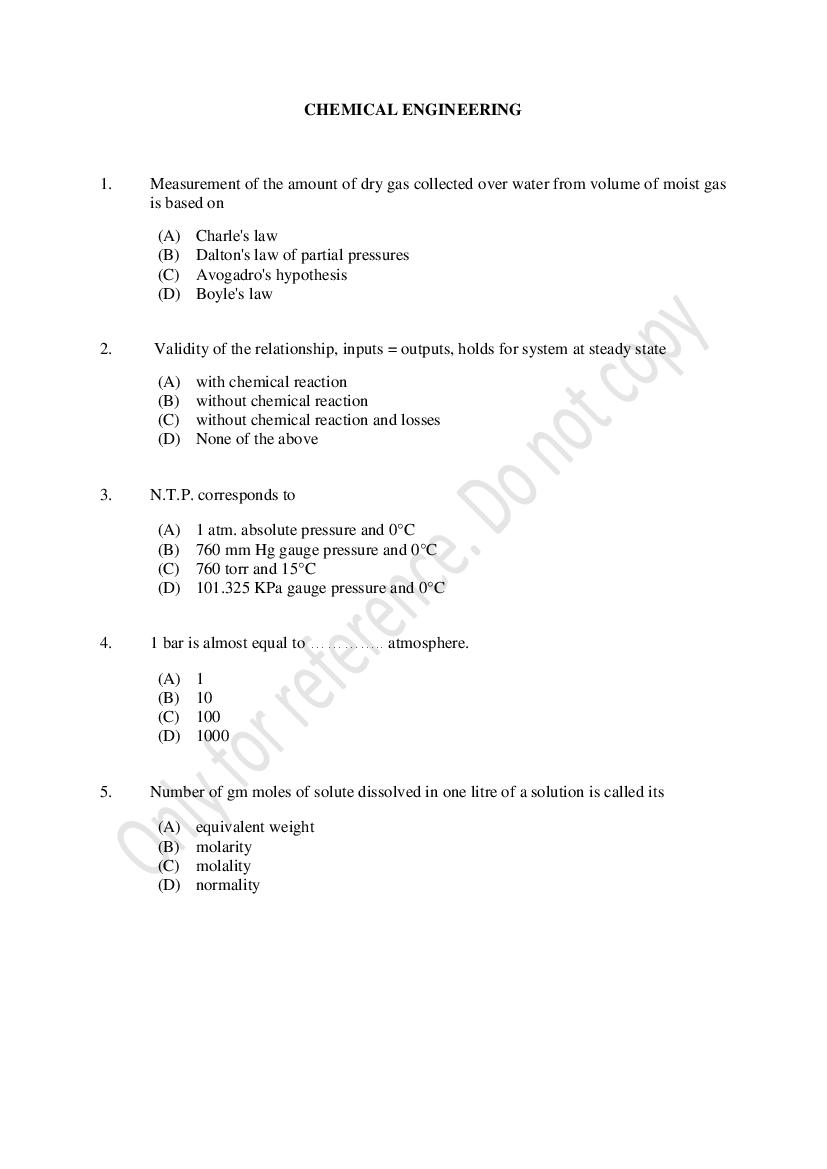
1. Measurement of the amount of dry gas collected over water from volume of moist gas
is based on
(A) Charle's law
(B) Dalton's law of partial pressures
(C) Avogadro's hypothesis
(D) Boyle's law
2. Validity of the relationship, inputs = outputs, holds for system at steady state
(A) with chemical reaction
(B) without chemical reaction
(C) without chemical reaction and losses
3. N.T.P. corresponds to
(A) 1 atm. absolute pressure and 0°C
(B) 760 mm Hg gauge pressure and 0°C
(C) 760 torr and 15°C
(D) 101.325 KPa gauge pressure and 0°C
4. 1 bar is almost equal to ………….. atmosphere.
(A) 1
(B) 10
(C) 100
(D) 1000
5. Number of gm moles of solute dissolved in one litre of a solution is called its
(A) equivalent weight
(B) molarity
(C) molality
(D) normality
Page 2
(A) normality
(B) molality
(C) molality
(D) equivalent weight
7. Number of gram equivalent of solute dissolved in one litre of solution is called its
(A) normality
(B) molarity
(C) molality
8. Kinetic theory of gas stipulates that, the
(A) energy is lost during molecular collisions
(B) molecules possess appreciable volume
(C) absolute temperature is a measure of the kinetic energy of molecules
9. For an ideal gas, the compressibility factor
(A) decreases with pressure rise
(B) is unity at all temperature
(C) is unity at Boyle's temperature
(D) zero
10. Real gases approach ideal behaviour at
(A) high pressure and high temperature
(B) low pressure and high temperature
(C) high pressure and low temperature
(D) low pressure and low temperature
11. Gases diffuse faster compared to liquids because of the reason
that the liquid molecules
(A) are held together by stronger intermolecular forces
(B) move faster
(C) have no definite shape
(D) are heavier
Page 3
(A) Boyle's law
(B) Amgat's law
(C) Raoult's law
(D) Trouton's rule
13. Volume percent for gases is equal to
(A) weight percent
(B) mole percent
(C) weight percent only for ideal gases
(D) mole percent only for ideal gases
14. A bypass stream in a chemical process is useful, because it
(A) facilitates better control of the process
(B) improves the conversion
(C) increases the yield of products
15. Average molecular weight of air is about
(A) 21
(B) 29
(C) 23
(D) 79
16. Pick out the correct statement.
(A) Heat of solution is always positive
(B) At equilibrium, G is zero
(C) For the reaction, PCl5 PCl3 + C12, H is less than E
(D) The heating of water in a beaker is an isolated system
17. An equation for calculating Vapour pressure is, log10 P =A – B/(t + c). This is called
(A) Kistyakowsky equation
(B) Antonie equation
(C) Kopp's rule
(D) Trouton's rule
Page 4
contact process are respectively
(A) V2O5 and Cr2Os
(B) Oxides of nitrogen and Cr2Os
(C) V2O5 on a porous carrier and oxides of nitrogen
(D) Oxides of Nitrogen and V2O5 on a porous carrier
19. Contact process
(A) yields acid of higher concentration than chamber process
(B) yields acids of lower concentration than chamber process
(C) is obsolete
(D) eliminates absorber
20. 20% oleum means that in 100 Kg, there are 20 Kg of
(A) SO2 and 80 Kg of H2SO4
(B) H2SO4 and 80 Kg of SO3
(C) SO3 for each 100 Kg of H2SO4
21. Producer gas consists mainly of
(A) CO, CO2, N2, H2
(B) CO, H2
(C) H2, CH4
(D) C2H2, CO2, H2
22. Oxygen is produced by fractionation of air using
(A) Linde's process
(B) Claude's process
(C) both Linde's and Claude's process
23. Raw materials for 'Solvay Process' for manufacture of the soda ash are
(A) salt, limestone and coke or gas
(B) ammonia, salt and limestone
(C) ammonia limestone and coke
Page 5
(A) carbonating tower
(B) ammonia recovery
(C) ammonia recovery and size of plant
(D) ammoniation of salt solution
25. Mercury cells for caustic soda manufacture, compared to diaphragm cells
(A) require lower initial investment
(B) require more power
(C) produce lower concentration NaOH
26. Cement mainly contains
(A) CaO, SiO2, Al2O3
(B) MgO, SiO2, K2O
(C) Al2O3, MgO, Fe2O3
(D) CaO, MgO, K2O
27. Gypsum is
(A) Calcium Chloride
(B) Potassium Sulphate
(C) Sodium Sulphate
(D) Calcium Sulphate
28. Glauber's salt is
(A) Calcium Sulphate
(B) Potassium Sulphate
(C) Potassium Chlorate
29. Widely used method for conditioning of boiler feed water is
(A) cold lime process
(B) coagulation
(C) hot-lime soda process
(D) sequestration
Page 6
(A) as a starting material for 'hypo'
(B) in photographic industry
(C) as rocket fuel
(D) in printing industry
31. Trinitro-toluene is
(A) used in glycerine manufacture
(B) an explosive
(C) used in dye manufacture
(D) None of the above
32. Oil is
(A) a mixture of glycerides
(B) a mixture of glycerides of fatty acids
(C) solid at normal temperature
(D) ester of alcohols other than glycerine
33. Wax is
(A) a mixture of glycerides
(B) a mixture of esters of Polyhydric alcohols excepting glycerine
(C) liquid at room temperature
(D) a mixture of glycerides of fatty acids
34. Unsaturated oils compared to saturated oils have
(A) lower melting point and higher reactivity to oxygen
(B) higher melting point and higher reactivity to oxygen
(C) lower melting point and lower reactivity to oxygen
(D) higher melting point and lower reactivity to oxygen
35. Rancidity of oil can be reduced by
(A) decoloration
(B) hydrogenation
(C) oxidation
(D) purification
Page 7
2
(A) cm /sec
(B) cm/sec
3
(C) cm /sec
2 2
(D) cm /sec
37. Molecular diffusion is caused by
(A) transfer of molecules from low concentration to high concentration region
(B) thermal energy of the molecules
(C) activation energy of the molecules
(D) potential energy of the molecules
38. Mass transfer co-efficient is defined as
(A) Flux = Co-efficient/concentration difference
(B) Co-efficient = Flux/concentration difference
(C) Flux = concentration difference/co-efficient
39. In physical terms, Schmidt number means
(A) thermal diffusivity/mass diffusivity
(B) thermal diffusivity/momentum diffusivity
(C) momentum diffusivity/mass diffusivity
(D) mass diffusivity/thermal diffusivity
40. At the same gas flow rate, the pressure drop in a packed tower being
irrigated with liquid ……………that in dry packed tower.
(A) is greater than
(B) is lower than
(C) is same as
(D) cannot be predicted as data are insufficient
41. Which of the following is an undesirable property in a tower packing?
(A) large surface per unit volume
(B) large free cross-section
(C) low weight per unit volume
(D) large weight of liquid retained
Page 8
(A) ideal solutions
(B) real solutions
(C) the mixture of water and alcohol
(D) non-ideal gases
43. Flash distillation is
(A) same as differential distillation
(B) used for multi component systems like crude refining
(C) same as simple distillation
(D) most useful for handling binary system
44. In a binary system, separation is very efficient when relative volatility is
(A) 1
(B) >1
(C) <1
(D) 0.5
45. Positive deviation from Raoult's law means a mixture whose total pressure is
(A) greater than that computed for ideality
(B) less than that computed for ideality
(C) less than the sum of the vapour pressure of the components
46. In azeotropic mixture, the equilibrium vapour composition is
(A) more than liquid composition
(B) less than liquid composition
(C) same as liquid composition
(D) independent of pressure
47. In rectifying section of a continuous distillation column
(A) vapour is enriched with low boilers
(B) vapour is enriched with high boilers
(C) liquid is stripped of high boilers
Page 9
(A) high temperature distillation
(B) for heat-sensitive materials
(C) very low pressure distillation
(D) Both (B) and (C)
49. In steam distillation, the
(A) temperature is 100°C
(B) temperature is more than 100°C
(C) product must be immiscible with water
(D) temperature is higher than the boiling point of either component
50. Steam distillation is used to separate
(A) azeotropes
(B) high boiling substances from non-volatile impurities
(C) heat sensitive materials
(D) mixtures of low relative volatility
51. What is the reflux ratio at total reflux?
(A) Zero
(B) Infinity
(C) Unity
(D) Data insufficient to predict
52. Which of the following is the most suitable for extraction in a system having very low
density difference?
(A) Mixer-settler extractor
(B) Centrifugal extractor
(C) Pulsed extractor
(D) Packed extraction tower
53. The solvent used in liquid extraction should not have high latent heat of
vaporisation, because
(A) the pressure drop and hence the pumping cost will be very high
(B) it cannot be recovered by distillation
(C) its recovery cost by distillation may be prohibitatively high
(D) it will decompose while recovering by distillation
Page 10
(A) temperature
(B) viscosity of solvent
(C) pressure
(D) size of the solid
55. Chemisorption (chemical adsorption) is
(A) same as "van der Waals" adsorption
(B) characterized by adsorption of heat
(C) an irreversible phenomenon
(D) a reversible phenomenon
56. Swenson-Walker crystalliser is a
(A) Continuous unit
(B) Batch unit
(C) Semi-batch unit
(D) Cooling (adiabatic)-cum-evaporation device
57. Moisture in a solid exerting an equilibrium vapour pressure equal to that of the pure
liquid at the same temperature is called
(A) Unbound moisture
(B) Critical moisture
(C) Free moisture
(D) Bound moisture
58. The falling rate period in the drying of a solid is characterized by
(A) increase in rate of drying
(B) increasing temperatures both on the surface and within the solid
(C) decreasing temperatures
59. Agitator is provided in a crystallizer for
(A) Avoiding deposition on cooler surfaces
(B) Formation of nuclei
(C) Crystal growth
(D) All (A), (B) and (C)
Page 11
(A) Separation of the constituents is the most effective
(B) No separation will occur
(C) Amount of solvent required will be minimum
(D) Solvent flow rate should be very low
61. Loss of heat from un lagged steam pipe to the ambient air is by
(A) conduction
(B) convection
(C) radiation
(D) All of the above
62. Fourier's law of heat conduction applies to
(A) convection
(B) radiation
(C) conduction
(D) All of the above
63. Fourier's law of heat conduction applies to
(A) isothermal surface
(B) non-isothermal surface
(C) Both (A) and (B)
64. Unsteady state heat conduction occurs when
(A) temperature distribution is independent of time
(B) temperature distribution is dependent on time
(C) heat flows in one direction only
(D) three dimensional heat flow is concerned
65. What is the unit of thermal conductivity?
2
(A) kcal/hr. m °C
(B) kcal/hr.m.°C
(C) kcal/hr.m
(D) kcal/hr. °C
Page 12
2
(A) BTU/hr. ft °F
(B) BTU/hr. °F. ft.
(C) BTU/hr. °F
(D) BTU/hr. ft
67. Which of the following is correct?
(A) Rate = Driving force × Resistance
(B) Driving force = Rate × Resistance
(C) Resistance = Driving force × Rate
(D) Rate = Resistance /Driving force
68. An insulator should have
(A) low thermal conductivity
(B) high thermal conductivity
(C) less resistance to heat flow
(D) a porous structure
69. Heat flux through several resistances in series is analogous to the current flowing
through several
(A) resistances in parallel
(B) capacitors in series
(C) resistances in series
70. The overall resistance, for heat transfer through a series of flat resistance,
is the …………… of the resistances.
(A) average
(B) geometric mean
(C) product
(D) sum
71. Which of the following has the highest thermal conductivity?
(A) Brick
(B) Air
(C) Water
(D) Silver
Page 13
(A) Logarithmic mean area
(B) Arithmetic mean area
(C) Geometric mean area
73. For heat flow through very thick walled cylinder, use
(A) arithmetic mean radius
(B) logarithmic mean radius
(C) geometric mean radius
(D) either (A) or (C)
74. What is the logarithmic mean of rl and r2?
(A) [(r1 – r2) / ln(r1/r2)]
(B) [(r1 – r2) / ln(r2/r1)]
(C) [(r2 – r1) / ln(r1/ r2]
(D) [(r1 – r2) / –ln(r1/r2)]
75. What is Nusselt number?
(A) Cp.μ / k
(B) hD / k
(C) h.Cp / μ
(D) Cp.μ / h
76. Prandtl number is
(A) Cp.μ / k
(B) hD / k
(C) Cp.μ / A
(D) μ / h.Cp
77. Thermal diffusivity is
(A) k / ρ.Cp
(B) ρ.Cp / k
(C) Cp.μ / a
(D) μ / hCp
Page 14
3 2 2
(A) gD .β.tρ / μ
2 2
(B) gD βtρ/ μ
2 2
(C) gD βtρ μ
3 2
(D) gD βtρ / μ
79. If h1 = inner film co-efficient and h2 = outer film co-efficient,
then the overall heat transfer co-efficient is
(A) always less, than h1
(B) always between h1 and h2
(C) always higher than h2
(D) dependent on metal resistance
80. Graetz number is
(A) mCp /kl
(B) kL / mCp
(C) mCp / k μ
(D) kL / mCp
81. Rate of a chemical reaction is independent of the concentration of
reactants for reaction.
(A) zero order
(B) third order
(C) consecutive
82. Which of the following is not a unit of reaction rate?
(A) moles formed/(surface of catalyst) (time)
(B) moles formed/(volume of reactor) (time)
(C) mole formed/(volume of catalyst) (time)
83. Which of the following is a controlling factor in very fast heterogeneous reaction?
(A) Heat and mass transfer effects
(B) Pressure
(C) Temperature
(D) Composition of reactant
Page 15
(A) pressure and temperature only
(B) temperature and composition only
(C) pressure and composition only
(D) pressure, temperature and composition
85. Rate determining step in a reaction consisting of a number of steps in series is the
(A) fastest step
(B) slowest step
(C) intermediate step
(D) data insufficient; can't be predicted
86. Chemical kinetics can predict the
(A) rate of reaction
(B) feasibility of reaction
(C) Both (A) and (B)
87. Velocity of a chemical reaction
(A) decreases with increase in temperature
(B) increases with increase of pressure of reactants for all reactions
(C) decreases with increase of reactant concentration
88. Sum of the powers of the concentration terms in the rate
equation is called the ……………….. of the reaction.
(A) order
(B) overall order
(C) molecularity
89. Molecularity of a reaction
(A) is always equal to the overall order of reaction
(B) may not be equal to the order of reaction
(C) can't have a fractional value
(D) Both (B) and (C)
Page 16
(A) unimolecular reaction with first order
(B) bimolecular reaction with second order
(C) bimolecular reaction with first order
(D) unimolecular reaction with second order
91. Concentration of the limiting reactant (with initial concentration of a moles/litre) after
time t is (a – x). Then t for a first order reaction is given by
(A) k.t = ln (a / (a – x))
(B) k.t = x / [a(a – x)]
(C) k.t = ln [(a – x) / a]
(D) k.t = [(a(a – x) / x]
92. Half life period of a chemical reaction is
(A) the time required to reduce the concentration of
the reacting substance to half its initial value
(B) half of the space time of a reaction
(C) half of the residence time of a reaction
(D) None of the above
93. Half-life period for a first order reaction is …………… the initial
concentration of the reactant.
(A) directly proportional to
(B) inversely proportional to
(C) independent of
94. The reaction in which rate equation corresponds to a stoichiometric equation is called
(A) elementary reaction
(B) non-elementary reaction
(C) parallel reaction
(D) autokinetic reaction
95. Equilibrium of a chemical reaction as viewed by kinetics is a
(A) dynamic steady state
(B) static steady state
(C) dynamic unsteady state
Page 17
(A) increase of reaction time
(B) increase in initial concentration
(C) total pressure
(D) decrease in total pressure
97. Arrhenius equation shows the variation of …………… with temperature.
(A) reaction rate
(B) rate constant
(C) energy of activation
(D) frequency factor
98. A fluid is one which
(A) cannot remain at rest under the action of shear force
(B) continuously expands till it fills any container
(C) is incompressible
(D) permanently resists distortion
99. In an incompressible fluid, density
(A) is greatly affected by moderate changes in pressure
(B) is greatly affected only by moderate changes in temperature
(C) remains unaffected with moderate change in temperature and pressure
(D) is sensible to changes in both temperature and pressure
100. Potential flow is the flow of
(A) compressible fluids with shear
(B) compressible fluids with no shear
(C) incompressible fluids with shear
(D) incompressible fluids with no shear
101. Potential flow is characterised by
(A) irrotational and frictionless flow
(B) irrotational and frictional flow
(C) one in which dissipation of mechanical energy into heat occurs
(D) the formation of eddies within the stream
Page 18
(A) shear stress and velocity
(B) velocity gradient and pressure intensity
(C) shear stress and rate of angular deformation in a fluid
(D) pressure gradient and rate of angular deformation
103. Dimension of viscosity is
–1 –1
(A) ML T
–1
(B) MLT
–1
(C) ML T
(D) MLT
104. Poise is converted into stoke by
(A) multiplying with density (gm/c.c.)
(B) dividing by density (gm/c.c.)
(C) multiplying with specific gravity
(D) dividing by specific gravity
105. Dimension of kinematic viscosity is
–1
(A) MLT
2 –1
(B) L .T
2
(C) L .T
2 –2
(D) L .T
106. With increase in the temperature, viscosity of a liquid
(A) increases
(B) decreases
(C) remains constant
(D) may increase or decreases depends on the liquid
107. For water, when the pressure increases, the viscosity
(A) also increases
(B) decreases
(C) remains constant
(D) first decreases and then increases
Page 19
(A) only when the fluid is frictionless
(B) only when the fluid is at rest having zero velocity
(C) when there is no motion of one fluid layer relative to an adjacent layer
(D) regardless of the motion of one fluid layer relative to an adjacent layer
109. Choose the set of pressure intensities that are equivalent
(A) 4.33 psi, 10 ft. of water, 8.83 inches of Hg
(B) 4.33 psi, 10 ft. of water, 20.7 inches of Hg
(C) 10 psi, 19.7 ft. of water, 23.3 inches of Hg
(D) 10 psi, 19.7 ft. of water, 5.3 inches of Hg
110. For a fluid rotating at constant angular velocity about vertical axis as a rigid body,
the pressure intensity varies as the
(A) square of the radial distance
(B) radial distance linearly
(C) inverse of the radial distance
(D) elevation along vertical direction
111. The centre of pressure is
(A) always below the centroid of the area
(B) always above the centroid of the area
(C) a point on the line of action of the resultant force
(D) at the centroid of the submerged area
112. Mass velocity is independent of temperature and pressure when the flow is
(A) unsteady through unchanged cross-section
(B) steady through changing cross-section
(C) steady and the cross-section is unchanged
(D) unsteady and the cross-section is changed
113. In turbulent flow
(A) the fluid particles move in an orderly manner
(B) momentum transfer is on molecular scale only
(C) shear stress is caused more effectively by cohesion than momentum transfer
(D) shear stresses are generally larger than in a similar laminar flow
Page 20
(A) frictionless and incompressible
(B) one which obeys Newton's law of viscosity
(C) highly viscous
115. Shape factor for a cylinder whose length equals its diameter is
(A) 1.5
(B) 0.5
(C) 1
116. The ratio of the actual mesh dimension of Taylor series to that of the
next smaller screen is
(A) 2
(B) 2
(C) 1
(D) None of the above
117. The opening of 200 mesh screen (Taylor series) is
(A) 0.0074 cm
(B) 0.0074 mm
(C) 0.0047 cm
118. The ratio of the area of openings in one screen (Taylor series)to that of the openings
in the next smaller screen is
(A) 1.5
(B) 1
(C) 2
(D) None of the above
119. Cumulative analysis for determining surface is more precise than differential analysis
because of the
(A) assumption that all particles in single fraction are equal in size
(B) fact that screening is more effective
(C) assumption that all particles in a single fraction are equal in size, is not needed
Page 21
(A) impact
(B) attrition
(C) compression
(D) cutting
121. Soft and non-abrasive materials can be made into fines by
(A) attrition
(B) compression
(C) cutting
122. Crushing efficiency is the ratio of
(A) surface energy created by the crushing to the energy absorbed by the solid
(B) the energy absorbed by the solid to that fed to the machine
(C) the energy fed to the machine to the surface energy created by the crushing
(D) the energy absorbed by the solid to the surface energy created by the crushing
123. Rittinger's crushing law states that
(A) work required to form a particle of any size is proportional to the square of the
surface to volume ratio of the product
(B) work required to form a particle. of a particular size is proportional to the
square root of the surface to volume ratio of the product
(C) work required in crushing is proportional to the new surface created
(D) for a given machine and feed, crushing efficiency is dependent on the size of
feed and product
124. Bond crushing law
(A) calls for relatively less energy for the smaller product particles than does the
Rittinger law
(B) is less realistic in estimating the power requirements of commercial crushers
(C) states that the work required to form particle of any sizefrom very large feed is
proportional to the square root of the volume to surface ratio of the product
(D) states that the work required for the crushing is proportional to the new surface
created
Page 22
(A) Gross energy (kWh/ton of feed) needed to reduce very large feed to such a size
that 80% of the product passes a 100 micron screen
(B) energy needed to crush one tonne of feed to 200 microns
(C) energy (kWh/ton of feed) needed to crush small feed to such a size that 80% of
the product passes a 200 mesh screen
(D) energy needed to crush one ton of feed to 100 microns
126. The operating speed of a ball mill should be ……………… the critical speed.
(A) less than
(B) much more than
(C) at least equal to
127. A fluid energy mill is used for
(A) cutting
(B) grindling
(C) ultragrinding
(D) crushing
128. Wet grinding in a revolving mill
(A) gives less wear on chamber walls than dry grinding
(B) requires more energy than for dry grinding
(C) increases capacity compared to dry grinding
(D) complicates handling of the product compared to dry grinding
129. Cement clinker is reduced to fine size by
(A) Roll crusher
(B) Ball mill
(C) Tube mill
(D) Hammer mill
130. Mixer used for rubber compounding is
(A) Mixer-extruders
(B) Banbury internal mixer
(C) Muller mixer
Page 23
(A) Pug mill
(B) Mixer-extruder
(C) Banbury mixer
(D) Muller mixer
132. For the preliminary breaking of hard rock, we use
(A) gyratory crusher
(B) ball mill
(C) tube mill
(D) squirrel-cage disintegrator
133. Fibrous material is broken by
(A) Roll crusher
(B) Squirrel-cage disintegrator
(C) Ball mil
134. Pick out the first order system from among the following.
(A) damped vibrator
(B) mercury in glass thermometer kept in boiling water
(C) interacting system of two tanks in series
(D) non-interacting system of two tanks in series
135. Response of a system to a sinusoidal input is called
(A) impulse response
(B) unit step response
(C) frequency response
136. Time constant is
(A) the time taken by the controlled variable to reach 63.2% of its full change
(B) same as transportation lag
(C) same as dead time
(D) the time required by the measured variable to reach 63.2% of its ultimate
change
Page 24
(A) same as time constant
(B) same as transportation lag
(C) the maximum change in the variable that does not change the reading of the
instrument
(D) None of the above
138. For measuring the temperature of a red hot furnace, which is the most
suitable instrument?
(A) Platinum resistance thermometer
(B) Thermocouple
(C) Optical pyrometer
(D) Bimetallic thermometer
139. Pick out the most suitable instrument for measuring temperature in the
range of –40 to 425°C.
(A) mercury thermometer
(B) bimetallic thermometer
(C) radiation pyrometer
140. Thermocouple is suitable for measuring
(A) liquid temperatures only
(B) very high temperatures only
(C) very low temperatures only
(D) both high and low temperatures
141. Psychrometer determines
(A) humidity of gases
(B) moisture content of solids
(C) water of crystallisation
(D) hygroscopic nature of solids
142. Continuous measurement of moisture content of paper in
paper industry is done by measuring
(A) thermal conductivity through the paper
(B) electrical resistance through the paper
(C) magnetic susceptibility
Page 25
(A) polarimeter
(B) polarograph
(C) dilatometer
(D) refractrometer
144. Pirani gauge is used for
(A) measurement of very high pressure
(B) measurement of high vacuum
(C) liquid level under pressure
(D) liquid level at atmospheric pressure
145. A barometer measures …………… pressure.
(A) absolute
(B) gauge
(C) both absolute and gauge
(D) dynamic
146. Continuous measurement of specific gravity of a liquid is done by
(A) hydrometer
(B) contact-type electric indicators
(C) displacement meter
(D) Both (A) and (C)
147. Which of the following is a thermodynamic property of a system?
(A) Concentration
(B) Mass
(C) Temperature
(D) Entropy
148. First law of thermodynamics is mathematically stated as
(A) dQ = dE + dW
(B) dQ = dE – dW
(C) dE = dQ + dW
(D) dW = dQ + De
Page 26
depends upon
(A) the two temperatures only
(B) the pressure of working fluid
(C) the mass of the working fluid
(D) both mass and pressure of the working fluid
150. Efficiency of a Carnot engine working between temperatures Tl and T2 (Tl < T2) is
(A) [(T2 – T1) /T2 ]
(B) [(T2 – T1) /T1 ]
(C) [(T1 – T2) /T2 ]
(D) [(T1 – T2) /T1 ]
Page 27
Subject Name: 603 CHEMICAL ENGINEERING
SI No. Key SI No. Key SI No. Key SI No. Key SI No. Key
1 B 31 B 61 D 91 A 121 A
2 C 32 B 62 C 92 A 122 A
3 A 33 B 63 C 93 C 123 C
4 A 34 A 64 B 94 A 124 A
5 B 35 B 65 B 95 A 125 A
6 C 36 A 66 A 96 A 126 A
7 A 37 B 67 B 97 B 127 C
8 C 38 B 68 A 98 A 128 C
9 B 39 C 69 C 99 C 129 C
10 B 40 A 70 D 100 D 130 B
11 A 41 D 71 D 101 A 131 A
12 C 42 A 72 A 102 C 132 A
13 D 43 B 73 B 103 A 133 B
14 A 44 B 74 A 104 B 134 B
15 B 45 A 75 B 105 B 135 C
16 B 46 C 76 A 106 B 136 A
17 B 47 B 77 A 107 D 137 C
18 D 48 D 78 A 108 C 138 C
19 A 49 C 79 B 109 A 139 B
20 A 50 B 80 A 110 A 140 D
21 A 51 B 81 A 111 C 141 A
22 C 52 B 82 D 112 C 142 B
23 B 53 C 83 A 113 D 143 A
24 C 54 A 84 D 114 A 144 B
25 D 55 C 85 B 115 A 145 A
26 A 56 A 86 A 116 B 146 D
27 D 57 A 87 D 117 A 147 D
28 D 58 B 88 B 118 D 148 A
29 C 59 D 89 D 119 C 149 A
30 C 60 B 90 C 120 C 150 A
Document Details
| Board / Org | Cochin University |
| Exam | CUSAT Common Admission Test |
| Type | Question Paper |
| Pages | 27 |
| Language | english |
| Updated | 22 Jul 2026 |