HBSE Class 12 Question Paper 2019 English Core
Finished viewing? Save it for later —
Download HBSE Class 12 Question Paper 2019 English Core (PDF · 64 pages)About HBSE Class 12 Question Paper 2019 English Core
HBSE Class 12 Question Paper 2019 English Core is available here for free download. Published by Haryana Board for Class 12, this question paper can be viewed online or downloaded as a PDF (64 pages). Candidates preparing for Class 12 can use HBSE Class 12 Question Paper 2019 English Core to understand the exam pattern, the type of questions asked, and the overall difficulty level.
Frequently Asked Questions
How can I download HBSE Class 12 Question Paper 2019 English Core?
Open this page and click the Download button to save HBSE Class 12 Question Paper 2019 English Core as a PDF. It is completely free on AglaSem Docs.
Is HBSE Class 12 Question Paper 2019 English Core free to download?
Yes. HBSE Class 12 Question Paper 2019 English Core can be viewed online and downloaded as a PDF free of cost on AglaSem Docs.
How many pages does HBSE Class 12 Question Paper 2019 English Core have?
HBSE Class 12 Question Paper 2019 English Core contains 64 pages, which you can read online or download together as a single PDF.
Where can I find more Class 12 study material?
You can find more Class 12 question papers, sample papers, syllabus, and answer keys on AglaSem Docs.
HBSE Class 12 Question Paper 2019 English Core – Text
Read the full text of this question paper below — useful to quickly search, copy and reference the content online without downloading the PDF.
📄 View text version (64 pages)
Page 1
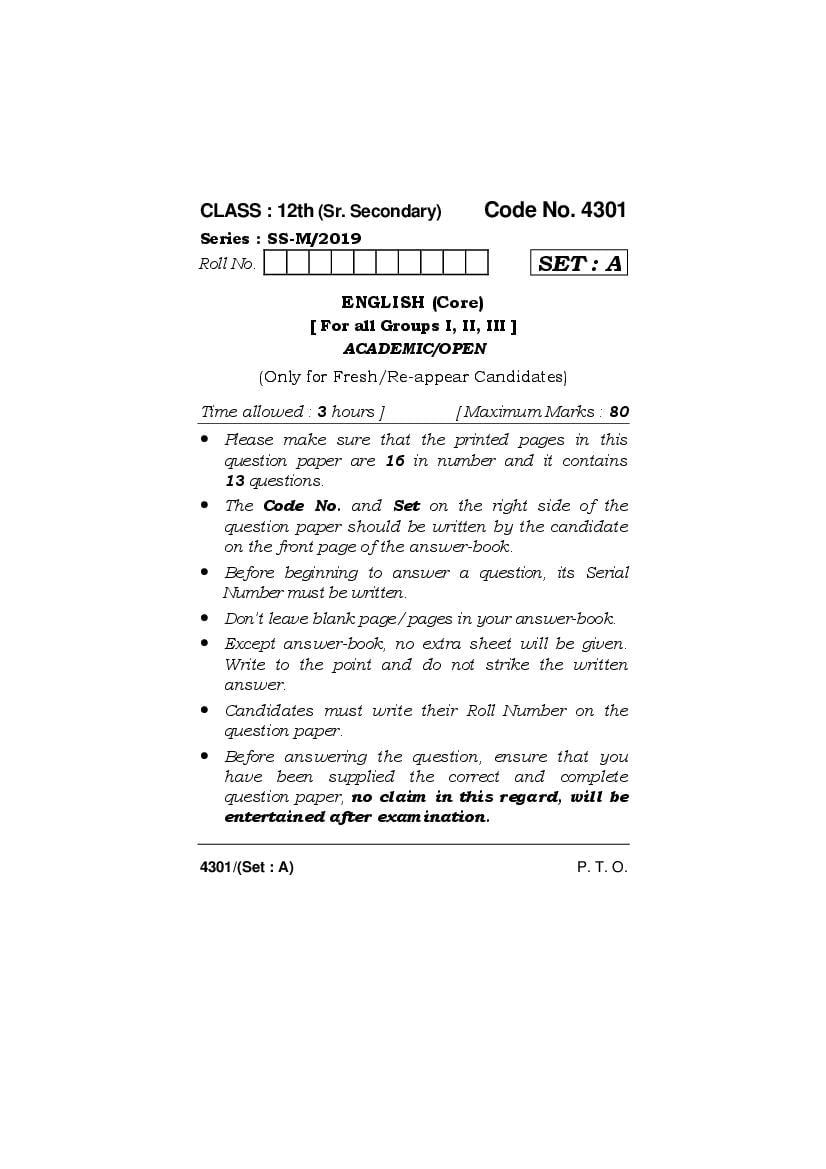
Series : SS-M/2019
Roll No. SET : A
ENGLISH (Core)
[ For all Groups I, II, III ]
ACADEMIC/OPEN
(Only for Fresh/Re-appear Candidates)
Time allowed : 3 hours ] [ Maximum Marks : 80
• Please make sure that the printed pages in this
question paper are 16 in number and it contains
13 questions.
• The Code No. and Set on the right side of the
question paper should be written by the candidate
on the front page of the answer-book.
• Before beginning to answer a question, its Serial
Number must be written.
• Don’t leave blank page / pages in your answer-book.
• Except answer-book, no extra sheet will be given.
Write to the point and do not strike the written
answer.
• Candidates must write their Roll Number on the
question paper.
• Before answering the question, ensure that you
have been supplied the correct and complete
question paper, no claim in this regard, will be
entertained after examination.
4301/(Set : A) P. T. O.
Page 2
General Instructions :
(i) This question paper is divided into four
Sections : A, B, C and D.
(ii) All the sections are compulsory.
(iii) Attempt all the parts of a question together.
(iv) Stick to the word-limit wherever prescribed.
SECTION – A
(Reading Skills) [ M. M. : 9
1. Read the following passage given below and
answer the questions that follow :
New Year is the time for resolution. Mentally, at
least most of us could compile formidable lists of
'do's and don'ts'. The same old favourites recur
year in and year out with monotonous
regularity. We resolve to get-up early each
morning, eat healthy food, exercise, be nice to
people we don't like and find more time for our
parents. Past experience has taught us that
certain accomplishments are beyond attainment.
If we remain deep rooted liars, it is only because
we have so often experienced the frustration that
results from failure. Most of us fail in our efforts,
at self-improvement because our schemes are
too ambitious and we never have time to carry
them out. We also 'make the fundamental error
of announcing our resolution to everybody so
that we look even more foolish when we slip
back into our bad old ways. Aware of these
pitfalls, this year I attempted to keep my
resolutions to myself. I limited myself to two
modest ambitions, to do physical exercise every
morning and to read more in the evening. An
overnight party on New Year's Eve provided me
with a good excuse for not carrying out either of
these new resolutions on the first day of the
year, but on the second, I applied myself
diligently to the task. The daily exercise lasted
only eleven minutes and I proposed to do them
4301/(Set : A)
Page 3
early in the morning before anyone had got up.
The self-discipline required to drag myself out of
bed eleven minutes earlier than usual was
considerable. Nevertheless, I managed to creep
down into the living room for two days before
anyone found me out. After jumping about on
the carpet and twisting the human frame into
uncomfortable positions, I sat down at the
breakfast table in an exhausted condition. It was
this that betrayed me. The next morning the
whole family trooped in to watch the
performance. That was really unsettling but I
fended off the taunts and jibes of the whole
family good-humouredly and soon everybody got
used to the idea. However, my enthusiasm
waned. The time I spent at exercises gradually
diminished. Little by little the eleven minutes fell
to zero. By January 10th, I was back to where I
had started from. I argued that if I spent less
time exhausting myself at exercises in the
morning, I would keep my mind fresh for reading
when I got home from work. Resisting the
hypnotising effect of television, I sat, in my room
for a few evenings with my eyes glued to a book.
One night, however, feeling cold and lonely, I
went downstairs and sat in front of the television
pretending to read. That proved to be my
undoing, for I soon got back to the old bad habit
of dozing off in front of the screen. I still haven't
given up my resolution to do more reading. In
fact, I have just bought a book entitled 'How to
Read a Thousand Words a Minute'. Perhaps it
will solve my problem, but I just have not had
time to read it.
Questions : 1×4=4
(i) What were the writer's two resolutions ?
(a) Physical exercise in the morning
(b) Read more in the evening
(c) Both (a) and (b)
(d) Not to make more resolutions
4301/(Set : A) P. T. O.
Page 4
(ii) How much time did the daily exercise last
initially ?
(a) 10 minutes
(b) 11 minutes
(c) 5 minutes
(d) 8 minutes
(iii) How many days did the narrator continue
his resolution ?
(a) 8 days
(b) 9 days
(c) 10 days
(d) 7 days
(iv) Which book did the narrator buy ?
(a) How to read a thousand words a minute
(b) How to be a good reader
(c) How to be firm on your resolutions
(d) The importance of exercising
OR
Many of us believe that 'small' means
'insignificant'. We believe that small actions and
choices do not have much impact on our lives.
We think that it is only the big things, the big
actions and the big decisions that really count.
But when you look at the lives of all great
people, you will see that they built their
character through small decisions, small choices
and small actions that they performed every day.
They transformed their lives through a step-by-
step or day-by-day approach. They nurtured and
nourished their good habits and chipped away at
their bad habits, one step at a time. It was their
small day-to-day decisions that added up to
make tremendous difference in the long run.
Indeed, in matters of personal growth and
4301/(Set : A)
Page 5
character building, there is no such thing as an
overnight success.
Growth always occurs through a sequential
series of stages. There is an organic process to
growth. When we look at children growing up,
we can see this process at work; the child first
learns to crawl, then to stand and walk, and
finally to run. The same is true in the natural
world. The soil must first be tilled, and then the
seed must be sowed. Next, it must be nurtured
with enough water and sunlight, and only then
will it grow, bear fruit and finally ripen and be
ready to eat.
Gandhi understood this organic process and
used this universal law of nature to his benefit.
Gandhi grew in small ways, in his day-to-day
affairs. He did not wake up one day
and find himself to be the "Mahatama". In fact,
there was nothing much in his early life that
showed signs of greatness. But from his mid-
twenties onwards, he deliberately and
consistently attempted to change himself, reform
himself and grow in some small way every day.
Day-by-day, hour-by-hour, he risked failure,
experimented and learnt from mistakes. In small
and large situations alike, he took up rather
than avoid responsibility. People have always
marvelled at the effortless way in which Gandhi
could accomplish the most difficult tasks. He
displayed great deal of self-mastery and
discipline that was amazing. These things did
not come easily to him. Years of practice and
disciplined training went into making his
successes possible. Very few saw his struggles,
fears, doubts and anxieties, or his inner efforts
to overcome them. They saw the victory, but not
the struggle. This is a common factor in the lives
of all great people: they exercised their freedoms
and choices in small ways that made great
impact on their lives and their environment.
4301/(Set : A) P. T. O.
Page 6
Each of their small decisions and actions,
added up to have a profound impact in the long
run. By understanding this principle, we can
move forward, with confidence, in the direction
of our dreams. Often when our "ideal goal" looks
too far from us, we become easily discouraged,
disheartened and pessimistic. However, when we
choose to grow in small ways, taking small steps
one at a time, performing it becomes easy.
Questions : 1×4=4
(i) The main idea in the first paragraph is that :
(a) Big things, big actions and big decisions
make a person great
(b) Small actions and decisions are
important in one's life
(c) Overnight success is possible for all of us
(d) Personal changes are not important
(ii) What does the writer mean by saying
'chipped away at their bad habits' ?
(a) Steadily gave up bad habits
(b) Slowly produced bad habits
(c) Gradually criticized bad habits
(d) Did not like bad habits
(iii) Which of the following statements is true in
the context of the third paragraph ?
(a) Gandhi became great overnight
(b) Gandhi showed signs of greatness in
childhood itself
(c) Every day Gandhi made efforts to change
himself in some small way
(d) Gandhi never made mistakes
4301/(Set : A)
Page 7
(iv) What is done by great people to transform
their lives ?
(a) They approach life on a day-by-day basis
(b) They build character in small ways
(c) They believe in performing everyday
(d) All of these
2. Read the following passage carefully and make
notes on it using headings and sub-headings.
Supply an appropriate title also : 4+1=5
The small village of Somnathpur contains an
extraordinary temple, built around 1268 A.D. by
the Hoyasalas of Karnataka – one of the most
prolific temple-builders. Belur and Helebid are
among their better-known works. 'While these
suffered during the invasions of the 14th
century, the Somnathpur temple stands more or
less intact in near-original condition. This small
temple captivates the beauty and vitality of its
detailed sculpture, covering almost every inch of
the walls, pillars and even ceilings. It has three
shikharas and stands on a star-shaped, raised
platform with 24 edges. The outer walls have a
profusion of detailed carvings: the entire surface
run over by carved plaques of stone. There were
vertical panels covered by exquisite figures of
gods and goddesses with many incarnations
being depicted. There were nymphs too, some
carrying an ear of maize – a symbol of plenty
and prosperity. The elaborate ornamentation,
the very characteristic of Hoyasala sculptures,
was a remarkable feature. On closer look – and
it is worth it – the series of friezes on the outer
walls revealed intricately carved caparisoned
(covered decorative cloth) elephants, charging
horsemen, stylized flowers, warriors, musicians,
crocodiles, and swans. The temple was actually
commissioned by Soma Dandanayaka or
4301/(Set : A) P. T. O.
Page 8
Somnath (he named the village after himself),
the minister of the Hoyasala king, Narasimha,
the third. The temple was built to house three
versions of Krishna. The inner center of the
temple was the Kalyana Mandapa. Leading from
here 'were three corridors each ending in a
shrine, one for each kind of Krishna –
Venugopala, Janardana and Prasanna Keshava,
though only two remain in their original form. In
the, darkness of the sanctum sanctorum, I tried
to discern the different images. The temple's
sculptural perfection is amazing and it includes
the doors of the temple and the three elegantly
carved towers.
SECTION – B
(Grammar/Writing Skills) [ M. M. : 26
3. Attempt any two from each sub-part :
(a) Change the form of narration : 1×2=2
(i) "I have read a new novel by R. K.
Narayan", said Monika.
(ii) "Do you wish to open an account ?" the
manager asked the customer.
(iii) "Bravo! Well done!", he said.
(b) Supply articles wherever necessary : 1 × 2 = 2
(i) We buy ………. oil by the litre.
(ii) ………. great Shakespeare committed
grammatical errors.
(iii) ………. rich should help the poor.
(c) Fill in the blanks with suitable modal
auxiliary verbs given in the brackets : 1 × 2 = 2
(i) She expects that her son …….. return.
(may/can)
4301/(Set : A)
Page 9
(ii) She advised that I ……… curtail
expenditure. (should/can)
(iii) She ……… not have left alone as it was
raining heavily. (can/must)
(d) Change the voice : 1×2=2
(i) He encourages me.
(ii) Please come soon.
(iii) It is impossible to do.
(e) Use the correct form of verbs given in the
brackets : 1×2=2
(i) More men than one ……. absent today.
(was/were)
(ii) Neither of the two boys …….... done it.
(has/have)
(iii) What evidence ………… these acts ?
(is/are)
4. Attempt any two of the following : 3×2=6
(a) The Residents' Welfare Association, Model
Town, Narnaul is organising a 'Diwali Fete' in
the locality. As the President of the
Association, draft a notice in not more than
50 words informing the residents about the
same. Give other essential detail too.
(b) You are Rama/Radha, General Manager of
Hotel Grand, Rohtak. You need a
receptionist for your hotel. Draft an
advertisement in not more than 50 words to
be published in "The Tribune", giving all the
relevant details.
4301/(Set : A) P. T. O.
Page 10
(c) Design a poster creating awareness on the
'Need to grow more trees'.
5. Attempt any one of the following : 5
(a) You are Bhavan/Bhavika. As an active
member of the Mountaineering Club of your
school, you had participated in a summer
camp organised by the Indian
Mountaineering Association. Write a report
on the camp and its activities for your school
newsletter in about 150-200 words.
(b) Write a paragraph of about 100 words on
"Importance of Yoga".
6. You are Kazim/Kumud of 148, Raj Nagar,
Jhajjar. You are awaiting your class XII results.
Meanwhile, you would like to do a short-term
course on etiquette development. Write a letter
to The Director, Personal Care, Rohtak enquiring
about the course detail. (125-150 words) 5
SECTION – C
(A) Main Reader [ Prose ] [ M. M. : 20
7. Read the passage given below and answer the
questions that follow :
I started for school very late that morning and
was in great dread of a scolding, especially
because M. Hamel had said that he would
question us on participles, and I did not know
the first word about them. For a moment I
4301/(Set : A)
Page 11
thought of running away and spending the day
out of doors. It was so warm, so bright! The
birds were chirping at the edge of the
woods; and in the open field back of the sawmill
the Prussian soldiers were drilling. It was all
much more tempting than the rule for
participles, but I had the strength to resist, and
hurried off to school.
Questions : 1×5=5
(i) Name the chapter from which this passage
has been taken :
(a) The Last Lesson
(b) Lost Spring
(c) Deep Water
(d) The Rattrap
(ii) Who does 'I' refer to these lines ?
(a) M. Hamel
(b) Franz
(c) Alphonse Daudet
(d) None of the above
(iii) M. Hamel was going to ask the questions on :
(a) gerunds
(b) infinitives
(c) participles
(d) tenses
(iv) What was the narrator full of ?
(a) fear
(b) pain
(c) happiness
(d) all of the above
4301/(Set : A) P. T. O.
Page 12
(v) Who was M. Hamel ?
(a) the narrator's neighbour
(b) the narrator's father
(c) the narrator's teacher
(d) the narrator's friend
OR
The makeup room had the look of a hair-cutting
salon with lights at all angles around half a
dozen large mirrors. They were all incandescent
lights, so you can imagine the fiery misery of
those subjected to makeup. The makeup
department was first headed by a Bengali who
became too big for the studio and left. He was
succeeded by a Maharashtrian who was assisted
by a Dharwar Kannadiga, an Andhra, a Madras
Indian Christian, an Anglo-Burmese and the
usual local Tamils. All this shows that there was
a great deal of national integration long before
A.I.R and Doordarshan began broadcasting
programmes on national integration.
Questions : 1×5=5
(i) Name the chapter from which this passage
has been taken :
(a) Indigo
(b) Poets and Pancakes
(c) The Interview
(d) Going Places
4301/(Set : A)
Page 13
(ii) How did the makeup room look ?
(a) like a hair-cutting saloon
(b) like a junk-shop
(c) both (a) and (b)
(d) neither (a) nor (b)
(iii) Of the following who headed the makeup
department first of all ?
(a) A Maharashtrian
(b) A Tamil
(c) A Bengali
(d) All of the above
(iv) The makeup room presented a picture of :
(a) Social discrimination
(b) The rich and the poor
(c) National Integration
(d) None of the above
(v) Which of the following contributed to
National Integration ?
(a) All India Radio (A.I.R.)
(b) Doordarshan
(c) Both (a) and (b)
(d) None of the above
8. Answer any one of the following : 5
How do you estimate M. Hamel as a man with a
ruler and as a man with a gesture ?
4301/(Set : A) P. T. O.
Page 14
OR
How did Douglas develop an aversion to water ?
9. Answer any five of the following : 2 × 5 = 10
(i) How was M. Hamel's class different the day
Franz went late to school ?
(ii) How is Mukesh's attitude to his situation
different from that of his family ?
(iii) Why did Douglas go to Lake Wentworth in
New Hampshire ?
(iv) Why didn't the stranger tell the ironmaster
that he was not Nils Olof ?
(v) Why did Gandhiji go to Lucknow in
December 1916 ? Who met him there and
why ?
(vi) Why did Sophie wish to become an actress ?
(vii) What was the autograph riddle ? Could it be
solved ?
SECTION – C
(B) Main Reader [ Poetry ] [ M. M. : 11
10. Read the stanza given below and answer the
questions that follow :
Driving from my parent's home to
Cochin last Friday morning,
I saw my mother, beside me,
doze, open mouthed, her face ashen like that
of a corpse and realised with pain
4301/(Set : A)
Page 15
that she was as old as she looked but soon
put that thought away, and looked out at young
Trees sprinting, the merry children spilling
out of their homes, ....
Questions :
(i) Name the poem and poet. 2
(ii) Where was the poet going to and with
whom ? 1
(iii) What did the daughter notice inside the car ?
1
(iv) In what state is the mother now ? 1
OR
The stunted, unlucky heir
Of twisted bones, reciting a father's gnarled
disease,
His lesson, from his desk. At the back of the dim
class
One un-noted, sweet and young.
Questions :
(i) Name the poem and poet. 2
(ii) Who is the unlucky heir ? 1
(iii) What will he inherit ? 1
(iv) Who is sitting at the back of the dim class ? 1
11. Answer any two of the following : 3×2=6
(i) Compare the world inside the car and
outside the car.
(ii) Do you think the poet, Pablo Neruda
advocates total inactivity and death ?
Why/Why not ?
(iii) List the things that cause suffering and pain.
(A Thing of Beauty)
4301/(Set : A) P. T. O.
Page 16
SECTION – D
(Supplementary Reader) [ M. M. : 14
12. Answer any one of the following : 5
When did the Tiger King stand in danger of
losing his kingdom ? How was he able to avert
the danger ?
OR
"If all the Japanese were like you, there wouldn't
have been a war" said Tom. Justify his
statement.
13. Answer any three of the following : 3×3=9
(i) Why did the Maharaja decide to get
married ?
(ii) How did Roger Skunk pay the wizard ?
(iii) How does Mr. Lamb try to remove the
baseless fears of Derry ?
(iv) Who do you think has outwitted the other –
Evans or the Governor ? How ?
S
4301/(Set : A)
Page 17
Series : SS-M/2019
Roll No. SET : B
ENGLISH (Core)
[ For all Groups I, II, III ]
ACADEMIC/OPEN
(Only for Fresh/Re-appear Candidates)
Time allowed : 3 hours ] [ Maximum Marks : 80
• Please make sure that the printed pages in this
question paper are 16 in number and it contains
13 questions.
• The Code No. and Set on the right side of the
question paper should be written by the candidate
on the front page of the answer-book.
• Before beginning to answer a question, its Serial
Number must be written.
• Don’t leave blank page / pages in your answer-book.
• Except answer-book, no extra sheet will be given.
Write to the point and do not strike the written
answer.
• Candidates must write their Roll Number on the
question paper.
• Before answering the question, ensure that you
have been supplied the correct and complete
question paper, no claim in this regard, will be
entertained after examination.
4301/(Set : B) P. T. O.
Page 18
General Instructions :
(i) This question paper is divided into four
Sections : A, B, C and D.
(ii) All the sections are compulsory.
(iii) Attempt all the parts of a question together.
(iv) Stick to the word-limit wherever prescribed.
SECTION – A
(Reading Skills) [ M. M. : 9
1. Read the following passage given below and
answer the questions that follow :
I had submitted an article 'Reforming our
education system' recently wherein the need for
our educational system to shift its focus from
insisting upon remembering to emphasizing or
understanding was stressed upon. This article
brought back the memory of an interesting
conversation between my daughter and myself in
the recent times wherein I had learnt that
Economics and Physics were a few of the most
difficult subjects for her as she had to mug up
the answers. Though I offered to help her out
with the immediate problem on hand, I learnt
subsequently that many a time it pays to mug
up the answer properly because the teachers
find it easier to evaluate that way. It seems, the
more deviation there is from the way the
sentences are framed in the textbook, the more
risk one runs of losing marks on that count
many a time. This reminded me of a training
session I had attended at work wherein we were
required to carry out an exercise of joining the
dots that were drawn in rows of three without
lifting the pen and without crossing the trodden
path more than once Though the exercise
seemed quite simple, almost 95 percent of us
failed to achieve he required result, no matter
how hard we tried. The instructor then informed
us cheerily that it happened all the time,
4301/(Set : B)
Page 19
because the dots that appeared to fit into a box
like formation do not allow us to
think out of the box. That was when I realised
that all of us carry these imaginary boxes in our
minds. Thanks to our stereotyped upbringing
that forces our thinking to conform to a set
pattern. "What is the harm in conforming as
long as it is towards setting up a good practice ?
someone might want to ask. Perhaps, no harm
done to others but to the person being confined
to "think by rote" may mean being deprived of
rising to the heights he/she is capable of rising
to, even without the person being aware of the
same. If we instil too much fear of failure in the
children right from the young age, the urge to
conform and play safe starts stifling the creative
urge which dares to explore, err and explore
again. As we know, most of the great inventions
were initially considered to be most outrageous
and highly impractical. It is because the persons
inventing the same were not bothered about
being ridiculed and were brave enough to think
of the unthinkable that these inventions came
into being. For many children, studies are the
most boring aspect of their lives. Learning,
instead of fun is being considered the most
mundane and avoidable activity. Thanks to the
propagators of an educational system which is
more information oriented than knowledge
oriented. Too much of syllabus, too many
students per teacher, lack of enough hands-on
exercises, teaching as a routine with the aim of
completing the syllabus in time rather than with
the goal of imparting knowledge, the curriculum
more often than not designed keeping in view
the most intelligent student rather than the
average student are important factors in this
regard. Peer pressure, high expectations of
the parents in an extremely competitive
environment, the multitude of distractions in an
4301/(Set : B) P. T. O.
Page 20
era of technological revolution are adding further
to the burden on the young minds. For a
change, can we have some English/Hindi poems
ickle, tickle and pickle the young minds and
send them on a wild goose chase for the pot of
gold at the end of a rainbow ? Can we have
lessons in History that make the child feel proud
of his heritage instead of asking him to mug up
the years of the events ? Can the physics and
chemistry lessons be taught more in the
laboratories than in the classrooms ? Can a
system be devised so as to make the educational
excursions compulsory for schools so that visits
to historical/botanical places are ensured
without fail ? Can the educational institutes
start off inter school projects on the Internet, the
way the schools abroad do, so as to encourage
the child to explore on her own and sum up her
findings in the form of a report ? Finally, can we
make the wonder of the childhood last and get
carried forward into the adulthood instead of
forcing pre-mature adulthood on children ? I, for
one, have realised that it is worth doing so,
hence I have asked my child to go ahead by
choosing to write the answers on her own, in her
own language by giving vent to her most fanciful
imagination !
Questions : 1×4=4
(i) What were the difficult subjects for the
narrator's daughter ?
(a) Biology and Chemistry
(b) Economics and Physics
(c) Political Science and English
(d) History and Maths
(ii) Why does it pay to mug up answers ?
(a) Because teachers find it easy to evaluate
(b) Because students find it easy to write
(c) Because teachers find it easy to teach
(d) Because students find it easy to remember
4301/(Set : B)
Page 21
(iii) What stifles the creative urge in children ?
(a) The urge to be always right
(b) The urge to do well in everything
(c) The urge to conform and play safe
(d) The urge to take risks
(iv) Learning is now being considered ………… .
(a) an interesting activity
(b) a mundane and avoidable activity
(c) a fun filled activity
(d) an interesting but avoidable activity
OR
From the moment a baby first opens its eyes, it
is learning. Sight and sensation spark off a
learning process which will determine in large
measure the sort of person it will become.
Language stands head and shoulders over all
other tools as an instrument of learning. It is
language that gives man his lead in intelligence
over all the other creatures. No other creature
can assemble a list of ideas, consider them,
draw conclusions and then explain his
reasoning. Man can do all this because he
possesses language. And if thought depends on
language, clearly the quality of an individual's
thought will depend on that person's language-
rudimentary or sophisticated, precise or
approximate, stereotyped or original. Very young
babies are soothed by human voice uttering
comforting words close to them. This essentially
emotional response provides early evidence that
feeling is an important component of language
learning. Children learn to use language in
interaction with other human beings and this
learning proceeds best against a background of
affectionate feedback from the person who is
closest to them. This is seen to perfection in the
interaction between parent and a baby: eyes
4301/(Set : B) P. T. O.
Page 22
locked together, the adult almost physically
drawing 'verbal' response from the baby, both
engulfed by that unique experience of intimate
and joyful 'connecting', which sets the pattern of
the relationship between two people. Thus, long
before they can speak, children are involved in a
two-way process of communication, which is
steadily building a foundation on which their
later use of language will be based. Constantly
surrounded by language, they are unconsciously
building structures in their minds into which
their speech and reading will later fit
grammatical constructions, tense sequences and
so on. The forms of these structures will depend
on the amount and complexity of speech they
hear. Fortunate are those children who listen to
articulate adults, expressing ideas and
defending opinions. They will know, long before
they can contribute themselves and understand
that relationships are forged through this
process of speaking and listening; that warmth
and humour have a place in the process, as
have all other human emotions. Using books is
the most important means of ensuring a child's
adequate language development. None of us can
endlessly initiate and maintain speech with very
small children; we run out of ideas or just get
plain sick of it. Their lives are confined to a
limited circle and they do not have enough
experience to provide raw material for constant
verbal interaction. Parents and children who
share books share the same frame of reference.
Incidents in everyday life constantly remind one
or the other of a situation, a character, an
action, from a jointly enjoyed book, with all the
generation of warmth and well-being that is
attendant upon such sharing. All too often, there
is a breakdown of communication between
parents and children when the problems of
adolescence arise. In most cases, this is most
4301/(Set : B)
Page 23
acute when the give and take of shared opinion
and ideas has not been constantly practised
throughout childhood. Books can play a major
role in the establishment of this verbal give and
take, because they are rooted in language.
Young children's understanding greatly outruns
their capacity for expression as their speech
strains to encompass their awareness, to
represent reality as they see it. Shades of
meaning which may be quite unavailable to the
child of limited verbal experience are startlingly
talked to toddler. All the wonderful modifying
words – later, nearly, tomorrow, almost, wait,
half, lend, begin to steer the child away from the
simple extremes of "Yes" and "No" towards the
adult word of compromise; from the child's black
and white world to the subtle shades and tints
of the real world. The range of imaginative
experience opened up by books expands the
inevitably limited horizons of children's
surroundings and allows them to make joyful,
intrigued, awestruck acquaintance with
countless people, animals, objects and ideas in
their first years of life, to their incalculable
advantage. Books also open children to new
points of view besides their own as
they unconsciously put themselves into other
people's places – 'if that could happen to him, it
could happen to me.' This imaginative self-
awareness brings apprehensions and fears as
well as heightened hopes and joys. In books,
children can experience language which is
subtle, resourceful, exhilarating and
harmonious; languages which provide the
human ear (and understanding) with a pointed
and precise pleasure, the searing illuminating
impact of good and true words.
4301/(Set : B) P. T. O.
Page 24
Questions : 1×4=4
(i) What is an important component of language
learning ?
(a) Feeling
(b) Linguistics
(c) Emotions
(d) Environment
(ii) What are the things that a baby can do that
enable it to learn about the world around it ?
(a) See and hear
(b) Sense and analyse
(c) Understand and use language
(d) See, hear and sense
(iii) Why do books help in establishment of
verbal give-and take ?
(a) Because they help in interaction with
others
(b) Because they are rooted in language
(c) Because they are beautiful to look at
(d) Because they have varied topics
(iv) How do books help children see things from
other's point of view ?
(a) Books help in imaginative self-awareness
(b) Books have beautiful cover
(c) Books generate a lot of discussion
(d) Books create awareness about various
topics
2. Read the following passage carefully and make
notes on it using headings and sub-headings.
Supply an appropriate title also : 4+1=5
It's 10 pm and the research paper is due the next
morning. Sam types frantically. Two weeks ago, it
seemed that there was plenty of time to get the
paper done. Last week, the final of a soccer
match on TV made it hard to study. Now it's
crunch time. Looking at the clock, Sam wonders,
"Why do I keep doing this to myself ? Why haven't
4301/(Set : B)
Page 25
I learned not to put things off until the last
minute ?" The word procrastination comes from
the Latin term 'Procrastinatus'. It means to put
forward until tomorrow. Standard dictionary
definitions all include the idea of postponement
or delay. Steel, a psychologist who has reviewed
hundreds of studies on the subject, states that to
procrastinate is "to voluntarily delay an intended
course of action despite expecting to be worse-off
for the delay". Another expert, Dr. Joseph R.
Ferrari (2005), distinguishes between people who
tend to put things off and "chronic" or "real"
procrastinators for whom this is their life and
who might even need therapy. Ferrari categorizes
procrastinators into three types: (a) stimulation
types that get a thrill from beating a deadline,
(b) avoiders put off doing things that might make
others think badly of them, and (c) decisional
procrastinators postpone making a decision until
they have enough information to avoid making a
wrong choice. Chronic procrastinators tend to
have a low self-esteem and focus on the past
more than the future. The Discounted
Expectancy Theory illustrates with a student like
Sam who puts off writing a paper. When the
deadline is far off, the rewards for socializing now
are greater than those for finishing a task not
due until later. As the deadline looms, the
rewards or consequences for finishing the paper
become more important. Tice and Baumeister
(1997) found that procrastinators on the average
got lower grades and had higher levels of stress
and illness. Chu and Choi (2005) however, say
that not all procrastinators are lazy and
undisciplined. "Passive procrastinators" are more
stressed, less efficient. "Active procrastinators
prefer to work under pressure" and "if something
unexpectedly comes up, they will knowingly
switch gears and engage in new tasks they
perceive as more urgent."
4301/(Set : B) P. T. O.
Page 26
SECTION – B
(Grammar/Writing Skills) [ M. M. : 26
3. Attempt any two from each sub-part :
(a) Change the form of narration : 1×2=2
(i) The girl said, "I shall do it."
(ii) "Where does the Principal live ?" a parent
asked the peon.
(iii) "I posted the letter" said the boy.
(b) Supply articles wherever necessary : 1 × 2 = 2
(i) There is ………. swimming pool in our
area.
(ii) Air is important for ………. life to exist.
(iii) Mr. Rao is ………. Director of the
Institute.
(c) Fill in the blanks with suitable modal
auxiliary verbs given in the brackets : 1 × 2 = 2
(i) If we request her, she …….. give a lift.
(must/might)
(ii) ……… you work hard you will pass.
(should/can)
(iii) I am sure the Principal ……… be in his
room. (might/must)
(d) Change the voice : 1×2=2
(i) I would like someone to help me.
(ii) I don't know the answer.
(iii) Don't stay here.
(e) Use the correct form of verbs given in the
brackets : 1×2=2
(i) The director as well as the dancers …….
honoured. (was/were)
(ii) Four miles …….... not a long distance.
(is/are)
(iii) Time and tide ………… for none.
(wait/waits)
4301/(Set : B)
Page 27
4. Attempt any two of the following : 3×2=6
(a) Avni/Ankit, a student of class XII has found
a wallet in the school playground. In addition
to cash, it contains some receipts. Write a
notice for the school notice board inviting the
rightful owner to claim it after giving detail of
the wallet and its contents.
(b) You are Ramesh/Ramana, the owner of an
independent house in D - Block, Sector 4,
Sonipat. You plan to sell it off. Draft an
advertisement in not more than 50 words to
be published in "The Tribune", giving all the
relevant details.
(c) Design a poster creating awareness about
'Cyber Safety'.
5. Attempt any one of the following : 5
(a) You are Gagan/Geeta of K. M. Public School
Rohtak. You are the Sports Captain of your
school. The annual sports were conducted
last month. Write a report of the event for
your school magazine in 150-200 words.
(b) Write a paragraph of about 100 words on
'Discrimination of Women'.
6. You are Suneel/Sunita, the head boy/girl of
Raman Public School, Jind. An excursion has
been planned from your school to Shimla. Write
a letter to The Secretary, Youth Hostel, Shimla
requesting him to provide accommodation for 15
girls and 20 boys for five days. (125-150 words)
5
4301/(Set : B) P. T. O.
Page 28
SECTION – C
(A) Main Reader [ Prose ] [ M. M. : 20
7. Read the passage given below and answer the
questions that follow :
This gang of nationally integrated makeup men
could turn any decent-looking person into a
hideous crimson hued monster with the help of
truck-loads of pancake and a number of other
locally made potions and lotions. Those were the
days of mainly indoor shooting and only five
percent of the film was shot outdoors. I suppose
the sets and studio lights needed the girls and
boys to be made to look ugly in order to look
presentable in the movie.
Questions : 1×5=5
(i) Name the author of the chapter from which
this passage has been taken :
(a) Louis Fisher
(b) Asokamitran
(c) Christopher Silvester
(d) A. R. Barton
(ii) What could makeup men do ?
(a) change the appearance of a person
(b) cheat any person
(c) teach moral values
(d) all of the above
(iii) What is used by makeup men ?
(a) pancakes
(b) potions
(c) lotions
(d) all of the above
(iv) What type of shooting was done mostly in
those days ?
(a) indoor
(b) outdoor
(c) both (a) and (b)
(d) neither (a) nor (b)
4301/(Set : B)
Page 29
(v) In those days only ……….. films were shot
outdoors.
(a) 1% (b) 5%
(c) 10% (d) 20%
OR
On Saturday they made their weekly pilgrimage
to watch United. Sophie and her father and little
Derek went down near the goal – Geoff, as
always, went with his mates higher up. United
won two-nil and Casey drove in the second goal,
a blend of innocence and Irish genius, going
round the two big defenders on the edge of the
penalty area, with her father screaming for him
to pass, and beating the hesitant goalkeeper
from a dozen yards. Sophie glowed with pride.
Afterwards Geoff was ecstatic.
Questions : 1×5=5
(i) Who went on weekly pilgrimage ?
(a) Sophie
(b) Sophie's younger brother, Derek
(c) Sophie's father
(d) All of the above
(ii) Where did Sophie's family go every
Saturday ?
(a) Picnic
(b) Theatre
(c) Pilgrimage
(d) All of the above
(iii) Casey was a ……….. .
(a) Football player
(b) Hockey player
(c) Cricket player
(d) Chess player
4301/(Set : B) P. T. O.
Page 30
(iv) Casey belonged to ……….
(a) England
(b) Ireland
(c) Holland
(d) Poland
(v) How does the author describe Casey's
second goal ?
(a) A blend of innocence
(b) Irish genius
(c) Both (a) and (b)
(d) Neither (a) nor (b)
8. Answer any one of the following : 5
The bangle makers of Firozabad make beautiful
bangles and make everyone happy but they live
and die in squalor. Elaborate.
OR
Edna is a better judge of character than her
father. Justify.
9. Answer any five of the following : 2 × 5 = 10
(i) How does M. Hamel pay a tribute to the
French language ?
(ii) What could be some of the reasons for the
migration of people from villages to cities ?
(iii) Which factors led Douglas to decide in favour
of Y. M. C. A. pool ?
(iv) Why was Edla happy to see the gift left by
the peddler ?
(v) How was Gandhi treated at Rajendra
Prasad's house ?
(vi) What was the special fascination of the
teenager Sophie ?
(vii) What did Sophie tell Geoff about Danny
Casey ?
4301/(Set : B)
Page 31
SECTION – C
(B) Main Reader [ Poetry ] [ M. M. : 11
10. Read the stanza given below and answer the
questions that follow :
Unless, governor, inspector, visitor,
This map becomes their window and these
windows
That shut upon their lives like catacombs,
Break O break open till they break the town
Questions :
(i) Name the poem and poet. 2
(ii) What is meant by 'this map' ? 1
(iii) What are 'these windows' which the poet
talks of ? 1
(iv) What have been referred to as 'catacombs' ? 1
OR
Perhaps the Earth can teach us
as when everything seems dead
and later proves to be alive.
Now I'll count up to twelve
and you keep quiet and I will go.
Questions :
(i) Name the poem and poet. 2
(ii) What and how can the Earth teach us ? 1
(iii) Explain, 'you keep quiet and I will go'. 1
(iv) What poetic device is used in the 1st line
here ? 1
11. Answer any two of the following : 3×2=6
(i) How does the poem, 'An Elementary School
Classroom in a Slum', portray the children ?
4301/(Set : B) P. T. O.
Page 32
(ii) Do we experience things of beauty only for
short moments or do they make a lasting
impression on us ?
(iii) Why do you think Aunt Jennifer's hands are
'fluttering through her wool' in the second
stanza ? Why is she finding the needle so
hard to pull ?
SECTION – D
(Supplementary Reader) [ M. M. : 14
12. Answer any one of the following : 5
Giving a bribe is an evil practice. How did the
Tiger King bribe the British Officer to save his
kingdom ? How do you view this act of his ?
OR
Why does Jo want that the wizard should hit the
mommy ? Does her stand reflect a child's
perspective on life ? What is your choice ?
13. Answer any three of the following : 3×3=9
(i) Why was the girl tied to a chair in Memories
of Childhood ?
(ii) What did Dr. Sadao do to help Tom escape to
freedom ?
(iii) How was Jo affected by Jack's story-telling ?
(iv) What clues did the answer sheet of Evans
provide to the Governor ?
S
4301/(Set : B)
Page 33
Series : SS-M/2019
Roll No. SET : C
ENGLISH (Core)
[ For all Groups I, II, III ]
ACADEMIC/OPEN
(Only for Fresh/Re-appear Candidates)
Time allowed : 3 hours ] [ Maximum Marks : 80
• Please make sure that the printed pages in this
question paper are 16 in number and it contains
13 questions.
• The Code No. and Set on the right side of the
question paper should be written by the candidate
on the front page of the answer-book.
• Before beginning to answer a question, its Serial
Number must be written.
• Don’t leave blank page / pages in your answer-book.
• Except answer-book, no extra sheet will be given.
Write to the point and do not strike the written
answer.
• Candidates must write their Roll Number on the
question paper.
• Before answering the question, ensure that you
have been supplied the correct and complete
question paper, no claim in this regard, will be
entertained after examination.
4301/(Set : C) P. T. O.
Page 34
General Instructions :
(i) This question paper is divided into four
Sections : A, B, C and D.
(ii) All the sections are compulsory.
(iii) Attempt all the parts of a question together.
(iv) Stick to the word-limit wherever prescribed.
SECTION – A
(Reading Skills) [ M. M. : 9
1. Read the following passage given below and
answer the questions that follow :
For four days, I walked through the narrow
lanes of the old city, enjoying the romance of
being in a city where history still lives - in its
cobblestone streets and people riding asses,
carrying vine leaves and palm as they once did
during the time of Christ. This is Jerusalem,
home to the sacred sites of Christianity, Islam
and Judaism. This is the place that houses the
church of the Holy Sepulchre, the place where
Jesus was finally laid to rest. This is also the site
of Christ's crucifixion, burial and resurrection.
Built by the Roman Emperor Constantine at the
site of an earlier temple to Aphrodite, it is the
most venerated Christian shrine in the world.
And justifiably so. Here, within the church, are
the last five stations of the cross, the 10th
station where Jesus was stripped of his clothes,
the 11th where he was nailed to the cross, the
12th where he died on the cross, the 13th where
the body was removed from the cross, and the
14th, his tomb. For all this weighty tradition, the
approach and entrance to the church is
nondescript. You have to ask for directions.
Even to the devout Christian pilgrims walking
along the Via Dolorosa – the Way of Sorrows –
first nine stations look clueless. Then a courtyard
appears, hemmed in by other buildings and a
doorway to one side. This leads to a vast area of
4301/(Set : C)
Page 35
huge stone architecture. Immediately inside the
entrance, is your first stop. It's the stone of
anointing: this is the place, according to Greek
tradition, where Christ was removed from the
cross. The Roman Catholics, however, believe it
to be the spot where Jesus' body was prepared
for burial by Joseph. What happened next ?
Jesus was buried. He was taken to a place
outside the city of Jerusalem where other graves
existed and there, he was buried in a cave.
However, all that is long gone, destroyed by
continued attacks and rebuilding; what remains
is the massive - and impressive - Rotunda (a
round building with a dome) that Emperor
Constantine built. Under this, and right in the
centre of the Rotunda, is the structure that
contains the Holy Sepulchre. "How do you know
that this is Jesus' tomb ?" I asked one of the
pilgrims standing next to me. He was clueless,
more interested, like the rest of them, in the
novelty of it all and in photographing it, than in
its history or tradition. At the start of the first
century, the place was a disused quarry outside
the city walls. According to the gospels, Jesus'
crucifixion occurred 'at a place outside the city
walls with graves nearby ... ' ... Archaeologists
have discovered tombs from that era, so the site
is compatible with the biblical period. The
structure at the site is a marble tomb built over
the original burial chamber. It has two rooms,
and you enter four at a time into the first of
these, the Chapel of the Angel. Here the angel is
supposed to have sat on a stone to recount
Christ's resurrection. A low door made of white
marble, partly worn away by pilgrims' hands,
leads to a smaller chamber inside. This is the
'room of the tomb', the place where Jesus was
buried. We entered in single file. On my right
was a large marble slab that covered the original
rock bench on which the body of Jesus was laid.
4301/(Set : C) P. T. O.
Page 36
A woman knelt and prayed. Her eyes were wet
with tears. She pressed her face against the slab
to hide them, but it only made it worse.
Questions : 1×4=4
(i) How does Jerusalem still retain the charm of
ancient era ?
(a) There are narrow lanes
(b) Roads are paved with cobblestones
(c) People can be seen riding asses
(d) All of the above
(ii) Holy Sepulchre is sacred to __
(a) Christianity
(b) Islam
(c) Judaism
(d) Both (a) and (c)
(iii) Why does one have to constantly ask for
directions to the church ?
(a) Its lanes are narrow
(b) Entrance to the church is nondescript
(c) People are not tourist friendly
(d) Everyone is lost in enjoying the romance
of the place
(iv) Where was Jesus buried ?
(a) In a cave
(b) At a place outside the city
(c) In the Holy Sepulchre
(d) Both (a) and (b)
OR
Maharana Pratap ruled over Mewar only for 25
years. However, he accomplished so much
grandeur during his reign that his glory
surpassed the boundaries of countries and time
turning him into an immortal personality. He
along with his kingdom became a synonym for
valour, sacrifice and patriotism. Mewar had been
4301/(Set : C)
Page 37
a leading Rajput kingdom even before Maharana
Pratap occupied the throne. Kings of Mewar,
with the cooperation of their nobles and
subjects, had established such traditions in the
kingdom, as augmented their magnificence
despite the hurdles of having a smaller area
under their command and less population.
There did come a few thorny occasions when the
flag of the kingdom seemed sliding down. Their
flag once again heaved high in the sky thanks to
the gallantry and brilliance of the people of
Mewar. The destiny of Mewar was good in the
sense that barring a few kings, most of the
rulers were competent and patriotic. This
glorious tradition of the kingdom almost
continued for 1500 years since its
establishment, right from the reign of Bappa
Rawal. In fact, only 60 years before Maharana
Pratap, Rana Sanga drove the kingdom to the
pinnacle of fame. His reputation went beyond
Rajasthan and reached Delhi. Two generations
before him, Rana Kumbha had given a new
stature to the kingdom through victories and
developmental work. During his reign, literature
and art also progressed extraordinarily. Rana
himself was inclined towards writing and his
works are read with reverence even today. The
ambience of his kingdom was conducive to the
creation of high quality work of art and
literature. These accomplishments were the
outcome of a long-standing tradition sustained
by several generations. The life of the people of
Mewar have been peaceful and prosperous
during the long span of time; otherwise such
extraordinary accomplishment in these fields
would not have been possible. This is reflected in
their art and literature as well as their loving
nature. They compensate for lack of admirable
physique by their firm but pleasant nature. The
ambience of Mewar remains lovely thanks to the
4301/(Set : C) P. T. O.
Page 38
cheerful and liberal character of its people. One
may observe astonishing pieces of workmanship
not only in the forts and palaces of Mewar but
also in public utility buildings. Ruins of many
structures which are still standing tall in their
grandeur are testimony to the fact that Mewar
was not only the land of the brave but also a
seat of art and culture. Amidst aggression and
bloodshed, literature and art flourished and
creative pursuits of literature and artists did not
suffer. Imagine, how glorious the period must
have been when the Vijaya Stambha which is
the sample of our great ancient architecture
even today, was constructed. In the same fort,
Kirti Stambha is standing high, reflecting how
liberal the then administration was which
allowed people from other communities and
kingdoms to come and carry out construction
work. It is useless to indulge in the debate
whether the Vijay Stambha was constructed first
or the Kirti Stambha. The fact is that both the
capitals are standing side by side and reveal the
proximity between the king and the subjects of
Mewar. The cycle of time does not remain the
same. Whereas the reign of Rana Sanga was
crucial in raising the kingdom to the acme of
glory, it also proved to be his nemesis. History
took a turn. The fortune of Mewar – the land of
the brave, started waning. Rana tried to save the
day with his acumen which was running against
the stream and the glorious traditions for
sometime.
Questions : 1×4=4
(i) Maharana Pratap became immortal
because :
(a) he ruled Mewar for 25 years
(b) he added a lot of grandeur to Mewar
(c) of his valour, sacrifice and patriotism
(d) both (b) and (c)
4301/(Set : C)
Page 39
(ii) Difficulties in the way of Mewar were :
(a) lack of cooperation of the nobility
(b) ancient traditions of the kingdom
(c) its small area and small population
(d) the poverty of the subjects
(iii) During thorny occasions :
(a) The flag of Mewar seemed to be lowered
(b) The people of Mewar showed gallantry
(c) Both (a) and (b)
(d) Neither (a) nor (b)
(iv) Mewar was lucky because :
(a) Most of its people were competent
(b) Most of its rulers were competent
(c) Both (a) and (b)
(d) Neither (a) nor (b)
2. Read the following passage carefully and make
notes on it using headings and sub headings.
Supply an appropriate title also : 4+1=5
Whether work should be placed among the
causes of happiness or among the causes of
unhappiness may perhaps be regarded as a
doubtful question. There is certainly much work
which is exceedingly irksome, and an excess of
work is always very painful. However, work is
not, to most people, more painful than idleness.
There are, in work, all grades; from more relief of
tedium up to the profoundest delights, according
to the nature of the work and the abilities of the
worker. Most of the work that most people have
to do is not interesting in itself, but even that
work has certain great advantages. To begin
with, it fills a good many hour of the day without
the need of deciding what one shall do. Most
people, when they are left free to fill their own
time according to their own choice, are at a loss
4301/(Set : C) P. T. O.
Page 40
to think of anything sufficiently pleasant to be
worth doing. And whatever they decide on, they
are troubled by the feeling that something else
would have been more pleasant here. To be able
to fill leisure intelligently is the last product of
civilization and at present very few people have
reached this level. Moreover, the exercise of
choice is tiresome in itself. Except, to people
with unusual initiative, it is positively agreeable
to be told what to do at each hour of the day,
provided the orders are not too unpleasant. Most
of the idle rich suffer unspeakable boredom. At
times they may find relief by hunting big game
in Africa or by flying around the world, but the
number of such sensations is limited, especially
after youth is past. Accordingly, the more
intelligent rich men work nearly as hard as if
they were poor. Work, therefore is desirable, first
and foremost as a preventive of boredom,
although uninteresting work is as boring as
having nothing to do. With this advantage of
work, another associated advantage is that it
makes holidays much more delicious when they
come. Provided that a man does not have to
work so hard as to impair his vigour, he is likely
to find far more zest than an idle man would
possibly find. The second advantage of most
paid work and some of unpaid work is that it
gives chances of success and opportunities for
ambition. In most work, success is measured by
income and while our capitalistic society
continues, this is inevitable. However dull work
too, becomes bearable, if it is a means of
building up a reputation. Continuity of purpose
is one of the most essential ingredients of
happiness and that comes chiefly through work.
4301/(Set : C)
Page 41
SECTION – B
(Grammar/Writing Skills) [ M. M. : 26
3. Attempt any two from each sub-part :
(a) Change the form of narration : 1×2=2
(i) "Lie down, Mohan", the father said to his
son.
(ii) "What shall I tell him, Mummy ?" the
child asked.
(iii) He said, "I do Yogasanas daily."
(b) Supply articles wherever necessary : 1 × 2 = 2
(i) ………. sky has no limits.
(ii) He is admitted to ………. hospital.
(iii) This ring is made of ………. gold.
(c) Fill in the blanks with suitable modal
auxiliary verbs given in the brackets : 1 × 2 = 2
(i) …….. our king live long! (May/Will)
(ii) Make haste lest you ……… get late.
(will/should)
(iii) My friend did not help me though he
……… have helped. (could/will)
(d) Change the voice : 1×2=2
(i) There is nothing to lose.
(ii) Shall I eat the fruit ?
(iii) The fruit tastes sweet.
(e) Use the correct form of verb given in the
brackets : 1×2=2
(i) I or he ……. to be rewarded. (am/is)
(ii) Many an accident …….... recently taken
place. (has/have)
(iii) No student and no teacher …………
present. (was/were)
4301/(Set : C) P. T. O.
Page 42
4. Attempt any two of the following : 3×2=6
(a) On the occasion of World Book Day, the
school has decided to organise a Book Fair.
Vishaka/Vishnu, the secretary of the Book
Club, wants to call a meeting of the office
bearers of the club to discuss the
arrangements for the fair. Write a notice in
not more than 50 words.
(b) You are Sudha/Sudhir of Model Town,
Sonipat. You wish to purchase some
property in Hisar. Draft an advertisement in
not more than 50 words to be published in
"The Tribune", giving all the relevant details.
(c) Design a poster creating awareness about
Right to Information.
5. Attempt any one of the following : 5
(a) You are Ankit/Ankita. You participated in a
career counselling programme organised by
'Careers'. You had the opportunity of
listening to professionals from various fields
like food technology, Biometric Sciences,
nanotechnology, media management etc.
Write a report of the programme in about
150-200 words for 'Employment Avenues.'
(b) Write a paragraph of about 100 words on
'Freedom of Speech'.
6. You are interested in taking The British Council
library membership in Delhi. Write a letter to The
Head Librarian asking for the details and the
required procedure. You are Preetam/Priya. 5
4301/(Set : C)
Page 43
SECTION – C
(A) Main Reader [ Prose ] [ M. M. : 20
7. Read the passage given below and answer the
questions that follow :
I heard M. Hamel say to me, "I won't scold you,
little Franz; you must feel bad enough. See how
it is! Every day we have said to ourselves, 'Bah!
I've plenty of time. I'll learn it tomorrow.' And
now you see where we've come out. Ah, that's the
great trouble with Alsace; she puts off learning
till tomorrow. Now those fellows out there will
have the right to say to you, 'How is it; you
pretend to be Frenchmen, and yet you can
neither speak nor write your own language ?' But
you are not the worst, poor little Franz. We've all
a great deal to reproach ourselves with."
Questions : 1×5=5
(i) Name the chapter from which this passage
has been taken :
(a) The Last Lesson
(b) Lost Spring
(c) Deep Water
(d) The Rattrap
(ii) Who does 'I' refer to in these lines ?
(a) M. Hamel
(b) Alphonse Daudet
(c) Vincent Daudet
(d) None of the above
(iii) Who would not scold Franz ?
(a) His father
(b) His mother
(c) M. Hamel
(d) None of the above
4301/(Set : C) P. T. O.
Page 44
(iv) What is the trouble with Alsace ?
(a) she is putting off learning till tomorrow
(b) she is leaving the city till tomorrow
(c) she is coming back till tomorrow
(d) none of the above
(v) Which language does M. Hamel teach ?
(a) English (b) German
(c) French (d) Hindi
OR
Gandhi decided to go first to Muzzafarpur, which
was en route to Champaran, to obtain more
complete information about conditions than
Shukla was capable of imparting. He accordingly
sent a telegram to Professor J. B. Kripalani, of
the Arts College in Muzzafarpur, whom he had
seen at Tagore's Shantiniketan school. The train
arrived at midnight, 15 April, 1917. Kripalani
was waiting at the station with a large body of
students. Gandhi stayed there for two days in
the home of Professor Malkani, a teacher in a
government school. "It was an extraordinary
thing in those days," Gandhi commented, "for a
government professor to harbour a man like
me". In smaller localities, the Indians were afraid
to show sympathy for advocates of home-rule.
Questions : 1×5=5
(i) Where did Gandhiji decide to go first ?
(a) Sevagram
(b) Lucknow
(c) Patna
(d) Muzzafarpur
4301/(Set : C)
Page 45
(ii) Why did Gandhiji decide to stay there
briefly ?
(a) to meet old friends
(b) to meet the sharecroppers
(c) to obtain complete information
(d) to find the official version
(iii) Whom had Gandhiji informed telegraphically ?
(a) Professor J. B. Kriplani
(b) Rajendra Prasad
(c) Professor Malkani
(d) Brij Kishor Babu
(iv) When did Gandhiji's train arrive there ?
(a) at noon
(b) at midnight
(c) at sunset
(d) at sunrise
(v) Who were waiting at the station with Kriplani
ji ?
(a) Sharecroppers
(b) Home-rule supporters
(c) Lawyers
(d) College students
8. Answer any one of the following : 5
Write a character sketch of Franz.
OR
The Champaran episode was a turning point in
Gandhiji's life. Elucidate.
4301/(Set : C) P. T. O.
Page 46
9. Answer any five of the following : 2 × 5 = 10
(i) "What a thunderclap these words were to
me!" Which were the words that shocked and
surprised little Franz ?
(ii) Would you agree that promises made to poor
children are poorly kept ? Why do you think
this happens in the incidents narrated in the
text ?
(iii) Why did the peddler sign himself as Captain
Von Stahle ?
(iv) Why did the peddler think that the world
was a rattrap ?
(v) How could Gandhi persuade the lawyers to
follow him into jail ?
(vi) Did Sophie really meet Danny Casey ?
(vii) What happened when Sophie and her family
went to watch the match on Saturday ?
SECTION – C
(B) Main Reader [ Poetry ] [ M. M. : 11
10. Read the stanza given below and answer the
questions that follow :
Fishermen in the cold sea
would not harm whales
and the man gathering salt
would look at his hurt hands.
Questions :
(i) Name the poem and poet. 2
(ii) What are 'fishermen' symbolic of ? 1
(iii) What message does the poet seem to give in
these lines ? 1
(iv) What image does Neruda portray in the last
lines ? 1
4301/(Set : C)
Page 47
OR
Therefore, on every morrow, are we wreathing
A flowery band to blind us to the earth,
Spite of despondence, of the inhuman dearth
Of noble natures, of the gloomy days
Of all the unhealthy and o'er-darkened ways.
Made for our searching
Questions :
(i) Name the poem and poet. 2
(ii) Explain : 'Wreathing a flowery band to bind
us to earth'. 1
(iii) Why is there an 'inhuman dearth of noble
natures' ? 1
(iv) What are 'unhealthy and o'er-darkened
ways' ? 1
11. Answer any two of the following : 3×2=6
(i) What does the poet want for the children of
the slums ?
(ii) What spreads the pall of despondence over
our dark spirits ? How is it removed ?
(iii) Why do you think Aunt Jennifer created
animals that are so different from her own
character ? What might the poet be
suggesting, through this difference ?
SECTION – D
(Supplementary Reader) [ M. M. : 14
12. Answer any one of the following : 5
Why did Sadao Hoki go to America ? Narrate his
experiences there.
4301/(Set : C) P. T. O.
Page 48
OR
The lesson, 'On the Face of It', is an apt
depiction of the loneliness and sense of
alienation experienced by people on account of a
disability. Explain.
13. Answer any three of the following : 3×3=9
(i) What does the chief Astrologer tell to be the
cause of Maharaja's death ?
(ii) Was Dr. Sadao arrested on the charge of
harbouring an enemy ?
(iii) Why does Mr. Lamb leave his gate always
open ?
(iv) How did Zitkala-Sa try to prevent the
shingling of her hair ?
S
4301/(Set : C)
Page 49
Series : SS-M/2019
Roll No. SET : D
ENGLISH (Core)
[ For all Groups I, II, III ]
ACADEMIC/OPEN
(Only for Fresh/Re-appear Candidates)
Time allowed : 3 hours ] [ Maximum Marks : 80
• Please make sure that the printed pages in this
question paper are 16 in number and it contains
13 questions.
• The Code No. and Set on the right side of the
question paper should be written by the candidate
on the front page of the answer-book.
• Before beginning to answer a question, its Serial
Number must be written.
• Don’t leave blank page / pages in your answer-book.
• Except answer-book, no extra sheet will be given.
Write to the point and do not strike the written
answer.
• Candidates must write their Roll Number on the
question paper.
• Before answering the question, ensure that you
have been supplied the correct and complete
question paper, no claim in this regard, will be
entertained after examination.
4301/(Set : D) P. T. O.
Page 50
General Instructions :
(i) This question paper is divided into four
Sections : A, B, C and D.
(ii) All the sections are compulsory.
(iii) Attempt all the parts of a question together.
(iv) Stick to the word-limit wherever prescribed.
SECTION – A
(Reading Skills) [ M. M. : 9
1. Read the following passage given below and
answer the questions that follow :
We often make all things around us the way we
want them. Even during our pilgrimages, we
have begun to look for whatever makes our heart
happy, gives comfort to our body and peace to
the mind. It is as if external solutions will fulfil
our needs, and we do not want to make any
special efforts even in our spiritual search. Our
mind is resourceful – it works to find shortcuts
in simple and easy ways. Even pilgrimages have
been converted into tourism opportunities.
Instead, we must awaken our conscience and
souls and understand the truth. Let us not
tamper with either our own nature or that of the
Supreme. All our cleverness is rendered
ineffective when nature does a dance of
destruction. Its fury can and will wash away all
imperfections. Indian culture, based on Vedic
treatises, assists in human evolution, but we are
now using our entire energy in distorting these
traditions according to our convenience instead
of making efforts to make ourselves worthy of
them. The irony is that humans are not even
aware of the complacent attitude they have
allowed themselves to sink to. Nature is
everyone's Amma and her fierce blows will
4301/(Set : D)
Page 51
sooner or later corner us and force us to
understand this truth. Earlier, pilgrimages to
places of spiritual significance were rituals that
were undertaken when people became free from
their worldly duties. Even now some seekers
take up this pious religious journey as a path to
peace and knowledge. Anyone travelling with
this attitude feels and travels with only a few
essential items that his body can carry. Pilgrims
traditionally travelled light, on foot, eating light,
dried chickpeas and fruits, or whatever was
available. Pilgrims of olden days did not feel the
need to stay in special AC bedrooms, or travel by
luxury cars or indulge themselves with delicious
food and savouries. Pilgrims traditionally moved
ahead, creating a feeling of belonging towards
all, conveying a message of brotherhood among
all they came across whether in small caves,
ashrams or local settlements. They received the
blessings and congregations of yogis and
mahatmas in return while conducting the
dharma of their pilgrimage. A pilgrimage is like
penance or sadhana to stay near nature and to
experience a feeling of oneness with it, to keep
the body healthy and fulfilled with the amount of
food, while seeking freedom from attachments
and yet remaining happy while staying away
from relatives and associates. This is how a
pilgrimage should be rather than making it like
a picnic by taking a large group along and living
in comfort, packing in entertainment, and
tampering with environment. What is worse is
giving a boost to the ego of having had a special
darshan. Now alms are distributed, charity done
while they brag about their spiritual experiences!
We must embark on our spiritual journey by
first understanding the grace and significance of
4301/(Set : D) P. T. O.
Page 52
a pilgrimage and following it up with the
prescribed rules and rituals - this is what
translates into the ultimate and beautiful
medium of spiritual evolution. There is no
justification for tampering with nature. A
pilgrimage is symbolic of contemplation and
meditation and acceptance, and is a metaphor
for the constant growth or movement and love
for nature that we should hold in our hearts.
This is the truth!
Questions : 1×4=4
(i) How can a pilgrim keep his body healthy ?
(a) By travelling light
(b) By eating small amounts of food
(c) By keeping free from attachments
(d) Both (a) and (b)
(ii) How do we satisfy our ego ?
(a) By having a special darshan
(b) By distributing alms
(c) By treating it like a picnic
(d) Both (a) and (c)
(iii) Who is referred to as 'everyone's Amma' in
this passage ?
(a) Humans
(b) Animals
(c) Nature
(d) Insects
(iv) What have been converted into tourism
opportunities ?
(a) Pilgrimages
(b) Temples
(c) Gurudwaras
(d) Churches
4301/(Set : D)
Page 53
OR
I've always held the belief that rationale or logic
has no place in faith. If you have faith in the
Supreme then you must also accept that you are
not out there to defend your faith based on any
scientific evidence. Those who don't share your
belief have an equal right to their opinion. What
matters is your personal stand. If you feel
peaceful and joyous, if you feel inspired to do
good deeds by having your faith, then by all
means keep it, there's no reason to abandon it.
Einstein once got a letter asking if he believed in
the Supreme. Einstein sent a telegram in
response stating, "I believe in Spinoza's idea of
the Supreme who reveals himself in the orderly
harmony of what exists, not in someone who
concerns himself with the fates and actions of
human beings." In case you are not familiar,
Baruch Spinoza (1632-1677) was a Dutch
philosopher (yes, not just brilliant engineers,
they have philosophers too). An unorthodox and
independent thinker, his views were
revolutionary at the time. His philosophy is
thought-provoking. So, where does that leave us
in regards to faith ? To me, faith is a sentiment,
it's an emotion. Just like you fall in love and you
surrender in love and you find yourself willing to
do anything for the person you love, same is
with faith. Faith is love When you have faith,
you let go off your worries of the future, you let
go of your guilt of the past, because you have
surrendered to the divine will. You remain
committed to a life of goodness and action. But
you also recognize that there are other bigger
forces, of immense scale, in play in the grand
scheme of things and it'll do you much good to
play along. You gain this courage, zest and zeal
to work hard, to excel, to serve. Life looks
beautiful and everything looks priceless then,
because it truly is. Even our suffering is
4301/(Set : D) P. T. O.
Page 54
priceless. It gives you strength, it makes you
reflect on you. It is priceless because you
appreciate life more, it brings you closer to you,
the real you. Don't limit yourself by asking petty
things from the Supreme. Trust the immensity of
nature. Faith does not mean all your dreams will
come true, it simply means you look upon
everything that's granted to you as a blessing.
Just focus on your deeds, and before long, you'll
be filled beyond measure. Accepting the
transient nature of this world, and its eternal
impermanence, is the definitive path to inner
peace. Either live in complete surrender or
exercise total control. If your boat is neither
anchored nor guided, it'll just drift then. It'll drift
in the direction of your thoughts, desires and
emotions. Here today, there tomorrow. Cosmic
intelligence is infinitely more subtle, smart,
organized and selfless than individual
intelligence. Anchor your ship if you are tired of
rowing. Have faith.
Questions : 1×4=4
(i) Faith :
(a) does not depend on rationale and logic
(b) is a personal stand
(c) fills us with joy and peace
(d) all of the above
(ii) 'Here today, there tomorrow' refers to :
(a) our thoughts
(b) our emotions
(c) our desires
(d) all of the above
(iii) Baruch Spinoza was :
(a) a Spanish writer
(b) a Dutch philosopher
(c) an American teacher
(d) an African engineer
4301/(Set : D)
Page 55
(iv) Who believes in Spinoza's idea of the
Supreme ?
(a) Albert Einstein
(b) Thomas Alva Edison
(c) Michael Faraday
(d) Sir Isaac Newton
2. Read the following passage carefully and make
notes on it using headings and sub headings.
Supply an appropriate title also : 4+1=5
It is surprising that sometimes we don't listen to
what people say to us. We hear them, but we
don't listen to them. I was curious to know how
hearing is different from listening. I had thought
both were synonyms, but gradually, I realised
there is a big difference between the two words.
Hearing is a physical phenomenon. Whenever
somebody speaks, the sound waves generated
reach you, and you definitely hear whatever is
said to you. However, even if you hear
something, it doesn't always mean that you
actually understand whatever is being said.
Paying attention to whatever you hear means
you are really listening. Consciously using your
mind to understand whatever is being said is
listening. Diving deeper, I found that listening is
not only hearing with attention, but is much
more than that. Listening is hearing with full
attention, and applying our mind. Most of the
time, we listen to someone, but our minds are
full of needless chatter and there doesn't seem to
be enough space to accommodate what is being
spoken. We come with a lot of prejudices and
preconceived notions about the speaker or the
subject on which he is talking. We pretend to
listen to the speaker, but deep inside, we sit in
judgement and are dying to pronounce right or
4301/(Set : D) P. T. O.
Page 56
wrong, true or false, yes or no, Sometimes, we
even come prepared with a negative mindset of
proving the speaker – wrong. Even if the speaker
says nothing harmful, we are ready to pounce on
him with our own version of things. What we
should ideally do is listen first with full
awareness. Once we have done that, we can
decide whether we want to make a judgement or
not. Once we do that, communication will be
perfect and our interpersonal relationship will
become so much better. Listening well doesn't
mean one has to say the right thing at the right
moment. In fact, sometimes if words are left
unspoken, there is a feeling of tension and
negativity. Therefore, it is better to speak out
your mind, but do so with awareness after
listening to the speaker with full concentration.
Let's look at this in another way. When you
really listen, you imbibe not only what is being
spoken, but you also understand what is not
spoken as well. Most of the time we don't really
listen even to people who really matter to us.
That's how misunderstandings grow among
families, husbands and wives, brothers and
sisters.
SECTION – B
(Grammar/Writing Skills) [ M. M. : 26
3. Attempt any two from each sub-part :
(a) Change the form of narration : 1×2=2
(i) "Go out and play for some time" said the
mother to her son.
(ii) "What a ghastly accident!" the passer-by
said.
(iii) The teacher said, "Oil floats on water."
4301/(Set : D)
Page 57
(b) Supply articles wherever necessary : 1 × 2 = 2
(i) ………. girl in jeans is my neighbour.
(ii) Martha goes to ………. church every
Sunday.
(iii) Shakespeare is ………. Kalidasa of
England.
(c) Fill in the blanks with suitable modal
auxiliary verbs given in the brackets : 1 × 2 = 2
(i) He went there so that he …….. borrow
money. (can/might)
(ii) ……… you please help my son ?
(Could/Might)
(iii) I …… not go outside now. (dare/ought to)
(d) Change the voice : 1×2=2
(i) Ganesh lifted the cat.
(ii) Do the work.
(iii) Then they put it on the table.
(e) Use the correct form of verb given in the
brackets : 1×2=2
(i) ……. I or her to be rewarded ? (am/is)
(ii) Five times ten …….... fifty. (is/are)
(iii) A pair of spectacles ………… broken.
(is/are)
4. Attempt any two of the following : 3×2=6
(a) You are Pranali Khanna, a Secretary of
Board of School Education, of your State.
Write a notice in not more than 50 words
informing various schools about the
Teachers' Training Program across the
country. Include all the relevant details.
4301/(Set : D) P. T. O.
Page 58
(b) You are Mahima/Mahesh. You plan to sell
your two-wheeler. Draft an advertisement in
not more than 50 words to be published in
"The Tribune", giving all the relevant details.
(c) Design a poster creating awareness about
the do's and don'ts (for the public) to prevent
bomb blasts.
5. Attempt any one of the following : 5
(a) You are Tapan/Tripti, a student of Modern
Public School, Kalka. Students of two
schools from Germany visited your school as
a part of a cultural exchange programme.
Students of your school put up a cultural
programme to welcome them. Write a report
on the programme for your school magazine
in 150-200 words.
(b) Write a paragraph of about 100 words on "I
am Eighteen".
6. You are Reena/Rohit. Even after repeated
complaints, nothing has been done to address
the problem of open potholes in your locality.
Write a letter to The Municipal Commissioner,
Karnal, requesting him to address the issue at
the earliest. 5
SECTION – C
(A) Main Reader [ Prose ] [ M. M. : 20
7. Read the passage given below and answer the
questions that follow :
One dark evening as he was trudging along the
road he caught sight of a little gray cottage by
the roadside, and he knocked on the door to ask
4301/(Set : D)
Page 59
shelter for the night. Nor was he refused. Instead
of the sour faces which ordinarily met him, the
owner, who was an old man without wife or
child, was happy to get someone to talk to in his
loneliness. Immediately he put the porridge pot
on the fire and gave him supper; then he carved
off such a big slice from his tobacco roll that it
was enough both for the stranger's pipe and his
own. Finally he got out an old pack of cards and
played 'mjölis' with his guest until bedtime.
Questions : 1×5=5
(i) Name the chapter from which this passage
has been taken :
(a) The Last Lesson
(b) Lost Spring
(c) Deep Water
(d) The Rattrap
(ii) Name the writer of this passage :
(a) Alphonse Daudet
(b) Anees Jung
(c) William O Douglas
(d) Selma Lagerlof
(iii) What did the vagabond see one dark
evening ?
(a) a little gray cottage
(b) an old woman
(c) a small boy
(d) all of the above
(iv) Who was the owner of the cottage ?
(a) an old woman
(b) an old man
(c) a rattrap seller
(d) the author himself
4301/(Set : D) P. T. O.
Page 60
(v) Who were these two men ?
(a) The old man and his guest
(b) The old man and his son
(c) The old man and his wife
(d) The old man and his father
OR
When I first visited Gandhi in 1942 at his
ashram in Sevagram, in central India, he said, "I
will tell you how it happened that I decided to
urge the departure of the British. It was in
1917."
He had gone to the December, 1916 annual
convention of the Indian National Congress
party in Lucknow. There were 2,301 delegates
and many visitors. During the proceedings,
Gandhi recounted, "a peasant came up to me
looking like any other peasant in India, poor and
emaciated, and said, I am Rajkumar Shukla. I
am from Champaran, and I want you to come to
my district'!" Gandhi had never heard of the
place. It was in the foothills of the towering
Himalayas, near the kingdom of Nepal.
Questions : 1×5=5
(i) Where was Gandhiji's ashram situated ?
(a) Champaran
(b) Sevagram
(c) Rohtak
(d) New Delhi
4301/(Set : D)
Page 61
(ii) Where was the ashram of Gandhiji situated ?
(a) Central India
(b) Northern India
(c) Southern India
(d) Eastern India
(iii) When was the annual convention of the
Congress Party held ?
(a) 1942
(b) 1917
(c) 1916
(d) 1919
(iv) What was the name of the peasant ?
(a) J. B. Kriplani
(b) Malkani
(c) Jawahar Lal
(d) Rajkumar Shukla
(v) Rajkumar Shukla was :
(a) poor
(b) emaciated
(c) both (a) and (b)
(d) neither (a) nor (b)
8. Answer any one of the following : 5
Do you agree with the way Sophie tries to fulfil
her dreams ?
OR
What did the writer see when Mukesh took her
to his home ?
4301/(Set : D) P. T. O.
Page 62
9. Answer any five of the following : 2 × 5 = 10
(i) Who did M. Hamel blame for the neglect of
learning on the part of boys like Franz ?
(ii) Mention any two long term consequences of
the drowning incident on Douglas.
(iii) Why was the crofter so talkative and friendly
with the peddler ?
(iv) Why did the peddler decline the invitation of
the ironmaster ?
(v) How did Gandhiji express his inability to
accompany Rajkumar Shukla ?
(vi) Does Geoff believe what Sophie says about
her meeting with Danny Casey ?
(vii) What were Sophie's dreams about her
future ?
SECTION – C
(B) Main Reader [ Poetry ] [ M. M. : 11
10. Read the stanza given below and answer the
questions that follow :
For once on the face of the Earth
let's not speak in any language,
let's stop for one second,
and not move our arms so much.
Questions :
(i) Name the poem and poet. 2
(ii) Why does the poet want us to keep quiet ? 1
(iii) What does he want us to do for one second ? 1
(iv) What does he mean by 'not move our arms' ? 1
4301/(Set : D)
Page 63
OR
Aunt Jennifer's fingers fluttering through her wool
Find even the ivory needle hard to pull
The massive weight of Uncle's wedding band
Sits heavily upon Aunt Jennifer's hand.
Questions :
(i) Name the poem and poet. 2
(ii) What does the first line of this stanza tell
about Aunt Jennifer ? 1
(iii) Why is it so hard for her to pull the ivory
needle ? 1
(iv) Explain, 'massive weight of uncle's wedding
band'. 1
11. Answer any two of the following : 3×2=6
(i) Justify the title of the poem, 'My Mother at
Sixty-Six'.
(ii) Why does the poet urge us to keep quiet ?
(iii) Do you sympathise with Aunt Jennifer ?
What is the attitude of the speaker towards
Aunt Jennifer ?
SECTION – D
(Supplementary Reader) [ M. M. : 14
12. Answer any one of the following : 5
How did Tiger King meet his end ?
4301/(Set : D) P. T. O.
Page 64
OR
How was the 'injured' McLerry able to befool the
prison officers ?
13. Answer any three of the following : 3×3=9
(i) What was the unforeseen hurdle that
brought the Maharaja's tiger hunt to a halt ?
(ii) In what condition did Dr. Sadao find the
American soldier at the seashore ?
(iii) How does Evans escape from the jail ?
(iv) How was Zitkala-Sa's hair cut ?
S
4301/(Set : D)
Document Details
| Board / Org | Haryana Board |
| Exam | Class 12 |
| Type | Question Paper |
| Pages | 64 |
| Updated | 30 Apr 2026 |