CUSAT CAT 2021 Question Paper Chemistry
Finished viewing? Save it for later —
Download CUSAT CAT 2021 Question Paper Chemistry (PDF · 37 pages)About CUSAT CAT 2021 Question Paper Chemistry
CUSAT CAT 2021 Question Paper Chemistry is available here for free download. Published by Cochin University for CUSAT Common Admission Test, this question paper can be viewed online or downloaded as a PDF (37 pages). Candidates preparing for CUSAT Common Admission Test can use CUSAT CAT 2021 Question Paper Chemistry to understand the exam pattern, the type of questions asked, and the overall difficulty level.
Frequently Asked Questions
How can I download CUSAT CAT 2021 Question Paper Chemistry?
Open this page and click the Download button to save CUSAT CAT 2021 Question Paper Chemistry as a PDF. It is completely free on AglaSem Docs.
Is CUSAT CAT 2021 Question Paper Chemistry free to download?
Yes. CUSAT CAT 2021 Question Paper Chemistry can be viewed online and downloaded as a PDF free of cost on AglaSem Docs.
How many pages does CUSAT CAT 2021 Question Paper Chemistry have?
CUSAT CAT 2021 Question Paper Chemistry contains 37 pages, which you can read online or download together as a single PDF.
Where can I find more CUSAT Common Admission Test study material?
You can find more CUSAT Common Admission Test question papers, sample papers, syllabus, and answer keys on AglaSem Docs.
CUSAT CAT 2021 Question Paper Chemistry – Text
Read the full text of this question paper below — useful to quickly search, copy and reference the content online without downloading the PDF.
📄 View text version (37 pages)
Page 1
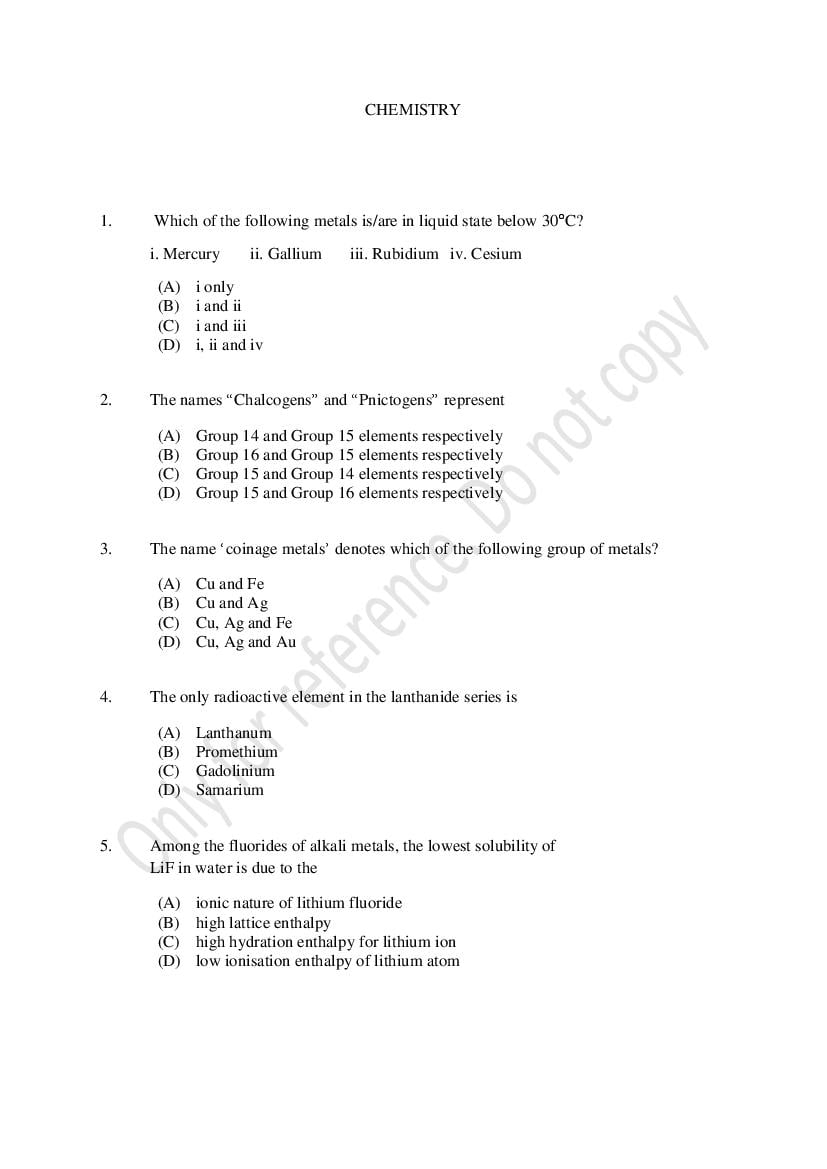
1. Which of the following metals is/are in liquid state below 30C?
i. Mercury ii. Gallium iii. Rubidium iv. Cesium
(A) i only
(B) i and ii
(C) i and iii
(D) i, ii and iv
2. The names “Chalcogens” and “Pnictogens” represent
(A) Group 14 and Group 15 elements respectively
(B) Group 16 and Group 15 elements respectively
(C) Group 15 and Group 14 elements respectively
(D) Group 15 and Group 16 elements respectively
3. The name ‘coinage metals’ denotes which of the following group of metals?
(A) Cu and Fe
(B) Cu and Ag
(C) Cu, Ag and Fe
(D) Cu, Ag and Au
4. The only radioactive element in the lanthanide series is
(A) Lanthanum
(B) Promethium
(C) Gadolinium
(D) Samarium
5. Among the fluorides of alkali metals, the lowest solubility of
LiF in water is due to the
(A) ionic nature of lithium fluoride
(B) high lattice enthalpy
(C) high hydration enthalpy for lithium ion
(D) low ionisation enthalpy of lithium atom
Page 2
(i) High boiling point
(ii) High negative standard electrode potential
(iii) High density
(iv) Large atomic size
(A) i and ii
(B) i and iv
(C) ii and iv
(D) iii and ii
7. Which of the following compounds are readily soluble in water?
(i) BeSO4 (ii) MgSO4 (iii) BaSO4 (iv) SrSO4
(A) (i) and (ii)
(B) (iii) and (iv)
(C) (ii) and (iv)
(D) (i) and (iv)
8. Find the correct formula of halides of alkaline earth metals from the following.
(i) BaCl2.2H2O
(ii) BaCl2.4H2O
(iii) CaCl2.6H2O
(iv) SrCl2.4H2O
(A) (ii) and (iii)
(B) (iv) and (ii)
(C) (iv) and (i)
(D) (i) and (iii)
9. Match the correct pairs:
Elements Properties
(i) Li (a) Insoluble sulphate
(ii) Na (b) Strongest monoacidic base
(iii) Ca (c) –
Most negative E value among alkali metals
(iv) Ba (d) Insoluble oxalate
(A) (i) - (b); (ii) - (c); (iii) - (d); (iv) - (a)
(B) (i) - (c); (ii) - (b); (iii) - (d); (iv) - (a)
(C) (i) - (b); (ii) - (c); (iii) - (a); (iv) - (d)
(D) (i) - (c); (ii) - (b); (iii) - (a); (iv) - (d)
Page 3
Elements Colour they impart to the flame
(i) Cs (a) Apple green
(ii) Ca (b) Brick red
(iii) Sr (c) Crimson red
(iv) Ba (d) Blue
(A) (i) - (c); (ii) - (a); (iii) - (d); (iv) - (b)
(B) (i) - (a); (ii) - (c); (iii) - (b); (iv) - (d)
(C) (i) - (b); (ii) - (d); (iii) - (a); (iv) - (c)
(D) (i) - (d); (ii) - (b); (iii) - (c); (iv) - (a)
11. A dehydrating agent commonly used in the laboratory is
(A) MgCO3
(B) CaF2
(C) CaCl2
(D) MgF
12. The correct sequence of the increasing basic nature of the given oxides is
(A) K2O < Na2O < Al2O3 < MgO
(B) Al2O3 < MgO < Na2O < K2O
(C) MgO < K2O < Al2O3 < Na2O
(D) MgO < K2O < Na2O < Al2O3
13. Which alkali metal does possess the highest ionization potential?
(A) Na
(B) Li
(C) Rb
(D) Cs
14. Alkali and alkaline earth metals exhibit coloured flame when heated over burner,
which is due to
(A) smaller electronegativity of alkali metals
(B) smaller ionic radius of these metals
(C) de-excitation of electrons from higher energy levels to lower energy level
(D) excitation of electrons from low energy levels to higher energy levels
Page 4
(A) high first ionization potential
(B) high second ionization potential
(C) high ionic radius
(D) high electronegativity
16. The oxides of beryllium are
(A) acidic
(B) basic
(C) neutral
(D) amphoteric
17. Sodium metal is kept under
(A) water
(B) alcohol
(C) kerosene
(D) benzene
18. Aluminium is more reactive but less easily corroded than iron, because
(A) aluminium is noble metal
(B) oxygen forms a protective oxide layer
(C) iron undergoes reaction easily with water
(D) iron forms mono and divalent ions
19. Inorganic benzene is
(A) B2H6
(B) B3N3H6
(C) B3O3H6
(D) P3N3H6
20. Reaction of PCl3 and PhMgBr would give
(A) Bromobanzene
(B) Chlorobenzene
(C) Triphenylphosphine
(D) Dichlorobenzene
Page 5
(A) 91.6%
(B) 83.3%
(C) 85.4%
(D) 87.5%
22. Which of the following is used in dry cell?
(A) KMnO4
(B) MnO2
(C) K2Cr2O7
(D) K2MnO2
23. The alloy used to fill dental cavities is
(A) Sodium amalgam
(B) Zinc chloride
(C) Mercury
(D) Mercury amalgam
24. The catalyst used in the Haber process for the manufacture of NH3 is
(A) Pt
(B) Fe + Mo
(C) CuO
(D) Al2O3
25. Predict the group of elements which has completely filled d-orbitals
(A) Ag, Pd, Pt
(B) Zn, Hg, Ir
(C) Ag, Au, Pt
(D) Pd, Au, Ag
26. Which of the following has highest value of their second ionization enthalpy?
(Atomic number of V, Cr, Mn and Fe are 23, 24, 25 and 26 respectively)
(A) V
(B) Cr
(C) Mn
(D) Fe
Page 6
(A) Zn and Zr have same oxidation state
(B) Zr and Hf have same covalent and ionic radius
(C) Zr and Nb have same oxidation state
(D) Zr and Yb have same covalent and ionic radius
2
28. Which group of ions have d configuration?
(A) Ti3+, V2+, Cr3+, Mn4+
(B) Ti1+, V4+, Cr6+, Mn7+
4+ 3+ 2+ 3+
(C) Ti , V , Cr , Mn
(D) Ti2+, V3+, Cr4+, Mn5+
10
29. What is the atomic number of the element with the electronic configuration [Kr] 4d ?
(A) 46
(B) 48
(C) 47
(D) 45
3+
30. [Co(NH3)6] ion is :
(A) Paramagentic
(B) Diamagnetic
(C) Square planar
(D) Trigonalbipyramidal
31. The type of isomerism shown by [Co(en)2(NCS)2]Cl and [Co(en)2(NCS)Cl]NCS is
(A) Coordination
(B) Ionization
(C) Linkage
(D) All of the above
32. Diethylene triamine is an example of
(A) Monodentate ligand
(B) Bidentate ligand
(C) Tridentate ligand
(D) Hexadentate ligand
Page 7
33. Number of possible optical isomers in [Co(en)2Cl2] is
(A) 2
(B) 3
(C) 4
(D) 6
34. Which one of the following is true according to the postulates of Werner’s theory for
coordination compounds?
(A) Primary valencies are ionizable
(B) Secondary valencies are ionizable
(C) Only primary valencies are non-ionizable
(D) Primary and secondary valencies are non-ionizable
35. Predict the correct order of the increasing field strength of the ligands NH3,
ethylenediamine (en), CN– and CO.
(A) CO < NH3 < en < CN–
(B) NH3 < en < CN– < CO
(C) CN– < NH3 < CO < en
(D) en < CN– < NH3 < CO
36. Among the following, which metal forms an organometallic bond
in the Grignard reaction?
(A) Sodium
(B) Titanium
(C) Magnesium
(D) Palladium
37. Zeigler-Natta catalyst is used for which type of reaction.
(A) Hydrogenation
(B) Polymerisation
(C) Oxidation
(D) Reduction
Page 8
(A) II
(B) III
(C) IV
(D) VI
2– 2–
39. The geometries of Zn(CN)4 and Ni(CN)4 are
(A) tetrahedral and square planar respectively
(B) tetrahedral and tetrahedral respectively
(C) square planar and tetrahedral respectively
(D) square planar and square planar respectively
40. In which of the following reaction, Wilkinson’s catalyst is used?
(A) Polymerisation
(B) Condensation
(C) Halogenation
(D) Hydrogenation
41. Which one of the following halides is soluble in water?
(A) AgF
(B) AgCl
(C) AgBr
(D) AgI
42. The metal whose salts do not give the borax bead test is
(A) Cr
(B) Pb
(C) Ni
(D) Mn
43. Formation of a rose-red precipitate, when a slightly alkaline solution of an inorganic
salt is treated with dimethylglyoxime, confirms the presence of
(A) Fe
(B) Co
(C) Ni
(D) Zn
Page 9
(A) Phosphate
(B) Sulphate
(C) Sulphide
(D) Nitride
45. Which of the following pairs of ions are not precipitated while
adding acidic solution of H2S?
2+ 2+
(A) Cu , Cd
3+ 3+
(B) Bi , As
3+ 4+
(C) Sb , Sn
2+ 2+
(D) Hg , Ni
46. Nitric acid is generally not used for preparation of original solution in analysis of
basic radicals, because
(A) it is a strong oxidising agent
(B) it is a reducing agent
(C) it forms insoluble nitrates
(D) nitrate ions cause interference with the scheme of analysis
47. CFSE of a cobalt(III) octahedral complex is
(A) 24 Dq
(B) 24 Dq + 3 P
(C) 24 Dq + 2 P
(D) 12 Dq + 2 P
48. The d orbital splitting in a square planar field is
(A) d 2 d xy d 2 d xz d yz
x y2 z
(B) d 2 d 2 d xy d xz d yz
x y2 z
(C) d 2 d xy d xz d yz d 2
x y2 z
(D) d xy d 2 d xz d yz d 2
x y2 z
Page 10
(A) Fe
(B) Cu
(C) Fe and Zn
(D) Mo
50. A nickel complex is red in colour and is diamagnetic. The structure of the complex is
(A) octahedral
(B) tetrahedral
(C) square pyramidal
(D) square planar
51. IUPAC name of the following compound
(A) N-Ethyl-N-methylcyclopropanamide
(B) N-Ethyl-N-methylcyclopropanecarboxamide
(C) N-methyl-N-ethylcyclopropanamide
(D) N-cyclopropanoyl-N-methylethanamine
52. Alkanamines have the general formula
(A) Cn H2n–1 N
(B) Cn H2n+1 N
(C) Cn H2n+3 N
(D) Cn H2n–3 N
53. Index of hydrogen deficiency for C6N4 is
(A) 9
(B) 5
(C) 7
(D) 4
Page 11
compounds which
(i) are insoluble in H2O
(ii) are volatile in steam
(iii) possess a high vapour pressure at 373 K
(iv) contain non-volatile impurities
(A) (i), (ii)
(B) (ii), (iii)
(C) (i), (ii), (iii)
(D) (i), (ii), (iii), (iv)
55. In which of the following, functional group isomerism is not possible
(A) C 2 H6 O
(B) C2H4O2
(C) C2H5Cl
(D) C 2 H3 N
56. The principle involved in paper chromatography is
(A) Adsorption
(B) Differential solubility
(C) Partition
(D) Size exclusion
57. The correct stability order of the following cations
(I) (II) (III)
(A) (II) > (I) > (III)
(B) (II) > (III) > (I)
(C) (III) > (I) > (II)
(D) (I) > (II) > (III)
58. The state of hybridization of C1 and C3 in CH2=C=CH-CN
2
(A) sp and sp
2
(B) sp and sp
2
(C) Both sp
(D) Both sp
Page 12
(A) CH3CO2H
(B) CH3CH2NH2
(C) CH3CH2OH
(D) CH3CH2SH
60. Which of the following free radicals is most stable?
(A)
(B)
(C)
(D)
61. Cyclopentadienyl anion is
(A) anti-aromatic
(B) aromatic
(C) non-aromatic
(D) homoaromatic
62. Higher stability of but-2-ene over but-1-ene is attributable to
(A) Inductive effect
(B) -delocalization
(C) Steric effect
(D) Hyperconjugative effect
63. Hunsdiecker reaction proceeds by …………… mechanism.
(A) Carbocation
(B) Carbanion
(C) Free radical
(D) Nitrene
Page 13
CH3COCH3 NH2CONH2 NH2CSNH2
(I) (II) (III) (IV)
(A) (I) only
(B) (I), (II), (III), (IV)
(C) (IV) only
(D) (II) and (III)
65. The most stable conformer of ethylene glycol (HO-CH2-CH2OH)
(A) Gauche
(B) Staggered
(C) Anti
(D) Eclipsed
66. Number of π-electrons in cyclobutadienyl anion
(A) 2
(B) 3
(C) 4
(D) 6
67. Which among the following reactions proceeds through a radical intermediate?
(A) CH3-CH=CH2 + HBr CH3-CH(Br)CH3
(B) CH3-CH=CH2 + HBr CH3-CH2-CH2Br
(C) CH3-CH=CH2 + Br2 CH3-CH(Br)CH2(Br)
(D) CH3-CH=O + HCN CH3CH(OH)CN
68. Which of the following statements is not true for SN1 substitution reaction?
(A) The rate of reaction does not depend on the molar concentration of
the nucleophile
(B) Is accelerated by nonpolar solvents
(C) The rate of reaction is altered by the addition of electrolyte
(D) E1 elimination completes with SN1 substitution
Page 14
(A)
(B)
(C)
(D)
70. Which among the following compounds does not show geometrical isomerism?
(A) 2,3-dimethylbut-2-ene
(B) 1,2-dibromopropene
(C) 2,3-dibromobut-2-ene
(D) 3-methylpent-2-ene
71. How many isomers of C5H11OH will be primary alcohols?
(A) 2
(B) 3
(C) 4
(D) 5
72. The number of possible stereoisomers for a compound of the structural formula
CH3-CH=CH-CH(OH)-CH3 is
(A) 6
(B) 4
(C) 3
(D) 2
Page 15
(A) A and B are identical
(B) A and B are enantiomers
(C) A and B diastereomers
(D) None of the above
74. Major product X formed in the following reaction is
(A)
(B)
(C)
(D)
Page 16
(A)
(B)
(C)
(D)
76. Major carbene intermediate (X) formed in the following reaction
(A)
(B)
(C)
(D)
77. Consider the following reaction
The structure of C3H6Cl2
(A) 1,1-dichloropropane
(B) 2,2-dichloropropane
(C) 1,2-dichloropropane
(D) 1,3-dichloropropane
Page 17
two reagents are taken in a 1:1 molar ratio is:
(A) ethoxy-2-bromoethane
(B) ethoxy-2-chloroethane
(C) 2-chloroethoxyethane
(D) 1-chloroethoxyethane
79. How many monohalogenated hydrocarbons, including stereoisomers are possible
when 2-methylbutane is chlorinated?
(A) 3
(B) 4
(C) 5
(D) 6
80. Choose the correct set of products formed in the following reaction
(A) All five products
(B) (I), (II), (IV), (V)
(C) (I) only
(D) (I) and (IV)
81. The product (X) of the following deamination reaction via Hofmann exhaustive
methylation is
(A)
(B)
(C)
(D)
Page 18
(A) (I)
(B) (II)
(C) Either (I) or (II)
(D) Neither (I) nor (II)
83. Major product/products formed when ethanol is heated with bleaching powder
followed by acidification is/are
(A) CHCl3 and formic acid
(B) CH3CHO
(C) CH3CO2H
(D) ClCH2CH2OH
84. Product Y obtained in the following reaction sequence is
(A)
(B)
(C)
(D)
Page 19
The final product Z is
(A) propionic acid
(B) propyne
(C) 2-ethoxypropane
(D) 1-ethoxypropane
86. Consider the following sequence of reaction
Which among the following is formed as the major product Z?
(A)
(B)
(C)
(D)
Page 20
(A)
(B)
(C)
(D)
Page 21
(A)
(B)
(C)
(D)
89. Major product (X) formed in the following reaction is
(A)
(B)
(C)
(D)
Page 22
of propanal and ethanal is treated with alkali is:
(A) 2
(B) 6
(C) 8
(D) 4
91. Major product (X) in the following reaction is
(A)
(B)
(C)
(D)
Page 23
(A)
(B)
(C)
(D)
93. Major product (Z) in the following reaction sequence is
(A)
(B)
(C)
(D)
94. The reactivity of RCOCl (I), RCOOCOR (II), RCOOR (III) and RCONH2 (IV) with
nucleophilic reagents follows the order
(A) (IV) > (III) > (II) > (I)
(B) (I) > (II) > (III) > (IV)
(C) (I) > (IV) > (III) > (II)
(D) (II) > (I) > (IV) > (III)
Page 24
(A)
(B)
(C)
(D)
Page 25
(A)
(B)
(C)
(D)
97. Nitrobenzene can be reduced to phenylhydroxylamine (PhNHOH) using
(A) Sn/HCl
(B) (NH4)2S
(C) Pd/H2
(D) Zn/NH4Cl
98. Which of the following will form the same aldaric acid on oxidation with dil. HNO3?
(I) (II) (III) (IV)
(A) (I), (II)
(B) (II), (III)
(C) (III), (IV)
(D) (IV), (I)
Page 26
sequences are possible?
(A) 6
(B) 8
(C) 5
(D) 4
100. Bakelite is a condensation polymer formed from
(A) Phenol and formaldehyde
(B) Urea and formaldehyde
(C) Terephthalic acid and ethylene glycol
(D) Melamine and formaldehyde
101. Zero-point energy of harmonic oscillator
1
(A) hv
2
(B) hv
(C) zero
1
(D) hv
2
102. 1 eV = ……………
–23
(A) 1.38 × 10 J
–19
(B) 1.602 × 10 J
(C) 4.186 J
(D) 8.314 J
6 –1
103. The wavelength of electromagnetic radiation of wave number 1.5 × 10 m
(A) 660 nm
(B) 66 nm
(C) 6.6 nm
(D) 0.66 nm
Page 27
(A) ʋrel = 2½ ʋmean
(B) ʋrel = (2RT) ʋmean
(C) ʋrel = (½RT) ʋmean
(D) ʋrel = (log 2) ʋmean
105. Choose the correct expression.
–1
(A) 1 A = 1 Cs , where A is ampere and C is coulombs
(B) 1 A = 1 Cs, where A is ampere and C is coulombs
–1
(C) 1 A = 1 V ohm
–1
(D) 1A=1Vs
106. The …………… is the variation of internal energy with volume at
constant temperature.
(A) Joule-Thomson effect
(B) isenthalpic expansion
(C) heat capacity
(D) internal pressure
107. The principal axis in benzene
(A) C3
(B) S3
(C) C2
(D) C6
108. A differential scanning calorimeter measures the
(A) Weight
(B) Temperature
(C) Heat capacity
(D) Energy transferred as heat
Page 28
I. H2O
II. CH2Cl2
III. C6H5Cl
IV. NH3
(A) I, II and III
(B) IV only
(C) II and IV
(D) None of the above
110. Number of symmetry operations associated with C3v
(A) 2
(B) 4
(C) 3
(D) 6
Page 29
(A) ∆v = 0
(B) ∆v = ±1, ±2, ±3…
(C) ∆v = ±1
(D) ∆v = ±½
112. a ≠ b ≠ c and γ ≠ = β = 90° belong to the class
(A) Monoclinic
(B) Cubic
(C) Orthorhombic
(D) Tetragonal
113. Which molecule belongs to asymmetric top type?
(A) O3
(B) HCN
(C) CH4
(D) NH3
114. Pick out the molecule showing both microwave and infrared spectra:
Br2, CS2, HBr, H2
(A) HBr
(B) H2
(C) Br2
(D) CS2
115. Ramachandran plot
(A) The logarithmic dependence of the molar Gibbs energy on the pressure
(B) A contour diagram of potential energy against the angles Ѱ and φ
(C) log k vs 1/T
(D) Internal energy, V vs Temp
Page 30
I. Â f(x) = SQR f(x)
II. Â f(x) = 0
III. Â f(x) = ln f(x)
IV. Â f(x) = [f(x)]–1
(A) none
(B) all
(C) II Only
(D) I, III and IV
117. Number of vibrational degrees of freedom of CO2
(A) 4
(B) 2
(C) 3
(D) 0
118. Unit of g-factor
(A) dimensionless
(B) s–1
(C) oC
(D) mol–1
119. Point group of transCHCl = CHCl
(A) C2h
(B) C3v
(C) C∞v
(D) C1
120. Which one of the following molecules does not have IR active vibrations?
(A) NO
(B) H2
(C) N2O
(D) CH4
Page 31
(A) HCl
(B) C 6 H6
(C) CH4
(D) C6H6 and HCl
122. Pick out the ion possessing the high value of equivalent
conductance at infinite dilution?
–
(A) OH
+
(B) H
+
(C) Li
–
(D) F
123. The point group associated with a linear molecule
(A) C∞v and Dh
(B) Cv only
(C) C1
(D) Dh only
124. Number of one-dimensional irreducible representations
associated with C2v point group
(A) 6
(B) 3
(C) 4
(D) 1
125. Which one of the following molecules is microwave active?
HCl, H2, CH4 and SF6
(A) HCl
(B) H2
(C) SF6
(D) CH4
126. Lowest energy electronic transition
(A) *
(B) n *
(C) n *
(D) *
Page 32
(A) zero
(B) molarity
(C) one
(D) infinity
128. X-rays are used in …………… spectroscopy.
(A) UV
(B) IR
(C) Photoelectron
(D) ESR
129. Symmetry number of methane
(A) 6
(B) 12
(C) 3
(D) 0
130. Root – mean – square speed of NO2 at 25°C
–1
(A) 515 ms
–1
(B) 5.15 ms
–1
(C) 0.515 ms
–1
(D) 51.5 ms
131. Spin angular momentum of a photon
–23
(A) 1.49 × 10 Js
–34
(B) 1.49 × 10 Js
–10
(C) 1.49 × 10 Js
–2
(D) 1.49 × 10 Js
132. Pick out the Boson
(A) proton
(B) neutron
(C) deuteron
(D) electron
133. Essential symmetry of triclinic system
(A) one C3 axis
(B) none
(C) one C6 axis
(D) one C2 axis
Page 33
(A) photons and deuterons
(B) electrons and protons
(C) deuterons and protons
(D) photons and electrons
135. The half-life of a second order reaction
1
(A) t½ = , where [A]0 is initial concentration
k[A] 0
0.693
(B) t½ = , where [A]0 is initial concentration
𝑘
(C) t½ = k, where [A]0 is initial concentration
(D) t½ = 0.693k, where [A]0 is initial concentration
136. Dispersion of liquid into a gas is called
(A) foam
(B) aerosol
(C) smoke
(D) gel
Page 34
(I) SF6
(II) CO2
(III) XeF4
(IV) H2O
(A) I, II and III
(B) IV only
(C) III and IV
(D) I and IV
2 2 2
138. Possible microstates for a carbon atom with the configuration 1s 2s 2p
(A) 12
(B) 6
(C) 15
(D) 9
139. Unit of partition function
(A) dimensionless
–1
(B) s
(C) J
–1
(D) K
140. Pick out the nuclei having spin, I = 1
1
(I) H
2
(II) D
14
(III) N
19
(IV) F
(A) (II) and (III)
(B) (I) only
(C) (IV) only
(D) (I) and (IV)
141. The bond order of NO
(A) 2½
(B) 2
(C) 1
(D) 3
Page 35
(A) Hg
(B) Ag
(C) Pb
(D) Al
–1
143. First line in the rotational spectrum of CO is 3.842 cm . The rotational
constant is equal to
–1
(A) 19.21 cm
–1
(B) 0.1921 cm
–1
(C) 1.921 cm
–1
(D) 38.42 cm
144. A solution shows absorbance A = 1.0. What percentage of radiation is absorbed by
the sample?
(A) 10
(B) 50
(C) 90
(D) 100
145. The number of radial nodes of 4d atomic orbital is
(A) 0
(B) 1
(C) 2
(D) 3
146. For the reaction A P the plot of concentration of P Vs time is linear passing
through the origin. The order of the reaction is
(A) 0
(B) 1
(C) 2
(D) 1
147. A buffer is prepared by mixing 100 ml, 0.1 M acetic acid (pKa = 4.76) and 100 ml,
0.1 M sodium acetate. The pH of the solution is
(A) 4.76
(B) 7.00
(C) 3.76
(D) 5.76
Page 36
(A) Electrophoresis
(B) Electro osmosis
(C) Streaming potential
(D) Donnan membrane equilibrium
149. Which of the following photochemical reaction has highest quantum yield?
(A) H2 – Cl2
(B) H2 – Br2
(C) H2 – I2
(D) Decomposition of ozone
150. In Raman spectroscopy …………… radiation is analyzed.
(A) transmitted
(B) emitted
(C) scattered
(D) fluorescent
Page 37
Subject Name: 604 CHEMISTRY
SI No. Key SI No. Key SI No. Key SI No. Key SI No. Key
1 D 31 B 61 B 91 A 121 C
2 B 32 C 62 D 92 B 122 B
3 D 33 A 63 C 93 D 123 A
4 B 34 A 64 B 94 B 124 C
5 B 35 B 65 A 95 D 125 A
6 C 36 C 66 C 96 D 126 B
7 A 37 B 67 B 97 D 127 B
8 D 38 C 68 B 98 B 128 C
9 B 39 A 69 D 99 A 129 B
10 D 40 D 70 A 100 A 130 A
11 C 41 A 71 D 101 A 131 B
12 B 42 B 72 B 102 B 132 C
13 B 43 C 73 B 103 A 133 B
14 C 44 A 74 B 104 A 134 B
15 B 45 D 75 A 105 A 135 A
16 D 46 A 76 D 106 D 136 B
17 C 47 C 77 A 107 D 137 A
18 B 48 A 78 B 108 D 138 C
19 B 49 B 79 D 109 A 139 A
20 C 50 D 80 B 110 D 140 A
21 B 51 B 81 D 111 B 141 A
22 B 52 C 82 B 112 A 142 A
23 D 53 A 83 A 113 A 143 C
24 B 54 D 84 A 114 A 144 C
25 D 55 C 85 D 115 B 145 B
26 B 56 C 86 B 116 D 146 A
27 B 57 A 87 A 117 A 147 A
28 D 58 D 88 C 118 A 148 D
29 A 59 A 89 B 119 A 149 A
30 B 60 C 90 D 120 B 150 C
Document Details
| Board / Org | Cochin University |
| Exam | CUSAT Common Admission Test |
| Type | Question Paper |
| Pages | 37 |
| Language | english |
| Updated | 22 Jul 2026 |