HP PAT 2027 Sample Paper
Finished viewing? Save it for later —
Download HP PAT 2027 Sample Paper (PDF · 24 pages)About HP PAT 2027 Sample Paper
HP PAT 2027 Sample Paper is available here for free download. Published by Himachal Pradesh Exams for HP PAT, this sample paper can be viewed online or downloaded as a PDF (24 pages). Candidates preparing for HP PAT can use HP PAT 2027 Sample Paper to understand the exam pattern, the type of questions asked, and the overall difficulty level.
Frequently Asked Questions
How can I download HP PAT 2027 Sample Paper?
Open this page and click the Download button to save HP PAT 2027 Sample Paper as a PDF. It is completely free on AglaSem Docs.
Is HP PAT 2027 Sample Paper free to download?
Yes. HP PAT 2027 Sample Paper can be viewed online and downloaded as a PDF free of cost on AglaSem Docs.
How many pages does HP PAT 2027 Sample Paper have?
HP PAT 2027 Sample Paper contains 24 pages, which you can read online or download together as a single PDF.
Where can I find more HP PAT study material?
You can find more HP PAT question papers, sample papers, syllabus, and answer keys on AglaSem Docs.
HP PAT 2027 Sample Paper – Text
Read the full text of this sample paper below — useful to quickly search, copy and reference the content online without downloading the PDF.
📄 View text version (24 pages)
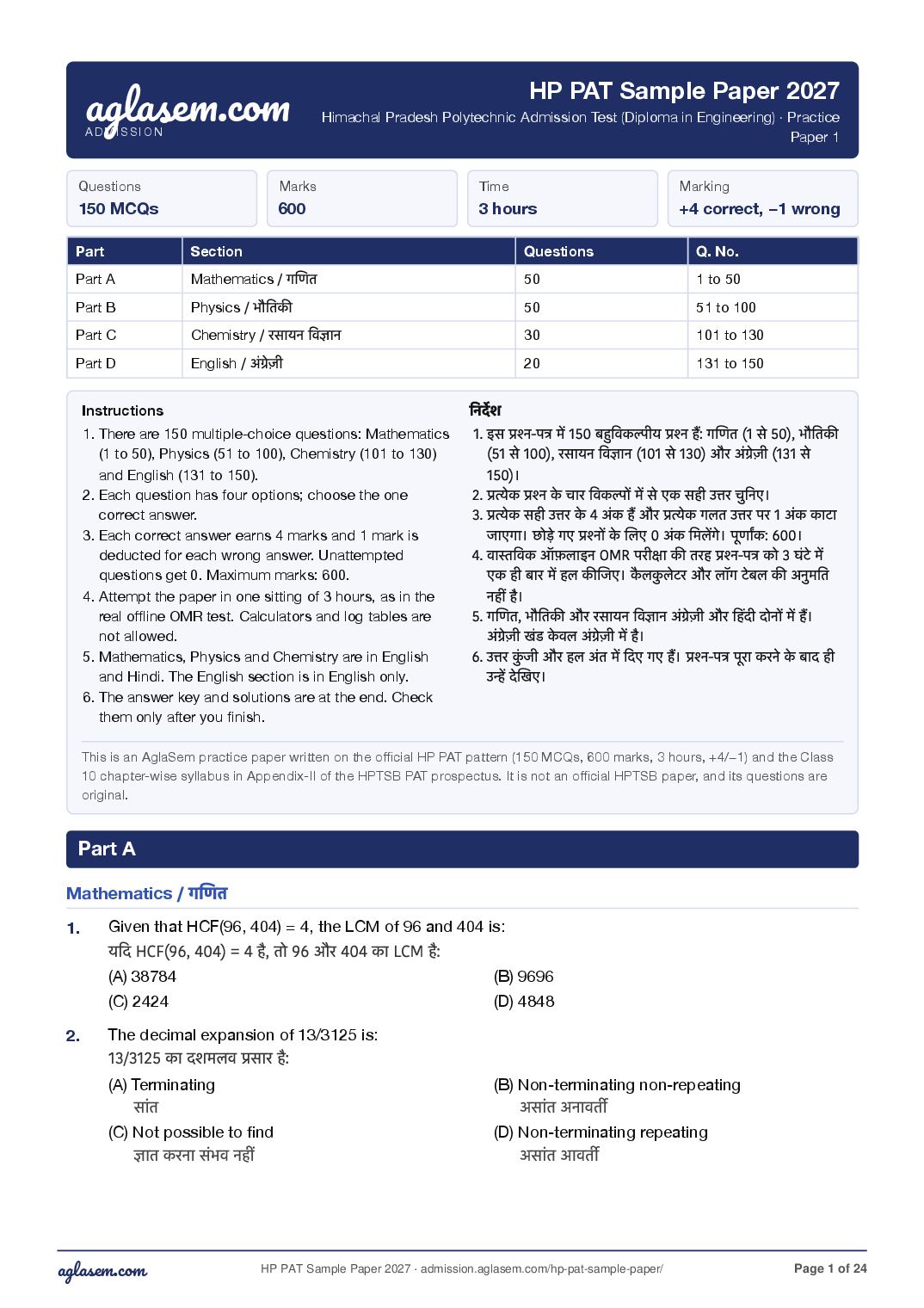
Page 1
Himachal Pradesh Polytechnic Admission Test (Diploma in Engineering) · Practice
ADMISSION
Paper 1
Questions Marks Time Marking
150 MCQs 600 3 hours +4 correct, −1 wrong
Part Section Questions Q. No.
Part A Mathematics / गणित 50 1 to 50
Part B Physics / भौतिकी 50 51 to 100
Part C Chemistry / रसायन विज्ञान 30 101 to 130
Part D English / अंग्रेज़ी 20 131 to 150
Instructions निर्देश
1. There are 150 multiple-choice questions: Mathematics 1. इस प्रश्न-पत्र में 150 बहुविकल्पीय प्रश्न हैं: गणित (1 से 50), भौतिकी
(1 to 50), Physics (51 to 100), Chemistry (101 to 130) (51 से 100), रसायन विज्ञान (101 से 130) और अंग्रेज़ी (131 से
and English (131 to 150). 150)।
2. Each question has four options; choose the one 2. प्रत्येक प्रश्न के चार विकल्पों में से एक सही उत्तर चुनिए।
correct answer. 3. प्रत्येक सही उत्तर के 4 अंक हैं और प्रत्येक गलत उत्तर पर 1 अंक काटा
3. Each correct answer earns 4 marks and 1 mark is जाएगा। छोड़े गए प्रश्नों के लिए 0 अंक मिलेंगे। पूर्णांक: 600।
deducted for each wrong answer. Unattempted 4. वास्तविक ऑफ़लाइन OMR परीक्षा की तरह प्रश्न-पत्र को 3 घंटे में
questions get 0. Maximum marks: 600. एक ही बार में हल कीजिए। कै लकु लेटर और लॉग टेबल की अनुमति
4. Attempt the paper in one sitting of 3 hours, as in the नहीं है।
real offline OMR test. Calculators and log tables are 5. गणित, भौतिकी और रसायन विज्ञान अंग्रेज़ी और हिं दी दोनों में हैं।
not allowed. अंग्रेज़ी खंड के वल अंग्रेज़ी में है।
5. Mathematics, Physics and Chemistry are in English 6. उत्तर कुं जी और हल अंत में दिए गए हैं। प्रश्न-पत्र पूरा करने के बाद ही
and Hindi. The English section is in English only. उन्हें देखिए।
6. The answer key and solutions are at the end. Check
them only after you finish.
This is an AglaSem practice paper written on the official HP PAT pattern (150 MCQs, 600 marks, 3 hours, +4/−1) and the Class
10 chapter-wise syllabus in Appendix-II of the HPTSB PAT prospectus. It is not an official HPTSB paper, and its questions are
original.
Part A
Mathematics / गणित
1. Given that HCF(96, 404) = 4, the LCM of 96 and 404 is:
यदि HCF(96, 404) = 4 है, तो 96 और 404 का LCM है:
(A) 38784 (B) 9696
(C) 2424 (D) 4848
2. The decimal expansion of 13/3125 is:
13/3125 का दशमलव प्रसार है:
(A) Terminating (B) Non-terminating non-repeating
सांत असांत अनावर्ती
(C) Not possible to find (D) Non-terminating repeating
ज्ञात करना संभव नहीं असांत आवर्ती
HP PAT Sample Paper 2027 · admission./hp-pat-sample-paper/ Page 1 of 24
Page 2
निम्नलिखित में से कौन-सी संख्या अपरिमेय है?
(A) 0.75 (B) 22/7
(C) √5 (D) √16
4. In Euclid's division lemma a = bq + r for positive integers a and b, the remainder r satisfies:
धनात्मक पूर्णांकों a और b के लिए यूक्लिड विभाजन प्रमेयिका a = bq + r में शेषफल r के लिए सत्य है:
(A) 0 < r ≤ b (B) 0 ≤ r ≤ b
(C) 0 ≤ r < b (D) 0 < r < b
5. If α and β are the zeros of x² − 5x + 6, then 1/α + 1/β equals:
यदि α और β बहुपद x² − 5x + 6 के शून्यक हैं, तो 1/α + 1/β बराबर है:
(A) 6/5 (B) 5/6
(C) −5/6 (D) 1/6
6. A quadratic polynomial whose zeros are 3 and −2 is:
वह द्विघात बहुपद जिसके शून्यक 3 और −2 हैं:
(A) x² − 5x + 6 (B) x² − x − 6
(C) x² + x − 6 (D) x² + 5x − 6
7. For what value of k do the equations 2x + 3y = 5 and 4x + ky = 10 have infinitely many solutions?
k के किस मान के लिए समीकरण 2x + 3y = 5 और 4x + ky = 10 के अपरिमित रूप से अनेक हल हैं?
(A) 8 (B) 3
(C) 6 (D) 4
8. The pair of equations x + 2y = 4 and 2x + 4y = 12 has:
समीकरण युग्म x + 2y = 4 और 2x + 4y = 12 के बारे में सही कथन है:
(A) No solution
इसका कोई हल नहीं है
(B) Exactly two solutions
इसके ठीक दो हल हैं
(C) Infinitely many solutions
इसके अपरिमित रूप से अनेक हल हैं
(D) A unique solution
इसका एक अद्वितीय हल है
9. The sum of two numbers is 25 and their difference is 7. The larger number is:
दो संख्याओं का योग 25 और अंतर 7 है। बड़ी संख्या है:
(A) 9 (B) 14
(C) 16 (D) 18
10. The roots of the equation x² − 7x + 12 = 0 are:
समीकरण x² − 7x + 12 = 0 के मूल हैं:
(A) 3 and 4 (B) 2 and 6
3 और 4 2 और 6
(C) −3 and −4 (D) 1 and 12
−3 और −4 1 और 12
11. The discriminant of the quadratic equation 2x² − 4x + 3 = 0 is:
द्विघात समीकरण 2x² − 4x + 3 = 0 का विविक्तकर है:
(A) 8 (B) −40
(C) −8 (D) 40
HP PAT Sample Paper 2027 · admission./hp-pat-sample-paper/ Page 2 of 24
Page 3
k के किस धनात्मक मान के लिए x² + kx + 9 = 0 के दो बराबर मूल हैं?
(A) 3 (B) 6
(C) 18 (D) 9
13. The roots of the equation 3x² − 5x + 2 = 0 are:
समीकरण 3x² − 5x + 2 = 0 के मूल हैं:
(A) Real and equal (B) Both negative
वास्तविक और बराबर दोनों ऋणात्मक
(C) Real and distinct (D) Not real
वास्तविक और भिन्न वास्तविक नहीं
14. The 10th term of the AP 5, 9, 13, 17, … is:
समांतर श्रेढ़ी 5, 9, 13, 17, … का 10वाँ पद है:
(A) 37 (B) 41
(C) 49 (D) 45
15. The sum of the first 20 terms of the AP 2, 5, 8, 11, … is:
समांतर श्रेढ़ी 2, 5, 8, 11, … के प्रथम 20 पदों का योग है:
(A) 630 (B) 610
(C) 600 (D) 590
16. How many two-digit numbers are divisible by 7?
दो अंकों की कितनी संख्याएँ 7 से विभाज्य हैं?
(A) 14 (B) 15
(C) 13 (D) 12
17. The nth term of an AP is 3n + 2. Its common difference is:
किसी समांतर श्रेढ़ी का nवाँ पद 3n + 2 है। इसका सार्व अंतर है:
(A) 2 (B) 3
(C) 5 (D) 1
18. The sum of the first n natural numbers is 210. The value of n is:
प्रथम n प्राकृ त संख्याओं का योग 210 है। n का मान है:
(A) 19 (B) 30
(C) 21 (D) 20
19. In ΔABC, DE ∥ BC with D on AB and E on AC. If AD = 3 cm, DB = 2 cm and AE = 4.5 cm, then EC is:
ΔABC में DE ∥ BC है, जहाँ D भुजा AB पर और E भुजा AC पर है। यदि AD = 3 cm, DB = 2 cm और AE = 4.5 cm है, तो EC
है:
(A) 4 cm (B) 2 cm
(C) 6 cm (D) 3 cm
20. The corresponding sides of two similar triangles are in the ratio 4 : 9. The ratio of their areas is:
दो समरूप त्रिभुजों की संगत भुजाएँ 4 : 9 के अनुपात में हैं। उनके क्षेत्रफलों का अनुपात है:
(A) 2 : 3 (B) 4 : 9
(C) 16 : 81 (D) 81 : 16
HP PAT Sample Paper 2027 · admission./hp-pat-sample-paper/ Page 3 of 24
Page 4
बिं दुओं (2, 3) और (5, 7) के बीच की दू री है:
(A) 25 units (B) √7 units
25 मात्रक √7 मात्रक
(C) 7 units (D) 5 units
7 मात्रक 5 मात्रक
22. The mid-point of the line segment joining (−2, 4) and (6, −8) is:
(−2, 4) और (6, −8) को मिलाने वाले रेखाखंड का मध्य-बिं दु है:
(A) (−4, 6) (B) (2, 2)
(C) (2, −2) (D) (4, −4)
23. The point that divides the line segment joining (1, 2) and (7, 8) internally in the ratio 1 : 2 is:
(1, 2) और (7, 8) को मिलाने वाले रेखाखंड को 1 : 2 के अनुपात में अंतः विभाजित करने वाला बिं दु है:
(A) (2, 3) (B) (5, 6)
(C) (4, 5) (D) (3, 4)
24. The area of the triangle with vertices (0, 0), (4, 0) and (0, 6) is:
शीर्षों (0, 0), (4, 0) और (0, 6) वाले त्रिभुज का क्षेत्रफल है:
(A) 24 sq. units (B) 6 sq. units
24 वर्ग मात्रक 6 वर्ग मात्रक
(C) 12 sq. units (D) 10 sq. units
12 वर्ग मात्रक 10 वर्ग मात्रक
25. If sin θ = 3/5 and θ is acute, then cos θ is:
यदि sin θ = 3/5 है और θ न्यून कोण है, तो cos θ है:
(A) 5/3 (B) 3/4
(C) 5/4 (D) 4/5
26. The value of sin² 30° + cos² 60° is:
sin² 30° + cos² 60° का मान है:
(A) 3/4 (B) 1/2
(C) 1 (D) 1/4
27. The value of tan 48° × tan 42° is:
tan 48° × tan 42° का मान है:
(A) 0 (B) 1/2
(C) √3 (D) 1
28. A ladder leaning against a wall makes an angle of 60° with the ground. Its foot is 5 m from the wall. The
length of the ladder is:
दीवार के सहारे टिकी एक सीढ़ी भूमि से 60° का कोण बनाती है। सीढ़ी का निचला सिरा दीवार से 5 m दू र है। सीढ़ी की लंबाई है:
(A) 5 m (B) 10√3 m
(C) 5√3 m (D) 10 m
29. The length of the tangent from a point 13 cm away from the centre of a circle of radius 5 cm is:
5 cm त्रिज्या वाले वृत्त के कें द्र से 13 cm दू र स्थित बिं दु से खींची गई स्पर्श रेखा की लंबाई है:
(A) 18 cm (B) 8 cm
(C) 10 cm (D) 12 cm
HP PAT Sample Paper 2027 · admission./hp-pat-sample-paper/ Page 4 of 24
Page 5
वृत्त के अंदर स्थित किसी बिं दु से वृत्त पर कितनी स्पर्श रेखाएँ खींची जा सकती हैं?
(A) 1 (B) 2
(C) Infinitely many (D) 0
अनंत
31. The angle between a tangent to a circle and the radius at the point of contact is:
किसी वृत्त की स्पर्श रेखा और स्पर्श बिं दु पर खींची गई त्रिज्या के बीच का कोण है:
(A) 180° (B) 90°
(C) 45° (D) 60°
32. PA and PB are tangents from an external point P to a circle with centre O. If ∠APB = 70°, then ∠AOB is:
कें द्र O वाले वृत्त पर बाह्य बिं दु P से स्पर्श रेखाएँ PA और PB खींची गई हैं। यदि ∠APB = 70° है, तो ∠AOB है:
(A) 140° (B) 110°
(C) 90° (D) 70°
33. To divide a line segment AB internally in the ratio 3 : 5 using a ray AX, the minimum number of points to
be marked on AX at equal distances is:
किरण AX की सहायता से रेखाखंड AB को 3 : 5 के अनुपात में अंतः विभाजित करने के लिए AX पर समान दू री पर कम से कम
कितने बिं दु अंकित करने होंगे?
(A) 3 (B) 5
(C) 15 (D) 8
34. To draw a pair of tangents to a circle that are inclined to each other at 60°, the angle between the two
radii to the points of contact must be:
किसी वृत्त पर ऐसी दो स्पर्श रेखाएँ खींचने के लिए जो परस्पर 60° पर झुकी हों, स्पर्श बिं दुओं तक खींची गई दोनों त्रिज्याओं के बीच
का कोण होना चाहिए:
(A) 120° (B) 60°
(C) 90° (D) 30°
35. The area of a sector of a circle of radius 21 cm with central angle 60° is (π = 22/7):
21 cm त्रिज्या वाले वृत्त के उस त्रिज्यखंड का क्षेत्रफल, जिसका कें द्रीय कोण 60° है (π = 22/7):
(A) 231 cm² (B) 462 cm²
(C) 115.5 cm² (D) 693 cm²
36. The length of an arc of a circle of radius 14 cm that subtends an angle of 90° at the centre is (π = 22/7):
14 cm त्रिज्या वाले वृत्त के उस चाप की लंबाई, जो कें द्र पर 90° का कोण बनाता है (π = 22/7):
(A) 154 cm (B) 22 cm
(C) 44 cm (D) 11 cm
37. A wheel has a diameter of 70 cm. How many complete revolutions does it make in covering 1.1 km? (π
= 22/7)
एक पहिए का व्यास 70 cm है। 1.1 km दू री तय करने में यह कितने पूरे चक्कर लगाएगा? (π = 22/7)
(A) 1000 (B) 250
(C) 550 (D) 500
38. The perimeter of a semicircular protractor of diameter 14 cm is (π = 22/7):
14 cm व्यास वाले अर्धवृत्ताकार चाँदे का परिमाप है (π = 22/7):
(A) 36 cm (B) 22 cm
(C) 44 cm (D) 58 cm
HP PAT Sample Paper 2027 · admission./hp-pat-sample-paper/ Page 5 of 24
Page 6
= 22/7):
एक वृत्त की परिधि 11 cm भुजा वाले वर्ग के परिमाप के बराबर है। वृत्त का क्षेत्रफल है (π = 22/7):
(A) 144 cm² (B) 154 cm²
(C) 616 cm² (D) 121 cm²
40. The volume of a cone of radius 3 cm and height 7 cm is (π = 22/7):
3 cm त्रिज्या और 7 cm ऊँ चाई वाले शंकु का आयतन है (π = 22/7):
(A) 22 cm³ (B) 66 cm³
(C) 198 cm³ (D) 132 cm³
41. A metal sphere of radius 3 cm is melted and recast into a cylinder of radius 2 cm. The height of the
cylinder is:
3 cm त्रिज्या वाले धातु के गोले को पिघलाकर 2 cm त्रिज्या का एक बेलन बनाया जाता है। बेलन की ऊँ चाई है:
(A) 6 cm (B) 4.5 cm
(C) 12 cm (D) 9 cm
42. The volume of a frustum of a cone with end radii 4 cm and 2 cm and height 3 cm is:
शंकु के उस छिन्नक का आयतन, जिसके सिरों की त्रिज्याएँ 4 cm और 2 cm तथा ऊँ चाई 3 cm है:
(A) 56π cm³ (B) 20π cm³
(C) 28π cm³ (D) 84π cm³
43. The total surface area of a solid hemisphere of radius r is:
r त्रिज्या वाले ठोस अर्धगोले का संपूर्ण पृष्ठीय क्षेत्रफल है:
(A) πr² (B) 4πr²
(C) 3πr² (D) 2πr²
44. Using the empirical relation between mean, median and mode, if mean = 30 and median = 32, then
mode is:
माध्य, माध्यक और बहुलक के आनुभविक संबंध से, यदि माध्य = 30 और माध्यक = 32 है, तो बहुलक है:
(A) 31 (B) 34
(C) 36 (D) 28
45. The class mark of the class 10–20 is:
वर्ग 10–20 का वर्ग चिह्न है:
(A) 10 (B) 30
(C) 15 (D) 20
46. Find the mean of the data: class 0–10 (frequency 3), class 10–20 (frequency 5), class 20–30 (frequency
2).
आँ कड़ों का माध्य ज्ञात कीजिए: वर्ग 0–10 (बारंबारता 3), वर्ग 10–20 (बारंबारता 5), वर्ग 20–30 (बारंबारता 2)।
(A) 12.5 (B) 14
(C) 13 (D) 15
47. A die is thrown once. The probability of getting a prime number is:
एक पासे को एक बार फें का जाता है। एक अभाज्य संख्या आने की प्रायिकता है:
(A) 1/6 (B) 1/2
(C) 1/3 (D) 2/3
48. A card is drawn from a well-shuffled pack of 52 cards. The probability that it is a red king is:
52 पत्तों की अच्छी तरह फें टी गई गड्डी से एक पत्ता निकाला जाता है। इसके लाल रंग का बादशाह होने की प्रायिकता है:
(A) 1/13 (B) 1/52
(C) 1/26 (D) 1/4
HP PAT Sample Paper 2027 · admission./hp-pat-sample-paper/ Page 6 of 24
Page 7
यदि P(E) = 0.35 है, तो P(E नहीं) है:
(A) 0.5 (B) 1.35
(C) 0.35 (D) 0.65
50. Two coins are tossed together. The probability of getting at least one head is:
दो सिक्के एक साथ उछाले जाते हैं। कम से कम एक चित आने की प्रायिकता है:
(A) 3/4 (B) 1/2
(C) 1 (D) 1/4
Part B
Physics / भौतिकी
51. The focal length of a concave mirror whose radius of curvature is 24 cm is:
एक अवतल दर्पण की वक्रता त्रिज्या 24 cm है। इसकी फोकस दू री है:
(A) 48 cm (B) 6 cm
(C) 24 cm (D) 12 cm
52. The image formed by a plane mirror is:
समतल दर्पण द्वारा बना प्रतिबिं ब होता है:
(A) Real, erect and magnified
वास्तविक, सीधा और बड़ा
(B) Real, inverted and of the same size
वास्तविक, उलटा और समान आकार का
(C) Virtual, erect and of the same size
आभासी, सीधा और समान आकार का
(D) Virtual, erect and diminished
आभासी, सीधा और छोटा
53. An object is placed 20 cm in front of a concave mirror of focal length 15 cm. The image is formed:
15 cm फोकस दू री वाले अवतल दर्पण के सामने 20 cm पर एक वस्तु रखी है। प्रतिबिं ब बनेगा:
(A) 60 cm in front of the mirror (B) 30 cm in front of the mirror
दर्पण के सामने 60 cm पर दर्पण के सामने 30 cm पर
(C) 60 cm behind the mirror (D) 8.6 cm behind the mirror
दर्पण के पीछे 60 cm पर दर्पण के पीछे 8.6 cm पर
54. In the previous question, the magnification produced by the mirror is:
पिछले प्रश्न में दर्पण द्वारा उत्पन्न आवर्धन है:
(A) −3 (B) +1/3
(C) −1/3 (D) +3
55. Which mirror is used as a rear-view mirror in vehicles?
वाहनों में पीछे का दृश्य देखने के लिए किस दर्पण का उपयोग होता है?
(A) Convex mirror (B) Plane mirror
उत्तल दर्पण समतल दर्पण
(C) Parabolic concave mirror (D) Concave mirror
परवलयिक अवतल दर्पण अवतल दर्पण
56. The refractive index of glass is 1.5. The speed of light in glass is (c = 3 × 10⁸ m/s):
काँच का अपवर्तनांक 1.5 है। काँच में प्रकाश की चाल है (c = 3 × 10⁸ m/s):
(A) 1.5 × 10⁸ m/s (B) 2 × 10⁸ m/s
(C) 4.5 × 10⁸ m/s (D) 3 × 10⁸ m/s
HP PAT Sample Paper 2027 · admission./hp-pat-sample-paper/ Page 7 of 24
Page 8
जब प्रकाश की किरण वायु से काँच में तिरछी प्रवेश करती है, तो वह:
(A) Is totally reflected back (B) Goes straight without bending
पूर्णतः वापस परावर्ति त होती है बिना मुड़े सीधी जाती है
(C) Bends towards the normal (D) Bends away from the normal
अभिलंब की ओर मुड़ती है अभिलंब से दू र मुड़ती है
58. The power of a lens of focal length −50 cm is:
−50 cm फोकस दू री वाले लेंस की क्षमता है:
(A) −0.5 D (B) −2 D
(C) +2 D (D) −50 D
59. An object is placed 15 cm from a convex lens of focal length 10 cm. The image distance from the lens
is:
10 cm फोकस दू री वाले उत्तल लेंस से 15 cm दू र एक वस्तु रखी है। लेंस से प्रतिबिं ब की दू री है:
(A) 30 cm (B) 15 cm
(C) 25 cm (D) 6 cm
60. When an object is placed at 2F₁ of a convex lens, the image is formed:
जब वस्तु उत्तल लेंस के 2F₁ पर रखी होती है, तो प्रतिबिं ब बनता है:
(A) At F₂; real, inverted, very small
F₂ पर; वास्तविक, उलटा, अत्यंत छोटा
(B) On the same side; virtual, erect
उसी ओर; आभासी, सीधा
(C) Beyond 2F₂; real, inverted, enlarged
2F₂ से परे; वास्तविक, उलटा, बड़ा
(D) At 2F₂; real, inverted, same size
2F₂ पर; वास्तविक, उलटा, समान आकार
61. A concave lens always forms an image that is:
अवतल लेंस हमेशा ऐसा प्रतिबिं ब बनाता है जो:
(A) Real, inverted and magnified (B) Real, inverted and diminished
वास्तविक, उलटा और बड़ा हो वास्तविक, उलटा और छोटा हो
(C) Virtual, erect and magnified (D) Virtual, erect and diminished
आभासी, सीधा और बड़ा हो आभासी, सीधा और छोटा हो
62. Two thin lenses of power +3 D and −1 D are placed in contact. The focal length of the combination is:
+3 D और −1 D क्षमता वाले दो पतले लेंस संपर्क में रखे हैं। संयोजन की फोकस दू री है:
(A) −50 cm (B) +50 cm
(C) +25 cm (D) +200 cm
63. In refraction through a glass prism, the angle between the incident ray produced forward and the
emergent ray produced backward is called the:
काँच के प्रिज़्म से अपवर्तन में आपतित किरण को आगे बढ़ाने और निर्गत किरण को पीछे बढ़ाने पर बना कोण कहलाता है:
(A) Angle of deviation (B) Angle of prism
विचलन कोण प्रिज़्म कोण
(C) Critical angle (D) Angle of incidence
क्रांतिक कोण आपतन कोण
HP PAT Sample Paper 2027 · admission./hp-pat-sample-paper/ Page 8 of 24
Page 9
प्रिज़्म द्वारा श्वेत प्रकाश के अपने अवयवी रंगों में बँटने को कहते हैं:
(A) Dispersion (B) Diffraction
वर्ण-विक्षेपण विवर्तन
(C) Scattering (D) Reflection
प्रकीर्णन परावर्तन
65. Which colour of white light is deviated the most by a glass prism?
काँच का प्रिज़्म श्वेत प्रकाश के किस रंग को सबसे अधिक विचलित करता है?
(A) Red (B) Green
लाल हरा
(C) Violet (D) Yellow
बैंगनी पीला
66. The ability of the eye lens to adjust its focal length is called:
नेत्र लेंस की अपनी फोकस दू री को समायोजित करने की क्षमता कहलाती है:
(A) Power of accommodation (B) Range of vision
समंजन क्षमता दृष्टि परास
(C) Near point of the eye (D) Persistence of vision
नेत्र का निकट बिं दु दृष्टि निर्बंध
67. Myopia (near-sightedness) is corrected by using a:
निकट-दृष्टि दोष (मायोपिया) को किसके उपयोग से ठीक किया जाता है?
(A) Bifocal lens (B) Cylindrical lens
द्विफोकसी लेंस बेलनाकार लेंस
(C) Concave lens (D) Convex lens
अवतल लेंस उत्तल लेंस
68. The least distance of distinct vision for a normal young adult eye is about:
सामान्य युवा वयस्क नेत्र के लिए सुस्पष्ट दर्शन की न्यूनतम दू री लगभग है:
(A) 25 m (B) 25 cm
(C) 2.5 cm (D) 250 cm
69. The blue colour of the clear sky is due to:
स्वच्छ आकाश का नीला रंग किस कारण होता है?
(A) Scattering of light by air molecules
वायु के अणुओं द्वारा प्रकाश का प्रकीर्णन
(B) Dispersion of light by water drops
जल की बूँदों द्वारा प्रकाश का वर्ण-विक्षेपण
(C) Reflection of light from the sea
समुद्र से प्रकाश का परावर्तन
(D) Refraction of light by ice crystals
हिम-क्रिस्टलों द्वारा प्रकाश का अपवर्तन
70. The twinkling of stars is due to:
तारों का टिमटिमाना किस कारण होता है?
(A) Atmospheric refraction (B) Scattering of light
वायुमंडलीय अपवर्तन प्रकाश का प्रकीर्णन
(C) Dispersion of light (D) Total internal reflection
प्रकाश का वर्ण-विक्षेपण पूर्ण आं तरिक परावर्तन
HP PAT Sample Paper 2027 · admission./hp-pat-sample-paper/ Page 9 of 24
Page 10
विद्युत आवेश का SI मात्रक है:
(A) Ohm (B) Coulomb
ओम कू लॉम
(C) Ampere (D) Volt
ऐम्पियर वोल्ट
72. A current of 0.5 A flows through a bulb for 10 minutes. The charge that flows is:
एक बल्ब में 10 मिनट तक 0.5 A धारा प्रवाहित होती है। प्रवाहित आवेश है:
(A) 50 C (B) 3000 C
(C) 300 C (D) 5 C
73. The work done in moving a charge of 2 C across a potential difference of 12 V is:
12 V विभवांतर वाले दो बिं दुओं के बीच 2 C आवेश को ले जाने में किया गया कार्य है:
(A) 10 J (B) 6 J
(C) 24 J (D) 14 J
74. A potential difference of 6 V is applied across a resistor of 3 Ω. The current is:
3 Ω के प्रतिरोधक के सिरों पर 6 V का विभवांतर लगाया गया है। धारा है:
(A) 0.5 A (B) 18 A
(C) 3 A (D) 2 A
75. The resistance of a wire is directly proportional to its length and inversely proportional to its:
किसी तार का प्रतिरोध उसकी लंबाई के अनुक्रमानुपाती और किसके व्युत्क्रमानुपाती होता है?
(A) Temperature (B) Mass
ताप द्रव्यमान
(C) Resistivity (D) Area of cross-section
प्रतिरोधकता अनुप्रस्थ काट का क्षेत्रफल
76. A wire of resistance R is stretched uniformly to twice its length. Its new resistance is:
R प्रतिरोध वाले एक तार को एकसमान खींचकर उसकी लंबाई दोगुनी कर दी जाती है। उसका नया प्रतिरोध है:
(A) 2R (B) 4R
(C) R (D) R/2
77. Three resistors of 2 Ω, 3 Ω and 5 Ω are connected in series. The equivalent resistance is:
2 Ω, 3 Ω और 5 Ω के तीन प्रतिरोधक श्रेणीक्रम में जुड़े हैं। तुल्य प्रतिरोध है:
(A) 10 Ω (B) 0.97 Ω
(C) 5 Ω (D) 30 Ω
78. Two resistors of 6 Ω each are connected in parallel. The equivalent resistance is:
6 Ω के दो प्रतिरोधक पार्श्वक्रम में जुड़े हैं। तुल्य प्रतिरोध है:
(A) 6 Ω (B) 3 Ω
(C) 1.5 Ω (D) 12 Ω
79. The SI unit of resistivity is:
प्रतिरोधकता का SI मात्रक है:
(A) Ω (B) Ω m²
(C) Ω m (D) Ω/m
80. A bulb is rated 100 W, 220 V. Its resistance is:
एक बल्ब पर 100 W, 220 V अंकित है। इसका प्रतिरोध है:
(A) 2.2 Ω (B) 4840 Ω
(C) 484 Ω (D) 22 Ω
HP PAT Sample Paper 2027 · admission./hp-pat-sample-paper/ Page 10 of 24
Page 11
1 kW का एक हीटर 2 घंटे तक उपयोग किया जाता है। खपत हुई विद्युत ऊर्जा है:
(A) 0.5 kWh (B) 2000 kWh
(C) 1 kWh (D) 2 kWh
82. 1 kWh is equal to:
1 kWh किसके बराबर है?
(A) 3600 J (B) 3.6 × 10⁶ J
(C) 1000 J (D) 3.6 × 10³ J
83. According to Joule's law of heating, the heat produced in a resistor is H =
जूल के तापन नियम के अनुसार किसी प्रतिरोधक में उत्पन्न ऊष्मा H =
(A) I²Rt (B) IR²t
(C) IRt² (D) I²R/t
84. Potential difference across a resistor is measured by a:
किसी प्रतिरोधक के सिरों का विभवांतर मापा जाता है:
(A) Voltmeter connected in series
श्रेणीक्रम में जुड़े वोल्टमीटर से
(B) Ammeter connected in parallel
पार्श्वक्रम में जुड़े ऐमीटर से
(C) Ammeter connected in series
श्रेणीक्रम में जुड़े ऐमीटर से
(D) Voltmeter connected in parallel
पार्श्वक्रम में जुड़े वोल्टमीटर से
85. The filament of an electric bulb is made of:
विद्युत बल्ब का तंतु किससे बना होता है?
(A) Tungsten (B) Nichrome
टंगस्टन नाइक्रोम
(C) Aluminium (D) Copper
ऐलुमिनियम ताँबा
86. Outside a bar magnet, magnetic field lines go from:
छड़ चुंबक के बाहर चुंबकीय क्षेत्र रेखाएँ जाती हैं:
(A) Both poles to the centre
दोनों ध्रुवों से कें द्र की ओर
(B) North pole to south pole
उत्तरी ध्रुव से दक्षिणी ध्रुव की ओर
(C) Centre to both poles
कें द्र से दोनों ध्रुवों की ओर
(D) South pole to north pole
दक्षिणी ध्रुव से उत्तरी ध्रुव की ओर
87. The direction of the magnetic field around a straight current-carrying conductor is given by:
धारावाही सीधे चालक के चारों ओर चुंबकीय क्षेत्र की दिशा किससे ज्ञात होती है?
(A) Fleming's right-hand rule (B) Right-hand thumb rule
फ्लेमिं ग का दक्षिण-हस्त नियम दक्षिण-हस्त अंगुष्ठ नियम
(C) Ohm's law (D) Fleming's left-hand rule
ओम का नियम फ्लेमिं ग का वामहस्त नियम
HP PAT Sample Paper 2027 · admission./hp-pat-sample-paper/ Page 11 of 24
Page 12
फ्लेमिं ग का वामहस्त नियम किसकी दिशा बताता है?
(A) Current in a domestic circuit
घरेलू परिपथ में धारा
(B) Induced current in a moving conductor
गतिशील चालक में प्रेरित धारा
(C) Magnetic field around a straight wire
सीधे तार के चारों ओर चुंबकीय क्षेत्र
(D) Force on a current-carrying conductor in a magnetic field
चुंबकीय क्षेत्र में धारावाही चालक पर बल
89. The magnetic field inside a long straight current-carrying solenoid is:
एक लंबी सीधी धारावाही परिनालिका के अंदर चुंबकीय क्षेत्र होता है:
(A) Circular (B) Strongest near the ends
वृत्ताकार सिरों के पास सबसे प्रबल
(C) Zero (D) Uniform
शून्य एकसमान
90. A device that converts electrical energy into mechanical energy is the:
विद्युत ऊर्जा को यांत्रिक ऊर्जा में बदलने वाली युक्ति है:
(A) Transformer (B) Galvanometer
ट्रांसफ़ॉर्मर गैल्वेनोमीटर
(C) Electric motor (D) Electric generator
विद्युत मोटर विद्युत जनित्र
91. Electromagnetic induction was discovered by:
विद्युत चुंबकीय प्रेरण की खोज किसने की?
(A) Georg Simon Ohm (B) André-Marie Ampère
जॉर्ज साइमन ओम आं द्रे-मारी ऐम्पियर
(C) Hans Christian Oersted (D) Michael Faraday
हैंस क्रिश्चियन ओर्स्टेड माइकल फ़ै राडे
92. In an electric generator, the energy conversion is from:
विद्युत जनित्र में ऊर्जा का रूपांतरण होता है:
(A) Mechanical to electrical (B) Electrical to mechanical
यांत्रिक से विद्युत विद्युत से यांत्रिक
(C) Electrical to heat (D) Chemical to electrical
विद्युत से ऊष्मा रासायनिक से विद्युत
93. The frequency of the AC supply in India is:
भारत में प्रत्यावर्ती धारा (AC) की आवृत्ति है:
(A) 50 Hz (B) 60 Hz
(C) 220 Hz (D) 100 Hz
94. An electric fuse works on the:
विद्युत फ़्यूज़ किस पर आधारित है?
(A) Chemical effect of current (B) Heating effect of current
धारा का रासायनिक प्रभाव धारा का तापीय प्रभाव
(C) Magnetic effect of current (D) Principle of induction
धारा का चुंबकीय प्रभाव प्रेरण का सिद्धांत
HP PAT Sample Paper 2027 · admission./hp-pat-sample-paper/ Page 12 of 24
Page 13
घरेलू वायरिं ग में भू-संपर्क (अर्थ) तार का विद्युतरोधी आवरण प्रायः किस रंग का होता है?
(A) Black (B) Red
काला लाल
(C) Yellow (D) Green
पीला हरा
96. Which of the following is a renewable source of energy?
निम्नलिखित में से कौन-सा ऊर्जा का नवीकरणीय स्रोत है?
(A) Wind (B) Coal
पवन कोयला
(C) Natural gas (D) Petroleum
प्राकृ तिक गैस पेट्रोलियम
97. The main constituent of biogas is:
बायोगैस का मुख्य घटक है:
(A) Nitrogen (B) Hydrogen
नाइट्रोजन हाइड्रोजन
(C) Carbon dioxide (D) Methane
कार्बन डाइऑक्साइड मेथेन
98. Nuclear power reactors produce energy by:
नाभिकीय विद्युत रिएक्टर ऊर्जा किसके द्वारा उत्पन्न करते हैं?
(A) Radioactive decay of carbon (B) Nuclear fusion
कार्बन का रेडियोऐक्टिव क्षय नाभिकीय संलयन
(C) Nuclear fission (D) Combustion of uranium
नाभिकीय विखंडन यूरेनियम का दहन
99. The ozone layer protects life on Earth from:
ओज़ोन परत पृथ्वी पर जीवन की किससे रक्षा करती है?
(A) Infrared radiation (B) Ultraviolet radiation
अवरक्त विकिरण पराबैंगनी विकिरण
(C) Radio waves (D) Visible light
रेडियो तरंगें दृश्य प्रकाश
100. In a food chain, the energy passed on from one trophic level to the next is about:
किसी आहार शृंखला में एक पोषी स्तर से अगले स्तर तक पहुँचने वाली ऊर्जा लगभग होती है:
(A) 90% (B) 10%
(C) 50% (D) 1%
Part C
Chemistry / रसायन विज्ञान
101. The electronic configuration of an element with atomic number 17 is:
परमाणु संख्या 17 वाले तत्व का इलेक्ट्रॉनिक विन्यास है:
(A) 2, 8, 8 (B) 2, 7, 8
(C) 2, 8, 6, 1 (D) 2, 8, 7
HP PAT Sample Paper 2027 · admission./hp-pat-sample-paper/ Page 13 of 24
Page 14
रदरफ़ोर्ड के ऐल्फ़ा-कण प्रकीर्णन प्रयोग से किसकी खोज हुई?
(A) Proton's charge (B) Atomic nucleus
प्रोटॉन का आवेश परमाणु नाभिक
(C) Neutron (D) Electron
न्यूट्रॉन इलेक्ट्रॉन
103. Isotopes of an element have the same:
किसी तत्व के समस्थानिकों में समान होती है:
(A) Atomic number (B) Mass number
परमाणु संख्या द्रव्यमान संख्या
(C) Number of neutrons (D) Atomic mass
न्यूट्रॉनों की संख्या परमाणु द्रव्यमान
104. The valency of magnesium (atomic number 12) is:
मैग्नीशियम (परमाणु संख्या 12) की संयोजकता है:
(A) 3 (B) 4
(C) 2 (D) 1
105. An atom of sodium has mass number 23 and atomic number 11. The number of neutrons in it is:
सोडियम के एक परमाणु की द्रव्यमान संख्या 23 और परमाणु संख्या 11 है। इसमें न्यूट्रॉनों की संख्या है:
(A) 11 (B) 23
(C) 12 (D) 34
106. CaCO₃ → CaO + CO₂ (on heating) is an example of a:
CaCO₃ → CaO + CO₂ (गर्म करने पर) किसका उदाहरण है?
(A) Combination reaction (B) Displacement reaction
संयोजन अभिक्रिया विस्थापन अभिक्रिया
(C) Double displacement reaction (D) Thermal decomposition reaction
द्विविस्थापन अभिक्रिया ऊष्मीय वियोजन अभिक्रिया
107. Fe + CuSO₄ → FeSO₄ + Cu is an example of a:
Fe + CuSO₄ → FeSO₄ + Cu किसका उदाहरण है?
(A) Displacement reaction (B) Neutralisation reaction
विस्थापन अभिक्रिया उदासीनीकरण अभिक्रिया
(C) Decomposition reaction (D) Combination reaction
वियोजन अभिक्रिया संयोजन अभिक्रिया
108. In the reaction CuO + H₂ → Cu + H₂O, the substance that gets oxidised is:
अभिक्रिया CuO + H₂ → Cu + H₂O में उपचयित होने वाला पदार्थ है:
(A) Cu (B) H₂
(C) H₂O (D) CuO
109. In the balanced equation a Fe + b H₂O → Fe₃O₄ + c H₂, the values of a, b and c are:
संतुलित समीकरण a Fe + b H₂O → Fe₃O₄ + c H₂ में a, b और c के मान हैं:
(A) 3, 2, 4 (B) 3, 4, 4
(C) 3, 4, 2 (D) 1, 4, 4
HP PAT Sample Paper 2027 · admission./hp-pat-sample-paper/ Page 14 of 24
Page 15
तैलीय भोजन की विकृ तगंधिता (रैंसिडिटी) को किससे धीमा किया जा सकता है?
(A) Storing it in a copper vessel
उसे ताँबे के बर्तन में रखकर
(B) Flushing the packet with nitrogen
पैके ट में नाइट्रोजन भरकर
(C) Keeping it open in sunlight
उसे धूप में खुला रखकर
(D) Adding water to the food
भोजन में पानी मिलाकर
111. A solution turns red litmus blue. Its pH is most likely to be:
एक विलयन लाल लिटमस को नीला कर देता है। इसका pH सबसे अधिक संभवतः कितना होगा?
(A) 10 (B) 7
(C) 4 (D) 1
112. The chemical formula of baking soda is:
खाने के सोडे (बेकिं ग सोडा) का रासायनिक सूत्र है:
(A) Na₂CO₃ (B) Na₂CO₃·10H₂O
(C) NaOH (D) NaHCO₃
113. The chemical formula of plaster of Paris is:
प्लास्टर ऑफ़ पेरिस का रासायनिक सूत्र है:
(A) CaCO₃ (B) CaSO₄·½H₂O
(C) CaSO₄ (D) CaSO₄·2H₂O
114. Bleaching powder is made by the action of chlorine on:
विरंजक चूर्ण किस पर क्लोरीन की क्रिया से बनता है?
(A) Quicklime in water (B) Gypsum
पानी में बिना बुझा चूना जिप्सम
(C) Dry slaked lime (D) Limestone
शुष्क बुझा हुआ चूना चूना पत्थर
115. An acid reacts with a metal carbonate to give a salt, water and:
अम्ल, धातु कार्बोनेट से अभिक्रिया करके लवण, जल और क्या देता है?
(A) Chlorine (B) Hydrogen
क्लोरीन हाइड्रोजन
(C) Oxygen (D) Carbon dioxide
ऑक्सीजन कार्बन डाइऑक्साइड
116. Which of the following metals is the most reactive?
निम्नलिखित में से कौन-सी धातु सबसे अधिक अभिक्रियाशील है?
(A) Iron (B) Copper
लोहा ताँबा
(C) Silver (D) Potassium
चाँदी पोटैशियम
117. The metal that is a liquid at room temperature is:
कमरे के ताप पर द्रव अवस्था में रहने वाली धातु है:
(A) Mercury (B) Bromine
पारा ब्रोमीन
(C) Gallium (D) Sodium
गैलियम सोडियम
HP PAT Sample Paper 2027 · admission./hp-pat-sample-paper/ Page 15 of 24
Page 16
सोडियम क्लोराइड (NaCl) में उपस्थित आबंध है:
(A) Ionic bond (B) Metallic bond
आयनिक आबंध धात्विक आबंध
(C) Covalent bond (D) Hydrogen bond
सहसंयोजक आबंध हाइड्रोजन आबंध
119. Galvanisation is the process of coating iron with a layer of:
यशदलेपन (गैल्वनीकरण) में लोहे पर किसकी परत चढ़ाई जाती है?
(A) Chromium (B) Zinc
क्रोमियम जस्ता
(C) Tin (D) Copper
टिन ताँबा
120. Sodium and potassium are stored under kerosene because they:
सोडियम और पोटैशियम को के रोसिन में रखा जाता है क्योंकि वे:
(A) React vigorously with air and water
वायु और जल से तीव्र अभिक्रिया करते हैं
(B) Are costly and need protection
महँगे होते हैं और सुरक्षा चाहिए
(C) Are very soft and break easily
बहुत नरम होते हैं और आसानी से टू टते हैं
(D) Lose their colour in light
प्रकाश में अपना रंग खो देते हैं
121. The general formula of alkanes is:
ऐल्के नों का सामान्य सूत्र है:
ₙ ₙ
(A) C H₂ ₊₂ ₙ ₙ
(B) C H₂ ₋₂
(C) CₙHₙ (D) CₙH₂ₙ
122. The IUPAC name of CH₃CH₂OH is:
CH₃CH₂OH का IUPAC नाम है:
(A) Ethanol (B) Ethanal
एथेनॉल एथेनैल
(C) Methanol (D) Ethanoic acid
मेथेनॉल एथेनोइक अम्ल
123. The functional group present in ethanoic acid is:
एथेनोइक अम्ल में उपस्थित प्रकार्यात्मक समूह है:
(A) –CO– (B) –COOH
(C) –CHO (D) –OH
124. Vegetable oil is converted into vegetable ghee by passing hydrogen in the presence of nickel. This is an:
निके ल की उपस्थिति में हाइड्रोजन प्रवाहित करके वनस्पति तेल को वनस्पति घी में बदला जाता है। यह है:
(A) Combustion reaction (B) Substitution reaction
दहन अभिक्रिया प्रतिस्थापन अभिक्रिया
(C) Oxidation reaction (D) Addition reaction
उपचयन अभिक्रिया संकलन अभिक्रिया
125. The number of covalent bonds in a molecule of methane (CH₄) is:
मेथेन (CH₄) के एक अणु में सहसंयोजक आबंधों की संख्या है:
(A) 5 (B) 8
(C) 2 (D) 4
HP PAT Sample Paper 2027 · admission./hp-pat-sample-paper/ Page 16 of 24
Page 17
mean of the other two, that is:
लीथियम (7), सोडियम और पोटैशियम (39) के डोबेराइनर त्रिक में सोडियम का परमाणु द्रव्यमान बाकी दो के माध्य के लगभग बराबर
है, अर्थात:
(A) 32 (B) 21
(C) 23 (D) 46
127. Newlands' law of octaves was found to apply only up to:
न्यूलैंड् स का अष्टक नियम के वल किस तत्व तक लागू पाया गया?
(A) Sodium (B) Calcium
सोडियम कै ल्सियम
(C) Argon (D) Potassium
आर्गन पोटैशियम
128. The modern periodic table is based on:
आधुनिक आवर्त सारणी किस पर आधारित है?
(A) Atomic number (B) Density
परमाणु संख्या घनत्व
(C) Number of neutrons (D) Atomic mass
न्यूट्रॉनों की संख्या परमाणु द्रव्यमान
129. On moving from left to right across a period, the atomic radius generally:
किसी आवर्त में बाएँ से दाएँ जाने पर परमाणु त्रिज्या सामान्यतः:
(A) Increases (B) First increases then decreases
बढ़ती है पहले बढ़ती फिर घटती है
(C) Decreases (D) Stays the same
घटती है समान रहती है
130. The modern periodic table has:
आधुनिक आवर्त सारणी में हैं:
(A) 7 groups and 18 periods (B) 8 groups and 7 periods
7 समूह और 18 आवर्त 8 समूह और 7 आवर्त
(C) 18 groups and 9 periods (D) 18 groups and 7 periods
18 समूह और 9 आवर्त 18 समूह और 7 आवर्त
Part D
English / अंग्रेज़ी
131. Choose the correct passive form: 'The workers built the bridge in 2010.'
(A) The bridge is built by the workers in 2010.
(B) The bridge was built by the workers in 2010.
(C) The bridge was build by the workers in 2010.
(D) The bridge had built by the workers in 2010.
132. Fill in the blank: If it rains tomorrow, we ______ the match.
(A) had cancelled (B) would cancel
(C) will cancel (D) cancelled
133. Fill in the blank: Mount Everest is ______ peak in the world.
(A) higher (B) most high
(C) the highest (D) the higher
HP PAT Sample Paper 2027 · admission./hp-pat-sample-paper/ Page 17 of 24
Page 18
(A) must (B) may
(C) might (D) could
135. Fill in the blank: He was very tired, ______ he kept working till midnight.
(A) yet (B) because
(C) so (D) unless
136. Choose the correct indirect form: He said, "I am busy."
(A) He said that he was busy. (B) He said that I am busy.
(C) He said that he is being busy. (D) He told that he has been busy.
137. Fill in the blank: She is ______ honest girl.
(A) the (B) no article
(C) an (D) a
138. Fill in the blank: This is the boy ______ won the first prize.
(A) whose (B) which
(C) whom (D) who
139. Fill in the blank: He has been ill ______ Monday.
(A) by (B) since
(C) from (D) for
140. Fill in the blank: Bread and butter ______ my favourite breakfast.
(A) is (B) were
(C) have (D) are
141. Choose the correct sentence:
(A) He gave me many useful advices.
(B) He gave me an useful advice.
(C) He gave me a useful advices.
(D) He gave me some useful advice.
142. Find the part with an error: (A) She don't / (B) like / (C) cold coffee.
(A) (A) She don't (B) (B) like
(C) (C) cold coffee (D) No error
143. Complete the dialogue. A: Would you like some tea? B: ______
(A) Yes, I would like. (B) Yes, I am liking.
(C) Yes, I like. (D) Yes, please.
144. Rearrange to make a meaningful sentence: always / the truth / speak / should / we
(A) We should always speak the truth.
(B) We should speak always the truth.
(C) We always should speak the truth.
(D) Should we always speak the truth.
145. Fill in the blank: There isn't ______ milk left in the bottle.
(A) several (B) many
(C) much (D) a few
HP PAT Sample Paper 2027 · admission./hp-pat-sample-paper/ Page 18 of 24
Page 19
(A) has been (B) was going
(C) is going to (D) will have
147. Fill in the blank: Listen! The baby ______.
(A) is crying (B) has cried
(C) cries (D) cried
148. Fill in the blank: I ______ him at the market yesterday.
(A) had been meet (B) have met
(C) met (D) have been meeting
149. Fill in the blank: She ______ in Shimla since 2015.
(A) lived (B) is living
(C) lives (D) has lived
150. Fill in the blank: When we reached the station, the train ______.
(A) had already left (B) already left
(C) was already leaving (D) has already left
HP PAT Sample Paper 2027 · admission./hp-pat-sample-paper/ Page 19 of 24
Page 20
1 B 2 A 3 C 4 C 5 B 6 B 7 C 8 A 9 C 10 A
11 C 12 B 13 C 14 B 15 B 16 C 17 B 18 D 19 D 20 C
21 D 22 C 23 D 24 C 25 D 26 B 27 D 28 D 29 D 30 D
31 B 32 B 33 D 34 A 35 A 36 B 37 D 38 A 39 B 40 B
41 D 42 C 43 C 44 C 45 C 46 B 47 B 48 C 49 D 50 A
51 D 52 C 53 A 54 A 55 A 56 B 57 C 58 B 59 A 60 D
61 D 62 B 63 A 64 A 65 C 66 A 67 C 68 B 69 A 70 A
71 B 72 C 73 C 74 D 75 D 76 B 77 A 78 B 79 C 80 C
81 D 82 B 83 A 84 D 85 A 86 B 87 B 88 D 89 D 90 C
91 D 92 A 93 A 94 B 95 D 96 A 97 D 98 C 99 B 100 B
101 D 102 B 103 A 104 C 105 C 106 D 107 A 108 B 109 B 110 B
111 A 112 D 113 B 114 C 115 D 116 D 117 A 118 A 119 B 120 A
121 A 122 A 123 B 124 D 125 D 126 C 127 B 128 A 129 C 130 D
131 B 132 C 133 C 134 A 135 A 136 A 137 C 138 D 139 B 140 A
141 D 142 A 143 D 144 A 145 C 146 C 147 A 148 C 149 D 150 A
Solutions
Mathematics / गणित
1. (B) HCF × LCM = product of the numbers, so LCM = 96 × 404 / 4 = 9696.
2. (A) 3125 = 5⁵ has no prime factor other than 2 or 5, so the decimal terminates (13/3125 = 0.00416).
3. (C) 5 is not a perfect square, so √5 is irrational. √16 = 4, 0.75 = 3/4 and 22/7 are rational.
4. (C) The remainder can be 0 but is always less than the divisor b.
5. (B) α + β = 5 and αβ = 6, so 1/α + 1/β = (α + β)/αβ = 5/6.
6. (B) Sum of zeros = 1 and product = −6, so the polynomial is x² − (sum)x + product = x² − x − 6.
7. (C) Need 2/4 = 3/k = 5/10, so 3/k = 1/2 and k = 6.
8. (A) 1/2 = 2/4 but 4/12 = 1/3 ≠ 1/2, so the lines are parallel and the pair is inconsistent.
9. (C) x + y = 25 and x − y = 7 give 2x = 32, so x = 16 (and y = 9).
10. (A) x² − 7x + 12 = (x − 3)(x − 4), so x = 3 or 4.
11. (C) D = b² − 4ac = 16 − 24 = −8.
12. (B) Equal roots need D = k² − 36 = 0, so k = 6 (positive value).
13. (C) D = 25 − 24 = 1 > 0, so the roots are real and distinct (they are 1 and 2/3).
14. (B) a₁₀ = a + 9d = 5 + 9 × 4 = 41.
15. (B) S₂₀ = (20/2)[2 × 2 + 19 × 3] = 10 × 61 = 610.
16. (C) They are 14, 21, …, 98: n = (98 − 14)/7 + 1 = 13.
ₙ ₙ
17. (B) a ₊₁ − a = 3(n + 1) + 2 − (3n + 2) = 3.
18. (D) n(n + 1)/2 = 210 gives n(n + 1) = 420 = 20 × 21, so n = 20.
19. (D) By the basic proportionality theorem AD/DB = AE/EC, so 3/2 = 4.5/EC and EC = 3 cm.
20. (C) Areas of similar triangles are in the ratio of the squares of corresponding sides: 4² : 9² = 16 : 81.
21. (D) √[(5 − 2)² + (7 − 3)²] = √(9 + 16) = 5.
22. (C) ((−2 + 6)/2, (4 − 8)/2) = (2, −2).
HP PAT Sample Paper 2027 · admission./hp-pat-sample-paper/ Page 20 of 24
Page 21
24. (C) It is a right triangle with legs 4 and 6, so area = ½ × 4 × 6 = 12.
25. (D) cos θ = √(1 − 9/25) = √(16/25) = 4/5.
26. (B) sin 30° = cos 60° = 1/2, so 1/4 + 1/4 = 1/2.
27. (D) tan 42° = tan(90° − 48°) = cot 48°, and tan 48° × cot 48° = 1.
28. (D) cos 60° = 5/L, so L = 5 ÷ ½ = 10 m.
29. (D) Tangent ⊥ radius, so length = √(13² − 5²) = √144 = 12 cm.
30. (D) Every line through an interior point cuts the circle at two points, so no tangent is possible.
31. (B) The tangent at any point of a circle is perpendicular to the radius through the point of contact.
32. (B) In quadrilateral OAPB, ∠OAP = ∠OBP = 90°, so ∠AOB = 360° − 180° − 70° = 110°.
33. (D) We need 3 + 5 = 8 equal parts, so 8 points A₁ to A₈ are marked.
34. (A) The angle between the radii and the angle between the tangents add up to 180°, so 180° − 60° = 120°.
35. (A) (60/360) × (22/7) × 21 × 21 = (1/6) × 1386 = 231 cm².
36. (B) (90/360) × 2 × (22/7) × 14 = ¼ × 88 = 22 cm.
37. (D) Circumference = (22/7) × 70 = 220 cm; 1.1 km = 110000 cm; 110000/220 = 500.
38. (A) Perimeter = πr + 2r = 22 + 14 = 36 cm.
39. (B) Circumference = 44 cm, so r = 7 cm and area = (22/7) × 49 = 154 cm².
40. (B) V = ⅓πr²h = ⅓ × (22/7) × 9 × 7 = 66 cm³.
41. (D) (4/3)π × 27 = π × 4 × h gives 36 = 4h, so h = 9 cm.
42. (C) V = (πh/3)(R² + r² + Rr) = π × 1 × (16 + 4 + 8) = 28π cm³.
43. (C) Curved surface 2πr² plus the flat circular base πr² = 3πr².
44. (C) Mode = 3 Median − 2 Mean = 96 − 60 = 36.
45. (C) Class mark = (lower limit + upper limit)/2 = (10 + 20)/2 = 15.
46. (B) Class marks 5, 15, 25: Σfx = 15 + 75 + 50 = 140 and Σf = 10, so mean = 14.
47. (B) Primes on a die are 2, 3, 5: P = 3/6 = 1/2.
48. (C) There are 2 red kings (hearts and diamonds): 2/52 = 1/26.
49. (D) P(not E) = 1 − 0.35 = 0.65.
50. (A) Outcomes HH, HT, TH, TT; three have at least one head, so 3/4.
Physics / भौतिकी
51. (D) f = R/2 = 24/2 = 12 cm.
52. (C) A plane mirror forms a virtual, erect image of the same size, as far behind the mirror as the object is in front.
53. (A) 1/v = 1/f − 1/u = −1/15 + 1/20 = −1/60, so v = −60 cm: a real image 60 cm in front of the mirror.
54. (A) m = −v/u = −(−60)/(−20) = −3: the image is real, inverted and three times the size.
55. (A) A convex mirror always gives an erect, diminished image and a wider field of view.
56. (B) v = c/n = 3 × 10⁸ / 1.5 = 2 × 10⁸ m/s.
57. (C) Glass is optically denser than air, so light slows down and bends towards the normal.
58. (B) P = 1/f (in metres) = 1/(−0.5) = −2 D; it is a concave lens.
59. (A) 1/v − 1/u = 1/f: 1/v = 1/10 + 1/(−15) = 1/30, so v = +30 cm (real image on the other side).
60. (D) For an object at 2F₁, a convex lens forms a real, inverted image of the same size at 2F₂.
61. (D) For any position of a real object, a concave lens gives a virtual, erect, diminished image between F and the
lens.
62. (B) P = +3 − 1 = +2 D, so f = 1/2 m = +50 cm.
63. (A) The emergent ray is bent away from the original direction; the angle between them is the angle of deviation.
HP PAT Sample Paper 2027 · admission./hp-pat-sample-paper/ Page 21 of 24
Page 22
65. (C) Violet has the shortest wavelength and the highest refractive index in glass, so it bends the most; red bends the
least.
66. (A) Ciliary muscles change the curvature of the eye lens; this is the power of accommodation.
67. (C) In myopia the image forms in front of the retina; a concave (diverging) lens of suitable power corrects it.
68. (B) The near point of a normal eye is about 25 cm.
69. (A) Fine air molecules scatter shorter (blue) wavelengths much more than red, so the sky looks blue.
70. (A) Starlight passes through air layers of changing refractive index, so its path and brightness keep changing.
71. (B) Charge is measured in coulomb (C); ampere is the unit of current.
72. (C) Q = I × t = 0.5 × 600 = 300 C.
73. (C) W = QV = 2 × 12 = 24 J.
74. (D) By Ohm's law, I = V/R = 6/3 = 2 A.
75. (D) R = ρl/A, so R ∝ l and R ∝ 1/A.
76. (B) Volume is constant, so doubling length halves the area: R' = ρ(2l)/(A/2) = 4R.
77. (A) In series, R = 2 + 3 + 5 = 10 Ω.
78. (B) 1/R = 1/6 + 1/6 = 1/3, so R = 3 Ω.
79. (C) ρ = RA/l has units Ω × m²/m = Ω m.
80. (C) R = V²/P = 220²/100 = 48400/100 = 484 Ω.
81. (D) E = P × t = 1 kW × 2 h = 2 kWh (2 units).
82. (B) 1 kWh = 1000 W × 3600 s = 3.6 × 10⁶ J.
83. (A) H = VIt = I²Rt for a current I through resistance R for time t.
84. (D) A voltmeter is always connected in parallel across the points whose potential difference is measured.
85. (A) Tungsten has a very high melting point (about 3380 °C) and glows without melting.
86. (B) Field lines emerge from the north pole and enter the south pole outside the magnet; inside they run from south
to north.
87. (B) Hold the wire in the right hand with the thumb along the current; the curled fingers give the field direction.
88. (D) Forefinger = field, middle finger = current, thumb = force (motion) on the conductor.
89. (D) Inside a long solenoid the field lines are parallel and equally spaced, so the field is uniform.
90. (C) An electric motor uses the force on a current-carrying coil in a magnetic field to produce rotation.
91. (D) Faraday discovered in 1831 that a changing magnetic field induces a current in a coil. Oersted found the
magnetic effect of current.
92. (A) A generator rotates a coil in a magnetic field (mechanical work) to induce current (electrical energy).
93. (A) Household AC in India is 220 V at 50 Hz; the current changes direction every 1/100 s.
94. (B) Excess current heats the fuse wire, which has a low melting point, so it melts and breaks the circuit.
95. (D) As per the convention in NCERT, live is red, neutral is black and earth is green.
96. (A) Wind is replenished naturally; coal, petroleum and natural gas are fossil fuels that cannot be renewed quickly.
97. (D) Biogas contains up to about 75% methane, with carbon dioxide, hydrogen and hydrogen sulphide.
98. (C) In a reactor heavy nuclei such as uranium-235 split (fission), releasing large energy.
99. (B) Ozone (O₃) in the stratosphere absorbs most of the harmful ultraviolet radiation from the Sun.
100. (B) By the ten per cent law, only about 10% of the energy at one level reaches the next.
Chemistry / रसायन विज्ञान
101. (D) 17 electrons fill K (2), L (8) and M (7). This element is chlorine.
102. (B) Most alpha particles passed through, but a few bounced back, showing a tiny, dense, positive nucleus.
HP PAT Sample Paper 2027 · admission./hp-pat-sample-paper/ Page 22 of 24
Page 23
mass numbers.
104. (C) Mg is 2, 8, 2; it loses its 2 valence electrons, so its valency is 2.
105. (C) Neutrons = mass number − atomic number = 23 − 11 = 12.
106. (D) One compound breaks into two simpler substances on heating, so it is thermal decomposition.
107. (A) Iron is more reactive than copper and displaces it from copper sulphate solution.
108. (B) H₂ gains oxygen to become H₂O, so it is oxidised; CuO loses oxygen and is reduced.
109. (B) 3Fe + 4H₂O → Fe₃O₄ + 4H₂ balances Fe (3), O (4) and H (8).
110. (B) Rancidity is oxidation of fats; nitrogen flushing, airtight packing and antioxidants keep oxygen away.
111. (A) Turning red litmus blue shows a base, so the pH is above 7.
112. (D) Baking soda is sodium hydrogencarbonate, NaHCO₃. Na₂CO₃·10H₂O is washing soda.
113. (B) Heating gypsum (CaSO₄·2H₂O) to 373 K gives plaster of Paris, calcium sulphate hemihydrate.
114. (C) Ca(OH)₂ + Cl₂ → CaOCl₂ + H₂O, using dry slaked lime.
115. (D) For example, Na₂CO₃ + 2HCl → 2NaCl + H₂O + CO₂.
116. (D) In the reactivity series K > Fe > Cu > Ag; potassium is at the top.
117. (A) Mercury is liquid at room temperature. Bromine is also liquid but is a non-metal; gallium melts only at about 30
°C.
118. (A) Na gives one electron to Cl, forming Na⁺ and Cl⁻ ions held by an ionic bond.
119. (B) A thin zinc coat protects iron and steel from rusting.
120. (A) Na and K react violently with oxygen and moisture and can catch fire in air, so they are kept under kerosene.
121. (A) Alkanes are saturated hydrocarbons, e.g. CH₄, C₂H₆, with formula C H₂ ₊₂. ₙ ₙ
122. (A) Two carbons (eth-) with an –OH group (-ol): ethanol.
123. (B) Ethanoic acid CH₃COOH has the carboxylic acid group –COOH.
124. (D) Hydrogen adds across C=C double bonds of unsaturated oils (hydrogenation), an addition reaction.
125. (D) Carbon shares one electron pair with each of the four hydrogen atoms: 4 single bonds.
126. (C) (7 + 39)/2 = 23, which is the atomic mass of sodium.
127. (B) The law of octaves worked well only for lighter elements, up to calcium.
128. (A) Moseley showed that atomic number is the basic property; the modern periodic law is based on it.
129. (C) Nuclear charge increases while electrons enter the same shell, pulling them closer, so atomic radius
decreases.
130. (D) The long form of the periodic table has 18 vertical groups and 7 horizontal periods.
English / अंग्रेज़ी
131. (B) Simple past active → was/were + past participle: 'was built'.
132. (C) A real future condition (first conditional) uses if + present simple, will + verb.
133. (C) Comparing one with all others needs the superlative 'the highest'.
134. (A) 'Must' expresses a strong obligation such as a legal rule.
135. (A) 'Yet' joins two contrasting ideas: he was tired, but he still worked.
136. (A) With a past reporting verb, 'I am' becomes 'he was'.
137. (C) 'Honest' begins with a vowel sound (the h is silent), so 'an' is used.
138. (D) 'Who' is the relative pronoun for a person acting as the subject of the clause.
139. (B) 'Since' is used with a point of time (Monday) in the present perfect.
140. (A) 'Bread and butter' is thought of as one dish, so it takes a singular verb.
141. (D) 'Advice' is uncountable: no 'a/an' and no plural form.
142. (A) With a third-person singular subject, use 'doesn't': 'She doesn't like cold coffee.'
HP PAT Sample Paper 2027 · admission./hp-pat-sample-paper/ Page 23 of 24
Page 24
144. (A) Adverbs of frequency come after the modal: 'should always speak'.
145. (C) 'Milk' is uncountable, so 'much' is used in negative sentences.
146. (C) 'Be going to' is used for a prediction based on present evidence.
147. (A) 'Listen!' shows an action happening now, so the present continuous is used.
148. (C) 'Yesterday' is a finished past time, so the simple past is used, not the present perfect.
149. (D) An action that began in the past and continues now, with 'since', takes the present perfect.
150. (A) The earlier of two past actions takes the past perfect.
HP PAT Sample Paper 2027 · admission./hp-pat-sample-paper/ Page 24 of 24
Document Details
| Board / Org | Himachal Pradesh Exams |
| Exam | HP PAT |
| Type | Sample Paper |
| Pages | 24 |
| Language | english |
| Updated | 27 Oct 2026 |