GATE 2022 Question Paper EY Ecology and Evolution
Finished viewing? Save it for later —
Download GATE 2022 Question Paper EY Ecology and Evolution (PDF · 43 pages)About GATE 2022 Question Paper EY Ecology and Evolution
GATE 2022 Question Paper EY Ecology and Evolution is available here for free download. Published by IIT for Graduate Aptitude Test in Engineering, this question paper can be viewed online or downloaded as a PDF (43 pages). Candidates preparing for Graduate Aptitude Test in Engineering can use GATE 2022 Question Paper EY Ecology and Evolution to understand the exam pattern, the type of questions asked, and the overall difficulty level.
Frequently Asked Questions
How can I download GATE 2022 Question Paper EY Ecology and Evolution?
Open this page and click the Download button to save GATE 2022 Question Paper EY Ecology and Evolution as a PDF. It is completely free on AglaSem Docs.
Is GATE 2022 Question Paper EY Ecology and Evolution free to download?
Yes. GATE 2022 Question Paper EY Ecology and Evolution can be viewed online and downloaded as a PDF free of cost on AglaSem Docs.
How many pages does GATE 2022 Question Paper EY Ecology and Evolution have?
GATE 2022 Question Paper EY Ecology and Evolution contains 43 pages, which you can read online or download together as a single PDF.
Where can I find more Graduate Aptitude Test in Engineering study material?
You can find more Graduate Aptitude Test in Engineering question papers, sample papers, syllabus, and answer keys on AglaSem Docs.
GATE 2022 Question Paper EY Ecology and Evolution – Text
Read the full text of this question paper below — useful to quickly search, copy and reference the content online without downloading the PDF.
📄 View text version (43 pages)
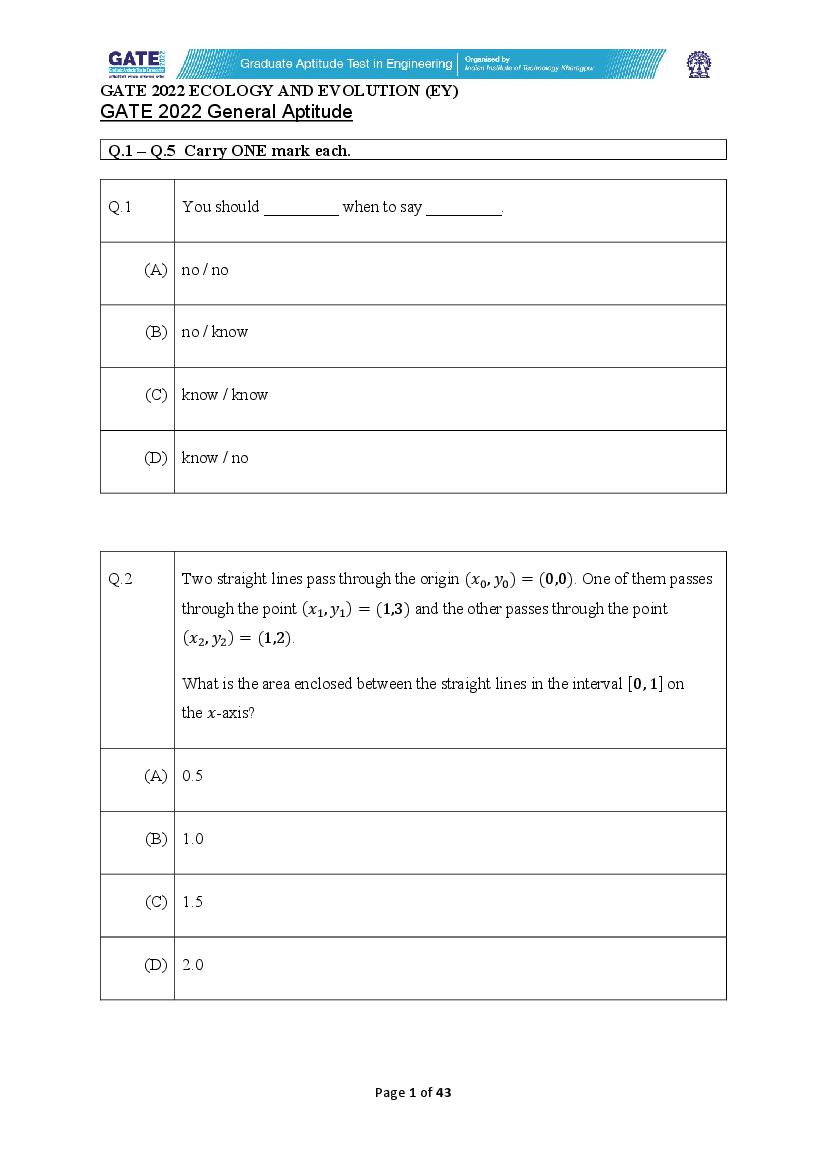
Page 1
Q.1 – Q.5 Carry ONE mark each.
Q.1 You should _________ when to say _________.
(A) no / no
(B) no / know
(C) know / know
(D) know / no
Q.2 Two straight lines pass through the origin (𝑥 , 𝑦 ) = (0,0). One of them passes
through the point (𝑥 , 𝑦 ) = (1,3) and the other passes through the point
(𝑥 , 𝑦 ) = (1,2).
What is the area enclosed between the straight lines in the interval [0, 1] on
the 𝑥-axis?
(A) 0.5
(B) 1.0
(C) 1.5
(D) 2.0
Page 1 of 43
Page 2
𝑝∶𝑞=1∶2
𝑞∶𝑟=4∶3
𝑟∶𝑠=4∶5
and 𝑢 is 50% more than 𝑠, what is the ratio 𝑝 ∶ 𝑢?
(A) 2 ∶ 15
(B) 16 ∶ 15
(C) 1: 5
(D) 16: 45
Page 2 of 43
Page 3
P is the sister of Q.
Q is the husband of R.
R is the mother of S.
T is the husband of P.
Based on the above information, T is ______ of S.
(A) the grandfather
(B) an uncle
(C) the father
(D) a brother
Page 3 of 43
Page 4
and ZV are tangential to the circle. The relation among the areas of the squares,
PXWR, RUVZ and SPQT is
(A) Area of SPQT = Area of RUVZ = Area of PXWR
(B) Area of SPQT = Area of PXWR Area of RUVZ
(C) Area of PXWR = Area of SPQT Area of RUVZ
(D) Area of PXWR = Area of RUVZ Area of SPQT
Page 4 of 43
Page 5
Q.6 Healthy eating is a critical component of healthy aging. When should one start
eating healthy? It turns out that it is never too early. For example, babies who
start eating healthy in the first year are more likely to have better overall health
as they get older.
Which one of the following is the CORRECT logical inference based on the
information in the above passage?
(A) Healthy eating is important for those with good health conditions, but not for
others
(B) Eating healthy can be started at any age, earlier the better
(C) Eating healthy and better overall health are more correlated at a young age, but
not older age
(D) Healthy eating is more important for adults than kids
Page 5 of 43
Page 6
month for 8 months of the year in a partnership business. The profit is shared in
proportion to the total investment made in that year.
If at the end of that investment year, Q receives of the total profit, what is the
value of 𝑥 (in ₹)?
(A) 2500
(B) 3000
(C) 4687
(D) 8437
Page 6 of 43
Page 7
14
14
12 11
10 9
Frequency
8 7
6
4
4 3
2
2
0
3 4 5 6 7 8 9
Marks
The above frequency chart shows the frequency distribution of marks obtained
by a set of students in an exam.
From the data presented above, which one of the following is CORRECT?
(A) mean > mode > median
(B) mode > median > mean
(C) mode > mean > median
(D) median > mode > mean
Page 7 of 43
Page 8
to move to P5 position.
The only movement allowed for a step involves, “two moves along one
direction followed by one move in a perpendicular direction”. The permissible
directions for movement are shown as dotted arrows in the right.
For example, a person at a given position Y can move only to the positions
marked X on the right.
Without occupying any of the shaded squares at the end of each step, the
minimum number of steps required to go from P2 to P5 is
1 2 3 4 5
P
Q
R
S
T
Example: Allowed steps for a person at Y
(A) 4
(B) 5
(C) 6
(D) 7
Page 8 of 43
Page 9
Consider a cube made by folding a single sheet of paper of appropriate shape.
The interior faces of the cube are all blank. However, the exterior faces that are
not visible in the above view may not be blank.
Which one of the following represents a possible unfolding of the cube?
(A)
(B)
(C)
(D)
Page 9 of 43
Page 10
Q.11 Which one of the following options denotes the time when the majority of animal
phyla first appeared in the fossil record? (MYA = Million Years Ago)
(A) 65 MYA
(B) 250 MYA
(C) 550 MYA
(D) 700 MYA
Q.12 Consider the following strains of an influenza virus and their basic reproduction
numbers (R0). Assuming that they are all equally virulent, which one of the
following strains would be most concerning for a completely vulnerable
population of humans?
(A) α-strain with R0 = 4.0
(B) β-strain with R0 = 1.0
(C) γ-strain with R0 = 0.5
(D) δ-strain with R0 = 0.2
Page 10 of 43
Page 11
of photosynthesis in C3 and C4 biochemical cycles?
(A) C3 > C4
(B) C4 > C3
(C) C3 = C4
(D) Energy requirement is unrelated to C3 or C4 cycle
Q.14 Which one of the following is a proximate explanation for grouping in animals?
(A) Animals in groups face a lower risk of predation.
(B) Animals form groups to forage efficiently.
(C) Groups can navigate their environment better.
(D) Groups form when individuals show attraction to others.
Page 11 of 43
Page 12
following processes?
(A) Habituation
(B) Sensitization
(C) Reinforcement
(D) Imprinting
Q.16 Male stickleback fish develop red colour on their ventral side in the breeding
season and maintain territories. When a conspecific male intruder enters their
territory, resident males perform an aggressive display. The ethologist Niko
Tinbergen presented models of different shapes to territorial male stickleback fish.
He found that models of any shape elicited aggressive displays, provided the
ventral part of the models was coloured red. This observation led to the
development of which one of the following concepts?
(A) Supernormal stimuli
(B) Sign stimuli
(C) Gestalt stimuli
(D) Internal stimuli
Page 12 of 43
Page 13
they had which one of the following combination of properties?
(A) Large diameter axons and electrical synapses
(B) Small diameter axons and electrical synapses
(C) Large diameter axons and chemical synapses
(D) Small diameter axons and chemical synapses
Q.18 Moth caterpillars that mimic bird droppings are an example of which one of the
following phenomena?
(A) Aposematism
(B) Batesian mimicry
(C) Masquerade
(D) Müllerian mimicry
Page 13 of 43
Page 14
coexistence of two species at the same trophic level within an ecological
community?
(A) Density-dependent predation
(B) Facilitation
(C) Intense interspecific competition
(D) Niche differentiation
Q.20 Which one of the following organisms is a cytoplasmically inherited symbiotic
bacterium that can cause extreme female-biased sex ratios in many insects?
(A) Clostridium
(B) Escherichia
(C) Mycobacterium
(D) Wolbachia
Page 14 of 43
Page 15
white flowers produced F1 generation with pink flowers. If the plants with pink
flowers are selfed, what is the proportion of white : pink : red flowers expected in
the next generation?
(A) 1:1:1
(B) 1:2:1
(C) 2:1:2
(D) 2:2:1
Q.22 A gene coding for a particular protein exhibits 2% DNA sequence divergence
between humans and chimpanzees. However, protein sequences encoded by them
are identical. Which one of the following processes explains this?
(A) Nonsynonymous changes in the gene sequences
(B) Synonymous changes in the gene sequences
(C) Nonsense mutations in the gene sequences
(D) Frameshift mutations in the gene sequences
Page 15 of 43
Page 16
population extinction via demographic stochasticity?
(A) Small geographical range and low population density
(B) Large geographical range and low population density
(C) Small geographical range and high population density
(D) Large geographical range and high population density
Q.24 Which one of the following is not an expected impact of global warming?
(A) Birds shifting their distributions to higher elevations
(B) Fish shifting their distributions to deeper waters
(C) Lizards shifting their distributions towards the equator
(D) Mammals shifting their distributions towards higher latitudes
Page 16 of 43
Page 17
in an ecosystem?
(A) Net Secondary Productivity
(B) Gross Primary Productivity
(C) Net Ecosystem Productivity
(D) Net Primary Productivity
Q.26 Which one of the following major mass extinctions is the most recent?
(A) Cretaceous-Paleogene
(B) Late Devonian
(C) Permian-Triassic
(D) Triassic-Jurassic
Page 17 of 43
Page 18
locus?
(A) Heterozygote advantage
(B) Genetic drift
(C) Negative frequency dependent selection
(D) Mutation-Selection balance
Q.28 Which one of the following is potentially explained by the mid-domain effect?
(A) Increase in body size of mammals at high latitudes
(B) Species richness along an elevational gradient
(C) Cumulative species richness with increasing area
(D) Species richness along a disturbance gradient
Page 18 of 43
Page 19
a patch of primary forest.
Which one of the following options best explains this pattern?
(A) Carbon sequestration
(B) Seed predation by forest-dwelling insects
(C) Pollination by forest-dwelling insects
(D) Seed dispersal by forest-dwelling birds and mammals
Page 19 of 43
Page 20
conservation-oriented captive breeding efforts in India?
(A) Great Indian Bustard
(B) Himalayan Quail
(C) Jerdon’s Courser
(D) White-winged Wood Duck
Q.31 Which one or more of the following is/are not an example of a zoonotic
disease(s)?
(A) Ebola
(B) HIV-AIDS
(C) Lyme disease
(D) Poliomyelitis
Page 20 of 43
Page 21
more of the following reasons explain(s) this outcome?
(A) Smaller areas have higher extinction rates.
(B) Smaller areas have low environmental heterogeneity.
(C) Smaller areas support smaller populations.
(D) Smaller areas have higher speciation rates.
Q.33 The term “living fossil” applies to which one or more of the following organisms?
(A) Coelacanth
(B) Echidna
(C) Horseshoe crab
(D) Rhinoceros viper
Page 21 of 43
Page 22
island gigantism?
(A) Absence of interspecific competitors
(B) Absence of predators
(C) Limited habitat
(D) Limited prey base
Q.35 Which one or more of the following options represent(s) life history trade-offs?
(A) Egg size versus clutch size
(B) Growth versus age at sexual maturation
(C) Mate choice versus offspring quality
(D) Survival versus reproduction
Page 22 of 43
Page 23
Q.36 Certain plants and animals rely on toxins such as cardiac glycosides for self-defense.
Digitoxin and bufalin, structurally similar toxins produced by foxglove plants and
bufonid toads, respectively, are one such example. Which one of the following
statements about these toxins is correct?
(A) They are structural and functional analogs.
(B) They are structural and functional homologs.
(C) They are structural analogs and functional homologs.
(D) They are structural homologs and functional analogs.
Q.37 A behavioural ecologist records the number of times a kingfisher succeeds in catching
fish over multiple five-minute intervals. Which one of the following distributions best
describes these data?
(A) Chi-squared
(B) Normal
(C) Poisson
(D) Student’s-t
Page 23 of 43
Page 24
phytoplankton blooms in rivers. To figure out whether these blooms were driven by
ammonium or phosphate fertilizers, researchers cultured a phytoplankton species in
multiple samples of unpolluted river water. The samples were divided equally among
three treatments: ammonium fertilizer added, phosphate fertilizer added and no
fertilizer added. They then measured phytoplankton density in each of the samples
after a week. Phytoplankton densities (in thousands of cells/ml) are reported in the
table shown.
Phytoplankton densities (mean ± SD) in treatments with
No fertilizer Phosphate Ammonium
added fertilizer added fertilizer added
6±1 7 ± 1.5 27 ± 2
Which one of the following inferences is correct?
(A) Nitrogen is the limiting nutrient for phytoplankton growth.
(B) Phosphorus is the limiting nutrient for phytoplankton growth.
(C) Both nitrogen and phosphorus limit phytoplankton growth.
(D) Neither nitrogen nor phosphorus limits phytoplankton growth.
Page 24 of 43
Page 25
on these strains measured after 24 hours are shown. Black and white bars represent
S1 and S2, respectively.
Which one of the following best describes the interaction between S1 and S2?
(A) Amensalism
(B) Commensalism
(C) Cooperator-cheater
(D) Mutualism
Page 25 of 43
Page 26
identical, can move freely, have perfect information about the environment, and
compete for resources when they are in a habitat. At equilibrium, which one of the
following represents the predicted outcome?
(A) The number of individuals present and the profitability per individual will be higher in
P than in Q.
(B) The number of individuals present and the profitability per individual will be the same
in P and in Q.
(C) The number of individuals present will be higher in P than in Q and the profitability
per individual will be the same in P and in Q.
(D) The number of individuals present will be higher in Q than in P and the profitability
per individual will be higher in P than in Q.
Page 26 of 43
Page 27
Which one of the marked points has the highest rate-of-change of prey-capture-rate?
(A) P
(B) Q
(C) R
(D) S
Page 27 of 43
Page 28
generation. A researcher estimated the association between beak size and relative
fitness, shown in the graph. The estimated slope was −0.05 with a 95% confidence
interval of −0.15 to 0.09.
Which one of the following evolutionary processes acting on beak size is the most
likely reason for the observed reduction in beak size?
(A) Genetic drift
(B) Group selection
(C) Kin selection
(D) Natural selection
Page 28 of 43
Page 29
is typically stronger on males than on females. Which one of the following figures is
the correct representation of the Bateman gradient? In all figures, the dotted line
represents males and the solid line females.
(A) A
(B) B
(C) C
(D) D
Page 29 of 43
Page 30
themselves (Producer tactic P) or follow other individuals and steal grains from them
(Scrounger tactic S). The following graphs show how the fitness of each tactic
(P : dashed line and S : solid line) varies as a function of the relative frequency of S.
Which one of the graphs shows the correct representation of these tactics if they were
maintained through negative frequency dependence?
(A) A
(B) B
(C) C
(D) D
Page 30 of 43
Page 31
investing disproportionately more in musculature leading to wider heads. To test for
positive allometry in a study population, a researcher measures body size and head
width for 100 individuals and fits a straight line to a log-log plot of these two traits.
Which one of the following estimated values of the slope indicates support for
positive allometry?
(A) 0
(B) 0.5
(C) 1
(D) 1.5
Q.46 A team of ecologists laid 100 plots of 50 m × 50 m in a forest and counted the number
of individuals of a tree species in each plot. They then calculated the mean and
variance of the number of individuals per plot. If trees are randomly distributed, then
which one of the following relationships between the variance and mean is expected?
(A) Variance > mean
(B) Variance < mean
(C) Variance = mean
(D) Variance is independent of the mean
Page 31 of 43
Page 32
communities P, Q and R. Based on both species richness and relative abundance,
which one of the following options correctly represents the ordering of communities
according to their species diversity?
(A) P>Q>R
(B) Q>P>R
(C) R>P>Q
(D) R>Q>P
Page 32 of 43
Page 33
relationships in the Kingdom Animalia?
(A)
(B)
(C)
(D)
Page 33 of 43
Page 34
communities. Which one of the following statements is correct about β-diversity?
(A) Only nestedness affects β-diversity.
(B) Only species turnover affects β-diversity.
(C) Both nestedness and species turnover affect β-diversity.
(D) Neither nestedness nor species turnover affects β-diversity.
Q.50 Consider the logistic population growth model, given by
𝑑𝑛 𝑛
=𝑟𝑛 1−
𝑑𝑡 𝑘
where r is the intrinsic growth rate, n is the population size and k is the carrying
capacity. Which one or more of the following is/are assumption(s) of the model?
(A) Carrying capacity is constant
(B) Density dependence is quadratic
(C) Continuous growth with no time-lags
(D) No genetic, age or size structure
Page 34 of 43
Page 35
identification?
(A) 16S rRNA
(B) Cytochrome Oxidase I
(C) IgG
(D) Microsatellites
Page 35 of 43
Page 36
out what cues the bees use to recognize the flowers, researchers performed the
following experiment. They presented individual bees with the stimuli given below
and examined the proportion of bees that approached and landed on the stimuli.
The results are shown below.
Stimulus Response (%)
1 Uncovered yellow flowers 90
2 Yellow flowers in a black porous cloth bag 0
3 Yellow flowers in a transparent plastic bag 90
4 Yellow flowers in a black plastic bag 0
Which one or more of the following interpretation(s) of the experiment is/are correct?
(A) All flower colours other than yellow are ineffective at eliciting approach responses.
(B) Olfactory cues are sufficient to elicit approach responses.
(C) Visual cues are necessary to elicit approach responses.
(D) Visual cues are sufficient to elicit approach responses.
Page 36 of 43
Page 37
frequencies (infrasound) for mate-finding and high frequencies (ultrasound)
for hunting prey?
(A) High frequencies transmit further without distortion than low frequencies.
(B) High frequencies scatter more and allow for high-resolution information.
(C) Low frequencies transmit further without distortion than high frequencies.
(D) Low frequencies scatter more and allow for high-resolution information.
Page 37 of 43
Page 38
environment and in the diet of a bat predator.
Prey Relative abundance Relative abundance
species in diet (%) in environment (%)
X 0 40
Y 30 40
Z 70 20
Which one or more of the following is/are possible interpretations based on the data?
(A) The predator shows a preference for prey species Z.
(B) The predator shows no preference for any of the three prey species.
(C) Species X is avoided by the predator.
(D) The predator shows a preference for prey species Y.
Page 38 of 43
Page 39
(A) Snake venom toxin specificity and prey receptor modification
(B) Egg discrimination by hosts and brood parasite egg colouration
(C) Cooperative breeding and offspring survival rate
(D) Crypsis in prey and visual acuity in predator
Page 39 of 43
Page 40
critical values corresponding to a two-tailed F-test at a level of significance of 0.05.
The observed F-statistic for two samples is indicated by the solid line.
Which one or more of the following inferences is/are correct?
(A) The null hypothesis cannot be rejected.
(B) The null hypothesis is true.
(C) The ratio of the variances of the two samples is not statistically significantly
different from 1.
(D) The ratio of the skewness of the two samples is not statistically significantly
different from 1.
Page 40 of 43
Page 41
in tropical savannas?
(A) Fire suppression
(B) Increase in mean annual rainfall
(C) Increased levels of browsing by herbivores
(D) Increased atmospheric CO2
Q.58 Gene conversion can lead to which one or more of the following evolutionary
outcomes?
(A) Concerted evolution
(B) Increased expression
(C) Increased sequence divergence
(D) Increased sequence similarity
Page 41 of 43
Page 42
could produce this outcome?
(A) A neutral locus with three alleles
(B) A locus under selection with two alleles
(C) A neutral locus with two alleles
(D) A locus under selection with one allele
Q.60 Which one or more of the following reasons has/have been invoked to explain high
species diversity in the tropics?
(A) Greater area in the tropics
(B) Higher speciation rates in the tropics
(C) Lower extinction rates in the tropics
(D) The tropics are closer to the sun
Page 42 of 43
Page 43
residual degrees of freedom are _______. (Answer in integer)
Q.62 The genome of an organism has 60% GC (Guanine-Cytosine) content.
The Adenine in this genome is________%. (Answer in integer)
Q.63 The prevalence of flu in a population is 1%. A diagnostic test has a false positive rate
of 10% and a false negative rate of 10%. The probability that a randomly chosen
person tests positive is ______. (Round off to three decimal places)
Q.64 In a deer population, the male-to-female ratio is 1 : 2. The probability that a randomly
formed group of size three has 2 males and 1 female is _________.
(Round off to two decimal places)
Q.65 The fitness 𝑓(𝑛) of an individual in a group of size 𝑛 is given by
𝑓(𝑛) = 𝑛 (10 − 𝑛)
At evolutionary equilibrium, groups are found in two different sizes. If one group size
is 6, the other group size must be _______. (Answer in integer)
Page 43 of 43
Document Details
| Board / Org | IIT |
| Exam | Graduate Aptitude Test in Engineering |
| Type | Question Paper |
| Pages | 43 |
| Language | english |
| Updated | 22 Jul 2026 |