CUSAT CAT 2021 Question Paper Engineering Science
Finished viewing? Save it for later —
Download CUSAT CAT 2021 Question Paper Engineering Science (PDF · 28 pages)About CUSAT CAT 2021 Question Paper Engineering Science
CUSAT CAT 2021 Question Paper Engineering Science is available here for free download. Published by Cochin University for CUSAT Common Admission Test, this question paper can be viewed online or downloaded as a PDF (28 pages). Candidates preparing for CUSAT Common Admission Test can use CUSAT CAT 2021 Question Paper Engineering Science to understand the exam pattern, the type of questions asked, and the overall difficulty level.
Frequently Asked Questions
How can I download CUSAT CAT 2021 Question Paper Engineering Science?
Open this page and click the Download button to save CUSAT CAT 2021 Question Paper Engineering Science as a PDF. It is completely free on AglaSem Docs.
Is CUSAT CAT 2021 Question Paper Engineering Science free to download?
Yes. CUSAT CAT 2021 Question Paper Engineering Science can be viewed online and downloaded as a PDF free of cost on AglaSem Docs.
How many pages does CUSAT CAT 2021 Question Paper Engineering Science have?
CUSAT CAT 2021 Question Paper Engineering Science contains 28 pages, which you can read online or download together as a single PDF.
Where can I find more CUSAT Common Admission Test study material?
You can find more CUSAT Common Admission Test question papers, sample papers, syllabus, and answer keys on AglaSem Docs.
CUSAT CAT 2021 Question Paper Engineering Science – Text
Read the full text of this question paper below — useful to quickly search, copy and reference the content online without downloading the PDF.
📄 View text version (28 pages)
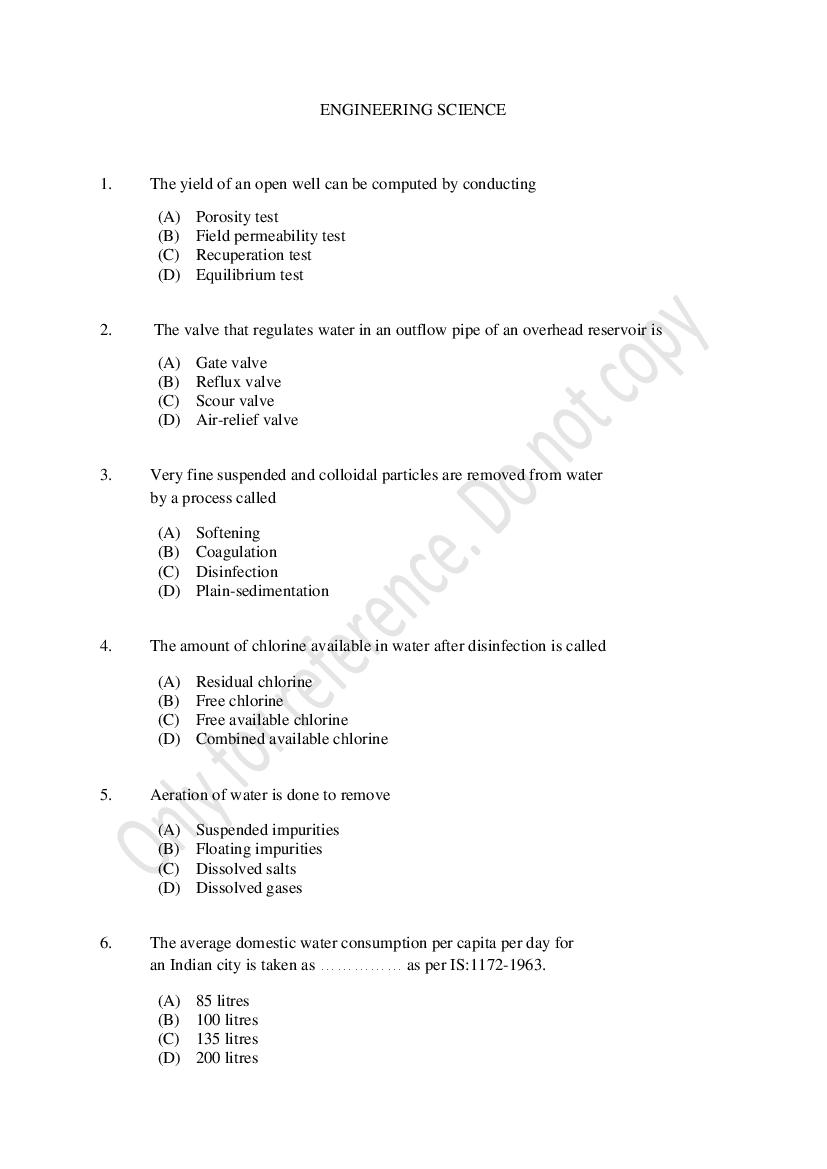
Page 1
1. The yield of an open well can be computed by conducting
(A) Porosity test
(B) Field permeability test
(C) Recuperation test
(D) Equilibrium test
2. The valve that regulates water in an outflow pipe of an overhead reservoir is
(A) Gate valve
(B) Reflux valve
(C) Scour valve
(D) Air-relief valve
3. Very fine suspended and colloidal particles are removed from water
by a process called
(A) Softening
(B) Coagulation
(C) Disinfection
(D) Plain-sedimentation
4. The amount of chlorine available in water after disinfection is called
(A) Residual chlorine
(B) Free chlorine
(C) Free available chlorine
(D) Combined available chlorine
5. Aeration of water is done to remove
(A) Suspended impurities
(B) Floating impurities
(C) Dissolved salts
(D) Dissolved gases
6. The average domestic water consumption per capita per day for
an Indian city is taken as …………… as per IS:1172-1963.
(A) 85 litres
(B) 100 litres
(C) 135 litres
(D) 200 litres
Page 2
(A) Typhoid
(B) Methemoglobinemia
(C) Gastroenteritis
(D) COVID-19
8. The product of Young’s modulus and moment of inertia is known as
(A) Modulus of rigidity
(B) Bulk modulus
(C) Flexural rigidity
(D) Torsional rigidity
9. When a body of mass m attains a velocity v from rest in time t,
then the kinetic energy of translation is
2
(A) mv
2
(B) mgv
2
(C) 0.5 mv
2
(D) 0.5 mgv
10. Mass moment of inertia of a uniform thin rod of mass ‘M’ and length ‘l’
about its mid-point and perpendicular to its length is
2
(A) (2/3)Ml
2
(B) (1/3)Ml
2
(C) (3/4) Ml
2
(D) (4/3)Ml
11. When a body is subjected to a direct tensile stress (p) in one plane, then maximum
normal stress occurs at a section inclined at …………… to the normal of the section.
(A) 0o
(B) 30o
(C) 45o
(D) 90o
Page 3
(A) Radioactive wastes
(B) Excess fertilizer
(C) Decaying animals and plants
(D) Human feces
13. Which of the following sanitizers is a surface active agent?
(A) Meta phosphate
(B) Tetra phosphate
(C) Teepol
(D) None of the above
14. Which of the following is found in the intermediate zone of a
waste stabilisation pond?
(A) Aerobic bacteria
(B) Algae
(C) Organic solids
(D) Facultative bacteria
15. …………… is formed when temporary hard water is boiled.
(A) Calcium bicarbonate
(B) Carbon dioxide
(C) Hydrogen chloride
(D) Calcium sulphite
16. The most commonly used non-empirical formula for calculating the flow velocity of
underground water is
(A) Hazen’s formula
(B) Bernoulli’s equation
(C) Darcy’s formula
(D) Lacy’s formula
17. The type of trap commonly used for receiving waste water from kitchen sinks and
bathrooms is
(A) Gully trap
(B) Intercepting trap
(C) Reverse trap
(D) Floor trap
Page 4
(A) Store water
(B) Increase the velocity in a pipeline
(C) Prevent overflow
(D) Absorb sudden rises of pressure
19. The dimensionless number that signifies the ratio of inertial forces to viscous forces is
(A) Prandtl number
(B) Mach number
(C) Reynolds number
(D) Sherwood number
20. A non Newtonian fluid that behaves as a rigid body at low stresses but flows as a
viscous fluid at high stress is
(A) Bingham plastic
(B) Pseudoplastic
(C) Rheopectic
(D) Dilatant
2 2
21. The components of velocity along the x-axis and the y-axis are u = ax + bxy + cy
and v = cxy respectively in a two dimensional flow. Under what condition will the
flow field be continuous?
(A) a+c=0
(B) 2a + c = 0
(C) 2b + c = 0
(D) b+c=0
22. The type of motion exhibited by a fluid element that moves from one position to
another and undergoes change in its dimensions is
(A) Rotation
(B) Angular Deformation
(C) Linear Deformation
(D) Linear Translation
Page 5
one of which is moving tangentially relative to the other.
(A) Poiseuille flow
(B) Couette flow
(C) Froude flow
(D) Rotational flow
24. A submerged orifice 1 metre wide has height of water 3 metres from the bottom of the
orifice and 2 metres from the top of the orifice. The difference in water levels on both
sides of the orifice is 1 metre. What is the discharge through the orifice if Cd = 0.6?
3
(A) 6.5 m /sec
3
(B) 8.5 m /sec
3
(C) 3.9 m /sec
3
(D) 2.6 m /sec
25. Which of the following can be used to predict pressure drop for fully developed flow
in a circular pipe?
(A) Moody chart
(B) Mollier chart
(C) Reynolds chart
(D) Scatter chart
26. Which of the following is not the reason for minor head loses in a pipe?
(A) Valves
(B) Bends
(C) Friction
(D) Tees
27. Water flows through a pipe of 0.5 m diameter and 9 km length at a
velocity of 1.09 m/sec. What is the head loss due to friction if the
coefficient of friction is 0.005?
(A) 21.8 m
(B) 26.5 m
(C) 15.5 m
(D) 32.8 m
Page 6
pipe with respect to some reference line is called
(A) Total energy gradient line
(B) Isotropic line
(C) Hydraulic gradient line
(D) Isobaric line
29. Which nozzle is used to accelerate a hot, pressurized gas passing
through it to a higher supersonic speed in the thrust direction?
(A) Pascal nozzle
(B) de Laval’ nozzle
(C) Bernouille’s nozzle
(D) Toricelli’s nozzle
30. A rectangular earthen channel is 1.2 m wide and 1 m deep. It has a longitudinal slope
of 1 in 1000. The hydraulic mean depth of the channel will be
(A) 0.55 m
(B) 1m
(C) 0.68 m
(D) 0.37 m
31. Which of the following does not belong to the category of grey water?
(A) Wastewater from bathroom sinks
(B) Wastewater from showers and tubs
(C) Wastewater from washing machines
(D) Wastewater from toilet flushing
32. Identify the instrument used to detect and measure odour dilution
(A) Chromatography
(B) Olfactometer
(C) Spectrophotometer
(D) Anemometer
Page 7
(A) A circular section gives the least perimeter for a given area, and therefore has
the maximum hydraulic mean depth for running full and half full conditions
(B) It is the most economical section since it requires minimum quantity of
material for its construction
(C) The section has uniform curvature and hence prevents the possibility of
deposits anywhere within the section
(D) Circular sewers are suitable where variation in discharge of sewage is very
large
34. …………… allow storm water or wastewater sewers to pass under
obstructions such as rivers.
(A) Lateral sewer
(B) Outfall sewer
(C) Depressed sewer
(D) Main sewer
35. When …………… is present in water at a concentration greater than 0.3 ppm,
the water will have a brown tinge.
(A) Manganese
(B) Magnesium
(C) Iron
(D) Zinc
36. Which of the following processes adds dissolved oxygen to a natural stream?
(A) Oxidation of organic matter
(B) Photosynthesis
(C) Nitrification
(D) Respiration by aquatic life
37. The process of overgrowth of plants and algae in lakes is known as
(A) Photosynthesis
(B) Eutrophication
(C) Respiration
(D) Transpiration
Page 8
activated sludge plants is
(A) Sedimentation
(B) Coagulation
(C) Flocculation
(D) Denitrification
39. Which of the following activated sludge process has the maximum
BOD removal efficiency?
(A) Extended aeration
(B) Step aeration
(C) Modified aeration
(D) Conventional
40. Settling of particles takes place by the contact of impurities present in wastewater
with each other in …………… settling.
(A) Flocculent settling
(B) Discrete settling
(C) Compression settling
(D) Hindered settling
41. Which of the following statements is not true for a rapid sand filter?
(A) High filter rate (4000 – 12000 litres per hour per square metre
of surface), small land requirements
(B) Effective in removing bacteria, viruses, fluoride, arsenic, salts,
odour and organic matter
(C) Backwashing takes only a few minutes and filters can be put
back into operation instantly
(D) Highly effective for removal of turbidity (usually < 0.1-1 NTU)
42. Which of the following aerobic processes is based on the symbiotic action between
algae and bacteria?
(A) Oxidation ditch
(B) Rotating biological contactor
(C) Oxidation pond
(D) Membrane bioreactor
Page 9
(A) Stratosphere
(B) Troposphere
(C) Ionosphere
(D) Exosphere
44. Which of the following is not a secondary pollutant?
(A) Ozone
(B) Peroxyacyl nitrates
(C) Nitric acid
(D) Sulphur dioxide
45. What is the emf if the current changes from 6A to 4A in 2 seconds and
the inductance is 8H?
(A) 8V
(B) 2V
(C) 4V
(D) 6V
46. What is the current leaving a parallel circuit if the currents in the three branches of the
circuit are 5A, 6A and 7A?
(A) 7A
(B) 18 A
(C) 11 A
(D) 5A
47. A RC circuit consists of a 100microF capacitor in series with a 80ohm resistor. What
is the time constant?
(A) 125 sec
(B) 0.008 sec
(C) 0.01 sec
(D) 12.5 sec
48. The relative permeability of a substance is less than that of free space.
The substance will be
(A) Ferromagnetic
(B) Paramagnetic
(C) Diamagnetic
(D) Both paramagnetic and ferromagnetic
Page 10
(A) Permeance
(B) Reluctance
(C) Resistance
(D) Conductance
50. An inductor with a ferromagnetic core has an inductance of 2000 H. The current
changes from 5A to 6A and the flux changes from 760 to 800 Wb. Calculate the
number of turns.
(A) 100
(B) 200
(C) 300
(D) 50
51. The current flowing in the inductive circuit is 2A in 4s. The inductance is 15H. What
will be the power in the circuit?
(A) 120 W
(B) 60 W
(C) 30 W
(D) 240 W
52. Excavation is to be carried out on a moderately firm ground for a depth of 1.5 m.
Which arrangement will you use to prevent the sleep of earth in foundation trenches?
(A) Vertical sheeting
(B) Sheet piling
(C) Stay bracing
(D) Runner
53. …………… is a temporary framework used in construction demolition,
maintenance or repair works.
(A) Shoring
(B) Grouting
(C) Underpinning
(D) Scaffolding
Page 11
discourage the strength of concrete in early stages?
(A) Chlorides
(B) Sulphates
(C) Nitrates
(D) Phosphates
55. “Loudness which corresponds to the magnitude of the sensation is proportional to the
logarithm of the intensity of the sound”. Which of the following laws governs this
statement?
(A) Weber and Fechner’s law
(B) Huygens–Fresnel law
(C) Loretz law
(D) Beer-Lambert law
56. The total set of greenhouse gas emissions caused by an individual, event, organisation
or product is known as
(A) Ecological footprint
(B) Carbon footprint
(C) Ecological pyramid
(D) Energy pyramid
57. The loss of …………… in wastewater may make it septic.
(A) Organic compounds
(B) Nitrates
(C) Dissolved oxygen
(D) Carbon content
58. Which of the following is not a ‘waste-to-energy conversion’ technique
for solid waste?
(A) Incineration
(B) Gasification
(C) Pyrolysis
(D) Composting
59. The number of steps involved in sulphur cycle is
(A) Six
(B) Five
(C) Eight
(D) Three
Page 12
in the natural environment?
(A) Diazotrophs
(B) Cyanobacteria
(C) Nitrobacter
(D) Nitrosomonas
61. Hot spots of biodiversity have
(A) high density of hot springs
(B) high density of biodiversity
(C) high density of endangered species only
(D) None of the above
62. Cultivation, and harvesting of timber is permitted in …………… if they do not
interfere with the project.
(A) National parks
(B) Biosphere reserves
(C) Sanctuaries
(D) Protected areas
63. Which of the following is not a design consideration for highways?
(A) Sight distance
(B) Cross section
(C) Settlement
(D) None of the above
64. An environmental impact assessment carried out for a policy or
programme is known as
(A) Strategic EIA
(B) Cumulative EIA
(C) Project EIA
(D) Rapid EIA
65. …………… is a system where water is distributed under low pressure through the
piped network in a pre-determined pattern and applied to each plant.
(A) Micro irrigation
(B) Nano irrigation
(C) Petite irrigation
(D) Flood irrigation
Page 13
(A) Ogee shaped
(B) Broad crested
(C) Sharp crested
(D) Narrow crested
67. Earth’s curvature is considered in …………… survey.
(A) Plane
(B) Basement
(C) Geodetic
(D) None of the above
68. The value of …………… is zero at point of contraflexure.
(A) Shear force
(B) Bending moment
(C) Strain energy
(D) Centre of gravity
69. …………… support offers resistance against vertical and horizontal moments.
(A) Hinged
(B) Simple
(C) Fixed
(D) Inclined
70. …………… is the phenomenon of slow growing strain under a stress
for a period of time.
(A) Yielding
(B) Breaking
(C) Creeping
(D) None of the above
71. The process of finding area of plane curves is often called
(A) Quadrature
(B) Revolution
(C) Convolution
(D) Mapping
Page 14
(A) 0.7, 0.21
(B) 0.3, 0.21
(C) 0.4, 0.75
(D) 0.1, 0.75
73. …………… is the dot product of two vectors A and B.
(A) Cartesian product
(B) Outer product
(C) Inner product
(D) Final product
74. ……………in columns is a type of mechanical failure which occurs
in materials due to the application of compressive load.
(A) Sagging
(B) Creeping
(C) Melting
(D) Buckling
75. The number of shear stress components that can act on a 3-D object is
(A) 3
(B) 6
(C) 9
(D) 2
76. A transformer has a primary current of 300 mA rms and is plugged into a 120 V rms
source. The secondary is providing 20 V across a 12 omega.gif load. What is the
efficiency of the transformer?
(A) 92%
(B) 80%
(C) 98%
(D) 85%
77. …………… is the distance travelled by a signal's energy in the time it takes for one
cycle to occur.
(A) Frequency
(B) Amplitude
(C) Wavelength
(D) Period
Page 15
(A) Dopants
(B) Electrons
(C) Holes
(D) Bonds
79. …………… are found in the upper part of an aquatic ecosystem.
(A) Nektons
(B) Benthos
(C) Arthropods
(D) Plankton
80. The tendency of biological systems to resist change is called
(A) Heliotropism
(B) Homeostasis
(C) Home tropism
(D) Evolution
81. …………… is considered as a common indicator organism
of sewage pollution in a water body.
(A) Escherichia coli
(B) Eicchornia Crassipes
(C) Lemna paucicostata
(D) Entamoeba histolytica
82. The concentration of DDT …………… as it travels along the food chain.
(A) decreases
(B) remains constant
(C) increases
(D) fluctuates randomly
83. …………… acts as an absorbing barrier for ultraviolet radiations in the stratosphere.
(A) Argon
(B) Ozone
(C) Oxygen
(D) Fluorocarbon
Page 16
(A) Kyoto protocol
(B) Montreal protocol
(C) Basel convention
(D) Ramsar treaty
85. Which of the following is the most harmful environmental pollutant?
(A) Animal waste
(B) Sewage
(C) Nutrients in excess
(D) Non-biodegradable chemicals
86. The concentration of many harmful pollutants has been found to increase in higher
trophic levels. This phenomenon is known as
(A) Biomagnification
(B) Eutrophication
(C) Biodegradation
(D) Bioremediation
87. Fish death occurs in water bodies contaminated by sewage. The main reason for such
occurrences is
(A) Pathogen
(B) Reduction in oxygen concentration
(C) Foul smell
(D) Clogging of grills by silt
88. Which of the following is a non-ionizing radiation with specific biological effects?
(A) Gamma rays
(B) X-rays
(C) UV radiation
(D) Beta rays
89. …………… is considered as an indicator of sulphur dioxide pollution
(A) Mosses
(B) Lichens
(C) Climbers
(D) Grasses
Page 17
that influence the germination, growth, survival, and reproduction of other
organisms is known as
(A) Allelopathy
(B) Ecological suppression
(C) Eutrophication
(D) Biomagnification
91. Which of the following techniques can be used to remove fluorides from water?
(A) Lime softening
(B) Ion exchange
(C) Reverse osmosis
(D) All of the above
92. Which of the following is a water borne disease?
(A) Scabies
(B) Hepatitis
(C) Asthma
(D) Rabies
2
93. The pressure inside a water droplet is 0.075 N/cm greater than the outside
pressure. What will be the diameter of the droplet? The surface tension may
be assumed as 0.075 N/m.
(A) 0.4 mm
(B) 4 mm
(C) 0.04 mm
(D) 0.6 mm
94. The force due to pressure gradient for fluid at rest is considered as
(A) Body force
(B) Surface force
(C) Force due to motion
(D) None of the above
Page 18
What is the weight of the body if depth of immersion is 1 m?
(A) 143 kN
(B) 73 kN
(C) 206 kN
(D) 412 kN
96. Kinetic energy factor for a fully developed laminar flow is around
(A) 4
(B) 1
(C) 6
(D) 2
97. …………… is a graph that indicates the power available at different streams of water.
(A) Hydrograph
(B) Powergraph
(C) Isobaric graph
(D) Flow graph
98. The sum of enthalpy and kinetic energy remains a constant in
(A) Isentropic flow
(B) Polytropic flow
(C) Adiabatic flow
(D) Isothermal flow
99. …………… is defined as the similarity between motion of the
model and the prototype.
(A) Kinematic similarity
(B) Geometric similarity
(C) Dynamic similarity
(D) Potential similarity
100. …………… is used to quantify the resistance of an object in a fluid environment.
(A) Viscosity
(B) Drag coefficient
(C) Momentum coefficient
(D) Diffusion coefficient
Page 19
their end points is called
(A) Support
(B) Pillar
(C) Beam
(D) Truss
102. The moment of inertia of a body does not depend on its
(A) Angular velocity
(B) Distribution
(C) Axis of rotation
(D) Mass
103. Steam is heated from 110oC to 114oC. Its specific heat at constant pressure
is 105 J/oC. The corresponding enthalpy change is
(A) 105 J
(B) 210 J
(C) 420 J
(D) 315 J
104. One percent of the people of country P are taller than 1.8 m. Two percent of the
people of country Q are taller than 1.8 m. There are thrice as many people in country
P as in country Q. Taking both countries together, what is the percentage of people
taller than 1.8 m?
(A) 3.0%
(B) 2.5%
(C) 1.5%
(D) 1.25%
105. Identify the group of nontoxic metals commonly found in natural water.
(A) Arsenic, lead and mercury
(B) Calcium, sodium and silver
(C) Iron, manganese and magnesium
(D) Cadmium, chromium and copper
Page 20
The amount of CO2 generated (in kg) during the process will be
(A) 2.75 Kg
(B) 3.2 Kg
(C) 2.5 Kg
(D) 2.1 Kg
107. At one end of a structural member subjected to compression, translation is restrained
at one end and both translation and rotation are restrained at the other end. The
effective length factor recommended by IS 456 : 2000 in this case is
(A) 0.80
(B) 0.70
(C) 0.65
(D) 0.50
108. Which of the following is used to determine the liquid limit of soil?
(A) Le Chatelier apparatus
(B) Casagrande’s apparatus
(C) Vicat apparatus
(D) Briquette testing apparatus
109. The entries in each column of a square matrix 𝑀 add up to 1.
Then an eigenvalue of 𝑀 is
(A) 1
(B) 3
(C) 2
(D) 4
110. The initial setting and early strength gain of ordinary Portland
cement is due to the presence of
(A) C3 A
(B) C3 S
(C) C2 S
(D) C4AF
Page 21
depends on the
(A) Grade of steel only
(B) Grade of concrete only
(C) Grade of concrete and grade of steel
(D) Grade of concrete and percentage of reinforcement
112. The faintest sound that a normal healthy individual can hear has a sound pressure of
(A) 0.2 μPa
(B) 2 μPa
(C) 55 μPa
(D) 20 μPa
2 2
113. Two curves 𝑥 = 4𝑦 and 𝑦 = 4𝑥 intersect at point (0, 0).
What is the angle of intersection?
(A) 0o
(B) 30o
(C) 45o
(D) 90o
114. The shear force at a section of beam under bending is equal to zero
then the bending moment at the section is
(A) Maximum
(B) Minimum
(C) Zero
(D) None of the above
115. The minimum essential treatment to be given to the water from a deep tube well to
make it potable
(A) Coagulation and flocculation
(B) Disinfection
(C) Filtration
(D) Settling
116. The analysis of river water shows that nitrates are present in excess. This indicates
(A) recent pollution of water with sewage
(B) immediate pollution of water with sewage
(C) past pollution of water with sewage
(D) no pollution of water with sewage
Page 22
3
Q m /s with silt factor ‘f’. The mean flow velocity (m/s) in the channel will be
2 1/6
(A) (Qf /140)
1/3
(B) (Qf/140)
22 1/6
(C) (Q f /140)
1/3
(D) 0.48 (Q/f)
118. Which of the following can be used to measure the amount of actual
evapotranspiration released by plants?
(A) Lysimeter
(B) Bolometer
(C) Thermoscope
(D) Manometer
119. It is required to maintain a minimum dissolved oxygen content
of …………… in a river for the survival of aquatic life.
(A) 0 mg/L
(B) 2 mg/L
(C) 4 mg/L
(D) 8 mg/L
120. …………… is a dimensionless parameter measuring the ratio of "the inertia
force on an element of fluid to the weight of the fluid element".
(A) Reynolds number
(B) Froude number
(C) Nusselt number
(D) Prandtl number
121. Which of the following waste water treatment operations involves mass transfer?
(A) Aeration
(B) Sedimentation
(C) Screening
(D) Equalisation
Page 23
transfer to the mass diffusivity
(A) Schmidt number
(B) Prandtl number
(C) Sherwood number
(D) Grashoff number
123. Which of the following has the highest capability of producing precise output when
compared to the remaining methods?
(A) Theodolite surveying
(B) Traverse surveying
(C) Terrestrial photogrammetry
(D) Aerial photogrammetry
124. Identify the feature which is not applicable to remote sensing.
(A) Electro-magnetic spectrum
(B) Interaction of energy with atmosphere
(C) Interaction of energy with satellite
(D) Electromagnetic energy
125. ………….. indicates the process of measuring depth below the water surface.
(A) Contouring
(B) Sounding
(C) Triangulation
(D) Traversing
126. The average percentage of water present in human body is
(A) 60
(B) 40
(C) 90
(D) 20
127. The largest producer of biofuel in the world is
(A) India
(B) Argentina
(C) Brazil
(D) United States of America
Page 24
(A) Water
(B) Air
(C) Soil
(D) Nutrients
129. Identify the organism which acts as primary decomposers and recyclers of most of the
dead plant material.
(A) Bacteria
(B) Fungi
(C) Protozoa
(D) Plankton
130. …………… is a symbiotic association between a fungus and a plant.
(A) Fungal mantle
(B) Mycelium
(C) Mycorrhizae
(D) Thallus
131. The presence and role of ……………. within an ecosystem has a disproportionate
effect on other organisms within the system.
(A) Keystone species
(B) Dominant species
(C) Super species
(D) Precious species
132. ………….. are special ecosystems in which the water level fluctuates dramatically
in different seasons.
(A) Coral reefs
(B) Wetlands
(C) Deep oceans
(D) Brackish water
133. Sunderbans, a delta of Ganges River is an example of
(A) Lake ecosystems
(B) Pond ecosystem
(C) Brackish water ecosystem
(D) River ecosystem
Page 25
relation to importation of hazardous chemicals?
(A) Montreal protocol
(B) Stockholm convention
(C) Basel convention
(D) Rotterdam convention
135. …………… is a suspension of fine solid particles or liquid droplets
in air or another gas.
(A) Smoke
(B) Aerosol
(C) Dust
(D) Particulates
136. The controlled use of …………… in conjunction with waste stabilization increases
the BOD removal capacity.
(A) Water hyacinth
(B) Moses
(C) Lichen
(D) Eupatorium
137. Which of the following techniques can be used for the effective removal of emulsified
oil from water?
(A) Gravity separation
(B) Screening
(C) Filtration
(D) Dissolved air floatation
138. Removal of sand, and gravel in the primary treatment of waste water is known as
(A) Coagulation
(B) Screening
(C) Grit removal
(D) Adsorption
139. Which of the following characteristics does not make a waste hazardous?
(A) Toxicity
(B) Viscosity
(C) Flammability
(D) Reactivity
Page 26
combined with oxygen forming carbon dioxide and water, which are released into the
atmosphere.
(A) Incineration
(B) Pyrolysis
(C) Composting
(D) Stabilisation
141. Chairperson of the National Crisis Management Committee is the
(A) Principal Secretary to the Prime Minister
(B) Cabinet Secretary
(C) Home Secretary
(D) Home Minister
142. …………… is an area of land that feeds all the water running under it and draining
off of it into a body of water.
(A) Water cycle
(B) Catchment area
(C) Water shed
(D) Water reservoir
143. Which of the following greenhouse gases has the highest global warming potential on
a 100 year scale?
(A) Carbon tetra fluoride
(B) Nitrous oxide
(C) Methane
(D) Water vapour
144. A disease that affects a large number of people within a community, population, or
region is known as
(A) Pandemic
(B) Endemic
(C) Epidemic
(D) Outbreak
145. Any substance that can disturb the development of an embryo or foetus is called
(A) Carcinogen
(B) Teratogen
(C) Mutagen
(D) Antibody
Page 27
(A) Community
(B) Colony
(C) Biome
(D) Species
147. …………… is an electrical device consisting of two dissimilar electrical conductors
forming an electrical junction.
(A) Pyrometer
(B) Thermocouple
(C) Galvanometer
(D) Resistance thermometer
148. …………… is the torque which acts on the moving system
of the instrument when it is moving.
(A) Vibrational torque
(B) Damping torque
(C) Rotational torque
(D) Inertial torque
149. Orifice plate flow meters require ……………. for accurate operation.
(A) Fully developed turbulent flow
(B) Laminar flow
(C) Plug flow
(D) Transitional flow
150. Rapid growth of bacteria is observed in the …………… phase of the growth curve.
(A) Lag phase
(B) Stationary phase
(C) Endogenous phase
(D) Log phase
Page 28
Subject Name: 607 ENGINEERING SCIENCE
SI No. Key SI No. Key SI No. Key SI No. Key SI No. Key
1 C 31 D 61 B 91 D 121 A
2 A 32 B 62 C 92 B 122 C
3 B 33 D 63 C 93 A 123 D
4 A 34 C 64 A 94 B 124 C
5 D 35 A 65 A 95 C 125 B
6 C 36 B 66 B 96 D 126 A
7 B 37 B 67 C 97 A 127 D
8 C 38 D 68 B 98 C 128 C
9 C 39 A 69 A 99 A 129 B
10 B 40 C 70 C 100 B 130 C
11 A 41 B 71 A 101 D 131 A
12 D 42 C 72 B 102 A 132 B
13 C 43 B 73 C 103 C 133 C
14 D 44 D 74 D 104 D 134 D
15 B 45 A 75 B 105 C 135 B
16 C 46 B 76 A 106 A 136 A
17 A 47 B 77 C 107 D 137 D
18 D 48 C 78 C 108 B 138 C
19 C 49 A 79 D 109 A 139 B
20 A 50 D 80 B 110 B 140 A
21 B 51 B 81 A 111 C 141 B
22 C 52 C 82 C 112 D 142 C
23 B 53 D 83 B 113 D 143 A
24 D 54 B 84 B 114 B 144 C
25 A 55 A 85 D 115 B 145 B
26 C 56 B 86 A 116 C 146 D
27 A 57 C 87 B 117 A 147 B
28 C 58 D 88 C 118 A 148 B
29 B 59 A 89 B 119 C 149 A
30 D 60 C 90 A 120 B 150 D
Document Details
| Board / Org | Cochin University |
| Exam | CUSAT Common Admission Test |
| Type | Question Paper |
| Pages | 28 |
| Language | english |
| Updated | 22 Jul 2026 |