CUSAT CAT 2021 Question Paper Food Science
Finished viewing? Save it for later —
Download CUSAT CAT 2021 Question Paper Food Science (PDF · 28 pages)About CUSAT CAT 2021 Question Paper Food Science
CUSAT CAT 2021 Question Paper Food Science is available here for free download. Published by Cochin University for CUSAT Common Admission Test, this question paper can be viewed online or downloaded as a PDF (28 pages). Candidates preparing for CUSAT Common Admission Test can use CUSAT CAT 2021 Question Paper Food Science to understand the exam pattern, the type of questions asked, and the overall difficulty level.
Frequently Asked Questions
How can I download CUSAT CAT 2021 Question Paper Food Science?
Open this page and click the Download button to save CUSAT CAT 2021 Question Paper Food Science as a PDF. It is completely free on AglaSem Docs.
Is CUSAT CAT 2021 Question Paper Food Science free to download?
Yes. CUSAT CAT 2021 Question Paper Food Science can be viewed online and downloaded as a PDF free of cost on AglaSem Docs.
How many pages does CUSAT CAT 2021 Question Paper Food Science have?
CUSAT CAT 2021 Question Paper Food Science contains 28 pages, which you can read online or download together as a single PDF.
Where can I find more CUSAT Common Admission Test study material?
You can find more CUSAT Common Admission Test question papers, sample papers, syllabus, and answer keys on AglaSem Docs.
CUSAT CAT 2021 Question Paper Food Science – Text
Read the full text of this question paper below — useful to quickly search, copy and reference the content online without downloading the PDF.
📄 View text version (28 pages)
Page 1
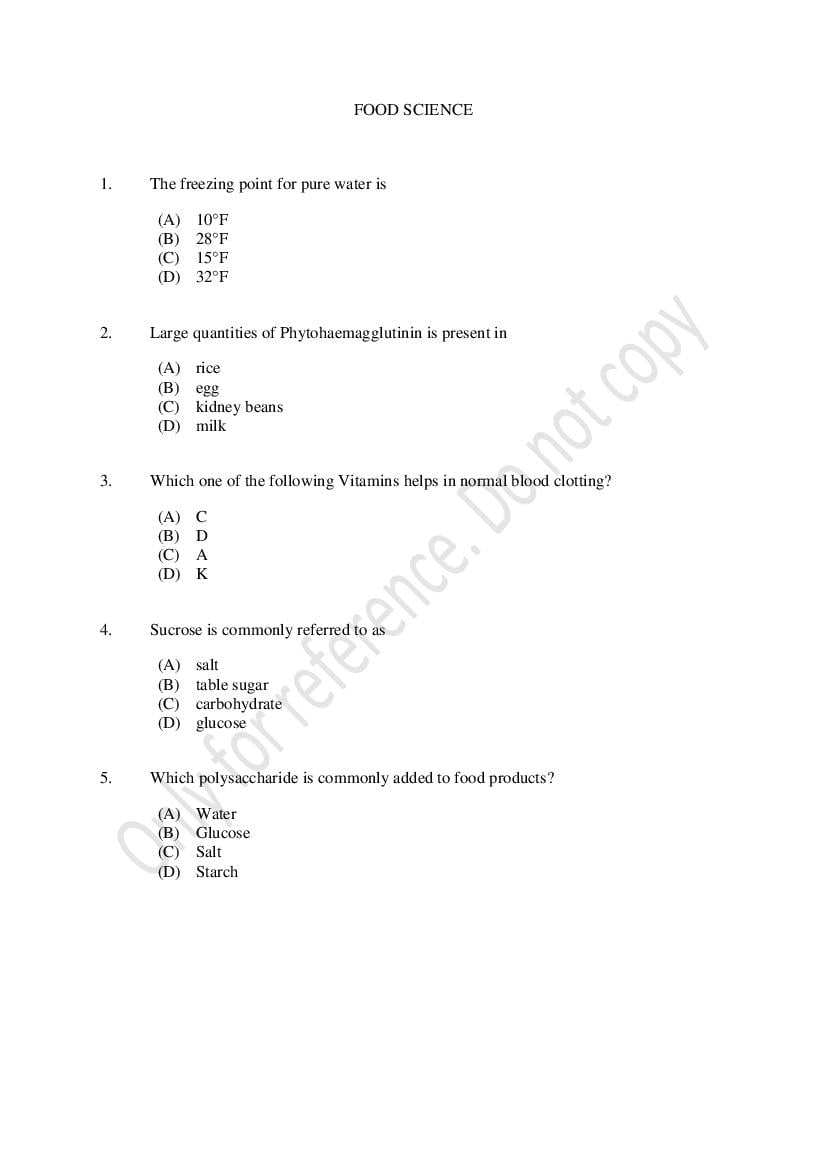
1. The freezing point for pure water is
(A) 10°F
(B) 28°F
(C) 15°F
(D) 32°F
2. Large quantities of Phytohaemagglutinin is present in
(A) rice
(B) egg
(C) kidney beans
(D) milk
3. Which one of the following Vitamins helps in normal blood clotting?
(A) C
(B) D
(C) A
(D) K
4. Sucrose is commonly referred to as
(A) salt
(B) table sugar
(C) carbohydrate
(D) glucose
5. Which polysaccharide is commonly added to food products?
(A) Water
(B) Glucose
(C) Salt
(D) Starch
Page 2
(A) 120-200°C
(B) 130-140°C
(C) 180-220°C
(D) 220-280°C
7. Major ingredient of carbonated soft drinks is
(A) Water
(B) Caffeine
(C) Corn syrup
(D) Flavouring
8. Which of the following acts as a Universal solvent?
(A) Water
(B) Soap
(C) Alcohol
(D) Aldehyde
9. Which micro mineral is essential for the production of thyroid hormones?
(A) Calcium
(B) Fluorine
(C) Iodine
(D) Magnesium
10. When food comes in contact with wood smoke, it is contaminated with
(A) Biaxin
(B) Chlorodiaxin
(C) Formalin
(D) None of the above
11. BIS stands for
(A) Board of Indian Standards
(B) Bureau of Indian Standards
(C) Bureau of International Standards
(D) None of the above
Page 3
(A) Cajanus cajan
(B) Cicer arietinum
(C) Vigna radiate
(D) Lathyrus sativus
13. Carbohydrates and proteins provide about …………… calories per gram.
(A) 5
(B) 4
(C) 2
(D) 6
14. Which among the following is called as ‘animal starch’?
(A) Caramel
(B) Cellulose
(C) Dextrins
(D) Glycogen
15. Stripping solvent off a meal is called
(A) Toasting
(B) Buttering
(C) Gamming
(D) Milling
16. Mould and Yeast are classified as
(A) viruses
(B) parasites
(C) fungi
(D) bacteria
17. Vitamin B2 is also known as
(A) Thiamine
(B) Niacin
(C) Riboflavin
(D) Folic acid
Page 4
(A) Maltose
(B) Dextrose
(C) Maltodextrin
(D) Glucose
19. Which type of drying is commonly used for producing milk powder?
(A) Wet
(B) Heat
(C) Spray
(D) Air
20. Which Vitamin is used most commonly to control enzymatic browning in fruits?
(A) K
(B) B
(C) C
(D) D
21. A common adulterant for black pepper is:
(A) Dried papaya seeds
(B) Poppy seeds
(C) Argimone seeds
(D) None of the above
22. Methemoglobinemia is caused due to …………… toxicity.
(A) Oxalate
(B) Phytate
(C) Methane
(D) Nitrobenzene
23. Which one of the following is a type of mushroom toxicity?
(A) Ergot
(B) Amatoxin
(C) Aflatoxin
(D) Fusarium
Page 5
(A) Amylase
(B) Protease
(C) Glucose-6-phosphate dehydrogenase
(D) Lipase
25. Tannins interfere with …………… absorption.
(A) Sodium
(B) Potassium
(C) Magnesium
(D) Iron
26. What is the expansion for HACCP?
(A) Hazard Analysis and Critical Control Point
(B) Health Assessment and Critical Control Point
(C) Health Analysis and Committee for Critical Control Point
(D) None of the above
27. AGMARK refers to
(A) Agricultural Marketing
(B) Agricultural Trading
(C) Agricultural Testing
(D) None of the above
28. Which of the following is a fish poisoning?
(A) Patulin
(B) Citrinin
(C) Ciguatera
(D) Fusarium
29. GMO Stands for
(A) Genetically Modified Organism
(B) Genetically Manufactured Oranges
(C) Gross Moldy Oranges
(D) Genetically Malfunctioning Organism
Page 6
(A) ICMR and NIN
(B) UNICEF and UNESCO
(C) FAO and WHO
(D) UNICEF and FAO
31. A more prominent chalaza indicates a …………… egg.
(A) staler
(B) healthier
(C) fresher
(D) rounder
32. One of the most common physical tests performed on fats is the determination of its
(A) Boiling point
(B) Cooling point
(C) Melting point
(D) Separating point
33. Candies such as rock candy, fondant and fudges are made from …………… sugars.
(A) Crystalline
(B) Non-crystalline
(C) Brown
(D) Sweet
34. Monoglycerides and diglycerides are used in a variety of foods as
(A) Emulsifiers
(B) Flavor
(C) Calories
(D) Color
35. Each gram of fat contains …………… kcal.
(A) 8
(B) 9
(C) 7
(D) 6
Page 7
(A) Glue
(B) Ethanol
(C) Paint
(D) Lotion
37. What happens when Fresh egg is placed in water?
(A) Floats
(B) Sinks
(C) Breaks
(D) None of the above
38. The sharp odor of fish is due to
(A) Trimethylamine
(B) Sulphur-di-oxide
(C) Ethyl chloride
(D) Methyl alcohol
39. Urea is added to milk to
(A) improve taste
(B) Improve flavor
(C) Increase shelf-life
(D) Increase nutritive value
40. FSSAI indicates
(A) Food Safety and Standards Authority of India
(B) Food Science and Standardization Authority of India
(C) Food Science and Safety Association of India
(D) None of the above
41. Botulism is caused by
(A) Clostridium species
(B) Salmonella species
(C) Streptococcal species
(D) None of the above
Page 8
(A) Salmonella species
(B) Streptococcus species
(C) Clostridium Botulinum
(D) None of the above
43. Fresh meat should be
(A) Bright red in colour
(B) Pink in colour
(C) Pale
(D) None of the above
44. Organoleptic evaluation is the other name for
(A) Objective evaluation
(B) Sensory evaluation
(C) Physiologic evaluation
(D) None of the above
45. Which part of the fish is cut lengthwise along one side parallel to the backbone?
(A) Steaks
(B) Nuggets
(C) Fillets
(D) Sticks
46. Gliadin is soluble in
(A) Salt
(B) Alcohol
(C) Dilute acid and alkali
(D) Sugar
47. Which of the following is a rapid pre-cooling method?
(A) Forced air Cooling
(B) Hydro Cooling
(C) Vacuum Cooling
(D) Evaporative Cooling
Page 9
(A) the boiling point will be higher
(B) the boiling point will be lesser
(C) the melting point will be higher
(D) the melting point will be lower
49. Nature of Gliadin is
(A) Viscous
(B) Elastic
(C) Extensive
(D) Tough
50. Which chemical is used for controlling sprouting of onion in storage?
(A) Maleic Hydrazide
(B) Ethylene
(C) Gallic acid
(D) Ascorbic acid
51. Carnauba wax is an example for
(A) Liquid wax
(B) Soft wax
(C) Hard wax
(D) Archaebacterial wax
52. The number of OH groups in fats can be expressed as
(A) Polenske number
(B) Reichert-Meissil number
(C) Acetyl number
(D) Iodine number
53. The degree of unsaturation of lipid can be measured as
(A) Saponification number
(B) Iodine number
(C) Polenske number
(D) Reichert-Meissil Number
Page 10
(A) L-types
(B) D-types
(C) An equi-molar mixture of L and D types
(D) Symmetric
55. Tomato fruits for canning are harvested at:
(A) Mature green stage
(B) Red ripe stage
(C) Immature green stage
(D) Half-ripe/pink stage
56. Which of the following amino acids will be absent in α (alpha) helix
structure of protein?
(A) Methionine
(B) Alanine
(C) Glutamic acid
(D) Proline
57. Benzoic Acid is most effective against
(A) Mould
(B) Yeast
(C) Bacteria
(D) Virus
58. What is the molecular formula of sucrose?
(A) C12H22O11
(B) C10H20O10
(C) C6H12O6
(D) C12H20O11
Page 11
fat. Which of the following statement is true about saponification number?
(A) The shorter the chain length of fatty acids, the higher will be the saponification
number
(B) The shorter the chain length of fatty acids, the lower will be the saponification
number
(C) The higher the chain saturation of fatty acids, the lower will be the
saponification number
(D) The lower the chain saturation of fatty acids, the higher will be the
saponification number
60. The enzyme abundantly distributed in adipocytes and germinating seeds is
(A) Protease
(B) Lipase
(C) Cellulase
(D) Nuclease
61. Rancidity of lipids in lipid-rich food stuffs is due to:
(A) Hydrogenation of unsaturated fatty acids
(B) Reduction of fatty acids
(C) Oxidation of fatty acids
(D) Dehydrogenation of saturated fatty acids
62. Vitamin C, Vitamin E, BHA, BHT, and sulfites are all
(A) Flavour enhancers
(B) Antimicrobial agents
(C) Additives
(D) Antioxidants
63. Which is the precursor of Ethylene?
(A) Tryptophan
(B) Methionine
(C) ABA
(D) IAA
Page 12
which one occurs least in proteins?
(A) Glycine
(B) Alanine
(C) Tryptophan
(D) Methionine
65. Double toned milk contains ……………% MF and ……………% MSNF.
(A) 1.5, 9.0
(B) 3.5, 8.5
(C) 3.0, 8.5
(D) 4.5, 8.5
66. Gluten is viscous and elastic in nature and is a combination of
(A) Gliadin and Glutenin
(B) Glutenin and Globulin
(C) Albumin and Globulin
(D) Globulin and Gliadin
67. Histones are rich in
(A) Lysine and Arginine
(B) Arginine and Histidine
(C) Histidine and Lysine
(D) Histidine and Glycine
68. Spinach is rich in
(A) Vitamin A
(B) Vitamin B
(C) Vitamin C
(D) Vitamin E
69. Bacteria prefer to use the codon CGA instead of AGA to code for Arginine.
This is an example for
(A) Second genetic code
(B) Nullomers
(C) Transcriptional decoding
(D) Allomers
Page 13
(A) Broad bean
(B) Cluster bean
(C) French bean
(D) Hyacinth bean
71. Red Chillies are rich source of
(A) Vitamin A
(B) Vitamin C
(C) Vitamin A and C
(D) Vitamin E
72. The amino acid commonly used as an ingredient in the buffers of SDS PAGE, is
(A) Aspartic acid
(B) Glutamic acid
(C) Glycine
(D) Aspartic acid and Lysine together
73. Which one of the following is a Climacteric type of fruit?
(A) Banana
(B) Citrus
(C) Litchi
(D) Grape
74. An aldo hexose will have …………… stereoisomers.
(A) 8
(B) 10
(C) 14
(D) 16
75. The term "three quarterful or full three quarter" is used to denote fruit maturity in
which of the following crops?
(A) Banana
(B) Mango
(C) Tomato
(D) Pineapple
Page 14
(A) Fruits
(B) Tubers
(C) Leafy vegetables
(D) None of the above
77. Maltose is a disaccharide of
(A) Glucose and galactose
(B) Glucose and glucose
(C) Glucose and lactose
(D) Fructose and lactose
78. Bitterness in Citrus juice is due to
(A) Sugar
(B) Acid
(C) Limonin
(D) Vitamins
79. Bitterness in Peach is due to
(A) Sugar
(B) Malic acid
(C) Hydrocyanin
(D) Prunasin acid
80. Storage of fruits and vegetables, where the gas composition is changed from that
of normal atmosphere and a precise control is maintained over the atmospheric
composition during storage period, is known as:
(A) Controlled Atmospheric (CA) storage
(B) Modified Atmospheric (MA) storage
(C) Cold storage
(D) Hypobaric storage
81. Which of the following is an alpha lactone?
(A) Vitamin C
(B) Vitamin D
(C) Vitamin A
(D) Vitamin K
Page 15
(A) Vitamin A
(B) Vitamin B1
(C) Vitamin B6
(D) Vitamin B12
83. Which of the following is a ketotetrose?
(A) Erythrulose
(B) Xylulose
(C) Sorbose
(D) Psicose
84. During controlled atmospheric storage composition,
which of the following set of gases is controlled?
(A) CO2, O2, N2
(B) C2H4, N2, O2
(C) CO2, CH4 , O2
(D) None of the above
85. Which of the following sugars gives a positive result with Seliwanoff test?
(A) Sucrose
(B) Glucose
(C) Galactose
(D) Mannose
86. The pH at which fruits and vegetables are divided as acidic and non-acidic
for thermal processing is
(A) 4.5
(B) 5.5
(C) 6.5
(D) 7.5
87. Select the odd one from the following
(A) Xylulose
(B) Dihydroxyacetone
(C) Glyceraldehyde
(D) Ribulose
Page 16
(A) Apple
(B) Mango
(C) Banana
(D) Pineapple
89. In pre-cooling, water is mostly removed by:
(A) Convection
(B) Conduction
(C) Radiation
(D) None of the above
90. Honey is adulterated using
(A) Fat
(B) Molasses
(C) Juice concentrate
(D) Corn flour
91. What is the maturity index for Avocado?
(A) Sugar content
(B) Acid content
(C) TSS
(D) Oil content
92. Lye peeling is done at a temperature of
(A) 75°C
(B) 84°C
(C) 93°C
(D) 105°C
93. Cinnamon is adulterated with
(A) Bombax bark
(B) Soil
(C) Cassia bark
(D) Dried leaves
Page 17
(A) increase
(B) decrease
(C) remain constant
(D) fluctuate
95. In Onion, pink colour is due to
(A) Anthocyanin
(B) Carotene
(C) Xanthophyll
(D) Quercitin
96. Glutenin is soluble in
(A) Salt
(B) Alcohol
(C) Dilute acid and alkali
(D) Sugar
97. Which of the folliwng bacteria can grow in alkaline pH?
(A) Lactobacilli
(B) Vibrio cholera
(C) Salmonella
(D) Staphylococcus
98. Guava fruit is botanically known as a
(A) Drupe
(B) Sorosis
(C) Berry
(D) Pome
99. The microbial cause of spoilage of honey is
(A) Zygosccharomyces
(B) Azotobactor
(C) Fusarium
(D) Candida
Page 18
(A) Neurospora
(B) Aspergillus
(C) Mucor
(D) Rhizopus
101. What is the threshold level of ethylene in fruits and vegetables?
(A) 0.01 µL/L
(B) 0.02 µL/L
(C) 0.03 µL/L
(D) 0.04 µL/L
102. Which statement about the pyranose form of mannose is not correct?
(A) it exists as two anomeric stereoisomers
(B) it reacts with Tollens' reagent to give a silver mirror. (i.e. it is a reducing sugar)
(C) reaction with excess CH3I and AgOH gives a non-reducing penta-O-methyl
derivative
(D) it resists reduction with aqueous sodium borohydride
103. Which two of the following aldohexoses give the same osazone derivative?
(A) 1 and 4
(B) 1 and 3
(C) 2 and 3
(D) 3 and 4
104. MSG is used as
(A) colour enhancer
(B) thickening agent
(C) flavour enhancer
(D) emulsifier
Page 19
(A) trypsin digestion
(B) cyanogen bromide
(C) chymotrypsin digestion
(D) Edman degradation
106. What is invert sugar, and why is it so named?
(A) The sugar mixture from hydrolysis of sucrose; fructose is isomerized to
glucose
(B) The sugar mixture from hydrolysis of sucrose; the optical rotation changes
from (+) to (–)
(C) The Sugar mixture from hydrolysis of starch; α-glycosidic bonds are changed
to β-glycosidic bonds
(D) The sugar mixture from hydrolysis of starch; glucose is isomerized to fructose
107. HIC is
(A) Hydrophilic Interaction Chromatography
(B) Hydrophilic Intermediate Chromatography
(C) Hydrophobic Interaction Chromatography
(D) Hydrophobic Intermediate Chromatography
108. The amino acid cysteine often forms a disulfide bond with another nearby cysteine.
This reaction is best classified as
(A) An addition
(B) A substitution
(C) An oxidation
(D) A reduction
109. Which of the following statements most correctly defines the isoelectric point?
(A) The pH at which all molecular species are ionized and that carry the same
charge
(B) The pH at which all molecular species are neutral and uncharged
(C) The pH at which half the molecular species are ionized (charged) and the other
half unionized
(D) The pH at which negatively and positively charged molecular species are
present in equal concentration
Page 20
as lipids?
(A) They are generally insoluble in water and soluble in organic solvents
(B) They are generally soluble in water and insoluble in organic solvents
(C) They have the common structural feature of two or more fused carbon rings
(D) They generally have a high weight proportion of oxygen (> 40%)
111. The Michaelis-Menton equation relates the rate of an enzyme-catalysed reaction to
which of the following?
(A) Substrate concentration
(B) Product concentration
(C) Activation energy
(D) Inhibitor concentration
112. Which of the following statements is untrue about protein secondary structure?
(A) The alpha helix, beta pleated sheet and beta turns are examples of protein
secondary structure
(B) The ability of peptide bonds to form intramolecular hydrogen bonds is
important to secondary structure
(C) The steric influence of amino acid residues is important to secondary structure
(D) The hydrophilic/hydrophobic character of amino acid residues is important to
secondary structure
113. The enzyme enterokinase helps in the conversion of
(A) Caseinogens into casein
(B) Trysionogen into trypsin
(C) Pepsinogen into pepsin
(D) Proteins into polypeptides
114. The formation of cystine occurs at
(A) Endoplasmic Reticulum
(B) Golgi apparatus
(C) Cytosol
(D) Mitochondria
Page 21
(A) electronic nose
(B) electronic detector
(C) electronic analyser
(D) electronic odour separator
116. Which of the following statements is false with respect to an enzyme's ability to
catalyse a reaction?
(A) An enzyme provides a reaction surface and a suitable environment for the
reaction to take place.
(B) An enzyme binds reactants such that they are positioned correctly and can
attain their transition-state configurations.
(C) An enzyme allows the reaction to go through a less stable transition state than
would normally be the case.
(D) An enzyme can weaken bonds in reactants through the binding process.
117. Which of the following is a group of proteolytic enzymes?
(A) Bromelin and Papain
(B) Cellulase and Myrosinase
(C) Maltase and Diastase
(D) Phosphatase and Chlorophyllase
118. Histidine is degraded to α-ketoglutarate and is described as a
(A) Gluco amino acid
(B) Glucogenic amino acid
(C) Ketogenic amino acid
(D) Keto-gluco acid
Page 22
(A) L-alanyl-L-phenylalanyl-glycine
(B) glycyl-L-phenylalanyl-L-alanine
(C) L-phenylalanyl-L-alanyl-glycine
(D) L-alanyl-glycyl-L-phenylalanine
120. Identify the strongest form of intermolecular bonding that could be formed involving
the residue of the amino acid, serine.
(A) Ionic bond
(B) Hydrogen bond
(C) van der Waals interactions
(D) None of the above
121. Which of the following statements is incorrect regarding transport proteins?
(A) They are present in cell membranes
(B) They serve to carry polar molecules across the hydrophobic cell membranes
(C) They are required to transport amino acids across cell membranes
(D) They are required to transport hydrophobic steroids across cell membranes
122. Beta-oxidation of fatty acids takes place at
(A) Peroxisomes
(B) Mitochondria
(C) Mitochondria and Peroxisomes
(D) Mitochondria, Peroxisomes and ER
123. ‘Solidity’ is the maturity index for
(A) Root vegetables
(B) Seed vegetables
(C) Leafy vegetables
(D) Cucurbits
Page 23
(A) Fermentation of Plum
(B) Fermentation of Peach
(C) Fermentation of Apple
(D) Fermentation of Rice
125. Bony armor fishes are
(A) Placoderms
(B) Ostracoderms
(C) Elasmobranchs
(D) None of the above
126. Which of the following fishes are viviparous?
(A) Chimeras
(B) Sharks
(C) Lamprey
(D) Salmons
127. Elasmobranchs remove Sodium Chloride through:
(A) Gills
(B) Rectal glands
(C) Liver
(D) Kidney
128. How many chambers are there in the heart of fishes?
(A) 1
(B) 3
(C) 4
(D) 2
129. Fishes that live in stagnant water are
(A) Protopterus
(B) Lepidosiren
(C) Neceratodus
(D) Sturecons
Page 24
(A) Hag fishes
(B) Lamprey
(C) Salmons
(D) Sharks
131. Which among the following are cartilaginous fishes?
(A) Osteichthyes
(B) Chondrichthyes
(C) Acanthodians
(D) Placoderms
132. Which one of the following is a true fish?
(A) Cattle fish
(B) Star fish
(C) Jelly fish
(D) Dog fish
133. Migration of fishes from fresh water to marine water for reproduction is known as
(A) Catadromonous
(B) Potamodromous
(C) Amphidromous
(D) Anadromous
134. Dorsal fin erosion in fishes is due to the deficiency of
(A) Leucine
(B) Histidine
(C) Lysine
(D) Tryptophan
135. Beche-de-Mere is obtained from
(A) Sea cucumber
(B) Seafen
(C) Sea lily
(D) Sea turtle
Page 25
(A) Crassostrea madrasensis
(B) Vanma litterata
(C) Sepia aculeate
(D) Perna viridis
137. The chemical which is used to induce triploids in fishes
(A) Calcium oxide
(B) Hydrochloric acid
(C) Sulphuric acid
(D) Nitrous oxide
138. Sea weeds are rich sources of
(A) Protein
(B) Fat
(C) Carbohydrate
(D) Iodine
139. Biodrum refers to
(A) Weeder
(B) Cutter
(C) Biofilter
(D) Ozonizer
140. Lordosis and scoliosis are due to the deficiency of
(A) Vitamin C
(B) Vitamin A
(C) Vitamin B complex
(D) Vitamin D
141. Seaweed, Nymphea produces
(A) Agar
(B) Caragenen
(C) Biotoxin
(D) Alginic acid
Page 26
(A) Lebeo rohita
(B) Clarias batrachus
(C) Catla catla
(D) Rostrelliger kauagurta
143. ‘Induced breeding technique’ is used in
(A) Marine fishery
(B) Capture fishery
(C) Inland fishery
(D) Culture fishery
144. Smoking is used as a technique of
(A) Mushroom cultivation
(B) Pulses cultivation
(C) Pickle preservation
(D) Fish preservation
145. Identify the edible freshwater telcost
(A) Catla catla
(B) Rays and Skates
(C) Hilsa ilisha
(D) Sharks
146. The larva of lamprey is
(A) Tonaria
(B) Tadpole
(C) Trochophore
(D) Ammocoete
147. Which of the following fishes show aestivation?
(A) Lepidosiren
(B) Protopterus
(C) Neoceratodus
(D) None of the above
Page 27
(A) Accelerated Fish Drying
(B) Accelerated Frequency Drying
(C) Accelerated Force Drying
(D) Accelerated Freeze Drying
149. Phosphatase test is used in the analysis of
(A) milk
(B) tea
(C) water
(D) coffee
150. What is the reason for blanching vegetables prior to freezing?
(A) To denature enzymes
(B) To prevent microbial activity
(C) To improve texture
(D) To maintain colour
Page 28
Subject Name: 618 FOOD SCIENCE
SI No. Key SI No. Key SI No. Key SI No. Key SI No. Key
1 D 31 C 61 C 91 D 121 D
2 C 32 C 62 D 92 C 122 B
3 D 33 A 63 B 93 C 123 C
4 B 34 A 64 C 94 A 124 C
5 D 35 B 65 A 95 D 125 B
6 C 36 B 66 A 96 C 126 B
7 A 37 B 67 A 97 B 127 B
8 A 38 A 68 C 98 C 128 D
9 C 39 C 69 B 99 A 129 C
10 B 40 A 70 B 100 A 130 D
11 B 41 A 71 C 101 A 131 B
12 D 42 C 72 C 102 D 132 D
13 B 43 A 73 A 103 B 133 D
14 D 44 B 74 D 104 C 134 D
15 A 45 C 75 A 105 B 135 C
16 C 46 B 76 C 106 B 136 A
17 C 47 B 77 B 107 C 137 A
18 C 48 C 78 C 108 C 138 C
19 C 49 A 79 D 109 D 139 A
20 C 50 A 80 A 110 A 140 A
21 A 51 C 81 A 111 A 141 D
22 D 52 C 82 D 112 D 142 D
23 B 53 B 83 A 113 B 143 D
24 C 54 A 84 A 114 A 144 D
25 D 55 B 85 A 115 A 145 A
26 A 56 D 86 A 116 C 146 D
27 A 57 B 87 C 117 A 147 A
28 C 58 A 88 C 118 B 148 D
29 A 59 A 89 B 119 A 149 A
30 C 60 B 90 B 120 B 150 A
Document Details
| Board / Org | Cochin University |
| Exam | CUSAT Common Admission Test |
| Type | Question Paper |
| Pages | 28 |
| Language | english |
| Updated | 22 Jul 2026 |