NBSE Class 8 Question Paper 2020 Science
Finished viewing? Save it for later —
Download NBSE Class 8 Question Paper 2020 Science (PDF · 4 pages)About NBSE Class 8 Question Paper 2020 Science
NBSE Class 8 Question Paper 2020 Science is available here for free download. Published by Nagaland Board for Class 8, this question paper can be viewed online or downloaded as a PDF (4 pages). Candidates preparing for Class 8 can use NBSE Class 8 Question Paper 2020 Science to understand the exam pattern, the type of questions asked, and the overall difficulty level.
Frequently Asked Questions
How can I download NBSE Class 8 Question Paper 2020 Science?
Open this page and click the Download button to save NBSE Class 8 Question Paper 2020 Science as a PDF. It is completely free on AglaSem Docs.
Is NBSE Class 8 Question Paper 2020 Science free to download?
Yes. NBSE Class 8 Question Paper 2020 Science can be viewed online and downloaded as a PDF free of cost on AglaSem Docs.
How many pages does NBSE Class 8 Question Paper 2020 Science have?
NBSE Class 8 Question Paper 2020 Science contains 4 pages, which you can read online or download together as a single PDF.
Where can I find more Class 8 study material?
You can find more Class 8 question papers, sample papers, syllabus, and answer keys on AglaSem Docs.
NBSE Class 8 Question Paper 2020 Science – Text
Read the full text of this question paper below — useful to quickly search, copy and reference the content online without downloading the PDF.
📄 View text version (4 pages)
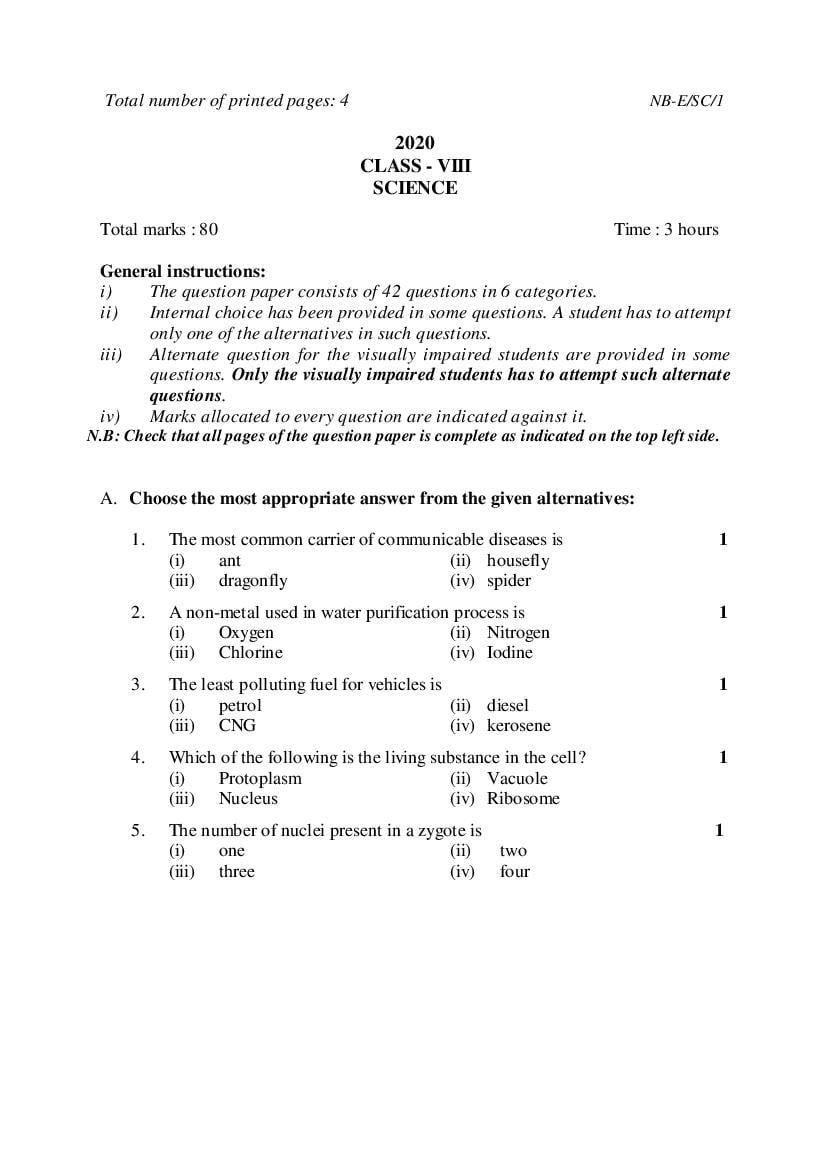
Page 1
2020
CLASS - VIII
SCIENCE
Total marks : 80 Time : 3 hours
General instructions:
i) The question paper consists of 42 questions in 6 categories.
ii) Internal choice has been provided in some questions. A student has to attempt
only one of the alternatives in such questions.
iii) Alternate question for the visually impaired students are provided in some
questions. Only the visually impaired students has to attempt such alternate
questions.
iv) Marks allocated to every question are indicated against it.
N.B: Check that all pages of the question paper is complete as indicated on the top left side.
A. Choose the most appropriate answer from the given alternatives:
1. The most common carrier of communicable diseases is 1
(i) ant (ii) housefly
(iii) dragonfly (iv) spider
2. A non-metal used in water purification process is 1
(i) Oxygen (ii) Nitrogen
(iii) Chlorine (iv) Iodine
3. The least polluting fuel for vehicles is 1
(i) petrol (ii) diesel
(iii) CNG (iv) kerosene
4. Which of the following is the living substance in the cell? 1
(i) Protoplasm (ii) Vacuole
(iii) Nucleus (iv) Ribosome
5. The number of nuclei present in a zygote is 1
(i) one (ii) two
(iii) three (iv) four
Page 2
6. An apple falls to the ground when they get detached from the tree
because of 1
(i) gravity (ii) friction
(iii) electricity (iv) magnetism
7. Margaret runs her toy car on dry marble floor, wet marble floor, newspaper
and towel spread on the floor. The force of friction acting on the car on
different surfaces in increasing order will be 1
(i) wet marble floor, dry marble floor, newspaper, towel
(ii) newspaper, towel, dry marble floor, wet marble floor
(iii) towel, newspaper, dry marble floor, wet marble floor
(iv) wet marble floor, dry marble floor, towel, newspaper
8. Sound can travel through 1
(i) gases only (ii) solids only
(iii) liquids only (iv) solids, liquids and gases
9. The device which can be used to test whether an object is carrying charge or
not is called 1
(i) electroscope (ii) telescope
(iii) microscope (iv) voltmeter
10. Which of the following gas damages the ozone layer? 1
(i) Chlorofluorocarbons (ii) Carbon dioxide
(iii) Chlorine (iv) Carbon monooxide
B. Fill in the blanks:
1. Process of separation of different constituents from petroleum is called
. 1
2. animals give birth to young ones. 1
3. Friction depends on the of surfaces. 1
4. The unit of frequency is . 1
5. Smog is made of smoke and . 1
C. Answer the following questions in one word or one sentence:
1. Name the microbe that causes tuberculosis. 1
2. What is force? 1
3. Name the organ in humans which produce sound. 1
4. List any two objects that are electroplated. 1
Page 3
5. Define dispersion of light. 1
D. Answer the following questions in about 10-20 words:
6. Write four points on the usefulness of microorganisms. 4×½=2
7. Can lemon pickle be stored in an aluminium utensil? Explain. 2
8. Give any two advantages of using CNG and LPG as fuels. 2×1=2
9. Write one function each of:
(i) plastids (ii) nucleus 1+1=2
10. What is metamorphosis? Give one example. 1+1=2
11. Give an example each of situation in which one pushes or pulls to change the state
of motion of objects. 1+1= 2
12. Explain why sliding friction is less than static friction. 2
13. Classify the following sounds into noise and music:
Guitar, sound of drilling machine, loudspeaker, bursting of fire crackers, piano,
violin, horns of vehicles, flute. 2
14. Name any two substances that will conduct electricity when added to distilled
water. 2×1=2
15. What is greenhouse effect? Name any two greenhouse gases. 1+1=2
E. Answer the following questions in about 30-40 words:
16. a. Describe any three physical properties of metals. 3×1=3
Or
b. Describe the changes that occur when iron nails are placed in copper sulphate
solution. Write the chemical reaction involved. (2+1=3)
17. Differentiate between inexhaustible and exhaustible natural resources giving one
example each. 1½+1½=3
18. Draw a labelled diagram of a plant cell. 3
State three differences between Eukaryotes and Prokaryotes. (3×1=3)
19. a. Give three examples each to show that friction is both a friend and a foe.
Page 4
Or 1½+1½=3
b. Give reason why:
(i) People often rub their hands in winter.
(ii) Sportsmen use shoes with spikes.
20. A pendulum oscillates 40 times in 4 seconds. Find its time period and frequency.
3
21. When the free ends of a tester are dipped into a solution, the magnetic needle show
deflection. Explain why. 3
22. Differentiate between regular and diffused reflection. Does diffused reflection
mean the failure of the laws of reflection? 2+1=3
23. a. Explain the circumstances leading to acid rain. How does acid rain affect human
beings? 1½+1½=3
Or
b. Write any three measures to make water safe for drinking. (3×1=3)
F. Answer the following questions in about 50-60 words:
24. a. What are antibiotics? Which group of microorganisms is used for making
antibiotics? What precautions must be taken while taking antibiotics? 1+1+2=4
Or
b. What are antibodies? Explain how vaccines work in protecting our body from
diseases. (2+2=4)
25. a. Define asexual reproduction. Explain any two methods of asexual reproduction
in animals. 1+1½+1½=4
Or
b. Explain the process of fertilization in human beings. (4)
26. In the following situation identify the agent exerting the force and the object on
which it acts. State the effect of the force in each case:
(i) Squeezing a piece of lemon between the fingers to extract its juice.
(ii) Taking out the paste from a toothpaste tube.
(iii) A load suspended from a spring while its other end is on a hook fixed to a
wall.
(iv) An athlete making a high jump to clear the bar at a certain height. 4×1=4
27. Describe the structure of the human eye with a labelled diagram. 2+2=4
Explain giving four points how the human eye can be taken care of. (4×1=4)
***************************************