HBSE Class 12 Question Paper 2020 English Elective
Finished viewing? Save it for later —
Download HBSE Class 12 Question Paper 2020 English Elective (PDF · 16 pages)About HBSE Class 12 Question Paper 2020 English Elective
HBSE Class 12 Question Paper 2020 English Elective is available here for free download. Published by Haryana Board for Class 12, this question paper can be viewed online or downloaded as a PDF (16 pages). Candidates preparing for Class 12 can use HBSE Class 12 Question Paper 2020 English Elective to understand the exam pattern, the type of questions asked, and the overall difficulty level.
Frequently Asked Questions
How can I download HBSE Class 12 Question Paper 2020 English Elective?
Open this page and click the Download button to save HBSE Class 12 Question Paper 2020 English Elective as a PDF. It is completely free on AglaSem Docs.
Is HBSE Class 12 Question Paper 2020 English Elective free to download?
Yes. HBSE Class 12 Question Paper 2020 English Elective can be viewed online and downloaded as a PDF free of cost on AglaSem Docs.
How many pages does HBSE Class 12 Question Paper 2020 English Elective have?
HBSE Class 12 Question Paper 2020 English Elective contains 16 pages, which you can read online or download together as a single PDF.
Where can I find more Class 12 study material?
You can find more Class 12 question papers, sample papers, syllabus, and answer keys on AglaSem Docs.
HBSE Class 12 Question Paper 2020 English Elective – Text
Read the full text of this question paper below — useful to quickly search, copy and reference the content online without downloading the PDF.
📄 View text version (16 pages)
Page 1
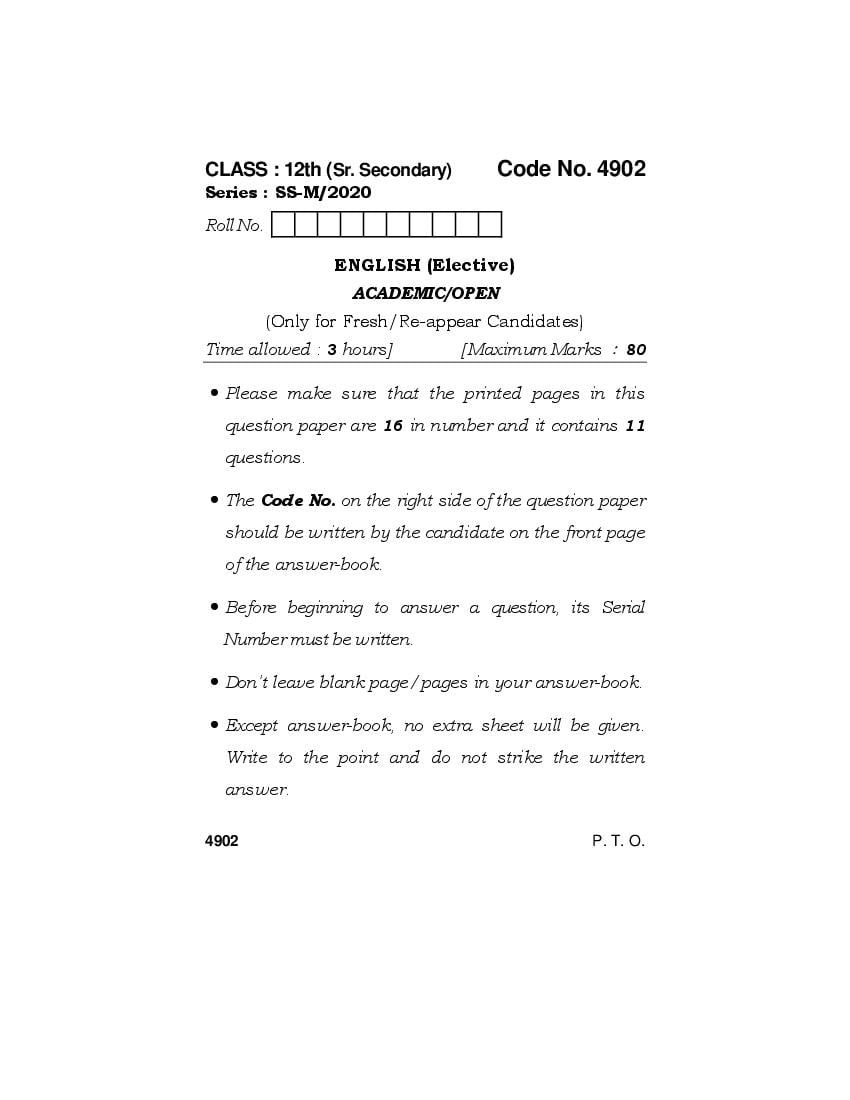
Series : SS-M/2020
Roll No.
ENGLISH (Elective)
ACADEMIC/OPEN
(Only for Fresh/Re-appear Candidates)
Time allowed : 3 hours] [ Maximum Marks % 80
• Please make sure that the printed pages in this
question paper are 16 in number and it contains 11
questions.
• The Code No. on the right side of the question paper
should be written by the candidate on the front page
of the answer-book.
• Before beginning to answer a question, its Serial
Number must be written.
• Don’t leave blank page / pages in your answer-book.
• Except answer-book, no extra sheet will be given.
Write to the point and do not strike the written
answer.
4902 P. T. O.
Page 2
• Candidates must write their Roll Number on the
question paper.
• Before answering the question, ensure that you
have been supplied the correct and complete
question paper, no claim in this regard, will be
entertained after examination.
Note : (i) All questions are compulsory.
(ii) This question paper is divided into four
Sections : A, B, C and D.
(iii) Attempt all parts of a question together.
(iv) Stick to the word limit wherever prescribed.
SECTION – A
1. Read the following passage carefully and answer
the questions that follow :
He groaned and sank back in his chair. He knew
there was no stopping her now. Except for
stories of grotesque births like those of two-
headed children or five-legged calves, there was
nothing she loved as dearly as tales of murder
and atrocity, and short of his having a stroke or
4902
Page 3
the fish-seller arriving at the door, nothing could
distract her now. He even heaved himself out of
his chair and shuffled off to the other end of the
balcony to feed the parrot in its cage a green
chilly or two without her so much as noticing his
departure. But when she had read to the end of
that fascinating item, she ran into another that
she read on in a voice like a law-maker's, and he
heard it without wishing to: "Electricity will be
switched off as urgent repairs to power lines
must be made, in Darya Ganj and Kashmere
Gate area, from 8 p.m. to 6 a.m. on the twenty-
first of May." My God, that is today.'
'Today? Tonight? No electricity?' he echoed,
letting the green chilly fall to the floor of the cage
where other offered and refused chillies lay in a
rotting heap. 'How will I sleep then?' he gasped
fearfully, 'without a fan ? In this heat?' and
already his diaphragm seemed to cave in, his
chest to rise and fall as he panted for breath.
Clutching his throat, he groped his way back to
the cane chair. 'Otima, Otima, 1 can't breathe,'
he moaned.
4902 P. T. O.
Page 4
Questions : 1×6=6
(i) What is the condition of the writer in the
beginning of the passage ?
(a) happy and cheerful
(b) groaning and sinking in the chair
(c) both (a) & (b)
(d) neither (a) nor (b)
(ii) What did the lady love most ?
(a) stories of suspense & thrill
(b) stories of joy & blessings
(c) tales of murder and atrocity
(d) none of the above
(iii) What was the reaction of the lady on
reading a news item ?
(a) happiness
(b) sadness
(c) mixed response
(d) none of the above
4902
Page 5
(iv) What expressions did the writer utter on
switching off of electricity ?
(a) How will I sleep then ?
(b) Without a fan ?
(c) In this heat ?
(d) All of the above
(v) What did he feel when he panted for
breath ?
(a) diaphragm seemed to cave in
(b) chest began to rise and fall
(c) both (a) & (b)
(d) neither (a) nor (b)
(vi) Clutching his throat, he uttered "Otima,
Otima I can't breathe". What sort of an
expression it is ?
(a) moaning
(b) laughing
(c) feeling good
(d) dancing
4902 P. T. O.
Page 6
2. Read the stanza given below and answer the
questions that follow :
I quarrelled with my brother
I don't know what about,
One thing led to another
And somehow we fell out
The start of it was slight,
The end of it was strong,
He said he was right,
I knew he was wrong !
We hated one another.
The afternoon turned black.
Then suddenly my brother
Thumped me on the back,
And said, "Oh, come along!
We can't go on all night −
I was in the wrong."
So he was in the right.
Questions : 1×6=6
(i) What is prominently described in the
passage ?
4902
Page 7
(ii) What was the temper of quarrel in the
beginning and in the end ?
(iii) What did the Poet think about the quarrel
with the brother ? What was the opinion of
the brother ?
(iv) Who are 'we' who hated one another ?
(v) Who thumped on whom on the back ?
(vi) In the end, according to the poetess, who
was right ?
3. Attempt any one of the following : 6
(i) You are Suman/Sohan, a student of Class
XII of a Govt. Sr. Sec. School. Write an
application to the Principal of your school
requesting him/her to allow you to collect
donations for supporting the ailing peon.
(ii) Write a paragraph on "Importance of Youth
Festivals".
4902 P. T. O.
Page 8
(iii) You are Raghu/Ragini, studying in class
XII. You attended a Blood Donation Camp
recently. Mentioning the date the number of
participants and other important details,
write a brief report for your school
magazine.
SECTION – B
4. Read the passage given below and answer the
questions that follow :
Before the disaster in Havana, I had seen
Frau Frieda in Barcelona in so unexpected and
fortuitous a way that it seemed a mystery to me.
It happened on the day Pablo Neruda stepped on
Spanish soil for the first time since the Civil
War, on a stopover during a long sea voyage to
Valparaiso. He spent a morning with us hunting
big game in the second-hand bookstores, and at
Porter he bought an old, dried-out volume with a
torn binding for which he paid what would have
been his salary for two months at the consulate
in Rangoon. He moved through the crowd like an
4902
Page 9
invalid elephant, with a child's curiosity in the
inner workings of each thing he saw, for the
world appeared to him as an immense wind-up
toy with which life invented itself.
I have never known anyone closer to the idea
one has of a Renaissance pope: He was
gluttonous and refined. Even against his will, he
always presided at the table. Matilde, his wife,
would put a bib around his neck that belonged
in a barbershop rather than a dining room, but
it was the only way to keep him from taking a
bath in sauce. That day at Carvalleiras was
typical. He ate three whole lobsters, dissecting
them with a surgeon's skill, and at the same
time devoured everyone else's plate with his eyes
and tasted a little from each with a delight that
made the desire to eat contagious: clams from
Galicia, mussels from Cantabria, prawns from
Alicante, sea cucumbers from the Costa Brava.
In the meantime, like the French, he spoke of
nothing but other culinary delicacies, in
particular the prehistoric shellfish of Chile,
which he carried in his heart. All at once he
stopped eating, tuned his lobster's antennae,
and said to me in a very quiet voice.
4902 P. T. O.
Page 10
Questions : 1×4=4
(i) Name the story and the author.
(ii) Where had the author seen Frau Frieda ?
How did she appear to him ?
(iii) What sort of a man Pope was ? How did his
wife Matilde make him eat ?
(iv) What did Pope eat that day and how ?
5. Read the stanza given below and answer the
questions that follow :
The trees are in their autumn beauty,
The woodland paths are dry,
Under the October twilight the water
Mirrors a still sky;
Upon the brimming water among the stones
Are nine-and-fifty swans.
The nineteenth autumn has come upon me
Since I first made my count;
I saw, before I had well finished,
All suddenly mount
4902
Page 11
And scatter wheeling in great broken rings
Upon their clamorous wings.
I have looked upon those brilliant creatures,
And now my heart is sore.
Questions : 1×4=4
(i) Name the poem and the poet.
(ii) How many swans are talked about in the
passage ?
(iii) For how many years has the poet been
witnessing this spectacle ?
(iv) What does the poet call 'the swans' ? And
why does he become sad ?
6. Read the passage given below and answer the
questions that follow :
So beware! If you allow any person, or class
of persons, to get the upper hand of you, he will
shift all that part of his slavery to Nature that
can be shifted on to your shoulders; and you will
find yourself working from eight to fourteen
hours a day when, if you had only yourself and
4902 P. T. O.
Page 12
your family to provide for, you could do it quite
comfortably in half the time or less. The object of
all honest governments should be to prevent
your being imposed on in this way. But the
object of most actual governments, I regret to
say, is exactly the opposite. They enforce your
slavery and call it freedom. But they also
regulate your slavery, keeping the greed of your
masters within certain bounds. When chattel
slavery of the negro sort costs more than wage
slavery, they abolish chattel slavery and make
you free to choose between one employment or
one master and another and this they call a
glorious triumph for freedom, though for you it
is merely the key of the street. When you
complain, they promise that in future you shall
govern the country for yourself. They redeem
this promise by giving you a vote, and having a
general election every five years or so.
Questions : 1×4=4
(i) Name the chapter and the author.
(ii) What does the author warn about in the
beginning of the passage.
4902
Page 13
(iii) What is the object of all honest
governments ?
(iv) What do governments actually enforce ?
7. Answer any two of the following in about 100
words : 6 + 6 = 12
(i) Who was Frank ? Why did Eveline's father
quarrel with him ?
(ii) How does A. K. Ramanujan's "Time and
Time Again" represent the complex
distillation of a lifetime of unusual thought
and feeling ?
(iii) How does Virginia Woolf's "The Mark on the
Wall" record fleeting impressions and
dedicate shades of mental experience ?
8. Answer any four of the following in about 30
words each, choosing at least one from each
sub-part a, b & c : 2×4=8
(a) (i) Who are Senciminers ?
(A Wedding in Brownsville)
4902 P. T. O.
Page 14
(ii) Sketch character of Bessie Carvil.
(Tomorrow)
(b) (i) What aspects of Indian society and
history get highlighted in Kamala Das
"Blood" ?
(ii) Love is described as light. What makes
John Donne talk about shadows ?
(A Lecture upon the Shadows)
(c) (i) Write a note on "Split Second
Impressions". (Film Making)
(ii) What is the simple truth that eludes
the philosopher or the scientist ?
SECTION – C
9. Answer in about 100 words : 6 + 6 = 12
(a) Discuss how R. N. Tagore's "Chandalika" is
rejection of cruel system of untouchability.
OR
What role does Mother play in "Chandalika" ?
4902
Page 15
(b) Manjula's sister does not appear in the play
"Broken Images" but is central to it. What
picture of her is built in your mind from
references in the play ?
OR
Why do you think Girish Karnad has used
the technique of the image in the play ?
(Broken Images)
10. Answer any four of the following questions in
about 30 words each, choosing two from each of
the two parts (a) and (b) : 2×4=8
(a) (i) What is Prakriti's idea of religion ?
(ii) How did Prakriti feel as soon as the
monk drank the water ?
(iii) How was the spell on the monk
broken ?
(b) (i) Who is Pramod ?
(ii) Why did Manjula resign from her job ?
(iii) What Cardinal sin has Manjula
committed, if at all ?
4902 P. T. O.
Page 16
SECTION – D
11. Write notes on any five of the following :
2 × 5 = 10
Simile, Metaphor, Rhyme, Scheme, Rhythm,
Pun, Paradox, Imagery.
S
4902
Document Details
| Board / Org | Haryana Board |
| Exam | Class 12 |
| Type | Question Paper |
| Pages | 16 |
| Updated | 30 Apr 2026 |