CG PPHT 2025 Syllabus
Finished viewing? Save it for later —
Download CG PPHT 2025 Syllabus (PDF · 12 pages)About CG PPHT 2025 Syllabus
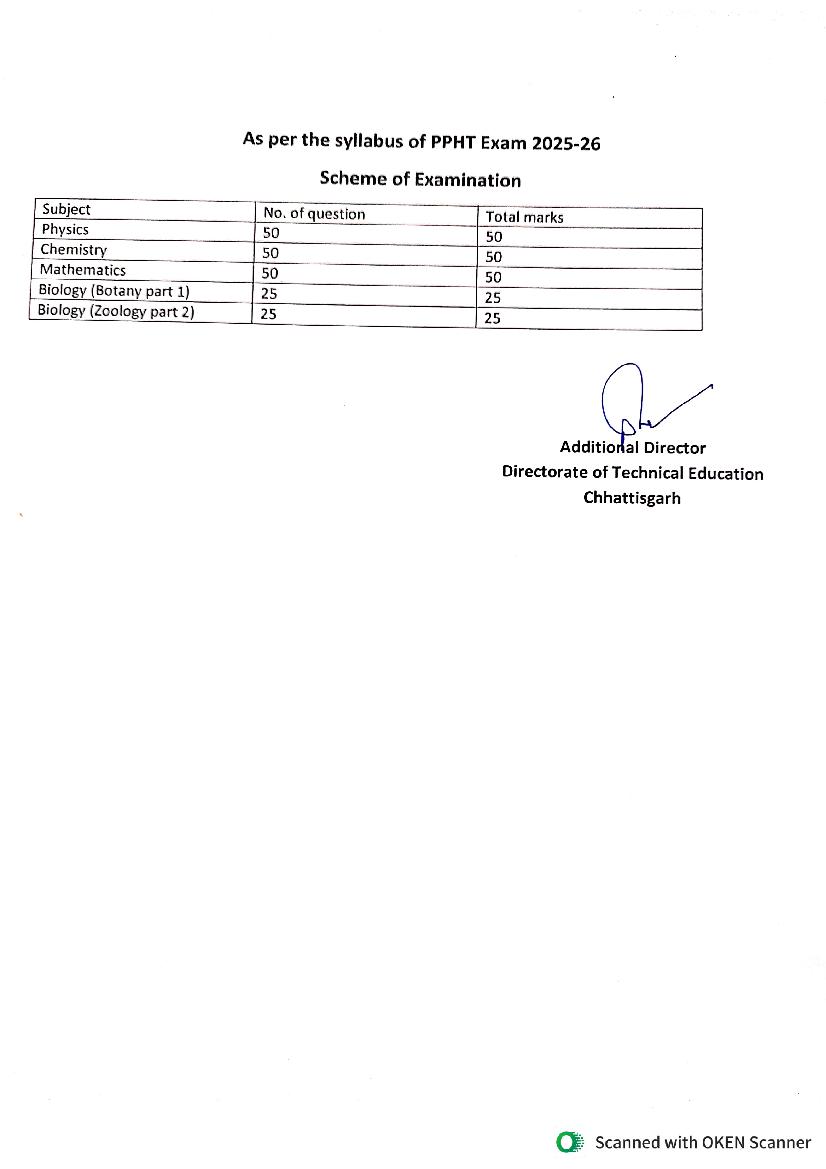
CG PPHT 2025 Syllabus is available here for free download. Published by CG Vyapam for CG PPHT, this syllabus can be viewed online or downloaded as a PDF (12 pages). Candidates preparing for CG PPHT can use CG PPHT 2025 Syllabus to understand the exam pattern, the type of questions asked, and the overall difficulty level.
Frequently Asked Questions
How can I download CG PPHT 2025 Syllabus?
Open this page and click the Download button to save CG PPHT 2025 Syllabus as a PDF. It is completely free on AglaSem Docs.
Is CG PPHT 2025 Syllabus free to download?
Yes. CG PPHT 2025 Syllabus can be viewed online and downloaded as a PDF free of cost on AglaSem Docs.
How many pages does CG PPHT 2025 Syllabus have?
CG PPHT 2025 Syllabus contains 12 pages, which you can read online or download together as a single PDF.
Where can I find more CG PPHT study material?
You can find more CG PPHT question papers, sample papers, syllabus, and answer keys on AglaSem Docs.
CG PPHT 2025 Syllabus – Text
Read the full text of this syllabus below — useful to quickly search, copy and reference the content online without downloading the PDF.
📄 View text version (11 pages)
Page 2
HkkSfrdh (Physics)
Units and dimensions, Dimensional analysis, S.I. Units, motion in two
dimensions. Cases ofuniform velocity and uniform acceleration, General
relation among position and velocity. Uniform circularmotion, Force and
inertia, Newton”s laws of motion .conservation of momentum and energy
Static and kineticfriction .
Work energy and power, Elastic collisions . Potential energy , Gravitational
potential energy and itsangular conversion to kinetic energy. Potential energy
of a spring . Rigid body rotation and conservation of itsmomentum, Moment of
inertia, theorems of parallel and perpendicular axis, (Moment of inertia of
uniformring, disc thin rod and cylinder only).
Acceleration due to gravity and its variation. Universal law of gravitation,
geostationary satellites,escape velocity.
Hookes law, Young”s modulus, shear and bulk modulus, surface energy and
surface tension, kinetictheory of gases, gas laws, kinetic energy and
temperature.
Specific heats at constant volume and constant pressure, Mechanical
equivalent of heat isothermal andadiabatic processes.
Heat conduction in one dimension. convection and radiation. Stefan”s law and
Newton”s law ofcooling.
Periodic motion, simple harmonic motion, Oscillations due to spring. Wave
motion principle of superposition.
progressive and stationary waves, beats and Doppler effect.
Wave nature of light. Interference, Young”s double slit experiment, velocity of
light and Doppler”seffect in light.
Reflection, refraction, total internal reflection, curved mirrors, Lenses, mirror
and lens formulae.
Dispersion in prism, absorption and emission spectra.
The human eye, defects of vision, magnification and resolving power of
telescope and microscope.
Page 3
Bohr model of the atom, Hydrogen spectrum, Composition of nucleus, atomic
masses and isotopes,radioactivity, laws of radio active decay, decay constant,
half life and mean life, Mass-energy relation, fission,X-Ray : properties and
uses.
Elementary ideas of conductor, semi-conductor and insulator, intrinsic and
extrinsic semi-conductors, pnjunction as a rectifier.
Bar magnet. lines of force, torque on a bar magnet due to magnetic field,
earth”s magnetic field,tangent galvanometer, vibration magnetometer.
Coulomb”s law of electrostatics, dielectric constant, electric field and potential
due to a point charge,dipole, dipole field, Guass‘s law in simple
geometricsElectrostatic potential, capacitance, parallel plate and spherical
capacitors, capacitors in series andparallel, energy of a capacitor.
Electric current, Ohm”s law, Kirchoffs laws, resistances in series and parallel,
temperature dependenceof resistance, wheat ston bridge, potentiometer.
Measurement of voltages and currents.
Electric power heating effects of currents, chemical effects and law of
electrolysis, thermoelectricity,Biot-Savart law, Magnetic fields due to a straight
wire, circular loop and soienoid.
Force on a moving charge in a magnetic field (Lorentz force), magnetic
moment of a current loop,effect of a uniform magnetic field of a current loop,
forces between two currents; moving galvanometer,ammeter and voltmeter.
Electromagnetic induction induced emfFaraday”s law. Lenz”s law, self and
mutual inductance.
Alternating currents impedence and reactance growth and decay of current in
L-R curcuit, elementary idea ofdynamo and transformer.
Page 4
GENERAL AND PHYSICAL CHEMISTRY
1. Structure of Atom : Constitution of nucleus : Bohr‘s atom model : quantum
numbers aufbau
principle electronic configuration of elements (upto-kr) : de-Broblie relation,
shapes of orbitals.
2. Chemical bond : Electrovalent covalent and co-ordinate bonds, hybridisation
(sp): hydrogen
bond : shapes of molecules (VSEPR theory) : bond polarity resonance. Elements
of VBT a
M.O.T.
3. Solutions: Modes of expressing concentrations of solutions : Types of
solutions, Raoults law ofcoUigative properties, non-ideal solution, abnormal
molecular weights.
4. Solid State : Crystal lattices, unit celts, Structure of ionic compounds close
packed structure
Ionic radii, imperfections (Point defects) : properties of solids
5. Nuclear chemistry: Radio active radiations: Half-life, radioactive decay,
group displacementlaw, Structure and properties of nucleus : Nuclear
reactions, disintegration series, artificial transmutation: isotopes and their
uses: Radio-carbon dating.
6. Chemical equilibrium: Chemical equilibrium, Law of mass action Kp and Kc:
Le-Chatelier
principle and its applications.
7. Ionic Equilibria in solutions, Solubility product, common ion effect, theories
of acids and basehydrolysis of salts: pH: buffers.
8. Thermochemistry and Thermodynamics: Energy changes during a chemical
reaction intrinsicenergy, enthalpy; First law of thermodynamics : Hess”s law
Heats of reactions; Second law ofthermodynamics; entropy ; free energy;
spontaneity of a chemical reaction, free energy changeand chemical
equilibrium; free energy as energy available for useful work.
Page 5
constant, rate expression,order of reaction, first order rate constant-
expression and characteristics, Arrhenous equation.
10. Electrochemistry: Oxidation, Oxidation number and ion-electron methods,
Etectrolytic
conduction, Faraday‘s laws: voltaic cell, electrode potentials, electromotive
force, Gibb‘s
energy and cell potentials. Nernest equation, commercial cells, fuel cell,
electrochemical theoryof corrosion.
11. Surface chemistry, Colloids and Catalysis-, Adsorption, Colloids (types
preparation and
properties), Emulsions, Micelles Catalysis: Types and characteristics.
INORGANIC CHEMISTRY:
12. Principles of metallurgical operations: Furnaces, ore concentration,
extraction, purificationmetallurgies of Na, Al, Fe, Cu, Ag, Zn and Pb and their
properties.
13. Chemical periodicity: s,p,d. and f-block elements, periodic Table,
periodicity, atomic and ionicradii valency, ionization energy, electron affinity,
electronegavivily, metallic character.
14. Comparative study of elements: Comparative, study of the following
families of elements: (i)Alkalimetals (ii) Alkaline earth metals (iii) Nitrogen
family (iv) Oxygen family (v) Halogens
(vi) Noble gases.
15. Transition metals : Electronic configuration of 3rd-Metal ions, oxidation
states, other generalcharacteristic properties, potassium permanganate,
potassium dichromate.
16. Co-ordination compounds : Simple nomenclature, bonding and stability,
classification and
bonding in organometallics.
17. Chemical analysis: Chemistry involved is simple inorganic qualitative
analysis : calculationsbased on acid base titrimetry
Page 6
18. Calculation of empirical and molecular formulae of organic compounds,
Nomenclature of
organic compounds, common functional groups, isomerism, Structure and
shapes of alkanes,
alkenes and benzene.
19. Preparation properties and uses of alkynes, alkynes and alkylnes , benzene
petroleum, cracking,octane number, gasoline additives.
20. Nomenclature. Physical Chemical properties, correlation of physical
properties with structuresproperties and uses of heloalkanes, halobenzenes,
alcohols and phenols : General ideas ofsome polyhalogen compounds viz.
dichloroethanes, dicholoroethers, chloroform, carbontetrachloride, D.D.T.,
benzene, hexachloride.
21. Nomenclature, methods of preparation, Chemical properties, correlations
of physical propertieswith structures and uses of ethers, aldehydes, ketones,
carboxylic acids and their derivatives.Brief account of the chemistry of
Cyanides, isocyanides, amines and nitro compounds.
22. polymeys Classification : Preparation and uses of common natural and
synthetic polymeys.
23. Biomolecules : Classification , Structures and biological importance of
carbohydrates, aminoacids, peptides, proteins and enzymes, nucleic acids and
lipids
Page 7
1. ALGEBRA: Algebra of complex numbers. Graphical representation complex
numbers.
moduls and argument of complex numbers, conjugated of a complex number
Triangle
inequality. Cube roots of unity. Arthmetic, geometric and harmonic
progression Arithmetic
geometric and harmonic means between two numbers. Sum of squares and
cubes of first
Natural numbers. Theory geometric equations relations between roots and
coefficients.
Quadratic expressions, quadratic equations in one variable, permutations and
combinations,
binomial Theorem (any index) exponential and logarithmics series.
Determinants upto third
order and their order and their elementary properties Matrices types of
matrices, adjoint and
inverse of matrix, elementary properties of matrices. Application in solving
simultanceous
equationsupto three variables.
2. TRIGONOMETRY : Trigonometry functions and their graphs, addition and
subtraction
Formula involving multiple and submultiples angles, general solutions of
triangles equations,
Relations between sides and angles of a triangles. Solutions of triangles,
inverse;
trigonometrical functions, height and distance (Simple Problems).
3. CO-ORDINATE GEOMETRY OF TWO DIMENSIONS : Rectangular Cartesian
coordinates. Straight line pair to straight line, dislance of a point from a line
angle between two
Page 8
Ellipse and Hyperbola in standard forms with elementary.properties tangents
and normals.
4. CO-ORDINATE GEOMETRY OF THREE DIMENSIONS : Rectangular co-ordinate
system, Direction cosines and direction ratios, equation of place in standard
forms.Perpendicular distance from a point equation of a line angle between
two lines.
5. VECTOR ALGEBRA :Definition of vector , addition of vectors. Components in
threedimensional space. Scalar and vector products. Triple products. Simple
application ingeometry and mechanics.
6. DIFFERENTIAL CALCULUS : function polynomial, rational trigonometric,
logarithmic andexponential. Inverse function, Limit continuity and
differentiability of functions, differentiationof rational. trigonometry and
exponential functions. Application of derivative in elementaryproblems in
mechanics increasing and decreasing functions. Maxima and Minima of
functionof one variable. Roll‘s theorem and mean value theorem.
7. INTEGRAL CALCULUS : Integrations as the inverse process of differentiation.
Integrationby parts. By substitution and by partial fraction. Definite integral.
Areas under simple cures.
8. DIFFERENTIAL EQUATIONS : Formulation of differential equation, order and
degree.Solution of differential equations by separation of variable method .
Homogeneous form Lineardifferential equation of first order.
9. STATISTICS : Probability addition and multiplication laws. conditional
probability. binomial
distribution Simple problems in correlation and regression.
10. NUMERICAL METHODS : Solution of equation by the methods of bisection,
false-positionand Newton-Raphson. Numerical integration by trapezoided and
Simpsons”s Rule.
11. LINEAR PROGRAMMING : Definition and formation of linear programming
problems.Solution by graphical method.
Page 9
ouLifrfoKku (BOTANY) ¼Hkkx &1½
Structral Organisation of cell, theory : Light and Electron Microscopic view of
cell Structure andfunctions of cell organelles : Nucleus, Mitochondria.
Chloroplast. endoplasmic reticulum, Golgi complex,lysosome, micro bodies,
microfilaments. Ribosomes.
Centrioles, and plasmids. Eukaryotic Chromosome(Morphology) cell and
plasma membrane. Differences between plant and animal cell CellDivision ,
Cellcycle singnifice of Mitosis and Meiosis.
Mendel”s Laws of inheritance, Monohybrid and dihydrid cross; Linkagae and
crossing over of geneticmaterial; DNA replication, genetic code, transcription,
translation and gene regulation.
Difference between prokaryote and Eukaryotes; Stucture, reproduction and
economic importance ofvirouses, Mycoplasma, Bacteriophage, Cynobacteria
(Nostoc) and Bacteria.
Five kingdom classification; Binomial nomenclature; External morphology and
life cycle of Spirogyra,Mucor, Funaria, Selaginella and pinus.
Elementary knowlege of Microsporogenesis, megasporogenesis, Fertilisation,
endosperm and embryo
development in Angiosperms.
Tissue and tissue systems. Meristeniatic and permanent issue. Mineral
nutritionessential elements andtheir functions. Uptake of minerals transport of
water arid solutes. Transpiration Photosynthesis andRespiration-Importance,
mechanism arid factors affecting these processes; photorespiration.
Enzymes and growth hormones with reference to their classification. Chemical
nature, mode of actionand importance, Elementary idea of photoperiodism
and phytochrome.
Ecosystem-Structures and function; Major ecosystems i.e. Lake and Forest;
Food chain. Food Web andEnergy flow. Ecological crists-Role of man in
Polluting Environment-Air, Water and Soil.
Page 10
economic value-Drugs,Fibers, cereals(Wheat and Rice) Pulses (gram), Oil Seeds
(Ground nut). Sugarcane, Coal and Petroleum.
Food preserevation Methods and importance.
principles of plant breeding and its role in improvement of crops.
Biotechnology; scope and importancein Agriculture and Industries
Manufacture of cheese, Yoghurt Alcohol Antibiotics
Page 11
Multicellularity-Structure And Functions of Animal Life :
- Structure an function of Animal tissues-Epithelial, Connective, Muscular,
Skeletal and Nerve.
- Histology of Mammalian organs- Stomach, Intestine, Liver Kidney, Lung,
Testis and Ovary.
- Structure and physiology of different organ systems of Human body-skin,
Digestive System,
Respiratory System, Circulatory System, Excretory system, Nervous system,
Reproductive system.
- Skeleton, joints, Muscles on the basis of movement, Receptors.
- Endocrine system with special reference to various Endocrine glands of man
and Hormonal coordination Vitamin & minerals (source and disorders due to
deficiencies).
DEVELOPMENTAL BIOLOGY AND GENETICS:
- Female reproductive cycles in mammals. Gametogenesis alongwith structure
of Sprerm and
ovum.
- Types of eggs. Fertilization, cleavage, types of cleavage and blastula.
Development of mammalsuptothree germinal layers, Foetal membranes-
Structure and functions in mammals.
- Growth, repair and ageing, amniocentesis.
- Chromosomes, types of chromosome, Human Karyotype and chromosomal
abnormalities andsyndromes. Hormonal, Chromosomal and Genic balance
theory of sex determination. Sex linkage andSex linked inheritance in Man.
- Blood Groups and their significance, Blood bank.
- Tissue culture, Genetic engineering (Brief idea). Mutation, gene mutation.
Page 12
dynamics Of human life withrespect to food supply, housing, health and
standard of living impact of population, problems and theircontrol.
TAXONOMY EVOLUTION ECONOMIC ZOOLOGY:
- Classification-Bionomial and trionomial nomenclature, Basic features of
classification.
- Classification of different animal phyla upto classes with characters and
suitable examples.
- ORIGIN OF LIFE. Theories of Organic evolution-Darwin, Lamarck, Synthetic.
Evidences of organicevolution. Human evolution.
- Economic Zoology‘ Sericulture, Apiculture, Lac culture, Poultry, fishery and
peral industry.
- Protozoan disease in relation to man. Insect carrying diseases in relation to
man.
- Cancer-types of cancer and cancer cell.
- Communicable diseases (Hepititis, AIDS) STD, Immune Response, Vaccines
and antisera,
Allergies.
- Smoking, alcoholism and drug addiction, symptoms and control.
- Wild life conservation.
- pesticides-Uses, advantages and hazards.
Document Details
| Board / Org | CG Vyapam |
| Exam | CG PPHT |
| Type | Syllabus |
| Pages | 12 |
| Updated | 24 Sep 2026 |