JNUEE 2021 Question Paper MA Development and Labour Studies
Finished viewing? Save it for later —
Download JNUEE 2021 Question Paper MA Development and Labour Studies (PDF · 22 pages)About JNUEE 2021 Question Paper MA Development and Labour Studies
JNUEE 2021 Question Paper MA Development and Labour Studies is available here for free download. Published by NTA for Jawaharlal Nehru University Entrance Examination, this question paper can be viewed online or downloaded as a PDF (22 pages). Candidates preparing for Jawaharlal Nehru University Entrance Examination can use JNUEE 2021 Question Paper MA Development and Labour Studies to understand the exam pattern, the type of questions asked, and the overall difficulty level.
Frequently Asked Questions
How can I download JNUEE 2021 Question Paper MA Development and Labour Studies?
Open this page and click the Download button to save JNUEE 2021 Question Paper MA Development and Labour Studies as a PDF. It is completely free on AglaSem Docs.
Is JNUEE 2021 Question Paper MA Development and Labour Studies free to download?
Yes. JNUEE 2021 Question Paper MA Development and Labour Studies can be viewed online and downloaded as a PDF free of cost on AglaSem Docs.
How many pages does JNUEE 2021 Question Paper MA Development and Labour Studies have?
JNUEE 2021 Question Paper MA Development and Labour Studies contains 22 pages, which you can read online or download together as a single PDF.
Where can I find more Jawaharlal Nehru University Entrance Examination study material?
You can find more Jawaharlal Nehru University Entrance Examination question papers, sample papers, syllabus, and answer keys on AglaSem Docs.
JNUEE 2021 Question Paper MA Development and Labour Studies – Text
Read the full text of this question paper below — useful to quickly search, copy and reference the content online without downloading the PDF.
📄 View text version (22 pages)
Page 1
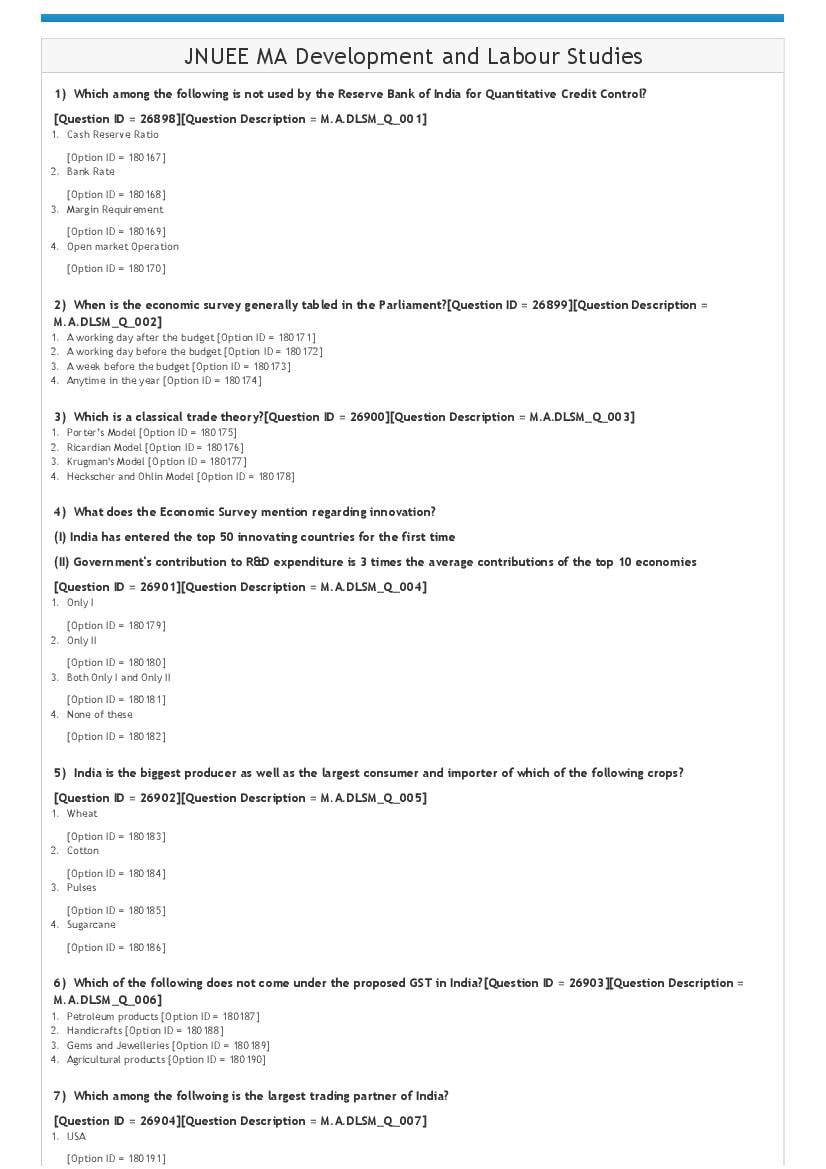
1) Which among the following is not used by the Reserve Bank of India for Quantitative Credit Control?
[Question ID = 26898][Question Description = M.A.DLSM_Q_001]
1. Cash Reserve Ratio
[Option ID = 180167]
2. Bank Rate
[Option ID = 180168]
3. Margin Requirement
[Option ID = 180169]
4. Open market Operation
[Option ID = 180170]
2) When is the economic survey generally tabled in the Parliament?[Question ID = 26899][Question Description =
M.A.DLSM_Q_002]
1. A working day after the budget [Option ID = 180171]
2. A working day before the budget [Option ID = 180172]
3. A week before the budget [Option ID = 180173]
4. Anytime in the year [Option ID = 180174]
3) Which is a classical trade theory?[Question ID = 26900][Question Description = M.A.DLSM_Q_003]
1. Porter’s Model [Option ID = 180175]
2. Ricardian Model [Option ID = 180176]
3. Krugman's Model [Option ID = 180177]
4. Heckscher and Ohlin Model [Option ID = 180178]
4) What does the Economic Survey mention regarding innovation?
(I) India has entered the top 50 innovating countries for the first time
(II) Government's contribution to R&D expenditure is 3 times the average contributions of the top 10 economies
[Question ID = 26901][Question Description = M.A.DLSM_Q_004]
1. Only I
[Option ID = 180179]
2. Only II
[Option ID = 180180]
3. Both Only I and Only II
[Option ID = 180181]
4. None of these
[Option ID = 180182]
5) India is the biggest producer as well as the largest consumer and importer of which of the following crops?
[Question ID = 26902][Question Description = M.A.DLSM_Q_005]
1. Wheat
[Option ID = 180183]
2. Cotton
[Option ID = 180184]
3. Pulses
[Option ID = 180185]
4. Sugarcane
[Option ID = 180186]
6) Which of the following does not come under the proposed GST in India?[Question ID = 26903][Question Description =
M.A.DLSM_Q_006]
1. Petroleum products [Option ID = 180187]
2. Handicrafts [Option ID = 180188]
3. Gems and Jewelleries [Option ID = 180189]
4. Agricultural products [Option ID = 180190]
7) Which among the follwoing is the largest trading partner of India?
[Question ID = 26904][Question Description = M.A.DLSM_Q_007]
1. USA
[Option ID = 180191]
Page 2
[Option ID = 180192]
3. China
[Option ID = 180193]
4. United Arab Emirates
[Option ID = 180194]
8) Which one of the following was the objective of the 12th five year plan of India?[Question ID = 26905][Question
Description = M.A.DLSM_Q_008]
1. Faster and Inclusive growth [Option ID = 180195]
2. Faster, sustainable and more inclusive growth [Option ID = 180196]
3. Faster, reliable and more inclusive growth [Option ID = 180197]
4. Faster, quick and reliable inclusive growth [Option ID = 180198]
9) Indian Economy is a[Question ID = 26906][Question Description = M.A.DLSM_Q_009]
1. Mixed Economy [Option ID = 180199]
2. Socialist Economy [Option ID = 180200]
3. Gandhian Economy [Option ID = 180201]
4. Free Economy [Option ID = 180202]
10) Major portion of working population in India is in[Question ID = 26907][Question Description = M.A.DLSM_Q_010]
1. Tertiary sector [Option ID = 180203]
2. Secondary Sector [Option ID = 180204]
3. Public sector [Option ID = 180205]
4. Private sector [Option ID = 180206]
11) ‘Take off stage’ in an economy means[Question ID = 26908][Question Description = M.A.DLSM_Q_011]
1. Restrictions are removed [Option ID = 180207]
2. Steady growth begins [Option ID = 180208]
3. Economy is stagnant [Option ID = 180209]
4. Economy is collapsing [Option ID = 180210]
12) Relative poverty is basically related to
[Question ID = 26928][Question Description = M.A.DLSM_Q_012]
1. Rich
[Option ID = 180211]
2. Poor
[Option ID = 180212]
3. Both rich and poor
[Option ID = 180213]
4. None of the above
[Option ID = 180214]
13) Which type of unemployment is more prominent in India?[Question ID = 26929][Question Description =
M.A.DLSM_Q_013]
1. Cyclical [Option ID = 180215]
2. Seasonal [Option ID = 180216]
3. Structural [Option ID = 180217]
4. Open [Option ID = 180218]
14) Labour Force Participation Rate (LFPR) is:
[Question ID = 26930][Question Description = M.A.DLSM_Q_014]
1. {(no. of employed persons + no of unemployed persons)/Total population} * 100
[Option ID = 180219]
2. {(no. of employed persons + no of unemployed persons who are unwilling to work)/Total population} * 100
[Option ID = 180220]
3. {no. of employed persons/Total population} * 100
[Option ID = 180221]
4. None of these
[Option ID = 180222]
15) The poverty gap is:[Question ID = 26931][Question Description = M.A.DLSM_Q_015]
1. The gap between rich and poor [Option ID = 180223]
2. Difference between poverty line and actual income level [Option ID = 180224]
3. The gap between developed nation and developing nation [Option ID = 180225]
4. None of these [Option ID = 180226]
Page 3
M.A.DLSM_Q_016]
1. First [Option ID = 180227]
2. Second [Option ID = 180228]
3. Third [Option ID = 180229]
4. Fourth [Option ID = 180230]
17) Which one of the following correctly matches?[Question ID = 26933][Question Description = M.A.DLSM_Q_017]
1. Lewis: Vicious Circle of poverty [Option ID = 180231]
2. Hirschman: Strategy of Unbalanced Growth [Option ID = 180232]
3. Nurkse: Theory of development with Unlimited Supply of Labour [Option ID = 180233]
4. Singer: Strategy of Balanced Growth [Option ID = 180234]
18) In the Solow model, if an economy experiences an increase in the investment rate and an increase in the depreciation
rate at the same time, then what will be the result? [Question ID = 26934][Question Description = M.A.DLSM_Q_018]
1. Output will rise [Option ID = 180235]
2. Output will fall [Option ID = 180236]
3. Capital per worker will rise [Option ID = 180237]
4. The result is ambiguous; we cannot be certain [Option ID = 180238]
19) The tax burden per unit of output will fall highest on consumers if
[Question ID = 26935][Question Description = M.A.DLSM_Q_019]
1. The demand curve is unitary elastic
[Option ID = 180239]
2. The demand curve is inelastic
[Option ID = 180240]
3. The demand curve is elastic
[Option ID = 180241]
4. The demand curve is perfectly elastic
[Option ID = 180242]
20)
[Question ID = 34146][Question Description = M.A.DLSM_Q_020]
1. P2 is the floor price [Option ID = 180511]
2. P1 is the ceiling price [Option ID = 180512]
3. P2 price leads to surplus [Option ID = 180513]
4. P2 price leads to shortage [Option ID = 180514]
21) Drawing conclusions about a population parameter based on a sample through sampling distribution is characteristic of
[Question ID = 26936][Question Description = M.A.DLSM_Q_021]
1. Inferential statistics [Option ID = 180243]
2. Explanatory statistics [Option ID = 180244]
3. Descriptive statistics [Option ID = 180245]
4. Normative statistics [Option ID = 180246]
22) Relationship between unemployment rate and real wage is typically
[Question ID = 26937][Question Description = M.A.DLSM_Q_022]
1. Indeterminate, i.e., sometimes positively related and at other times negatively related
[Option ID = 180247]
2. Negatively related
Page 4
3. Positively related
[Option ID = 180249]
4. Unrelated
[Option ID = 180250]
23) Who demonstrated that educational attainment can act as a labour market signal for screening workers?
[Question ID = 26938][Question Description = M.A.DLSM_Q_023]
1. Michael Spence
[Option ID = 180251]
2. Theodore Schultz
[Option ID = 180252]
3. Angus Deaton
[Option ID = 180253]
4. Jagdish Bhagwati
[Option ID = 180254]
24) For deciding activity status of a person in Usual Principal Status recall/reference period is:
[Question ID = 26939][Question Description = M.A.DLSM_Q_024]
1. 365 days
[Option ID = 180255]
2. 30 days
[Option ID = 180256]
3. 7 days
[Option ID = 180257]
4. 100 days
[Option ID = 180258]
25) Unemployment rates among educated/literates and illeterates are typically as follows:
[Question ID = 26940][Question Description = M.A.DLSM_Q_025]
1. Unemployment rate among literates < unemployment rate among illiterates
[Option ID = 180259]
2. Unemployment rate among literates > Unemployment rate among illiterates
[Option ID = 180260]
3. Unemployment rate among literates = Unemployment rate among illiterates
[Option ID = 180261]
4. keeps fluctuating; sometimes, Unemployment rate among literates < unemployment rate among illiterates and at other times the opposite is true
[Option ID = 180262]
26) The abscissa of the point of intersection of less than type and greater than type cumulative frequency curves always
gives us:
[Question ID = 26941][Question Description = M.A.DLSM_Q_026]
1. Arithmetic mean
[Option ID = 180263]
2. Median
[Option ID = 180264]
3. Mode
[Option ID = 180265]
4. Harmonic mean
[Option ID = 180266]
27) Working‐age population in India defined by National Sample Survey is:
[Question ID = 26942][Question Description = M.A.DLSM_Q_027]
1. 15‐59 years
[Option ID = 180267]
2. 15‐60 years
[Option ID = 180268]
3. 18‐60 years
[Option ID = 180269]
4. 21‐59 years
[Option ID = 180270]
Page 5
26943][Question Description = M.A.DLSM_Q_028]
1. Unemployment Rate (UR) was 6.1% [Option ID = 180271]
2. Unemployment Rate (UR) was 5.1% [Option ID = 180272]
3. Unemployment Rate (UR) was 7.1% [Option ID = 180273]
4. Unemployment Rate (UR) was 10.1% [Option ID = 180274]
29) The Chi‐Square Test of Independence can compare Statistical independence or association between:
[Question ID = 26944][Question Description = M.A.DLSM_Q_029]
1. Two categorical variables
[Option ID = 180275]
2. Two continuous variables
[Option ID = 180276]
3. Two categorical and continuous variables
[Option ID = 180277]
4. Neither, two categorical variables; nor, two continuous variables
[Option ID = 180278]
30) Goodness of fit in an Ordinary Least Squares regression is captured by R2 and is defined as follows: (where, TSS = Total
Sum of Squares; ESS = Explained Sum of Squares; RSS = Residual Sum of Squares)
[Question ID = 26985][Question Description = M.A.DLSM_Q_030]
1.
[Option ID = 180515]
2.
[Option ID = 180516]
3.
[Option ID = 180517]
4.
[Option ID = 180518]
31)
[Question ID = 26986][Question Description = M.A.DLSM_Q_031]
1. A ‐ I , B ‐ II , C ‐ III , D ‐ IV [Option ID = 180519]
2. A ‐ II, B ‐I , C ‐ IV, D ‐ III [Option ID = 180520]
3. A ‐ III, B ‐ I, C ‐ II, D ‐ IV [Option ID = 180521]
4. A ‐ IV, B ‐ III, C ‐I , D ‐ II [Option ID = 180522]
32)
Page 6
1. A ‐ I, B ‐II , C ‐ III, D ‐ IV [Option ID = 180523]
2. A ‐ III, B ‐II , C ‐I , D ‐ IV [Option ID = 180524]
3. A ‐ IV, B ‐II , C ‐ III, D ‐ I [Option ID = 180525]
4. A ‐ II, B ‐ I , C ‐IV , D ‐ III [Option ID = 180526]
33) Given below are two statements, one is labelled as
Assertion A and the other is labelled as Reason R
Assertion A: In a non‐discriminating monopsonistic labour market workers receive less than their value of marginal product.
Reason R : Marginal cost of hiring labour for monopsonist lies above the labour supply curve.
In light of the above statements, choose the correct answer from the options given below
[Question ID = 26945][Question Description = M.A.DLSM_Q_033]
1. Both A and R are true and R is the correct explanation of A
[Option ID = 180279]
2. Both A and R are true but R is NOT the correct explanation of A
[Option ID = 180280]
3. A is true but R is false
[Option ID = 180281]
4. A is false but R is true
[Option ID = 180282]
34) Given below are two statements, one is labelled as Assertion A and the other is labelled as Reason R
Assertion A : Labour supply curve is always positively sloped.
Reason R : Labour supply curve for workers are obtained by utility maximization exercise of workers.
In light of the above statements, choose the correct answer from the options given below
[Question ID = 35304][Question Description = M.A.DLSM_Q_034]
1. Both A and R are true and R is the correct explanation of A
[Option ID = 180283]
2. Both A and R are true but R is NOT the correct explanation of A
[Option ID = 180284]
3. A is true but R is false
[Option ID = 180285]
4. A is false but R is true
[Option ID = 180286]
35) Labour reforms in India are targeted at:
A. Extending social security to gig workers.
B. Ease the rules for 'hire and fire'.
C. Replace the term 'inspectors' by 'inspector‐cum‐facilitators'.
D. Retain the concept of 'scheduled employment' for implementing minimum wages.
Choose the correct answer from the options given below:
[Question ID = 35305][Question Description = M.A.DLSM_Q_035]
1. A, B and D only
[Option ID = 180287]
2. B, C and D only
[Option ID = 180288]
3. B and D only
[Option ID = 180289]
4. A, B and C only
[Option ID = 180290]
36) Labour Force Participation Rate (LFPR) and Worker Population Ratio (WPR) are important indicators of labour market
and for India where:
A. Male LFPR > Female LFPR
B. Male LFPR < Female LFPR
Page 7
D. Male WPR < Female WPR
Choose the correct answer from the options given below:
[Question ID = 35306][Question Description = M.A.DLSM_Q_036]
1. A and C only
[Option ID = 180291]
2. A and D only
[Option ID = 180292]
3. B and C only
[Option ID = 180293]
4. B and D only
[Option ID = 180294]
37) Consider the following four types of labour supply curves and identify the one in which income effect is greater than
substitution effect
A. Perfectly elastic labour supply curve
B. Perfectly inelastic labour supply curve
C. Throughout positively sloped labour supply curve
D. Backward‐bending labour supply curve
Choose the correct answer from the options given below:
[Question ID = 35307][Question Description = M.A.DLSM_Q_037]
1. A and D only
[Option ID = 180295]
2. D only
[Option ID = 180296]
3. B only
[Option ID = 180297]
4. A and B only
[Option ID = 180298]
38) All mathematical operations are permitted for the following types of variables at:
A. Nominal level measurement
B. Ordinal level measurement
C. Interval level measurement
D. Ratio level measurement
Choose the correct answer from the options given below:
[Question ID = 35308][Question Description = M.A.DLSM_Q_038]
1. A and B only
[Option ID = 180299]
2. B and C only
[Option ID = 180300]
3. C and D only
[Option ID = 180301]
4. D and B only
[Option ID = 180302]
39) Suppose a nationʹs population grows by 1 per cent and real output grows by 3 percent. What will happen to per person
output growth in such an economy?
[Question ID = 35309][Question Description = M.A.DLSM_Q_039]
1. It will increase by 4 per cent
[Option ID = 180303]
2. It will increase by 3 per cent
[Option ID = 180304]
3. It will increase by 2 per cent
[Option ID = 180305]
4. It will increase by 1 per cent
[Option ID = 180306]
Page 8
unemployment is called:
[Question ID = 35310][Question Description = M.A.DLSM_Q_040]
1. Frictional unemployment
[Option ID = 180307]
2. Seasonal unemployment
[Option ID = 180308]
3. Cyclical unemployment
[Option ID = 180309]
4. Structural unemployment
[Option ID = 180310]
41) What does the term 'nanny state' refer to?[Question ID = 35311][Question Description = M.A.DLSM_Q_041]
1. A developed but failed state [Option ID = 180311]
2. An underdeveloped and failed state [Option ID = 180312]
3. A state with a limited number of welfare programmes [Option ID = 180313]
4. A state with an extensive number of welfare programmes [Option ID = 180314]
42)
[Question ID = 26988][Question Description = M.A.DLSM_Q_042]
1. A ‐ III, B ‐ I, C ‐ II, D ‐ IV [Option ID = 180527]
2. A ‐ II, B ‐ I, C ‐ IV, D ‐ III [Option ID = 180528]
3. A ‐ III, B ‐ I, C ‐ IV, D ‐II [Option ID = 180529]
4. A ‐ III, B ‐ II, C ‐ IV, D ‐ I [Option ID = 180530]
43) Who among the following thinkers first used the term ideology as the science of ideas?[Question ID = 35312][Question
Description = M.A.DLSM_Q_043]
1. Antonio Gramsci [Option ID = 180315]
2. Antoine Destutt de Tracy [Option ID = 180316]
3. Aristotle [Option ID = 180317]
4. Machiavelli [Option ID = 180318]
44) The Gandhian notion of Sarvodaya is about the upliftment or progress of one and all. This idea he draws from:
[Question ID = 35313][Question Description = M.A.DLSM_Q_044]
1. Unto This Last: John Ruskin
[Option ID = 180319]
2. The Fallacy of Speed: Thomas F. Taylor
[Option ID = 180320]
3. Life without Principles: Henry David Thoreau
[Option ID = 180321]
4. Civilization: Its Curse and Cure: Edward Carpenter
[Option ID = 180322]
45) Which among the following rights is described by Dr. B. R. Ambedkar as the heart and soul of the Indian constitution?
[Question ID = 35314][Question Description = M.A.DLSM_Q_045]
1. Right to life and personal liberty [Option ID = 180323]
2. Right to equality [Option ID = 180324]
3. Right to Constitutional remedies [Option ID = 180325]
4. Right to liberty [Option ID = 180326]
46)
Page 9
1. A ‐ III, B ‐ I, C ‐ IV, D ‐ II [Option ID = 180531]
2. A ‐ III, B ‐ II, C ‐ IV , D ‐ I [Option ID = 180532]
3. A ‐ IV, B ‐ II , C ‐ III, D ‐ I [Option ID = 180533]
4. A ‐ IV, B ‐ III, C ‐ I, D ‐ II [Option ID = 180534]
47) NPM (New Public Management) advocates for the use of private sector management techniques in managing the affairs
of the government. It is associated with '3Es'. Which among the following is NOT one of those? [Question ID = 35315]
[Question Description = M.A.DLSM_Q_047]
1. Effeciency [Option ID = 180327]
2. Economy [Option ID = 180328]
3. Environment [Option ID = 180329]
4. Effectiveness [Option ID = 180330]
48) Who among the following modern Indian political thinkers is regarded as ‘the poet of patriotism’, ‘the prophet of
nationalism’, and ‘the lover of humanity'? [Question ID = 35316][Question Description = M.A.DLSM_Q_048]
1. Rabindranath Tagore [Option ID = 180331]
2. Swami Vivekananda [Option ID = 180332]
3. Aurobindo Ghosh [Option ID = 180333]
4. Muhammad Iqbal [Option ID = 180334]
49) Who among the following thinkers has argued that ‘it is better to be a human being dissatisfied than a pig satisfied:
better to be Socrates dissatisfied than a fool satisfied’?
[Question ID = 35317][Question Description = M.A.DLSM_Q_049]
1. James Mill
[Option ID = 180335]
2. John Stuart Mill
[Option ID = 180336]
3. Epicurus
[Option ID = 180337]
4. Jeremy Bentham
[Option ID = 180338]
50) Who among the following thinker has said that 'that government is best which governs not at all'? [Question ID = 35318]
[Question Description = M.A.DLSM_Q_050]
1. John Locke [Option ID = 180339]
2. Henry David Thoreau [Option ID = 180340]
3. J. S. Mill [Option ID = 180341]
4. Leo Tolstoy [Option ID = 180342]
51) What does the term civitas sine suffragio mean?[Question ID = 35319][Question Description = M.A.DLSM_Q_051]
1. Citizenship without franchise [Option ID = 180343]
2. Citizenship with full legal and political rights [Option ID = 180344]
3. Citizenship without legal rights [Option ID = 180345]
4. Citizenship with political rights [Option ID = 180346]
52) Which among the following articles of the Indian constitution deal with citizenship?[Question ID = 35320][Question
Description = M.A.DLSM_Q_052]
1. Articles 5 to 10 [Option ID = 180347]
2. Articles 5 to 11 [Option ID = 180348]
3. Articles 5 to 12 [Option ID = 180349]
4. Articles 5 to 13 [Option ID = 180350]
53) Which article of the Indian constitution deals with the separation of judiciary from the executive? [Question ID =
35321][Question Description = M.A.DLSM_Q_053]
1. Article 131 [Option ID = 180351]
2. Article 74 [Option ID = 180352]
3. Article 51 [Option ID = 180353]
4. Article 50 [Option ID = 180354]
54) 'World Systems Theory' that divides the world into the core, semiperiphery, and periphery is attributed to who among
Page 10
1. Immanuel Wallerstein [Option ID = 180355]
2. Paul A Baran [Option ID = 180356]
3. Andre Gunder Frank [Option ID = 180357]
4. David Harvey [Option ID = 180358]
55) Who among the following thinkers in Indian politics propounded the idea of 'Sampoorna Kranti' (Total Revolution)?
[Question ID = 35323][Question Description = M.A.DLSM_Q_055]
1. Ram Manohar Lohia [Option ID = 180359]
2. Jayprakash Narayan [Option ID = 180360]
3. B. R. Ambedkar [Option ID = 180361]
4. Vinoba Bhave [Option ID = 180362]
56)
[Question ID = 26990][Question Description = M.A.DLSM_Q_056]
1. A ‐ III, B ‐ I, C ‐ II, D ‐ IV [Option ID = 180535]
2. A ‐ III, B ‐ IV, C ‐ II, D ‐ I [Option ID = 180536]
3. A ‐ II, B ‐ III, C ‐ I, D ‐ IV [Option ID = 180537]
4. A ‐ II, B ‐ IV, C ‐ I, D ‐ III [Option ID = 180538]
57) Swachh Bharat Mission (Grameen) comes under which of the following ministries of the Government of India? [Question
ID = 26946][Question Description = M.A.DLSM_Q_057]
1. Ministry of Agriculture and Farmers Welfare [Option ID = 180363]
2. Ministry of Rural Development [Option ID = 180364]
3. Ministry of Panchayati Raj [Option ID = 180365]
4. Department of Drinking Water and Sanitation, Ministry of Jal Shakti [Option ID = 180366]
58) Which one of the following countries is NOT included in the Citizenship (Amendment) Act 2019 for granting citizenship
rights to persecuted religious minorities? [Question ID = 26947][Question Description = M.A.DLSM_Q_058]
1. Pakistan [Option ID = 180367]
2. Bangladesh [Option ID = 180368]
3. Afghanistan [Option ID = 180369]
4. Sri Lanka [Option ID = 180370]
59)
[Question ID = 26991][Question Description = M.A.DLSM_Q_059]
1. A ‐ III, B ‐ IV, C ‐ I, D ‐ II [Option ID = 180539]
2. A ‐ III, B ‐ IV, C ‐ II, D ‐ I [Option ID = 180540]
3. A ‐ III, B ‐ I, C ‐ IV, D ‐ II [Option ID = 180541]
4. A ‐ II, B ‐ IV, C ‐ I, D ‐ III [Option ID = 180542]
60) Who among the following is the author of the text, 'Development as Freedom'?
[Question ID = 26948][Question Description = M.A.DLSM_Q_060]
1. Ramchandra Guha
[Option ID = 180371]
2. Amartya Sen
[Option ID = 180372]
3. Jean Dreze
Page 11
4. Manmohan Singh
[Option ID = 180374]
61) The concept of 'anomie', which refers to a sense of normlessness, was first introduced by:
[Question ID = 26949][Question Description = M.A.DLSM_Q_061]
1. Karl Marx
[Option ID = 180375]
2. Emile Durkheim
[Option ID = 180376]
3. Max Weber
[Option ID = 180377]
4. Auguste Comte
[Option ID = 180378]
62) R.K.Merton identifies five possible responses to the tensions between socially endorsed values and the limited means of
achieving them. Which of the following is not a response identified by Merton? [Question ID = 26950][Question Description =
M.A.DLSM_Q_062]
1. Conformity [Option ID = 180379]
2. Innovation [Option ID = 180380]
3. Ritualism [Option ID = 180381]
4. Constructivism [Option ID = 180382]
63) The loss of control on the part of workers over labour tasks, the products of their labour, other workers and the
separation of workers from their essential 'species being' is referred to as:
[Question ID = 26951][Question Description = M.A.DLSM_Q_063]
1. Alienation
[Option ID = 180383]
2. Anomie
[Option ID = 180384]
3. Ageism
[Option ID = 180385]
4. Bureaucracy
[Option ID = 180386]
64) Auguste Comte's vision for sociology was for it to become a:
[Question ID = 26952][Question Description = M.A.DLSM_Q_064]
1. Positive Science
[Option ID = 180387]
2. Interpretative Science
[Option ID = 180388]
3. Commonsensical discipline
[Option ID = 180389]
4. Cultural Science
[Option ID = 180390]
65)
[Question ID = 26992][Question Description = M.A.DLSM_Q_065]
1. A ‐III , B ‐V, C ‐ III, D ‐ II [Option ID = 180543]
2. A ‐II, B ‐ IV, C ‐ I, D ‐ V [Option ID = 180544]
3. A ‐ II , B ‐ III, C ‐ I, D ‐ IV [Option ID = 180545]
4. A ‐ V, B ‐ II, C ‐ III, D ‐ I [Option ID = 180546]
Page 12
society? [Question ID = 26953][Question Description = M.A.DLSM_Q_066]
1. Conflict Theory [Option ID = 180391]
2. Functionalism [Option ID = 180392]
3. Positivism [Option ID = 180393]
4. Symbolic Interactionism [Option ID = 180394]
67) Which of the following theoretical perspective begins from the premise that social reality is ‐ to varying degrees ‐ the
product of interactions between individuals and groups, not something that is obvious to all? [Question ID = 26954][Question
Description = M.A.DLSM_Q_067]
1. Feminism [Option ID = 180395]
2. Symbolic Interactionism [Option ID = 180396]
3. Positivism [Option ID = 180397]
4. Social Constructionism [Option ID = 180398]
68) Which of the following methods uses participant observation to gain in‐depth knowledge or understanding of relatively
small‐scale social phenomena? [Question ID = 26955][Question Description = M.A.DLSM_Q_068]
1. Survey Method [Option ID = 180399]
2. Ethnography [Option ID = 180400]
3. Experimental Method [Option ID = 180401]
4. Biographical Research [Option ID = 180402]
69) Who gave the concept of 'Sociological Imagination'?[Question ID = 26956][Question Description = M.A.DLSM_Q_069]
1. C. Wright Mills [Option ID = 180403]
2. Talcott Parsons [Option ID = 180404]
3. Anthony Giddens [Option ID = 180405]
4. Ralph Miliband [Option ID = 180406]
70) Who had pointed out that the increase in bureaucracy would imprison us in an 'iron cage'?[Question ID = 26957]
[Question Description = M.A.DLSM_Q_070]
1. Anthony Giddens [Option ID = 180407]
2. C. Wright Mills [Option ID = 180408]
3. Max Weber [Option ID = 180409]
4. Jurgen Habermas [Option ID = 180410]
71) Which of the following statement is incorrect?[Question ID = 26958][Question Description = M.A.DLSM_Q_071]
1. R.K. Merton distinguished between Manifest and Latent Functions. [Option ID = 180411]
2. Talcott Parsons studied the functioning of social systems through his AGIL Model [Option ID = 180412]
3. The book "Economy and Society" was written by Karl Marx [Option ID = 180413]
4. Herbert Blumer coined the term 'Symbolic Interactionism' [Option ID = 180414]
72) A testable hunch, an idea, or an educated guess, about a given state of affairs put forward in exact terms to provide
the basis for empirical testing is referred to as:
[Question ID = 26959][Question Description = M.A.DLSM_Q_072]
1. Research Design
[Option ID = 180415]
2. Causality
[Option ID = 180416]
3. Variables
[Option ID = 180417]
4. Hypothesis
[Option ID = 180418]
73) Which of the following scholars wrote 'The Modernity of Tradition' in India?[Question ID = 26960][Question Description =
M.A.DLSM_Q_073]
1. Yogendra Singh [Option ID = 180419]
2. P. Sanal Mohan [Option ID = 180420]
3. Partha Chatterjee [Option ID = 180421]
4. L.I. Rudolph and S.H. Rudolph [Option ID = 180422]
74) A system in which social positions are filled on the basis of individual merit and achievement, rather than ascribed
criteria is referred to as:
[Question ID = 26961][Question Description = M.A.DLSM_Q_074]
1. Democracy
[Option ID = 180423]
2. Bureaucracy
[Option ID = 180424]
3. Reservation
[Option ID = 180425]
Page 13
[Option ID = 180426]
75) The economic belief that free market forces, achieved by minimizing government restrictions on business, provide the
only route to economic growth is called:
[Question ID = 26962][Question Description = M.A.DLSM_Q_075]
1. Socialism
[Option ID = 180427]
2. Welfarism
[Option ID = 180428]
3. Neoliberalism
[Option ID = 180429]
4. Fordism
[Option ID = 180430]
76)
[Question ID = 26993][Question Description = M.A.DLSM_Q_076]
1. A ‐ I, B ‐ III, C ‐ IV, D ‐ II [Option ID = 180547]
2. A ‐ V, B ‐ I, C ‐ III, D ‐ II [Option ID = 180548]
3. A ‐ V, B ‐ I, C ‐ IV, D ‐ II [Option ID = 180549]
4. A ‐ I, B ‐ IV, C ‐ III, D ‐ II [Option ID = 180550]
77) Who used the concept of 'footloose labour' to understand India's informal economy?[Question ID = 26963][Question
Description = M.A.DLSM_Q_077]
1. Mario Rutten [Option ID = 180431]
2. Jan Breman [Option ID = 180432]
3. John Harriss [Option ID = 180433]
4. Barbara Harriss‐White [Option ID = 180434]
78) Given below are TWO Statements.
Statement I: E. Durkheim defines religion in terms of a distinction between the sacred and the profane.
Statement II: Karl Marx connected religion primarily with social inequalities and power.
In light of the above statements, choose the most appropriate answer from the options given below.
[Question ID = 26964][Question Description = M.A.DLSM_Q_078]
1. Both Statement I and Statement II are correct
[Option ID = 180435]
2. Both Statement I and Statement II are incorrect
[Option ID = 180436]
3. Statement I is correct but Statement II is incorrect
[Option ID = 180437]
4. Statement I is incorrect but Statement II is correct
[Option ID = 180438]
79) The mix of globalizing processes and local contexts which often lead to a strengthening rather than diminishing of local
and regional cultures is described as:
[Question ID = 34128][Question Description = M.A.DLSM_Q_079]
1. Globalization
[Option ID = 180439]
2. Glocalization
[Option ID = 180440]
3. Localization
Page 14
4. Regionalization
[Option ID = 180442]
80) Which of the following scholars name is famously associated with the concept of 'global village'?[Question ID = 34129]
[Question Description = M.A.DLSM_Q_080]
1. Marshall McLuhan [Option ID = 180443]
2. Marcel Mauss [Option ID = 180444]
3. T.H. Marshall [Option ID = 180445]
4. Anthony Giddens [Option ID = 180446]
81) Arrange the following events in chronological order
A. Enactment of the Deccan Agriculturalists' Relief Act
B. Appointment of the Indigo Commission
C. Enactment of Punjab Land Alienation Act
D. Chota Nagpur Tenancy Act
Choose the correct answer from the options given below
[Question ID = 34130][Question Description = M.A.DLSM_Q_081]
1. A, B, C, D
[Option ID = 180447]
2. B, A, C, D
[Option ID = 180448]
3. B, C, A, D
[Option ID = 180449]
4. A, B, D, C
[Option ID = 180450]
82)
[Question ID = 26994][Question Description = M.A.DLSM_Q_082]
1. A ‐ i, B ‐ ii, C ‐ iii, D ‐ iv [Option ID = 180551]
2. A ‐ ii, B ‐ iii, C ‐ i, D ‐ iv [Option ID = 180552]
3. A ‐ iv, B ‐ ii, C ‐ iii, D ‐ i [Option ID = 180553]
4. A ‐ i, B ‐ iii, C ‐ ii, D ‐ iv [Option ID = 180554]
83) Given below are two statements, one is labelled on Assertion A and the other is labelled on Reason R
Assertion: After the conquest of Bengal, the East India Company officials like Alexander Dow, Philip Francis etc., despite
their ideological differences, shared a common faith in the Physiocratic School of thought and these ideas went into the
making of Permanent Settlement in Bengal.
Reason: The Physiocratic School of thinking grew in mid 18th century France. They argued about the productive power of
nature. According to them, the source of wealth was agriculture, whose net product circulated through various classes of
society; the greater this net product, the stronger the circulation and hence the greater the wealth.
Choose the correct answer from the options given below:
[Question ID = 34131][Question Description = M.A.DLSM_Q_083]
1. Both A and R are correct and R is the correct explanation of A
[Option ID = 180451]
2. Both A and R are correct but R is NOT the correct explanation of A
[Option ID = 180452]
3. A is correct but R is not correct
[Option ID = 180453]
4. A is not correct but R is correct
[Option ID = 180454]
Page 15
A. The roots of Ryotwari system lay partly in the Scottish Enlightenment which insisted on the primacy of agriculture and
celebrated the importance of the yeoman farmer within agricultural societies, and also in Utilitarian thought.
B. It was also influenced by Ricardo's theory of Rent which hinted at eliminating the zamindars and appropriate a larger
share of the increasing income from the new acquisitions of land.
C. The experiments on the Ryotwari system started after the fall of Mysore in Madras Presidency by Col.Read and Thomas
Munro. They were abandoned after Munro left for England in 1807 and were revived only after his return to India as
Governor of Madras.
D. Munro argued that Ryotwari was the ancient Indian land tenure system and hence was best suited for Indian conditions,
because of his love for India’s past and traditions.
Choose the correct answer(s) from the options given below:
[Question ID = 34132][Question Description = M.A.DLSM_Q_084]
1. A, B and D only
[Option ID = 180455]
2. A, B., C only
[Option ID = 180456]
3. A, C, D only
[Option ID = 180457]
4. B, C, D only
[Option ID = 180458]
85) Consider the following statements on Jute idendity in colonical India":
A. The Eastern India, particularly Bengal, was home to cluster of Jute Mills that developed from the 1850s
B. Unlike the Cotton industry, where Lancashire dominated the trade keeping the Indian cotton industries subservient to its
interests, Bengal Jute Industry was able to surpass and later marginalise the Scottish Dundee based Industry.
C. This was probably because the production and export of Jute was almost an exclusive British enterprise atleast till the
1920s.
D. Jute Industry also had one of the highest percentages of women workforce i.e., almost 20% from its initial decades till
independence.
Choose the correct answer from the options given below:
[Question ID = 34133][Question Description = M.A.DLSM_Q_085]
1. A, B, D only
[Option ID = 180459]
2. A, B, C only
[Option ID = 180460]
3. A, C, D only
[Option ID = 180461]
4. A and D only
[Option ID = 180462]
86) Given below are two statements, one is labelled as Assertion A and the other is labelled as Reason R
Assertion A : The role played by Railways in the modernization and industrialization of India is questionable. For example, in
his initial prediction in 1853, Karl Marx thought that railways would be the 'forerunner of modern industry' in India.
However, by 1881, he revised his assessment, stating that the 'railways were useless to the Hindus' and formed part of 'a
bleeding process with vengeance.'
Reason R : The government guaranteed interest for investors led to wasteful expenditure and to 'drain of the economy'.
The financial capital, management, and most of the equipment including locomotives, sleepers came from Britain. This
effectively blocked the possibility of forming backward linkages with the rest of the Indian economy.
In light of the above statements, choose the correct answer from the options given below
[Question ID = 34134][Question Description = M.A.DLSM_Q_086]
1. Both A and R are true and R is the correct explanation of A
[Option ID = 180463]
2. Both A and R are true but R is NOT the correct explanation of A
[Option ID = 180464]
3. A is true but A is false
[Option ID = 180465]
4. A is false but R is true
[Option ID = 180466]
Page 16
A. The rise and growth of industries, especially Jute and Cotton since late 19th century led to the formation of a industrial
working class in organised sector in India.
B. There was a vast increase in the size of the working class in the late 19th and early decades of 20th century. In the
decade of 1911‐21 alone, there were roughly 6 lakh workers added to the total number of 2.1 million workers in the
organised sector.
C. This growth in size of the working class was fuelled, according to some historians, by the push factors i.e., the rural poor
were pushed out of their villages as agrarian economy could not longer support them.
D. The pattern of this labour migration was permanent, as the workers got removed from their village connections
Choose the correct answer from the options given below:
[Question ID = 34135][Question Description = M.A.DLSM_Q_087]
1. A, B, D only
[Option ID = 180467]
2. A, B, C only
[Option ID = 180468]
3. B, D, C only
[Option ID = 180469]
4. A, C, D only
[Option ID = 180470]
88) Which among the follwing is the first organised trade union in India?
[Question ID = 34136][Question Description = M.A.DLSM_Q_088]
1. Ahemdabad Textile Union
[Option ID = 180471]
2. Printers' Union
[Option ID = 180472]
3. Madras Labour Union
[Option ID = 180473]
4. Kamgar Hitwardhak Sabha
[Option ID = 180474]
89) Which of the following statements are correct?
A. The Trade Union Movement picked momentum in the second decade of 20th century and by 1920, there were around
125 unions with more than 250,000 members.
B. Many nationalist leaders who were connected with labour issues realised that there was a need for a central organisation
of labour to co‐ordinate the works of the trade unions all over India. Tilak, N.M.Joshi, B.P.Wadia, Dewan Chamanlall, Lala
Lajpat Rai, Joseph Baptista and other leaders made efforts towards this end.
C. The founding of International Labour Organisation(ILO) after the World War I, also gave fillip to these efforts as it was felt
that there should be a central organisation to chose nominees to represent Indian Labour at ILO.
D. Thus, All Indian Trade Union Congress was established in the year 1920 and N. M. Joshi became its first president.
[Question ID = 34137][Question Description = M.A.DLSM_Q_089]
1. A, B, C Only
[Option ID = 180475]
2. A, B, D Only
[Option ID = 180476]
3. B, C, D only
[Option ID = 180477]
4. A, C, D only
[Option ID = 180478]
90) Consider the following statements about the First Factory Act of India
A. It was enacted in the year 1881.
B. This act was not passed for philanthropic reasons, but at the insistence of British industrialists, who had to put up with
similar restrictions on labour at home. Thus, it was passed to make exploitation of cheap labour by Indian industrialists
difficult.
C. It mentioned regulation of working hours for adult labour
D. It gave clear definiton of child labour and restricted the number of hours for children
Page 17
[Question ID = 34138][Question Description = M.A.DLSM_Q_090]
1. A, B, D only
[Option ID = 180479]
2. A, C, D only
[Option ID = 180480]
3. B, C, D only
[Option ID = 180481]
4. A, B, C only
[Option ID = 180482]
91) Consider the following statements
1. In Madras, the workers of Buckhingham and Carnatic (Binny)Mills resorted to strike in the year 1921.
2. In the course of the strike, the Madras Labour Union leaders found that they were liable to prosecution and imprisonment
for bona‐fide union activities and it was felt that some legislation for the protection of trade unions was necessary.
3. The then General Secretary of AITUC, N. M. Joshi moved a resolution in the Central Legislative Assembly recommending
that Government should introduce legislation for the registration and protection of trade unions.
4. The Government finally relented and the passed the Trade Unions Act according protection to trade unions in the year
1922.
choose the correct answer from the options given below:
[Question ID = 34139][Question Description = M.A.DLSM_Q_091]
1. 1, 2, 3 only
[Option ID = 180483]
2. 1, 2, 4 only
[Option ID = 180484]
3. 2, 3, 4 only
[Option ID = 180485]
4. All are true
[Option ID = 180486]
92) Given below are two statements,one is labelled on Assertion A and the other is labelled on Reason R
Assertion: By the 1860s, the colonial government under Victorian moral code was engaged in identifying groups of habitual
criminals, trying to differentiate them from the 'respectable labouring poor'. The colonial officials' notion that roving bands
of criminals must, on the analogy of caste system, have a hereditary basis led to the enactment of Criminal Tribes Act,
1871.
Reason: The British preference for settled agriculture over foraging led to the conceptualization of the nomad as vagarant,
and even criminal. These coupled with the restrictions on forest access and resource use led to creation of criminalised
social categories that could be readily exploited for labour.
Choose the correct answer from the option given below:
[Question ID = 34140][Question Description = M.A.DLSM_Q_092]
1. Both A and R are correct and R is the correct explanation of A
[Option ID = 180487]
2. Both A and R are correct but R is NOT the correct explanation of A
[Option ID = 180488]
3. A is correct but R is not correct
[Option ID = 180489]
4. A is not correct but R is correct
[Option ID = 180490]
93) Identify the industries that were exclusively/mostly dominated by English Capitalists/Capital in India?
[Question ID = 34141][Question Description = M.A.DLSM_Q_093]
1. Plantations, Jute and Mining
[Option ID = 180491]
2. Plantations, Steel and Cement
[Option ID = 180492]
3. Steel, Cement and Jute
[Option ID = 180493]
4. Steel, Mining and Cement
[Option ID = 180494]
Page 18
promotion of small dams, tanks or minor irrigation projects because the former:
Choose the correct answer from option given below:
[Question ID = 34142][Question Description = M.A.DLSM_Q_094]
1. Offered them greater prospects for centralised bureaucratic control.
[Option ID = 180495]
2. Offered scope for greater revenue extraction
[Option ID = 180496]
3. Could reinforce their claims of ordering the 'wastes' into productive lands
[Option ID = 180497]
4. All of the above
[Option ID = 180498]
95) By virtue of the 1878 Forest Act, the Colonial State:
A. Claimed state control and became the land lord of forests and forest resources
B. Created restrictions on access to forests for various social groups 3
C. Witnessed many protests and confrontations with people
D. Created property rights for communities living in the forests for generations
Choose the correct answer from the options given below:
[Question ID = 34143][Question Description = M.A.DLSM_Q_095]
1. A, B, C only
[Option ID = 180499]
2. A and D only
[Option ID = 180500]
3. B and C only
[Option ID = 180501]
4. A, B, D only
[Option ID = 180502]
96) According to Rajnarayan Chandavarkar, a historian of Labour, the three things responsible for the growth of Indian
merchants and industries in colonial India were:
A. Relentless improvisation in the use of old machinery
B. Manipulation of raw materials
C. Access to cheap labour
D. Utilising the British skilled labour
Choose the correct answer from the options given below:
[Question ID = 34144][Question Description = M.A.DLSM_Q_096]
1. A, B, D only
[Option ID = 180503]
2. A, B, C only
[Option ID = 180504]
3. B, C, D only
[Option ID = 180505]
4. A, C, D only
[Option ID = 180506]
97) Read the passage and answer the following questions:‐
What is real development? An increase in overall well‐being of all citizens? Or economic growth, involving ‘public‐private
partnerships’ and a continued pattern of industrialisation and commercialisation? In the name of development, in India and
other countries, numerous large‐scale projects imposed on unwilling populations have brought a multitude of new consumer
items to an expanding middle class, at the cost of a rapid destruction of ecosystems and rural communities. Is this real
development? How to transform present developmental patterns to achieve a more truly sustainable path towards collective
well‐being? Is there any politically feasible path out of the multidimensional economic, environmental, social and climate
change cataclysms facing us now in India and worldwide?
These are the questions probed by this book, based around a course of fifteen lectures on ecology and economics presented
at the Institute of Rural Management, Anand, in January 2011, after a course of five lectures Felix Padel gave in October
2010 at the Department of Sociology, Mumbai University. In effect, they are snapshots of India at a particular moment in
Page 19
May 2009 until July 2011, during which period he made a series of crucial, controversial decisions and statements about
balancing environmental and economic imperatives. These controversies reflect an opening in perspectives about the
economic‐ecological balance, and in how to deal with corruption and blatant violations of the law. Jairam Ramesh’s analysis
of the ‘Two Cultures’ (Ramesh 2010) provides our starting point in Chapter One, and the Rule of Law is the theme in our
final chapter.
The mainstream paradigms dominating economic theory and financial practice have been questioned, from diverse
perspectives, by numerous writers. These include Frederick Soddy, whose distinction between ‘real wealth’ and ‘virtual
wealth’ (1926, 1934) formed part of the inspiration behind the ecological economics that crystallised into a new discipline
during the 1980s, and foreshadowed David Korten’s Agenda for a New Economy: From Phantom Wealth to Real Wealth
(2009).
Throughout this book, an attempt is made to reclaim the meaning of basic concepts such as development, growth,
democracy and freedom, through the experience of people living close to nature. Economic and engineering‐based models
that equate a high gross domestic product (GDP) or advanced technology with development, need interrogation from the
standpoint of the large number of people whose standard of living has fallen drastically, thanks to ‘development projects’.
Present development paradigms have been set by apex institutions such as the World Bank (WB) and International Monetary
Fund (IMF), dictating reforms and funding projects in many countries that have often proved disastrous, not only in
economic terms, but especially in their impacts on ecosystems and the overall well‐being of the people. Where is the
accountability for this history of disastrous decisions?
Movements against projects threatening to destroy ecosystems and communities are sometimes called ‘anti‐development’.
Another view sees such movements as the core of real development. How to bring about a shift in the power structure
centred in financial institutions? Capitalism, by definition, is always ready to capitalise on any disaster, since playing the
stock market means making a profit out of rapid rises and falls in prices. Has the rise of corporate power trapped us into a
vicious cycle of boom and bust?
In questioning fundamentally the way development has been defined, we also question the division of countries, and
regions, into ‘developed’, ‘developing’ and ‘underdeveloped’. As Gustavo Esteva (1992) puts this in The Development
Dictionary, the day President Truman took office, 20 January 1949, he inaugurated the concept of ‘underdevelopment’ as
a blueprint for the spread of America’s development paradigm.
On that day, 2 billion people became underdeveloped … [The concept] took on an unsuspected colonizing virulence. …
Since then, development has connoted at least one thing: to escape from the undignified condition called
underdevelopment. … For those who make up two‐thirds of the world’s population today, to think of development—any kind
of development—requires first the perception of themselves as underdeveloped, with the whole burden of connotations
that this carries. (Esteva 1992: 6–7)
Darwin’s theory of evolution showed how thousands of species have developed, on interrelated, yet separate paths. By
contrast, when this theory was applied to society, by Herbert Spencer, Marx, Engels and others, theorists from the Left and
Right laid down a uniform model of set stages of development, from primitive communism to feudalism and capitalism.
Development and underdevelopment are the key concepts used to impose this uniform model of rapid growth, culminating
in today’s ‘New World Order’, characterised by extreme forms of exploitation and inequality. Can we move ‘beyond
developmentality’ (Deb 2009)?
As in the 1870s, when Henry George wrote his forgotten bestseller Progress and Poverty, ‘the great enigma of our times’ is
why such rapid, extensive progress in technology and other domains has vastly increased poverty, rather than eradicating
it. What developments are needed to bring a more equitable sharing of the earth’s resources and a possibility to shift
towards patterns of long‐term sustainability?
The essence of neoliberal capitalism is the theory propagated by eighteenth‐century economists that if everyone follows
their self‐interest this will lead to the greatest common good. Facts have shown otherwise. Can we develop beyond this
entrenched selfishness? Can we solve the problem of power to ensure that our leaders are not ruled by self‐interest? Can
we develop a model of sharing resources and wealth, instead of fighting over them? Can we develop to another stage,
beyond the beckoning fate for our species of spiralling decline through overexploitation and resource wars?
What is the author's opinion on application of Darwin's theory of evolution to the society?
[Question ID = 26995][Question Description = M.A.DLSM_Q_097]
1. The author says that scienetific theories like evolution cannot be applied to the society.
[Option ID = 180555]
2. Natural world and social world are bound by different rules and hence cannot be compared.
[Option ID = 180556]
3. Most of the social thinkers have adequately applied the scientific theory to society.
[Option ID = 180557]
4. The author says that there need not be a unilinear path of development of society just like there is no single path of evolution.
[Option ID = 180558]
98) Read the passage and answer the following questions:‐
Page 20
partnerships’ and a continued pattern of industrialisation and commercialisation? In the name of development, in India and
other countries, numerous large‐scale projects imposed on unwilling populations have brought a multitude of new consumer
items to an expanding middle class, at the cost of a rapid destruction of ecosystems and rural communities. Is this real
development? How to transform present developmental patterns to achieve a more truly sustainable path towards collective
well‐being? Is there any politically feasible path out of the multidimensional economic, environmental, social and climate
change cataclysms facing us now in India and worldwide?
These are the questions probed by this book, based around a course of fifteen lectures on ecology and economics presented
at the Institute of Rural Management, Anand, in January 2011, after a course of five lectures Felix Padel gave in October
2010 at the Department of Sociology, Mumbai University. In effect, they are snapshots of India at a particular moment in
history, focused around key controversies highlighted while Jairam Ramesh was minister for environment and forests from
May 2009 until July 2011, during which period he made a series of crucial, controversial decisions and statements about
balancing environmental and economic imperatives. These controversies reflect an opening in perspectives about the
economic‐ecological balance, and in how to deal with corruption and blatant violations of the law. Jairam Ramesh’s analysis
of the ‘Two Cultures’ (Ramesh 2010) provides our starting point in Chapter One, and the Rule of Law is the theme in our
final chapter.
The mainstream paradigms dominating economic theory and financial practice have been questioned, from diverse
perspectives, by numerous writers. These include Frederick Soddy, whose distinction between ‘real wealth’ and ‘virtual
wealth’ (1926, 1934) formed part of the inspiration behind the ecological economics that crystallised into a new discipline
during the 1980s, and foreshadowed David Korten’s Agenda for a New Economy: From Phantom Wealth to Real Wealth
(2009).
Throughout this book, an attempt is made to reclaim the meaning of basic concepts such as development, growth,
democracy and freedom, through the experience of people living close to nature. Economic and engineering‐based models
that equate a high gross domestic product (GDP) or advanced technology with development, need interrogation from the
standpoint of the large number of people whose standard of living has fallen drastically, thanks to ‘development projects’.
Present development paradigms have been set by apex institutions such as the World Bank (WB) and International Monetary
Fund (IMF), dictating reforms and funding projects in many countries that have often proved disastrous, not only in
economic terms, but especially in their impacts on ecosystems and the overall well‐being of the people. Where is the
accountability for this history of disastrous decisions?
Movements against projects threatening to destroy ecosystems and communities are sometimes called ‘anti‐development’.
Another view sees such movements as the core of real development. How to bring about a shift in the power structure
centred in financial institutions? Capitalism, by definition, is always ready to capitalise on any disaster, since playing the
stock market means making a profit out of rapid rises and falls in prices. Has the rise of corporate power trapped us into a
vicious cycle of boom and bust?
In questioning fundamentally the way development has been defined, we also question the division of countries, and
regions, into ‘developed’, ‘developing’ and ‘underdeveloped’. As Gustavo Esteva (1992) puts this in The Development
Dictionary, the day President Truman took office, 20 January 1949, he inaugurated the concept of ‘underdevelopment’ as
a blueprint for the spread of America’s development paradigm.
On that day, 2 billion people became underdeveloped … [The concept] took on an unsuspected colonizing virulence. …
Since then, development has connoted at least one thing: to escape from the undignified condition called
underdevelopment. … For those who make up two‐thirds of the world’s population today, to think of development—any kind
of development—requires first the perception of themselves as underdeveloped, with the whole burden of connotations
that this carries. (Esteva 1992: 6–7)
Darwin’s theory of evolution showed how thousands of species have developed, on interrelated, yet separate paths. By
contrast, when this theory was applied to society, by Herbert Spencer, Marx, Engels and others, theorists from the Left and
Right laid down a uniform model of set stages of development, from primitive communism to feudalism and capitalism.
Development and underdevelopment are the key concepts used to impose this uniform model of rapid growth, culminating
in today’s ‘New World Order’, characterised by extreme forms of exploitation and inequality. Can we move ‘beyond
developmentality’ (Deb 2009)?
As in the 1870s, when Henry George wrote his forgotten bestseller Progress and Poverty, ‘the great enigma of our times’ is
why such rapid, extensive progress in technology and other domains has vastly increased poverty, rather than eradicating
it. What developments are needed to bring a more equitable sharing of the earth’s resources and a possibility to shift
towards patterns of long‐term sustainability?
The essence of neoliberal capitalism is the theory propagated by eighteenth‐century economists that if everyone follows
their self‐interest this will lead to the greatest common good. Facts have shown otherwise. Can we develop beyond this
entrenched selfishness? Can we solve the problem of power to ensure that our leaders are not ruled by self‐interest? Can
we develop a model of sharing resources and wealth, instead of fighting over them? Can we develop to another stage,
beyond the beckoning fate for our species of spiralling decline through overexploitation and resource wars?
What is author’s contention with the terms 'Development and Underdevelopment'?
[Question ID = 26996][Question Description = M.A.DLSM_Q_098]
1. They are inadequate to explain the growth of new world order
Page 21
2. It is through these terms that uniform models of growth are imposed on different societies.
[Option ID = 180560]
3. They denote extreme forms of inequality and exploitation
[Option ID = 180561]
4. They constrict the thinking of the author
[Option ID = 180562]
99) Read the passage and answer the following questions:‐
What is real development? An increase in overall well‐being of all citizens? Or economic growth, involving ‘public‐private
partnerships’ and a continued pattern of industrialisation and commercialisation? In the name of development, in India and
other countries, numerous large‐scale projects imposed on unwilling populations have brought a multitude of new consumer
items to an expanding middle class, at the cost of a rapid destruction of ecosystems and rural communities. Is this real
development? How to transform present developmental patterns to achieve a more truly sustainable path towards collective
well‐being? Is there any politically feasible path out of the multidimensional economic, environmental, social and climate
change cataclysms facing us now in India and worldwide?
These are the questions probed by this book, based around a course of fifteen lectures on ecology and economics presented
at the Institute of Rural Management, Anand, in January 2011, after a course of five lectures Felix Padel gave in October
2010 at the Department of Sociology, Mumbai University. In effect, they are snapshots of India at a particular moment in
history, focused around key controversies highlighted while Jairam Ramesh was minister for environment and forests from
May 2009 until July 2011, during which period he made a series of crucial, controversial decisions and statements about
balancing environmental and economic imperatives. These controversies reflect an opening in perspectives about the
economic‐ecological balance, and in how to deal with corruption and blatant violations of the law. Jairam Ramesh’s analysis
of the ‘Two Cultures’ (Ramesh 2010) provides our starting point in Chapter One, and the Rule of Law is the theme in our
final chapter.
The mainstream paradigms dominating economic theory and financial practice have been questioned, from diverse
perspectives, by numerous writers. These include Frederick Soddy, whose distinction between ‘real wealth’ and ‘virtual
wealth’ (1926, 1934) formed part of the inspiration behind the ecological economics that crystallised into a new discipline
during the 1980s, and foreshadowed David Korten’s Agenda for a New Economy: From Phantom Wealth to Real Wealth
(2009).
Throughout this book, an attempt is made to reclaim the meaning of basic concepts such as development, growth,
democracy and freedom, through the experience of people living close to nature. Economic and engineering‐based models
that equate a high gross domestic product (GDP) or advanced technology with development, need interrogation from the
standpoint of the large number of people whose standard of living has fallen drastically, thanks to ‘development projects’.
Present development paradigms have been set by apex institutions such as the World Bank (WB) and International Monetary
Fund (IMF), dictating reforms and funding projects in many countries that have often proved disastrous, not only in
economic terms, but especially in their impacts on ecosystems and the overall well‐being of the people. Where is the
accountability for this history of disastrous decisions?
Movements against projects threatening to destroy ecosystems and communities are sometimes called ‘anti‐development’.
Another view sees such movements as the core of real development. How to bring about a shift in the power structure
centred in financial institutions? Capitalism, by definition, is always ready to capitalise on any disaster, since playing the
stock market means making a profit out of rapid rises and falls in prices. Has the rise of corporate power trapped us into a
vicious cycle of boom and bust?
In questioning fundamentally the way development has been defined, we also question the division of countries, and
regions, into ‘developed’, ‘developing’ and ‘underdeveloped’. As Gustavo Esteva (1992) puts this in The Development
Dictionary, the day President Truman took office, 20 January 1949, he inaugurated the concept of ‘underdevelopment’ as
a blueprint for the spread of America’s development paradigm.
On that day, 2 billion people became underdeveloped … [The concept] took on an unsuspected colonizing virulence. …
Since then, development has connoted at least one thing: to escape from the undignified condition called
underdevelopment. … For those who make up two‐thirds of the world’s population today, to think of development—any kind
of development—requires first the perception of themselves as underdeveloped, with the whole burden of connotations
that this carries. (Esteva 1992: 6–7)
Darwin’s theory of evolution showed how thousands of species have developed, on interrelated, yet separate paths. By
contrast, when this theory was applied to society, by Herbert Spencer, Marx, Engels and others, theorists from the Left and
Right laid down a uniform model of set stages of development, from primitive communism to feudalism and capitalism.
Development and underdevelopment are the key concepts used to impose this uniform model of rapid growth, culminating
in today’s ‘New World Order’, characterised by extreme forms of exploitation and inequality. Can we move ‘beyond
developmentality’ (Deb 2009)?
As in the 1870s, when Henry George wrote his forgotten bestseller Progress and Poverty, ‘the great enigma of our times’ is
why such rapid, extensive progress in technology and other domains has vastly increased poverty, rather than eradicating
it. What developments are needed to bring a more equitable sharing of the earth’s resources and a possibility to shift
towards patterns of long‐term sustainability?
Page 22
their self‐interest this will lead to the greatest common good. Facts have shown otherwise. Can we develop beyond this
entrenched selfishness? Can we solve the problem of power to ensure that our leaders are not ruled by self‐interest? Can
we develop a model of sharing resources and wealth, instead of fighting over them? Can we develop to another stage,
beyond the beckoning fate for our species of spiralling decline through overexploitation and resource wars?
What is the greatest enigma according to the author?
[Question ID = 26997][Question Description = M.A.DLSM_Q_099]
1. How Captialism proliferates itself.
[Option ID = 180563]
2. How we can go beyond self‐interests
[Option ID = 180564]
3. Why rapid, extensive progress in technology vastly increased poverty, rather than eradicating it.
[Option ID = 180565]
4. How we can bring a more equitable and sustainable sharing of the earth’s resources
[Option ID = 180566]
100) Given below are two statements, one is labelled as Assertion A and the other is labelled as Reason R
Assertion A: One common feature of labour in both Coal mines and Plantations in colonial India was the preference given
for adivasi labour.
Reason R: The adivasis were thought to be docile, their bodies better suited for hard labour. Besides, it was believed that
the man and women work together in the adivasi society when compared to the Hindu society.
In light of the above statements, choose the most appropriate answer from the options given below
[Question ID = 34145][Question Description = M.A.DLSM_Q_100]
1. Both A and R are correct and R is the correct explanation of A
[Option ID = 180507]
2. Both A and R are correct but R is NOT the correct explanation of A
[Option ID = 180508]
3. A is correct but R is not correct
[Option ID = 180509]
4. A is not correct but R is correct
[Option ID = 180510]
Document Details
| Board / Org | NTA |
| Exam | Jawaharlal Nehru University Entrance Examination |
| Type | Question Paper |
| Pages | 22 |
| Updated | 22 Jul 2026 |