JNUEE 2021 Question Paper MA Arts and Aesthetics
Finished viewing? Save it for later —
Download JNUEE 2021 Question Paper MA Arts and Aesthetics (PDF · 29 pages)About JNUEE 2021 Question Paper MA Arts and Aesthetics
JNUEE 2021 Question Paper MA Arts and Aesthetics is available here for free download. Published by NTA for JNUEE, this question paper can be viewed online or downloaded as a PDF (29 pages). Candidates preparing for JNUEE can use JNUEE 2021 Question Paper MA Arts and Aesthetics to understand the exam pattern, the type of questions asked, and the overall difficulty level.
Frequently Asked Questions
How can I download JNUEE 2021 Question Paper MA Arts and Aesthetics?
Open this page and click the Download button to save JNUEE 2021 Question Paper MA Arts and Aesthetics as a PDF. It is completely free on AglaSem Docs.
Is JNUEE 2021 Question Paper MA Arts and Aesthetics free to download?
Yes. JNUEE 2021 Question Paper MA Arts and Aesthetics can be viewed online and downloaded as a PDF free of cost on AglaSem Docs.
How many pages does JNUEE 2021 Question Paper MA Arts and Aesthetics have?
JNUEE 2021 Question Paper MA Arts and Aesthetics contains 29 pages, which you can read online or download together as a single PDF.
Where can I find more JNUEE study material?
You can find more JNUEE question papers, sample papers, syllabus, and answer keys on AglaSem Docs.
JNUEE 2021 Question Paper MA Arts and Aesthetics – Text
Read the full text of this question paper below — useful to quickly search, copy and reference the content online without downloading the PDF.
📄 View text version (29 pages)
Page 1
1) Ashoka iron pillar is situated at :[Question ID = 27633][Question Description = S1_SAAM_235_MA_Q001]
1. Nalanda [Option ID = 184667]
2. Sanchi [Option ID = 184668]
3. Delhi [Option ID = 184669]
4. Jammu [Option ID = 184670]
2) Altamira Cave is located at :[Question ID = 27634][Question Description = S1_SAAM_235_MA_Q002]
1. Northern Spain [Option ID = 184671]
2. Northern France [Option ID = 184672]
3. Italy [Option ID = 184673]
4. Eastern Spain [Option ID = 184674]
3) Khajuraho Temples are situated at :[Question ID = 27635][Question Description = S1_SAAM_235_MA_Q003]
1. Uttar Pradesh [Option ID = 184675]
2. West Bengal [Option ID = 184676]
3. Madhya Pradesh [Option ID = 184677]
4. Rajasthan [Option ID = 184678]
4) ‘Abhinava Bharati’, an aesthetic commentary is written by :
[Question ID = 27636][Question Description = S1_SAAM_235_MA_Q004]
1. Bharata
[Option ID = 184679]
2. Abhinavagupta
[Option ID = 184680]
3. Anandavardhana
[Option ID = 184681]
4. Bhamaha
[Option ID = 184682]
5) The Paris Salon means :[Question ID = 27637][Question Description = S1_SAAM_235_MA_Q005]
1. Official art exhibition [Option ID = 184683]
2. Art Academy [Option ID = 184684]
3. Art Administration [Option ID = 184685]
4. Private Gallery [Option ID = 184686]
6) ‘Hamzanama’ was painted under the patronage of :[Question ID = 27638][Question Description =
S1_SAAM_235_MA_Q006]
1. Akbar [Option ID = 184687]
2. Shahjahan [Option ID = 184688]
3. Aurangzeb [Option ID = 184689]
4. Babar [Option ID = 184690]
7) Gaganendranath Tagore’s art works are in :
[Question ID = 27639][Question Description = S1_SAAM_235_MA_Q007]
1. Revivalist and Cubistic style
[Option ID = 184691]
2. Ajanta and Miniature style
[Option ID = 184692]
3. Folk and Tribal style
[Option ID = 184693]
4. All of the above
[Option ID = 184694]
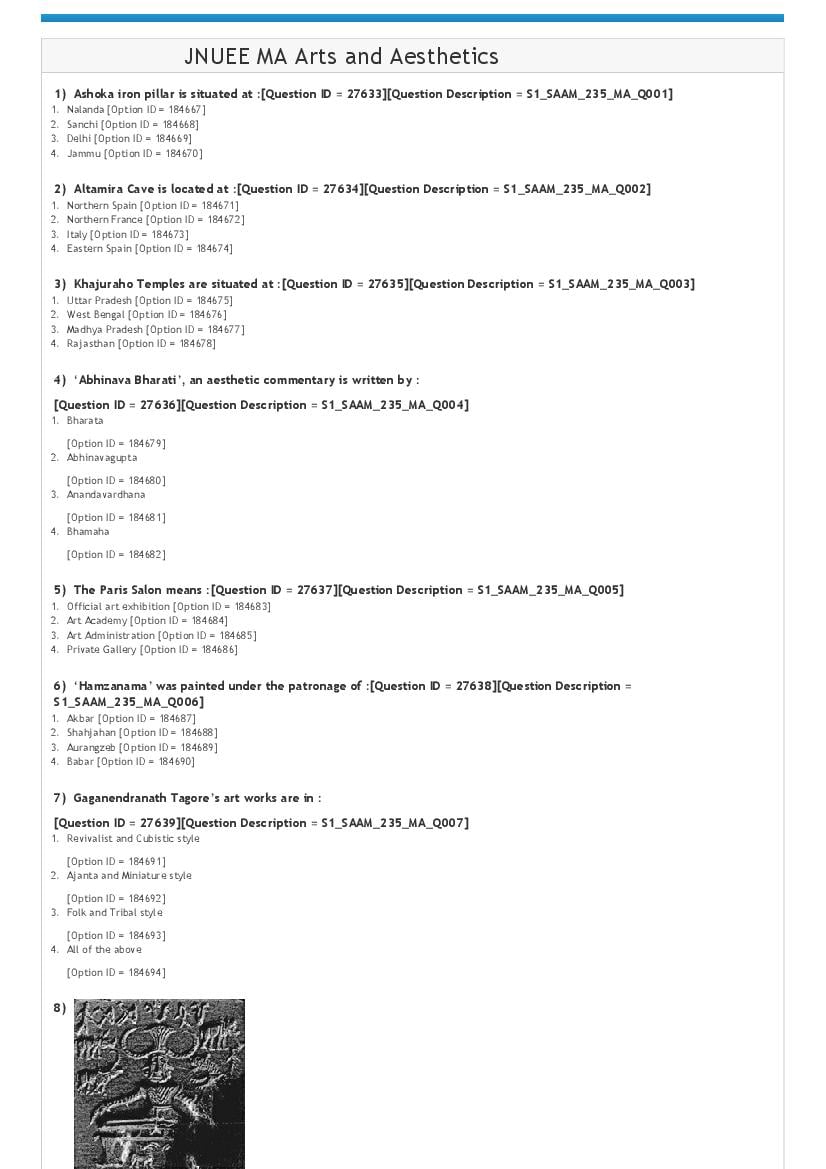
8)
Page 2
[Question ID = 34166][Question Description = S1_SAAM_235_MA_Q008]
1. Nalanda
[Option ID = 184695]
2. Mohenjo‐daro
[Option ID = 184696]
3. Lothal
[Option ID = 184697]
4. Kutch
[Option ID = 184698]
9) Burn out process is associated with
[Question ID = 34167][Question Description = S1_SAAM_235_MA_Q009]
1. Multiple casting
[Option ID = 184699]
2. Bronze casting
[Option ID = 184700]
3. Fibre–Glass casting
[Option ID = 184701]
4. Rubber casting
[Option ID = 184702]
10) World’s largest statue is called :
[Question ID = 34168][Question Description = S1_SAAM_235_MA_Q010]
1. Spring Temple Buddha
[Option ID = 184703]
2. Statue of Liberty
[Option ID = 184704]
3. Statue of Unity
[Option ID = 184705]
4. Christ the Redeemer
[Option ID = 184706]
11) The use of line in the below building’s design achieves primarily which of the following effects ?
[Question ID = 34169][Question Description = S1_SAAM_235_MA_Q011]
1. Creating a sense of dynamic movement
[Option ID = 184707]
2. Drawing the viewer’s eye toward the sky
[Option ID = 184708]
3. Communicating a sense of rigid formality
[Option ID = 184709]
4. Depicting a smooth implied texture
[Option ID = 184710]
12) The below iconic symbol was designed by :
Page 3
1. Steve Jobs
[Option ID = 184711]
2. Steve Wazniak
[Option ID = 184712]
3. Isaac Newton
[Option ID = 184713]
4. Rob Janoff
[Option ID = 184714]
13) Chromolithography prints designed to resemble oil paintings in style, with close similarities to the artistic techniques of
oil paintings is called :
[Question ID = 34171][Question Description = S1_SAAM_235_MA_Q013]
1. Oleograph
[Option ID = 184715]
2. Serigraph
[Option ID = 184716]
3. Collograph
[Option ID = 184717]
4. Holograph
[Option ID = 184718]
14) The self portrait below is of a famous Indian miniature painter of Jasrota called Nainsukha (c. 1710 – 1778), who is
associated with :
[Question ID = 34172][Question Description = S1_SAAM_235_MA_Q014]
1. Mughal School
[Option ID = 184719]
2. Rajasthani School
[Option ID = 184720]
3. Pala School
[Option ID = 184721]
4. Pahari School
[Option ID = 184722]
15) Who is the author of the book ‘Art and Visual Culture in India’ ?[Question ID = 34173][Question Description =
S1_SAAM_235_MA_Q015]
1. Anish Kapoor [Option ID = 184723]
2. Gayatri Sinha [Option ID = 184724]
3. Saryu Doshi [Option ID = 184725]
4. Geeta Kapoor [Option ID = 184726]
16)
‘Vanaprastham’ (1999), the visually stunning film by Shaji Karun on the complex narratives that interweave in the
traditional art form of Kathakali was elevated by the stunning performance of Mohanlal, the superstar from Kerala.
Equally brilliant was the performance of the highly experienced actress who played his lover.
Who essayed that character ?
[Question ID = 34174][Question Description = S1_SAAM_235_MA_Q016]
1. Manju Bhargavi
Page 4
2. Suhasini
[Option ID = 184728]
3. Gautami
[Option ID = 184729]
4. Radhika
[Option ID = 184730]
17) A social scientist working for TISS with no formal training in filmmaking went on to make several award winning films
like ‘Vastupurush’ and ‘Kasav’ dealing with very important social and psychological issues. Who is this person ?
[Question ID = 34175][Question Description = S1_SAAM_235_MA_Q017]
1. Mohan Agashe
[Option ID = 184731]
2. Sumitra Bhave
[Option ID = 184732]
3. Aparna Sen
[Option ID = 184733]
4. Nagraj Manjule
[Option ID = 184734]
18) After securing a Ph.D. in Elizabethan drama from the University of Birmingham he attracted the attention of director
Richard Attenborough who asked him to write the screenplay for his memorable film called ‘Gandhi’ (1982). This film
went on later to win him the Oscar for his Original Screenplay. Name the person who wrote the screenplay.
[Question ID = 34176][Question Description = S1_SAAM_235_MA_Q018]
1. Ken Loach
[Option ID = 184735]
2. John Brily
[Option ID = 184736]
3. Basil Wright
[Option ID = 184737]
4. Bill Douglas
[Option ID = 184738]
19) The renowned novel ‘Midnight’s Children’ by Salman Rushdie was recently made into a film directed by one of the
following :
[Question ID = 34177][Question Description = S1_SAAM_235_MA_Q019]
1. Mira Nair
[Option ID = 184739]
2. Deepa Mehta
[Option ID = 184740]
3. Gurinder Chadha
[Option ID = 184741]
4. Geetu Mohandas
Page 5
20) In the recent trend to name other film industries after Hollywood, one particular nation’s cinema is popularly referred
to as ‘Nollywood’. Which country are we talking about ?
[Question ID = 34178][Question Description = S1_SAAM_235_MA_Q020]
1. Norway
[Option ID = 184743]
2. Nambia
[Option ID = 184744]
3. Nigeria
[Option ID = 184745]
4. Nicaragua
[Option ID = 184746]
21) “Beyond The Clouds” is a poetic film made by the renowned Iranian filmmaker Majid Majidi. The film was shot entirely
in India and the music for the film was composed by :
[Question ID = 34179][Question Description = S1_SAAM_235_MA_Q021]
1. Vishal Bhardwaj
[Option ID = 184747]
2. A.R. Rahman
[Option ID = 184748]
3. Anu Malik
[Option ID = 184749]
4. Rashid Khan
[Option ID = 184750]
22)
Playing the main role in the film ‘Theory of Everything’ (2014) must have been an extremely challenging task to
portray the famous scientist cum author of several books. Look at the image and identify this celebrated person on
whom this biopic has been made ?
[Question ID = 34180][Question Description = S1_SAAM_235_MA_Q022]
1. Roger Penrose
[Option ID = 184751]
2. Richard Feynman
[Option ID = 184752]
3. Carl Sagan
[Option ID = 184753]
4. Stephen William Hawking
[Option ID = 184754]
23) The film ‘Raja Harishchandra’ by Dadasaheb Phalke has been recognized as the first feature length film made in India.
Which year was it released ?[Question ID = 34181][Question Description = S1_SAAM_235_MA_Q023]
1. 1914 [Option ID = 184755]
2. 1917 [Option ID = 184756]
3. 1913 [Option ID = 184757]
4. 1915 [Option ID = 184758]
24) The abbreviation OTT in the many OTT platforms that we witness today stands for :
[Question ID = 34182][Question Description = S1_SAAM_235_MA_Q024]
1. Official Televised Theatre
[Option ID = 184759]
2. On The Television
[Option ID = 184760]
Page 6
[Option ID = 184761]
4. Outright Temporal Technology
[Option ID = 184762]
25)
The person in the picture is a Farsi film maker who started of his career as a film maker for children and young adults.
He is certainly one of the earliest who put Iranian cinema on the world map.
[Question ID = 34183][Question Description = S1_SAAM_235_MA_Q025]
1. Majid Majidi
[Option ID = 184763]
2. Jaffar Panahi
[Option ID = 184764]
3. Abbas Kiarostami
[Option ID = 184765]
4. Asghar Farhadhi
[Option ID = 184766]
26) Marathi film maker Chaitanya Tamhane won the “Best Screenplay” award for his film “The Disciple (2020)” at one of
the following film festivals.
[Question ID = 34184][Question Description = S1_SAAM_235_MA_Q026]
1. Cannes film festival
[Option ID = 184767]
2. Toronto film festival
[Option ID = 184768]
3. Berlin film festival
[Option ID = 184769]
4. Venice film festival
[Option ID = 184770]
27) “Manto (2018)” is a film about the famous and controversial writer and playwright Saadat Hasan Manto who was born in
British India. After the partition he wrote about its hard truths that no one dared to talk about. The film was directed by
Nandita Das. Who is the actor playing the role of Manto in this film?
[Question ID = 27640][Question Description = S1_SAAM_235_MA_Q027]
1. Naseerudin Shah
[Option ID = 184771]
2. Nawazuddin Siddiqui
[Option ID = 184772]
3. Manoj Bajpayee
[Option ID = 184773]
4. Rajkumar Rao
[Option ID = 184774]
28)
Page 7
and director of Indian Cinema. He dominated the movie industry as a 'Movie Moghul' for almost for four decades.
[Question ID = 27641][Question Description = S1_SAAM_235_MA_Q028]
1. Meyyappa Chettiayar
[Option ID = 184775]
2. Naggi Reddy
[Option ID = 184776]
3. Nataraj Mudaliyar
[Option ID = 184777]
4. S.S. Vasan
[Option ID = 184778]
29)
The woman in the picture is a well‐known documentary film maker in the 1930s. She was patronized by Adolf Hitler.
[Question ID = 27642][Question Description = S1_SAAM_235_MA_Q029]
1. Margarethe von Trotta
[Option ID = 184779]
2. Leni Reifensthal
[Option ID = 184780]
3. Agnes Varda
[Option ID = 184781]
4. Marta Meazaros
[Option ID = 184782]
30) “Third Cinema” represents one of the following film movements that deals with serious political and social issues.
[Question ID = 27643][Question Description = S1_SAAM_235_MA_Q030]
1. Queer film movement [Option ID = 184783]
2. Feminist film movement [Option ID = 184784]
3. Latin American film movement [Option ID = 184785]
4. Documentary film movement [Option ID = 184786]
31) The term ‘Spect‐Actor’ denoting the dual role of both Spectator and Actor was coined by :
[Question ID = 27644][Question Description = S1_SAAM_235_MA_Q031]
1. Bertolt Brecht
Page 8
2. Peter Brook
[Option ID = 184788]
3. Richard Schechner
[Option ID = 184789]
4. Augusto Boal
[Option ID = 184790]
32) The ‘Chitrābhinaya’ described by Bharatamuni is a specific kind of :
[Question ID = 27645][Question Description = S1_SAAM_235_MA_Q032]
1. Vāchika Abhinaya
[Option ID = 184791]
2. Āharya Abhinaya
[Option ID = 184792]
3. Āngika Abhinaya
[Option ID = 184793]
4. Sāttvika Abhinaya
[Option ID = 184794]
33) According to the first chapter of Nātyashāstra Drama was originated in :
[Question ID = 27646][Question Description = S1_SAAM_235_MA_Q033]
1. Satayuga
[Option ID = 184795]
2. Kaliyuga
[Option ID = 184796]
3. Dwaparyuga
[Option ID = 184797]
4. Treta yuga
[Option ID = 184798]
34) Which book among the following is NOT authored by Kapila Vatsyayan ?
[Question ID = 27647][Question Description = S1_SAAM_235_MA_Q034]
1. Traditions of Indian Folk Dance
[Option ID = 184799]
2. The Square and the Circle of the Indian Arts
[Option ID = 184800]
3. Theatre of Roots
[Option ID = 184801]
4. Traditional Indian Theatre : Multiple Streams
[Option ID = 184802]
35) Pt. Vishnu Narayana Bhatkhande was a leading [Question ID = 27648][Question Description = S1_SAAM_235_MA_Q035]
1. Dramaturgist [Option ID = 184803]
2. Musicologist [Option ID = 184804]
3. Anthropologist [Option ID = 184805]
4. Indologist [Option ID = 184806]
36) “Choreographing Empathy : Kinesthesia in Performance” is the famous work of :
[Question ID = 27649][Question Description = S1_SAAM_235_MA_Q036]
1. Susan Langer
[Option ID = 184807]
2. Martha Graham
[Option ID = 184808]
3. Alwin Nikolais
[Option ID = 184809]
4. Susan Foster
[Option ID = 184810]
37) Who among the following is an Elizabethan playwright ?
[Question ID = 27650][Question Description = S1_SAAM_235_MA_Q037]
1. Henrik Ibsen
[Option ID = 184811]
Page 9
[Option ID = 184812]
3. Christopher Marlowe
[Option ID = 184813]
4. Tennessee Williams
[Option ID = 184814]
38) The Lucknow Gharana (School) of Kathak is celebrated for its lyrical and poetical quality laid down by :
[Question ID = 27651][Question Description = S1_SAAM_235_MA_Q038]
1. Binda Din
[Option ID = 184815]
2. Thakur Prasad
[Option ID = 184816]
3. Kalka Prasad
[Option ID = 184817]
4. Acchan Maharaj
[Option ID = 184818]
39) Which one of the following is NOT a form of Oral tradition engaged in performing the Epics ?
[Question ID = 27652][Question Description = S1_SAAM_235_MA_Q039]
1. Ankia Nat
[Option ID = 184819]
2. Wari Liba
[Option ID = 184820]
3. Ojhapali
[Option ID = 184821]
4. Pala
[Option ID = 184822]
40) The elements of which folk or traditional theatre form are found in the play ‘Nar Nari’ written by Nāg Bodas ?
[Question ID = 27653][Question Description = S1_SAAM_235_MA_Q040]
1. Tamasha
[Option ID = 184823]
2. Yakshagana
[Option ID = 184824]
3. Nautanki
[Option ID = 184825]
4. Bhavai
[Option ID = 184826]
41) What is Bertolt Brecht’s Epic theatre in the context of Dramatic theatre ?
[Question ID = 27654][Question Description = S1_SAAM_235_MA_Q041]
1. Its Supporter
[Option ID = 184827]
2. Its Opponent
[Option ID = 184828]
3. Its Example
[Option ID = 184829]
4. Its Imitation
[Option ID = 184830]
42) Which audience was targeted by the Epic theatre ?[Question ID = 27655][Question Description =
S1_SAAM_235_MA_Q042]
1. Working class [Option ID = 184831]
2. Elite Class [Option ID = 184832]
3. Intellectual [Option ID = 184833]
4. The West [Option ID = 184834]
43) Whose words are these, “Artists who do not go forward go backward”....?[Question ID = 27656][Question Description =
S1_SAAM_235_MA_Q043]
1. Bertolt Brecht [Option ID = 184835]
2. Badal Sircar [Option ID = 184836]
3. Anton Chekhov [Option ID = 184837]
Page 10
44) Sangita‐Ratnakara, the most exhaustive treatise on Indian music was written by :
[Question ID = 27657][Question Description = S1_SAAM_235_MA_Q044]
1. Sardula
[Option ID = 184839]
2. Narada
[Option ID = 184840]
3. Matanga
[Option ID = 184841]
4. Sarangadeva
[Option ID = 184842]
45) An actor in Greek drama, who performed minor roles for example, the Priest and the Herdsman in ‘Oedipus Rex’ is
called :
[Question ID = 34244][Question Description = S1_SAAM_235_MA_Q045]
1. Protagonist
[Option ID = 184843]
2. Tritagonist
[Option ID = 184844]
3. Deuteragonist
[Option ID = 184845]
4. Antagonist
[Option ID = 184846]
46) Which one of the following is NOT a kind of play presented or performed in ancient/classical Greek theatre ?
[Question ID = 34245][Question Description = S1_SAAM_235_MA_Q046]
1. Tragi‐Comedy
[Option ID = 184847]
2. Tragedy
[Option ID = 184848]
3. Comedy
[Option ID = 184849]
4. Satyr
[Option ID = 184850]
47) According to Rasa theory, what are vibhavas ?
[Question ID = 34246][Question Description = S1_SAAM_235_MA_Q047]
1. Consequents
[Option ID = 184851]
2. Transitory mental states
[Option ID = 184852]
3. Permanent mental states
[Option ID = 184853]
4. Determinants
[Option ID = 184854]
48) According to Nayaka bhed as given in Natyashastra, the Nayaka who is self‐controlled and exalted is referred to as :
[Question ID = 34247][Question Description = S1_SAAM_235_MA_Q048]
1. Dhiroddhata Nayaka [Option ID = 184855]
2. Dhiralalita Nayaka [Option ID = 184856]
3. Dhirodatta Nayaka [Option ID = 184857]
4. Dhiraprashanta Nayaka [Option ID = 184858]
49) According to Nayika bhed as given in Natyashastra, the Nayika who is suffering separation is called :
[Question ID = 34248][Question Description = S1_SAAM_235_MA_Q049]
1. Khandita
[Option ID = 184859]
2. Virahotkanthita
[Option ID = 184860]
3. Vipralabdha
[Option ID = 184861]
Page 11
[Option ID = 184862]
50) Which among the following is NOT a Sthayi bhava ?[Question ID = 34249][Question Description =
S1_SAAM_235_MA_Q050]
1. Harsha [Option ID = 184863]
2. Hāsa [Option ID = 184864]
3. Utsāha [Option ID = 184865]
4. Vismaya [Option ID = 184866]
51) Ravan shaking Mount Kailasa is found at
A. Badami Caves
B. Virupaksha Temple
C. Ellora Caves
D. Elephanta Caves
Choose the most appropriate answer from the options given below :
[Question ID = 34250][Question Description = S1_SAAM_235_MA_Q051]
1. A and D Only
[Option ID = 184867]
2. A and B Only
[Option ID = 184868]
3. B and C Only
[Option ID = 184869]
4. C and D Only
[Option ID = 184870]
52) The ‘Ellora Caves’ consist of the following two :
A. Buddhist and Hindu caves only
B. Jain cave temples only
C. Monolithic Kailas temple
D. Buddhist, Jain and Hindu caves
Choose the most appropriate answer from the options given below :
[Question ID = 34251][Question Description = S1_SAAM_235_MA_Q052]
1. A and C Only
[Option ID = 184871]
2. A and D Only
[Option ID = 184872]
3. B and C Only
[Option ID = 184873]
4. C and D Only
[Option ID = 184874]
53) At which two places ‘Sun Temples’ are located ?
A. Mahabalipuram (Mamallapuram)
B. Modhera
C. Konark
D. Lepakshi
Choose the most appropriate answer from the options given below :
[Question ID = 34252][Question Description = S1_SAAM_235_MA_Q053]
1. A and B Only
[Option ID = 184875]
2. B and C Only
[Option ID = 184876]
3. C and D Only
[Option ID = 184877]
4. A and D Only
[Option ID = 184878]
Page 12
A. Kamal Haasan
B. Bhupen Hazarika
C. Yash Chopra
D. S.D. Burman
E. Asha Bhosle
Choose the most appropriate answer from the options given below :
[Question ID = 34253][Question Description = S1_SAAM_235_MA_Q054]
1. A, C, D Only
[Option ID = 184879]
2. B, D, E Only
[Option ID = 184880]
3. B, C, E Only
[Option ID = 184881]
4. A, B, D Only
[Option ID = 184882]
55) Which of the following three are celebrated Japanese film directors ?
A. Nagisa Oshima
B. Zhang Yimou
C. Yasujiro Ozu
D. Wong Kar Wai
E. Kon Ichikawa
Choose the most appropriate answer from the options given below :
[Question ID = 34254][Question Description = S1_SAAM_235_MA_Q055]
1. B, C, D Only
[Option ID = 184883]
2. A, B, E Only
[Option ID = 184884]
3. B, D, E Only
[Option ID = 184885]
4. A, C, E Only
[Option ID = 184886]
56) Which three of the following are film school ?
A. FTII, Pune
B. Stephens College, Colombia
C. Koefia Academy, Rome
D. la Femis, Paris
E. Raindance School, London
Choose the most appropriate answer from the options given below :
[Question ID = 34255][Question Description = S1_SAAM_235_MA_Q056]
1. B, A, C Only
[Option ID = 184887]
2. D, E, A Only
[Option ID = 184888]
3. C, E, B Only
[Option ID = 184889]
4. A, D, E Only
[Option ID = 184890]
57) The opening verse and the closing verse in the Ancient Sanskrit Drama are respectively known as :
A. Āmukha
B. Nāndi
C. Prastāvna
D. Praveshaka
E. Bharatavākya
Choose the correct answer from the options given below :
Page 13
1. A and C Only
[Option ID = 184891]
2. B and E Only
[Option ID = 184892]
3. C and D Only
[Option ID = 184893]
4. D and E Only
[Option ID = 184894]
58) These are two Sāttvika Bhavas enumerated by Bharatamuni in Nātyashāstra.
A. Sveda (Perspiration)
B. Glani (Exhaustion)
C. Ashru (Tears)
D. Mada (Intoxication)
E. Nirveda (Distress)
Choose the correct answer from the options given below :
[Question ID = 34257][Question Description = S1_SAAM_235_MA_Q058]
1. B and D Only
[Option ID = 184895]
2. C and E Only
[Option ID = 184896]
3. D and E Only
[Option ID = 184897]
4. A and C Only
[Option ID = 184898]
59) Which three of the following are folk dances of Punjab ?
A. Tippani
B. Bhangra
C. Jhumer
D. Karthi
E. Saila
Choose the correct answer from the options given below :
[Question ID = 34258][Question Description = S1_SAAM_235_MA_Q059]
1. A, B and C Only
[Option ID = 184899]
2. B, C and D Only
[Option ID = 184900]
3. C, D and E Only
[Option ID = 184901]
4. B, C and E Only
[Option ID = 184902]
60) Which three of the following plays are penned by Ben Jonson, an Elizabethan play wright ?
A. Volpone
B. The Winter’s Tale
C. The Silent Woman
D. The Alchemist
E. The Spanish Tragedy
Choose the correct answer from the options given below :
[Question ID = 34259][Question Description = S1_SAAM_235_MA_Q060]
1. A, B and C Only
[Option ID = 184903]
2. B, C and D Only
[Option ID = 184904]
3. A, C and D Only
[Option ID = 184905]
4. C, D and E Only
Page 14
61) Match List I with List II
List – I List – II
A. The Kiss I. Piet Mondrian
B. Girl with a Pearl Earring II. Johannes Earring
C. Les Demoiselles d’Avignon III. Gustav Klimt
D. Composition with Red, Blueand Yellow IV. Pablo Picasso
Choose the correct answer from the options given below :
[Question ID = 34260][Question Description = S1_SAAM_235_MA_Q061]
1. A‐I, B‐III, C‐II, D‐IV
[Option ID = 184907]
2. A‐III, B‐II, C‐IV, D‐I
[Option ID = 184908]
3. A‐II, B‐I, C‐IV, D‐III
[Option ID = 184909]
4. A‐IV, B‐II, C‐III, D‐I
[Option ID = 184910]
62) Match List I with List II
List – I List – II
A. Tate Art Gallery I. Hyderabad
B. Louvre Museum II. Bhopal
C. Bharat Bhawan III. London
D. Salarjang Museum IV. Paris
Choose the correct answer from the options given below :
[Question ID = 34261][Question Description = S1_SAAM_235_MA_Q062]
1. A‐IV, B‐III, C‐I, D‐II
[Option ID = 184911]
2. A‐III, B‐IV, C‐II, D‐I
[Option ID = 184912]
3. A‐I, B‐II, C‐III, D‐IV
[Option ID = 184913]
4. A‐II, B‐IV, C‐I, D‐III
[Option ID = 184914]
63) Match List I with List II
List – I List – II
A. Marcel Duchamp I. Florence Pieta
B. Balbir Singh Katt II. Triumph of Labour
C. Michelangelo III. Bicycle Wheel
D. D. P. Roychowdhury IV. Nadeshwar
Choose the correct answer from the options given below :
[Question ID = 34262][Question Description = S1_SAAM_235_MA_Q063]
1. A‐IV, B‐II, C‐I, D‐III
[Option ID = 184915]
2. A‐III, B‐I, C‐II, D‐IV
[Option ID = 184916]
3. A‐III, B‐IV, C‐I, D‐II
[Option ID = 184917]
4. A‐II, B‐I, C‐III, D‐IV
[Option ID = 184918]
64) Match List I with List II
List – I List – II
A. Arriflex I. Sound Recording Device
B. Nagra II. Lenses
C. Sennheiser III. Motion Picture Camera
D. Carl Zeiss IV. Audio Accessories
Choose the correct answer from the options given below :
Page 15
1. A‐I, B‐II, C‐III, D‐IV
[Option ID = 184919]
2. A‐IV, B‐III, C‐II, D–I
[Option ID = 184920]
3. A‐III, B‐I, C‐IV, D–II
[Option ID = 184921]
4. A‐II, B‐IV, C‐I, D‐III
[Option ID = 184922]
65) Match List I with List II
List – I List – II
A. Satyajit Ray I. Padatik
B. Mrinal Sen II. 36, Chowringee Lane
C. Aparna Sen III. Paar
D. Gautam Ghosh IV. Pratidwandi
Choose the correct answer from the options given below :
[Question ID = 27658][Question Description = S1_SAAM_235_MA_Q065]
1. A‐I, B‐III, C‐IV, D‐II
[Option ID = 184923]
2. A‐IV, B‐I, C‐II, D‐III
[Option ID = 184924]
3. A‐IV, B‐III, C‐II, D‐I
[Option ID = 184925]
4. A‐III, B‐IV, C‐I, D‐II
[Option ID = 184926]
66) Match List I with List II
List – I List – II
A. French New Wave I. Vittorio De Sica
B. Neo Realism II. Lars von Trier
C. Dogme 95 III. Sergei Eisenstein
D. Soviet Montage IV. Francois Truffaut
Choose the correct answer from the options given below :
[Question ID = 27659][Question Description = S1_SAAM_235_MA_Q066]
1. A‐III, B‐II, C‐IV, D‐I
[Option ID = 184927]
2. A‐IV, B‐I, C‐II, D‐III
[Option ID = 184928]
3. A‐II, B‐IV, C‐III, D‐I
[Option ID = 184929]
4. A‐I, B‐III, C‐IV, D‐II
[Option ID = 184930]
67) Match List I with List II
List – I List – II
A. Conventional, stylized mode of dramatic representation I. Āviddha
B. A wordless song, using sounds II. Pravritti
of svara or rhythm beats
C. Regional usages in speech, III. Dhruva
dress, food, behaviour
D. Vigorous type of dramatic IV. Nātydharmi
performance
Choose the correct answer from the options given below :
[Question ID = 27660][Question Description = S1_SAAM_235_MA_Q067]
1. A‐IV, B‐III, C‐II, D‐I
[Option ID = 184931]
2. A‐I, B‐IV, C‐III, D‐II
[Option ID = 184932]
3. A‐II, B‐I, C‐IV, D‐III
Page 16
4. A‐III, B‐II, C‐I, D‐IV
[Option ID = 184934]
68) Match List I with List II
List – I List – II
A. Bhavabhuti I. Urubhangam
B. Kālidāsa II. Mudrā Rākshas
C. Vishākhadatta III. Malati Madhava
D. Bhāsa IV. Mālvika‐Agnimitram
Choose the correct answer from the options given below :
[Question ID = 27661][Question Description = S1_SAAM_235_MA_Q068]
1. A‐II, B‐III, C‐I, D‐IV
[Option ID = 184935]
2. A‐III, B‐IV, C‐II, D‐I
[Option ID = 184936]
3. A‐IV, B‐I, C‐III, D‐II
[Option ID = 184937]
4. A‐I, B‐II, C‐IV, D‐III
[Option ID = 184938]
69) Match List I with List II
List – I List – II
A. Bharatanatyam I. Shambhu Maharaj
B. Kathak II. Mrinalini Sarabhai
C. Odissi III. Darshana Zaveri
D. Manipuri IV. Kelucharan Mohapatra
Choose the correct answer from the options given below :
[Question ID = 27662][Question Description = S1_SAAM_235_MA_Q069]
1. A‐II, B‐I, C‐IV, D‐III
[Option ID = 184939]
2. A‐III, B‐I, C‐IV, D‐II
[Option ID = 184940]
3. A‐II, B‐III, C‐I, D–IV
[Option ID = 184941]
4. A‐IV, B‐III, C‐II, D‐I
[Option ID = 184942]
70) Match List I with List II
List – I List – II
A. Tiner Talwar I. Chandrasekhar Kambar
B. Jokumaraswami II. Mahesh Elkunchwar
C. Lehraon ke Rajhans III. Utpal Dutt
D. Wada Chirebandi IV. Mohan Rakesh
Choose the correct answer from the options given below :
[Question ID = 27663][Question Description = S1_SAAM_235_MA_Q070]
1. A‐III, B‐I, C‐II, D‐IV
[Option ID = 184943]
2. A‐IV, B‐II, C‐III, D‐I
[Option ID = 184944]
3. A‐II, B‐IV, C‐I, D‐III
[Option ID = 184945]
4. A‐III, B‐I, C‐IV, D‐II
[Option ID = 184946]
71) Select the correct sequence of the Western Art in order of period.
A. Futurism
B. Fauvism
C. Dadaism
D. Surrealism
Page 17
[Question ID = 27664][Question Description = S1_SAAM_235_MA_Q071]
1. D, A, B, C
[Option ID = 184947]
2. B, C, D, A
[Option ID = 184948]
3. C, D, A, B
[Option ID = 184949]
4. B, A, C, D
[Option ID = 184950]
72) Select the correct sequence of monument sites from North to South in India.
A. Sanghol
B. Jaggayyapet
C. Martend
D. Bhimbetika
Choose the correct answer from the options given below :
[Question ID = 27665][Question Description = S1_SAAM_235_MA_Q072]
1. A, B, C, D
[Option ID = 184951]
2. C, A, D, B
[Option ID = 184952]
3. B, C, A, D
[Option ID = 184953]
4. D, B, C, A
[Option ID = 184954]
73) Which is the correct sequence of stages involved in Creative thinking ?
A. Preparation
B. Orientation
C. Verification
D. Incubation
E. Illumination
Choose the correct answer from the options given below :
[Question ID = 27666][Question Description = S1_SAAM_235_MA_Q073]
1. A, B, D, E, C
[Option ID = 184955]
2. A, B, D, C, E
[Option ID = 184956]
3. B, A, D, E, C
[Option ID = 184957]
4. E, C, A, B, D
[Option ID = 184958]
74) Arrange the following films in the order of their release :
A. Aradhana
B. Lagaan
C. Mother India
D. Aakrosh
E. Sholay
Choose the correct answer from the options given below :
[Question ID = 27667][Question Description = S1_SAAM_235_MA_Q074]
1. A, C, D, E, B
[Option ID = 184959]
2. E, D, B, C, A
[Option ID = 184960]
3. D, A, C, B, E
[Option ID = 184961]
4. C, A, E, D, B
Page 18
75) Arrange these Hollywood films in order of their release :
A. Inception
B. Taxi Driver
C. Modern Times
D. Lawrence of Arabia
E. Citizen Kane
Choose the correct answer from the options given below :
[Question ID = 27668][Question Description = S1_SAAM_235_MA_Q075]
1. D, E, C, B, A
[Option ID = 184963]
2. C, E, D, B, A
[Option ID = 184964]
3. E, D, C, B, A
[Option ID = 184965]
4. B, C, D, A, E
[Option ID = 184966]
76) Arrange in the order of youngest to oldest of the following film festivals.
A. Cannes
B. Berlin
C. Venice
D. Sundance
E. Toronto
Choose the correct answer from the options given below :
[Question ID = 27669][Question Description = S1_SAAM_235_MA_Q076]
1. E, C, A, D, B
[Option ID = 184967]
2. B, E, D, C, A
[Option ID = 184968]
3. D, E, B, A, C
[Option ID = 184969]
4. C, A, B, E, D
[Option ID = 184970]
77) Give the correct chronological sequence of the following Rasa Commentators
A. Abhinavagupta
B. Bhatta Nāyaka
C. Bharatamuni
D. Shankuka
E. Bhatta Lollata
Choose the correct answer from the options given below :
[Question ID = 27670][Question Description = S1_SAAM_235_MA_Q077]
1. C, E, D, B, A
[Option ID = 184971]
2. A, D, B, C, E
[Option ID = 184972]
3. D, E, C, B, A
[Option ID = 184973]
4. A, B, C, D, E
[Option ID = 184974]
78) Give the correct sequence of the following parts of Bharata’s Theatre in the ascending
order from East to West.
A. Ranga Peetha
B. Prekshaka Niveshanam
C. Ranga Shirsha
D. Nepathyagruha
Page 19
[Question ID = 27671][Question Description = S1_SAAM_235_MA_Q078]
1. C, B, D, A
[Option ID = 184975]
2. D, C, A, B
[Option ID = 184976]
3. A, D, B, C
[Option ID = 184977]
4. B, A, C, D
[Option ID = 184978]
79) Arrange the following Institutions/Universities of Performing Arts/Drama/Music etc.
according to their correct geographical location from North to South.
A. National School of Drama
B. Sarojini Naidu School of Performing Arts, Fine Arts and Communication
C. FLAME School of Performing Arts
D. Faculty of Performing Arts, The Maharaja Sayajirao University
E. Raja Mansingh Tomar Music and Arts University
Choose the correct answer from the options given below :
[Question ID = 27672][Question Description = S1_SAAM_235_MA_Q079]
1. E, A, C, B, D
[Option ID = 184979]
2. A, C, D, B, E
[Option ID = 184980]
3. A, E, C, D, B
[Option ID = 184981]
4. A, E, D, C, B
[Option ID = 184982]
80) Arrange the following directors according to their states of origin from West to East.
A. Sanjay Upadhyay
B. Jashwant Thaker
C. Ratan Thiyam
D. Bansi Kaul
E. Badal Sircar
Choose the correct answer from the options given below :
[Question ID = 27673][Question Description = S1_SAAM_235_MA_Q080]
1. B, D, A, E, C
[Option ID = 184983]
2. D, B, E, A, C
[Option ID = 184984]
3. E, C, B, D, A
[Option ID = 184985]
4. B, D, C, E, A
[Option ID = 184986]
81) Given below are two statements : One is labelled as Assertion A and the other is
labelled as Reason R.
Assertion A : From Gupta period onwards river goddesses were used to be carved
on door jambs of entrance of Hindu temples in Northern
India.
Reason R : Because rivers were main life lines of culture, civilization and
trade.
In the light of the above statements, choose the correct answer from the options given
below :
[Question ID = 27674][Question Description = S1_SAAM_235_MA_Q081]
1. Both A and R are true and R is the correct explanation of A.
[Option ID = 184987]
2. Both A and R are true but R is NOT the correct explanation of A.
Page 20
3. A is true but R is false
[Option ID = 184989]
4. A is false but R is true.
[Option ID = 184990]
82) Given below are two statements : One is labelled as Assertion A and the other is labelled as Reason R.
Assertion A : In the Gothic period, painting plays a lesser role compared to
sculpture and architecture.
Reason R : Because the new architectural construction allowed greater scope
for plastic arts compared to the pictorial.
In the light of the above statements, choose the most appropriate answer from the
options given below :
[Question ID = 27675][Question Description = S1_SAAM_235_MA_Q082]
1. Both A and R are correct and R is the correct explanation of A.
[Option ID = 184991]
2. Both A and R are correct but R is NOT the correct explanation of A.
[Option ID = 184992]
3. A is correct but R is not correct
[Option ID = 184993]
4. A is not correct but R is correct.
[Option ID = 184994]
83) Given below are two statements : One is labelled as Assertion A and the other is
labelled as Reason R.
Assertion A : Serigraphy, commonly known as Silk Screen Printing because silk
cloth is used for taking prints.
Reason R : Silk is used because the fine pores of silk fabric allow the ink/
paint to be transferred on the surface of fabric, paper or any other
medium.
In the light of the above statements, choose the correct answer from the options given
below :
[Question ID = 34283][Question Description = S1_SAAM_235_MA_Q083]
1. Both A and R are true and R is the correct explanation of A.
[Option ID = 184995]
2. Both A and R are true but R is NOT the correct explanation of A.
[Option ID = 184996]
3. A is true but R is false
[Option ID = 184997]
4. A is false but R is true.
[Option ID = 184998]
84) Given below are two statements :
Statement I :
In a non‐egalitarian society, the cinema house in India, emerged as the first democratic space, where anyone could get in
and be together for a few hours without the distinction of caste, class or religion. Anyone who could afford a ticket could go
and watch a film. From the time cinema emerged as popular entertainment, the response of the upper class was one of
disdain. Film entertainment was ‘low culture’ for them.
Statement II : Few other art forms have been subject to Spectatorship and the reactions generated by all film‐viewing
public were going to have a major impact not only on the political framework of India but also on all the other art forms that
have existed so far. The upper class embraced the democratic approach of cinema and encouraged Indian cinema to grow
in popularity.
In the light of the above statements, choose the most appropriate answer from the options given below :
[Question ID = 34284][Question Description = S1_SAAM_235_MA_Q084]
1. Both Statement I and Statement II are correct.
[Option ID = 184999]
2. Both Statement I and Statement II are incorrect.
[Option ID = 185000]
3. Statement I is correct but Statement II is incorrect.
Page 21
4. Statement I is incorrect but Statement II is correct.
[Option ID = 185002]
85) Given below are two statements : One is labelled as Assertion A and the other is
labelled as Reason R.
Assertion A : In the matter of background music, it is meaningless to worry about
rules laid down for singing or playing pure classical music, as
background music need not be assessed as pure music at all.
However, if the background music it provides can match the mood
of the film, it is not just music, but music that has been entirely
successful in achieving its goal.
Reason R : Classical musicians are not competent to handle the variety of
moods and associations required for the assembly of shots that
constitute the film viewing experience. It is better to leave this area
to self‐taught lay musicians.
In the light of the above statements, choose the most appropriate answer from the
options given below :
[Question ID = 34285][Question Description = S1_SAAM_235_MA_Q085]
1. Both A and R are correct and R is the correct explanation of A.
[Option ID = 185003]
2. Both A and R are correct but R is NOT the correct explanation of A.
[Option ID = 185004]
3. A is correct but R is not correct
[Option ID = 185005]
4. A is not correct but R is correct.
[Option ID = 185006]
86) Given below are two statements : One is labelled as Assertion A and the other is
labelled as Reason R.
Assertion A : Andrzej Wajda says : Every director in the world wants to do
something original. Each of us tries to look at the world with our
own eyes, but our task is made difficult because other, more
original and talented artists have come before us and taken away
some of the freshness of vision. One day I was flying from Palermo
to Rome, thirty thousand feet up, when I saw through the plane
window a sky that was blood red and green; a mystical sunset.
I was revelling in the joy of that moment of perfection when
I realized that I had already seen that same sky, not from a
plane but in a painting by Mattias Grunewald, his magnificent
Crucifixion.
Reason R : A film maker sometimes want to do something so original that
audience are going to watch it for the very first time. But anyone’s
exposure to the world of art is always incomplete. Therefore it is
mystic and incorrect to think I want to create something complete
original.
In the light of the above statements, choose the most appropriate answer from the
options given below :
[Question ID = 34286][Question Description = S1_SAAM_235_MA_Q086]
1. Both A and R are true and R is the correct explanation of A.
[Option ID = 185007]
2. Both A and R are true but R is NOT the correct explanation of A.
[Option ID = 185008]
3. A is true but R is false
[Option ID = 185009]
4. A is false but R is true.
[Option ID = 185010]
87) Given below are two statement :
Statement I: Aristotale in his 'Poetics' maintains that poetry has sprung from the mimetic impulse and the instinct for
Page 22
would be intrested in realities and not in imitations.
Statement II: Such ancient doctrines of imitation are not opposed to the expressionist thesis. They recognize, perheps,
implicity, that the artist present his evaluative interpretation of reality, and thereby is expressing his feeling and sense of
values.
In the light of the above statements, choose the most appropriate answer from the
options given below :
[Question ID = 34287][Question Description = S1_SAAM_235_MA_Q087]
1. Both Statement I and Statement II are correct.
[Option ID = 185011]
2. Both Statement I and Statement II are incorrect.
[Option ID = 185012]
3. Statement I is correct but Statement II is incorrect.
[Option ID = 185013]
4. Statement I is incorrect but Statement II is correct.
[Option ID = 185014]
88) Given below are two statements : One is labelled as Assertion A and the other is
labelled as Reason R.
Assertion A : Edward Hanslick, the great Viennese music critic in his famous
little book on The Beautiful in Music strongly defended the
autonomy, the self‐sufficiency of music.
Reason R : He firmly believed that music has something special to do with
feeling or emotion, as he says, “the thrilling effect of a theme is
owing to the supposed extreme grief of the composer and not to the
extreme intervals.
In the light of the above statements, choose the most appropriate answer from the
options given below :
[Question ID = 34288][Question Description = S1_SAAM_235_MA_Q088]
1. Both A and R are true and R is the correct explanation of A.
[Option ID = 185015]
2. Both A and R are true but R is NOT the correct explanation of A.
[Option ID = 185016]
3. A is true but R is false
[Option ID = 185017]
4. A is false but R is true.
[Option ID = 185018]
89) Given below are two statements : One is labelled as Assertion A and the other is
labelled as Reason R.
Assertion A : The use of Alienation Effect in Acting and Production by Brecht is
not new.
Reason R : The Alienation Effect oriented Acting Style of Chinese Theatre is
much older than that.
In the light of the above statements, choose the most appropriate answer from the
options given below :
[Question ID = 34289][Question Description = S1_SAAM_235_MA_Q089]
1. Both A and R are true and R is the correct explanation of A.
[Option ID = 185019]
2. Both A and R are true but R is NOT the correct explanation of A.
[Option ID = 185020]
3. A is true but R is false
[Option ID = 185021]
4. A is false but R is true.
[Option ID = 185022]
90) Given below are two statements :
Page 23
‘Controlled’ and ‘Subcontrolled’
Statement II : The actor’s work is a subconscious process and arousal of emotions
is a switch ‘on’ and switch ‘off’ process.
In the light of the above statements, choose the most appropriate answer from the
options given below :
[Question ID = 34290][Question Description = S1_SAAM_235_MA_Q090]
1. Both Statement I and Statement II are true.
[Option ID = 185023]
2. Both Statement I and Statement II are false.
[Option ID = 185024]
3. Statement I is true but Statement II is false.
[Option ID = 185025]
4. Statement I is false but Statement II is true.
[Option ID = 185026]
91) Answer the questions based on the following paragraph :
Silent era comedies were full of prat falls, sight gags, and the classic “slipping on a banana peel” shtick. Cinema icons
Buster Keaton and Herold Lloyd built their careers upon this slapstick form of comedy, but where Chaplin differs from his
fellow comedians is how his brand of comedy affected audiences on a psychological level.
There are many different theories of humour from philosophers like Sigmund Freud and Mikhail Bakhtin, but the
one that seems to make the most sense within the context of silent era slapstick comedy is that of English philosopher
Thomas Hobbes “superiority theory” (which also traces back to Plato and Aristotle). It suggests that humans take delight in
other people’s misfortunes as a way to feel superior – giggling via schadenfreude, as it were. We laugh at the muscle‐bound
dude who slips and falls in front of his date, because he’s big and we’re not.
However, this wasn’t the case for Chaplin’s iconic character, The Tramp. Instead, he made audiences laugh
because they related to his suffering, and laughter and according to Harvard Professor George Eman Vaillant, is a defense
mechanism that allows people to explore and talk about things that are unpleasant and painful. The way Chaplin
incorporated tragedy into his comedies gave audiences someone they could truly identify with as they struggled to survive
the Great Depression.
Chaplin’s comedic explorations into the human condition transformed cinema, mostly comedies, from a mere
novelty into a poetic art form, because his films were able to address real issues with dimensional characters in a way that
made them easier to talk about. In other words, his films might’ve been funny because The Tramp wore big shoes and a
tiny jacket, but they were great because he was too impoverished to afford anything else – and that was something
audiences at the time could really understand.
It kind of makes one of Chaplin’s most famous quotes more poignant than ever :
“Life is tragedy when seen in close‐up, but a comedy in long‐shot.”
Still, Chaplin was banned from the U.S. Instead of fighting to re‐enter the country, Chaplin decided to make his
home in Switzerland and released a statement about his experience. “...... Since the end of the last world war, I have
been the object of lies and propaganda by powerful reactionary groups who, by their influence and by the aid of America’s
yellow press, have created an unhealthy atmosphere in which liberal‐minded individuals can be singled out and persecuted.
Under these conditions I find it virtually impossible to continue my motion‐picture work, and I have therefore given up my
residence in the United States.”
The term ‘Yellow Press’ refers to one of the meanings mentioned below
[Question ID = 34291][Question Description = S1_SAAM_235_MA_Q091]
1. Magazines which have a yellow front cover
[Option ID = 185027]
2. Journalists who indulge in spreading fake news
[Option ID = 185028]
3. Newspapers which contain colourful advertisements
[Option ID = 185029]
4. Journals which are high priced.
[Option ID = 185030]
92) Answer the questions based on the following paragraph :
Silent era comedies were full of prat falls, sight gags, and the classic “slipping on a banana peel” shtick. Cinema icons
Buster Keaton and Herold Lloyd built their careers upon this slapstick form of comedy, but where Chaplin differs from his
fellow comedians is how his brand of comedy affected audiences on a psychological level.
Page 24
one that seems to make the most sense within the context of silent era slapstick comedy is that of English philosopher
Thomas Hobbes “superiority theory” (which also traces back to Plato and Aristotle). It suggests that humans take delight in
other people’s misfortunes as a way to feel superior – giggling via schadenfreude, as it were. We laugh at the muscle‐bound
dude who slips and falls in front of his date, because he’s big and we’re not.
However, this wasn’t the case for Chaplin’s iconic character, The Tramp. Instead, he made audiences laugh
because they related to his suffering, and laughter and according to Harvard Professor George Eman Vaillant, is a defense
mechanism that allows people to explore and talk about things that are unpleasant and painful. The way Chaplin
incorporated tragedy into his comedies gave audiences someone they could truly identify with as they struggled to survive
the Great Depression.
Chaplin’s comedic explorations into the human condition transformed cinema, mostly comedies, from a mere
novelty into a poetic art form, because his films were able to address real issues with dimensional characters in a way that
made them easier to talk about. In other words, his films might’ve been funny because The Tramp wore big shoes and a
tiny jacket, but they were great because he was too impoverished to afford anything else – and that was something
audiences at the time could really understand.
It kind of makes one of Chaplin’s most famous quotes more poignant than ever :
“Life is tragedy when seen in close‐up, but a comedy in long‐shot.”
Still, Chaplin was banned from the U.S. Instead of fighting to re‐enter the country, Chaplin decided to make his
home in Switzerland and released a statement about his experience. “...... Since the end of the last world war, I have
been the object of lies and propaganda by powerful reactionary groups who, by their influence and by the aid of America’s
yellow press, have created an unhealthy atmosphere in which liberal‐minded individuals can be singled out and persecuted.
Under these conditions I find it virtually impossible to continue my motion‐picture work, and I have therefore given up my
residence in the United States.”
The word ‘Schadenfreude’ means one of the explanations listed below :
[Question ID = 34292][Question Description = S1_SAAM_235_MA_Q092]
1. Laughing at someone else’s misery
[Option ID = 185031]
2. Sympathizing with someone who is hurt
[Option ID = 185032]
3. The kind of dress worn by a tramp
[Option ID = 185033]
4. The German word for Psychology
[Option ID = 185034]
93) Answer the questions based on the following paragraph :
Silent era comedies were full of prat falls, sight gags, and the classic “slipping on a banana peel” shtick. Cinema icons
Buster Keaton and Herold Lloyd built their careers upon this slapstick form of comedy, but where Chaplin differs from his
fellow comedians is how his brand of comedy affected audiences on a psychological level.
There are many different theories of humour from philosophers like Sigmund Freud and Mikhail Bakhtin, but the
one that seems to make the most sense within the context of silent era slapstick comedy is that of English philosopher
Thomas Hobbes “superiority theory” (which also traces back to Plato and Aristotle). It suggests that humans take delight in
other people’s misfortunes as a way to feel superior – giggling via schadenfreude, as it were. We laugh at the muscle‐bound
dude who slips and falls in front of his date, because he’s big and we’re not.
However, this wasn’t the case for Chaplin’s iconic character, The Tramp. Instead, he made audiences laugh
because they related to his suffering, and laughter and according to Harvard Professor George Eman Vaillant, is a defense
mechanism that allows people to explore and talk about things that are unpleasant and painful. The way Chaplin
incorporated tragedy into his comedies gave audiences someone they could truly identify with as they struggled to survive
the Great Depression.
Chaplin’s comedic explorations into the human condition transformed cinema, mostly comedies, from a mere
novelty into a poetic art form, because his films were able to address real issues with dimensional characters in a way that
made them easier to talk about. In other words, his films might’ve been funny because The Tramp wore big shoes and a
tiny jacket, but they were great because he was too impoverished to afford anything else – and that was something
audiences at the time could really understand.
It kind of makes one of Chaplin’s most famous quotes more poignant than ever :
“Life is tragedy when seen in close‐up, but a comedy in long‐shot.”
Still, Chaplin was banned from the U.S. Instead of fighting to re‐enter the country, Chaplin decided to make his
home in Switzerland and released a statement about his experience. “...... Since the end of the last world war, I have
been the object of lies and propaganda by powerful reactionary groups who, by their influence and by the aid of America’s
yellow press, have created an unhealthy atmosphere in which liberal‐minded individuals can be singled out and persecuted.
Under these conditions I find it virtually impossible to continue my motion‐picture work, and I have therefore given up my
residence in the United States.”
Page 25
1. A‐III, B‐II, C‐I, D‐IV
[Option ID = 185035]
2. A‐IV, B‐III, C‐II, D‐I
[Option ID = 185036]
3. A‐II, B‐IV, C‐I, D‐III
[Option ID = 185037]
4. A‐I, B‐III, C‐II, D‐IV
[Option ID = 185038]
94) Answer the questions based on the following paragraph :
Silent era comedies were full of prat falls, sight gags, and the classic “slipping on a banana peel” shtick. Cinema icons
Buster Keaton and Herold Lloyd built their careers upon this slapstick form of comedy, but where Chaplin differs from his
fellow comedians is how his brand of comedy affected audiences on a psychological level.
There are many different theories of humour from philosophers like Sigmund Freud and Mikhail Bakhtin, but the
one that seems to make the most sense within the context of silent era slapstick comedy is that of English philosopher
Thomas Hobbes “superiority theory” (which also traces back to Plato and Aristotle). It suggests that humans take delight in
other people’s misfortunes as a way to feel superior – giggling via schadenfreude, as it were. We laugh at the muscle‐bound
dude who slips and falls in front of his date, because he’s big and we’re not.
However, this wasn’t the case for Chaplin’s iconic character, The Tramp. Instead, he made audiences laugh
because they related to his suffering, and laughter and according to Harvard Professor George Eman Vaillant, is a defense
mechanism that allows people to explore and talk about things that are unpleasant and painful. The way Chaplin
incorporated tragedy into his comedies gave audiences someone they could truly identify with as they struggled to survive
the Great Depression.
Chaplin’s comedic explorations into the human condition transformed cinema, mostly comedies, from a mere
novelty into a poetic art form, because his films were able to address real issues with dimensional characters in a way that
made them easier to talk about. In other words, his films might’ve been funny because The Tramp wore big shoes and a
tiny jacket, but they were great because he was too impoverished to afford anything else – and that was something
audiences at the time could really understand.
It kind of makes one of Chaplin’s most famous quotes more poignant than ever :
“Life is tragedy when seen in close‐up, but a comedy in long‐shot.”
Still, Chaplin was banned from the U.S. Instead of fighting to re‐enter the country, Chaplin decided to make his
home in Switzerland and released a statement about his experience. “...... Since the end of the last world war, I have
been the object of lies and propaganda by powerful reactionary groups who, by their influence and by the aid of America’s
yellow press, have created an unhealthy atmosphere in which liberal‐minded individuals can be singled out and persecuted.
Under these conditions I find it virtually impossible to continue my motion‐picture work, and I have therefore given up my
residence in the United States.”
Given below are two statements : One is labelled as Assertion A and the other is
labelled as Reason R.
Assertion A : His films might have been funny because the tramp wore big shoes
and a tiny jacket but they were great because he was too
impoverished to afford anything else.
Reason R : The way Chaplin incorporated tragedy into his comedies gave
audiences someone they could truly identify with as they struggled
to survive the Great Depression.
In the light of the above statements, choose the most appropriate answer from the
Page 26
[Question ID = 34294][Question Description = S1_SAAM_235_MA_Q094]
1. Both A and R are correct and R is the correct explanation of A.
[Option ID = 185039]
2. Both A and R are correct but R is NOT the correct explanation of A.
[Option ID = 185040]
3. A is correct but R is not correct
[Option ID = 185041]
4. A is not correct but R is correct.
[Option ID = 185042]
95) Answer the questions based on the following paragraph :
Silent era comedies were full of prat falls, sight gags, and the classic “slipping on a banana peel” shtick. Cinema icons
Buster Keaton and Herold Lloyd built their careers upon this slapstick form of comedy, but where Chaplin differs from his
fellow comedians is how his brand of comedy affected audiences on a psychological level.
There are many different theories of humour from philosophers like Sigmund Freud and Mikhail Bakhtin, but the
one that seems to make the most sense within the context of silent era slapstick comedy is that of English philosopher
Thomas Hobbes “superiority theory” (which also traces back to Plato and Aristotle). It suggests that humans take delight in
other people’s misfortunes as a way to feel superior – giggling via schadenfreude, as it were. We laugh at the muscle‐bound
dude who slips and falls in front of his date, because he’s big and we’re not.
However, this wasn’t the case for Chaplin’s iconic character, The Tramp. Instead, he made audiences laugh
because they related to his suffering, and laughter and according to Harvard Professor George Eman Vaillant, is a defense
mechanism that allows people to explore and talk about things that are unpleasant and painful. The way Chaplin
incorporated tragedy into his comedies gave audiences someone they could truly identify with as they struggled to survive
the Great Depression.
Chaplin’s comedic explorations into the human condition transformed cinema, mostly comedies, from a mere
novelty into a poetic art form, because his films were able to address real issues with dimensional characters in a way that
made them easier to talk about. In other words, his films might’ve been funny because The Tramp wore big shoes and a
tiny jacket, but they were great because he was too impoverished to afford anything else – and that was something
audiences at the time could really understand.
It kind of makes one of Chaplin’s most famous quotes more poignant than ever :
“Life is tragedy when seen in close‐up, but a comedy in long‐shot.”
Still, Chaplin was banned from the U.S. Instead of fighting to re‐enter the country, Chaplin decided to make his
home in Switzerland and released a statement about his experience. “...... Since the end of the last world war, I have
been the object of lies and propaganda by powerful reactionary groups who, by their influence and by the aid of America’s
yellow press, have created an unhealthy atmosphere in which liberal‐minded individuals can be singled out and persecuted.
Under these conditions I find it virtually impossible to continue my motion‐picture work, and I have therefore given up my
residence in the United States.”
Given below are two statements : One is labelled as Assertion A and the other is
labelled as Reason R.
Assertion A : “Life is a tragedy when seen in close‐up but a comedy in long shot”
– Chaplin.
Reason R : By and large people tend to live removed from day to day issues
and imagine that all is well. Only on personal examination do
problems surface.
In the light of the above statements, choose the most appropriate answer from the
options given below :
[Question ID = 34295][Question Description = S1_SAAM_235_MA_Q095]
1. Both A and R are true and R is the correct explanation of A.
[Option ID = 185043]
2. Both A and R are true but R is NOT the correct explanation of A.
[Option ID = 185044]
3. A is true but R is false
[Option ID = 185045]
4. A is false but R is true.
[Option ID = 185046]
Page 27
Bhakti movements were binding factors and they bind together. But at the same time they tried to free people
from the shackles of exploitation. There is a famous song influenced by Tagore’s Geetanjali in Bengal: “let my head bow
down at your sacred feet, let all my ahankar be dissolved in my tears.” In that poem he says, “unite me with everything;
but free me from all bonds.” In one of the songs, saint Appar says when he is on his way to Siva temple, he has to pass
through the forest and he sees an elephant couple making love. He says, “Here I had the vision of Siva”. Tagore says, “Let
me be united to everything,”at the same time, “let me not be bound by anything or anybody”, which indeed, is the spirit
of the Bhakti Movement. On the one hand they freed people from shackles of ignorance, superstition and exploitation. At
the same time they united different sections of people. One of the banes of Indian society was the caste system. Today we
talk of dalit theatre, women’s theatre and so on. A Bhakti movement produced the first dalit art. The first women’s theatre
in India again was a product of Bhakti movement. One of the earliest Tamil poets of Saivism was Karaikkal Ammaiyar, who
wrote great spiritual poetry. In the North we have great women saint poets like Meerabai of Rajasthan, Lalleswari of Kashmir
and Jinabai, Bahinabai and others of Maharashtra. It liberated the exploited sections of Indian society, sundras and
untouchables, women and tribals. The last Bhakti movement in India was in fact started by a tribal saint called Bimapur in
Orissa. It was again an anti‐temple movement. The call was, “don’t worship the wooden images” which was a reaction
against the temple of Jagannath, where the lord is worshipped in a wooden form. Bhakti was a movement of a great scale
which was to transform every aspect of human life.
“Let my head bow down at your sacred feet, let all my ahankar be dissolved in my tears.” This famous song was influenced
by whose work ?
[Question ID = 34296][Question Description = S1_SAAM_235_MA_Q096]
1. Meerabai
[Option ID = 185047]
2. Lalleswari
[Option ID = 185048]
3. Appar
[Option ID = 185049]
4. Tagore
[Option ID = 185050]
97) Answer the question based on the following paragraph :
Bhakti movements were binding factors and they bind together. But at the same time they tried to free people
from the shackles of exploitation. There is a famous song influenced by Tagore’s Geetanjali in Bengal: “let my head bow
down at your sacred feet, let all my ahankar be dissolved in my tears.” In that poem he says, “unite me with everything;
but free me from all bonds.” In one of the songs, saint Appar says when he is on his way to Siva temple, he has to pass
through the forest and he sees an elephant couple making love. He says, “Here I had the vision of Siva”. Tagore says, “Let
me be united to everything,”at the same time, “let me not be bound by anything or anybody”, which indeed, is the spirit
of the Bhakti Movement. On the one hand they freed people from shackles of ignorance, superstition and exploitation. At
the same time they united different sections of people. One of the banes of Indian society was the caste system. Today we
talk of dalit theatre, women’s theatre and so on. A Bhakti movement produced the first dalit art. The first women’s theatre
in India again was a product of Bhakti movement. One of the earliest Tamil poets of Saivism was Karaikkal Ammaiyar, who
wrote great spiritual poetry. In the North we have great women saint poets like Meerabai of Rajasthan, Lalleswari of Kashmir
and Jinabai, Bahinabai and others of Maharashtra. It liberated the exploited sections of Indian society, sundras and
untouchables, women and tribals. The last Bhakti movement in India was in fact started by a tribal saint called Bimapur in
Orissa. It was again an anti‐temple movement. The call was, “don’t worship the wooden images” which was a reaction
against the temple of Jagannath, where the lord is worshipped in a wooden form. Bhakti was a movement of a great scale
which was to transform every aspect of human life.
Page 28
1. A‐III, B‐I, C‐IV, D‐II
[Option ID = 185051]
2. A‐IV, B‐II, C‐I, D‐III
[Option ID = 185052]
3. A‐I, B‐III, C‐II, D‐IV
[Option ID = 185053]
4. A‐II, B‐IV, C‐III, D‐I
[Option ID = 185054]
98) Answer the question based on the following paragraph :
Bhakti movements were binding factors and they bind together. But at the same time they tried to free people
from the shackles of exploitation. There is a famous song influenced by Tagore’s Geetanjali in Bengal: “let my head bow
down at your sacred feet, let all my ahankar be dissolved in my tears.” In that poem he says, “unite me with everything;
but free me from all bonds.” In one of the songs, saint Appar says when he is on his way to Siva temple, he has to pass
through the forest and he sees an elephant couple making love. He says, “Here I had the vision of Siva”. Tagore says, “Let
me be united to everything,”at the same time, “let me not be bound by anything or anybody”, which indeed, is the spirit
of the Bhakti Movement. On the one hand they freed people from shackles of ignorance, superstition and exploitation. At
the same time they united different sections of people. One of the banes of Indian society was the caste system. Today we
talk of dalit theatre, women’s theatre and so on. A Bhakti movement produced the first dalit art. The first women’s theatre
in India again was a product of Bhakti movement. One of the earliest Tamil poets of Saivism was Karaikkal Ammaiyar, who
wrote great spiritual poetry. In the North we have great women saint poets like Meerabai of Rajasthan, Lalleswari of Kashmir
and Jinabai, Bahinabai and others of Maharashtra. It liberated the exploited sections of Indian society, sundras and
untouchables, women and tribals. The last Bhakti movement in India was in fact started by a tribal saint called Bimapur in
Orissa. It was again an anti‐temple movement. The call was, “don’t worship the wooden images” which was a reaction
against the temple of Jagannath, where the lord is worshipped in a wooden form. Bhakti was a movement of a great scale
which was to transform every aspect of human life.
The last Bhakti movement in India was an anti‐temple movement which was started against the temple of
[Question ID = 34298][Question Description = S1_SAAM_235_MA_Q098]
1. Lord Rama
[Option ID = 185057]
2. Lord Shiva
[Option ID = 185058]
3. Lord Krishna
[Option ID = 185055]
4. Lord Jagannath
[Option ID = 185056]
99) Answer the question based on the following paragraph :
Bhakti movements were binding factors and they bind together. But at the same time they tried to free people
from the shackles of exploitation. There is a famous song influenced by Tagore’s Geetanjali in Bengal: “let my head bow
down at your sacred feet, let all my ahankar be dissolved in my tears.” In that poem he says, “unite me with everything;
but free me from all bonds.” In one of the songs, saint Appar says when he is on his way to Siva temple, he has to pass
through the forest and he sees an elephant couple making love. He says, “Here I had the vision of Siva”. Tagore says, “Let
me be united to everything,”at the same time, “let me not be bound by anything or anybody”, which indeed, is the spirit
of the Bhakti Movement. On the one hand they freed people from shackles of ignorance, superstition and exploitation. At
the same time they united different sections of people. One of the banes of Indian society was the caste system. Today we
talk of dalit theatre, women’s theatre and so on. A Bhakti movement produced the first dalit art. The first women’s theatre
in India again was a product of Bhakti movement. One of the earliest Tamil poets of Saivism was Karaikkal Ammaiyar, who
wrote great spiritual poetry. In the North we have great women saint poets like Meerabai of Rajasthan, Lalleswari of Kashmir
and Jinabai, Bahinabai and others of Maharashtra. It liberated the exploited sections of Indian society, sundras and
untouchables, women and tribals. The last Bhakti movement in India was in fact started by a tribal saint called Bimapur in
Orissa. It was again an anti‐temple movement. The call was, “don’t worship the wooden images” which was a reaction
against the temple of Jagannath, where the lord is worshipped in a wooden form. Bhakti was a movement of a great scale
which was to transform every aspect of human life.
Given below are two statements :
Statement I : Tagore says, “Let me be united to everything” at the same time, “Let me not be bound by anything or
Page 29
Statement II : Bhakti Movements were binding factors and they bind together. But they did not free the people from
shackles of ignorance, superstition and exploitation.
In the light of the above statements, choose the most appropriate answer from the options given below : In the light of the
above statements, choose the most appropriate answer from the options given below :
[Question ID = 34299][Question Description = S1_SAAM_235_MA_Q099]
1. Both Statement I and Statement II are true.
[Option ID = 185059]
2. Both Statement I and Statement II are false.
[Option ID = 185060]
3. Statement I is correct but Statement II is false.
[Option ID = 185061]
4. Statement I is incorrect but Statement II is true.
[Option ID = 185062]
100) Answer the question based on the following paragraph :
Bhakti movements were binding factors and they bind together. But at the same time they tried to free people
from the shackles of exploitation. There is a famous song influenced by Tagore’s Geetanjali in Bengal: “let my head bow
down at your sacred feet, let all my ahankar be dissolved in my tears.” In that poem he says, “unite me with everything;
but free me from all bonds.” In one of the songs, saint Appar says when he is on his way to Siva temple, he has to pass
through the forest and he sees an elephant couple making love. He says, “Here I had the vision of Siva”. Tagore says, “Let
me be united to everything,”at the same time, “let me not be bound by anything or anybody”, which indeed, is the spirit
of the Bhakti Movement. On the one hand they freed people from shackles of ignorance, superstition and exploitation. At
the same time they united different sections of people. One of the banes of Indian society was the caste system. Today we
talk of dalit theatre, women’s theatre and so on. A Bhakti movement produced the first dalit art. The first women’s theatre
in India again was a product of Bhakti movement. One of the earliest Tamil poets of Saivism was Karaikkal Ammaiyar, who
wrote great spiritual poetry. In the North we have great women saint poets like Meerabai of Rajasthan, Lalleswari of Kashmir
and Jinabai, Bahinabai and others of Maharashtra. It liberated the exploited sections of Indian society, sundras and
untouchables, women and tribals. The last Bhakti movement in India was in fact started by a tribal saint called Bimapur in
Orissa. It was again an anti‐temple movement. The call was, “don’t worship the wooden images” which was a reaction
against the temple of Jagannath, where the lord is worshipped in a wooden form. Bhakti was a movement of a great scale
which was to transform every aspect of human life.
Given below are two statements : One is labelled as Assertion A and the other is labelled as Reason R.
Assertion A : Both Dalit Theatre and Women’s Theatre are the product of the modern/contemporary era only.
Reason R : A Bhakti movement produced the first dalit art; the first women’s theatre in India again was a product of Bhakti
movement.
In the light of the above statements, choose the most appropriate answer from the options given below :
[Question ID = 34300][Question Description = S1_SAAM_235_MA_Q100]
1. Both A and R are true and R is the correct explanation of A.
[Option ID = 185063]
2. Both A and R are true but R is NOT the correct explanation of A.
[Option ID = 185064]
3. A is true but R is false
[Option ID = 185065]
4. A is false but R is true.
[Option ID = 185066]