AP DEECET 2020 Question Paper Biological Science (Tamil)
Finished viewing? Save it for later —
Download AP DEECET 2020 Question Paper Biological Science (Tamil) (PDF · 48 pages)About AP DEECET 2020 Question Paper Biological Science (Tamil)
AP DEECET 2020 Question Paper Biological Science (Tamil) is available here for free download. Published by APSCHE for AP DEECET, this question paper can be viewed online or downloaded as a PDF (48 pages). Candidates preparing for AP DEECET can use AP DEECET 2020 Question Paper Biological Science (Tamil) to understand the exam pattern, the type of questions asked, and the overall difficulty level.
Frequently Asked Questions
How can I download AP DEECET 2020 Question Paper Biological Science (Tamil)?
Open this page and click the Download button to save AP DEECET 2020 Question Paper Biological Science (Tamil) as a PDF. It is completely free on AglaSem Docs.
Is AP DEECET 2020 Question Paper Biological Science (Tamil) free to download?
Yes. AP DEECET 2020 Question Paper Biological Science (Tamil) can be viewed online and downloaded as a PDF free of cost on AglaSem Docs.
How many pages does AP DEECET 2020 Question Paper Biological Science (Tamil) have?
AP DEECET 2020 Question Paper Biological Science (Tamil) contains 48 pages, which you can read online or download together as a single PDF.
Where can I find more AP DEECET study material?
You can find more AP DEECET question papers, sample papers, syllabus, and answer keys on AglaSem Docs.
AP DEECET 2020 Question Paper Biological Science (Tamil) – Text
Read the full text of this question paper below — useful to quickly search, copy and reference the content online without downloading the PDF.
📄 View text version (48 pages)
Page 1
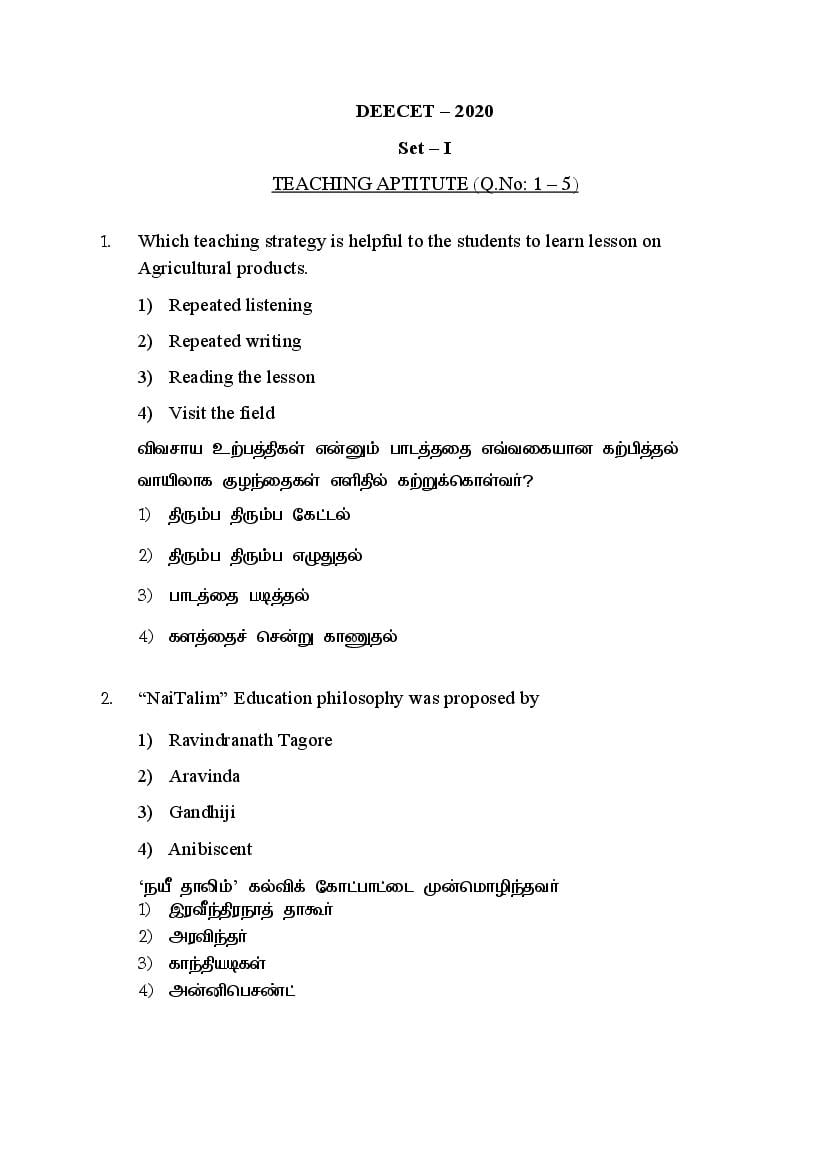
Set – I
TEACHING APTITUTE (Q.No: 1 – 5)
1. Which teaching strategy is helpful to the students to learn lesson on
Agricultural products.
1) Repeated listening
2) Repeated writing
3) Reading the lesson
4) Visit the field
↑ΞΜôΥ ∆σΣιƒΚρ Φτàλ ΣôΟιΘûΘ ΦπΞûΚΥô∴ Κσ♦ιΘο
Ξô♠ΩôΚ ÏΨϕûΘΚρ Φ↓ƒο ΚσßχùΚôρΞν>
1) ƒÚλΣ ƒÚλΣ úΚγΟο
2) ƒÚλΣ ƒÚλΣ ΦÝÕΘο
3) ΣôΟιûΘ Σ⁄ιΘο
4) ΚΖιûΘε ùΜτß ΚôÔΘο
2. “NaiTalim” Education philosophy was proposed by
1) Ravindranath Tagore
2) Aravinda
3) Gandhiji
4) Anibiscent
‘ΡÂ Θô←λ’ Κο↑χ úΚôγΣôγûΟ ØτùΤô→ϕΘΞν
1) ΒςÅϕƒςΡôι Θôáν
2) ≅ς↑ϕΘν
3) ΚôϕƒΥ⁄Κρ
4) ≅τ±ùΣΜηγ
Page 2
1) Arrange a person to bring him school regularly
2) Complaint to his parents
3) Throw him out from school
4) Identify the reason and provide proper councelling.
Σρ↓χÏ ùΘôΟνϕÕ ΞÚûΚ ΘςôΘ ΤôΠΞνΚÞχΚôΚ ùΜµΥ úΞη⁄Υ
ΘÏϕΘ ùΜΥο
1) ƒ∴Øλ ≅Ξû∴ Σρ↓χÏ ≅ûΨιÕ ΞÚΣΞûς ΓσΣôÓ ùΜµΘο
2) ùΣσú[ôνΚ↓Ολ ×Κôν ùΜµΞÕ
3) Σρ↓♠←ÚϕÕ ≅Ξû∴ ùΞ↓úΥσßΞÕ
4) ΚôςΠιûΘχ ΚηΟ°ϕÕ ΘÏϕΘ ≅°Üûς ΞΨδÏΘο
4. Student particulars are entered in this register
1) Admission register
2) Census register
3) Parent meeting register
4) Stock register.
Σρ↓♠ο úΜνχÏλúΣôÕ ΤôΠΞ±τ ↑ΞςδΚûΖ Βƒο 䟚 ùΜµΞν
1) úΜνχûΚκ ΣƒúΞÓ
2) ΚΠχùΚÓκ× ΣƒúΞÓ
3) ùΣσú[ôν áγΟκ ΣƒúΞÓ
4) ΒÚκ×κ ΣƒúΞÓ
Page 3
1) 0 – 3 years
2) 3 – 5 years
3) 6 – 8 years
4) 6 – 14 years
Øτ ùΘôΟχΚ Κο↑ ΒϕΘ ΞΥƒ∴ÚχÏ↔ΥÕ
1) 0 ` 3 ΑηÓΚρ
2) 3 ` 5 ΑηÓΚρ
3) 6 ` 8 ΑηÓΚρ
4) 6 ` 14 ΑηÓΚρ
Page 4
6. Largest brackish water lagoon in Asia
1) Chilika lake
2) Loktak lake
3) Kolleru lake
4) Pulikot lake
Α′Υô↑τ ♥ΚκùΣ↔Υ ∆κ׿ν Γ↔
1) ′οΚô Γ↔
2) úΩôχΘχ Γ↔
3) ùΚôοúΩÚ Γ↔
4) ×←Κôγ Γ↔
7. DISA act – 2019 refers to
1) Domestic violence
2) Sexual offence against women
3) Child rights
4) Medical services
ƒΜô ΜγΟλ ` 2019 ΒûΘχ Ï°κ♦Ó€[Õ−
1) ÅγÓχ ùΚôÓûΤ
2) ùΣηΚ↓τ ÁÕ Σô←∴χ ùΚôÓûΤ
3) ÏΨϕûΘ ∆↔ûΤΚρ
4) ΤÚιÕΞ úΜûΞΚρ
Page 5
1) 5th September
2) 5th August
3) 5th June
4) 5th October
‘∆ΩΚ Α′↔Υν ƒ∴λ’ ùΚôηΟôΟκΣÓλ Ρôρ
1) ùΜκΟλΣν ` 5
2) ΑΚυγ ` 5
3) ⊥øτ ` 5
4) ≅χúΟôΣν ` 5
9. The singer who won Bharataratna award for the year 2019 was
1) BgupenHazarika
2) Mrunalsen
3) Hari Prasad chowrasia
4) Priyadas
2019 Αλ Αη⁄σΚô∴ ‘ΣôςΘ ςι∴ô’ ↑Úƒû∴κ ùΣσ[ ΣôΟΚν
1) éùΣτ ⊥ô↔Κô
2) ØÚΠôο ùΜτ
3) ↔♦ςΜôι ùΜΖúς′Υô
4) ♦↔ΥôΘôυ
Page 6
1) Aarogyasethu
2) Raithubandu
3) Spandana
4) Bhoodar
ΤχΚρ ♦ςε′û∴ΚûΖι νχÏλ ΘΖΤôΚ ΣΥτΣÓιΘκΣÓλ
ùΜΥ←
1) Αúςôχ€Υ úΜÕ
2) ûςÕ ΣϕÕ
3) υΣϕΘ∴ô
4) éΘôν
Page 7
11. Raghu is a fatalist. He believes in …………..
Choose the word / phrase to complete the sentence.
1) history.
2) wealth
3) fate
4) God
12. After she ………………………………. her teeth, she took her breakfast.
Choose the correct form of verb to complete the sentence.
1) will brush
2) had brushed
3) would brush
4) brushes
13. Choose the compound sentence from the following.
1) We like songs but they like games.
2) We like songs which are melodious.
3) We like songs if they are composed by Rehaman.
4) We like songs at the time of our breakfast.
Page 8
1) courage
2) courageous
3) courageously
4) encourage
15. Rip Van Winkle helped the short man.
Choose the passive voice of the sentence above.
1) The short man helped Rip Van Winkle.
2) The short man has helped by Rip Van Winkle
3) The short man was helped Rip Van Winkle
4) The short man was helped by Rip Van Winkle.
Page 9
16. ¿ì+~ y{ìýË »»¿£µµ esZ¿s£ +Á
1) eT
2) sÁ
3) È
4) >·
17. »»|¾\¢\T nsÁTdTïHsÁTµµ y¿±«¿ì e«Ü¹s¿£ nsÁ+ e#ûÌ y¿£«+
1) |¾\\¢ T nsÁesÁT
2) |¾\\¢ T nsÁe&+ ýñ<T
3) |¾\\¢ T nsÁTkÍïsTÁ
4) |¾\\¢ T nsÁeýñ<T
18. ¿ì+~ y{ìýË »»q|Ú+d¿*£ +>·+µµ
1) seTT&T
2) \¿¡ë
3) e¿£e TT
4) kÍ$çÜ
Page 10
1) yîÞ²¢sTÁ
2) bõ+<sÁT
3) bÍ&sÁT
4) #ûXæsÁT
20. ¿ì+~ y{ìýË »»eTVäçbÍD²¿£sÁ+µµ Ôà @sÁÎ&q |<+
1) >·sÞÁ +ø
2) ÈeTTq
3) nsÁ¿£
4) |TqeTT
Page 11
21. Ïσ[ôΩχ Ï[Ξφ′♠τ Α′↔Υν
1) ΣôúΞϕΘν ΣôςƒΘôΜτ
2) ƒ↔áΟ ςôΜκΣχ Κ↑ςôΥν
3) ΣγÓχúΚôγûΟ ΚοΥôΠ ÑϕΘςλ
4) ΙΖûΞΥôν
22. ‘ΒΖδúΚôΞ⁄Κρ’ , ΒεùΜôο←σÏ ΒιΘû∴ ΤôιƒûςΚρ
1) Αß
2) ΓÝ
3) ΦγÓ
4) ΙτΣÕ
23. é↑úΩ ′[ϕΘ é ΦÕùΞ∴χ úΚγΟúΣôÕ+ Μσßλ ΘΥδΚôΤο ΣÚιƒκé
Φ∴χ á°ΥΞν
1) Σ↔ƒΤôσ ΚûΩΝν
2) ≅°Νν ≅ηΠô
3) ΟôχΟν−Ø−ΞςΘςôΜ∴ôν
4) ƒÚ−↑−Κ−
Page 12
1) 07
2) 2/
3) 01
4) 105
25. ‘↑Ñλ×’ ΦτΣΘτ ùΣôÚρ
1) Ξô∴λ
2) Κôσß
3) ¿ν
4) ùΡÚκ×
26. ‘Εν ∆[δ€ΥÕ’ ΦτΣÕ ΒπΞûΚ ΑÏùΣΥςôÏλ
1) ùΘô→ΩôÏ ùΣΥν
2) ΒΟΞôÏ ùΣΥν
3) ØΘΩôÏ ùΣΥν
4) ΚôΩΞôÏ ùΣΥν
27. Τςλ ∗ úΞν < ΤςúΞν ΦτΣÕ ΒπΞûΚκ ×Πνε′ΥôÏλ
1) ƒ↔Θο ↑Κôςκ ×Πνε′
2) ΒΥο×κ ×Πνε′
3) ùΚÓΘο ↑Κôςκ ×Πνε′
4) úΘôτ[ο ↑Κôςκ ×Πνε′
Page 13
1) ΒΥν≠ν ùΞηΟûΖ
2) Κ←ιΘûΖ
3) Ιτ°Υ Ξφ′ιΘûΖ
4) ùΞη≠ν ùΞηΟûΖ
29. ΤÚΘ ♣ΩιƒσÏ↔Υ ùΘµΞλ
1) ØÚΚτ
2) ƒÚΤôο
3) Βϕƒςτ
4) ΞÚΠτ
30. ΥûΞ Υ ΣΥιΘΩôο ΥûΞ ♠àλ ≅φΜκΣÓλ
, Βχ Ï[γΣô↑ο ≅ûΤϕÕρΖ ≅∞
1) ùΜôσùΣôÚρ ♦τΞÚ♣ûΩΥ∞
2) ùΜôο♦τΞÚ ♣ûΩΥ∞
3) ùΣôÚρ ♦τΞÚ ♣ûΩΥ∞
4) ΘσÏ°κúΣσ[ ≅∞
Page 14
31. Value of (1 + 2 + 3 )
1) 2
2) 6
3)
4) -
(1 + 2 + 3 ) τ Τƒκ×
1) 2
2) 6
3)
4) -
32. If x+y = 10 and xy = 20 then the value of x3 + y3 is
1) 400
2) 600
3) 1000
4) 1600
x+y = 10 Τσßλ xy = 20 Φ±ο x3 + y3 τ Τƒκ×
1) 400
2) 600
3) 1000
4) 1600
Page 15
1) -2
2) -6
3) 2
4) 6
x = -1 Φ±ο 5x-4x2+3 Φàλ ΣοÛßκ×χúΚôûΞ♠τ Τƒκ×
1) `2
2) -6
3) 2
4) 6
34. The area of a circle, if its circumference is 88cm is (in sq cm)
1) 154
2) 176
3) 576
4) 616
ΙÚ ΞγΟιƒτ Σ↔ƒó 88 ùΜ−Á− Φ±ο ≅Θτ ΣςκΣΖÜ (Μ−ùΜ−Á , ο )
1) 154
2) 176
3) 576
4) 616
Page 16
1) 20º
2) 40º
3) 70º
4) 140º
ΒςηÓ ♥ûΚ♣ςκ×χ úΚôΠδΚ↓τ ↑€Θλ 2:7 Φ±ο ≅Ξσ°ο
′°Υ úΚôΠλ
1) 20º
2) 40º
3) 70º
4) 140º
36. If the mean of the observations x, x+3, x+5, x+7, x+10 is 9 then the mean of
last three observations is
1) 10
2) 10
3) 11
4) 11
x, x+3, x+5, x+7, x+10 Α€Υ ↑ΞςδΚ↓τ áγÓ ΜςôΜ↔ 9 Φ±ο
ΚûΟ′ êτß ↑ΞςδΚ↓τ áγÓ ΜςôΜ↔
1) 10
2) 10
3) 11
4) 11
Page 17
taken in order is
1) rhombus
2) rectangle
3) square
4) any parallelogram
ΙÚ ΜôµΜÕςιƒτ ΣχΚδΚ↓τ ûΤΥκ×ρ↓ΚûΖ Ξ↔ûΜØû[♠ο
ΒûΠκΣΘôο ΓσΣÓλ ΣΟλ
1) ΜôµΜÕςλ
2) ùΜπΞΚλ
3) ΜÕςλ
4) ΓúΘàλ ΒûΠΚςλ
38. The Price of an article rises 20% and then falls 20% then the net rise of fall
present in the price of an article is
1) 4%
2) 6.25%
3) 20%
4) no change
ΙÚ ùΣôÚ↓τ ↑ûΩΥô∴Õ ØΘ←ο 20% ≅ƒΚ↔ιÕ+ ♦τ∴ν
20% Ïû[ϕΘôο ùΣôÚ↓τ ♣Κς ↑ûΩ♠ο Ïû[ϕΘ ΜΘÅΘλ
1) 4%
2) 6.25%
3) 20%
4) Τôσ[♥οûΩ
Page 18
1)
2) 1
3) 2
4) 3
sinA + sin2A= 1 Φ±ο cos2A + cos4A τ Τƒκ×
1)
2) 1
3) 2
4) 3
40. Which term of the A.P. 21, 42, 63, 84, .....is 210
1) 9th
2) 10th
3) 11th
4) 12th
21, 42, 63, 84, .... Φàλ áγÓιùΘôΟ↔ο 210 ΦτΣÕ ΦιΘû∴ΥôΞÕ
∆ßκΣôÏλ>
1) 9ΞÕ
2) 10ΞÕ
3) 11ΞÕ
4) 12ΞÕ
Page 19
41. Fragrant material is
1) carrot
2) cabbage
3) pepper
4) peanuts
•θχΚηΟΞσ°ο ΡßΤΠκùΣôÚρ
1) úΚςγ
2) ØγûΟχúΚôυ
3) ♥ΖÏ
4) ΣγΟô∞
42. In bulb the part which gives us light
1) metal base
2) glass chamber
3) filament
4) terminals
Σο♦ο Ι↓ ∆♥Ýλ ∋Ι↓Úλ( ΣôΚλ
1) ∆úΩôΚ ≅⁄ΘΖλ
2) ΚηΠô⁄ ùΣγΟΚλ
3) ΒûΨ
4) ♥τΞôµΚρ
Page 20
1) carbon dioxide
2) water
3) sunlight
4) above all
Ι↓εúΜνχûΚ♠ο ΣδÏùΣßλ êΩκùΣôÚγΚρ
1) ΚôνΣτ, ûΟ , Αχû]Ó
2) ¿ν
3) ã↔Υ Ι↓
4) úΤσΚηΟ ≅û∴ιÕλ
44. Lemon contain acid
1) Acetic acid
2) Citric acid
3) Oleic acid
4) Oxalic acid
ΦÛ♥εûΜ ΣΨιƒο ΚôΠκΣÓλ ≅♥Ωλ
1) ≅′⁄χ ≅♥Ωλ
2) ′γ↔χ ≅♥Ωλ
3) ϑ←χ ≅♥Ωλ
4) Αχ]ô←χ ≅♥Ωλ
Page 21
1) small pox
2) swine flu
3) typhoid
4) pellagra
ΒÕ ùΘôσßúΡôµ ≅οΩ
1) ùΣ↔ΥλûΤ
2) Στ°χΚôµεΜο
3) ûΟΣôµÓ
4) ùΣοΩôχςô
46. This vitamin is essential for the health of eye
1) Vitamin-A
2) Vitamin-B
3) Vitamin-C
4) Vitamin-D
Κη∞τ Αúςôχ€ΥιƒσÏ ≅Ξ′ΥΤô∴ ûΞγΟ♥τ
1) ûΞγΟ♥τ - A
2) ûΞγΟ♥τ - B
3) ûΞγΟ♥τ - C
4) ûΞγΟ♥τ - D
Page 22
1) nucleus
2) mitochondria
3) ribosomes
4) cell wall
ùΜο←ο Μχƒ úΜ♥χΚκΣÓλ Σσ
1) ∆γΚÚ∋♣ëχ↓υ(
2) ûΤγúΟôΚôηγ↔Υô
3) ûςúΣôúΜôλΚρ
4) ùΜοÑΞν
48. These are lives in aquatic habitat
1) Leech, hydrilla
2) may fly and dragon fly
3) fish and crabs
4) above all
ΒûΞ ¿νΞôθ Ξôθ↑ΟδΚ↓ο Ξôθ€τ[∴
1) ≅γûΟ Τσßλ ûγ↔οΩô
2) ΧΜο Τσßλ ΘγΟôτ
3) ÁτΚρ Τσßλ ΡηÓΚρ
4) úΤσΚηΟ ≅û∴ιÕλ
Page 23
1) m2
2) m
3) mm2
4) cm2
ΜÕς ùΜτ⁄ÁγΟν ΦτΣΘτ Ï°ÂÓ
1) m2
2) m
3) mm2
4) cm2
50. The respiratory organs in fish are
1) lungs
2) spiracles
3) lenticles
4) gills
Á±τ ÑΞôΜ ∆ßκ×
1) ÖûςÂςοΚρ
2) ÑΨοΚρ∋υûΣς€οΚρ(
3) ùΩτ⁄ùΜοΚρ
4) ùΜÜρΚρ
Page 24
51. Bison hills are spread along the river bank of
1) Ganga
2) Godavari
3) Indus
4) Kaveri
ûΣΜτ ÏτßΚρ ΒϕΘ ΡƒχΚûς♠ο Σς↑ÙρΖ∴
1) ΚδûΚ
2) úΚôΘôΞ↔
3) ′ϕÕ
4) ΚôúΞ↔
52. The powerful kingdom among Mahajanapadas
1) Vajji
2) Kosala
3) Magadha
4) Asmaka
ΤΚô⊥∴ΣΘδΚ↓ο ΜχƒΞôµϕΘ ≅ςÑ
1) Ξϖ≥
2) úΚôΜΩλ
3) ΤΚΘλ
4) ≅υΤΚλ
Page 25
water are called
1) pervious rocks
2) imperviousrocks
3) aquifer
4) sedimentaryrocks
♦ΖÜΚρ ≅οΩÕ ÖηÕûΖΚρ ùΚôηÓ ¿ûςι Θτàρ
ùΚôη⁄ÚχÏλ Σôû[ΚûΖ ΒπΞôß ≅ûΨκΣν
1) ΕÓÚÜ Σôû[Κρ
2) ΕÓÚΞô Σôû[Κρ
3) ¿νúΘχΚλ
4) Σ⁄Üκ Σôû[Κρ
54. ‘shalabhoga’- is a category of land used for the purpose of
1) land gifted to temples
2) land for the maintenance of a school
3) land donated to Jaina institutions
4) land gifted to Brahmins
‘ΜôΩ úΣôΚλ’ Φτàλ ΞûΚûΥε úΜνϕΘ ♣Ωλ ΒϕΘ úΡôχΚιƒσΚôΚ
ΣΥτΣÓιΘκΣγΟÕ
1) úΚô↑οΚÞχÏ ΡτùΚôûΟΥôΚ ΞΨδΚκΣγΟ ♣Ωλ
2) Σρ↓ûΥ ♣νΞ€κΣΘσΚôΚ ΞΨδΚκΣγΟ ♣Ωλ
3) û⊥∴ ≅ûΤκ×ΚÞχÏ ΞΨδΚκΣγΟ ♣Ωλ
4) ♦ςôΤΠνΚÞχÏ ΞΨδΚκΣγΟ ♣Ωλ
Page 26
1) Sumerians
2) Romans
3) Indians
4) Chinese
Βτßλ ♣ûΩιƒÚχÏλ ♥Κκ ΣΨûΤΥô∴ ♣ΩκΣΟδΚûΖ Κ↓Τη
ΣΩûΚΚ↓τ ÁÕ ∆ÚΞôχ€ΥΞνΚρ
1) ÑúΤ↔ΥνΚρ
2) úςôΤô±ΥνΚρ
3) ΒϕƒΥνΚρ
4) ≠∴νΚρ
56. Bhoodan means donating land to the landless. Who started this
movement?
1) Rabindranath Tagore
2) VinobaBhave
3) Raja Ramamohan Roy
4) DayanandaSaraswathi
‘éΘô∴λ ΦτΣÕ ♣ΩΤσ[ΞνΚÞχÏ ♣ΩδΚûΖ ΞΨδÏΞΘôÏλ’ ΒϕΘ
ΒΥχΚιûΘ ùΘôΟδ€ΥΞν Υôν>
1) ΒςÅϕƒςΡôι Θôáν
2) ↑úΡôΣô ΣôúΞ
3) Βςô⊥ôςôλ úΤôΚτςôµ
4) ΘΥô∴ϕΘ ΜςυΞƒ
Page 27
1) hot and dry winds
2) cool winds
3) cold dry winds
4) coldpolar winds
»íµ ΚôσßΚρ
1) ùΞκΣΤô∴ Τσßλ Ξ[ηΟ ΚôσßΚρ
2) Ï↓νϕΘ ΚôσßΚρ
3) Ï↓νϕΘ Ξ[ηΟ ΚôσßΚρ
4) Ï↓νϕΘ ÕÚΞχ ΚôσßΚρ
58. ‘liberty, equality and fraternity’ are the slogans related to
1) American revolution
2) England revolution
3) French revolution
4) Russian revolution
»ÑΘϕƒςλ+ ΜΤιÕΞλ+ ΜúΚôΘςιÕΞλµ Φτàλ ØΨχΚδΚρ ΒΘàΟτ
ùΘôΟν×ûΟΥûΞ
1) ≅ùΤ↔χΚôκ ×ςγ′
2) Βδ€ΩôϕÕκ ×ςγ′
3) ♦ςφÑκ ×ςγ′
4) ΒςωΥκ ×ςγ′
Page 28
1) proximity to the markets
2) availability of skilled and unskilledlabour.
3) pollution free environment
4) availability of other factors ofproduction
Στ∴ôγÓ ΚλùΣ±Κ↓τ ùΜΥσΣôÓΚÞχÏ ϑν ΒΟιûΘι úΘνÜ
ùΜµΞƒο ΒοΩôΘ ↑ƒØû[
1) ΜϕûΘΚÞχÏ ≅Ú€ο ΒÚιΘο
2) ƒ[àρΖ Τσßλ ƒ[∴σ[ ∆ûΨκΣôΖνΚρ €ûΟιΘο
3) ΤôΜσ[ ÑσßεãΨο
4) Τσ[ ∆σΣιƒχ Κôς∞Κρ €ûΟιΘο
60. The curtain raiser of economic liberalization policy is
1) Rajiv Gandhi
2) PV NarasimhaRao
3) IK Gujral
4) VPSingh
ùΣôÚΖôΘôς ΘôςôΖΤΥΤôχΚο ùΚôρûΚχÏ ƒûς ↑Ωχ€ΥΞν
1) ΒςôËπ Κôϕƒ
2) ♦−↑− Ρς′λΤ ςôπ
3) Η−úΚ− Ï⊥ςôο
4) ↑−♦− ′δ
Page 29
PART- B
BOTANY (Q. No. 61-80)
61. All prokaryotic organisms are grouped under
1) Monera
2) Protesta
3) Plantae
4) Animalia
ΦοΩô ×úςôúΚ↔Υô⁄χ ∆♠↔∴δΚÞλ ≅ûΤϕÕρΖ ΞûΚκΣôÓ
1) ùΤô±ςô
2) ×úςô⁄υΟô
3) ♦ΖôηúΟ
4) ≅±Τô←Υô
62. Identify the correct sequence of taxonomical categories
1) speices, order, division, kingdom
2) Genus, species, order, kingdom
3) species, genus, order, kingdom
4) kingdom, genus, species, order
ΞûΚκΣôγ⁄τ ♣ûΩΚûΖ Μ↔Υô∴ Ξ↔ûΜ€ςΤιƒο ≅ûΤχΚÜλ
1) ′σ°∴λ+ Ξ↔ûΜ+ ♦↔Ü+ Βςôϖ≥Υλ
2) úΣ↔∴λ+ ′σ°∴λ+ Ξ↔ûΜ+ Βςôϖ≥Υλ
3) ′σ°∴λ+ úΣ↔∴λ+ Ξ↔ûΜ+ Βςôϖ≥Υλ
4) Βςôϖ≥Υλ+ úΣ↔∴λ+ ′σ°∴λ+ Ξ↔ûΜ
Page 30
1) Vacuoles
2) Lysosomes
3) Golgi apparatus
4) Ribosomes
ùΜοΚρ ΘΤχÏ ΘôúΤ ′ûΘιÕχ ùΚôρΖ ΚôςΠΤô∴ ùΜο
ÖηÔßκ×
1) ΞôχëúΞôοΚρ
2) ûΩúΜôúΜôλΚρ
3) úΚôοûΚ ∆ßκ×Κρ
4) ûςúΣôúΜôλΚρ
64. The stored food material of Phaeophyceae members is
1) fats
2) floridean starch
3) Mannitol&Laminarin
4) Cellulose
ΣÝκ× Σô′Κ↓ο úΜ♥ιÕ ûΞχΚκΣÓλ ∆ΠÜ
1) ùΚôÝκ×
2) κúΖô↔⁄Υτ υΟôνε
3) úΤτ±Οôο Τσßλ Ωô♥∴↔τ
4) ùΜοÛúΩôυ
Page 31
1) Chilli
2) Ashwagandha
3) Belladona
4) Tobacco
•θχΚηΟ ΙÚ ΘôΞςιƒο ♣úΚô⁄τ ΑοΚΩôµÓ ∆ρΖÕ
1) ♥ΖΚôµ
2) ≅υΞΚϕΘô
3) ùΣοΩúΟô∴ô
4) ×ûΚ♠ûΩ
66. Persistent pappus type of calyx is seen in the fruit of
1) Cypsela
2) Nut
3) Caryopsis
4) Legume
•θχΚηΟ ΣΨιƒο ‘¿ηΟ Ρôρ ♣ûΩιƒÚχÏλ ç↑’ ΞûΚ
×ο←ΞγΟλ ΚôΠκΣÓλ
1) ΙÚ↑ûΘ ùΞ⁄Υô ∆Ων ′ßΚ±
2) ùΚôγûΟΚρ ≅οΩÕ ϑÓ Ιγ⁄Υ ∆ΩνΚ±
3) ùΞ⁄Υô ∆ΩνΚ±
4) ΒÚ×[ ùΞ⁄χΚ±
Page 32
1) saccharides
2) nucleucides
3) nucleosomes
4) nucleotides
♣ëχ↓χ ≅♥Ω ≅ûΤκ♦τ ≅ΩÏ
1) ΜôχΚûςÓΚρ ≅οΩÕ ΜνχΚûςΚρ
2) ♣ëχ↓úΥôûΜÓΚρ
3) ♣ëχ↓úΥôúΜôλΚρ
4) ♣ëχ↓úΥôûΟγΚρ
68. Pollinating agent in grasses
1) insects
2) wind
3) water
4) birds
×σΚ↓ο ΤΚςϕΘ úΜνχûΚ ΡûΟùΣ[ ∆ΘÜλ Κôς∞
1) éε′Κρ
2) Κôσß
3) ¿ν
4) Σ[ûΞΚρ
Page 33
1) haploid
2) diploid
3) triploid
4) tetraploid
ØΘτûΤ ΚÚΕη ∆γΚÚ ΦτΣÕ
1) ΙÚ ûΤΥλ
2) ΒÚ ûΤΥλ
3) ØλûΤΥλ
4) ΡôτÏ ûΤΥλ
70. In monocot stem vascular bundles are
1) large number arranged in a single ring
2) large number irregular scattered
3) limited number arranged in a single ring
4) Specific number irregularly scattered
ΙÚ ↑ûΘ♠ûΩ ΘôΞςιƒτ ΘηÓΚ↓ο ΜôσßχÏΨο Κσû[Κρ
1) ≅ƒΚ Φη∞χûΚ♠ο ΙÚ ΞûΖΥλ úΣôτ[ ≅ûΤκ♦ο
≅ûΤϕƒÚχÏλ
2) ≅ƒΚ Φη∞χûΚ♠ο ΑδΚôδúΚ ′Θ° ΒÚχÏλ
3) Ï[ûϕΘ Φη∞χûΚ♠ο ΙÚ ΞûΖΥλ úΣôτ[ ≅ûΤκ♦ο
≅ûΤϕƒÚχÏλ
4) Ï°κ♦γΟ Φη∞χûΚ♠ο ΑδΚôδúΚ ′Θ° ΒÚχÏλ
Page 34
1) oxalo acetic acid
2) Pyruvic acid
3) Malic acid
4) Phosphoenol pyruvate
C4 ΘôΞςδΚ↓ο CO2 τ ØΘτûΤ Γσ♦
1) ΑχΜúΩô ≅′⁄χ ≅♥Ωλ
2) ûΣÚ↑χ ≅♥Ωλ
3) Τô←χ ≅♥Ωλ
4) ΣôυúΣô Χ∴ôο ûΣÚúΞγ
72. The possibility of formation of gametes from a tall pea plant having ‘Tt’ as its
genotype are
1) ‘T’ type = 3/4, ‘t’ type = 1/4
2) ‘T’ type = 1/2, ‘t’ type = 1/2
3) all are of ‘T’ type
4) all are of ‘t’ type
‘Tt’ Ë∴ôχΚ Ση× ùΚôηΟ ΙÚ ùΡγûΟΥô∴ ΣγΟô∞ ΘôΞςιƒο
∆ÚΞôÏλ ΚΩκ× ↑ûΘΚρ
1) ‘T’ ΞûΚ = 3/4, ‘t’ ΞûΚ = 1/4
2) ‘T’ ΞûΚ = 1/2, ‘t’ ΞûΚ = 1/2
3) ΦοΩô ↑ûΘΚÞλ ‘T’ ΞûΚûΥ ΜôνϕΘûΞ
4) ΦοΩô ↑ûΘΚÞλ ‘t’ ΞûΚûΥ ΜôνϕΘûΞ
Page 35
1) DNA fingerprinting
2) PCR
3) Gel electrophoresis
4) Annealing
DNA ÕηÓΚûΖ ♦↔ιùΘÓχΚ ΣΥτΣÓλ ùΘô→οÖγΣ Øû[
1) DNA ΘΟΥ↑Υο
2) PCR ≅οΩÕ ΣΩ♦ ùΡôƒι ùΘôΟν↑û∴
3) áθΤ ♥τ∴ôσΣÏκ×
4) ΣΘ∴ôσ[ο
74. These are used to kill the dicotyledonous weeds
1) Ethylene
2) Cytokinins
3) Auxins
4) Gibberellins
ΒÚ↑ûΘ♠ûΩ ΚûΖι ΘôΞςδΚûΖ ùΚôοΩ ΒûΘ
ΣΥτΣÓιÕΞν
1) Φιƒ←τ
2) ûΜγúΟôûΚ±τ
3) Αχ′τΚρ
4) ËκΣ↔ο←τ
Page 36
1) hypertonic solution
2) hypotonic solution
3) isotonic solution
4) pure water
ùΜοûΩ ΦϕΘ ƒςΞιƒο ûΞχÏλ úΣôÕ ∆♠νΤ ÑÚχΚΤûΟÙλ
≅οΩÕ Κ±Κ ∆ΩνÜχÏ ΑγΣÓιΘ Ø⁄Ùλ>
1) ≅Ον♥Ï ƒςΞλ
2) ≅Ον Ïû[Ü ƒςΞλ
3) ΙιΘ ≅ΟνÜ ƒςΞλ
4) ÑιΘΤô∴ ¿ν
76. Sonalika and kalyansona are hybrid varieties of
1) Wheat
2) Rice
3) Sugarcane
4) Maize
úΜô∴ô←Κô Τσßλ ΚοΥôη úΜô∴ô Α€ΥûΞ ΒϕΘ ΘôΞςιƒτ
ΚΩκ♦∴ ΞûΚΚΖôÏλ
1) úΚôÕûΤ
2) ≅↔′
3) ΚÚλ×
4) ΤχΚôεúΜôΖλ
Page 37
1) UAA
2) AUG
3) UAG
4) UGA
ΤςΣÔ Ï°♠ο “ùΘôΟχΚ♣ûΩ Ï°Υτ”
1) UAA
2) AUG
3) UAG
4) UGA
78. Using biological agents, in order to spread fear and causing death upon large
population in the society is called
1) Bioterrorism
2) Bioremediation
3) Biofortification
4) Biopiracy
∆♠νùΣôÚûΖ ΣΥτΣÓιƒ+ ΜêΚιƒο ≅εΜιûΘ ΓσΣÓιƒ+ ≅ƒΚ
ΤχΚρ Β[κΣΘσÏ ΚôςΠΤôΚ ≅ûΤΞÕ+
1) ∆♠↔Υο ↑ςΞôΘλ
2) ∆♠νΞ→ çµûΤΥôχΚο
3) ∆♠↔Υο ΞÛîγΟο
4) ∆♠↔Υο ΚΖÜ
Page 38
1) product molecules
2) substrate molecules
3) enzyme molecules
4) enzyme – substrate complex
“úΣôγ⁄ ↑û∴ ΘÓκΣôτΚρ”+ •θχΚηΟ ΙτßΟτ ùΡÚδ€Υ
Ξ⁄ùΞôιΘûΞΥôΚ ΒÚχÏλ
1) ∆σΣιƒ êΩχáßΚρ
2) ≅⁄ιΘΖ ùΣôÚρ êΩχáßΚρ
3) ùΡôƒ êΩχáßΚρ
4) ùΡôƒ - ≅⁄ιΘΖ ùΣôÚρ ≅ûΠÜ
80. Which microbes have genome, that is surrounded by protein coat?
1) Virus
2) Bacteria
3) Protozoans
4) Fungi
ΤςΣÔ ùΣôÚûΖ Ñσ° ×ςΘ ∆û[ ∆ρΖ ÖηÔ♠νΚρ
1) ûΞςυΚρ
2) Σôχ≈↔Υô
3) ×úςôúΟôúΜôΞô
4) ΚôΖôτΚρ
Page 39
PART- B
ZOOLOGY (Q. No. 81-100)
81. The study of functioning of various organs in human body is
1) External Morphology
2) Anatomy
3) Physiology
4) Genetics
Τ±Θ ∆Ο←ο ∆ρΖ ΣοúΞß ∆ßκ×Κρ Σ∞×↔Ùλ Øû[ûΥ Σσ°
Σ⁄χÏλ ≅°↑Υο
1) ×[ιúΘôσ[↑Υο
2) ∆ρΖûΤκ♦Υο
3) ùΜΥ←Υο
4) Τς♦Υο
82. The life span of RBC in humans is
1) 30 Days
2) 60 Days
3) 100 Days
4) 120 Days
Τ±Θ±ο+ ′Ξκ× ΒςιΘ ùΜοΚ↓τ ΑÙγΚôΩλ
1) 30 ΡôγΚρ
2) 60 ΡôγΚρ
3) 100 ΡôγΚρ
4) 120 ΡôγΚρ
Page 40
1) Reticular
2) Glandural
3) Muscle
4) Adipose
ùΚôÝκûΣ úΜ♥ιÕ ûΞχÏλ ƒÑχΚρ
1) ΞûΩιƒÑχΚρ
2) Ñςκ♦Μôν ƒÑχΚρ
3) ΘûΜ ƒÑχΚρ
4) ≅⁄úΣôυ ƒÑχΚρ
84. The excretory structures in Earthworm are
1) Kidneys
2) Nephredia
3) Green glands
4) Flame cells
Τη×Ý↑ο ∆ρΖ Κ→Ü¿χΚ ∆ßκ×
1) ′ß¿ςΚδΚρ
2) ùΡκÃ⁄ΥôχΚρ
3) ΣεûΜ Ñςκ♦Κρ
4) ÑΟν ùΜοΚρ
Page 41
1) Echinodermata
2) Pisces
3) Mollusca
4) Annelida
ΡγΜιƒς Áτ •ΨχΚηΟ ùΘôσûΥ ΜôνϕΘÕ
1) ØγúΘô←
2) Á±∴λ
3) ùΤοÛΟ←Κρ
4) ΞûΖΘûΜκ×ÝχΚρ
86. The animal that can respire through skin is
1) Fish
2) Frog
3) Snake
4) Crocodile
úΘôο êΩΤôΚ ÑΞô′χÏλ ↑ΩδÏ
1) Áτ
2) ΘΞûΖ
3) Σôλ×
4) ØΘûΩ
Page 42
1) Longitudinal binary fission
2) Horizontal binary fission
3) Anisogamy
4) Amphimixis
ëχ↓∴ô↑ο ΡûΟùΣßλ Β∴κùΣßχΚ Øû[
1) ¿ΖΞôγΟ ΒÚΜΤ ♦ΖÜ
2) €ûΟ ΒÚΜΤ ♦ΖÜ
3) úΞσßÚΞ ùΜο←ûΠÜ
4) ΒÚΚΩκ× ≅οΩÕ ×ΠνÜ Øû[
88. The type of locomotion in amoeba is
1) Swimming
2) Gliding
3) Ciliary
4) Amoeboid
≅ÁΣô↑ο ΡûΟùΣßλ ΒΟκùΣΥνε′
1) ¿ϕÕΘο
2) ΡÝ↑ε ùΜοÛΘο
3) Öη∞ûΨ ΡΚνÜ
4) ≅Á♦Υ ΡΚνÜ
Page 43
1) Housefly
2) Culex mosquito
3) Anophelousmosquito
4) Man
♦ΖôυúΤô⁄Υλ ΞôθχûΚ ÑΨσ′♠ο ØΘτûΤ ϑλ×♠↔
1) ΧχΚρ
2) χëùΩχυ ùΚôÑ
3) ≅∴ô♦Ωυ ùΚôÑ
4) Τ±Θτ
90. The respiratory structures in cockroach are
1) Trachea
2) Gills
3) Skin
4) Lungs
ΚςκΣôτ éε′♠τ ÑΞôΜ ∆ßκ×Κρ
1) êεÑχÏΨοΚρ∋γς•Υô(
2) ùΜÜρΚρ
3) úΘôο
4) ÖûςÂςο
Page 44
1) Dentine
2) Bone
3) Enamel
4) Cartilage
Τ±Θ ∆Ο←ο ∆ρΖ ♥ΚÜλ ∆߃Υô∴ ùΣôÚρ
1) ùΟτ⁄τ
2) ΦÛλ×
3) Φ∴ôΤο
4) ÏÚιùΘÛλ×
92. The Sex-linked gene in humans causes
1) Colour Blindness
2) Turner Syndrome
3) Colour of skin
4) Colour of eyes
Τ±Θ±ο Σô←ûΠ ΤςΣÔ↑∴ôο ∆ηΟôÏλ ♣ûΩ
1) ♣[χÏÚÓ
2) Ον∴ν ′τγúςôλ
3) úΘôο ♣[λ
4) ΚηΚ↓τ ♣[λ
Page 45
1) 10 pairs
2) 12 pairs
3) 14 pairs
4) 8 pairs
Τ±Θ±τ Τôν♦ο ≅ûΤϕÕρΖ ↑Ωô ΦÛλ×Κρ Φη∞χûΚ
1) 10 ⊥ûΘΚρ
2) 12 ⊥ûΘΚρ
3) 14 ⊥ûΘΚρ
4) 8 ⊥ûΘΚρ
94. The nerve band that connects right and left halves of cerebral hemisphere is
1) Carpus Callosm
2) Cerebral Cortex
3) Longitudinal fissures
4) Meninges
êûΖ♠τ ΞΩÕ Τσßλ ΒΟÕ ≅ûςχ úΚôΖδΚûΖ ΒûΠχÏλ
Ρςλ×κ ΣγûΟ
1) ΚôνΣυ ΚοúΩôΜλ
2) ùΣÚêûΖκ ×[∞
3) €ûΟΤγΟ ♦ΖÜ
4) ùΤ±φΜυ
Page 46
1) Adrenal
2) Thymus
3) Pancreas
4) Pituitory
‘ΜηûΟ♠Ó ≅οΩÕ Σ[’ ôνúΤôû∴ ÑςχÏλ Ñςκ♦
1) ≅γ↔∴ο
2) ûΘΤυ
3) ΚûΠΥλ
4) ♦γëγΟ↔¸
96. Identify the one that is not an extra embryonic membrane
1) Amnion
2) Umbilical Cord
3) Chorion
4) Yolksac
•θχΚηΟΞσ°ο ×[χΚÚε ãθ ΜπÜ ≅οΩôΘÕ
1) Σ±χÏΟο
2) ùΘôκéθ ùΚô⁄
3) ΚÚ ùΞ↓Ùû[
4) ΤφΜρ ΚÚκûΣ
Page 47
1) Periodic abstinence
2) Male and female condoms
3) Intra uterine devices
4) Oral contraceptive pills
ΒΥσûΚΥô∴ ΚÚιΘûΟ Øû[
1) ΚôΩØû[ ×ΠνΘûΩ Θ↑νιΘο
2) Αη Τσßλ ùΣη Ï° ∆û[Κρ
3) ΚÚκûΣ♠àρ ùΣôÚιΘκΣÓλ ΚÚιΘûΟ ΜôΘ∴δΚρ (IUDS )
4) ΚÚιΘûΟ ΤôιƒûςΚρ
98. The wing of an insect and wing of bird are
1) Homologous organs
2) Analogous organs
3) Vestigeal organs
4) Connecting links
éε′Κ↓τ ′[ÏΚρ Τσßλ Σ[ûΞΚ↓τ ′[ÏΚρ ΦτΣûΞ
1) ∆ÚùΞôιΘ ∆ßκ×Κρ
2) ùΜΥùΩôιΘ ∆ßκ×Κρ
3) ΦεΜ ∆ßκ×Κρ
4) ΒûΠκ× ΣôΩλ ∆ßκ×Κρ
Page 48
1) Fishes
2) Chicken
3) Honeybees
4) Sheep
‘úΞΚο ΡΟ∴λ ∋ΞôοΑγÓ ΡΟ∴λ(’ ΑÓλ ∆♠↔∴δΚρ
1) ÁτΚρ
2) úΚô→Κρ
3) úΘÉχΚρ
4) ùΜλΤ° ΑÓΚρ
100. Identify the method that is not used to diagnose disease
1) MRI
2) Vaccine
3) X-Ray
4) CAT
úΡôµΚûΖ ΚηΟ°Υ ΣΥτΣΟôΘ Øû[ûΥ ΚηÓ♦⁄−
1) MRI
2) ΘÓκé′
3) X- ΚƒνΚρ
4) CAT