ISC Class 12 Question Paper 2020 for Biology
Finished viewing? Save it for later —
Download ISC Class 12 Question Paper 2020 for Biology (PDF · 1 page)About ISC Class 12 Question Paper 2020 for Biology
ISC Class 12 Question Paper 2020 for Biology is available here for free download. Published by CISCE for Class 12, this question paper can be viewed online or downloaded as a PDF (1 page). Candidates preparing for Class 12 can use ISC Class 12 Question Paper 2020 for Biology to understand the exam pattern, the type of questions asked, and the overall difficulty level.
Frequently Asked Questions
How can I download ISC Class 12 Question Paper 2020 for Biology?
Open this page and click the Download button to save ISC Class 12 Question Paper 2020 for Biology as a PDF. It is completely free on AglaSem Docs.
Is ISC Class 12 Question Paper 2020 for Biology free to download?
Yes. ISC Class 12 Question Paper 2020 for Biology can be viewed online and downloaded as a PDF free of cost on AglaSem Docs.
How many pages does ISC Class 12 Question Paper 2020 for Biology have?
ISC Class 12 Question Paper 2020 for Biology contains 1 page, which you can read online or download together as a single PDF.
Where can I find more Class 12 study material?
You can find more Class 12 question papers, sample papers, syllabus, and answer keys on AglaSem Docs.
ISC Class 12 Question Paper 2020 for Biology – Text
Read the full text of this question paper below — useful to quickly search, copy and reference the content online without downloading the PDF.
📄 View text version (5 pages)
Page 1
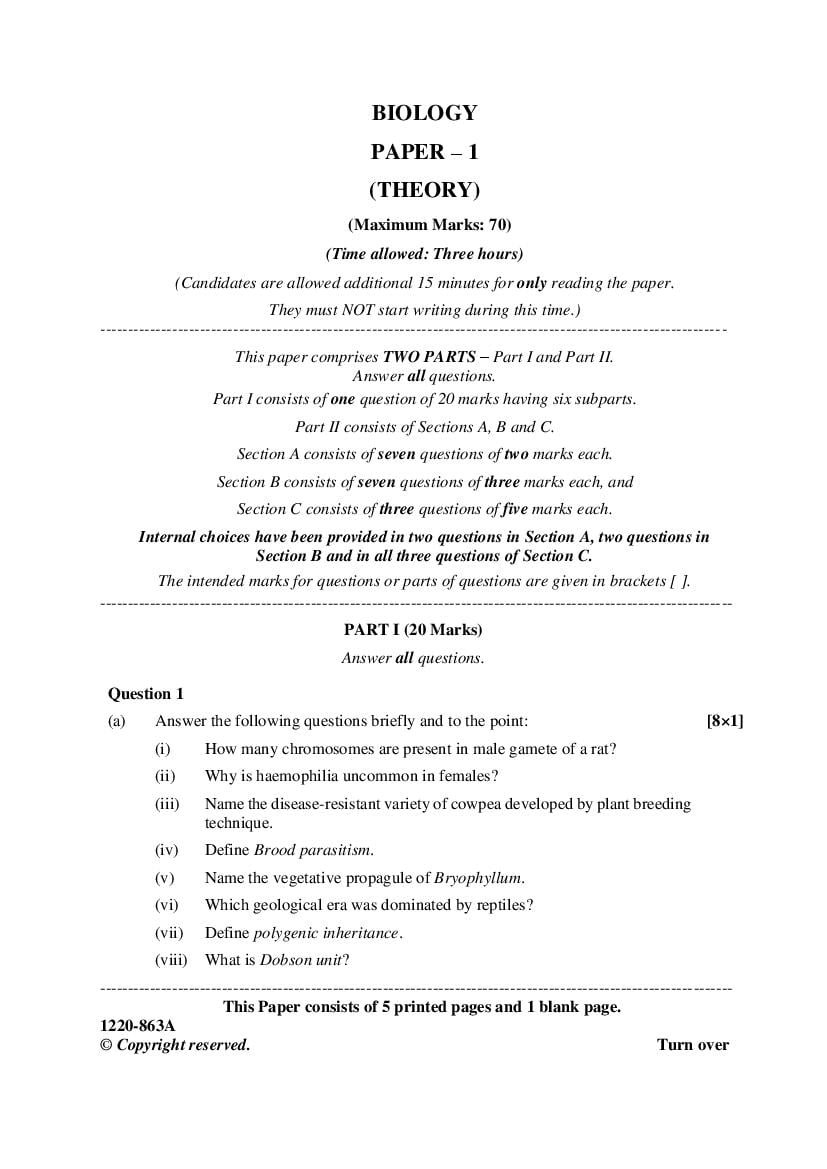
PAPER – 1
(THEORY)
(Maximum Marks: 70)
(Time allowed: Three hours)
(Candidates are allowed additional 15 minutes for only reading the paper.
They must NOT start writing during this time.)
-----------------------------------------------------------------------------------------------------------------
This paper comprises TWO PARTS – Part I and Part II.
Answer all questions.
Part I consists of one question of 20 marks having six subparts.
Part II consists of Sections A, B and C.
Section A consists of seven questions of two marks each.
Section B consists of seven questions of three marks each, and
Section C consists of three questions of five marks each.
Internal choices have been provided in two questions in Section A, two questions in
Section B and in all three questions of Section C.
The intended marks for questions or parts of questions are given in brackets [ ].
------------------------------------------------------------------------------------------------------------------
PART I (20 Marks)
Answer all questions.
Question 1
(a) Answer the following questions briefly and to the point: [8×1]
(i) How many chromosomes are present in male gamete of a rat?
(ii) Why is haemophilia uncommon in females?
(iii) Name the disease-resistant variety of cowpea developed by plant breeding
technique.
(iv) Define Brood parasitism.
(v) Name the vegetative propagule of Bryophyllum.
(vi) Which geological era was dominated by reptiles?
(vii) Define polygenic inheritance.
(viii) What is Dobson unit?
------------------------------------------------------------------------------------------------------------------
This Paper consists of 5 printed pages and 1 blank page.
© Copyright reserved. Turn over
Page 2
option in each case:
(i) If 10 individuals in a laboratory population of 100 mice die during the
period of one year, the death rate in this population will be:
(1) 110
(2) 0·01
(3) 0·1
(4) 90
(ii) The flowers which open their petals to expose their reproductive parts to
allow pollination are called:
(1) Cleistogamous
(2) Geitonogamous
(3) Chasmogamous
(4) Autogamous
(iii) Which of the following is paired incorrectly:
(1) Cyclosporin A - Trichoderma polysporum
(2) Streptokinase - Saccharomyces cerevisiae
(3) Swiss Cheese - Propionibacterium
(4) Penicillin - Penicillium
(iv) The pathogen which causes Syphilis:
(1) Neisseria
(2) Chlamydia
(3) Treponema
(4) Papilloma virus
(c) Give one significant contribution of each of the following scientists: [2×1]
(i) F. Griffith
(ii) P. Ehrlich
(d) Expand the following: [2×1]
(i) IUI
(ii) ADA
(e) Define the following: [2×1]
(i) Biopiracy
(ii) Aneuploidy
--------------------------------------------------------------------------------------------------------------------
2
Page 3
(i) Cyanobacteria increase the productivity in paddy fields.
(ii) The shape of the pyramid of biomass in an aquatic ecosystem is inverted.
PART II
SECTION A (14 Marks)
Question 2 [2]
Give one significant difference between the following:
(i) Linkage and crossing over
(ii) Transition and transversion
Question 3 [2]
Study the graph given below and answer the questions that follow:
Population Density (N)
a
b
Time (T)
(i) In the absence of predators which one of the two curves would appropriately depict
the prey population? Give a reason.
(ii) Time has been shown on X-axis and there is a parallel dotted line shown above.
Explain the significance of this dotted line.
Question 4 [2]
What is biogas? Name any two main constituents of biogas.
Question 5 [2]
Explain two characteristics of cancer cells.
-------------------------------------------------------------------------------------------------------------------
3
1220-863A Turn over
Page 4
(a) Draw a labelled diagram of a germinating pollen grain with at least four labellings.
OR
(b) Draw a labelled diagram of a mature human ovum with at least four labellings.
Question 7 [2]
What is outbreeding? How is it useful in animal breeding?
Question 8 [2]
(a) What is biomagnification? Write two effects of biomagnification.
OR
(b) Write a short note on the contribution of Ahmed Khan of Bangalore.
SECTION B (21 Marks)
Question 9 [3]
Give three adaptations in organisms by which they avoid predation.
Question 10 [3]
(a) Define decomposition. Explain main steps involved in the process of
decomposition.
OR
(b) Write three causes and three effects of cultural eutrophication.
Question 11 [3]
(i) Write two differences between homologous organs and analogous organs.
(ii) Give one example of homologous organs and one example of analogous organs
found in plants.
Question 12 [3]
Describe the process of double fertilization in angiosperms. What is its significance?
Question 13 [3]
What is a bioreactor? Explain important features of a Stirred tank bioreactor.
--------------------------------------------------------------------------------------------------------------------
4
Page 5
Give three significant differences between asexual reproduction and sexual
reproduction.
Question 15 [3]
(a) Explain the process of spermatogenesis in humans.
OR
(b) Give an account of hormonal control of oogenesis.
SECTION C (15 Marks)
Question 16 [5]
(a) Explain the various steps involved in Recombinant DNA technology.
OR
(b) Explain the steps involved in the production of human insulin by Recombinant
DNA technology.
Question 17 [5]
(a) (i) Give an account of Meselson and Stahl’s experiment.
(ii) What is the significance of Meselson and Stahl’s experiment?
OR
(b) (i) Describe the Oparin Haldane Theory of origin of life.
(ii) The tadpole larva of amphibians resembles fishes. How does this observation
support evolution?
Question 18 [5]
(a) Draw a labelled diagram to show the life cycle of Plasmodium.
OR
(b) Draw a labelled diagram to show replication of HIV in human cells.
-------------------------------------------------------------------------------------------------------------------
5
1220-863A Turn over
Document Details
| Board / Org | CISCE |
| Exam | Class 12 |
| Type | Question Paper |
| Pages | 1 |
| Language | english |
| Updated | 22 Jul 2026 |