AMU Entrance Exam Syllabus for M.Sc. and M.A. in Statistics
Finished viewing? Save it for later —
Download AMU Entrance Exam Syllabus for M.Sc. and M.A. in Statistics (PDF · 3 pages)About AMU Entrance Exam Syllabus for M.Sc. and M.A. in Statistics
AMU Entrance Exam Syllabus for M.Sc. and M.A. in Statistics is available here for free download. Published by Default for Admission Tests, this syllabus can be viewed online or downloaded as a PDF (3 pages). Candidates preparing for Admission Tests can use AMU Entrance Exam Syllabus for M.Sc. and M.A. in Statistics to understand the exam pattern, the type of questions asked, and the overall difficulty level.
Frequently Asked Questions
How can I download AMU Entrance Exam Syllabus for M.Sc. and M.A. in Statistics?
Open this page and click the Download button to save AMU Entrance Exam Syllabus for M.Sc. and M.A. in Statistics as a PDF. It is completely free on AglaSem Docs.
Is AMU Entrance Exam Syllabus for M.Sc. and M.A. in Statistics free to download?
Yes. AMU Entrance Exam Syllabus for M.Sc. and M.A. in Statistics can be viewed online and downloaded as a PDF free of cost on AglaSem Docs.
How many pages does AMU Entrance Exam Syllabus for M.Sc. and M.A. in Statistics have?
AMU Entrance Exam Syllabus for M.Sc. and M.A. in Statistics contains 3 pages, which you can read online or download together as a single PDF.
Where can I find more Admission Tests study material?
You can find more Admission Tests question papers, sample papers, syllabus, and answer keys on AglaSem Docs.
AMU Entrance Exam Syllabus for M.Sc. and M.A. in Statistics – Text
Read the full text of this syllabus below — useful to quickly search, copy and reference the content online without downloading the PDF.
📄 View text version (3 pages)
Page 1
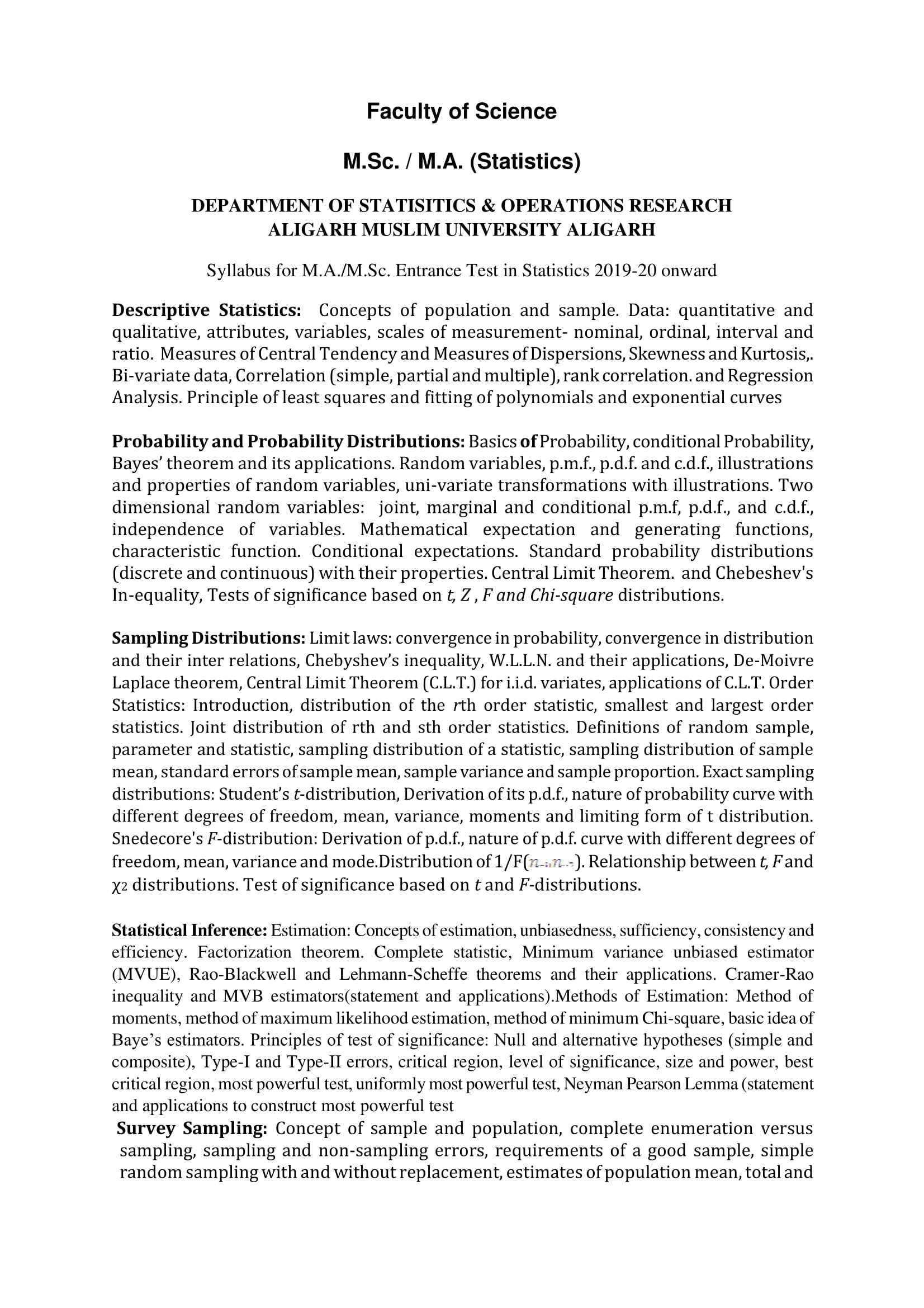
M.Sc. / M.A. (Statistics)
DEPARTMENT OF STATISITICS & OPERATIONS RESEARCH
ALIGARH MUSLIM UNIVERSITY ALIGARH
Syllabus for M.A./M.Sc. Entrance Test in Statistics 2019-20 onward
Descriptive Statistics: Concepts of population and sample. Data: quantitative and
qualitative, attributes, variables, scales of measurement- nominal, ordinal, interval and
ratio. Measures of Central Tendency and Measures of Dispersions, Skewness and Kurtosis,.
Bi-variate data, Correlation (simple, partial and multiple), rank correlation. and Regression
Analysis. Principle of least squares and fitting of polynomials and exponential curves
Probability and Probability Distributions: Basics of Probability, conditional Probability,
Bayes’ theorem and its applications. Random variables, p.m.f., p.d.f. and c.d.f., illustrations
and properties of random variables, uni-variate transformations with illustrations. Two
dimensional random variables: joint, marginal and conditional p.m.f, p.d.f., and c.d.f.,
independence of variables. Mathematical expectation and generating functions,
characteristic function. Conditional expectations. Standard probability distributions
(discrete and continuous) with their properties. Central Limit Theorem. and Chebeshev's
In-equality, Tests of significance based on t, Z , F and Chi-square distributions.
Sampling Distributions: Limit laws: convergence in probability, convergence in distribution
and their inter relations, Chebyshev’s inequality, W.L.L.N. and their applications, De-Moivre
Laplace theorem, Central Limit Theorem (C.L.T.) for i.i.d. variates, applications of C.L.T. Order
Statistics: Introduction, distribution of the rth order statistic, smallest and largest order
statistics. Joint distribution of rth and sth order statistics. Definitions of random sample,
parameter and statistic, sampling distribution of a statistic, sampling distribution of sample
mean, standard errors of sample mean, sample variance and sample proportion. Exact sampling
distributions: Student’s t-distribution, Derivation of its p.d.f., nature of probability curve with
different degrees of freedom, mean, variance, moments and limiting form of t distribution.
Snedecore's F-distribution: Derivation of p.d.f., nature of p.d.f. curve with different degrees of
freedom, mean, variance and mode.Distribution of 1/F( ). Relationship between t, F and
χ2 distributions. Test of significance based on t and F-distributions.
Statistical Inference: Estimation: Concepts of estimation, unbiasedness, sufficiency, consistency and
efficiency. Factorization theorem. Complete statistic, Minimum variance unbiased estimator
(MVUE), Rao-Blackwell and Lehmann-Scheffe theorems and their applications. Cramer-Rao
inequality and MVB estimators(statement and applications).Methods of Estimation: Method of
moments, method of maximum likelihood estimation, method of minimum Chi-square, basic idea of
Baye’s estimators. Principles of test of significance: Null and alternative hypotheses (simple and
composite), Type-I and Type-II errors, critical region, level of significance, size and power, best
critical region, most powerful test, uniformly most powerful test, Neyman Pearson Lemma (statement
and applications to construct most powerful test
Survey Sampling: Concept of sample and population, complete enumeration versus
sampling, sampling and non-sampling errors, requirements of a good sample, simple
random sampling with and without replacement, estimates of population mean, total and
Page 2
size determination. Stratified random sampling, estimates of population mean and total,
variances of these estimates, proportional and optimum allocations and their comparison
with SRS. Systematic Sampling, estimates of population mean and total, variances of these
estimates. Ratio and regression methods of estimation, estimates of population mean and
total (for SRS of large size), variances of these estimates and estimates of theses variances,
variances in terms of correlation coefficient between X and Y for regression method and
their comparison with SRS.
Linear Models: Gauss-Markov set-up: Theory of linear estimation, Estimiability of linear parametric
functions, Method of least squares, Gauss-Markov theorem, Estimation of error variance. Regression
analysis: Simple regression analysis, Estimation and hypothesis testing in case of simple and multiple
regression models, Concept of model matrix and its use in estimation. Analysis of variance: Fixed,
random and mixed effect models, analysis of variance and covariance in one-way classified data for fixed
effect models, analysis of variance and covariance in two-way classified data with one observation per
cell for fixed effect models Model checking: Prediction from a fitted model, Violation of usual
assumptions concerning normality, Homoscedasticity and collinearity, Diagnostics using quantile-quantile
plots.
Design of Experiments: Experimental designs: Role, historical perspective, terminology,
experimental error, basic principles, Basic designs: Completely Randomized Design (CRD),
Randomized Block Design (RBD),Latin Square Design (LSD) – layout, model and statistical
analysis, relative efficiency, analysis with missing observations. Factorial experiments: advantages,
notations and concepts, 22, 23…2n and 32 factorial experiments, design and analysis, Total and
Partial confounding for 22 (n≤5), 32 and 32.Factorial experiments in a single replicate, fractional
factorial design and analysis of 2k. Balanced Incomplete Block Design and Analysis
Calculus: Real valued sequences and series, convergence / divergence of sequences and series,
comparison test, real valued functions, limit and continuity, power series, Differential and
Integral Calculus - Differentiability, Rolle's theorem, Mean value theorem and Taylor /
Maclaurin expansions, higher order derivatives and partial derivatives, maxima and minima of
functions of one variable.
Elements of Linear Algebra: Vector space, subspace, dimension of a vector space, real valued
matrices, rank, determinant and inverse of a matrix, properties of square, diagonal and symmetric
matrices, characteristic roots and vectors of a matrix, simultaneous linear equations.
Operations Research: Linear Programming Problem, Mathematical formulation of the L.P.P,
graphical solutions of a L.P.P. Simplex method for solving L.P.P. Charne’s M-technique for
solving L.P.P. involving artificial variables. Special cases of L.P.P. Concept of Duality in L.P.P:
Dual Simplex method. Post-optimality analysis. Transportation Problem: Initial solution by
North West corner rule, Least cost method andVogel’s approximation method (VAM), MODI’s
method to find the optimal solution, special cases of transportation problem. Assignment
problem: Hungarian method to find optimal assignment, special cases of assignment problem.
Game theory: Rectangular game, minimax-maximin principle, solution to rectangular game using
graphical method, dominance and modified dominance property to reduce the game matrix and
solution to rectangular game with mixed strategy.
Page 3
Document Details
| Board / Org | Default |
| Exam | Admission Tests |
| Type | Syllabus |
| Pages | 3 |
| Updated | 30 Apr 2026 |