AMU Entrance Exam Syllabus for M.Sc. in Applied Geology
Finished viewing? Save it for later —
Download AMU Entrance Exam Syllabus for M.Sc. in Applied Geology (PDF · 3 pages)About AMU Entrance Exam Syllabus for M.Sc. in Applied Geology
AMU Entrance Exam Syllabus for M.Sc. in Applied Geology is available here for free download. Published by Default for Admission Tests, this syllabus can be viewed online or downloaded as a PDF (3 pages). Candidates preparing for Admission Tests can use AMU Entrance Exam Syllabus for M.Sc. in Applied Geology to understand the exam pattern, the type of questions asked, and the overall difficulty level.
Frequently Asked Questions
How can I download AMU Entrance Exam Syllabus for M.Sc. in Applied Geology?
Open this page and click the Download button to save AMU Entrance Exam Syllabus for M.Sc. in Applied Geology as a PDF. It is completely free on AglaSem Docs.
Is AMU Entrance Exam Syllabus for M.Sc. in Applied Geology free to download?
Yes. AMU Entrance Exam Syllabus for M.Sc. in Applied Geology can be viewed online and downloaded as a PDF free of cost on AglaSem Docs.
How many pages does AMU Entrance Exam Syllabus for M.Sc. in Applied Geology have?
AMU Entrance Exam Syllabus for M.Sc. in Applied Geology contains 3 pages, which you can read online or download together as a single PDF.
Where can I find more Admission Tests study material?
You can find more Admission Tests question papers, sample papers, syllabus, and answer keys on AglaSem Docs.
AMU Entrance Exam Syllabus for M.Sc. in Applied Geology – Text
Read the full text of this syllabus below — useful to quickly search, copy and reference the content online without downloading the PDF.
📄 View text version (3 pages)
Page 1
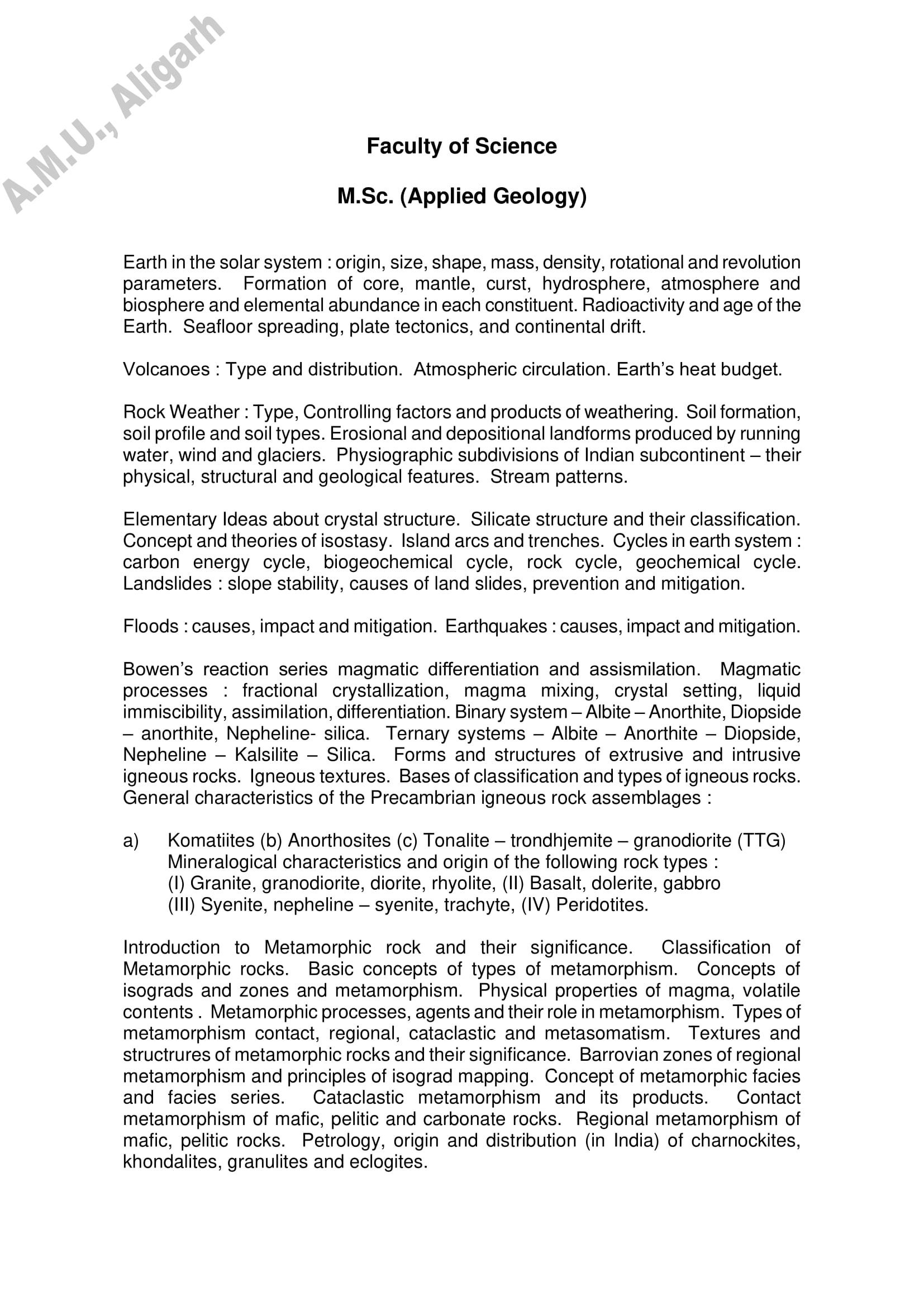
M.Sc. (Applied Geology)
Earth in the solar system : origin, size, shape, mass, density, rotational and revolution
parameters. Formation of core, mantle, curst, hydrosphere, atmosphere and
biosphere and elemental abundance in each constituent. Radioactivity and age of the
Earth. Seafloor spreading, plate tectonics, and continental drift.
Volcanoes : Type and distribution. Atmospheric circulation. Earth’s heat budget.
Rock Weather : Type, Controlling factors and products of weathering. Soil formation,
soil profile and soil types. Erosional and depositional landforms produced by running
water, wind and glaciers. Physiographic subdivisions of Indian subcontinent – their
physical, structural and geological features. Stream patterns.
Elementary Ideas about crystal structure. Silicate structure and their classification.
Concept and theories of isostasy. Island arcs and trenches. Cycles in earth system :
carbon energy cycle, biogeochemical cycle, rock cycle, geochemical cycle.
Landslides : slope stability, causes of land slides, prevention and mitigation.
Floods : causes, impact and mitigation. Earthquakes : causes, impact and mitigation.
Bowen’s reaction series magmatic differentiation and assismilation. Magmatic
processes : fractional crystallization, magma mixing, crystal setting, liquid
immiscibility, assimilation, differentiation. Binary system – Albite – Anorthite, Diopside
– anorthite, Nepheline- silica. Ternary systems – Albite – Anorthite – Diopside,
Nepheline – Kalsilite – Silica. Forms and structures of extrusive and intrusive
igneous rocks. Igneous textures. Bases of classification and types of igneous rocks.
General characteristics of the Precambrian igneous rock assemblages :
a) Komatiites (b) Anorthosites (c) Tonalite – trondhjemite – granodiorite (TTG)
Mineralogical characteristics and origin of the following rock types :
(I) Granite, granodiorite, diorite, rhyolite, (II) Basalt, dolerite, gabbro
(III) Syenite, nepheline – syenite, trachyte, (IV) Peridotites.
Introduction to Metamorphic rock and their significance. Classification of
Metamorphic rocks. Basic concepts of types of metamorphism. Concepts of
isograds and zones and metamorphism. Physical properties of magma, volatile
contents . Metamorphic processes, agents and their role in metamorphism. Types of
metamorphism contact, regional, cataclastic and metasomatism. Textures and
structrures of metamorphic rocks and their significance. Barrovian zones of regional
metamorphism and principles of isograd mapping. Concept of metamorphic facies
and facies series. Cataclastic metamorphism and its products. Contact
metamorphism of mafic, pelitic and carbonate rocks. Regional metamorphism of
mafic, pelitic rocks. Petrology, origin and distribution (in India) of charnockites,
khondalites, granulites and eclogites.
Page 2
Morphology and occurrence of bedding plane structures, internal structures, soft
sediment deformational structures, biogenic structures and significance of ichno
fossils. Sandstone : Classification and origin. Conglomerates : origin and
classification. Shale, types, their bedding characteristics and mineralogy.
Classification and origin of carbonates with special reference of Folk’s classification.
Classification of sedimentary rocks : terrigenous and chemical sedimentary rocks.
Important primary sedimentary structure bedding, ripple marks, cross bedding and
mud cracks.
Principles of nomenclature and classification of lithostratigraphic, chronostratigraphic,
biostratigraphic and tectonic / genetic facies. Various geological divisions of
Peninsular Shield : Cratons – Dharwar, Baster, Singhbhum, Bundelkhand and
Aravalli. Mobile belts : Eastern Ghats, Southern Granulite Terrain, Satpura. Delhi
supergroup, Vindhyan Supergroup, Cudappah Supergroup. Aravali
supergroup,Gondwana Supergroup, Deccan Traps./ Siwalik system. Evolution of
Himalayas.
Basic ideas about the method of mineral exploration and mining, Renewable and non
renewable energy resources. Distribution of mineral deposits in space and time.
Geological seting, mineralogical characteristics and Indian distribution of non metallic
mineral deposits i.e. Iron, manganese, Copper, Lead and Zinc, Chromite, Bauxite
etcv. Systematic classification of minerals, Silicates, Carbonates, Oxides, Sulfides,
Sulfates, Halides. Ore deposits related to magmatic activity. Hydrothermal and
skarn deposits. Ore deposits formed by sedimentation, oxidation and supergene
enrichment, replacement, Method of Mineral exploration. Physiographics,
mineralogical, stratigraphic, lithologic and structural guides to ore.
Methods of mineral exploitation – open pit and underground mining.
Microfossils : definition, significance and a brief account of important groups.
Morphology and geological distribution, of brachiopods, Trilobita, Gastropoda.
Cephalopoda. Evolutionary History of Equidae. Morphology, Classification and
Geological range of important Gondwana flora.
Definition of force, stress and strain, stages of rock deformation, stress strain
diagram. Unconformalities, their types of recognition in the fields and on geological
maps. Geometric and genetic classification of folds. Synforms and antiforms.
Mechanics and causes of foldinig. Description and classification of faults. Planar
structures, their identification and description. Type of cleavage and schistosity and
their origin. Types of lineations, their origin and their relation to major structures.
Joints, their classification and significance.
Basics of remote sensing, EMR, platforms, sensors. Types of aerial photographs.
Framing and Scanning Systems. Types of Satellites and images. IRS, LANDSAT
AND SPOT Satellites. EMR interaction with atmosphere and earth surface spectral
signatures of soil, water and vegetation. Basic drainage pattern and their recognition
on images / aerial photos. Identification and characteristics of common rock types
on aerial; photographs / satellite images. Concept of datum and coordinate system.
Map projections : Conical, cylindrical and azimuthal. Basic concepts and applications
of GIS in geosciences, functions of GIS, data structure, data input and analysis in
Page 3
and limitations.
Hydrologic mcycle and its component. Rock properties affecting ground water.
Classification of aquifers.
Darcy’s Law and its validity permeability. Ground water provinces of India. Vertical
distribution of Ground water, concept of water shed management, chemical quality of
ground water. Ground water pollution. Petrology of coal, types, classification and
ranks. Origin of Coal. Gondwana and Tertiary coalfields of India. Origin, migration
and entrapment of natural hydrocarbons. Structural stratigraphic and mixed oil traps.
Hydrocarbon exploration techniques – geological and geophysical methods.
Onshore and off shore distribution of petroliferous basins in India.
Radioactive minerals : mineralology, geochemistry, origin and distribution of uranium
and theorium deposits in India. Detection and measurement of radioactivity. Surface
and subsurface methods of mineral exploration. Geophysical methods of mineral
exploration – air borne versus ground surveys. Gravity, electrical, magnetic and
seismic methods. Methods of drilling, assaying and reserve estimation.
Document Details
| Board / Org | Default |
| Exam | Admission Tests |
| Type | Syllabus |
| Pages | 3 |
| Updated | 30 Apr 2026 |