Kerala SET 2019 Feb Question Paper Mathematics
Finished viewing? Save it for later —
Download Kerala SET 2019 Feb Question Paper Mathematics (PDF · 11 pages)About Kerala SET 2019 Feb Question Paper Mathematics
Kerala SET 2019 Feb Question Paper Mathematics is available here for free download. Published by Kerala Exams for Kerala SET, this question paper can be viewed online or downloaded as a PDF (11 pages). Candidates preparing for Kerala SET can use Kerala SET 2019 Feb Question Paper Mathematics to understand the exam pattern, the type of questions asked, and the overall difficulty level.
Frequently Asked Questions
How can I download Kerala SET 2019 Feb Question Paper Mathematics?
Open this page and click the Download button to save Kerala SET 2019 Feb Question Paper Mathematics as a PDF. It is completely free on AglaSem Docs.
Is Kerala SET 2019 Feb Question Paper Mathematics free to download?
Yes. Kerala SET 2019 Feb Question Paper Mathematics can be viewed online and downloaded as a PDF free of cost on AglaSem Docs.
How many pages does Kerala SET 2019 Feb Question Paper Mathematics have?
Kerala SET 2019 Feb Question Paper Mathematics contains 11 pages, which you can read online or download together as a single PDF.
Where can I find more Kerala SET study material?
You can find more Kerala SET question papers, sample papers, syllabus, and answer keys on AglaSem Docs.
Kerala SET 2019 Feb Question Paper Mathematics – Text
Read the full text of this question paper below — useful to quickly search, copy and reference the content online without downloading the PDF.
📄 View text version (11 pages)
Page 1
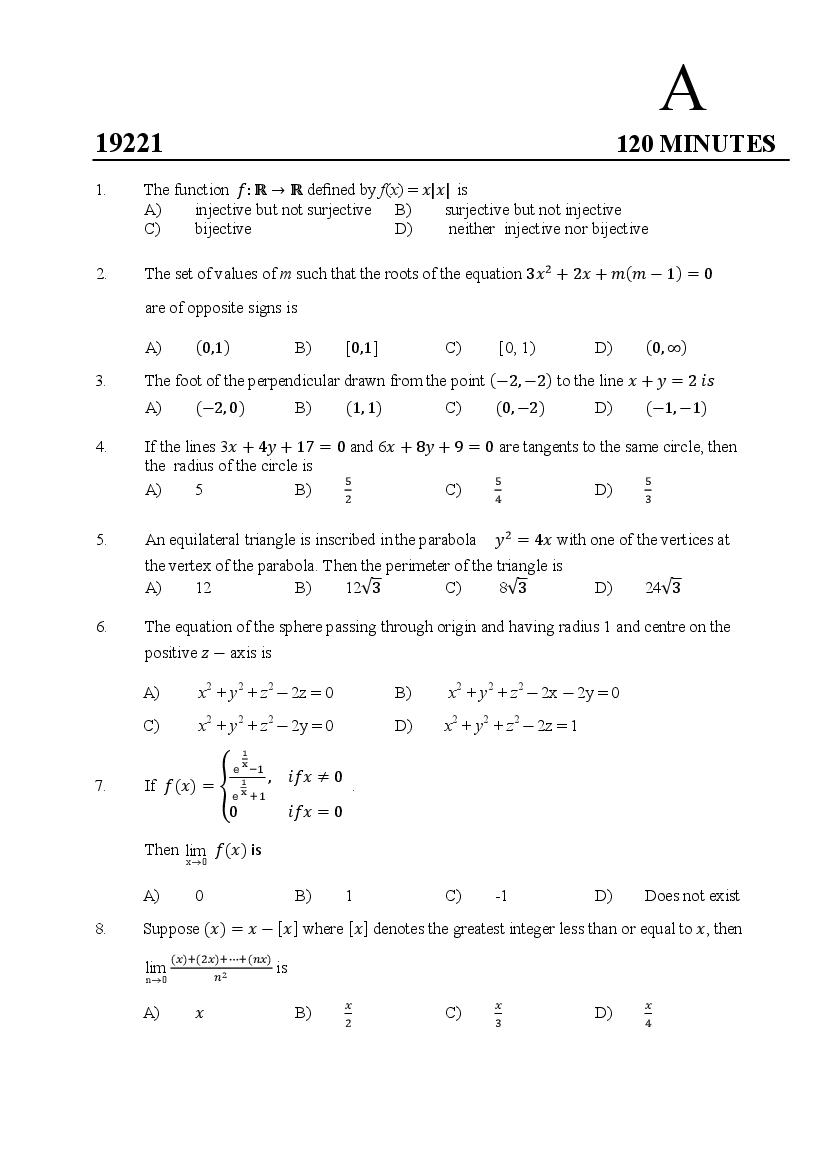
19221 120 MINUTES
1. The function : ℝ → ℝ defined by f(x) = | | is
A) injective but not surjective B) surjective but not injective
C) bijective D) neither injective nor bijective
2. The set of values of m such that the roots of the equation 3 +2 + ( − 1) = 0
are of opposite signs is
A) (0,1) B) [0,1] C) [0, 1) D) (0, ∞)
3. The foot of the perpendicular drawn from the point (−2, −2) to the line + =2
A) (−2, 0) B) (1, 1) C) (0, −2) D) (−1, −1)
4. If the lines 3 + 4 + 17 = 0 and 6 + 8 + 9 = 0 are tangents to the same circle, then
the radius of the circle is
A) 5 B) C) D)
5. An equilateral triangle is inscribed in the parabola = 4 with one of the vertices at
the vertex of the parabola. Then the perimeter of the triangle is
A) 12 B) 12√3 C) 8√3 D) 24√3
6. The equation of the sphere passing through origin and having radius 1 and centre on the
positive − axis is
A) x2 + y2 + z2 − 2z = 0 B) x2 + y2 + z2 − 2x − 2y = 0
C) x2 + y2 + z2 − 2y = 0 D) x2 + y2 + z2 − 2z = 1
, ≠0 .
7. If ( )=
0 =0
Then lim ( ) is
x 0
A) 0 B) 1 C) -1 D) Does not exist
8. Suppose ( ) = − [ ] where [ ] denotes the greatest integer less than or equal to , then
( ) ( ) ⋯ ( )
lim is
n 0
A) B) C) D)
Page 2
replacement. The probability that the third ball is red is:
A) B) C) D)
10. A problem in statistics is given to three students whose chances of solving it individually are , ,
respectively. The probability that the problems was solved by exactly one of them is
A) B) C) D)
x sin ( ), ≠0
11. If ( )=
0 =0
then,
A) is not continues at =0
B) is continues everywhere but it is not differentiable at at =0
C) is differentiable everywhere but its first derivative ′( ) is not continuous
D) is infinitely differentiable
12. If ∫ √ =∫ + ( ), then
A) ( ) = √1 + x , (x) = −log (x+√1 + x ) + c
B) ( )= , (x) = −log (x− √1 + x ) + c
√
C) ( ) = −√1 + x , (x) = log (x+ √1 + x ) + c
D) ( ) = √1 + x , (x) = −log (x− √1 + x ) + c
13. Let ( ) and ( ) be two real sequences with = , = , n≥1
!
A) ( ) converges to 0 and ( ) converges to 1
B) ( ) converges to 1 and ( ) converges to 1
C) ( ) converges to 1 and ( ) converges to 0
D) ( ) converges to 0 and ( ) converges to 0
14. The value of the integral ∫ [ ] ( ) , where [ ] denotes the greatest integer not greater
than is
A) B) 13 C) D) 10
2
Page 3
15. Let be the function defined by ( ) = . Then
0, =0
A) is continuous but not of bounded variation
B) is bounded and not of bounded variation
C) is neither continuous nor of bounded variation
D) is bounded, continuous and of bounded variation
16. Let 〈 〉 be a sequence of non-negative measurable functions that converges almost everywhere
to a function and if ≤ , for all , ℎ
A) ∫ < lim ∫ B) ∫ = lim ∫
C) ∫ =0 D) ∫ > lim ∫
(-1)n n( n1)
17. Suppose = ( ) = z . Then
n 1 n
A) ( ) converges for z <1 and diverges at z=1
B) ( ) converges for z ≤1
C) ( ) converges for z >1
D) ( ) converges for all z
18. Let x be a connected open subset of ℂ and : → ℂ be an analytic function. Then which of the
following is true?
A) If ( ) is real for all ∈ , then is a constant function
B) If ( ) is real for all ∈ , then ≡0
C) If ( ) is purely imaginary for all ∈ , then ≡0
D) If ( ) is real for all ∈ , then ( ) > 0 for all
e iz
19. Let be the circle : z = 2 . The value of 2
dz is
c (z 10) sin z
A) 2 B) C) −2 D) 0
5 1
20. If , = 1, 2, … .5 are the 5th roots of unity, then is
i 1 z i
A) 5 B) C) 0 D) 5i
3
Page 4
A) 1 B) 2 C) 3 D) 4
22. The largest order of an element in ℤ x ℤ x ℤ is
A) 96 B) 48 C) 24 D) 12
23. The inverse of the permutation (1, 2, 3) (4, 7, 8) in is
A) (1, 3, 2) (4, 7, 8) B) (1, 2, 3) (4, 7, 8)
C) (1, 3, 2) (7, 4, 8) D) (1, 3, 2) (4, 8, 7)
24. The number of solutions of x2 +8 − 3 = 0 inℤ is
A) 0 B) 1 C) 2 D) 12
25. Which of the following is true?
A) The fields ℝ and ℂ are isomorphic
B) 2ℤ and 3ℤ are isomorphic rings
C) There is only one ring homomorphism from ℤ to ℤ
D) There is only one group homomorphism from ℤ to ℤ
26. The number of zero divisors of ℤ is
A) 360 B) 180 C) 96 D) 48
27. Suppose ( ) = x + 3x + 2. Which of the following is true?
A) ( ) is irreducible over ℝ
B) ( ) is irreducible over ℚ but reducible over ℝ
C) ( ) is irreducible over ℂ
D) ( ) is reducible over ℚ and ℝ
28. Which of the following is true?
A) is algebraic over ℝ
B) is algebraic over ℚ
C) √2 is transcendental over ℝ
D) √2 + √3 is transcendental over ℝ
29. The degree of ℚ (√2 , √3 ) over ℚ is
A) 1 B) 2 C) 4 D) 8
30. Let R be a ring with unity and M be an ideal containing a unit, then
A) M is a proper ideal
B) M=R
C) R/ M is a field, if R is commutative ring
D) M is the trivial ideal {0}
31. Let A and B be two square matrices of same order defined over ℝ and B be non-singular. Then,
A) rank (AB) = rank (B) B) rank (BA) = rank (B)
C) rank (AB) = rank (A) D) rank (AB) ≤ rank (B)
32. The value of a for which the system of equations + + = 1, − + 2 = 0,
2 + 3 = has infinitely many solutions is
A) 1 B) 2 C) 3 D) 0
4
Page 5
A) {( , , ): − = 0} B) {( , , ): + = 0}
C) {( , , ): − = 0} D) {(0, 0, 0)}
1 0 1 0
34. Suppose = and = . Then
1 1 0 1
A) A and B have different characteristic equations but the same minimal polynomials
B) A and B are diagonalizable
C) A is diagonalizable but B is not
D) B is diagonalizable but A is not
35. Let ∈ (ℝ), the set of all 3 x 3 matrices over ℝ, be a symmetric matrix. Which of the
following can be the characteristic values of A?
A) 1, 0, 1 B) 1, 1 + , 1 −
C) 1, , − D) 0, 1,
36. If the characteristic roots of ∈ (ℝ) are 1, , , the cube roots of unity, then the
characteristic roots of are
A) 1, , B) 2, 1 + , 1 +
C) 1, 1 − , 1 − , D) 1, 1, 1
37. Let : ℝ → ℝ be defined by ( , ) = ( , 2 ). = {( , ): + = 1}.Then ( ) is
A) {( , ): + = 1} B) {( , ): 2 + = 1}
C) {( , ): 2 + = 2} D) {( , ): +2 = 2}
38. If is an odd integer, is of the form
A) 8 + 1, ∈ ℤ B) 8 − 1, ∈ ℤ
C) 16 + 1, ∈ ℤ D) 16 − 1, ∈ ℤ
39. The highest integer value of such that 3 divides 1749600 is
A) 5 B) 6 C) 7 D) 8
40. Which of the following is not true if is an integer greater than 1?
A) 1 + 2 + ⋯ + ( − 1) ≡ 0 ( )
B) 1 + 2 + ⋯ + ( − 1) ≡ 0 ( )
C) 1 + 2 + ⋯ + ( − 1) ≡ 0 ( )
D) 1 − 2 + ⋯ + (2 − 1) − (2 ) ≡ 0 ( )
41. The orthogonal trajectories of the family of curve = 4 ( + ) is
A) =4 ( + ) B) =4 ( + )
C) =4 ( + ) D) =4 ( + )
42. If W is the Wronskian of the differential equation + = 0, then
A) W 1 B) W 1 C) W 1 D) W =0
5
Page 6
A) ∫ ( ) ( ) = 1 if =
B) ∫ ( ) ( ) = if ≠
C) ∫ ( ) ( ) = 0 if =
D) ∫ ( ) ( ) = if =
44. Let ( ) denote the Bessel function. Which of the following is true?
A) ( ) = ( )
B) ( ) = ( )
C) ( ) = ( )
D) ( ) = ( )
45. The solution of the partial differential equation ( − ) +( − ) = − is
A) + + = ( + − )
B) + + = ( − + )
C) + + = ( + + )
D) + − = ( + + )
46. The solution of the partial differential equation + = .
A) =( + ) + B) =( + ) +
C) =( − ) + D) 2 =( + ) +
47. The equation 2 +4 − = 0 is
A) Parabolic B) Elliptic
C) Hyperbolic D) Parabolic only in the region where ≥0
48. Suppose = {0, 1, 2, 3}, = { , ∅, {0}, {3}, {0, 3} }, = { , ∅, {3}, {0, 1, 3} }. Let the
map ∶ ( , ) → ( , ) be defined as ( ) = , Then
A) is continuous but not open.
B) is open and not continuous.
C) is both open and continuous.
D) is neither open nor continuous.
6
Page 7
Consider the metrics and defined by, ( , ) = ∈ | ( ) − ( )| and
( , ) = ∫ | ( ) − ( )| . Then
A) The topology generated by is stronger than the topology generated by
B) The topology generated by is stronger than the topology generated by
C) Both and generate the same topology
D) The largest topology contained in the intersection of the topologies generated by
and is the trivial topology.
50. Which of the following is not a topological property?
A) Compactness B) Connectedness
C) Completeness D) First countability
51. Let ( , ∥, ∥) be a normed linear space over ℂ. Then which of the following is not true?
A) Every closed subset of is compact.
B) If { ∈ ∶ ∥ ∥≤ 1} is compact, then is finite dimensional.
C) If every closed and bounded subset of is compact then is finite dimensional.
D) If { ∈ ∶ ∥ ∥≤ 1} is compact, then is infinite dimensional.
52. Let = ℝ with norm∥, ∥ defined by ∥ ( , ) ∥= + and : → with ( , ) = + .
Then ∥ ∥ is
A) 1 B) √2 C) 2 D) √3
53. Suppose = [0, 1] with inner product defined by f(t), g(t) =∫ ( ) ( ) . If ( ) =
and ( ) = 1 − , then ∥ − ∥, where ∥, ∥ is the norm induced by the inner product.
A) 1 B) C) D)
54. Suppose = [− , − ]. For each ∈ ℕ, let ( ) be a sequence of functions defined on
[− , ], by ( ) = . Then,
A) { } is an orthonormal set in
B) { } is an orthogonal set but not orthonormal in
C) { } is neither orthonormal set nor orthogonal in
D) { } is both orthonormal and orthogonal in
55. Let be the projection map defined on a normed linear space and the identity map.
Which of the following is not true?
A) − is also a projection
B) Range of is the zero space of −
C) Zero space of is the zero space of −
D) There can be a non-zero element in the intersection of Range space of and zero space
of
7
Page 8
√ √ √
A) B) C) √3 D)
57. The area of the region {(x, y) ∈ ℝ ; x ≤ y ≤ 1 − x } is
√
A) B) C) D) 2√3
√
58. From a group of 7 men and 6 women, five persons are to be selected to form a committee
so that at least 3 men are there on the committee. In how many ways can it be done?
A) 525 B) 756 C) 221 D) 635
( ) ( )
59. Consider the series ∑∞ and ∑∞ . Then
√
A) both series are conditionally convergent
B) both series are absolutely convergent
C) the first series is conditionally convergent and the second series is absolutely
convergent
D) the first series is absolutely convergent and the second series is conditionally
convergent
60. The number of zeros of z + 3z + 1 in |z| < 1, counted with multiplicity is
A) 0 B) 1 C) 2 D) 3
61. The harmonic conjugate of the function u(x, y) = x − 3xy is
A) 3x y − y B) 3xy C) y − 3xy D) 3xy − y
62. The total number of subgroups of a cyclic group of order 24 is
A) 8 B) 6 C) 4 D) 2
2 1 0
0 2 2
63. If the matrix is invertible in ℤ/nℤ, then
1 1 2
(i) gcd(2, n) = 1 (ii) gcd(3, n) = 1 (iii) gcd(6, n) = 1
Choose the correct statement(s):
A) (i) only B) (ii) only
C) (i) and (ii) only D) (i), (ii) and (iii)
8
Page 9
A) 1 B) 2 C) 4 D) 8
65. Let I, J be ideals in ℤ[x] generated by x + x + x + 1 and x − 2x + x − 2 respectively.
Then I + J is generated by the polynomial
A) 2x − x + 2x − 1 B) x+1
C) x−1 D) x +1
66. Which of the following is necessarily an invertible matrix?
A) A nilpotent matrix B) An idempotent matrix
C) An orthogonal matrix D) A symmetric matrix
1 2 0 1
5 4 2 6
67. The rank of the matrix is
4 2 2 5
A) 1 B) 2 C) 3 D) 4
68. Let A be an n × n matrix. Then det(5A) = ⋯
A) 5det(A) B) 5 det(A) C) 5 det(A) D) n det(A)
69. The matrix of change of basis from the standard basis (e , e ) of ℝ to (e + e , e − e ) is
1 1 1 −1 1 1 1 1
A) 1 −1 B) 1 1 C) −1 1 D) 1 −1
70. Which of the following maps are linear transformations from ℝ to ℝ ?
(i) f(x, y) = (x + 2, y + 2,2) (ii) f(x, y) = (x + y, x − y, 0)
(iii) f(x, y) = (x, y, xy) (iv) f(x, y) = (x + y, x − y, 2y)
A) (i) and (ii) B) (ii) and (iii) C) (ii) and (iv) D) (iii) and (iv)
71. Let T be a linear operator on ℂ , n > 1 such that every non-zero vector of ℂ is an eigen
vector of T. Then
A) all eigen values of T are distinct
B) all eigen values of T are real
C) all eigen values of T are equal
D) T must be the zero matrix
9
Page 10
functional on V. Then dim(Ker T) is
A) 1 B) n−1 C) n D) n+1
73. The system x ≡ 1(mod6), x ≡ 1(mod4) has
A) exactly one solution, modulo12
B) exactly two solutions, modulo12
C) exactly six solutions, modulo12
D) no solution
74. Find a collection of linearly independent solutions of − = 0.
A) {1, x, e , e } B) {1, x, e , xe }
C) {1, x, e , xe } D) {1, x, e , xe }
75. The envelope of the 1-parameter family (x − a) + (y − 2a) + z = 1 is
A) z = ±1 B) (2x − y) + 5z = 5
C) (2x − y) = 1 D) x +y =1
76. Which of the following is a wave equation?
A) u =u B) u =u C) u =u D) u =u
77. Which of the following is is not a metric on ℝ?
A) d(x, y) = |x − y| B) d(x, y) = |e − e |
| | | | | |
C) d(x, y) = |x − y | D) d(x, y) = | |
78. Let (X, d) be a metric space. For A, B ⊆ X, define d(A, B) == inf{d(x, y); x ∈ A, y ∈ B}.
Choose the correct statement(s).
(i) If A and B are disjoint, then d(A, B) > 0
(ii) If A and B are closed and disjoint, then d(A, B) > 0
(iii) If A and B are compact and disjoint, then d(A, B) > 0
A) (i),(ii) and (iii) B) (ii) and (iii) only
C) (iii) only D) none of these
10
Page 11
A) There is a norm on X
B) There is a norm on X which induces the discrete metric
C) The sum of two norms on X is a norm on X
D) Any metric induced by a norm on X is unbounded
80. Which of the following space is a Hilbert space?
A) l∞ space B) l space C) l space D) l space
____________________
11
Document Details
| Board / Org | Kerala Exams |
| Exam | Kerala SET |
| Type | Question Paper |
| Pages | 11 |
| Updated | 23 Oct 2026 |