AMU Entrance Exam Syllabus for M.Sc. in Biochemistry
Finished viewing? Save it for later —
Download AMU Entrance Exam Syllabus for M.Sc. in Biochemistry (PDF · 20 pages)About AMU Entrance Exam Syllabus for M.Sc. in Biochemistry
AMU Entrance Exam Syllabus for M.Sc. in Biochemistry is available here for free download. Published by Default for Admission Tests, this syllabus can be viewed online or downloaded as a PDF (20 pages). Candidates preparing for Admission Tests can use AMU Entrance Exam Syllabus for M.Sc. in Biochemistry to understand the exam pattern, the type of questions asked, and the overall difficulty level.
Frequently Asked Questions
How can I download AMU Entrance Exam Syllabus for M.Sc. in Biochemistry?
Open this page and click the Download button to save AMU Entrance Exam Syllabus for M.Sc. in Biochemistry as a PDF. It is completely free on AglaSem Docs.
Is AMU Entrance Exam Syllabus for M.Sc. in Biochemistry free to download?
Yes. AMU Entrance Exam Syllabus for M.Sc. in Biochemistry can be viewed online and downloaded as a PDF free of cost on AglaSem Docs.
How many pages does AMU Entrance Exam Syllabus for M.Sc. in Biochemistry have?
AMU Entrance Exam Syllabus for M.Sc. in Biochemistry contains 20 pages, which you can read online or download together as a single PDF.
Where can I find more Admission Tests study material?
You can find more Admission Tests question papers, sample papers, syllabus, and answer keys on AglaSem Docs.
AMU Entrance Exam Syllabus for M.Sc. in Biochemistry – Text
Read the full text of this syllabus below — useful to quickly search, copy and reference the content online without downloading the PDF.
📄 View text version (20 pages)
Page 1
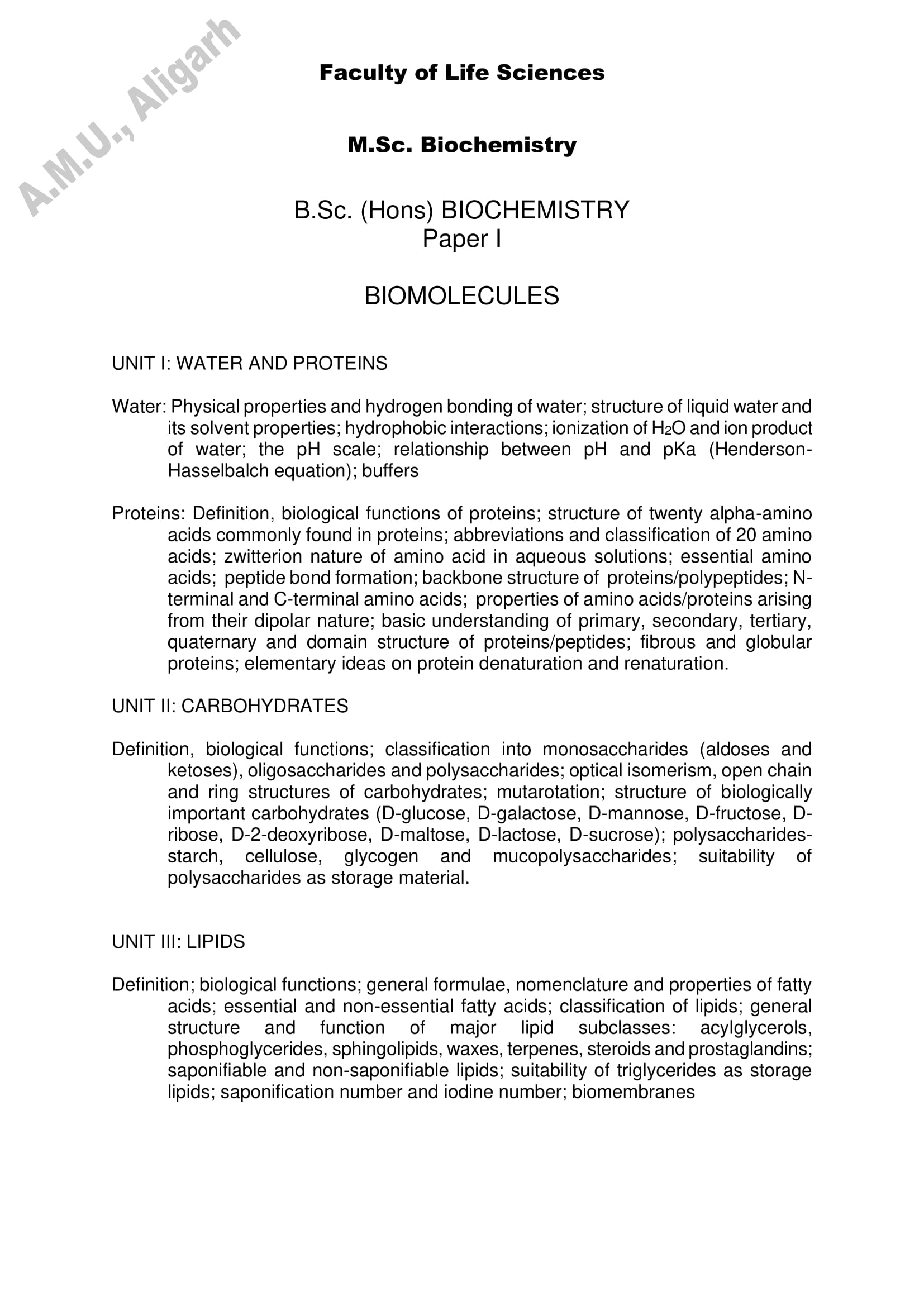
M.Sc. Biochemistry
B.Sc. (Hons) BIOCHEMISTRY
Paper I
BIOMOLECULES
UNIT I: WATER AND PROTEINS
Water: Physical properties and hydrogen bonding of water; structure of liquid water and
its solvent properties; hydrophobic interactions; ionization of H2O and ion product
of water; the pH scale; relationship between pH and pKa (Henderson-
Hasselbalch equation); buffers
Proteins: Definition, biological functions of proteins; structure of twenty alpha-amino
acids commonly found in proteins; abbreviations and classification of 20 amino
acids; zwitterion nature of amino acid in aqueous solutions; essential amino
acids; peptide bond formation; backbone structure of proteins/polypeptides; N-
terminal and C-terminal amino acids; properties of amino acids/proteins arising
from their dipolar nature; basic understanding of primary, secondary, tertiary,
quaternary and domain structure of proteins/peptides; fibrous and globular
proteins; elementary ideas on protein denaturation and renaturation.
UNIT II: CARBOHYDRATES
Definition, biological functions; classification into monosaccharides (aldoses and
ketoses), oligosaccharides and polysaccharides; optical isomerism, open chain
and ring structures of carbohydrates; mutarotation; structure of biologically
important carbohydrates (D-glucose, D-galactose, D-mannose, D-fructose, D-
ribose, D-2-deoxyribose, D-maltose, D-lactose, D-sucrose); polysaccharides-
starch, cellulose, glycogen and mucopolysaccharides; suitability of
polysaccharides as storage material.
UNIT III: LIPIDS
Definition; biological functions; general formulae, nomenclature and properties of fatty
acids; essential and non-essential fatty acids; classification of lipids; general
structure and function of major lipid subclasses: acylglycerols,
phosphoglycerides, sphingolipids, waxes, terpenes, steroids and prostaglandins;
saponifiable and non-saponifiable lipids; suitability of triglycerides as storage
lipids; saponification number and iodine number; biomembranes
Page 2
Nucleosides and nucleotides; generalized structural plan of nucleic acids; Watson-Crick
model of DNA; size of DNA in prokaryotic and eukaryotic cells; central dogma of
molecular biology; gene, genome and chromosome; basic ideas of DNA
replication, transcription and protein biosynthesis; genetic code and codons;
mutations- definition and types.
RECOMMENDED BOOKS
1. Lehninger Principles of Biochemistry by Nelson and Cox (2008) Worth Publishers,
Inc. New York.
2. Biochemistry by Berg, Tymoczko and Stryer (5th Edition, 2007) W.H. Freeman Press,
San Francisco, USA.
3. Introducing Biochemistry by Wood and Pickering (1982) ELBS/John Muray.
4. Outlines of Biochemistry by Conn and Stumpf (5th Edition, 1987) Wiley, New Delhi.
Page 3
Paper II
MICROBIOLOGY & VIROLOGY
UNIT I: CRITERIA FOR CLASSIFICATION, MORPHOLOGY, NUTRITION &
PHYSIOLOGY OF BACTERIA
Brief introduction to microorganisms, criteria used in the classification of bacteria -
morphology, cytology, genetics, host specialization, serology, physiology etc.
General organization of bacterial cells - gram positive and gram negative
organisms; structure and function of peptidoglycan in gram positive and gram
negative organisms; function of polymeric components in outer membrane and
acidic polymers in gram negative organisms. Bacterial growth; phases of growth,
factors affecting bacterial growth; Physical (pH, temperature and oxygen
requirements) and nutritional factors
UNIT II: BACTERIAL GENETICS
Adaptation and mutation: types of mutations and their effects; Significance of Gene
transfer in bacteria; Methods of Lateral gene transfer: transformation,
transduction and conjugation; their discovery and mechanism, Generalised and
specialised transduction; Temperate and virulent phages, lysogenic and lytic
cycles, Characteristics of plasmids, Transposable elements: Insertion sequence
and transposons.
UNIT III: MORPHOLOGY & REPLICATION OF VIRUSES
Definitions of virus, viroids, virusoids and prion; General properties of viruses; Virus
structure; variations in size and shape/symmetry, Cultivation and detection of
viruses; Plaque formation and Haemagglutination inhibition test, Replication of
bacteriophages and retroviruses (to include all events in the infection cycle).
Replication of DNA animal viruses.
UNIT IV: VIRAL INFECTIONS
Acute viral infections - Influenza, dengue and yellow fever viruses, persistent viral
infections- Herpes/Hepatitis and AIDS; transformation and Cancer ; Role of
vaccines in prevention of viral infections, types of Polio vaccines.
RECOMMENDED BOOKS
1. Jacquelyn G. Black, MICROBIOLOGY principles and explorations (2004) John
Wiley & Sons, Inc.
Page 4
Benjamin/Cummings Publishing Co., Inc. California, USA.
3. M. Pelczar, E.C.S. Chan and M.R. Krieg, MICROBIOLOGY, McGraw Hill Inc.,
Singapore (1997).
4. Tortora, Funke and Case Microbiology and Introduction by Pearson Education,
Inc.
Page 5
Paper III
ENZYMOLOGY
UNIT I: INTRODUCTION
Definition, historical perspective, IUB enzyme classification (rationale, overview and
specific examples), Nature of non-enzymatic and enzymatic catalysis. Measurement
and expression of enzyme activity, enzyme assays. Definition of IU, enzyme turn over
number and specific activity. Role of non-protein organic molecules and inorganic ions
co-factors, coenzymes, prosthetic groups. Role of vitamins as coenzyme precursors
(general treatment), details of coenzyme function of NAD and pyridoxal phosphate.
UNIT II: MECHANISM OF ENZYME ACTION
Concept of enzyme-substrate complex, evidences for the formation of enzyme-substrate
complex. Nature of substrate binding sites, active sites of enzymes. Collision and
transition state theory. Michaelis-Menten equation, determination and significance of
Vmax and Km. Lock and key and induced fit model of enzyme-substrate interactions.
Stereo specificity of the enzyme for substrates. Enzyme catalytic efficiency, proximity,
orientation, distortion or strain, acid-base and nucleophilic catalysis.
UNIT III: ENZYME KINETICS
Kinetics of zero and first order reactions, effect of enzyme concentration, substrate
concentration temperature and pH on enzyme activity; enzyme inhibition (reversible and
irreversible inhibition). Evaluation of Km, Ki and Vmax in the presence of inhibitors.
Significance and evaluation of energy of activation and free energy.
UNIT IV: BI-SUBSTRATE KINETICS, ALLOSTERIC AND ISOENZYMES
Bi-substrate enzymes (rapid equilibrium, random bi-bi, ordered bi-bi and ping-pong bi-bi
reactions). Allosteric enzymes – definition, behavior and physiological significance.
Isoenzymes – physiological and diagnostic significance.
RECOMMENDED BOOKS
1. R.K.Murray, D.K. Garner, P.A. Mayes and V.W. Rodwell, HARPER’S
BIOCHEMISTRY, 22nd edn. (1990), Prentice-Hall, International, USA.
2. P.K. Stumpf, OUTLINES OF BIOCHEMISTRY, 4th edn. (1994), Wiley Eastern, New
Delhi, (Chapters 7 & 8).
3. Nelson and Cox, LEHNINGER’s PRINCIPLES OF BIOCHEMISTRY, (2000),
Kalyani Publishers, Ludhiana/Worth Publishers, Inc., New York.
Page 6
5. G.L. Zubay BIOCHEMISTRY 4th Ed. (1998) W.C. Brown Publishers, USA.
Page 7
Paper IV
METABOLISM
UNIT I: ANAEROBIC CARBOHYDRATE METABOLISM
Definition, reactions of glycolysis, entry of galactose, fructose and mannose in
glycolysis, utilization of sucrose and lactose, production of ATP and its utilization during
muscle contraction; oxygen debt; alcoholic fermentation; glycogenolysis,
gluconeogenesis, glycogenesis; hexose monophosphate shunt pathway and its
significance; regulation of glycolysis; what happen in diabetes? galactosemia, glucose
intolerance.
UNIT II: AEROBIC CARBOHYDRATE METABOLISM
History and background of the tricarboxylic acid (TCA) cycle; oxidation of pyruvate to
acetyl CoA; individual reactions of the TCA cycle; energetic of the cycle, anabolic nature
of TCA cycle; regulation of TCA cycle, electron transport oxidative phosphorylation;
Energy coupling hypothesis.
UNIT III: LIPID METABOLSIM
Historical development and individual reactions of beta oxidation pathway; oxidation of
unsaturated fatty acids and odd chain fatty acids; metabolism of triacytylglycerols;
formation of ketone bodies; biosynthesis of fatty acid and cholesterol; role of serum
lipoproteins (LDL, HDL) in the development of coronary heart disease (CHD).
UNIT IV: NITROGEN METABOLISM
Introduction, metabolism of ammonia, urea cycle (preliminary account), nitrogen balance
studies in man (normal, negative and positive nitrogen balance); transamination and
deamination reactions, comparative biochemistry of nitrogen excretion; metabolism of
purines and pyrimidines including regulation (preliminary account); amino acids as
biosynthetic precursors & nucleotide and nucleoside coenzymes; biologically active
amines (e.g. epinephrone, non-epinephrine, dopamine, serotonin, r-amino-butyric acid
& histamine), glutathione as cofactor.
RECOMMENDED BOOKS
1. Nelson and Cox, Lehninger’s, PRINCIPLES OF BIOCHEMISTRY, (2000),
Kalyani Publish, Ludhiana/Worth Publish., Inc. New York (Chapters
13,14,15,16,17,18,19,20 & 21).
Page 8
Wiley Eastern, New Delhi (Chapters 10 to 14,16, & 17).
3. L. Stryer, BIOCHEMISTRY , 4th edn., (1995), W.H. Freeman Press, San
Francisco, USA (Chapter 26 for UNIT V).
Page 9
Paper V
ELEMENTARY CELL BIOLOGY AND PHYSIOLOGY
UNIT I: SUBCELLULAR ORGANELLES
(a) Ultrastructure, organization and functions of mitochondria, nucleus, endoplasmic
reticulum, golgi apparatus, lysosomes and microbodies, peroxisome.
(b) Structure of a typical plant cell. Cell wall – composition, structure and functions.
Ultrastructure of chloroplast. Light and dark reactions of photosynthesis.
Photophosphorylations. Vacoules – special functions in plants.
UNIT II: MEMBRANE STRUCTURE AND FUNCTION
Functions of biological membranes. Composition - nature of lipids, proteins,
carbohydrates and other molecules. Model membranes - monolayer, bilayer,
liposomes. Singer and Nicholson model (fluid-mosaic model). Cytoskeleton,
Transport function of membranes., active and passive transport of various
substrates; synapse: chemical and electrical synapse. Membrane potential and
nerve impulses.
UNIT III: BLOOD AND LYMPH
Components of blood and their functions, erythrocytes and leucocytes, granular
and agranular elucocytes, resistance of the body to infection: the macrophage
system and inflammation, phagocytosis by neutrophils and machrophages,
immunity and allergy: Humoral and cellular immunity (or innate and acquired
immunity), antigens and hapten T and B lymphocytes, blood groups, the ABO
system, the Rhesus sytem, intrinsic and extrinsic pathways for blood clotting,
composition and functions of lymph and lymphatic system
UNIT V: ENDOCRINE EXCRETORY SYSTEM
(a) Endocrine system: A brief outline of various endocrine glands and their physiological
roles, hormones: storage and secretion, feedback regulation, receptors and their
activation, mechanisms of extracellular and intracellular hormones, plant hormones.
(b) Excretion: The structure and functions of the kidney. Nephron, glomarular
membrane, glannular filtration rate (GFR); function of tubules, selective reabsorption
by active and passive transport of sugars, amino acids, urea and creatinine, urine
formation, role in acid base balance.
RECOMMENDED BOOKS
Page 10
2. B. Alberts, D. Bray, J. Lewis, M. Reff, K. Roberts & J.D. Watson MOLECULAR
BIOLOGY OF THE CELL, 3rd edn: (1989) Garland publishjing Inc. New York, USA.
3. J. Darnell, H. Lodish and D. Baltimore. MOLECULAR CELL BIOLOGY, (1986),
Scientific American Books (a subsidiary of W.H. Freeman Press, USA).
4. C.J. Avers, A MOLECULAR CELL BIOLOGY, (1986), Addison Wesley Pub. Co. Inc.
USA.
5. S.C. Rastogi, CELL BIOLOGY, (1988), Tata McGraw Hill Publishing Co., Ltd. New
Delhi.
6. Guyton: Textbook of Medical Physiology 10th edition (2000).
Page 11
Paper VI
ENVIRONMENTAL BIOCHEMISTRY AND IMMUNOLOGY
UNIT I: Ecology and Environmental Toxicology
(a) Food chain and Food web; Biogeochemical cycles; Types of ecosystems;
Concept of habitat and ecological niches;
(b) Toxic chemicals in the environment, Impact of toxic chemicals on enzymes;
Biochemical effects of –As, Cd, Pb, Hg, Co, NOx , SOx , O3, pesticides,
carcinogens; Toxicity testing systems.
(c) Water treatment strategies; Bioremediation.
UNIT II: ENVIRONMENTAL POLLUTION
(a) Concept of environment and its pollution; primary and secondary pollutants;
pollution of water, air, soil.
(b) Oil slick, eutrophication, biomagnifications; Green house effect and global
warming, Ozone hole and its causal agents, Acid Rain.
UNIT III: BASIC ASPECTS OF IMMUNITY
(a) Resistance to disease: cellular and humeral immunity, clonal selection
hypotheses and cell mediated immunity.
(b) Definition of antigen, antibody, hapten, antigenic and haptenic determent,
structure of antibody molecules, classes of antibodies, polyclonal and
monoclonal antibodies.
(c) Primary and secondary immune response, idea of vaccination, adjuvant.
UNIT IV: INFECTION AND DISEASE
(a) Host-parasite relationship: normal flora, pathogenecity, disease progress,
transmission and types of diseases, disease establishment and diagnosis
with special reference to AIDS.
(b) Hypersensitivity reactions, Gel and Coombs classification, Type I, II, III IV
types of hypersensitivity. Interleukins and interferon.
(c) Brief introduction to autoimmunity, major autoimmune disorders and
antigens involved.
RECOMMENDED BOOKS
1. A.K. De “Environmental Chemistry” Wiley Eastern Limited, New Delhi, 3rd Edition
(1994).
Page 12
3. E.P. Odum “Fundamentals of Ecology” S. Chand, 2008.
4. Alcamo “Fundamental of Microbiology, Jones & Bartectt-2011.
Page 13
Paper VII
BIOCHEMICAL TECHNIQUES
UNIT I: SPECTROSCOPIC AND CHROMATOGRAPHIC TECHNIQUES
a) Spectroscopic techniques: Basic principles of radiation energy and atomic structure.
Absorption spectra and its biochemical usefulness, Beer Lamberts law, esssential
components and use of colorimeters and spectrophotometers (UV,Vis) and fluorescence
spectroscopy.
b) Column chromatographic techniques: Gel filtration, Ion exchange and affinity
chromatography - basic principles, materials and applications.
UNIT II: CENTRIFUGATION TECHNIQUES
Principle of centrifugation, Ultracentrifugation: Preparative and analytical
ultracentrifugation, Sub cellular fractionation: Differential centrifugation, sedimentation
velocity and sedimentation equilibrium methods, applications of centrifugation
techniques.
UNIT III: MICROSCOPIC TECHNIQUES
Microscopy: Light microscopy; compound light microscopy, phase contrast microscopy,
transmission and scanning electron microscopy. Freeze fracture and freeze etching
techniques. Confocal microscopy.
UNIT IV: IMMUNOLOGICAL AND RADIOISOTOPE TECHNIQUES
Immunological Techniques: Single radial immunodiffusion and immunodoublediffusion,
immunoelectrophoresis; rocket and counter current immunoelectrophoresis,
electrophoresis PAGE and SDS protein immunoblotting / western blotting- basic
principle, practical procedures and applications.
Radioisotope Techniques: The nature of radioactivity, types of radioactive decay, rate of
radioactive decay; decay constant and half life, detection and measurement of
radioactivity; methods based upon gas ionization (Geiger-Muller counting) , excitation
(liquid scintillation counting) and exposure to photographic emulsion (autoradiography)
RECOMMENDED BOOKS
Page 14
TECHNIQUES OF PRACTICAL BIOCHEMISTRY, (1986), ELBS/Edward Arnold.
2. D. Friefolder, PHYSICAL BIOCHEMISTRY, (1992), W.H. Freeman and Co., New
York.
3. T.G. Cooper, TOOLS OF BIOCHEMISTRY, (1977), John Wiley and Sons, New
York.
4. D.T. Plummer, AN INTRODUCTION TO PRACTICAL BIOCHEMISTRY, (1979), Tata
McCraw Hill Publishing Co., Ltd., New Delhi.
5. C.K. Mathews and K.E. Van Holde, BIOCHEMISTRY, (1990), The
Benjemin/Cummings Publishing Company, Redwood City, California, USA (See
under Tools of Biochemistry, Chapters 6, 10, 11, 12 & 16).
6. R.F. Boyer, MODERN EXPERIMENTAL BIOCHEMISTRY, (1986), The
Benjamin/Cummings Publishing Co., Redwood City, California, USA.
Page 15
Paper VIII
NUTRITIONAL AND CLINICAL BIOCHEMISTRY
UNIT I: HUMAN NUTRITION
Introduction and definition of food and nutrition, functions of food, factors altering
nutritional requirements, Genetic and environmental determinants of food intake.
Macronutrients (carbohydrates, fats, proteins and water) and their functions;
Micronutrients (vitamins A, D, E, K. vit. B-complex group and vit. C; minerals: Calcium,
phosphorus, iron, zinc, copper and iodine); arsenic, lead and fluoride toxicity.
UNIT II: NUTRITIVE AND CALORIFIC VALUE OF FOODS
Basic concepts of energy expenditure, units of energy, measurement of energy
expenditure by direct or indirect calorimetry, calculation of non-protein RQ and its
conversion to weight of carbohydrates and fats (in gm) metabolized, determination of
amount of protein metabolized and calculation of total heat production of the diet; basal
metabolism and methods of measuring basal metabolic rate (BMR), energy
requirements under conditions of pregnancy, lactation and various physical activities,
calculation of energy expenditure of average reference men and women. Specific
dynamic action (SDA) of food; prevention of malnutrition specially protein - calorie
malnutrition (kwashiorkor and marasmus) by improvement of diets; under nutrition
(anorexia and bulimia) and starvation; over nutrition and obesity; nutritional support in
special clinical situations.
UNIT III: BASIC CONCEPTS OF CLINICAL BIOCHEMISTRY
(a) Definition and scope of clinical biochemistry in diagnosis; setting up and solving
problems related to operation of clinical biochemistry laboratory including its quality
control; internal and external quality assurance producers; manual vs automation in
clinical laboratory.
(b) Collection and preservation of biological fluids (blood, serum, plasma, urine and
CSF); chemical parameters of blood, clearance tests, physical and chemical analysis of
urine and CSF; controllable biological variables, physiological factors affecting the
composition of body fluids; influence of food, drugs and stimulants; effect of underlying
medical conditions on laboratory values.
UNIT IV: CLINICAL ENZYMOLOGY, HORMONAL AND OTHER DISORDERS
Principles of diagnostic enzymology; definition of functional and non-functional plasma
enzymes, problems of enzyme assay in clinical biochemistry laboratory; factors affecting
enzyme levels in plasma or serum; selection of enzyme tests; enzyme and enzymes
pattern in health and diseases with special mention of plasma lipase, amylase,
cholinesterase;, alkaline and acid phosphates, SGOT, SGPT, LDH & CPK.
Page 16
pituitarism, haemoglobinopathies; anemia, thalassemia, sickle cell anaemia, jaundice,
rheumatoid arthritis; kidney and liver function tests.
RECOMMENDED BOOKS
1. M.L. Bishop, J.L.D.V. Laufen and E.P. Fody, CLINICAL CHEMISTRY (1985), J.B.
Lippincot Co., Philadelphia, USA.
2. D.L. Williams and V. Mark (editors), PRINCIPLES OF CLINICAL BIOCHEMISTRY ,
2nd edn. (1988), Heipman Professional Publications Ltd., Oxford, UK.
3. T.M. Delvin (editor), TEXT BOOK OF BIOCHEMISTRY WITH CLINICAL
CORRELATION, (1982), Jhon Wiley & Sons Inc. USA.
4. R.K. Murray, D. Granner, P. Mayes and V. Rodwell HARPER’S BIOCHEMISTRY
(25th ed., International Edition) (2000) Appleton and Lange, USA.
5. G.P. Talwar, L.M. Srivastava and K.D. Moudgil (Editors), TEXT BOOK OF
BIOCHEMISTRY AND HUMAN BIOLOGY, Chapters 36-42 (SectionA), Chapters
100 & 101 (Section B).
6. I.M. Weisbrot STATISTICS FOR CLINICAL LABORATORY.
7. A.L. Lehninger, PRINCIPLES OF BIOCHEMISTRY, (1982), Worth Publishers, Inc.
New York, USA/Kalyani Publishers, Ludhiana, NewDelhi.
8. R. Montgomery, R.L. Dryer, T.W.onway and A.A.pector, BIOCHEMISTRY, A CASE
ORIENTED APPROACH, 2ND EDN. (1977), The C.V. Mosby Co. St. Louis, USA.
9. C.H. Gray, P.J.N. Howorth and M.G. Rinsler, CLINICAL CHEMICAL PATHOLOGY
(1985), ELBS.
Page 17
Paper IX
MOLECULAR GENETICS
UNIT I: BASIC ASPECTS OF GENETICS
(i) Mendelian Genetics – Principles of Mendelian inheritance and epistasis, gene
interaction; linkage-autosomal and sex-linked traits, principle of cross-over
mapping.
(ii) Extranuclear Inheritance – Mitochondrial and chloroplast mediated inheritances.
UNIT II: GENETIC INFORMATION: BIOCHEMIST’S OUTLOOK
(i) Genetic Material: historical perspective – DNA, RNA and protein as potential
candidates, earlier theories and circumstantial evidence in favour of DNA,
concrete proofs in favour of DNA and RNA as genetic material; Salient features
of viral, bacterial and eukaryotic genomes and extrachromosal DNAs.
(ii) Central dogma of molecular genetics – Old and current version; Teminism
(iii) Nucleic Acid Hybridization – Denaturation and renaturation of DNA, Tm and
buoyant density of DNA; cot value and satellite DNA; Unique, moderate and
highly repetitive DNA sequences, DNA palindromes.
UNIT III: STRUCTURAL DETAILS OF NUCLEIC ACIDS
(i) Primary, Secondary and Tertiary Structures of DNA – Generalized structures of
nucleotides and nucleic acids; Watson – Crick model, A,B, and Z types of DNA,
deep and narrow grooves; handedness and chirality in DNA; tertiary structure
and linking number.
(ii) Structure and properties of RNA-Classes of RNA and brief idea of their primary,
secondary and tertiary structure.
UNIT - IV: MUTATION AND REPAIR
(i) Mutation: Molecular basis of mutation, types of mutation, e.g., transition,
transversion, frame shift, suppresser sensitive, germinal and somatic, backward
and forward mutations. True reversion and suppression, dominant and recessive
mutations, spontaneous and induced mutations - Lederberg’s replica plating
experiment.
(ii) Mutagenecity Testing: Correlation of mutagenecity and carcinogenecity; Ames
testing.
Page 18
coli: repairs--including mismatch, excision, nucleotide and SOS. Role of uracil-
DNA glycosylase; significance of thymine in DNA.
RECOMMENDED BOOKS
1. Nelson and Cox, Lehninger’s Principles of Biochemistry (2000), Worth Publish.,
Inc. New York.
2. J.D. Watson et al., MOLECULAR BIOLOGY OF THE GENE, (2007) 5 th Edition
Pearson Education.
3. E.J. Gardner and D.P. Snustad. PRINCIPLE OF GENETICS (2000) 10 th Edition,
John Wiley & Sons, Singapore.
4. D.P. Snustad et al., PRINCIPLES OF GENETICS (2002) 6th Edition.
5. B.D. Davis et al., MICOBIOLOGY, Harper International edition, 5th Edition.
Page 19
Paper X
MOLECULAR BIOLOGY
UNIT I: DNA REPLICATION AND TRANSCRIPTION
(i) Replication: Possible modes of replication, Meselson Stahl experiment, origin of
replication in E. coli, major proteins and enzymes involved in replication process:
DNA replication in nut shell, rolling circle model of replication.
(ii) Transcription: Mechanism of transcription, DNA dependent RNA polymerase(s),
recognition, binding and initiation sites, TATA/Pribnow box, chain termination and
the role of the protein, split genes and post-transcriptional processing of RNA in
eukaryotes including splicing of primary transcript, inhibitors of transcription.
UNIT II: GENETIC CODE AND
(i) Genetic Code: Basic features of genetic code, biological significance of
degeneracy, Wobble hypothesis, gene within genes and overlapping genes,
universality of genetic code and its exception, single coding system between the
nucleic acids and amino acids, pseudo genes.
(ii) Mechanism of Translation: Ribosome structures, A and P sites, Charged tRNA,
f-met tRNA, initiator codon, Shine-Dalgarno consensus sequence, formation of
70S initiation complex, role of EF-Tu, EF-Ts, EE-G and GTP, Non-sense codons
and release factors, RFI and RF2. Post-translational modifications and inhibitors
of protein synthesis.
UNIT III: GENE REGULATION, PCR, SITE DIRECTED MUTAGENESIS AND DNA
SEQUENCING
(i) Regulation of Gene Expression: Enzyme induction and repression, positive
regulation and negative regulation, operon concept, Lac operon, attenuation and
trp operon.
(ii) DNA sequencing, PCR and site directed mutagenesis: Amplification of DNA by
Polymerase Chain Reaction, primer designing, site directed mutagenesis.
Sanger’s and Maxam-Gilbert methods of DNA sequencing.
UNIT IV: RECOMBINANT DNA
Page 20
Restriction endonucleases, SI nucleases, DNA ligases, Alkaline phosphatase,
Reverse transcriptase, DNA polymerase, poly nucleotide kinase, terminal
transferase. Use of Linkers and Adapters.
(ii) Cloning vectors: General properties of Plasmid, Cosmid, Phage, YAC, Shuttle
vector and Expression vectors.
RECOMMENDED BOOKS
1. Nelson and Cox, Lehninger’s Principles of Biochemistry (2000), Worth Publish.,
Inc. New York, USA.
2. L. Stryer. BIOCHEMISTRY, 4th Edn., (1995), W.H. Freeman Press, San
Fransisco, USA.
3. E. J. Gardner and D.P. Snustad. PRINCIPAL OF GENETICS (1984), John Wiley
& Sons, New York, USA.
Document Details
| Board / Org | Default |
| Exam | Admission Tests |
| Type | Syllabus |
| Pages | 20 |
| Updated | 30 Apr 2026 |