ISC Class 12 Question Paper 2020 for Chemistry Practical
Finished viewing? Save it for later —
Download ISC Class 12 Question Paper 2020 for Chemistry Practical (PDF · 1 page)About ISC Class 12 Question Paper 2020 for Chemistry Practical
ISC Class 12 Question Paper 2020 for Chemistry Practical is available here for free download. Published by CISCE for Class 12, this question paper can be viewed online or downloaded as a PDF (1 page). Candidates preparing for Class 12 can use ISC Class 12 Question Paper 2020 for Chemistry Practical to understand the exam pattern, the type of questions asked, and the overall difficulty level.
Frequently Asked Questions
How can I download ISC Class 12 Question Paper 2020 for Chemistry Practical?
Open this page and click the Download button to save ISC Class 12 Question Paper 2020 for Chemistry Practical as a PDF. It is completely free on AglaSem Docs.
Is ISC Class 12 Question Paper 2020 for Chemistry Practical free to download?
Yes. ISC Class 12 Question Paper 2020 for Chemistry Practical can be viewed online and downloaded as a PDF free of cost on AglaSem Docs.
How many pages does ISC Class 12 Question Paper 2020 for Chemistry Practical have?
ISC Class 12 Question Paper 2020 for Chemistry Practical contains 1 page, which you can read online or download together as a single PDF.
Where can I find more Class 12 study material?
You can find more Class 12 question papers, sample papers, syllabus, and answer keys on AglaSem Docs.
ISC Class 12 Question Paper 2020 for Chemistry Practical – Text
Read the full text of this question paper below — useful to quickly search, copy and reference the content online without downloading the PDF.
📄 View text version (4 pages)
Page 1
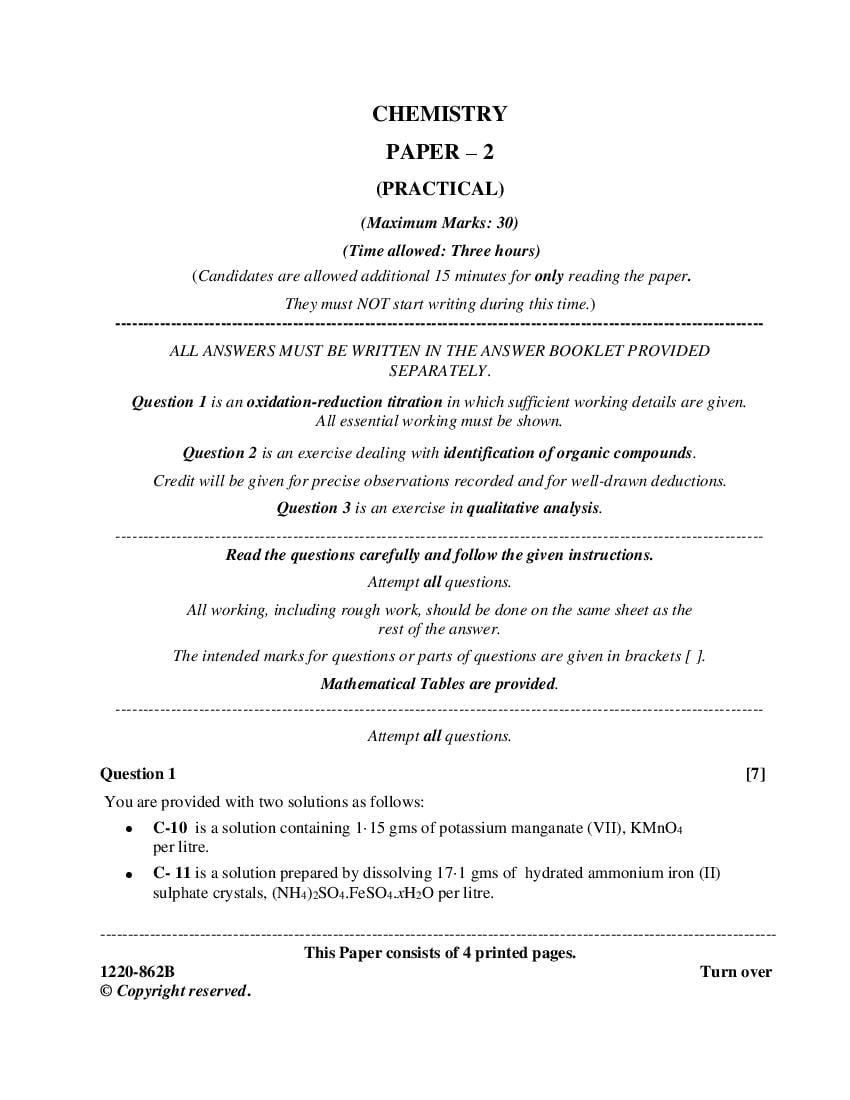
PAPER – 2
(PRACTICAL)
(Maximum Marks: 30)
(Time allowed: Three hours)
(Candidates are allowed additional 15 minutes for only reading the paper.
They must NOT start writing during this time.)
---------------------------------------------------------------------------------------------------------------------
ALL ANSWERS MUST BE WRITTEN IN THE ANSWER BOOKLET PROVIDED
SEPARATELY.
Question 1 is an oxidation-reduction titration in which sufficient working details are given.
All essential working must be shown.
Question 2 is an exercise dealing with identification of organic compounds.
Credit will be given for precise observations recorded and for well-drawn deductions.
Question 3 is an exercise in qualitative analysis.
---------------------------------------------------------------------------------------------------------------------
Read the questions carefully and follow the given instructions.
Attempt all questions.
All working, including rough work, should be done on the same sheet as the
rest of the answer.
The intended marks for questions or parts of questions are given in brackets [ ].
Mathematical Tables are provided.
---------------------------------------------------------------------------------------------------------------------
Attempt all questions.
Question 1 [7]
You are provided with two solutions as follows:
• C-10 is a solution containing 1·15 gms of potassium manganate (VII), KMnO4
per litre.
• C- 11 is a solution prepared by dissolving 17·1 gms of hydrated ammonium iron (II)
sulphate crystals, (NH4)2SO4.FeSO4.xH2O per litre.
This Paper consists of 4 printed pages.
1220-862B Turn over
© Copyright reserved.
Page 2
Rinse and fill the burette with the given solution C-10 (KMnO4). Pipette out 20 ml or
25 ml of C-11 (hydrated ammonium iron (II) sulphate solution) and transfer into a
clean conical flask. To this, add 20 ml of C-12 (dilute sulphuric acid) specially
provided for titration.
Titrate the solution in the conical flask with C-10 (KMnO4) slowly till one drop of this
gives a light permanent pink colour to the solution C-11 in the flask. The pink colour
should not disappear on shaking the contents in the conical flask.
Repeat the above procedure to get at least two concordant readings.
Tabulate your readings.
State:
(a) The capacity of the pipette used.
(b) The titre value you intend to use in your calculations.
Show the titre value to the Visiting Examiner.
The equations for the above reactions are as follows:
2KMnO4 + 8H2SO4 + 10(NH4)2SO4.FeSO4.xH2O →
K2SO4 + 2MnSO4 + 10(NH4)2SO4 + 5Fe2(SO4)3 + 8H2O + 10x H2O
The ionic equation for the reaction is:
2MnO−
4 + 10Fe + 16H → 2Mn + 10Fe + 8H2O
2+ + 2+ 3+
Relative atomic masses:
K = 39 Fe = 56 Mn = 55 S = 32 N = 14 H=1 O = 16
Calculate the following:
(i) The molarity of the solution of potassium manganate(VII) C-10.
(ii) The molarity of hydrated ammonium iron(II) sulphate solution C-11.
(iii) The molecular mass of hydrated ammonium iron(II) sulphate deduced from
the experimental data.
(iv) The numerical value of x, i.e. the number of molecules of water of
crystallisation in (NH4)2SO4.FeSO4.xH2O
Note: Molarity must be calculated up to at least 4 decimal places.
2
Page 3
You are provided with two organic compounds, C-13 and C-14.
Perform the experiments given below on each of the two compounds. Record the changes
taking place at every step of the experiment.
Note the smell of the substance formed, if significant, the colour of the solution obtained,
the colour of the precipitate produced and any other observations you may have. State the
identity of each compound on the basis of the experiments and observational changes.
(a) Substance C - 13
(i) Take 2 ml of C-13 in a test tube and add 1 ml of freshly prepared pyrogallol
solution. Shake the contents. Add 2 ml of concentrated hydrochloric acid.
(ii) Take 2 ml of C-13 in a test tube and add a few crystals of resorcinol. Shake
the contents. Slowly add 1 ml of concentrated sulphuric acid along the side
of the test tube.
(iii) Take 2 ml of C-13 in a clean test tube. To this, add 2 ml of Fehling’s
solution. Warm the contents in a water bath.
(b) Substance C-14
(i) Take 2 ml of C-14 in a test tube and add 1 ml of freshly prepared sodium
nitroprusside solution, followed by 1 ml of ammonium hydroxide solution.
(ii) Take 2 ml of C-14 in a test tube. To this add 2 ml of iodine solution. Add
sodium hydroxide solution with constant shaking until the brown colour
disappears. Heat the contents, then cool.
(iii) Take about 0·5 ml of mercuric chloride (HgCl2) solution in a test tube. To
this add dilute solution of sodium hydroxide drop by drop till no further
change occurs. To the above contents add C-14 solution drop by drop till the
additional drop makes no change in the content.
3
1220-862B Turn over
Page 4
Analyse qualitatively the substance C-15 which contains one anion and one cation. Identify
these ions.
(a) While testing for anion you must mention:
(i) How the gases were identified.
(ii) The confirmatory test for anion.
Show the results as required, to the Visiting Examiner.
(b) While testing for cation you must mention:
(i) How the original solution for group analysis was prepared.
(ii) The formal group analysis with pertinent group reagents.
(iii) The confirmatory test for cation.
Show the results as required, to the Visiting Examiner.
Note: Use of qualitative analysis booklet/table is not allowed.
Question 4
Show the following to the Visiting Examiner for assessment:
(a) Project [10]
(b) Chemistry Practical File. [5]
4
Document Details
| Board / Org | CISCE |
| Exam | Class 12 |
| Type | Question Paper |
| Pages | 1 |
| Language | english |
| Updated | 22 Jul 2026 |