JNUEE 2021 Question Paper MA Eco with specialization in World Eco
Finished viewing? Save it for later —
Download JNUEE 2021 Question Paper MA Eco with specialization in World Eco (PDF · 19 pages)About JNUEE 2021 Question Paper MA Eco with specialization in World Eco
JNUEE 2021 Question Paper MA Eco with specialization in World Eco is available here for free download. Published by NTA for Jawaharlal Nehru University Entrance Examination, this question paper can be viewed online or downloaded as a PDF (19 pages). Candidates preparing for Jawaharlal Nehru University Entrance Examination can use JNUEE 2021 Question Paper MA Eco with specialization in World Eco to understand the exam pattern, the type of questions asked, and the overall difficulty level.
Frequently Asked Questions
How can I download JNUEE 2021 Question Paper MA Eco with specialization in World Eco?
Open this page and click the Download button to save JNUEE 2021 Question Paper MA Eco with specialization in World Eco as a PDF. It is completely free on AglaSem Docs.
Is JNUEE 2021 Question Paper MA Eco with specialization in World Eco free to download?
Yes. JNUEE 2021 Question Paper MA Eco with specialization in World Eco can be viewed online and downloaded as a PDF free of cost on AglaSem Docs.
How many pages does JNUEE 2021 Question Paper MA Eco with specialization in World Eco have?
JNUEE 2021 Question Paper MA Eco with specialization in World Eco contains 19 pages, which you can read online or download together as a single PDF.
Where can I find more Jawaharlal Nehru University Entrance Examination study material?
You can find more Jawaharlal Nehru University Entrance Examination question papers, sample papers, syllabus, and answer keys on AglaSem Docs.
JNUEE 2021 Question Paper MA Eco with specialization in World Eco – Text
Read the full text of this question paper below — useful to quickly search, copy and reference the content online without downloading the PDF.
📄 View text version (19 pages)
Page 1
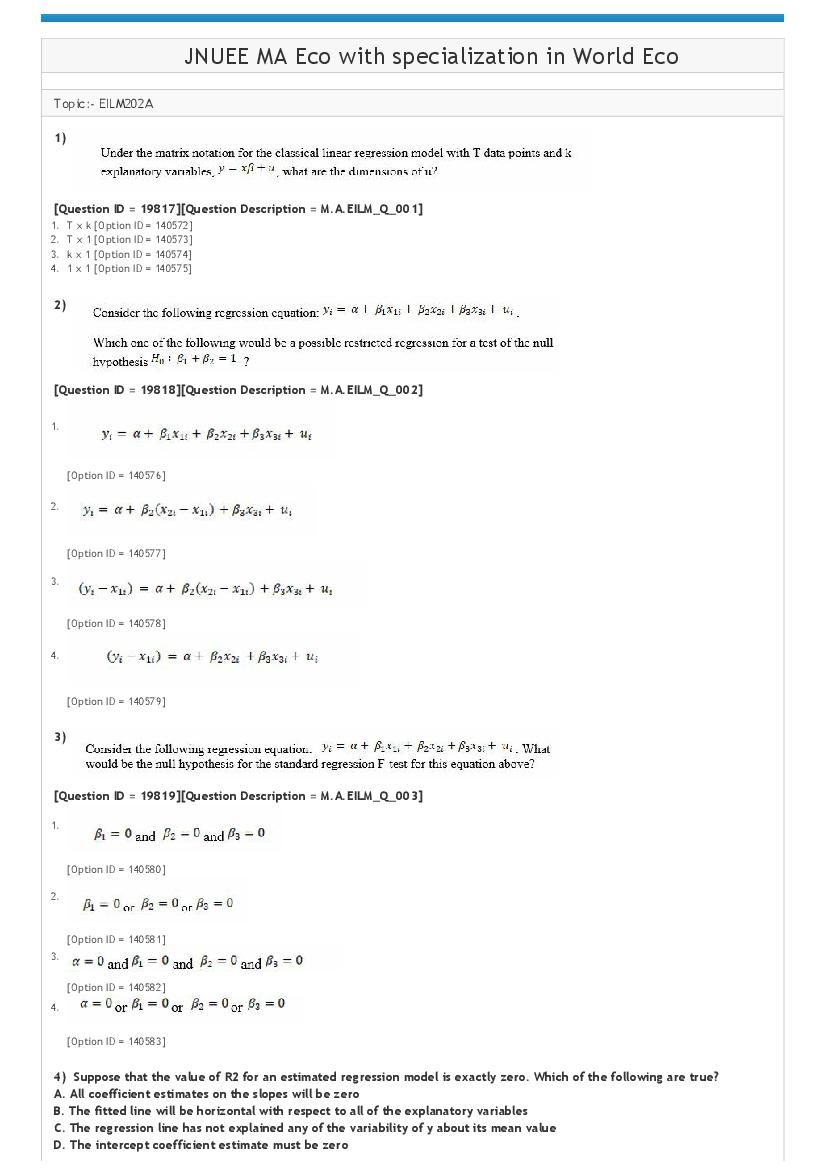
Topic:‐ EILM202A
1)
[Question ID = 19817][Question Description = M.A.EILM_Q_001]
1. T x k [Option ID = 140572]
2. T x 1 [Option ID = 140573]
3. k x 1 [Option ID = 140574]
4. 1 x 1 [Option ID = 140575]
2)
[Question ID = 19818][Question Description = M.A.EILM_Q_002]
1.
[Option ID = 140576]
2.
[Option ID = 140577]
3.
[Option ID = 140578]
4.
[Option ID = 140579]
3)
[Question ID = 19819][Question Description = M.A.EILM_Q_003]
1.
[Option ID = 140580]
2.
[Option ID = 140581]
3.
[Option ID = 140582]
4.
[Option ID = 140583]
4) Suppose that the value of R2 for an estimated regression model is exactly zero. Which of the following are true?
A. All coefficient estimates on the slopes will be zero
B. The fitted line will be horizontal with respect to all of the explanatory variables
C. The regression line has not explained any of the variability of y about its mean value
D. The intercept coefficient estimate must be zero
Page 2
1. A, B C and D
[Option ID = 140584]
2. A, B and C only
[Option ID = 140585]
3. A and B only
[Option ID = 140586]
4. C and D only
[Option ID = 140587]
5)
[Question ID = 19821][Question Description = M.A.EILM_Q_005]
1. A, B, C and D
[Option ID = 140588]
2. A, B and C only
[Option ID = 140589]
3. A and C only
[Option ID = 140590]
4. B and D only
[Option ID = 140591]
6) What would be the consequences for the OLS estimator if heteroscedasticity is present in a regression model but
ignored?
A. It will be biased
B. It will be inconsistent
C. It will be inefficient
D. None of the above
Choose the correct answer from the options given below:[Question ID = 19822][Question Description = M.A.EILM_Q_006]
1. A, B and C only [Option ID = 140592]
2. B only [Option ID = 140593]
3. C only [Option ID = 140594]
4. D only [Option ID = 140595]
7) Near multicollinearity occurs when[Question ID = 19823][Question Description = M.A.EILM_Q_007]
1. Two or more explanatory variables are perfectly correlated with one another [Option ID = 140596]
2. The explanatory variables are highly correlated with the error term [Option ID = 140597]
3. The explanatory variables are highly correlated with the dependent variable [Option ID = 140598]
4. Two or more explanatory variables are highly correlated with one another [Option ID = 140599]
8) Which one of the following is NOT an example of misspecification of functional form in regression analysis? [Question ID =
19824][Question Description = M.A.EILM_Q_008]
1. Using a linear specification when y scales as a function of the squares of x [Option ID = 140600]
2. Using a linear specification when a double‐logarithmic model would be more appropriate [Option ID = 140601]
3. Modelling y as a function of x when in fact it scales as a function of 1/x [Option ID = 140602]
4. Excluding a relevant variable from a linear regression model [Option ID = 140603]
9) In a four‐sector economy, which of the following is assumed always to increase when GDP increases?[Question ID =
19825][Question Description = M.A.EILM_Q_009]
1. I (Investment) [Option ID = 140604]
Page 3
3. M (Import) [Option ID = 140606]
4. X (Export) [Option ID = 140607]
10) Which of the following is not a convincing argument for a negatively sloping AD (Aggregate Demand) curve?[Question
ID = 19826][Question Description = M.A.EILM_Q_010]
1. A rise in the price level in a country will tend to lead to a fall in the real value of exports and a rise in the real value of imports [Option ID = 140608]
2. A rise in the price level in a country will lead to lower real spending because it will lead to lower real wealth [Option ID = 140609]
3. A rise in the price level in a country will necessarily reduce the real value of firms' profits, causing them to reduce planned investment [Option ID =
140610]
4. A rise in the price level in a country will lead to lower real spending because it will lead to a higher interest rate [Option ID = 140611]
11) Suppose the real wage in a country is at the equilibrium level, but there is some natural unemployment.
Which of the following does not help to explain this natural unemployment?
[Question ID = 19827][Question Description = M.A.EILM_Q_011]
1. At the equilibrium wage, some people will prefer to stay at home with their families than have paid employment
[Option ID = 140612]
2. At the equilibrium wage, some people who recently returned to the labour force after caring for young children will be unemployed while they wait
for what they feel is the right job
[Option ID = 140613]
3. At the equilibrium wage, some people may be unemployed because the demand for their skills has fallen and there are no suitable jobs available
[Option ID = 140614]
4. At the equilibrium wage, some new graduates will be unemployed while they wait for what they feel is the right job
[Option ID = 140615]
12)
[Question ID = 19828][Question Description = M.A.EILM_Q_012]
1.
[Option ID = 140616]
2.
[Option ID = 140617]
3.
[Option ID = 140618]
4.
[Option ID = 140619]
13)
[Question ID = 19829][Question Description = M.A.EILM_Q_013]
1. 70 [Option ID = 140620]
2. 9000 [Option ID = 140621]
3. 500 [Option ID = 140622]
4. 300 [Option ID = 140623]
14)
[Question ID = 21447][Question Description = M.A.EILM_Q_014]
1.
Page 4
2.
[Option ID = 140869]
3.
[Option ID = 140870]
4.
[Option ID = 140871]
15)
[Question ID = 18602][Question Description = M.A.EILM_Q_015]
1.
[Option ID = 140624]
2.
[Option ID = 140625]
3.
[Option ID = 140626]
4. None of the above [Option ID = 140627]
16)
[Question ID = 18603][Question Description = M.A.EILM_Q_016]
1.
[Option ID = 140628]
2.
[Option ID = 140629]
3.
[Option ID = 140630]
4. None of the above [Option ID = 140631]
17) In Country X, cigarettes are forbidden, so people trade cigarettes in a black market. The cigarette demand is QD = 12 −
P, and the cigarette supply is Qs = 2P, where P is price.
The government becomes aware of the black market and reinforces the police so that half of the cigarette supply would be
seized and destroyed. How does the consumer surplus change between the two situations?
[Question ID = 18604][Question Description = M.A.EILM_Q_017]
1. remains the same
[Option ID = 140632]
2. decreases by 10
[Option ID = 140633]
3. decreases by 14
[Option ID = 140634]
4. none of the above
[Option ID = 140635]
18) Suppose parking fees at South Extension increases. If demand is relatively elastic then[Question ID = 18605][Question
Description = M.A.EILM_Q_018]
1. total revenue from parking fees will fall. [Option ID = 140636]
2. total revenue from parking fees will rise. [Option ID = 140637]
3. total revenue from parking fees is constant. [Option ID = 140638]
Page 5
19)
[Question ID = 18606][Question Description = M.A.EILM_Q_019]
1.
[Option ID = 140640]
2.
[Option ID = 140641]
3.
[Option ID = 140642]
4. None of the above [Option ID = 140643]
20)
[Question ID = 18607][Question Description = M.A.EILM_Q_020]
1.
[Option ID = 140644]
2. The function does not have a maximum
[Option ID = 140645]
3.
[Option ID = 140646]
4. None of the above
[Option ID = 140647]
21)
[Question ID = 18608][Question Description = M.A.EILM_Q_021]
1.
[Option ID = 140648]
2.
[Option ID = 140649]
3.
[Option ID = 140650]
4.
[Option ID = 140651]
22)
[Question ID = 18609][Question Description = M.A.EILM_Q_022]
1.
[Option ID = 140652]
2.
[Option ID = 140653]
3.
[Option ID = 140654]
4. None of the above [Option ID = 140655]
23)
Page 6
1.
[Option ID = 140656]
2.
[Option ID = 140657]
3.
[Option ID = 140658]
4.
[Option ID = 140659]
24)
[Question ID = 18611][Question Description = M.A.EILM_Q_024]
1. a deficit of 50. [Option ID = 140660]
2. a surplus of 50. [Option ID = 140661]
3. a deficit of 125. [Option ID = 140662]
4. a surplus of 75. [Option ID = 140663]
25) If the interest rate is higher in country X than in country Y, then[Question ID = 18612][Question Description =
M.A.EILM_Q_025]
1. the currency of country X is expected to appreciate relative to the currency of country Y. [Option ID = 140664]
2. the currency of country Y is expected to appreciate relative to the currency of country X. [Option ID = 140665]
3. the effect on the expected exchange rate is uncertain. [Option ID = 140666]
4. none of the above is true. [Option ID = 140667]
26)
[Question ID = 18613][Question Description = M.A.EILM_Q_026]
1. an increase in investment and a decrease in private consumption. [Option ID = 140668]
2. an increase in investment and a decrease in government spending. [Option ID = 140669]
3. an increase in investment and an increase in private saving. [Option ID = 140670]
4. a decrease in investment and a decrease in public saving. [Option ID = 140671]
Page 7
the[Question ID = 18614][Question Description = M.A.EILM_Q_027]
1. money supply. [Option ID = 140672]
2. level of technology. [Option ID = 140673]
3. stock of capital. [Option ID = 140674]
4. size of the labor force. [Option ID = 140675]
28) According to the classical macro model, which of the following is NOT consistent with perfect competition?[Question ID
= 18615][Question Description = M.A.EILM_Q_028]
1. Labor demand is determined by real wages and the marginal product of labor. [Option ID = 140676]
2. Workers are unique and bargain individually for their wages. [Option ID = 140677]
3. The marginal product of labor is diminishing. [Option ID = 140678]
4. Workers have no influence on their wages but accept them as given. [Option ID = 140679]
29) The supply of labor in the classical macro model is a function of the
A. marginal product of labor.
B. real wage.
C. the public’s preference for leisure.
D. money wage.
Choose the correct answer from the options given below: [Question ID = 18616][Question Description = M.A.EILM_Q_029]
1. A only [Option ID = 140680]
2. A and D only [Option ID = 140681]
3. B and C only [Option ID = 140682]
4. C and D only [Option ID = 140683]
30)
[Question ID = 18617][Question Description = M.A.EILM_Q_030]
1.
[Option ID = 140684]
2.
[Option ID = 140685]
3.
[Option ID = 140686]
4.
[Option ID = 140687]
31) A positively sloped LM schedule will be relatively flat if the interest elasticity of money demand is[Question ID = 18618]
[Question Description = M.A.EILM_Q_031]
1. low. [Option ID = 140688]
2. zero. [Option ID = 140689]
3. infinity. [Option ID = 140690]
4. high. [Option ID = 140691]
32)
[Question ID = 18619][Question Description = M.A.EILM_Q_032]
1.
[Option ID = 140692]
2.
[Option ID = 140693]
3.
Page 8
4.
[Option ID = 140695]
33) Consider two economies that are identical, with the exception that one has a high marginal propensity to consume
(mpc) while the other has a low mpc. If the money supply is increased by the same amount in each economy, the high mpc
economy will experience:
A. A larger increase in output.
B. A smaller decrease in the interest rate.
C. A smaller increase in output.
D. A larger decrease in the interest rate.
Choose the correct answer from the options given below: [Question ID = 18620][Question Description = M.A.EILM_Q_033]
1. A only [Option ID = 140696]
2. A and B only [Option ID = 140697]
3. B and C only [Option ID = 140698]
4. C and D only [Option ID = 140699]
34) Country A takes 20 labour hours to produce a yard of cloth and 100 labour hours to produce a ton of wheat, while
Country B takes 20 labour hours to produce a yard of cloth and 20 labour hours to produce a ton of wheat. Then which of
the following statement is true:
[Question ID = 18621][Question Description = M.A.EILM_Q_034]
1. There is no potential for mutual gains from trade between the two countries A and B
[Option ID = 140700]
2. There is potential for mutual gains from trade always irrespective of the relative price
[Option ID = 140701]
3. There is potential for mutual gains from trade always irrespective of the relative price
[Option ID = 140702]
4. There is potential for mutual gains from trade always irrespective of the relative price
[Option ID = 140703]
35) Consider a world with two factors of production, namely capital and labour, and where countries engage in free trade
as per the Heckscher Ohlin framework. If a capital‐abundant small country imposes an import tariff of 20% then we would
expect its:
A. Wage will increase
B. Rental will increase
C. Wage will decrease
D. Rental will decrease
In light of the above statements, choose the most appropriate answer from the options given below [Question ID = 18622]
[Question Description = M.A.EILM_Q_035]
1. Statements A and B are true [Option ID = 140704]
2. Statements C and D are true [Option ID = 140705]
3. Statements A and D are true [Option ID = 140706]
4. Statements B and C are true [Option ID = 140707]
36) If the domestic demand and domestic supply for shirts in a small country are given as
QD = 11 – 2P
QS = – 1 + 2P
and if the international price of shirts is 2 units, then the country will [Question ID = 18623][Question Description =
M.A.EILM_Q_036]
1. Export 2 shirts [Option ID = 140708]
2. Import 2 shirts [Option ID = 140709]
3. Export 4 shirts [Option ID = 140710]
4. Import 4 shirts [Option ID = 140711]
37) The domestic demand and supply of computer chips for a small country are given as
QD = 14 – 2P
QS = – 2 + 2P
Initially the small country engages in free trade at the international price of 1 unit, but now the government imposes an
import quota of 8 computer chips, then [Question ID = 18624][Question Description = M.A.EILM_Q_037]
1. Domestic price will remain unchanged [Option ID = 140712]
2. Domestic price will double [Option ID = 140713]
3. Domestic price will triple [Option ID = 140714]
4. Domestic price will decline [Option ID = 140715]
Page 9
[Question ID = 18625][Question Description = M.A.EILM_Q_038]
1. A will export both food and cloth to B [Option ID = 140716]
2. A will export food to B and import cloth from B [Option ID = 140717]
3. A will export cloth to B and import food from B [Option ID = 140718]
4. A will not trade, as there is no scope for gains from trade [Option ID = 140719]
39) A country uses capital and labour to produce two commodities, motorcycles and bread, where the production of
motorcycles is capital–intensive and bread is labour–intensive at any factor price. Then under the assumption of constant
returns to scale and full employment, an increase in the supply of labour at constant commodity prices will lead to
A. An absolute increase in the production of motorcycles
B. An absolute increase in the production of bread
C. An absolute decrease in the production of motorcycles
D. An absolute decrease in the production of bread
In light of the above statements, choose the most appropriate answer from the options given below
[Question ID = 18626][Question Description = M.A.EILM_Q_039]
1. Statements A and B only
[Option ID = 140720]
2. Statements A and D only
[Option ID = 140721]
3. Statements B and C only
[Option ID = 140722]
4. None of the above
[Option ID = 140723]
40) In the simple Ricardian model with labour being the only resource to produce two goods at constant costs, the pre‐
trade price of goods is[Question ID = 18627][Question Description = M.A.EILM_Q_040]
1. determined by the absolute demand for the goods [Option ID = 140724]
2. determined by the absolute endowment of labour [Option ID = 140725]
3. determined by the relative demand for the goods [Option ID = 140726]
4. independent of the demand for goods [Option ID = 140727]
41) Free trade is the optimal trading policy for[Question ID = 18628][Question Description = M.A.EILM_Q_041]
1. small country [Option ID = 140728]
2. large country [Option ID = 140729]
3. both small and large countries [Option ID = 140730]
4. neither small nor large country [Option ID = 140731]
42) Consider a small country with the domestic demand and domestic supply for pens given as
QD = 10 – P
QS = – 2 + P
Initially the small country engages in free trade at the international price of 2 units, but now the government imposes an
import tariff of 1 unit, then government import tariff revenue would be [Question ID = 18629][Question Description =
M.A.EILM_Q_042]
1. 14 [Option ID = 140732]
2. 9 [Option ID = 140733]
3. 7 [Option ID = 140734]
4. 6 [Option ID = 140735]
43) In the Heckscher Ohlin model, free trade in goods will lead to
A. increase in wage rate in the labour abundant country
B. increase in wage rate in the capital abundant country
C. decrease in wage rate in the labour abundant country
D. decrease in rental in the capital abundant country
Page 10
1. A only [Option ID = 140736]
2. B only [Option ID = 140737]
3. A and B only [Option ID = 140738]
4. C and D only [Option ID = 140739]
44) The specialization in production due to free trade is likely to be
A. Complete with increasing opportunity costs
B. Complete with constant opportunity costs
C. Incomplete with increasing opportunity costs
D. Incomplete with constant opportunity costs
Choose the correct answer from the options given below: [Question ID = 18631][Question Description = M.A.EILM_Q_044]
1. A and D only [Option ID = 140740]
2. B and C only [Option ID = 140741]
3. C and D only [Option ID = 140742]
4. A, and either B or D [Option ID = 140743]
45) Suppose U=u(t) and V=v(t) are two variables which are functions of time t. The expression for the rate of growth of Y
(rogY) when Y= U‐V is [Question ID = 18632][Question Description = M.A.EILM_Q_045]
1. rogY = rogU ‐ rogV [Option ID = 140744]
2. rogY = u rogU ‐ v rogV [Option ID = 140745]
3. rogY = rogU /rogV [Option ID = 140746]
4. rogY = (u rogU ‐ v rogV)/ (u‐v) [Option ID = 140747]
46)
[Question ID = 18633][Question Description = M.A.EILM_Q_046]
1.
[Option ID = 140748]
2.
[Option ID = 140749]
3.
[Option ID = 140750]
4.
[Option ID = 140751]
47)
[Question ID = 18634][Question Description = M.A.EILM_Q_047]
1.
[Option ID = 140752]
2.
[Option ID = 140753]
3.
[Option ID = 140754]
4.
[Option ID = 140755]
Page 11
[Question ID = 18635][Question Description = M.A.EILM_Q_048]
1.
[Option ID = 140756]
2.
[Option ID = 140757]
3.
[Option ID = 140758]
4.
[Option ID = 140759]
49)
[Question ID = 18636][Question Description = M.A.EILM_Q_049]
1. B only [Option ID = 140760]
2. A only [Option ID = 140761]
3. C only [Option ID = 140762]
4. A and B only [Option ID = 140763]
50)
[Question ID = 18637][Question Description = M.A.EILM_Q_050]
1. A only [Option ID = 140764]
2. A, B, and C only [Option ID = 140765]
3. B, C, and D only [Option ID = 140766]
4. All of A to D are true. [Option ID = 140767]
51) While solving for a competitive equilibrium in a general equilibrium model with N commodities a price normalization is
required because of which of the reasons below:
A. The homogeneity of degree zero of demands of consumers and supplies of producers in prices
B. The Walras law
Choose the correct answer from the options given below: [Question ID = 18638][Question Description = M.A.EILM_Q_051]
1. A only [Option ID = 140768]
Page 12
3. Both A and B [Option ID = 140770]
4. Neither A nor B [Option ID = 140771]
52) If the competitive equilibrium price of a good is zero then which of the following situations is indicated
A. There is an excess supply of the good
B. Consumer preferences are such that more of the good is preferred to less.
C. The economy has a zero initial endowment of the good.
Choose the correct answer from the options given below: [Question ID = 18639][Question Description = M.A.EILM_Q_052]
1. A only [Option ID = 140772]
2. B and C only [Option ID = 140773]
3. C only [Option ID = 140774]
4. A and C only [Option ID = 140775]
53) Suppose both the output and input prices faced by a competitive profit maximizing producer double. Then the
maximum profit he can earn [Question ID = 18640][Question Description = M.A.EILM_Q_053]
1. will remain unchanged [Option ID = 140776]
2. will reduce [Option ID = 140777]
3. will double [Option ID = 140778]
4. can reduce, increase, or remain unchanged [Option ID = 140779]
54) Suppose the technology exhibits constant returns to scale. Then the maximum economic profit of a competitive
producer [Question ID = 18641][Question Description = M.A.EILM_Q_054]
1. Can be negative but not positive [Option ID = 140780]
2. Can be positive but not negative [Option ID = 140781]
3. Cannot be positive [Option ID = 140782]
4. Can be negative or positive [Option ID = 140783]
55)
[Question ID = 18642][Question Description = M.A.EILM_Q_055]
1. A only
[Option ID = 140784]
2. B only
[Option ID = 140785]
3. C only
[Option ID = 140786]
4. A and C only
[Option ID = 140787]
56) Let A and B be events such that P(A) = 1/2, P(B) = 1/3 and P(AB) = 1/4. Then the value of P(A/B) is [Here, P(A/B)
indicates probability of A conditional on B][Question ID = 18643][Question Description = M.A.EILM_Q_056]
1. 1/2 [Option ID = 140788]
2. 3/4 [Option ID = 140789]
3. 1/8 [Option ID = 140790]
4. 4/3 [Option ID = 140791]
57) Let A and B be independent events with P(A)=1/2 and P(AUB) = 2/3. Then P(Bc A) is (here Bc indicates the
complement of event B) [Question ID = 18644][Question Description = M.A.EILM_Q_057]
1. 1/2 [Option ID = 140792]
2. 1/3 [Option ID = 140793]
3. 2/3 [Option ID = 140794]
4. 4/3 [Option ID = 140795]
58)
Page 13
1. 0 [Option ID = 140796]
2. 1 [Option ID = 140797]
3. ‐1 [Option ID = 140798]
4. ‐1.2 [Option ID = 140799]
59)
[Question ID = 18646][Question Description = M.A.EILM_Q_059]
1. 8/25 [Option ID = 140800]
2. 9/25 [Option ID = 140801]
3. 10/25 [Option ID = 140802]
4. 11/25 [Option ID = 140803]
60) For a symmetric distribution which of the following is true?[Question ID = 18647][Question Description =
M.A.EILM_Q_060]
1. The kurtosis is zero [Option ID = 140804]
2. The skewness is zero [Option ID = 140805]
3. The mean is zero [Option ID = 140806]
4. The variance is zero [Option ID = 140807]
61) For which of the following probability distribution is mean > variance?[Question ID = 18648][Question Description =
M.A.EILM_Q_061]
1. Binomial distribution [Option ID = 140808]
2. Poisson distribution [Option ID = 140809]
3. Exponential distribution [Option ID = 140810]
4. Normal distribution [Option ID = 140811]
62) The mean and variance of a binomial variable are 4 and 4/3 respectively. What are the parameters of the distribution?
[Question ID = 18649][Question Description = M.A.EILM_Q_062]
1. n=6, p=1/3 [Option ID = 140812]
2. n=6, p=2/3 [Option ID = 140813]
3. n=2, p=3/5 [Option ID = 140814]
4. n=2, p=2/4 [Option ID = 140815]
63)
[Question ID = 18650][Question Description = M.A.EILM_Q_063]
1. 0 [Option ID = 140816]
2. 2 [Option ID = 140817]
3. ‐2 [Option ID = 140818]
4. 1 [Option ID = 140819]
64) If the determinant of a matrix is zero, then which of the following is true?[Question ID = 18651][Question Description =
M.A.EILM_Q_064]
1. The inverse exists [Option ID = 140820]
2. The inverse does not exist [Option ID = 140821]
3. The columns are linearly independent [Option ID = 140822]
Page 14
65)
[Question ID = 18652][Question Description = M.A.EILM_Q_065]
1. 0 [Option ID = 140824]
2. 1 [Option ID = 140825]
3. 2 [Option ID = 140826]
4. 3 [Option ID = 140827]
66) Suppose that A is (5X4) matrix, B is (r x s) matrix and C is (p X 3) matrix. If ATBCT is defined (where AT and CT are
transposes of A and C respectively), then the value of r and s are
[Question ID = 18653][Question Description = M.A.EILM_Q_066]
1. r= 5, s = 3
[Option ID = 140828]
2. r = 3, s = 5
[Option ID = 140829]
3. r= 3, s = 3
[Option ID = 140830]
4. r= 5, s =5
[Option ID = 140831]
67) One study found that the Gini coefficient for Country A was 0.3 and that of Country B was 0.33. From this information
we can conclude that Country A and Country B [Question ID = 18654][Question Description = M.A.EILM_Q_067]
1. had virtually the same number of households in absolute poverty [Option ID = 140832]
2. had virtually the same percentage of households in absolute poverty [Option ID = 140833]
3. had virtually the same Human Development Index level [Option ID = 140834]
4. none of the above [Option ID = 140835]
68) If a borrower takes actions that may not lead to the best project outcome and therefore, a high risk of default, but this
cannot be observed by the lender then this is related to the problem of[Question ID = 18655][Question Description =
M.A.EILM_Q_068]
1. balance of trade [Option ID = 140836]
2. moral hazard [Option ID = 140837]
3. social goods [Option ID = 140838]
4. hyperinflation [Option ID = 140839]
69) Which of the following is NOT a possible cost of high fertility rate and rapid population growth
A. increasing returns to natural resources with a positive impact on average food consumptiom
B. increased congestion
C. higher labour force growth rate and higher unemployment
Choose the correct answer from the options given below: [Question ID = 18656][Question Description = M.A.EILM_Q_069]
1. A only [Option ID = 140840]
2. A and B only [Option ID = 140841]
3. A and C only [Option ID = 140842]
4. all of the above [Option ID = 140843]
70) According to the Lewis Model, as industry expands, it is able to withdraw labour from agriculture without affecting
agricultural output because [Question ID = 18657][Question Description = M.A.EILM_Q_070]
1. there is no fixed capital in agriculture [Option ID = 140844]
2. there are diminishing returns to labour in agriculture [Option ID = 140845]
3. the marginal product of labour in agriculture is zero [Option ID = 140846]
4. none of the above [Option ID = 140847]
71) Which of the following is NOT a component of the Human Development Index?[Question ID = 18658][Question
Description = M.A.EILM_Q_071]
1. expected years of schooling of children at school entry age [Option ID = 140848]
2. gross national income per capita in purchasing power parity terms [Option ID = 140849]
3. life expectancy [Option ID = 140850]
4. infant mortality rate [Option ID = 140851]
72) Which of the following is NOT consistent with Rosenstein‐Rodan’s theory of development?
Page 15
B. social overhead capital has large indivisibilities
C. social overhead capital must be produced before directly productive activities
Choose the correct answer from the options given below: [Question ID = 21443][Question Description = M.A.EILM_Q_072]
1. A only [Option ID = 140852]
2. A and B only [Option ID = 140853]
3. B only [Option ID = 140854]
4. C only [Option ID = 140855]
73) If the distribution of income in a country is (100,120,140,155) and the poverty line is 150, then poverty as denoted by
the headcount ratio___________ compared to the poverty gap measure.
[Question ID = 21444][Question Description = M.A.EILM_Q_073]
1. is higher
[Option ID = 140856]
2. is lower
[Option ID = 140857]
3. is same as
[Option ID = 140858]
4. cannot be determined
[Option ID = 140859]
74) Two income distributions are given below where the first set of numbers denotes incomes and the second set of
numbers denotes the number of people earning each of hose incomes
Income distribution 1: (100,200,300,400); (50, 25,75,25)
Income distribution 2: (200, 400, 600, 800); (50, 25,75,25)
The Lorenz curves for the two distributions will
A. be the same based on relative income
B. violate the Dalton principle
C. be indeterminate
Choose the correct answer from the options given below [Question ID = 21445][Question Description = M.A.EILM_Q_074]
1. A only [Option ID = 140860]
2. B only [Option ID = 140861]
3. B and C only [Option ID = 140862]
4. none of the above [Option ID = 140863]
75) The Harrod‐Domar growth model suggests that growth is[Question ID = 21446][Question Description = M.A.EILM_Q_075]
1. directly related to savings and inversely related to the capital/output ratio. [Option ID = 140864]
2. directly related to the capital/output ratio and inversely related to savings. [Option ID = 140865]
3. indirectly related to savings and the capital/output ratio [Option ID = 140866]
4. directly related to savings and the capital/output ratio. [Option ID = 140867]
Topic:‐ EILM202B
1) Read the problem below
A family owns a plot of land and two people are needed to work on each acre of land. Each acre produces an output of
Rs.6000 and each member of the family can choose to either work on the land or work elsewhere for an annual wage rate
of Rs.1500. If land is leased out then labour working on it must be paid Rs.2000.
How much rent per acre can the family earn annually if the land is leased out ?[Question ID = 13591][Question Description =
M.A.EILM_Q_076]
1. 1500 [Option ID = 141700]
2. 7000 [Option ID = 141701]
3. 3000 [Option ID = 141702]
4. 2000 [Option ID = 141703]
2) Read the problem below
A family owns a plot of land and two people are needed to work on each acre of land. Each acre produces an output of
Rs.6000 and each member of the family can choose to either work on the land or work elsewhere for an annual wage rate
of Rs.1500. If land is leased out then labour working on it must be paid Rs.2000.
If the family has eight people then what is the minimum number of acres of land needed for it to be optimal to lease out ?
[Question ID = 13592][Question Description = M.A.EILM_Q_077]
1. 2 [Option ID = 141704]
2. 4 [Option ID = 141705]
3. 5 [Option ID = 141706]
4. 3 [Option ID = 141707]
Topic:‐ EILM202C
Page 16
[Question ID = 18920][Question Description = M.A.EILM_Q_078]
1. The only possible steady state is (x=0, y=0). [Option ID = 142008]
2. The two possible steady states are (x=0, y=0) and (x=2/3, y= ‐2/3). [Option ID = 142009]
3. The two possible steady states are (x=0, y=0) and (x= ‐3/2, y = 2/3) [Option ID = 142010]
4. The only possible steady state is (x= 3/2, y = 3/2). [Option ID = 142011]
2)
[Question ID = 18921][Question Description = M.A.EILM_Q_079]
1. 0 [Option ID = 142012]
2. e – 1 [Option ID = 142013]
3. ∞ [Option ID = 142014]
4. 1 [Option ID = 142015]
3)
[Question ID = 18922][Question Description = M.A.EILM_Q_080]
1. 1 [Option ID = 142016]
2. 2 [Option ID = 142017]
3. 0 [Option ID = 142018]
4. 3 [Option ID = 142019]
4) A singular matrix[Question ID = 18923][Question Description = M.A.EILM_Q_081]
1. Must have a positive trace [Option ID = 142020]
2. Is invertible [Option ID = 142021]
3. Has a determinant equal to zero [Option ID = 142022]
4. Must be equal to its transpose [Option ID = 142023]
5) Suppose there is a negative AD shock and no shock to AS. It is known that as a result, the economy has fallen into a
recession, and output has decreased. Then which of the following alone MUST be true? [Question ID = 18924][Question
Description = M.A.EILM_Q_082]
1. The AS curve is horizontal [Option ID = 142024]
2. The AS curve is upward sloping [Option ID = 142025]
3. The AS curve is vertical [Option ID = 142026]
4. Prices are not bearing the full impact of the AD shock. [Option ID = 142027]
6) Consider two different economies, (i) a closed Keynesian liquidity trap economy, and (ii) an open economy with perfect
capital mobility and a fixed exchange rate. Then expansionary monetary policy [Question ID = 18925][Question Description
= M.A.EILM_Q_083]
1. Is effective in (i) but not (ii) [Option ID = 142028]
2. Is ineffective in both [Option ID = 142029]
3. Is effective in both [Option ID = 142030]
4. Is effective in (ii) but not (i) [Option ID = 142031]
7) According to the classical quantity theory of money, the LM curve[Question ID = 18926][Question Description =
M.A.EILM_Q_084]
1. Must be horizontal [Option ID = 142032]
2. Must be vertical [Option ID = 142033]
3. Must be upward sloping [Option ID = 142034]
4. Must be downward sloping [Option ID = 142035]
8) The Phillips curve[Question ID = 18927][Question Description = M.A.EILM_Q_085]
1. Shows a negative relationship between output and unemployment [Option ID = 142036]
2. Shows a negative relationship between output and inflation [Option ID = 142037]
3. Shows a negative relationship between unemployment and inflation [Option ID = 142038]
4. Must be horizontal [Option ID = 142039]
9) A monopolist sells the same product in two geographically separated markets, at price P1 in market 1 and at price P2 in
market 2. It is known that P1=2P2. Denote the price elasticities of demand for the product in market 1 and market 2 by e1
Page 17
could be true?[Question ID = 18928][Question Description = M.A.EILM_Q_086]
1. e1 = 1/2, e2 = 1/2 [Option ID = 142040]
2. e1=3/2, e2 = 3 [Option ID = 142041]
3. e1 = 3, e2 = 5 [Option ID = 142042]
4. e1= 1, e2 = 1 [Option ID = 142043]
10)
[Question ID = 18929][Question Description = M.A.EILM_Q_087]
1. [80, 160] [Option ID = 142044]
2. [40, 200] [Option ID = 142045]
3. [80, 100] [Option ID = 142046]
4. [70, 160] [Option ID = 142047]
11) In which of the following cases do we get L‐shaped indifference curves?[Question ID = 18930][Question Description =
M.A.EILM_Q_088]
1. Perfect substitutes [Option ID = 142048]
2. Perfect complements [Option ID = 142049]
3. Lexicographic preferences [Option ID = 142050]
4. When one good becomes a “bad” [Option ID = 142051]
12) The demand for labor will be more elastic when[Question ID = 18931][Question Description = M.A.EILM_Q_089]
1. Labor and capital are highly substitutable and product demand is elastic [Option ID = 142052]
2. Labor and capital are highly substitutable and product demand is inelastic [Option ID = 142053]
3. Labor and capital are not easily substitutable and product demand is elastic [Option ID = 142054]
4. Labor and capital are not easily substitutable and product demand is inelastic [Option ID = 142055]
13) Which of the following circumstances will increase the likelihood of an individual being a nonparticipant in the labor
market?[Question ID = 18932][Question Description = M.A.EILM_Q_090]
1. High earnings capacity in the labor market [Option ID = 142056]
2. The absence of non‐wage income [Option ID = 142057]
3. A potential market wage that exceeds the individual’s reservation wage [Option ID = 142058]
4. Availability of substantial non‐wage income [Option ID = 142059]
14) A reduction in the number of low‐cost student loans should reduce the number of people going for college education
because[Question ID = 18933][Question Description = M.A.EILM_Q_091]
1. the direct cost of college are higher [Option ID = 142060]
2. the foregone cost of college are higher [Option ID = 142061]
3. the monetary benefits of attending college are reduced [Option ID = 142062]
4. all of the above [Option ID = 142063]
15) If an estimator is said to be consistent, it is implied that
[Question ID = 18934][Question Description = M.A.EILM_Q_092]
1. On average, the estimated coefficient values will equal the true values
[Option ID = 142064]
2. The OLS estimator is unbiased and no other unbiased estimator has a smaller variance
[Option ID = 142065]
3. The estimates will converge upon the true values as the sample size increases
[Option ID = 142066]
4. The coefficient estimates will be as close to their true values as possible for small and large samples.
[Option ID = 142067]
16) Negative residual autocorrelation is indicated by which one of the following?[Question ID = 18935][Question Description
= M.A.EILM_Q_093]
1. A cyclical pattern in residuals [Option ID = 142068]
2. An alternating pattern in residuals [Option ID = 142069]
3. A complete randomness in the residuals [Option ID = 142070]
4. Residuals are close to zero [Option ID = 142071]
17)
[Question ID = 18936][Question Description = M.A.EILM_Q_094]
1. A fixed effects model
Page 18
2. A time fixed effects model
[Option ID = 142073]
3. A random effects model
[Option ID = 142074]
4. A pure time series model
[Option ID = 142075]
18) Simultaneous causality[Question ID = 18937][Question Description = M.A.EILM_Q_095]
1. means that the independent variables in a regression model are correlated with each other [Option ID = 142076]
2. leads to correlation between the regressor and the error term [Option ID = 142077]
3. means that a third variable affects both Y and X [Option ID = 142078]
4. cannot be established since regression analysis only detects correlation between variables [Option ID = 142079]
19) When the average difference of earnings between college graduates and high school graduates is used to estimate the
“return” to a college degree, an economist would argue that the estimated return would be: [Question ID = 18938]
[Question Description = M.A.EILM_Q_096]
1. Biased downward if more able workers are more likely to go to college. [Option ID = 142080]
2. Biased downward if earnings differences don’t account for the fact that college graduates generally have more generous fringe benefit packages
than high school graduates. [Option ID = 142081]
3. Biased upward if the jobs that high school graduates accept typically have less desirable non‐pecuniary features than the jobs that college graduates
accept. [Option ID = 142082]
4. Both options (2) and (3) above [Option ID = 142083]
20)
[Question ID = 18939][Question Description = M.A.EILM_Q_097]
1. 0
[Option ID = 142084]
2.
[Option ID = 142085]
3. diverges
[Option ID = 142086]
4. 2
[Option ID = 142087]
21)
[Question ID = 18940][Question Description = M.A.EILM_Q_098]
1. Converges by the nth term divergence test [Option ID = 142088]
2. Diverges by the comparison test [Option ID = 142089]
3. Converges by the comparison test [Option ID = 142090]
4. Diverges by the ratio test [Option ID = 142091]
22)
[Question ID = 18941][Question Description = M.A.EILM_Q_099]
1.
[Option ID = 142092]
2.
[Option ID = 142093]
Page 19
[Option ID = 142094]
4.
[Option ID = 142095]
23) Which of the following are advantages of greater exchange rate flexibility?
A. The alleviation of potential conflicts that arise between the internal balance and the external balance.
B. A more stable environment for growth in world trade and international investment.
C. A recession abroad would not have contractionary effects on the domestic economy.
Choose the correct answer from the options given below:
[Question ID = 18942][Question Description = M.A.EILM_Q_100]
1. A only
[Option ID = 142096]
2. A and B only
[Option ID = 142097]
3. B only
[Option ID = 142098]
4. A and C only
[Option ID = 142099]
Document Details
| Board / Org | NTA |
| Exam | Jawaharlal Nehru University Entrance Examination |
| Type | Question Paper |
| Pages | 19 |
| Updated | 22 Jul 2026 |