CUSAT CAT 2021 Question Paper Microbiology
Finished viewing? Save it for later —
Download CUSAT CAT 2021 Question Paper Microbiology (PDF · 27 pages)About CUSAT CAT 2021 Question Paper Microbiology
CUSAT CAT 2021 Question Paper Microbiology is available here for free download. Published by Cochin University for CUSAT Common Admission Test, this question paper can be viewed online or downloaded as a PDF (27 pages). Candidates preparing for CUSAT Common Admission Test can use CUSAT CAT 2021 Question Paper Microbiology to understand the exam pattern, the type of questions asked, and the overall difficulty level.
Frequently Asked Questions
How can I download CUSAT CAT 2021 Question Paper Microbiology?
Open this page and click the Download button to save CUSAT CAT 2021 Question Paper Microbiology as a PDF. It is completely free on AglaSem Docs.
Is CUSAT CAT 2021 Question Paper Microbiology free to download?
Yes. CUSAT CAT 2021 Question Paper Microbiology can be viewed online and downloaded as a PDF free of cost on AglaSem Docs.
How many pages does CUSAT CAT 2021 Question Paper Microbiology have?
CUSAT CAT 2021 Question Paper Microbiology contains 27 pages, which you can read online or download together as a single PDF.
Where can I find more CUSAT Common Admission Test study material?
You can find more CUSAT Common Admission Test question papers, sample papers, syllabus, and answer keys on AglaSem Docs.
CUSAT CAT 2021 Question Paper Microbiology – Text
Read the full text of this question paper below — useful to quickly search, copy and reference the content online without downloading the PDF.
📄 View text version (27 pages)
Page 1
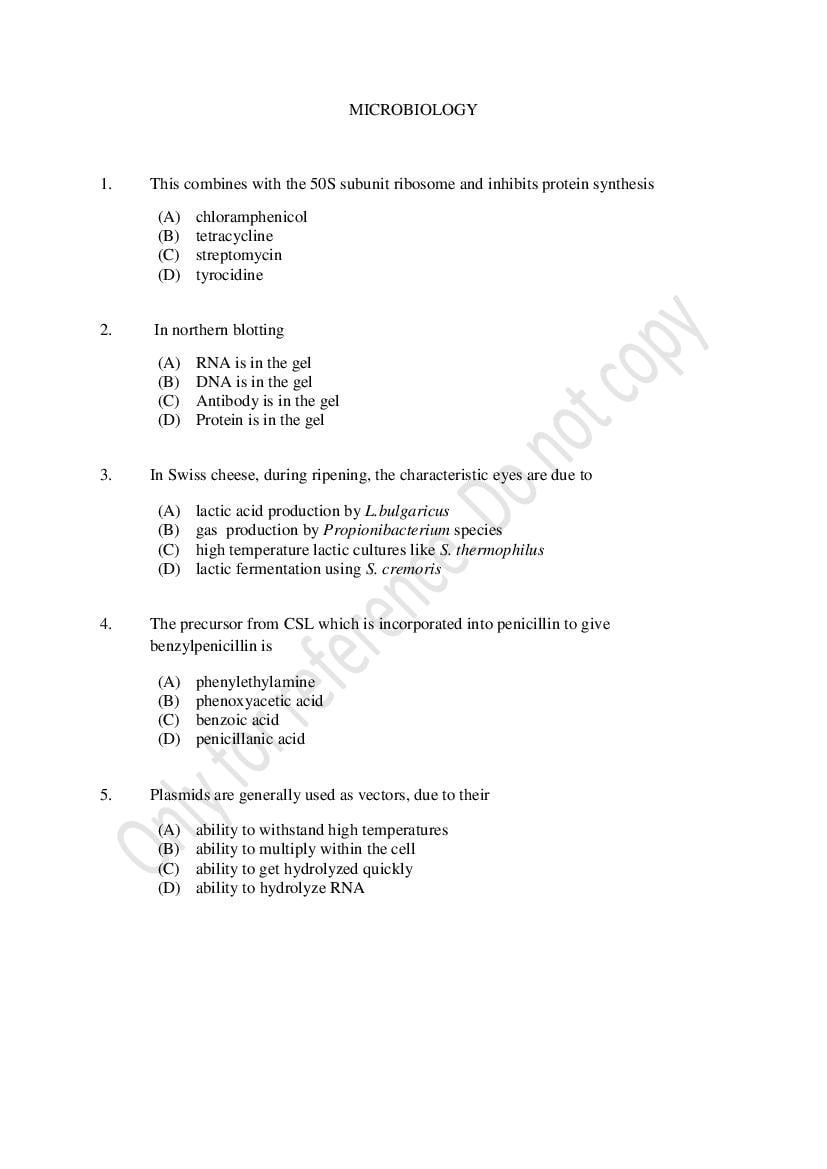
1. This combines with the 50S subunit ribosome and inhibits protein synthesis
(A) chloramphenicol
(B) tetracycline
(C) streptomycin
(D) tyrocidine
2. In northern blotting
(A) RNA is in the gel
(B) DNA is in the gel
(C) Antibody is in the gel
(D) Protein is in the gel
3. In Swiss cheese, during ripening, the characteristic eyes are due to
(A) lactic acid production by L.bulgaricus
(B) gas production by Propionibacterium species
(C) high temperature lactic cultures like S. thermophilus
(D) lactic fermentation using S. cremoris
4. The precursor from CSL which is incorporated into penicillin to give
benzylpenicillin is
(A) phenylethylamine
(B) phenoxyacetic acid
(C) benzoic acid
(D) penicillanic acid
5. Plasmids are generally used as vectors, due to their
(A) ability to withstand high temperatures
(B) ability to multiply within the cell
(C) ability to get hydrolyzed quickly
(D) ability to hydrolyze RNA
Page 2
used as detoxifying agent.
(A) Starch
(B) Acrylamide
(C) Alginic acid
(D) Gelatin
7. Limulus amebocyte lysate (LAL) bioassay is used to monitor for
(A) steroids
(B) endotoxins
(C) exotoxins
(D) squalene
8. The major factor responsible in the tissue rejection process is
(A) Polyclonal Ab produced against foreign Ag
(B) Monoclonal Ab produced against foreign Ag
(C) MHC protein present on the cells
(D) Cytotoxic T-cell reacting against the foreign Ag
9. The pH of a tissue culture medium was changed from 6 to 3, this change would
(A) Precipitate the proteins in the medium
(B) Increase the number of hydrogen ions thousand fold
(C) Dissolve all the salts
(D) Halve the concentration of the hydroxyl ions
10. In Bt cotton, the Bt protein
(A) Causes more cotton production
(B) Increases the protein content
(C) Stops egg laying by adult
(D) Prevents larvae from further feeding
11. A person without thymus will not be able to
(A) Develop an inflammatory response
(B) Reject a tissue transplant
(C) Produce antibodies
(D) Fight cold and cough
Page 3
(A) the biomass produced to the substrate utilized
(B) the biomass concentration to the product concentration
(C) the specific growth rate to the substrate availability
(D) the specific growth rate to the biomass concentration
13. It’s a water-in-oil emulsion with the heat killed tubercle bacteria
(A) Freund’s complete adjuvant
(B) Freund’s incomplete adjuvant
(C) Complement
(D) None of the above
14. What is diauxie?
(A) Nothing really. The cells just start growing
(B) The stage wise uptake of nutrients
(C) A requirement for growth factors
(D) Microbiological die-off
15. This is prepared by cleavage of DNA polymerase with subtilisin, giving a large
enzyme fragment, which has no 5’ to 3’exonuclease activity, but which still acts as a
5’ to 3’ polymerase.
(A) Klenow fragment
(B) Okazaki fragment
(C) Telomerase
(D) Hind III
16. The analysis of a gene reveals that 30% of the nucleotides is G residues. Calculate the
values for A +T.
(A) 30%
(B) 40%
(C) 50%
(D) 60%
17. The enzyme used in the prevention of chill –haze in beer is
(A) Amylase
(B) Lipase
(C) Cellulase
(D) Papain
Page 4
equipment in the plant is known as
(A) Preliminary treatment
(B) Primary treatment
(C) Preparatory treatment
(D) None of the above
19. Which of the following appears first in the circulation on stimulation?
(A) IgM
(B) IgG
(C) IgD
(D) IgE
20. A protein having both structural and enzymatic properties is
(A) Actin
(B) Trypsin
(C) Myosin
(D) Collagen
21. The RBC is
(A) Rotating Biological Chain Reactor
(B) Rotating Biological Contactor
(C) Rotating Biological Centrifuge
(D) Round Biological Chamber
22. The single letter symbol for lysine is
(A) L
(B) K
(C) Y
(D) S
23. Advantages of trickling filters is
(A) Ponding occurs
(B) Bio-coenoses develop within the reactor
(C) Specific area of voidage is less
(D) The action is not filtration
Page 5
(A) absorbance
(B) transmittance
(C) reciprocal of transmittance
(D) logarithm of transmittance
25. One of the following is used in waste water treatment
(A) air lift reactors
(B) membrane bioreactors
(C) hollow fiber reactors
(D) continuously stirred tank reactor
26. The first discovered example of a positive regulation in bacteria was
(A) L-ara operon
(B) lac operon
(C) trp operon
(D) glu operon
27. In glycerol production, the inhibitor effect is
(A) glycerol -3-phosphate production is repressed
(B) conversion of glycerol -3-phosphate to glycerol is repressed
(C) conversion of glycerol-3-phosphate to DHAP is repressed
(D) acetaldehyde production is repressed
28. The repeat unit size in base pairs of the telomeres
(A) 8 base pairs
(B) 6 base pairs
(C) 4 base pairs
(D) 3 base pairs
29. 1-fluoro-2, 4-dinitrobenzene is known as
(A) Edman’s reagent
(B) Sanger’s reagent
(C) Folin’s reagent
(D) Ninhydrin reagent
Page 6
(A) approaches Vm
(B) is independent of [S]
(C) is independent of [E]
(D) is proportional to [S]
31. The mannitol supplied in the incubation mixture of protoplast isolation,
functions primarily as
(A) source of energy
(B) buffer
(C) osmotic stabilizer
(D) N-source
32. In fluidized bed reactors
(A) Temperature gradients are very high
(B) Temperature is more or less uniform
(C) Hotspots are formed
(D) Segregation of solids occurs
33. An example of Gram positive plant pathogenic bacterium is
(A) Pseudomonas
(B) Erwinia
(C) Xanthomonas
(D) Corynebacterium
34. The different phases of the cell cycle are in the following order
(A) G1, S, G2, M
(B) S, G1, G2, M
(C) G2, S, M, G1
(D) M, G2, S, G1
35. When 20 Ci of radioactive elements were kept for 40 days, the radioactivity was
reduced to 5 Ci, then the half life of the radioactive element is
(A) 10
(B) 15
(C) 20
(D) 30
Page 7
(A) Crista
(B) Matrix
(C) F0 – F1 complex
(D) Outer membrane
37. The function of penicillin in the production of glutamic acid by
Micrococcus glutaricus is
(A) increase glutamic acid production
(B) increase the purity of glutamic acid
(C) act as inducer
(D) increase cell wall permeability for glutamic acid release
38. In prokaryotes, ETC and oxidative phosphorylation occur
(A) in the cytosol
(B) attached to the cell wall
(C) in the plasma membrane
(D) in vacuoles
39. The kinetics of microbial cell death is
(A) arithmetic
(B) exponential
(C) logarithmic
(D) None of the above
40. In electrophoresis, if the pH is above the isoelectric pH of a protein, it will
(A) migrate to the anode
(B) migrate to the cathode
(C) remain stationary
(D) precipitate
41. While constructing genomic library, one of the following combinations of restriction
enzymes is most ideal. Recognize the combination
(A) EcoR1 and Sau3A1
(B) EcoR1 and BamH1
(C) BamH1 and Sau3A1
(D) BamH1 and HindIII
Page 8
(A) IgE
(B) IgM
(C) Immunecomplex
(D) CMI
43. Oxygen demand increases when
(A) the carbon source concentration is more reduced
(B) the carbon source is more reduced
(C) the carbon source concentration is less reduced
(D) carbon source is less reduced
44. The inhibition of glycolysis by oxygen is called
(A) Hypochromic effect
(B) Bernoullii effect
(C) Pasteur effect
(D) Bohr effect
45. Methylated DNA has not been found in
(A) Drosophila
(B) E.coli
(C) Homo sapiens
(D) Arabidopsis thaliana
46. Growth of bacteria requiring p-amino benzoic acid is inhibited by
(A) pantothenic acid
(B) tetrahydrofolic acid
(C) folic acid
(D) sulfonamides
47. The chemical which induces premature polypeptide chain termination
(A) Actinomycin
(B) Streptomycin
(C) Erythromycin
(D) Puromycin
Page 9
(A) 1% sugar
(B) 1.5% sugar
(C) 2% sugar
(D) 2.5 % sugar
49. Under aerobic conditions, cellular yield coefficient is used to estimate
(A) Carbon requirements for biomass production
(B) Nitrogen requirements for biomass production
(C) Energy requirements for biomass production
(D) All the above
50. Which of the following is unchanged in the Lineweaver and Burk plot of an enzyme
by the presence of an uncompetitive inhibitor?
(A) X-intercept
(B) Y-intercept
(C) Slope
(D) None of the above
51. Origin of replication in E.coli is recognized by a complex of proteins called as
(A) Replisome
(B) DNA polymerase
(C) Primosome
(D) Ribosome
52. Chitin is a polymer of
(A) Glucosamine
(B) N-acetylglucosamine
(C) N-acetyl galactosamine
(D) Glucose and maltose
53. Which of the following is false about anaerobic waste water treatment processes?
(A) Less sensitive to upsets by toxicants
(B) Produce less sludge than aerobic process
(C) Slower than aerobic process
(D) All the above
Page 10
(A) Microaerophilic conditions
(B) Anaerobic conditions
(C) Aerobic conditions
(D) Conditions of nutrient depletion
55. Eukaryotic cells contain …………..DNA polymerases.
(A) 3
(B) 4
(C) 5
(D) 6
56. Beet molasses
(A) is limiting in biotin for yeast production
(B) is 70-75% sugar
(C) best molasses ever
(D) is hydrol
57. The addition of antifoams in an aerated bioreactor will decrease oxygen transfer rates
because antifoams
(A) decrease bubble coalescence
(B) reduce surface tension of the liquid
(C) decrease bubble size
(D) increase substrate availability
58. In fermentor sterilization, the thermal death characteristics of which organism is used?
(A) Bacillus megaterium
(B) Bacillus macerans
(C) Bacillus stearothermophilus
(D) Coxiella burnetti
59. When Saccharomyces cerevisiae is grown in a medium with a high concentration of
glucose, the cells will
(A) ferment only if the dissolved oxygen concentration is high
(B) ferment only if the dissolved oxygen concentration is low
(C) ferment regardless of the concentration of dissolved oxygen
(D) None of the above
Page 11
(A) Penicillin
(B) Glutamic acid
(C) Acetic acid from oxidation of alcohol
(D) Ethanol from fermentation of glucose
61. The region of the air lift reactor in which the air is sparged is called
(A) the down comer
(B) the air riser
(C) the disengagement zone
(D) flotsam
62. Antibiotic that damages the cytoplasmic membrane
(A) Chloramphenicol
(B) Polymyxin
(C) Penicillin
(D) Cycloserine
63. Identify the variety of surface ripened cheese
(A) Monterey
(B) Limburger
(C) Gouda
(D) Edam
64. The Orleans process is used in the manufacture of
(A) Interferon
(B) Dextran
(C) Vinegar
(D) 2,3-butanediol
65. Picornaviridae are
(A) Viruses composed of single stranded (+) type RNA
(B) Viruses composed of single stranded (-) type RNA
(C) Viruses composed of single stranded DNA
(D) Viruses composed of double stranded RNA
Page 12
diagnostic of
(A) Vesicular stomatitis
(B) Mumps
(C) Rabies
(D) Influenza
67. Mammals cannot synthesize
(A) linoleate and linolenate
(B) palmitic acid and linoleic acid
(C) oleic acid and linoleic acid
(D) palmitic acid and oleic acid
68. The outer membrane of the Gram negative cell wall is anchored to the underlying
peptidoglycan by means of
(A) Pseudomurein
(B) Braun’s lipoprotein
(C) Teichoic acids
(D) Core polysaccharide
69. The resolving power of the unaided human eye is
(A) 10 micrometre
(B) 100 micrometre
(C) 1000 nanometre
(D) 1000 nanometre
70. MacConkey agar is modified according to need. Choose the correct answer from the
following
(i) If swarming of Proteus species is not required, sodium chloride is omitted.
(ii) Crystal violet at 0.0001% is included to inhibit Gram-positive bacteria.
(iii) MacConkey with sorbitol is used to isolate an enteric pathogen E. coli O157.
(A) (i), (ii) and (iii) are incorrect
(B) (i), (ii) are correct, but (iii) is incorrect
(C) (i), (ii) and (iii) are all correct
(D) (i) and (iii) are incorrect, but (ii) is correct
Page 13
Kovac’s reagent containing
(A) p-dimethylaminobenzaldehyde
(B) p-aminobenzoic acid and aldehyde
(C) tetramethylparaphenylene diamine dihydrochloride
(D) p-dimethylaminocinnamaldehyde
72. Identify this medium based on the composition- yeast extract, peptone, sodium
thiosulfate, sodium citrate, ox, gall, sodium cholate, saccharose, sodium chloride,
ferric citrate, bromothymol blue, thymol blue and agar.
(A) Simmon’s citrate agar
(B) TCBS agar
(C) EMB agar
(D) XLD agar
73. Select the correct choice for the statement-The redox indicator used in oxidase test
(i) hydrochloride salt of N,N,N′,N′-tetramethyl-p-phenylenediamine
(ii) hydrochloride salt of p-dimethyaminocinnamaldehyde
(iii) Wurster's blue is the trivial name and the radical cation is a characteristic blue-
violet colour
(iv) It loses two electrons in one-electron oxidation steps
(A) (i) is correct, (ii), (iii) and (iv) are incorrect
(B) (i), (iii) and (iv) are correct, while (ii) is incorrect
(C) (i) and (ii) are correct, (iii) and (iv) are incorrect
(D) (ii), (iii) and (iv) are correct, while (i) is incorrect
74. The Crystal® VC Rapid Diagnostic Test (RDT) Procedure is used for
(A) E.coli
(B) V.parahaemolyticus
(C) P.aeruginosa
(D) V.cholerae
75. Peroxisomes and glyoxysomes are
(A) energy transforming organelles
(B) membraneless organelles
(C) macrobodies
(D) microbodies
Page 14
(A) Cytokinins
(B) Gibberillins
(C) Auxins
(D) Abscisic acid
77. The flattened, bulb like structure, produced by the fungi, which allows them to
penetrate their host plants directly is known as
(A) appressorium
(B) propagule
(C) biotroph
(D) aecium
78. The openings on fruits, stems and tubers that are filled with loosely connected cells to
allow passage of air are known as
(A) Hydathodes
(B) Lenticels
(C) Porins
(D) Stomata
79. Cutin is an insoluble polyester of
(A) C12 and C20 hydroxy fatty acids
(B) C20 hydroxy fatty acids
(C) C12 hydroxy fatty acids
(D) C16 and C18 hydroxy fatty acids
80. The wild fire disease of tobacco is caused by
(A) Pseudomonas syringae
(B) Pseudomonas aeroginosa
(C) Pseudomonas putida
(D) Pseudomonas solanacearum
81. The disease caused by the bacterium Agrobacterium tumefaciens is
(A) Corn smut
(B) Crown gall
(C) Banana wilt
(D) Root knot
Page 15
(A) The rate of respiration generally increases
(B) The rate of respiration generally decreases
(C) Transpiration is usually decreased
(D) Photosynthesis usually increases
83. The causative agent of smuts that cause the ears and grains to be transformed into
greenish black mass or soot is
(A) Puccinia
(B) Phytopthora
(C) Ustilago
(D) Fusarium
84. The saponins present in oats and which have antifungal membranolytic activity is
(A) Tomatine
(B) Avenacin
(C) Zeatin
(D) Lectin
85. The precursor of the wound hormone traumatin, that also acts as a signal transducer of
the defense reaction in plant-pathogen interactions is
(A) Jasmonic acid
(B) Gibberellic acid
(C) Indol acetic acid
(D) Glutamic acid
86. Phytoalexins
(A) Are produced during compatible biotrophic infections
(B) Are produced by healthy cells adjacent to the localized damaged and necrotic
cells in response to materials diffusing from the damaged cells
(C) Do not accumulate around both resistant and susceptible necrotic tissues
(D) Are not produced after stimulation by phytopathogenic microorganisms or by
chemical and mechanical injury
87. During drought conditions, plants produce a hormone known as
(A) Indole acetic acid
(B) Ethylene
(C) Abscisic acid
(D) Indole butyric acid
Page 16
(A) contain the nucleus of one cell and the cytoplasm of the other cell
(B) contain the nuclei and the cytoplasm of both protoplast cells
(C) contain only the nuclei of both protoplast cells
(D) contain only the cytoplasm of both protoplast cells
89. Cauliflower mosaic virus is a
(A) ds DNA virus
(B) ss DNA virus
(C) ss RNA virus
(D) ds RNA virus
90. Bordeaux mixture used against downy mildew is a product of the reaction of
(A) Copper sulfate and calcium hydroxide
(B) Sodium sulfate and calcium hydroxide
(C) Calcium sulfate and calcium hydroxide
(D) Zincsulfate and calcium hydroxide
91. The pH of normal unpolluted rain is usually
(A) pH 7.0
(B) pH 6.0
(C) pH 5.6
(D) pH 4.5
92. Protoplasts are used for genetic engineering because
(A) they have diploid nucleus
(B) they have no cell wall
(C) they have no cell membrane
(D) they have intact cytoplasm
93. Ectomycorrhizae is an association of
(A) bacteria and plant
(B) cyanobacteria and fungi
(C) bacteria and fungi
(D) fungi and plant root
Page 17
(A) 110°C
(B) 115°C
(C) 121°C
(D) 125°C
95. The fungus-like members of the kingdom Chromista that have elongated mycelium
containing cellulose but no cross walls are
(A) Myxomycetes
(B) Oomycetes
(C) Zygomycetes
(D) Plasmodiophoromycetes
96. Xanthomonas campestris is a seed pathogen that causes
(A) black rot of Cauliflower
(B) root rot of Barley
(C) anthracnose of French beans
(D) leaf blight of Carrot
97. Koch’s postulates-Which of the statements below is false?
(A) The microorganisms must not necessarily be found isolated with every
instance of disease
(B) The microorganism must be isolated and brought into pure culture and its
specific characters studied
(C) When the host is inoculated with the isolated microorganism under optimum
conditions, the disease should appear with characteristic symptoms
(D) The microorganism be reisolated and on comparison with the original culture,
must be found identical
98. A group of plant proteins that bind to specific carbohydrates
(A) Pectins
(B) Lectins
(C) Chitins
(D) Cutins
99. Haustoria are present in plants like
(A) Vanda
(B) Rhizophora
(C) Tinospora
(D) Mistletoe
Page 18
(A) is a medium for the preservation of green color in plant specimen
(B) is a nuclear stain
(C) is a fixative
(D) is a culture medium for bacteria
101. Loeffler’s alkaline methylene blue is
(A) Flagella stain
(B) Spore stain
(C) Acid fast stain
(D) Capsule stain
102. Process absent in virus or not virus mediated
(A) Replication
(B) Mutation
(C) protein synthesis
(D) energy liberation
103. Mycoplasma like organisms which have only cell membrane and lacking cell wall are
classified as
(A) Gracilicutes
(B) Firmicutes
(C) Mollicutes
(D) Proteobacteria
104. The change of a cell through uptake and expression of additional genetic material
(A) Conjugation
(B) Transformation
(C) Generalized transduction
(D) Specialized transduction
105. RNA dependent DNA polymerase is part of genome of
(A) Influenza virus
(B) Herpes virus
(C) Adenovirus
(D) Papilloma virus
Page 19
(A) AT to GC
(B) GC to AT
(C) TA to AT
(D) CG to GC
107. The function of the sex (F) pilus of Escherichia coli involves
(A) transport of nutrients
(B) attachment of cells to inert surfaces
(C) movement of cells in a type of twitching motion
(D) transfer of DNA between bacteria during conjugation
108. In bacterial genetics, the term competence refers to a bacterium with
(A) ability to be transformed
(B) the F factor integrated into its chromosomal DNA
(C) susceptibility to lytic infection by bacteriophage
(D) ability to act as a DNA donor during transformation
109. Which of the following is an advantage that ectotherms have over endotherms of the
same size?
(A) They require much less food
(B) They are less vulnerable to predation during cold weather
(C) They can remain active in cold weather or on cold nights
(D) They have higher metabolic rates and grow more quickly
110. As an animal gets larger, which of the following occurs?
(A) Its surface area grows more rapidly than its volume
(B) Its volume grows more rapidly than its surface area
(C) Its volume and surface area increase in perfect proportion to each other
(D) Its volume increases, but its total surface area decreases
111. Cellulose is fermented in which of the following structures in rabbits?
(A) Small intestine
(B) Caecum
(C) Rectum
(D) Rumen
Page 20
(A) Brain stem
(B) Cerebellum
(C) Frontal lobe
(D) Hippocampus
113. Which of the following classes of muscles is/are voluntary?
(A) Skeletal muscle
(B) Cardiac muscle
(C) Smooth muscle
(D) All of the above
114. Which of the following developmental processes is not controlled by hormones?
(A) The initial development of male and female gonads in mammals, soon after
fertilization
(B) Overall growth in vertebrates
(C) Moulting in insects and other invertebrates
(D) Metamorphosis in insects and other invertebrates
115. Which of the following modes of asexual reproduction describes the mode of
reproduction in Sea anemones?
(A) Fusion
(B) Fission
(C) Budding
(D) Parthenogenesis
116. What happens during cleavage?
(A) The neural tube forms
(B) The inner cell mass of the blastocyst begins dividing rapidly
(C) The zygote divides rapidly without growth, forming a mass of cells
(D) Massive movements of cells form the three germ layers
117. What is the most important difference between the innate and adaptive immune
responses?
(A) The innate response does not distinguish between pathogens, while the
adaptive response does
(B) Only the innate response is activated by antigens
(C) The adaptive response generates immunological memory and is more specific
than the innate response
(D) The innate response does not kill cells; the adaptive response does
Page 21
(A) CD4+ cells are immature, and CD8+ cells are mature
(B) CD4+ cells are activated, and CD8+ cells are not
(C) CD4+ cells activate cell-mediated responses, and CD8+cells activate humoral
responses
(D) CD4+ cells interact with Class II MHC proteins and CD8+cells interact with
class I MHC proteins
119. Which of the following is not found in the cells of higher plants?
(A) Plasma membrane
(B) Chromoplasts
(C) Ribosomes
(D) Centriole
120. A behaviour is considered adaptive if it increases an individual’s fitness. How is
fitness measured?
(A) Strength
(B) Speed
(C) Body size
(D) Number of viable offspring
121. A taxon is
(A) A group of related plants or animals
(B) A type of living organism
(C) A group of related families
(D) A taxonomic group of any rank
122. The pesticide DDT will be mostly concentrated in
(A) Tertiary consumers
(B) Primary decomposers
(C) Primary producers
(D) Secondary consumers
123. What does genetic diversity mean?
(A) The count of species in a territory
(B) Species interacting with the abiotic environment
(C) Abundance of each species present
(D) The complete genetic information of a population, species or a group of species
Page 22
(A) Monera
(B) Protista
(C) Fungi
(D) Plantae
125. The group of vertebrates with the greatest capacity for gas exchange
across the skin is
(A) Fishes
(B) Amphibians
(C) Reptiles
(D) Mammals
126. Which of Mendel’s laws cannot be observed in a single-factor cross?
(A) Segregation
(B) Dominance
(C) Independent assortment
(D) Recessiveness
127. The enzyme that allows short segments of DNA to move from one location in the
genome to another is
(A) Transposase
(B) Restriction endonuclease
(C) DNA polymerase
(D) RNA polymerase
128. The movement of landmasses that have changed their positions, shapes, and
association with other landmasses is called
(A) Glaciation
(B) Pangaea
(C) Continental drift
(D) Biogeography
129. Neck is absent in frog. This helps frog in
(A) Jumping around
(B) Swimming in water
(C) Respiration
(D) Catching prey
Page 23
(A) Pygostyle
(B) Uropyge
(C) Urostyle
(D) None of the above
131. Hepatic portal system starts from
(A) Digestive system to liver
(B) Kidney to liver
(C) Liver to heart
(D) Liver to kidney
132. Nissl granules are found in
(A) Internal ear
(B) Uriniferous tubules
(C) Bile juice
(D) Neuronal cell
133. Which of the following chromosomes are found in salivary glands of Drosophila?
(A) Normal
(B) Lampbrush
(C) Polytene
(D) Heterochromatic
134. In ecological sense, the desert animals are termed as
(A) Arboreal
(B) Cursorial
(C) Benthic
(D) Xeric
135. Animal species should be preserved mainly because
(A) They are lovely creatures
(B) They are useful to mankind
(C) Man cannot recreate a species of animals if it be destroyed
(D) Zoologists want to study them
Page 24
(A) Only B-cells
(B) Only T-cells
(C) Mainly T-cells
(D) Both B - and T- cells
137. Helper T-cells
(A) Produce antibodies
(B) Stimulate antibody production by B-cells
(C) Produce B-cells
(D) Produce B-cells as well as Killer cells
138. Heterocysts are specialized for
(A) Aerobic respiration
(B) Photosynthesis
(C) Nitrogen fixation
(D) Reproduction
139. Coprophilous fungi grow on
(A) Grasses
(B) Dung
(C) Animals
(D) Wood
140. Sorosis is the fruit that develops from an inflorescence like:
(A) Spike or Spadix
(B) Capitulum
(C) Racemose
(D) Cymose
141. Female sex organ of Rodophyceae is
(A) Carpogonium
(B) Archegonium
(C) Oogonium
(D) Sporogonium
Page 25
(A) Prothallus is formed
(B) Sex organs are formed
(C) Spores are formed
(D) Gametes are formed
143. Lichens are ecologically important because
(A) They are associations of algae and fungi
(B) They can grow in highly polluted areas
(C) They are pioneers of vegetation in a lithosphere
(D) They are symbiotic with higher plants
144. The catalytic efficiency of two different enzymes can be compared by the
(A) formation of the product
(B) the pH of optimum value
(C) the Km value
(D) molecular size of the enzyme
145. When synapsis is complete all along the chromosome, the cell is said to have entered
a stage called
(A) Zygotene
(B) Pachytene
(C) Diplotene
(D) Diakinesis
146. The pathway of the movement of water through cell wall only is called
(A) Symplast pathway
(B) Plasmodesmata pathway
(C) Apoplast pathway
(D) Vacuolar pathway
147. Hevea brasiliensis belongs to the family:
(A) Fabaceae
(B) Lamiaceae
(C) Verbinaceae
(D) Euphorbiaceae
Page 26
partners is called:
(A) Symbiosis
(B) Commensalism
(C) Parasitism
(D) Mutualism
149. The correct sequence of flow of electrons in the light reaction is
(A) PS II, plastoquinone, cytochromes, PS I, ferredoxin
(B) PS I, plastoquinone, cytochrome, PS II, ferredoxin
(C) PS I, ferredoxin, PS II
(D) PS I, plastoquinone, cytochromes, PS II, ferredoxin
150. The chemiosmotic hypothesis of oxidative phosphorylation process is that ATP is
formed because
(A) A proton gradient forms across the inner mitochondrial membrane
(B) There is a change in the permeability of the inner mitochondrial membrane
towards ADP
(C) High energy bonds are formed in mitochondrial proteins
(D) ADP is pumped out of the matrix into the inner membrane space
***********
Page 27
Subject Name: 623 MICROBIOLOGY
SI No. Key SI No. Key SI No. Key SI No. Key SI No. Key
1 A 31 C 61 C 91 C 121 A
2 A 32 B 62 B 92 B 122 A
3 B 33 D 63 B 93 D 123 C
4 A 34 A 64 C 94 C 124 A
5 B 35 C 65 A 95 B 125 B
6 C 36 C 66 C 96 A 126 C
7 B 37 D 67 A 97 A 127 A
8 C 38 C 68 B 98 B 128 C
9 B 39 B 69 B 99 D 129 B
10 D 40 A 70 C 100 A 130 C
11 B 41 C 71 A 101 C 131 A
12 C 42 D 72 B 102 D 132 D
13 A 43 B 73 B 103 C 133 C
14 B 44 C 74 D 104 B 134 D
15 A 45 D 75 D 105 A 135 C
16 B 46 D 76 C 106 A 136 D
17 D 47 D 77 A 107 D 137 B
18 A 48 C 78 B 108 A 138 C
19 A 49 A 79 D 109 A 139 B
20 C 50 C 80 A 110 B 140 A
21 B 51 C 81 B 111 B 141 A
22 B 52 B 82 A 112 D 142 C
23 B 53 A 83 C 113 A 143 C
24 B 54 C 84 B 114 A 144 C
25 D 55 C 85 A 115 B 145 B
26 A 56 A 86 B 116 C 146 C
27 D 57 B 87 C 117 C 147 D
28 B 58 C 88 A 118 D 148 D
29 B 59 B 89 A 119 D 149 A
30 D 60 A 90 A 120 D 150 A
Document Details
| Board / Org | Cochin University |
| Exam | CUSAT Common Admission Test |
| Type | Question Paper |
| Pages | 27 |
| Language | english |
| Updated | 22 Jul 2026 |