GATE 2022 Question Paper CY Chemistry
Finished viewing? Save it for later —
Download GATE 2022 Question Paper CY Chemistry (PDF · 47 pages)About GATE 2022 Question Paper CY Chemistry
GATE 2022 Question Paper CY Chemistry is available here for free download. Published by IIT for Graduate Aptitude Test in Engineering, this question paper can be viewed online or downloaded as a PDF (47 pages). Candidates preparing for Graduate Aptitude Test in Engineering can use GATE 2022 Question Paper CY Chemistry to understand the exam pattern, the type of questions asked, and the overall difficulty level.
Frequently Asked Questions
How can I download GATE 2022 Question Paper CY Chemistry?
Open this page and click the Download button to save GATE 2022 Question Paper CY Chemistry as a PDF. It is completely free on AglaSem Docs.
Is GATE 2022 Question Paper CY Chemistry free to download?
Yes. GATE 2022 Question Paper CY Chemistry can be viewed online and downloaded as a PDF free of cost on AglaSem Docs.
How many pages does GATE 2022 Question Paper CY Chemistry have?
GATE 2022 Question Paper CY Chemistry contains 47 pages, which you can read online or download together as a single PDF.
Where can I find more Graduate Aptitude Test in Engineering study material?
You can find more Graduate Aptitude Test in Engineering question papers, sample papers, syllabus, and answer keys on AglaSem Docs.
GATE 2022 Question Paper CY Chemistry – Text
Read the full text of this question paper below — useful to quickly search, copy and reference the content online without downloading the PDF.
📄 View text version (47 pages)
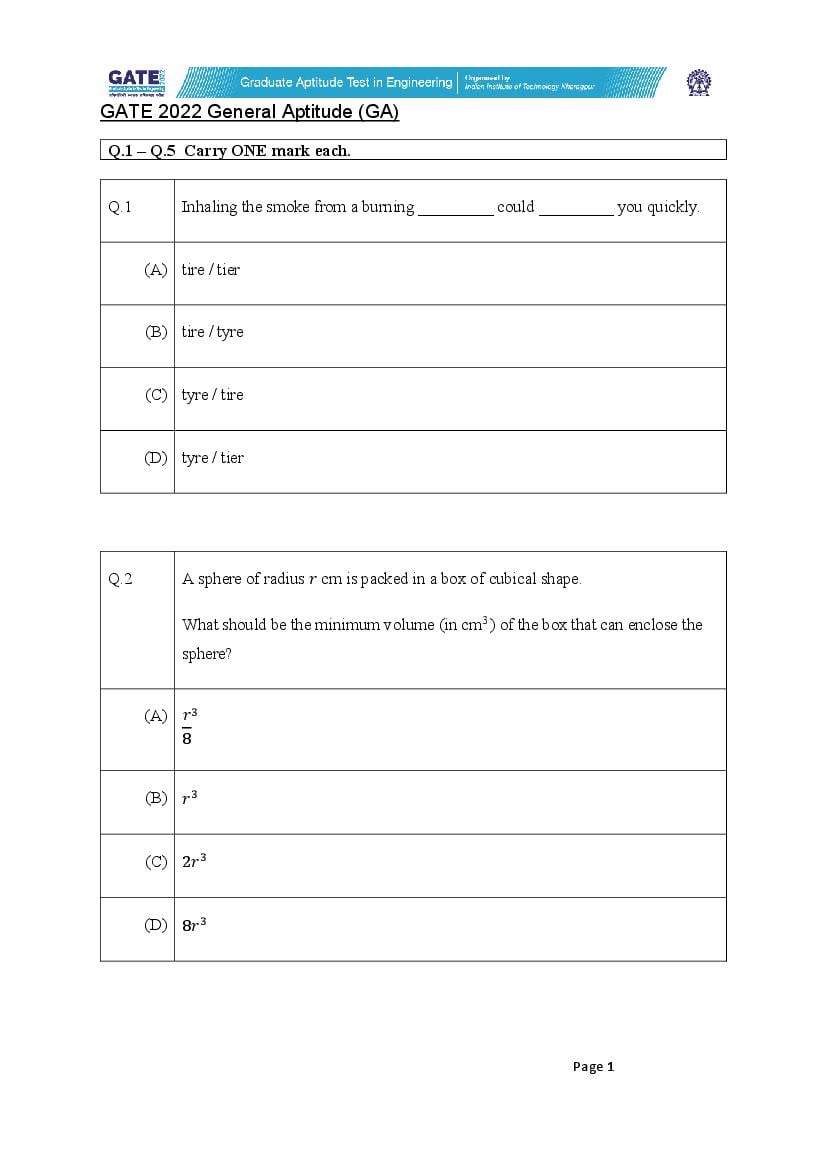
Page 1
Q.1 – Q.5 Carry ONE mark each.
Q.1 Inhaling the smoke from a burning _________ could _________ you quickly.
(A) tire / tier
(B) tire / tyre
(C) tyre / tire
(D) tyre / tier
Q.2 A sphere of radius 𝑟 cm is packed in a box of cubical shape.
What should be the minimum volume (in cm3 ) of the box that can enclose the
sphere?
(A) 𝑟
8
(B) 𝑟
(C) 2𝑟
(D) 8𝑟
Page 1
Page 2
respectively. Pipe R draws the water out from the storage tank at a rate of 34
litres per minute. P, Q and R operate at a constant rate.
If it takes one hour to completely empty a full storage tank with all the pipes
operating simultaneously, what is the capacity of the storage tank (in litres)?
(A) 26.8
(B) 60.0
(C) 120.0
(D) 127.5
Page 2
Page 3
center not necessarily in the same order. Consider the following statements:
P sits next to S and T.
Q sits diametrically opposite to P.
The shortest distance between S and R is equal to the shortest distance
between T and U.
Based on the above statements, Q is a neighbor of
(A) U and S
(B) R and T
(C) R and U
(D) P and S
Page 3
Page 4
given below. The doors are closed initially.
What is the minimum number of doors that need to be opened in order to go
from the point P to the point Q?
(A) 4
(B) 3
(C) 2
(D) 1
Page 4
Page 5
Q.6 Rice, a versatile and inexpensive source of carbohydrate, is a critical component
of diet worldwide. Climate change, causing extreme weather, poses a threat to
sustained availability of rice. Scientists are working on developing Green Super
Rice (GSR), which is resilient under extreme weather conditions yet gives higher
yields sustainably.
Which one of the following is the CORRECT logical inference based on the
information given in the above passage?
(A) GSR is an alternative to regular rice, but it grows only in an extreme weather
(B) GSR may be used in future in response to adverse effects of climate change
(C) GSR grows in an extreme weather, but the quantity of produce is lesser than
regular rice
(D) Regular rice will continue to provide good yields even in extreme weather
Page 5
Page 6
Q.7
When the arrow comes to rest, there are eight equally likely outcomes. It could
come to rest in any one of the sectors numbered 1, 2, 3, 4, 5, 6, 7 or 8 as shown.
Two such disks are used in a game where their arrows are independently spun.
What is the probability that the sum of the numbers on the resulting sectors upon
spinning the two disks is equal to 8 after the arrows come to rest?
(A) 1
16
(B) 5
64
(C) 3
32
(D) 7
64
Page 6
Page 7
(i) 3𝑝 − 𝑞 < 4
(ii) 3𝑞 − 𝑝 < 12
Which one of the following expressions below satisfies the above two
inequalities?
(A) 𝑝 + 𝑞 < 8
(B) 𝑝 + 𝑞 = 8
(C) 8 ≤ 𝑝 + 𝑞 < 16
(D) 𝑝 + 𝑞 ≥ 16
Page 7
Page 8
statements.
Statement 1: Some engineers are writers.
Statement 2: No writer is an actor.
Statement 3: All actors are engineers.
Conclusion I: Some writers are engineers.
Conclusion II: All engineers are actors.
Conclusion III: No actor is a writer.
Conclusion IV: Some actors are writers.
Which one of the following options can be logically inferred?
(A) Only conclusion I is correct
(B) Only conclusion II and conclusion III are correct
(C) Only conclusion I and conclusion III are correct
(D) Either conclusion III or conclusion IV is correct
Page 8
Page 9
with a single round hole near the center? Pieces cannot overlap.
(A)
(B)
(C)
(D)
Page 9
Page 10
Q.11 The major product M formed in the following reaction is
(A)
(B)
(C)
(D)
Page 10
Page 11
Q.12
(A)
(B)
(C)
(D)
Page 11
Page 12
{[M] = molecular ion peak}
(A) [M], [M+2] and [M+4] with relative intensity of 1:2:1
(B) [M] and [M+2] with relative intensity of 1:1
(C) [M], [M+2] and [M+4] with relative intensity of 1:3:1
(D) [M] and [M+2] with relative intensity of 2:1
Page 12
Page 13
HCl afforded a cyclic compound M and a dipeptide. The dipeptide on treatment
with PhNCS (pH = 8.0) followed by heating with dilute HCl afforded a cyclic
compound N and an acyclic compound O. The CORRECT sequence (from N- to
C-terminus) of the tripeptide is
(A) glycine-phenylalanine-valine
(B) valine-phenylalanine-glycine
(C) glycine-tyrosine-valine
(D) glycine-phenylalanine-alanine
Page 13
Page 14
(A)
(B)
(C)
(D)
Page 14
Page 15
Q.16
(A)
(B)
(C)
(D)
Page 15
Page 16
(A) the temperature differences between the sample and reference are measured as a
function of temperature
(B) the differences in heat flow into the reference and sample are measured as a function
of temperature
(C) the change in the mass of the sample is measured as a function of temperature
(D) the glass transition is observed as a sharp peak
Q.18 The 𝜈 resonance Raman stretching frequency (cm-1) of the coordinated
dioxygen in oxy-hemoglobin and oxy-hemocyanin appears, respectively, nearly at
(A) 1136 and 744
(B) 1550 and 744
(C) 744 and 1136
(D) 744 and 1550
Page 16
Page 17
[Mo2(CH3CO2)4] complex is(are), respectively,
(A) 1, 2, 1
(B) 1, 2, 0
(C) 1, 1, 0
(D) 1, 1, 1
Page 17
Page 18
respectively. If 𝑆 = ⟨1𝑠 |1𝑠 ⟩, the option that is ALWAYS CORRECT is
(A) S=1
(B) S=0
(C) S = imaginary constant
(D) 0≤S≤1
The pure vibrational spectrum of a hypothetical diatomic molecule shows three
Q. 21 peaks with the following intensity at three different temperatures.
Peak Intensity (arbitrary unit)
300 K 600 K 900 K
I 1.0 1.0 1.0
II 0.1 0.1 0.1
III 0.02 0.04 0.06
The CORRECT statement is
(A) Peak I appears at the lowest energy
(B) Peak II appears at the lowest energy
(C) Peak III appears at the lowest energy
(D) Peak I appears at the highest energy
Page 18
Page 19
(A) D6h
(B) Oh
(C) D6d
(D) C6v
Q. 23 A point originally at (1, 3, 5) was subjected to a symmetry operation (𝑂 ) that
shifted the point to (−1, −3, 5). Subsequently, the point at (−1, −3, 5) was
subjected to another symmetry operation (𝑂 ) that shifted this point to
(−1, −3, −5). The symmetry operators 𝑂 and 𝑂 are, respectively,
(A) 𝐶 (𝑥) and 𝜎(𝑥𝑦)
(B) 𝐶 (𝑧) and 𝜎(𝑥𝑦)
(C) 𝜎(𝑥𝑦) and 𝐶 (𝑧)
(D) 𝑆 and 𝑆
Page 19
Page 20
isotherm. For a fixed fractional coverage, the correct relation between K and P at a
fixed temperature is
[𝐾 = 𝑘 /𝑘 , 𝑘 and 𝑘 are the rate constants for adsorption and desorption,
respectively. Assume non-dissociative adsorption.]
(A) 𝐾 P /
(B) 𝐾 P
(C) 𝐾 P
(D) 𝐾 P /
Q. 25 The temperature dependence of the rate constant for a second-order chemical
reaction obeys the Arrhenius equation. The SI unit of the ‘pre-exponential factor’
is
(A) s-1
(B) m3 mol-1 s-1
(C) mol m-3 s-1
(D) (m3 mol-1)2 s-1
Page 20
Page 21
(A) H2O2, NaOH
(B)
(C) DIBAL-H, then mCPBA
(D) SO3·pyridine, Me2SO
Page 21
Page 22
is(are)
(A) P shows a sharp singlet at δ = 3.70 ppm (for Ha and Hb)
(B) Q shows a sharp singlet at δ = 3.70 ppm (for Ha and Hb)
(C) P shows a AB-quartet centered at δ = 3.63 ppm (for Ha and Hb)
(D) Q shows a AB-quartet centered at δ = 3.63 ppm (for Ha and Hb)
Q.28 The CORRECT statement(s) about thallium halides is(are)
(A) TlF is highly soluble in water whereas other Tl-halides are sparingly soluble
(B) TlF adopts a distorted NaCl structure
(C) TlI3 is isomorphic with CsI3 and the oxidation state of Tl is +3
(D) Both TlBr and TlCl have CsCl structure
Page 22
Page 23
is(are)
(A) The collision between atoms causes broadening of the spectral line
(B) Shorter the lifetime of the excited state, the broader is the line width
(C) Doppler broadening is more pronounced as the flame temperature increases
(D) In flame and plasma, the natural line broadening exceeds the collisional line
broadening
Page 23
Page 24
metal centre present in the active site of metalloenzyme.
A B
P Cu I B12-coenzyme
Q Mo II Carboxypeptidase
R Co III Nitrate reductase
S Zn IV Cytochrome P-450
V Tyrosinase
(A) P-V, Q-III, R-I, S-II
(B) P-IV, Q-II, R-I, S-III
(C) P-II, Q-IV, R-V, S-III
(D) P-V, Q-III, R-II, S-IV
Page 24
Page 25
pure substance X is(are)
(A) The molar volume of solid X is less than the molar volume of liquid X
(B) X does not have a normal boiling point
(C) The melting point of X decreases with increase in pressure
(D) On increasing the pressure of the gas isothermally, it is impossible to reach solid
phase before reaching liquid phase
Q. 32 The parameter(s) fixed for each system in a canonical ensemble is(are)
(A) temperature
(B) pressure
(C) volume
(D) composition
Page 25
Page 26
spectrum recorded at 25 C in CDCl3 is
Q.34 The diffraction angle (in degree, rounded off to one decimal place) of (321) sets of
plane of a metal with atomic radius 0.125 nm, and adopting BCC structure is
(Given: the order of reflection is 1 and the wavelength of X-ray is 0.0771 nm)
Q. 35 For the angular momentum operator 𝐿 and the spherical harmonics 𝑌 (𝜃, 𝜙),
𝐿 + 𝐿 𝑌 (𝜃, 𝜙) = 𝑛 ℏ 𝑌 (𝜃, 𝜙).
The value of 𝑛 is
Page 26
Page 27
Q.36 The major product P obtained in the following reaction sequence is
(A)
(B)
(C)
(D)
Page 27
Page 28
Q.37
(A)
(B)
(C)
(D)
Page 28
Page 29
(A)
(B)
(C)
(D)
Page 29
Page 30
(A)
(B)
(C)
(D)
Page 30
Page 31
(A)
(B)
(C)
(D)
Page 31
Page 32
(A)
(B)
(C)
(D)
Page 32
Page 33
(solid circles represent atom). The crystal system of the unit cell is
(A) triclinic
(B) monoclinic
(C) tetragonal
(D) orthorhombic
Q.43 The number of equivalents of H2S gas released from the active site of rubredoxin,
2-iron ferredoxin, and 4-iron ferredoxin when treated with mineral acid,
respectively, are
(A) 4, 6, 8
(B) 0, 2, 4
(C) 1, 2, 4
(D) 0, 2, 3
Page 33
Page 34
the high-spin [Mn(dmso)6]3+ complex (dmso: dimethylsulfoxide) is
(A) only one
(B) two with intensity ratio 1:2
(C) two with intensity ratio 1:1
(D) six with intensity ratio 1:1:1:1:1:1
Page 34
Page 35
*indicates a radioactive isotope
The rate constants in the given self-exchange electron transfer reactions at a
certain temperature follow
(A) k11 > k22 > k33
(B) k22 > k11 > k33
(C) k33 > k22 > k11
(D) k22 > k33 > k11
Page 35
Page 36
(A)
(B)
(C)
(D)
Page 36
Page 37
a metal produces a brown precipitate that is insoluble in dilute acid. The cationic
species is
(A) Fe3+
(B) UO22+
(C) Th4+
(D) Cu2+
Q.48 The electronic spectrum of a Ni(II) octahedral complex shows four d-d bands,
labelled as P, Q, R, and S. Match the bands corresponding to the transitions.
λmax, nm (ε, M-1cm-1) Transitions
3
P 1000 (50) I A2g(F) → 3T1g(P)
3
Q 770 (8) II A2g(F) → 3T1g(F)
3
R 630 (55) III A2g(F) → 3T2g(F)
3
S 375 (110) IV A2g(F) → 1Eg(D)
(A) P-IV, Q-III, R-II, S-I
(B) P-III, Q-IV, R-II, S-I
(C) P-II, Q-IV, R-I, S-III
(D) P-I, Q-IV, R-II, S-III
Page 37
Page 38
column shows a set of molecules.
P. Symmetric rotor (oblate) 1. SiH4
Q. Symmetric rotor (prolate) 2. CH3Cl
R. Spherical rotor 3. C6H6
S. Asymmetric rotor 4. CH3OH
5. CO2
The CORRECT match is
(A) P-1, Q-2, R-3, S-4
(B) P-3, Q-2, R-1, S-4
(C) P-3, Q-5, R-1, S-2
(D) P-5, Q-4, R-3, S-2
Page 38
Page 39
vibration of SO3 is
(I) (II) (III)
‘+’ and ‘−’ indicate
out-of-plane motion
(A) (I) and (II) are infrared active while (III) is infrared inactive
(B) (I) is infrared inactive while (II) and (III) are infrared active
(C) (I) and (III) are infrared inactive while (II) is infrared active
(D) None of the modes are infrared active since SO3 has zero dipole moment
Page 39
Page 40
(A)
(B)
(C)
(D)
Page 40
Page 41
(A)
(B)
(C)
(D)
Page 41
Page 42
(A) Brønsted acidity of B10H14 is higher than that of B5H9
(B) Structurally B10H14 is a closo-borane
(C) The metal-promoted fusion of B H produces B10H14
(D) Both B10H14 and B10H12(SEt2)2 have the same number of valence electrons
Q.54 The CORRECT statement(s) about the Group-I metals is(are)
(A) Reactivity of Group-I metals with water decreases down the group
(B) Among the Group-I metals, Li spontaneously reacts with N2 to give a red-brown
layer-structured material
(C) Thermal stability of Group-I metal peroxides increases down the group
(D) All the Group-I metal halide are high-melting colorless crystalline solids
Page 42
Page 43
(Atomic number of Os = 76, Rh = 45, Mo = 42, and Fe = 26)
(A)
(B)
(C)
(D)
Page 43
Page 44
(A) 𝐶 , 𝐴, 𝐵
(B) 𝐶, 𝐵, 𝐴
(C) 𝐵, 𝐴 , 𝐶
(D) 𝐴, 𝐵 , 𝐶
Q. 57 The difference between the number of Gauche-butane interactions present in P
and Q is
Q.58 The calculated magnetic moment (in BM, rounded off to two decimal places) of a
Ce3+ complex is
Page 44
Page 45
wavefunction,
3 7
Ψ(𝑟, 𝜃. 𝜙) = 𝑅 (𝑟)𝑌 (𝜃, 𝜙) − 𝑖 𝑅 (𝑟)𝑌 (𝜃, 𝜙) + 𝑥𝑅 (𝑟)𝑌 (𝜃, 𝜙).
8 16
Here, 𝑅 and 𝑌 represent the radial and angular components of the
+
eigenfunctions of He ion, respectively, and 𝑥 is an unknown constant. If the energy
of the ion is measured in the above state, the probability (rounded off to two decimal
places) of obtaining the energy of − atomic unit is
Q.60 A certain wavefunction for the hydrogen-like atom is given by
/
/
Ψ(𝑟, 𝜃, 𝜙) = 6− 𝑟𝑒 cos 𝜃 .
The number of node(s) in this wavefunction is
Page 45
Page 46
Cu│CuSO4(aq, 1.0 mol/kg)│Hg2SO4(s)│Hg(l)│Pt
at 25 C and 1 bar is 0.36 V. The value of the mean activity coefficient (rounded
off to three decimal places) of CuSO4 at 25 C and 1 bar is
[Given: Standard electrode potential values at 25 C for
Cu + 2e Cu and
Hg SO + 2e 2Hg + SO
are 0.34 V and 0.62 V, respectively.
Consider: RT/F at 25 C = 0.0256 V]
Page 46
Page 47
dimensional random coil linear polyethylene of molecular weight 8,40,000 is
[Given: CC bond length = 0.154 nm]
Q. 63 The activation energy of the elementary gas-phase reaction O3 + NO NO2 + O2
is 10.5 kJ mol-1. The value of the standard enthalpy of activation (rounded off to
two decimal places in kJ mol-1) at 25 C is
[Given: R is 8.314 J mol-1 K-1]
Q. 64 In a collection of molecules, each molecule has two non-degenerate energy levels
that are separated by 5000 cm-1. On measuring the population at a particular
temperature, it was found that the ground state population is 10 times that of the
upper state. The temperature (in K, rounded off to the nearest integer) of
measurement is
[Given: Value of the Boltzmann constant = 0.695 cm-1 K-1]
Q. 65 The change in entropy of the surroundings (in J K-1, rounded off to two decimal
places) to convert 1 mol of supercooled water at 263 K to ice at 263 K at 1 bar is
[Consider: ΔfusH at 273 K = 6.0 kJ mol-1, and the molar heat capacity of water is
higher than that of ice by 37.0 J K-1 mol-1 in the temperature range of 263 K to
273 K]
Page 47
Document Details
| Board / Org | IIT |
| Exam | Graduate Aptitude Test in Engineering |
| Type | Question Paper |
| Pages | 47 |
| Language | english |
| Updated | 22 Jul 2026 |