CUSAT CAT 2021 Question Paper Zoology
Finished viewing? Save it for later —
Download CUSAT CAT 2021 Question Paper Zoology (PDF · 27 pages)About CUSAT CAT 2021 Question Paper Zoology
CUSAT CAT 2021 Question Paper Zoology is available here for free download. Published by Cochin University for CUSAT Common Admission Test, this question paper can be viewed online or downloaded as a PDF (27 pages). Candidates preparing for CUSAT Common Admission Test can use CUSAT CAT 2021 Question Paper Zoology to understand the exam pattern, the type of questions asked, and the overall difficulty level.
Frequently Asked Questions
How can I download CUSAT CAT 2021 Question Paper Zoology?
Open this page and click the Download button to save CUSAT CAT 2021 Question Paper Zoology as a PDF. It is completely free on AglaSem Docs.
Is CUSAT CAT 2021 Question Paper Zoology free to download?
Yes. CUSAT CAT 2021 Question Paper Zoology can be viewed online and downloaded as a PDF free of cost on AglaSem Docs.
How many pages does CUSAT CAT 2021 Question Paper Zoology have?
CUSAT CAT 2021 Question Paper Zoology contains 27 pages, which you can read online or download together as a single PDF.
Where can I find more CUSAT Common Admission Test study material?
You can find more CUSAT Common Admission Test question papers, sample papers, syllabus, and answer keys on AglaSem Docs.
CUSAT CAT 2021 Question Paper Zoology – Text
Read the full text of this question paper below — useful to quickly search, copy and reference the content online without downloading the PDF.
📄 View text version (27 pages)
Page 1
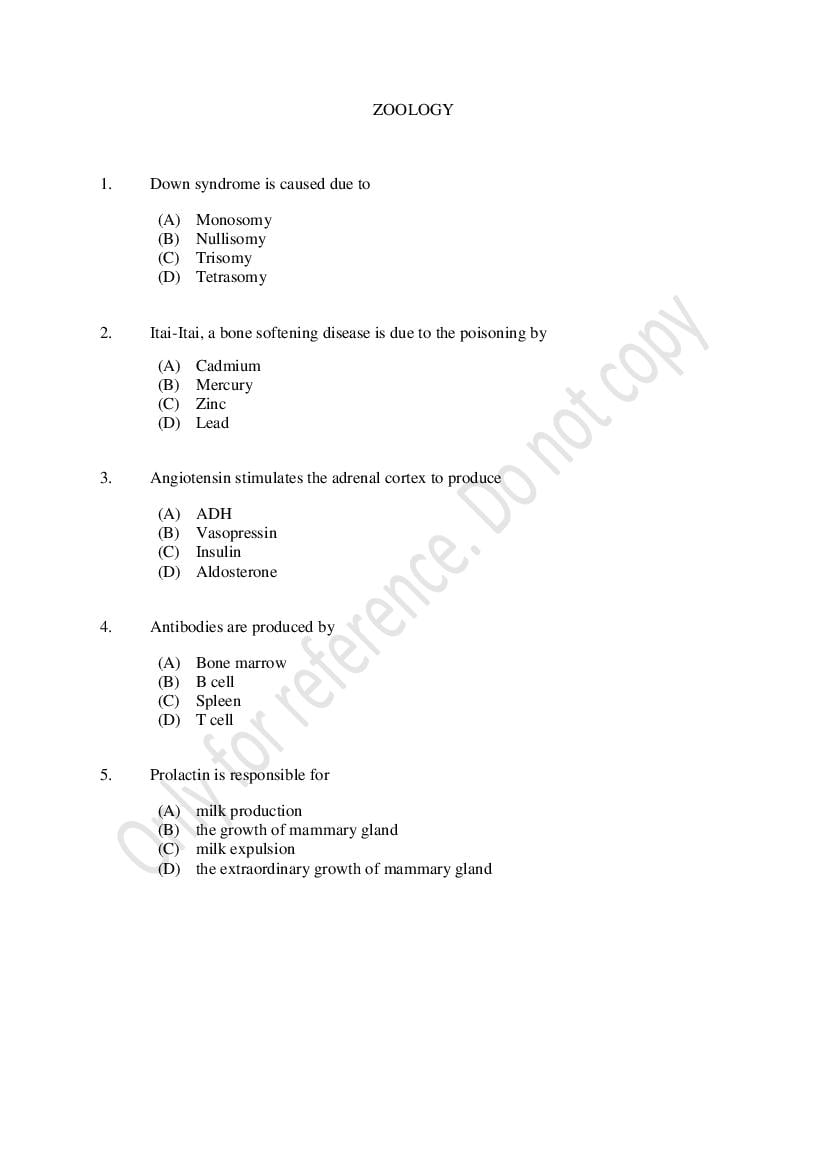
1. Down syndrome is caused due to
(A) Monosomy
(B) Nullisomy
(C) Trisomy
(D) Tetrasomy
2. Itai-Itai, a bone softening disease is due to the poisoning by
(A) Cadmium
(B) Mercury
(C) Zinc
(D) Lead
3. Angiotensin stimulates the adrenal cortex to produce
(A) ADH
(B) Vasopressin
(C) Insulin
(D) Aldosterone
4. Antibodies are produced by
(A) Bone marrow
(B) B cell
(C) Spleen
(D) T cell
5. Prolactin is responsible for
(A) milk production
(B) the growth of mammary gland
(C) milk expulsion
(D) the extraordinary growth of mammary gland
Page 2
(A) Steroid
(B) Protein
(C) Lipid
(D) Carbohydrate
7. The test which is used to confirm HIV infection is
(A) Western Blot
(B) ELISA
(C) Diploid cell staining
(D) Pure culture
8. The term ‘heterosis’ represents
(A) Male sterility
(B) Hybrid vigour
(C) Hybrid incompatibility
(D) Cladogen
9. Which of the following is associated with Minamata disease?
(A) Cadmium
(B) Lead
(C) Mercury
(D) Trichomonads
10. Monophagy is a mode of feeding on
(A) a mixed food
(B) a selected type food
(C) a variety of food
(D) a single type of food
11. Oncology is the study of
(A) Birds
(B) Mammals
(C) Cancer
(D) Tiddues
Page 3
(A) Watson and Crick
(B) Messelson and Stahl
(C) Beattle and Tantee
(D) William and Frankli
13. The phenomenon of ‘summer sleep’ by animals is called
(A) hibernation
(B) aestivation
(C) laziness
(D) lethargy
14. The largest structure in the cell is
(A) Golgi apparatus
(B) Mitochondria
(C) Nucleus
(D) Centrosome
15. Which of the following is a poor source of protein?
(A) Egg
(B) Pulses
(C) Meat
(D) Rice
16. Typhoid is caused by
(A) Salmonella typhi
(B) Klebsiella oxytoca
(C) Psudomonas aeruginosa
(D) Escherichia coli
17. Which is not a non-degradable pollutant?
(A) DDT
(B) Sewage
(C) Plastic
(D) Heavymetals
Page 4
(A) Liver cells
(B) Plasma cells
(C) Blood cells
(D) Spleen cells
19. The most beneficial activity of insects is
(A) they are good source of food
(B) they are good soil builders
(C) they are good pollinators
(D) they are good scavengers
20. The most abundant monosaccharide in nature is
(A) Lactose
(B) Glucose
(C) Maltose
(D) Sucrose
21. Race-way culture refers to culture of organisms in
(A) Pond
(B) River
(C) Lake
(D) Reservoir
22. One of the following is an example of floating weeds
(A) Vallisneria
(B) Spirogyra
(C) Nymphae
(D) Eichornia
23. In using oil immension lens, the media is
(A) Cedar wood oil
(B) Sandal wood oil
(C) Mustard oil
(D) Cashew nut oil
Page 5
(A) egg laying
(B) sperm forming
(C) giving birth to young ones
(D) spawning behaviour
25. Which of the following is called American cotton bollworm?
(A) Rabila frontalis
(B) Dysdercus unigulatus
(C) Helicoverpa armigera
(D) Anomis flava
26. Non-disjunction leads to
(A) Euploidy
(B) Polyploidy
(C) Enuploidy
(D) Aneuploidy
27. White Spot Disease is caused by
(A) a Bacteria
(B) a Virus
(C) a Parasite
(D) None of the above
28. Which of the following has a dimorphic nucleus?
(A) Amoeba proteus
(B) Paramecium caudatum
(C) Plasmodium vivax
(D) Trypanosoma gambiense
29. Lateral line system is found in
(A) frog
(B) bird
(C) fish
(D) rat
Page 6
(A) Cytosine and Uracil
(B) Thymine and Cytosine
(C) Guanine and Adenine
(D) Guanine and Cytosine
31. The protein part of an enzyme is called
(A) Holoenzyme
(B) Apoenzyme
(C) Prosthetic group
(D) Cofactor
32. Fertilizin is found on
(A) eggs
(B) sperms
(C) walls of uterus
(D) walls of seminal vesicle
33. The primary function of melatonin is
(A) to conserve body heat
(B) to protect the skin from UV rays
(C) to protect the skin against sun burns
(D) to give a beautiful complexion to the skin
34. In cryopreservation, the preservative used is
(A) formaldehyde gas
(B) liquid nitrogen
(C) liquid neon
(D) liquid formaldehyde
35. Ductless glands which pour their secretions into the blood are termed as
(A) Endocrine
(B) Holocrine
(C) Apocrine
(D) Exocrine
Page 7
(A) isohedral
(B) spherical
(C) helical
(D) triangular
37. X-ray diffraction studies of DNA were carried out by
(A) Wilkins and Watson
(B) Watson and Crick
(C) Franklin and Watson
(D) Wilkins and Franklin
38. Following are the water borne diseases except
(A) Cholera
(B) Pertussis
(C) Typhoid
(D) Hepatitis A
39. Which of the following is used as the biocontrol for Lepidopteran pests?
(A) Bacillus bacteria
(B) Nematodes
(C) Trichogramma
(D) Lady bird beetle
40. One of the principal mediators of inflammatory responses is
(A) Alkylamine
(B) Histamine
(C) Interferon
(D) Peptone
41. Which of the following is a nucleoprotein?
(A) Keratin
(B) Chromatin
(C) Histone
(D) Proteoglycan
Page 8
embryogenesis is
(A) Blastomere
(B) Blastoderm
(C) Blastemaa
(D) Blastocyst
43. Energy requiring process by which secretary granules discharge their contents by
fusing with the cell membrane is known as
(A) Exocytosis
(B) Endocytosis
(C) Pinocytosis
(D) Phagocytosis
44. Ozone layer depletion is due to
(A) Polycyclic aromatic hydrocarbons
(B) Chloroflurocarbons
(C) Oxygen
(D) Carbon dioxide
45. Which is the pacemaker of heart?
(A) SA Node
(B) Purkinje fiber
(C) Bundle of His muscle
(D) AV Node
46. Germplasm theory was proposed by
(A) Weismann
(B) Roux
(C) Muller
(D) Haeck
47. Formation of yolk is called
(A) Oogenesis
(B) Yolkogenesis
(C) Vitellogenesis
(D) Albumenosis
Page 9
(A) Lymph node
(B) Bone marrow
(C) Spleen
(D) Tonsile
49. The concept of ‘pyramid’ in ecology was introduced by
(A) Hackel
(B) Spancer
(C) Charles Elton
(D) Galton
50. The study of fresh water ecosystem is called
(A) Limnology
(B) Hydrology
(C) Barology
(D) Aqualogy
51. Which is known as a ‘missing link’ in evolution?
(A) Archaeopteryx
(B) Myohippus
(C) Pesipattu
(D) Sphenodon
52. In brain, respiratory centre is situated in
(A) Medulla oblongata
(B) Hypothalamus
(C) Cerebrum
(D) Cerebellum
53. The addictive substance in tobacco is
(A) Nicotinic acid
(B) Nicotinamide
(C) Niacin
(D) Nicotine
Page 10
(A) Carbon dioxide
(B) Methane
(C) Ethanol
(D) Hydrogen
55. ‘Super bug’ used for cleaning oil spills in sea is a manipulated
(A) Bug
(B) Insect
(C) Bacteria
(D) Virus
56. The monohybrid ratio according to Mendelian principles is
(A) 3:1
(B) 1:2:1
(C) 9:3:3:1
(D) 12:3:1
57. Which vitamin is required for blood coagulation?
(A) Vitamin K
(B) Vitamin A
(C) Vitamin C
(D) Vitamin E
58. The animals that can tolerate wide range of salt concentrations are called
(A) Stenohaline
(B) Euryhaline
(C) Volume conformers
(D) Ionic conformers
59. Nucleotide is the combination of
(A) Nucleoside and phosphate group
(B) Nucleotide and phosphate group
(C) Nucleoside and sugar
(D) Sugar, Phosphoric acid and Nucleoside
Page 11
(A) Rennin
(B) Ribozyme
(C) Pepsin
(D) Trypsin
61. Chronic excretion of large amounts of urine of low specific gravity is indicative of
(A) diabetes innocens
(B) diabetes insipidus
(C) diabetes intermittens
(D) diabetes mellitus
62. Silver fish is a/an
(A) Fish
(B) Insect
(C) Crustacean
(D) Chanos chanos
63. Which of the following is referred as ‘Living fossil’?
(A) Lamprey
(B) Latimeria
(C) Hag fish
(D) Mackerel
64. Exposure to a toxicant occurring in high amounts for short periods of time.
(A) Acute exposure
(B) Chronic exposure
(C) Sub chronic exposure
(D) Long term exposure
65. DNA footprinting technique is usually used to identify:
(A) the sites of DNA where DNA binding proteins attach
(B) the segment of DNA which codes for a specific protein
(C) the binding site of RNA polymerase to its promoter region
(D) the site for termination of transcription processes
Page 12
(A) Addison disease
(B) Cushing syndrome
(C) Hyperthyroidism
(D) Hypothyroidism
67. The “master gland” of the endocrine system, located at the base of the brain, is the
(A) Apical gland
(B) Bartholin gland
(C) Pituitary gland
(D) Thyroid gland
68. Metaphase of cell division is arrested by
(A) Glycerol
(B) Colchicine
(C) Glycosteroid
(D) Trisodium citrate
69. Allopatric populations are those, which
(A) inhabit different geographical areas
(B) inhabit same geographical area
(C) occur everywhere
(D) occur nowhere and are extinct
70. ‘EDTA’ is used as a/an
(A) Binding agent
(B) Cooling agent
(C) Clotting inhibitor
(D) Anti-chelating agent
71. Chlorella sp are widely used in the removal of
(A) organic wastes
(B) hydrocarbons
(C) heavy metals
(D) all of the above
Page 13
(A) Gene bank
(B) Gene library
(C) Gene pool
(D) Herbarium
73. Which group of vertebrates comprises the highest number of endangered species?
(A) Mammals
(B) Fishes
(C) Birds
(D) Reptiles
74. Which is the ‘animal symbol’ of W.W.F (World Wildlife Fund)?
(A) Red Panda
(B) Giant Panda
(C) Tiger
(D) Kangaroo
75. Testosterone is produced by
(A) Sertoli cells
(B) Leydig’s cells
(C) Oxyntic cells
(D) Pituitary gland
76. Emphasema is caused by
(A) UV-Radiation
(B) water pollution
(C) air pollution
(D) noise pollution
77. Which is the World Wildlife week?
(A) First week of September
(B) Last week of September
(C) First week of October
(D) Last week of October
Page 14
life?
(A) Oxygen
(B) Ozone
(C) Methane
(D) Carbon dioxide
79. Which of the following phyla of animals is exclusively marine?
(A) Protozoa
(B) Porifera
(C) Echinodermata
(D) Mollusca
80. The main component of photochemical smog is
(A) PAN
(B) O3
(C) Both (A) and (B)
(D) SO2
81. Effect of thyroxine on B.M.R is
(A) increase
(B) uncertain
(C) decrease
(D) no effect
82. Which hormone facilitates child birth?
(A) Oxytocin
(B) FSH
(C) LH
(D) Prolactin
83. Blastopore is
(A) found in blastula
(B) present at future anterior
(C) the external opening of gastrocoel
(D) the opening of neural tube end of embryo
Page 15
(A) left lobe of liver
(B) right lobe of liver
(C) cystic duct
(D) gall bladder
85. Chromosomal theory of inheritance was given by
(A) Sutton and Boveri
(B) Morgan
(C) Darwin
(D) Correns
86. Groups of identical cells specialized for performing similar functions are called
(A) Identical cells
(B) Organs
(C) Tissues
(D) Organelles
87. Dengue virus is transmitted by
(A) Anopheles mosquito
(B) Aedes mosquito
(C) Culex mosquito
(D) Mansonia
88. Number of hydrogen bonds between Cytosine and Guanine is
(A) 3
(B) 4
(C) 2
(D) 6
89. Our bones and teeth are generally made of
(A) Hydrolith
(B) Chloropetite
(C) Fluoropetite
(D) Tricalcium phosphate
Page 16
(A) Polychaeta
(B) Hirudinea
(C) Oligochaeta
(D) Animalia
91. One of the following is not a function of bones.
(A) Place for muscle attachment
(B) Protection of vital organs
(C) Secretion of hormones for calcium regulation in blood and bones
(D) Production of blood corpuscles
92. True species are
(A) Interbreeding
(B) Sharing the same niche
(C) Inbreeding
(D) Reproductively isolated
93. Malpighian tubules are:
(A) Excretory organs of insects
(B) Excretory organs of frog
(C) Respiratory organs of insects
(D) Endocrine glands of insects
94. LH and FSH are collectively called
(A) Oxytocin
(B) Somatotropins
(C) Luteotropins
(D) Gonadotropins
95. In India, Lion (Panthera lea) is now restricted to
(A) Kaziranga Sanctuary (Assam)
(B) Gir forest (Gujarat)
(C) Annamalai Sanctuary (Tamil Nadu)
(D) Corbet National Park (Uttar Pradesh)
Page 17
(A) Keratin
(B) Globulin
(C) Chitin
(D) Histone
97. Indian Ornithologist known as ‘Bird man of India’ is
(A) Dr. M.S .Mani
(B) Dr.R.Manocha
(C) Dr.Salim Ali
(D) Dr.P.K.Mehta
98. Anadromous fishes move
(A) From sea to fresh water
(B) From sea to estuary
(C) From river to sea
(D) From estuary to sea
99. Which Annelidan animal is sanguivorous?
(A) Earthworm
(B) Leech
(C) Turbellaria
(D) Aphrodite
100. Monotremes are unique mammals, since they
(A) Possess hair
(B) Give birth to live young ones
(C) Secret milk in a pouch
(D) Lay eggs
101. Night blindness is caused by the deficiency of
(A) Vitamin A
(B) Vitamin B
(C) Vitamin C
(D) Vitamin D
Page 18
(A) Salivary glands
(B) Pituitary glands
(C) Thyroid glands
(D) Pancreas
103. Quinine, used as remedy for malaria is extracted from
(A) Bark of Cinchona plant
(B) Bark of Cinnamon
(C) Ocimum leaves
(D) None of the above
104. Which of the following glands has both endocrine and exocrine nature?
(A) Liver
(B) Pancreas
(C) Thyroid
(D) Mammary glands
105. In urochordates, notochord is present
(A) Throughout the body
(B) In the abdominal region
(C) Only in larval tail
(D) Larval pharynx
106. Which era is known as “the golden age of reptiles”?
(A) Archaeozoic
(B) Proterozoic
(C) Paleozoic
(D) Mesozoic
107. Receptors stimulated by touch and pressure, vibrations and balance
(A) Chemoreceptors
(B) Mechanoreceptors
(C) Photoreceptors
(D) Thermoreceptors
Page 19
(A) 1973
(B) 1975
(C) 1978
(D) 1990
109. Respiratory pigment in fishes is
(A) Haemoglobin
(B) Haemocyanin
(C) Erythrocyanin
(D) None
110. Which one of these is a cartilaginous fish?
(A) Star fish
(B) Dog fish
(C) Cray fish
(D) Silver fish
111. The book “Systema Naturea” was written by
(A) Linnaeus
(B) Lamarck
(C) Aristotle
(D) Darwin
112. Which is the correct order of phases of meiosis?
(A) Leptotene, Pachytene, Zygotene, Diplotene, Diakinesis
(B) Leptotene, Diakinesis, Pachytene, Diplotene, Zygotene
(C) Leptotene, Zygotene, Pachytene, Diplotene, Diakinesis
(D) Diakinesis, Diplotene, Pachytene, Zygotene, Leptotene
113. Aristotle’s lantern is present in
(A) Sea lilies
(B) Sea cucumber
(C) Sea urchin
(D) Sea pen
Page 20
(A) Asteroidea
(B) Ophiuroidea
(C) Crinoidea
(D) Echinoidea
115. Butterfly has which of the following types of mouth parts?
(A) Piercing and sucking type
(B) Siphoning type
(C) Sponging type
(D) Chewing and sucking type
116. Which state is the largest producer of silk in India?
(A) Karnataka
(B) Andhra Pradesh
(C) Assam
(D) West Bengal
117. The scientist who decoded the language of bees is
(A) Charles Darwin
(B) William Harvey
(C) Karl von Frisch
(D) Carolus Linnaeus
118. Which part of a mollusk can make a hard shell?
(A) Foot
(B) Mantle
(C) Ctenidia
(D) Placoid
119. After the discharge of oocyte, the Graafian follicle forms a yellow body known as
(A) Corpus allatum
(B) Corpus callosum
(C) Corpus cardiacum
(D) Corpus luteum
Page 21
(A) Stomach
(B) Pancreas
(C) Liver
(D) Duodenum
121. Synthesis of vitamin D with the help of sunlight takes place in
(A) Skin
(B) Liver
(C) Adipose tissue
(D) Gall bladder
122. The pH of blood in arteries and veins is
(A) Same
(B) More in arteries and less in veins
(C) Not definite
(D) Less in arteries and more in veins
123. Animals that are well known for the use of pheromones are
(A) Centipedes
(B) Hydra
(C) Pigeons
(D) Ants
124. Pseudociliated epithelium is a characteristic feature of mucous membrane of
(A) Liver
(B) Heart
(C) Trachea
(D) Stomach
125. The life span of RBC is
(A) 100 days
(B) 110 days
(C) 120 days
(D) 130 days
Page 22
(A) Urea
(B) Ammonia
(C) Fatty acids
(D) Uric acid
127. Cretinism is a human disorder which is due to the under-secretion of
(A) Adrenalin
(B) Cortisone
(C) Glucagon
(D) Thyroxin
128. The first successful heart transplantation was performed by
(A) Dr. William Harvey
(B) Sir F. G. Hoffkins
(C) Dr. Louis Pasture
(D) Dr. Christiaan Barnard
129. When there is a decrease in the concentration of oxygen in the blood, the breathing
rate
(A) Increases
(B) Decreases
(C) First increases and then decreases
(D) Is not affected
130. Bats can fly in the dark because
(A) They have a better vision in the dark
(B) The pupils of their eyes are very big
(C) They are guided by ultrasonic waves produced by them
(D) Any bird can do this
131. Eukaryotic chromosome is
(A) Nucleoprotein
(B) Lipoprotein
(C) Lipopolysaccharide
(D) Galactolipid
Page 23
(A) Nitrifying bacteria
(B) Denitrifying bacteria
(C) Ammonifying bacteria
(D) None of the above
133. Placoid scales are present in
(A) Labeo
(B) Scoliodon
(C) Hippocampus
(D) Protopterus
134. Competition for light, nutrients and space is most severe between
(A) Closely related organisms growing in different niches
(B) Closely related organisms growing in the same area/niche
(C) Distantly related organisms growing in the same habitat
(D) Distantly related organisms growing in different niches
135. The length of one helix of DNA is
(A) 25 A°
(B) 3.4 A°
(C) 10 A°
(D) 34 A°
136. Both respiration and photosynthesis require
(A) Glucose
(B) Sunlight
(C) Chlorophyll
(D) Cytochrome
137. The larva of Balanoglossus is
(A) Tornaria
(B) Auricularia
(C) Nauplia
(D) Zoea
Page 24
(A) is an enzyme that degrades bacterial cell wall
(B) contains hydrolases with acidic pH optima
(C) is defective in Zellweger syndrome
(D) is enclosed by toe membranes
139. Agar is extracted from
(A) Red algae
(B) Brown algae
(C) Green algae
(D) Blue green algae
140. Oxygen haemoglobin dissociation curve will shift to right on decrease of
(A) Acidity
(B) Carbon dioxide concentration
(C) pH
(D) Temperature
141. The larva of the Echinodermata shows
(A) Bilateral symmetry
(B) Biradial symmetry
(C) Pentamerous radial symmetry
(D) Radial symmetry
142. C R Z means
(A) Coastal Recovery Zone
(B) Coastal Regulation Zone
(C) Coastal Resources Zone
(D) Coastal Response Zone
143. Filariasis or Elephantiasis is transmitted by
(A) Mosquito
(B) Bed bug
(C) Fruit fly
(D) House fly
Page 25
(A) Viviparous
(B) Oviparous
(C) Ovoviviparous
(D) Viviovoparous
145. Readily available energy in a cell remains in the form of
(A) Fat
(B) Glucose
(C) ATP
(D) Glycogen
146. Pore bearing organisms are called as
(A) Helminthes
(B) Echinoderms
(C) Poriferans
(D) Annelidans
147. Insulin is secreted by
(A) Alpha cells of islets of langerhans
(B) Beta cells of islets langerhans
(C) Liver
(D) Gall bladder
148. The poison glands of poisonous snakes are modified
(A) Buccal glands
(B) Palantine glands
(C) Salivary glands
(D) Lacrymal glands
149. The blood group known as universal recipient is
(A) B
(B) A
(C) AB
(D) O
Page 26
(A) Jelly fish
(B) Sea pen
(C) Portuguese man of war
(D) Cuttle fish
Page 27
Subject Name: 615 ZOOLOGY
SI No. Key SI No. Key SI No. Key SI No. Key SI No. Key
1 C 31 B 61 B 91 C 121 A
2 A 32 A 62 B 92 D 122 B
3 D 33 B 63 B 93 A 123 D
4 B 34 B 64 A 94 D 124 C
5 A 35 A 65 A 95 B 125 C
6 B 36 B 66 C 96 A 126 D
7 A 37 D 67 C 97 C 127 D
8 B 38 B 68 B 98 A 128 D
9 C 39 C 69 A 99 B 129 A
10 D 40 B 70 C 100 D 130 C
11 C 41 C 71 C 101 A 131 A
12 B 42 A 72 A 102 A 132 B
13 B 43 A 73 A 103 A 133 B
14 C 44 B 74 B 104 B 134 B
15 D 45 D 75 B 105 C 135 D
16 A 46 A 76 C 106 D 136 D
17 B 47 C 77 C 107 B 137 A
18 A 48 B 78 B 108 A 138 B
19 C 49 C 79 C 109 A 139 A
20 B 50 A 80 C 110 B 140 C
21 B 51 A 81 A 111 A 141 A
22 D 52 D 82 A 112 C 142 B
23 A 53 D 83 C 113 C 143 A
24 A 54 B 84 D 114 B 144 A
25 C 55 C 85 A 115 B 145 C
26 D 56 A 86 C 116 A 146 C
27 B 57 A 87 B 117 C 147 B
28 B 58 B 88 A 118 B 148 C
29 C 59 A 89 D 119 D 149 C
30 B 60 B 90 A 120 B 150 D
Document Details
| Board / Org | Cochin University |
| Exam | CUSAT Common Admission Test |
| Type | Question Paper |
| Pages | 27 |
| Language | english |
| Updated | 22 Jul 2026 |