JNUEE 2021 Question Paper MA History Ancient Medieval N Modern
Finished viewing? Save it for later —
Download JNUEE 2021 Question Paper MA History Ancient Medieval N Modern (PDF · 22 pages)About JNUEE 2021 Question Paper MA History Ancient Medieval N Modern
JNUEE 2021 Question Paper MA History Ancient Medieval N Modern is available here for free download. Published by NTA for Jawaharlal Nehru University Entrance Examination, this question paper can be viewed online or downloaded as a PDF (22 pages). Candidates preparing for Jawaharlal Nehru University Entrance Examination can use JNUEE 2021 Question Paper MA History Ancient Medieval N Modern to understand the exam pattern, the type of questions asked, and the overall difficulty level.
Frequently Asked Questions
How can I download JNUEE 2021 Question Paper MA History Ancient Medieval N Modern?
Open this page and click the Download button to save JNUEE 2021 Question Paper MA History Ancient Medieval N Modern as a PDF. It is completely free on AglaSem Docs.
Is JNUEE 2021 Question Paper MA History Ancient Medieval N Modern free to download?
Yes. JNUEE 2021 Question Paper MA History Ancient Medieval N Modern can be viewed online and downloaded as a PDF free of cost on AglaSem Docs.
How many pages does JNUEE 2021 Question Paper MA History Ancient Medieval N Modern have?
JNUEE 2021 Question Paper MA History Ancient Medieval N Modern contains 22 pages, which you can read online or download together as a single PDF.
Where can I find more Jawaharlal Nehru University Entrance Examination study material?
You can find more Jawaharlal Nehru University Entrance Examination question papers, sample papers, syllabus, and answer keys on AglaSem Docs.
JNUEE 2021 Question Paper MA History Ancient Medieval N Modern – Text
Read the full text of this question paper below — useful to quickly search, copy and reference the content online without downloading the PDF.
📄 View text version (22 pages)
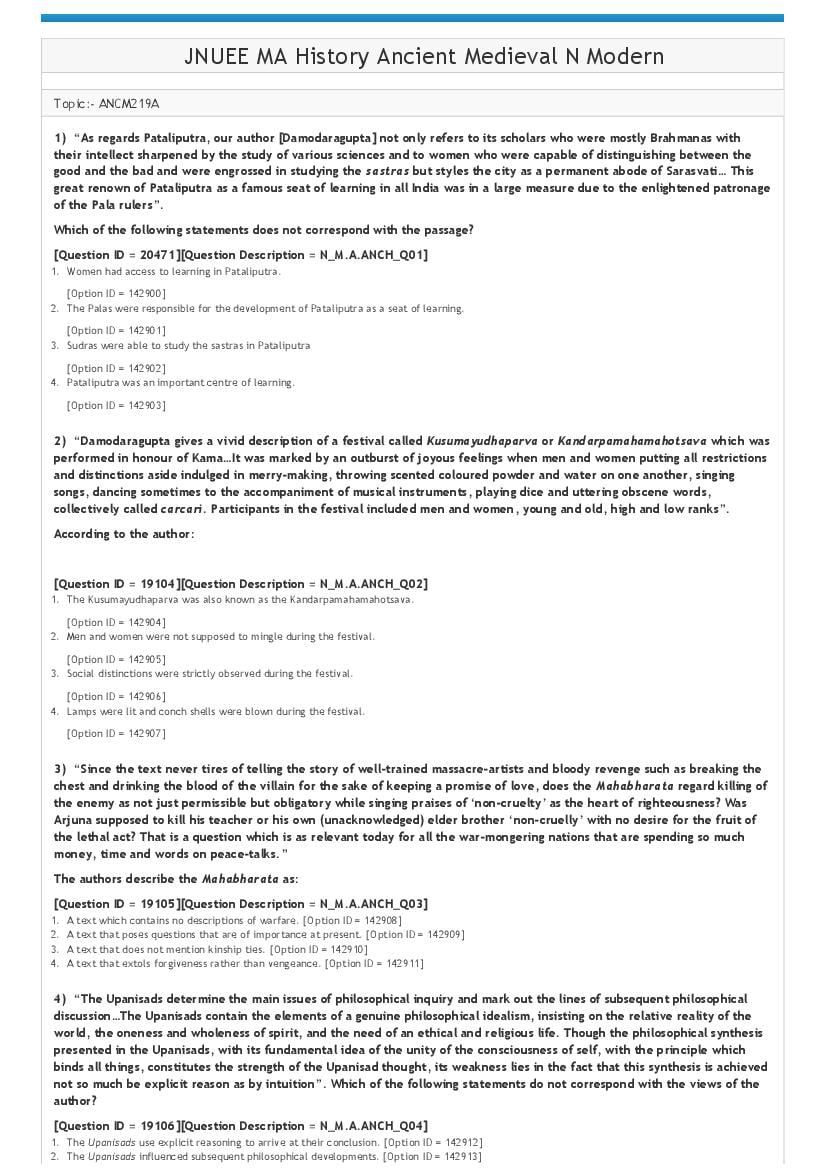
Page 1
Topic:‐ ANCM219A
1) “As regards Pataliputra, our author [Damodaragupta] not only refers to its scholars who were mostly Brahmanas with
their intellect sharpened by the study of various sciences and to women who were capable of distinguishing between the
good and the bad and were engrossed in studying the sastras but styles the city as a permanent abode of Sarasvati… This
great renown of Pataliputra as a famous seat of learning in all India was in a large measure due to the enlightened patronage
of the Pala rulers”.
Which of the following statements does not correspond with the passage?
[Question ID = 20471][Question Description = N_M.A.ANCH_Q01]
1. Women had access to learning in Pataliputra.
[Option ID = 142900]
2. The Palas were responsible for the development of Pataliputra as a seat of learning.
[Option ID = 142901]
3. Sudras were able to study the sastras in Pataliputra
[Option ID = 142902]
4. Pataliputra was an important centre of learning.
[Option ID = 142903]
2) “Damodaragupta gives a vivid description of a festival called Kusumayudhaparva or Kandarpamahamahotsava which was
performed in honour of Kama…It was marked by an outburst of joyous feelings when men and women putting all restrictions
and distinctions aside indulged in merry‐making, throwing scented coloured powder and water on one another, singing
songs, dancing sometimes to the accompaniment of musical instruments, playing dice and uttering obscene words,
collectively called carcari. Participants in the festival included men and women, young and old, high and low ranks”.
According to the author:
[Question ID = 19104][Question Description = N_M.A.ANCH_Q02]
1. The Kusumayudhaparva was also known as the Kandarpamahamahotsava.
[Option ID = 142904]
2. Men and women were not supposed to mingle during the festival.
[Option ID = 142905]
3. Social distinctions were strictly observed during the festival.
[Option ID = 142906]
4. Lamps were lit and conch shells were blown during the festival.
[Option ID = 142907]
3) “Since the text never tires of telling the story of well‐trained massacre‐artists and bloody revenge such as breaking the
chest and drinking the blood of the villain for the sake of keeping a promise of love, does the Mahabharata regard killing of
the enemy as not just permissible but obligatory while singing praises of ‘non‐cruelty’ as the heart of righteousness? Was
Arjuna supposed to kill his teacher or his own (unacknowledged) elder brother ‘non‐cruelly’ with no desire for the fruit of
the lethal act? That is a question which is as relevant today for all the war‐mongering nations that are spending so much
money, time and words on peace‐talks.”
The authors describe the Mahabharata as:
[Question ID = 19105][Question Description = N_M.A.ANCH_Q03]
1. A text which contains no descriptions of warfare. [Option ID = 142908]
2. A text that poses questions that are of importance at present. [Option ID = 142909]
3. A text that does not mention kinship ties. [Option ID = 142910]
4. A text that extols forgiveness rather than vengeance. [Option ID = 142911]
4) “The Upanisads determine the main issues of philosophical inquiry and mark out the lines of subsequent philosophical
discussion…The Upanisads contain the elements of a genuine philosophical idealism, insisting on the relative reality of the
world, the oneness and wholeness of spirit, and the need of an ethical and religious life. Though the philosophical synthesis
presented in the Upanisads, with its fundamental idea of the unity of the consciousness of self, with the principle which
binds all things, constitutes the strength of the Upanisad thought, its weakness lies in the fact that this synthesis is achieved
not so much be explicit reason as by intuition”. Which of the following statements do not correspond with the views of the
author?
[Question ID = 19106][Question Description = N_M.A.ANCH_Q04]
1. The Upanisads use explicit reasoning to arrive at their conclusion. [Option ID = 142912]
2. The Upanisads influenced subsequent philosophical developments. [Option ID = 142913]
Page 2
4. The Upanisads emphasize the need for an ethical life. [Option ID = 142915]
5) “The Mauryan Empire appears to have been administered by dividing it into provinces, which were placed in charge of
viceroys, who were often princes of royal blood. Rudradaman in his inscription refers to the Vaisya Pusyagupta who was a
Rastriya in Surastra in the reign of Chandragupta Maurya…And under Asoka himself… four princely viceroys are said to have
administered such territories from Taksasila, Ujjayini, Tosali and Suvarnagiri. It would appear that such an arrangement was
natural, for a wholly centralized administration in the far‐flung Empire would have been almost impossible because of the
difficulties of communications in those days”. Which of the following statements conveys the central idea of the author?
[Question ID = 19107][Question Description = N_M.A.ANCH_Q05]
1. Our major source of information about the Mauryan empire is provided by inscriptions.
[Option ID = 142916]
2. The Mauryan empire was highly centralized.
[Option ID = 142917]
3. It is natural that princes of the royal blood should be chosen as viceroys.
[Option ID = 142918]
4. Centralized administration was very difficult during the time of the Mauryan empire.
[Option ID = 142919]
6) “The Smrti of Yajnavalkya shows the greatest affinity to the Arthasastra in its chapter on vyavahara. On a large
number of topics the two works show the same rules which are often found expressed in identical words. This is hardly
explicable without the hypothesis of borrowing on the part of one from the other. And a close comparison of the two works
leaves little room for doubt that the Smrti cannot be regarded as the source on which the Arthasastra has drawn”.
The author states:
[Question ID = 19108][Question Description = N_M.A.ANCH_Q06]
1. There are no similarities between the Smrti of Yajnavalkya and the Arthasastra.
[Option ID = 142920]
2. The vocabulary used by the authors of the two texts is different. [Option ID = 142921]
3. There is no evidence that the authors borrowed from one another. [Option ID = 142922]
4. It is virtually certain that Yajnavalkya borrowed from the Arthasastra. [Option ID = 142923]
7) “The two global wars of the first half of the twentieth century appear to have made it clear that, after all, Asoka was
right in denouncing the conquest of countries by arms and recommending the conquest of the hearts of mankind by love.
He dreamt of a world in which all peoples would live in harmony like members of the same family. The day of the complete
realization of that dream may be still far off. But it seems that we are gradually moving towards it”. According to the
author: [Question ID = 19109][Question Description = N_M.A.ANCH_Q07]
1. Asoka’s dream will be realized in future. [Option ID = 142924]
2. The World Wars show that there can be no peace. [Option ID = 142925]
3. We are likely to realize the goal of peace soon. [Option ID = 142926]
4. Arms are the best way to establish harmony. [Option ID = 142927]
8) “The classical Indian poets excelled in exquisite lyrics, often epigrammatic, chiselled with artful care. These ‘brilliant
poems in miniature’ display a subtle play of fancy, graceful tender feelings, and worldly wisdom. They contain condensed
poetic imagery and compact meaning. Most of the short poems were collected and preserved in anthologies. The earliest of
such collections are the Tamil Sangam anthologies, composed during the first and third centuries A.D. Some of the Sanskrit
lyrics, on the other hand, are preserved in groups of one or more Sataka (Hundred Stanzas), thematically arranged, and
attributed to individual authors, such as Amaru’s Sataka containing about a hundred verses on love, or Bhartrhari’s Satakas
containing over three hundred poems, arranged under three headings: On Conduct, On Love, and On Renunciation”.
According to the author:
[Question ID = 19110][Question Description = N_M.A.ANCH_Q08]
1. Indian poets were not able to compose short poems.
[Option ID = 142928]
2. Tamil and Sanskrit poems were grouped into anthologies.
[Option ID = 142929]
3. Bhartrhari composed a hundred verses on the art of warfare.
[Option ID = 142930]
4. Ancient Indian poets did not write about love.
[Option ID = 142931]
9) “According to the Milindapanha, King Menander was finally converted to Buddhism but the process of conversion was
not easy either for the Greek king or for the Buddhist monk, for in their encounter two cultures and traditions collided. The
Page 3
touching Buddhism, Nagasena responds with either counter‐questions or subtle answers through a series of similes. In this
process, Nagasena provides a metaphysical basis for the teachings of Buddha. Though the question‐answer technique of
Milindapanha somewhat resembles the Upanisadic dialogue, yet it has a distinct Buddhist flavor”.
From the passage it is evident that:
[Question ID = 19111][Question Description = N_M.A.ANCH_Q09]
1. The Milindapanha consists of dialogues. [Option ID = 142932]
2. The dialogues are between a Buddhist monk and a trader. [Option ID = 142933]
3. There is no mention of the Buddha in the text. [Option ID = 142934]
4. The explanations offered by Nagasena are direct and simple. [Option ID = 142935]
10) “In classical Sanskrit, every kavya (courtly poetry or poetic prose narrative) had to have ‘eighteen kinds of
descriptions’, which included sunrise, the sea, the rains and similar set pieces. One of the most important among these was
the hero’s jaunt through the city. The convention was later adopted in all the Sanskrit‐influenced medieval literatures of
India. So every kavya had to include the description of a city, and the cities in widely different kavyas tended to look
alike”.
According to the author:
[Question ID = 19112][Question Description = N_M.A.ANCH_Q10]
1. Kavyas were normative texts which prescribed ideal social conduct. [Option ID = 142936]
2. The descriptions of cities in kavyas were realistic. [Option ID = 142937]
3. Kavyas included descriptions of natural phenomena. [Option ID = 142938]
4. Sanskrit did not have any influence on later literary traditions [Option ID = 142939]
11) “Even when manuscripts were available they had many errors and textual differences from copy to copy. Only some
Tamil scholars and Saivite monasteries protected and preserved the texts they liked. Some kings and rich men arranged for
copies to be made, when the manuscripts became old and fell apart. The scribes had to be well‐chosen and well paid.
Among rich Jains, there was a practice of Sastradanam, of giving new copies of old religious manuscripts as gifts to scholars
on occasions like weddings. Thus, precariously, expensively, accidentally, was knowledge transmitted in written language”.
According to the author [Question ID = 19113][Question Description = N_M.A.ANCH_Q11]
1. Manuscripts were invariably reliable. [Option ID = 142940]
2. Preparing manuscripts was an expensive process. [Option ID = 142941]
3. Manuscripts were preserved only on the initiative of religious institutions. [Option ID = 142942]
4. There was no tradition of gifting manuscripts. [Option ID = 142943]
12) “The best treatment of the question of proprietary claims of cultivators and the State is found in the Mimamsa works.
The Mimamsa writers anticipate the points that a modern writer on the subject discusses. The discussion starts on the
injunction that in the Visvajit sacrifice a votary should give away all his belonging to the officiating priests. The natural
question is: ‘What can a man legally give as his own?’ Jaimini initiates the discussion by stating that land is not to be
transferred, for it belongs equally to all”. The passage indicates that: [Question ID = 19114][Question Description =
N_M.A.ANCH_Q12]
1. Gifts were offered during sacrifices. [Option ID = 142944]
2. Land was regarded as an ideal gift. [Option ID = 142945]
3. Modern writers do not discuss questions of land ownership. [Option ID = 142946]
4. Priests did not receive gifts at sacrifices. [Option ID = 142947]
13) “By the days of the Pallavas in the north and the Pandyas in the south the organization in the brahmadeya villages had
taken a definite shape and was known usually as the sabha. Its emergence as a perfected institution is seen first in the
Tondaimandalam area in the days of the Pallavas. It appears that it functioned in at least twenty different places in the
area in the eighth and ninth centuries. However, details regarding their constitution and working are not available”.
According to the author
[Question ID = 19115][Question Description = N_M.A.ANCH_Q13]
1. The sabha was a common institution but was not universal. [Option ID = 142948]
2. Sabhas were found only in the northern region. [Option ID = 142949]
3. There were no sabhas in the eighth century. [Option ID = 142950]
4. Brahmadeya villages did not have sabhas. [Option ID = 142951]
14) [in Japan] the elite universities have retained their privileged positions as training grounds for the nation’s future
leaders, and access to these universities remains intensely meritocratic in principle; the best universities have been known
to hold their entrance exams in sports stadiums to accommodate the number of applicants. However, principle and practice
often diverge: success in the ever‐more demanding entrance exams is increasingly reliant upon the financial means of
parents to put their children into specialist ‘cram schools’ in the evenings, at weekends and during the ‘school vacations’.
The author suggests that: [Question ID = 19116][Question Description = N_M.A.ANCH_Q14]
1. Poor children find it easy to access elite universities. [Option ID = 142952]
2. There are very few applicants for elite universities. [Option ID = 142953]
3. Parents spend extra money to enable students to join elite universities. [Option ID = 142954]
4. Elite universities do not train leaders for the future. [Option ID = 142955]
15) “21st century Japan is home to a range of so‐called ‘new religions’, many of which saw resurgence during the 1990s.
Page 4
Tokyo subway in 1995. Most of these groups are syncretic religious movements, combining elements of Shinto, Buddhism,
and various folk beliefs. In fact, contemporary Japanese society has a complicated relationship with religion: a 2005 survey
reported that 80% of Japanese observed Shinto rituals and ceremonies and that nearly 70 % considered themselves to be
Buddhist.” The author demonstrates: [Question ID = 19117][Question Description = N_M.A.ANCH_Q15]
1. All Japanese follow the same religion. [Option ID = 142956]
2. All Japanese religious traditions are new. [Option ID = 142957]
3. Many Japanese believe in more than one religion. [Option ID = 142958]
4. Most Japanese do not practice rituals. [Option ID = 142959]
16) “A typical characterization of China’s past, often put forward by Chinese modernizers in the 20th century, is that late
imperial China was a corrupt, ‘feudal’ mess that was held back by unchanging conservative, Confucian thought. Yet the
imperial Chinese state, while underpinned by ideas of order and hierarchy, was also driven by a sense of mutual obligation
between different groups in society and gave rise to an ever‐changing and highly dynamic political and social culture,
although this had collapsed in many important respects by the early 20th century”. The author indicates that [Question ID =
19118][Question Description = N_M.A.ANCH_Q16]
1. Chinese society was not stagnant. [Option ID = 142960]
2. Chinese society was backward. [Option ID = 142961]
3. Chinese society was not hierarchical. [Option ID = 142962]
4. Chinese society was egalitarian. [Option ID = 142963]
17) “The Song dynasty (960‐1276) saw one of the major changes in the Chinese economy. Up to that point, the majority of
farmers were subsistence cultivators, but by the end of the dynasty, they had become specialists, producing cash crops or
making goods for the market. At the same time, a countrywide internal market developed in China, which would go on to
expand under the Ming and Qing. A paper and metal money economy also thrived during this period, leading to financial
crises and increasing contrasts between the very rich and the very poor”. Which of the following did not occur during the
period of the Song dynasty? [Question ID = 19119][Question Description = N_M.A.ANCH_Q17]
1. The cultivation of cash crops became more important. [Option ID = 142964]
2. The internal market in China became significant. [Option ID = 142965]
3. Most farmers remained primarily subsistence cultivators. [Option ID = 142966]
4. Both paper and metal currency were in use. [Option ID = 142967]
18) “Darwin inherited enough money from his family to ensure that he never needed to work for a living. He added to this
with income from the enormous sales of his books, and managed his financial affairs skilfully. Towards the end of his life he
became very rich. He was revered by his intimate scientific friends and loved by his family, to whom he was devoted. The
family lost three children, each bereavement causing Darwin the most intense grief. Cruelty in any form roused him to
passionate anger: there was no passage in the Journal of Researches more deeply felt than where he attacked the
institution of slavery”. The author indicates that Darwin: [Question ID = 19120][Question Description = N_M.A.ANCH_Q18]
1. Was troubled by poverty throughout his life. [Option ID = 142968]
2. Was able to earn money by writing books. [Option ID = 142969]
3. Was supportive of slavery. [Option ID = 142970]
4. Was not attached to his family. [Option ID = 142971]
19) “The profound distinction that Darwin rightly perceived between his own evolutionism and that of his many
predecessors lay in his solution to the crucial but subsidiary question of the mechanism of evolutionary change. The solution,
christened natural selection by Darwin, was in fact an elementary argument built up from premises that were simple and
universally acceptable. The furious response which the Origin of Species received at the hands of its critics was surely a
reaction to the logic of a simple argument from acceptable premises that led inexorably to an unacceptable conclusion”.
The author suggests that: [Question ID = 19121][Question Description = N_M.A.ANCH_Q19]
1. Darwin attempted to explain evolution by natural selection. [Option ID = 142972]
2. The idea of natural selection was widely accepted. [Option ID = 142973]
3. Darwin was in complete agreement with his predecessors. [Option ID = 142974]
4. Darwin’s premises were contested by critics. [Option ID = 142975]
20) “To know what characters are likely to be important for the fitness of an organism, one must understand a great deal
about its biology and the environment in which it lives. The same character may give high fitness in one species but not in
another. For instance, speed is not important for fitness in a lizard that evades predators by cryptic coloration. If such a
lizard lives in trees and perches on twigs, it is more important to be good at holding on than to run fast, and so short legs,
not long ones, will be associated with high fitness”. The authors argue that: [Question ID = 19122][Question Description =
N_M.A.ANCH_Q20]
1. There are universal characteristics of fitness. [Option ID = 142976]
2. Long legs would be hazardous for lizards. [Option ID = 142977]
3. Lizards do not need to blend into their environment. [Option ID = 142978]
4. Speed is always necessary for survival. [Option ID = 142979]
21) “The observation that organisms can be classified hierarchically into groups, which successfully share more and more
traits that are lacking in other groups, was an important advance in biology. The classification of organisms into species, and
the naming system of species, were developed long before Darwin. Before biologists could begin thinking about the
evolution of species, it was clearly important to have the concept of species as distinct entities”. According to the authors:
[Question ID = 19123][Question Description = N_M.A.ANCH_Q21]
1. Conceptualizing the category of species was essential for the theory of evolution. [Option ID = 142980]
Page 5
3. Darwin did not rely on the concept of species. [Option ID = 142982]
4. The grouping of organisms on the basis of shared traits in not a useful strategy. [Option ID = 142983]
22) “Even though a majority lived in towns or villages rather than cities or urban centres, the free adult male citizens, the
event‐making movers and shakers of ancient Hellenism, were full sharing members of political communities also called polis
—for which the best translation into English is ‘citizen‐state’. …It is from the ancient Greek polis in that sense that we
derive ‘politics’ and its cognates, and it is this feature of Greek civilization, which spawned such key terms as aristocracy,
oligarchy, tyranny and – last but by no means least—democracy, that gives ancient Greece much of its enduring and current
salience”.
The author suggests:
[Question ID = 19124][Question Description = N_M.A.ANCH_Q22]
1. The entire population of the polis played an active role in politics. [Option ID = 142984]
2. Urban populations were dominated by rural populations in ancient Greece. [Option ID = 142985]
3. There is no connection between the term polis and politics. [Option ID = 142986]
4. Several terms for political institutions used in Greece are still relevant. [Option ID = 142987]
23) “Rarely indeed have ordinary people been so empowered—ordinary adult male citizen people, that is, since the
Athenians were jealous of their perks and privileges, and as the citizen body soared up to the 50,000 mark (out of a total
population of some 250,000‐300,000 as against the ‘normative’ polis’s few hundreds or thousands), they were quick to
clamp tight restrictions on access via marriage laws; the most important of these, sponsored by none other than Pericles in
451, prescribed that to be a citizen one had to have been born not just male but the son of two lawfully wedded Athenian
citizen parents”.
The author suggests that:
[Question ID = 19125][Question Description = N_M.A.ANCH_Q23]
1. The proportion of citizens in Athens was greater than in other states.
[Option ID = 142988]
2. There were no restrictions on acquiring citizenship in Athens.
[Option ID = 142989]
3. Marriage laws were not effective in regulating citizenship.
[Option ID = 142990]
4. Citizens in Athens had no special privileges.
[Option ID = 142991]
24) “Traditional languages often encode basic information about biodiversity that would be of considerable interest to
science. Scientific description and classification has uncovered only a fraction of the species that there are in our world and
new ones are being reported constantly. In many cases, species that are ‘new’ to Western science are in fact familiarly
distinguished by the people who live in the area where they are found, and identified as distinct in their languages. The
loss of those languages would eliminate a significant resource that can aid our efforts to understand the full range of life on
Earth”. Which of the following captures the idea of the passage best? [Question ID = 19126][Question Description =
N_M.A.ANCH_Q24]
1. Traditional languages are dying out. [Option ID = 142992]
2. Traditional languages need not be preserved. [Option ID = 142993]
3. Traditional languages contain valuable knowledge. [Option ID = 142994]
4. Traditional knowledge is irrelevant. [Option ID = 142995]
25) “Considering how widely Indo‐European languages are distributed geographically, and their influence in world affairs,
one might assume that a good proportion of the world’s languages belong to this family. This is not the case, however: there
are only about 400 Indo‐European languages, although many of them are spoken over large territories. …Languages are not
uniformly distributed around the world… only 234 are spoken in Europe, while 2,322 are spoken in Asia. Another 2,110 are
spoken in Africa, 993 in the America, and 1,250 in the Pacific”. The author states that: [Question ID = 19127][Question
Description = N_M.A.ANCH_Q25]
1. Europe has more linguistic diversity than Asia. [Option ID = 142996]
2. Asia has less linguistic diversity than Africa. [Option ID = 142997]
3. The greatest linguistic diversity is in the Pacific region. [Option ID = 142998]
4. America has greater linguistic diversity than Europe. [Option ID = 142999]
26) “Some authorities argue that racialized thought is a very modern and very European invention. Others say that it can
clearly be found in the ancient world, and among many non‐European peoples. There is little doubt, though, that such
thought became dominant among European rulers and thinkers, became a major rationalization for empire, and massively
influenced all aspects of colonial policy, during the 19th century”. According to the author: [Question ID = 19128][Question
Description = N_M.A.ANCH_Q26]
1. Racialization became influential in the 19th century. [Option ID = 143000]
2. Racialization was unknown in the ancient world. [Option ID = 143001]
3. Racialization was specific to Europe. [Option ID = 143002]
4. Racialization was unknown among non‐Europeans. [Option ID = 143003]
27) “Most analysts…seem to agree that an empire is formed, most often by conquest, out of a dominant ‘core’ and a
Page 6
modern seaborne empires they might indeed be thousands of miles apart. In other cases, though, the geographical lines
between them might be blurred. Core and periphery might even be closely intermingled, inhabiting the same physical
spaces: ideas like ‘internal colonialism’…were developed to try to explain such situations. And it has not always been at all
clear where the core ends and the periphery begins”. The author suggests that: [Question ID = 19129][Question Description
= N_M.A.ANCH_Q27]
1. Core and periphery are invariably spatially distinct areas. [Option ID = 143004]
2. The separation between core and periphery is best seen in seaborne empires. [Option ID = 143005]
3. Peripheries cannot exist within the spatially defined core areas. [Option ID = 143006]
4. Peripheries sometimes dominate the core. [Option ID = 143007]
28) “Historians, particularly from the late stages of the German Enlightenment, were increasingly convinced that to
understand history properly, one needed to do two interlinked things: first, to study the archival sources in great detail; and
secondly, to develop theories of causation that would draw together the complex relationships between the effects of
geographical location, social systems, economic force, cultural ideas, technological advances, and individual will. History was
moving away from politics and law towards economics and what we would now call sociology”. According to the author,
historians moved towards economics and sociology because [Question ID = 19130][Question Description = N_M.A.ANCH_Q28]
1. They were no longer interested in politics and law. [Option ID = 143008]
2. Archival sources provided more information about economics. [Option ID = 143009]
3. There was an interest in complex theories of causation. [Option ID = 143010]
4. Historians were not affected by the German Enlightenment. [Option ID = 143011]
29) “The historian does not simply ‘report from the archives’. If he or she did, they would most probably repeat half‐
truths, and confusions, if not downright lies. For sources are not innocent; their voices talk to certain ends, intend certain
consequences. They are not mirrors of past reality, but events in themselves...To place something in writing—particularly at
any point prior to this century—should be seen as an extraordinary event, and therefore in need of explanation”. The
author views archival sources: [Question ID = 19131][Question Description = N_M.A.ANCH_Q29]
1. As transparent. [Option ID = 143012]
2. As inexplicable. [Option ID = 143013]
3. As invariably unreliable. [Option ID = 143014]
4. As created for specific reasons. [Option ID = 143015]
30) “Looking east, China could surely have borrowed the idea of writing from Mesopotamia during the 3rd/ 2nd millennium
BC or after via the Central Asian cultures of the Silk Route, and gone on to develop the unique set of Chinese characters.
For comparison, the idea of printing took 600 or 700 years to reach Europe from China, and the idea of paper, which was
invented in China in the early 2nd century AD or before, took even longer to spread via the Silk Route to 8th century
Baghdad and thereby reach Europe in the 11th century”. The author uses comparisons to establish that: [Question ID =
19132][Question Description = N_M.A.ANCH_Q30]
1. Several major discoveries were made in China. [Option ID = 143016]
2. Writing travelled from west to east. [Option ID = 143017]
3. The Silk Route was a major means of communication. [Option ID = 143018]
4. Ideas can take a long time to spread from one area to another. [Option ID = 143019]
31) “Economically, Babylon declined in importance when Alexander’s alleged plan to make the city the capital of Asia,
following his defeat of the Persian empire, failed to transpire after his death in 323 BC. The city was also bypassed by new
desert trade routes from Asia to the Mediterranean, which opened up with the domestication of the camel as a pack animal.
Seleucia, the city on the Tigris to the north of Babylon, founded by one of Alexander’s generals, Seleucus Nikator, replaced
Babylon as the leading city of Mesopotamia in the 3rd century BC and after”. Which of the following statements is supported
by the text? [Question ID = 19133][Question Description = N_M.A.ANCH_Q31]
1. Babylon was the capital of Asia. [Option ID = 143020]
2. Babylon declined with the rise of Seleucia. [Option ID = 143021]
3. Babylon was strategically located vis‐à‐vis new trade routes. [Option ID = 143022]
4. The domestication of the camel enhanced the importance of Babylon. [Option ID = 143023]
32) “There is no question that interstate rivalries intensified at the outset of the 20th century as a result of mass
migration, urbanization, colonial competition, and the excessive liberalization of world trade. The ensuing period of
extreme nationalism culminated in two devastating world wars, genocides, a long global economic depression, and hostile
measures to protect narrowly conceived political communities”. The author suggests that [Question ID = 19134][Question
Description = N_M.A.ANCH_Q32]
1. Mass migrations were caused by interstate rivalries. [Option ID = 143024]
2. Colonial competition was beneficial for international relations. [Option ID = 143025]
3. The world wars were a consequence of extreme nationalism. [Option ID = 143026]
4. Global economic depression resulted in genocides. [Option ID = 143027]
33) The rising significance of the English language has a long history, reaching back to the birth of British colonialism in the
late 16th century. At that time, only approximately seven million people used English as their mother tongue. By the 1990s,
this number had swollen to over 350 million native speakers, with 400 million more using English as a second language.
Today, more than 80 per cent of the content posted on the Internet is in English. Almost half of the world’s population of
foreign students is enrolled at institutions in Anglo‐American countries. Which of the statements below corresponds with the
passage? [Question ID = 19135][Question Description = N_M.A.ANCH_Q33]
1. The majority of the students in Anglo‐American countries are foreigners. [Option ID = 143028]
Page 7
3. The use of English on the Internet is insignificant. [Option ID = 143030]
4. There is little connection between colonialism and the spread of English. [Option ID = 143031]
Topic:‐ ANCM219B
1) On the basis of the quotation, answer questions “On the whole, traditional (i.e., pre‐Islamic) India was much less
oriented toward the written word than many other ancient and traditional cultures such as those of classical China and
Japan or of the Islamic world. From Vedic times on, and even to the present day in some cultural contexts, it is oral rather
than written learning that has always been esteemed in India as true knowledge, an attitude reflected in such proverbs as
pustakastha tu yd vidya parahastagatam dhanam, "Knowledge in a book [is like] money in someone else's hand." There is a
pervasive, if unspoken, attitude that the written word is essentially a reflection rather than a true manifestation of
language, and this may explain the relative lack of attention to the aesthetic aspects of writing in traditional India, as well
as the carelessness and imprecision which characterize many, though by no means all, of the written documents, both
epigraphic and non‐epigraphic, of ancient India.” Consider the following statements:
A. Writing was not considered important in ancient India.
B. There was a lack of accuracy in the written records.
C. Bookish knowledge was valuable like money.
D. China, Japan and Islamic cultures were superior to Indian culture. [Question ID = 19136][Question Description =
N_M.A.ANCH_Q34]
1. A and B are true. [Option ID = 143032]
2. A, B and D are false [Option ID = 143033]
3. C and D are true [Option ID = 143034]
4. A, C and D are false [Option ID = 143035]
2) In the above quotation, which of the following statements are made:
A. Pre‐Islamic India was different from the later period because of political reasons.
B. The advent of Islam saw the introduction of writing to India.
C. Islamic influences led to a greater aesthetic appreciation of the written word.
D. Orality negatively impacted the aesthetic quality of the written texts in early India
[Question ID = 19137][Question Description = N_M.A.ANCH_Q35]
1. A and B are true [Option ID = 143036]
2. A, B and C are true [Option ID = 143037]
3. B, C and D are false [Option ID = 143038]
4. D is true [Option ID = 143039]
Topic:‐ ANCM219C
1) Read the following statements:
A. The Krtyakalpataru was composed by Bhatta Laksmidhara.
B. The text is dated to the 9th century.
C. The patron of the author was a Gahadavala ruler.
D. The Gahadavala dynasty ruled from the 8th to the 11th century CE.
Which of the following is correct?
[Question ID = 19138][Question Description = N_M.A.ANCH_Q36]
1. A, B, C and D are true.
[Option ID = 143040]
2. A and C are true.
[Option ID = 143041]
3. B, C and D are true.
[Option ID = 143042]
4. C and D are true.
[Option ID = 143043]
2) Read the following statements:
A. There are 8 family books in the Rg Veda.
B. Sakala, Baskala and Sayana are the three sakhas of the Rg Veda.
C. The Rg Veda has ten mandalas.
D. Rg Veda was composed in the middle of the first millennium BCE.
Which is the correct answer?
[Question ID = 19139][Question Description = N_M.A.ANCH_Q37]
1. A, B, C and D are true.
[Option ID = 143044]
Page 8
[Option ID = 143045]
3. B and D are true.
[Option ID = 143046]
4. A and C are true.
[Option ID = 143047]
3) The following are part of the Grhyasutra corpus:
A.Vishnu
B.Vasistha
C.Gobhila
D.Manava
Choose the correct answer:
[Question ID = 19140][Question Description = N_M.A.ANCH_Q38]
1. A and B are false
[Option ID = 143048]
2. A, B, C and D are false.
[Option ID = 143049]
3. B and D are false.
[Option ID = 143050]
4. C and D are false
[Option ID = 143051]
4) Aksapada Gautama, Dignaga, Dharmakirti and Udayana are associated with:[Question ID = 19141][Question Description =
N_M.A.ANCH_Q39]
1. Buddhism [Option ID = 143052]
2. Jainism [Option ID = 143053]
3. Nyaya [Option ID = 143054]
4. Vaisesika [Option ID = 143055]
Topic:‐ ANCM219D
1) Read the following passage and answer questions “Feminist historians, trained as most historians are to be more
comfortable with description than theory, have nonetheless increasingly looked for usable theoretical formulations. They
have done so for at least two reasons. First, the proliferation of case studies in women's history seems to call for some
synthesizing perspective that can explain continuities and discontinuities and account for persisting inequalities as well as
radically different social experiences. Second, the discrepancy between the high quality of recent work in women's history
and its continuing marginal status in the field as a whole (as measured by textbooks, syllabi, and monographic work) points
up the limits of descriptive approaches that do not address dominant disciplinary concepts, or at least that do not address
these concepts in terms that can shake their power and perhaps transform them. It has not been enough for historians of
women to prove either that women had a history or that women participated in the major political upheavals of' Western
civilization.”
A. The author states that feminist historians have eschewed theoretical formulations in favour of descriptive history.
B. Historians tend towards description rather than theory.
Choose the correct answer:
[Question ID = 19142][Question Description = N_M.A.ANCH_Q40]
1. A and B are true
[Option ID = 143056]
2. A and B are false
[Option ID = 143057]
3. A is true, B is false
[Option ID = 143058]
4. A is false, B is true.
[Option ID = 143059]
2) A. Women’s history in recent years is of high quality.
B. Women’s history finds adequate space in textbooks.
Choose the correct answer from the options given below: [Question ID = 19143][Question Description = N_M.A.ANCH_Q41]
1. A is true, B is false [Option ID = 143060]
2. A is false, B is true [Option ID = 143061]
3. A and B are false [Option ID = 143062]
Page 9
3) A. Theory helps in synthesizing different perspectives.
B. Social inequalities and varied experiences can be explained with theoretical models.
Choose the correct answer from the options given below: [Question ID = 19144][Question Description = N_M.A.ANCH_Q42]
1. A is false, B is true [Option ID = 143064]
2. A and B are true [Option ID = 143065]
3. A is true, B is false [Option ID = 143066]
4. A and B are false [Option ID = 143067]
4) A. The purpose of women’s history is to go beyond women’s participation in political events.
B. Descriptive histories provide the possibilities to query dominant concepts and notions of power.
Choose the correct answer from the options given below: [Question ID = 19145][Question Description = N_M.A.ANCH_Q43]
1. A and B are true [Option ID = 143068]
2. A is false, B is true [Option ID = 143069]
3. A is true, B is false [Option ID = 143070]
4. A and B are false [Option ID = 143071]
Topic:‐ ANCM219E
1) Ettutokai and Pattupattu are:
[Question ID = 19146][Question Description = N_M.A.ANCH_Q44]
1. Kavyas
[Option ID = 143072]
2. Vamsavallis
[Option ID = 143073]
3. Sangam poetry
[Option ID = 143074]
4. Nighantu
[Option ID = 143075]
2) Karaikkal Ammaiyar, Appar and Sambandar were:[Question ID = 19147][Question Description = N_M.A.ANCH_Q45]
1. Alvars [Option ID = 143076]
2. Nayanars [Option ID = 143077]
3. Aghoris [Option ID = 143078]
4. Munis [Option ID = 143079]
3) Enkidu and Utnapishtu are characters in:[Question ID = 19148][Question Description = N_M.A.ANCH_Q46]
1. Epic of Gilgamesh [Option ID = 143080]
2. Iliad [Option ID = 143081]
3. Book of the Dead [Option ID = 143082]
4. Historia [Option ID = 143083]
4) Alexander the Great was also known as:[Question ID = 19149][Question Description = N_M.A.ANCH_Q47]
1. Philip III [Option ID = 143084]
2. Neoptalemus [Option ID = 143085]
3. Augustus [Option ID = 143086]
4. Alexander III [Option ID = 143087]
5) The founder of the early medieval Chola dynasty’s lineage was[Question ID = 19150][Question Description =
N_M.A.ANCH_Q48]
1. Parantaka [Option ID = 143088]
2. Vijayalaya [Option ID = 143089]
3. Aditya [Option ID = 143090]
4. Rajaraja [Option ID = 143091]
6) The Pallava pruler who was called Mamalla was:[Question ID = 19151][Question Description = N_M.A.ANCH_Q49]
1. Narasimhavarman I [Option ID = 143092]
2. Mahendravarman I [Option ID = 143093]
3. Mahendravarman II [Option ID = 143094]
4. Narasimhavarman II [Option ID = 143095]
7) Gotami Apadana, Buddhacarita, Harsacarita and Ramacaritam may be classified as:
[Question ID = 19152][Question Description = N_M.A.ANCH_Q50]
1. Historical chronicles
[Option ID = 143096]
2. Plays
Page 10
3. Grammatical works
[Option ID = 143098]
4. Biographical literature
[Option ID = 143099]
8) Which of the following was manufactured in India during the medieval period?[Question ID = 19153][Question
Description = N_M.A.ANCH_Q51]
1. Bangles and jars [Option ID = 143100]
2. Drinking glasses [Option ID = 143101]
3. Mirrors [Option ID = 143102]
4. Telescopes [Option ID = 143103]
9) Which one of the following is an often‐ignored technological advance that aided centralization by Indo‐Muslim rulers:
[Question ID = 19154][Question Description = N_M.A.ANCH_Q52]
1. glass [Option ID = 143104]
2. gunpowder [Option ID = 143105]
3. paper [Option ID = 143106]
4. Persian wheel [Option ID = 143107]
10) The capital of the Portuguese Asian empire was[Question ID = 19155][Question Description = N_M.A.ANCH_Q53]
1. Calicut [Option ID = 143108]
2. Goa [Option ID = 143109]
3. Cochin [Option ID = 143110]
4. Colombo [Option ID = 143111]
11) The direct maritime connection between India and Europe was first made by the[Question ID = 19156][Question
Description = N_M.A.ANCH_Q54]
1. Dutch [Option ID = 143112]
2. French [Option ID = 143113]
3. Portuguese [Option ID = 143114]
4. English [Option ID = 143115]
12) Which among the following was not used by Babur to fight the rulers of the Indian subcontinent?[Question ID = 19157]
[Question Description = N_M.A.ANCH_Q55]
1. matchlockmen [Option ID = 143116]
2. field cannon [Option ID = 143117]
3. cavalry [Option ID = 143118]
4. war elephants [Option ID = 143119]
13) The decimal ranking order that Akbar employed for his nobility originated from a system that was used among[Question
ID = 19158][Question Description = N_M.A.ANCH_Q56]
1. The Rajputs [Option ID = 143120]
2. The Mongols [Option ID = 143121]
3. The Safavids [Option ID = 143122]
4. The Lodis [Option ID = 143123]
14) Muhammad Gisu Daraz was a sufi who belonged to which order? [Question ID = 19159][Question Description =
N_M.A.ANCH_Q57]
1. Qadiriyyah [Option ID = 143124]
2. Chisti [Option ID = 143125]
3. Suhrawardi [Option ID = 143126]
4. Naqshbandi [Option ID = 143127]
15) Who among the following was NOT a ruler of the Vijayanagar empire [Question ID = 19160][Question Description =
N_M.A.ANCH_Q58]
1. Pratapa Rudra [Option ID = 143128]
2. Rama Raya [Option ID = 143129]
3. Krishna Deva Raya [Option ID = 143130]
4. Hari Hara [Option ID = 143131]
16) “Unlike the working class in colonial India, the Russian working class lacked even elementary trade union rights. The
Indian Trade Union Act of 1926 allowed any seven persons of the company to form a registered trade union. Labour laws
were enacted to keep the working class movement within the constitutional bounds and separate it from the general
political movement in the country. It is through this framework that the colonial state attempted to exercise hegemony over
the working class’’.
1. The Labour Laws in colonial India were enacted to promote brotherhood and activism amongst the working class.
2. The Indian Trade Union Act of 1926 was a deliberate move of the colonial goverment to avert the working class from
participating in the nationalist and revolutionary campaigns.
3. The colonial Labour laws were aimed at directing all working class resentment through mode of petitioning and appealing.
Page 11
Choose the correct answer from the options given below:
[Question ID = 20626][Question Description = N_M.A.ANCH_Q59]
1. 1,2,3,4
[Option ID = 143132]
2. 1,3,5
[Option ID = 143133]
3. 2,3
[Option ID = 143134]
4. 1,4
[Option ID = 143135]
17) ‘For us apart from ‘boycotts’ the ‘war of position’ would comprise peaceful hartals, phases of mass upsurges followed
by limited political activity, rallies, open meetings, demonstrations, mass dharnas, hunger strikes and
jathamarches....Gandhi was following a strategy of ‘war of position’, Communists were following a strategy of ‘war of
movement’ and ‘revolutionary insurrectionists’ were using the methods of ‘underground warfare’ with the object of ‘secret
preparations of weapons and combat troops’.
In the light of the passage above, which of the following statements are correct :
1. a 'war of maneuver' involves physically overwhelming the coercive apparatus of the state. The success of this strategy
depends on the nature of the state's hegemony, that is, its position within civil society.
2. Gandhi held ‘war of position’ but appreciated ‘war of movement’ and ‘revolutionary insurrectionists’ use of methods of
‘underground warfare’
3. In modern liberal democracies, direct confrontation (armed uprising, general strike, etc.) will not threaten the dominant
groups so long as their credibility and authority is firmly rooted in civil society
4. In India the ‘war of position’ did not include peaceful methods such as ‐ peaceful hartals, phases of mass upsurges
followed by limited political activity, rallies, open meetings, demonstrations, mass dharnas, hunger strikes and
jathamarches.
5. 'war of position' as process slowly builds up the strength of the social foundations of a new state by creating alternative
institutions and alternative intellectual resources within existing society
6. In the East the State was everything, civil society was primordial and gelatinous; in the West, there was a proper relation
between State and civil society, and when the state tottered, a sturdy structure of civil society was immediately revealed.
Choose the correct answer from the options given below:
[Question ID = 20627][Question Description = N_M.A.ANCH_Q60]
1. 1,2,3,4,5
[Option ID = 143136]
2. 1,3,5, 6
[Option ID = 143137]
3. 2, 4,5
[Option ID = 143138]
4. 1,3,4
[Option ID = 143139]
18) ‘Gandhi formulated the various elements of a unique strategy to effectively confront the British – Indian colonial state ‐
a hegemonic state‐ in‐ formation. The significance of this contribution, which places him in the line of such master
politicians and strategists as Lenin, Mao, and Ho Chi Minh, needs to be placed in the world historical context. Nowhere has a
developed democratic state broken down through its inner contradictions; nowhere has power been seized from the
bourgeoisie by a revolutionary proletariat. The point we want to emphasize is that the Indian National Movement led by
Gandhi remains the only movement in the world in the twentieth century which wrested State power from a colonial state ‐
a hegemonic state‐in–formation.’
Which is of the following statements is correct :
1. The author highlights benefits of a government based on revolutionary proletariat.
2. The author is claiming that National Movement in India led by Gandhi was extraordinary and eventually succeeded in
snatching away power from the colonial state.
3. The author states that Lenin, Mao, and Ho Chi Minh cannot be equated with Gandhi as they could not disable the colonial
hegemonic state‐in‐formation
4. The author is of opinion that colonial state failed to acquire the status of a hegemonic state‐in‐formation by overthrowing
revolutionary proletariat parties.
5. The author is of opinion that in a democratic state it is most likely that one class will not take over another.
Page 12
[Question ID = 20628][Question Description = N_M.A.ANCH_Q61]
1. 1,2,3
[Option ID = 143140]
2. 1,4,5
[Option ID = 143141]
3. 4,5
[Option ID = 143142]
4. 2,5
[Option ID = 143143]
19) ‘M.N.Roy described the British rule as ‘imperialist absolutism’ while Jayprakash Narayan was of the view that Indians
were living under ‘contradictions of Czarism’. Gandhi was convinced that without the consent of the Indian it would be
almost impossible for the British to continue to rule India with the help of armed forces.'
According to the passage, which of the following statements are correct:
1. Jayaprakash Narayan was of opinion that armed forces preferred continuation of British empire
2. Gandhi set out to challenge the rule of the colonial armed forces perpetuated by imperialist absolutism.
3. Gandhi believed that armed forces in colonial India were capable of defeating the democratic rights of people
4. MN Roy is of opinion that imperialist absolutism would eventually pave the way for the will of the people where Gandhi
would become irrrelevant
5. Although India was colonised and armed, Gandhi upheld the belief in democracy and constitutionalism
Choose the correct answer from the options given below:
[Question ID = 20629][Question Description = N_M.A.ANCH_Q62]
1. 1,2,3,4,5
[Option ID = 143144]
2. 1,3,4,5
[Option ID = 143145]
3. 2,5
[Option ID = 143146]
4. 1,4,5
[Option ID = 143147]
20) Agency is the material and ideological effect of encounters between different actors...Linda Nash uses the example of
tidewater rice cultivation on the Georgia coast in the United States to illustrate this point. This large‐scale hydraulic system
was not purely the result of the intentional acts of human agents, but the product of complex interactions between humans
and the environment, ...Similarly, Timothy Mitchell has shown how the building of the Aswan Dam, a landmark technocratic
development project in post‐war Egypt, was shaped and undermined by the humble mosquito.... In their analysis agency is
the result of the entanglement of these actors and their capacities, actions and behaviours. What is the view this author
takes of agency in history
[Question ID = 20630][Question Description = N_M.A.ANCH_Q63]
1. environment is at the centre of history
[Option ID = 143148]
2. interaction between the environment and human and other zoological species shapes history
[Option ID = 143149]
3. human agency is the ultimate force of history
[Option ID = 143150]
4. environment is constantly shaped by the intervention of human beings
[Option ID = 143151]
21) In British Burma....( elephants) were objects and subjects of colonization. .... They were treated as meaty machines to
be captured, trained, worked, bought, sold and experimented upon. At the same time they were essential, sentient co‐
workers whose labour enabled the extraction of timber that would have otherwise been either impossible or unprofitable to
log. They made possible the export of teak, a wood that.... became synonymous with Burma. ... Due to their importance,
these animals had to be looked after, cared for, studied and even understood. In other words, their agency was central to
their value.... Asian elephants... were not ready‐made commodities. As Nicole Shukin has argued in her book Animal
Capital, the seemingly natural existence of animals masks the symbolic and material contests involved in their rendering as
commodities. Why did the colonial regime have to study elephants? [Question ID = 20631][Question Description =
N_M.A.ANCH_Q64]
1. To shape their nature and capacities to timber extraction. [Option ID = 143152]
2. Because elephants were naturally suited to logging timber. [Option ID = 143153]
3. To care for them and understand them. [Option ID = 143154]
4. Anthropologists argued that among wild animals elephants could be more easily domesticated and tamed. [Option ID = 143155]
Page 13
elephants were to be trained and worked.... On the other hand, elephants working in these camps were semi‐captive. Most
were not bred in the camps and all were released at night, albeit in fetters... Elephants’ behaviours and bodily needs
dictated much about where the camps could be established and how they operated...Elephants were never fully
domesticated and as a result their commodity status was one that required almost constant human labour to maintain.
Which of the following statements are supported by this paragraph ?
i. elephants demanded continuous labour to produce value for the timber industry
ii. elephants were never fully subordinated to human control
iii. disentangling elephants from their wild haunts was a continuous process
Choose the correct answer from the options given below:
[Question ID = 20632][Question Description = N_M.A.ANCH_Q65]
1. ii only
[Option ID = 143156]
2. i and ii only
[Option ID = 143157]
3. i, ii, and iii only
[Option ID = 143158]
4. i and iii only
[Option ID = 143159]
23) The harnessing of their agential capacities for logging and transport also made them vulnerable to infectious disease....
Anthrax was a particular concern. From the 1880s onwards there were attempts made to use the elephant camps as jungle
laboratories for developing and testing vaccines against the disease. Despite this, it took over thirty years before a rigorous
trial was implemented. ...Timber firms were happy to use the inoculations but were reluctant to risk their animals as control
specimens. In the opening two decades of the twentieth century... (s)mall‐scale trials were run... but the substantial
amount of money represented in the body of an elephant continued to lead to a wariness on the part of the timber firms.
They wanted to spread the risk, as well as the cost, to the state... The outcome of these discussions, in 1928, was the
employment of a veterinary research officer paid by both the state and the big timber firms.(I)t was determined ...that the
research officer should be a South African. This reflected the status that this settler colony had acquired for expertise in
veterinary medicine.... By 1932, only a couple of hundred of the corporation's animals remained unvaccinated
Why did it take so long to start vaccinating elephants against anthrax ? Choose the right answers
i. It was difficult to control elephants when giving them the vaccine
ii. Timber firms wanted the state to share the cost of developing a vaccine
iii. Timber firms wanted the state to undertake the cost of developing a vaccine.
iv.The medical benefits of the vaccine had to be balanced against the risk of losing a costly animal.
v. The advance of veterinary knowledge about animal disease in South Africa provided reassurance.
[Question ID = 20633][Question Description = N_M.A.ANCH_Q66]
1. i and ii only
[Option ID = 143160]
2. ii and iii only
[Option ID = 143161]
3. iii and v only
[Option ID = 143162]
4. ii only
[Option ID = 143163]
24) Gendered politics has been and continues to be a pillar of the international political economy of jeans, bikinis, dresses,
sweatshirts, and tank tops. Making women visible is crucial to making reliable sense of the international politics of making
women’s labor cheap. How is women’s labor made cheap? It is commonplace to speak of “cheap women’s labor.” The
phrase is used in public policy discussions as if cheapness were somehow inherent in women’s work—especially in the work
of those women pushed to the societal and international margins. Reality is quite different: women’s work is only as
unrewarded or as low‐paid as it is made to be.
Which of these statements reflect the author’s viewpoint ?
i. The straightforward reason why the international garment industry rests on female workers is because they are cheap
ii. Public policy discussions question the idea that women’s labour is cheap
iii. The operations of power and gender shape the notion that female labour is cheap
iv. Manufactured garments have an international political and gendered history
Page 14
1. i and ii only
[Option ID = 143164]
2. ii and iii only
[Option ID = 143165]
3. iii and iv only
[Option ID = 143166]
4. i and iv only
[Option ID = 143167]
25) One of the hallmarks of unfeminist commentaries on international politics is their underestimation of power. Organizing
factory jobs, designing machinery, and enforcing factory rules to keep women productive and feminized—these were
crucial strategies devised by entrepreneurs and supportive government officials to launch Europe’s nineteenth‐century
industrial revolution. Industrialized textile production and garment‐making were central to Britain’s rise to global power.
Male entrepreneurs in industries deliberately feminized labor in order to make it profitable and internationally competitive.
.... lessons in feminizing industrial labor were traded across national borders. . The making of the “mill girl” proved crucial
in not only imperial but also anti‐imperial efforts.... Japanese male entrepreneurs, backed by their government’s Meiji
reformers who were determined to resist Western colonization, also chose young rural women as their first industrial
workers.
Which of the following statements do NOT reflect the points being made in THIS paragraph ?
i. The whole milieu of textile factories was shaped to secure a female labour force
ii. Arrangements were made to ensure that women did not lose their femininity by working in factories.
iii. Britain was unique in the degree to which it launched its industrial revolution using women workers in textile industries.
iv. Entrepreneurs and reformers chose women workers for textile industries , states had no role to play.
v. Meiji reformers felt Japanese rural women would benefit by access to factory work.
[Question ID = 20635][Question Description = N_M.A.ANCH_Q68]
1. i, ii and iii only
[Option ID = 143168]
2. ii, iii, and iv only
[Option ID = 143169]
3. ii, iii, iv and v only
[Option ID = 143170]
4. ii, iv and v only
[Option ID = 143171]
26) Feminization, however, has never been as easy to sustain as mainstream historians, limited by their lack of gender
curiosity, have made it appear to be. Mothers and fathers have had to be persuaded to let their daughters leave home and
delay marriage. Women textile workers and garment workers themselves frequently have been hard to control.... It has
taken managers’, parents’, and officials’ threats, coercion, enticements, and revised legal structures to bring factory
women back into line. Furthermore, industrial productivity and profit‐maximizing goals have frequently contradicted
prevailing cultural norms of femininity. On those occasions, government economic strategists, industrialists, technology
engineers, and their media supporters have had to find ways to deny, or at least defuse, the gendered ideological
awkwardness. Why was it not always easy to get a female work force and use it in ‘feminised’ ways?
i. because other socially sanctioned ideas about feminine roles came in the way
ii. women did not always behave in the docile way expected of female labour
iii. government, engineers and media criticized the use of female labour
iv. changes in the mode of production could challenge existing codes of femininity
v. teaching women how to work more productively and profitably was difficult .
[Question ID = 20636][Question Description = N_M.A.ANCH_Q69]
1. i, ii and iv only
[Option ID = 143172]
2. ii, iii, iv only
[Option ID = 143173]
3. iii, iv only
[Option ID = 143174]
4. iii, iv, v only
[Option ID = 143175]
27) (I)n the mid‐nineteenth century the sewing machine... set off both liberated women’s cheers and sexualized
Page 15
entrepreneurs were purchasing the machines in bulk... The sewing machine allowed company owners to break down the
process of making a dress or a pair of pants into discrete operations and thus impose a rationalized factory system on the
seamstresses: each woman would sew only a small part of the garment—a sleeve, a tuck, a back pocket. The garment‐
factory owner could pay employees by the piece, rather than by the hour or by the entire finished product. This, in turn,
allowed manufacturers to transform the makers of garments: they were no longer seen as skilled artisans; henceforth they
could be imagined as mere interchangeable employees. This allowed male factory owners to free themselves of artisan
men... That is, the rise of the industrialized garment and textile factories required a denigration of one form of masculinity,
the masculinized artisan.
Which of the following statements do NOT give us a correct idea of the impact of sewing machines on the garment industry?
i. A higher level of skill was required now from female workers
ii. The work became lighter because each woman only had to sew a particular part of the garment.
iii. the cost of labour increased
iv.the cost of labour decreased
v. male artisans lost their standing in the garment industry
[Question ID = 20637][Question Description = N_M.A.ANCH_Q70]
1. i and ii only
[Option ID = 143176]
2. i, ii and iii only
[Option ID = 143177]
3. ii, iii and iv only
[Option ID = 143178]
4. ii, iii, iv and v only
[Option ID = 143179]
28) Levi Strauss maintained factories in the United States for longer than many large brand‐name clothing companies.....
At the same time, however, Levi’s senior executives were hostile to workers joining independent unions.... the company
moved its factories to the American South and Southwest, regions whose conservative state legislators made it hard for
workers to form unions. By the early 1980s, El Paso, Texas, had become known locally as “the jeans capital of the world.”
The majority of American workers sewing Levi’s in the 1980s, using its telltale orange thread, were Latina women, women
who at the time were politically marginalized in American society ... But ... the company’s feminized, racialized U.S.
production formula proved unable to match ... profit expectations. By 2004, Levi’s had moved all its manufacturing out of
the United States—to the Philippines, China, Indonesia, and Turkey.... The production location changed, the ethnicities and
nationalities of its workers changed; but Levi’s executives continued to prefer women as the backbone of its manufacturing
workforce. What made Levi Strauss shift its garment production units outside America?
[Question ID = 20638][Question Description = N_M.A.ANCH_Q71]
1. Latina women began to organize unions
[Option ID = 143180]
2. The policy of employing Latina women was criticized as racist
[Option ID = 143181]
3. Latina women could be paid low wages, but female workers overseas could be paid even less
[Option ID = 143182]
4. In Texas legislators opposed the shift of garment factories to their state.
[Option ID = 143183]
29) In official discussions, there was a constant attempt to rationalize the continued use of foot runners for carrying mail,
as against horse‐drawn vehicles. ...In taking tenders for horse daks ( post carried by horse transport) , contractors had to
guarantee a minimum average speed of 5–6 miles per hour – i.e. a speed higher than the average of 4–5 miles per hour for
runners – and they had to agree to pay fines for any delays. In official calculations, however, this increase in speed had to
be weighed against the additional costs of a horse establishment. ....Contracts for horse dak were often discontinued,
because of a failure to maintain the terms of speed specified in their contract. Why did horse daks fail to keep up speed?
.... horses required tracks that were clear of trees, stumps, and other obstacles. The post horse system in Tokugawa Japan,
or in Europe in the seventeenth and eighteenth century, functioned efficiently in regions where an elaborate network of
roads and bridges had been built. In India, by contrast, dauriyas were preferred in most regions, because they could move
fast through forests and difficult terrain......Unlike a runner establishment, investment in horse daks involved a larger
outlay of capital .... Investment in horses was also risky, since horses were frequently seriously hurt in negotiating difficult
terrains.... Another reason why contractors were reluctant to continue with horse daks was the system of payment in
arrears. (Lastly) Networks connected with dauriyas were entrenched in local communities, and these were usually opposed
to the entry of horse daks. ...Dak contractors in Bengal pointed to the enormous problems they faced in running horse daks,
against which, ‘‘the natives particularly the whole body of the Post office subordinates are greatly prejudiced’’. Why was it
difficult to replace the dauriyas, postal runners by horses?
Pick out the right answers ‐
Page 16
ii. Dauriyas always maintained a higher speed than horses
iii. The dauriya could travel through spaces where the horse couldn’t.
iv. Contractors for horse daks were paid very late and were often fined
v. Contractors had to invest more for a horse dak and risked losing more
vi. Postal subordinates were prejudiced against the postal runners
[Question ID = 20639][Question Description = N_M.A.ANCH_Q72]
1. i and ii only
[Option ID = 143184]
2. ii, iii and iv only
[Option ID = 143185]
3. ii, iii, iv and v only
[Option ID = 143186]
4. i, iii, iv and v only
[Option ID = 143187]
30) The thought that war, however terrible it is, at least promotes medicine or medical science has been endorsed by
many doctors for years. .... Of course, everyone acquainted with medical work in times of war knows examples in his
speciality of procedures which have their origins in a war.... However, the first question to be raised is whether that
knowledge is inevitably linked together with those wars?... The industrial manufacture of penicillin was indeed partly a
result of World War II, but its discovery had taken place in 1929. It is possible that its application would have been slower
without the war, but it would certainly not have failed to occur, as is apparent in the fact that penicillin was first used on a
large scale after a big fire in a nightclub in Boston, Massachusetts at the end of 1942, which had nothing to do with the
war. Its success led to penicillin being placed at the disposal of military doctors.
What is the aim of this article?
i. to show how war promotes the advance of medical knowledge
ii. To illustrate through the example of penicillin that the link between discovery, application and military use is a complex
one
iii. To argue that even without a war certain advances in medical knowledge would have taken place
[Question ID = 20640][Question Description = N_M.A.ANCH_Q73]
1. i only
[Option ID = 143188]
2. ii and iii only
[Option ID = 143189]
3. i and ii only
[Option ID = 143190]
4. ii only
[Option ID = 143191]
31) Many of the medical experiments took place in appalling circumstances. From time to time injured people would be
used to test treatment methods which would have raised questions in more normal times.... Often it would not be a matter
of treatment, but of a trial that would normally be tested on mice or rats, but for which people were available in war
time..... Many injured soldiers have had to do without a leg that would not have been amputated under less pressure of
time... The inevitable search for alternatives, which is seen as an advantage of war, is frequently not pursued and often
interrupted to change to a familiar method, while the alternatives which were nevertheless discovered were often only
applicable to their time and place.
What is the author’s opinion about the way in which war shapes medical practice.?
i. In war time, doctors often choose faster rather than better forms of surgery
ii. Greater care is taken in war time about the use of human subjects for testing new treatment methods.
iii. War medicine tends to revert to familiar methods
iv. If new methods are discovered they are widely applicable
v. In war time human subjects are used without sufficient checks for medical trials
[Question ID = 20641][Question Description = N_M.A.ANCH_Q74]
1. i and iii
[Option ID = 143192]
2. ii, iii and v
[Option ID = 143193]
3. i, iii and v
Page 17
4. i and v
[Option ID = 143195]
32) The main task of a doctor in times of war...is not to help the individual but to strengthen the fighting force of the army
... A military doctor or a doctor active in wartime is a member of the armed forces and will... have to consider its military
aims first . A doctor who regularly acts contrary to those aims will attract the anger of his military (medical) superior. This
implies that the proposition 'war is beneficial for medicine' should immediately be followed by the ...antithesis 'medicine is
beneficial for war', because medicine...raises the fighting strength and keeps the armed forces at full strength... The
military in wartime dominate the medical... and doctors give the wellbeing of the national army preference over the
individual wellbeing of the soldier, not only in the field but also in the laboratory..... There are many uncertainties
concerning the proposition 'war is beneficial for medicine'; it could even be reversed twofold: 'Peace is beneficial for
medicine and medicine is beneficial for war'. What is the author’s response to the idea that war is beneficial to medicine.
i. War advances medical knowledge both at the site of conflict and in the laboratory
ii. Doctors have to give priority not to the interest of their patients but to task of keeping fighting forces at full strength
iii. Medicine is beneficial for war because it saves lives .
iv. Medicine is beneficial for war because it keeps men fit for fighting
[Question ID = 20642][Question Description = N_M.A.ANCH_Q75]
1. i and ii only
[Option ID = 143196]
2. ii and iii only
[Option ID = 143197]
3. iii and iv only
[Option ID = 143198]
4. ii and iv only
[Option ID = 143199]
33) World War I began the process of integrating the entire world's forests into a global economy of war. But the reach of
the empires in 1914‐18 allowed only limited exploitation of the tropics; the second great war would see a far greater scale
of damage... Before 1914 most timber was used within India, very little was exported, except where hard woods were
available near coastal ports: teak from Malabar on the southwest coast and other hardwoods from the Andaman Islands....
During the war, greatly intensified rotational logging absorbed all available British foresters and their Indian subordinates.
Their production went largely into strengthening the infrastructure of British military needs and strategic interests in the
Middle East and the northern Mediterranean; most of it remained in place after the war. .... Timber products research at
the Forest Department's headquarters at Dehra Dun identified many new uses for ignored tree species, thereby
permanently broadening the range of timber harvesting in the Indian sub‐continent. What was the impact of World War one
on India’s forest resources.
Choose the wrong answers
i. The colonial government decided it would make only limited use of forest resources.
ii. Earlier no wood was exported from India , but now hard woods began to be exported for military needs
iii. Research at Dehradun showed that a broader range of trees were of value
iv. There was intensified extraction of forest resources for British military needs, but the lack of infrastructure put some
limits.
v. In World War two there was a much greater exploitation of tropical forest resources than in World War one
[Question ID = 20643][Question Description = N_M.A.ANCH_Q76]
1. i and ii only
[Option ID = 143200]
2. ii and iii only
[Option ID = 143201]
3. i and iv only
[Option ID = 143202]
4. i and v only
[Option ID = 143203]
34) In the industrialized and bureaucratically mature economies where timber technology and management systems were
well developed, there was severe overcutting of forests during the war. But the work was done selectively, depending on
the species required for specific military purposes. Moreover, the strategic importance of readily harvested forest resources
had become more vividly clear to planners than ever before. Internationally in the 1920s there was intense concern about
future shortages of timber products, which led to intensified efforts at reforestation and sustained‐yield management.
Reforestation programs, however, largely took the form of softwood plantations using fastgrowing, commercially valuable
species. The old‐growth forests, both deciduous and coniferous, that had been damaged or destroyed could not be returned
Page 18
greater momentum toward integrating these forests into the global economy for both peacetime and future wars.
What was the difference between the impact of First world war on forests in industrialised economies as compared with
tropical regions? Tick the right answers
i. War meant that forest resources were harvested indiscriminately, both in the industrialised countries and in the tropics
ii. War led to great overcutting of forests in the industrialised economies but in the tropics the impact was less.
iii. Both in the industrialised west and in the tropics there was a realization of the importance of forests for commercial use
and for future wars
iv. In the industrialised economies, forest resources were already well integrated into the global economy; in the tropics
world war one speeded this process.
v. In the industrialised world forest diversity was maintained by re‐forestation.
[Question ID = 20644][Question Description = N_M.A.ANCH_Q77]
1. ii and iv only
[Option ID = 143204]
2. ii and iii only
[Option ID = 143205]
3. i and iii only
[Option ID = 143206]
4. iii and iv only
[Option ID = 143207]
35) India, the most highly developed possession in the British Empire, had the professional and technological infrastructure
in place for intensive operations during World War II, more than any other country in the colonial or tropical world. Early in
the war felling schedules were greatly accelerated in its highly managed monsoon forests... But by the end of the war...
the Forest Service concluded that this had not been beyond the capacity of the government forests to sustain. In contrast,
private forests had been badly damaged, as owners had responded to very high prices in civilian markets. .... India's major
forest zone closest to actual war was in Assam in the northeast. There timber cutting doubled between 1939 and 1945, and
fuelwood gathering tripled. This occurred primarily after 1942, when many troops moved up the Brahmaputra valley to
counter the Japanese army in Burma. Massive profits lay in this work for private contractors, who also built many new roads
for military motor lorries and jeeps. All of that infrastructure remained in place after the war, opening Assam's hill forests to
exploitation far more than before. What was the impact of First World War on India’s forest resources ? what is incorrect of
these statements
i. Indian forestry was better developed than that of other colonies so its forest resources could be exploited effectively in
world war two.
ii. In India owners of private forests, keeping future commercial interests in mind, preserved their resources better than
government forests
iii. In Assam the government profited massively from the building of motorable roads for the extraction of forest resources
and for military use.
iv. World War two created a permanent transport infrastructure and a wider market for forest produce in Assam.
[Question ID = 19161][Question Description = N_M.A.ANCH_Q78]
1. i and ii Only
[Option ID = 143208]
2. ii and iii Only
[Option ID = 143209]
3. iii and iv Only
[Option ID = 143210]
4. ii and iv Only
[Option ID = 143211]
36) “Nature” is more than a resource bank whose riches can trigger armed conflict and finance its depredations; it is also a
medium through which military and paramilitary violence is conducted. The militarisation of nature is part of a dialectic in
which earthy, vibrant matter shapes the contours of conflict and leaves its marks on the bodies of soldiers who are both
vectors and victims of military violence. What are the ways in which the natural world or the environment leaves its mark
on war ?
Choose the correct statements
i. War is driven by conflict over natural resources
ii. Natural resources provide the means to wage war
iii. Environment shapes the way a particular war is fought, and war leaves its impact on the environment
iv. Environment shapes the way a war is fought and it also leaves its mark on the bodies of soldiers
[Question ID = 19162][Question Description = N_M.A.ANCH_Q79]
Page 19
[Option ID = 143212]
2. i and iii Only
[Option ID = 143213]
3. ii and iii Only
[Option ID = 143214]
4. i, ii, iii and iv
[Option ID = 143215]
37) My accounts can only be sketches, but they share a way of thinking of “nature”...as a modality that is intrinsic to the
execution of military and paramilitary violence..... This interdependence marked the climactic co‐production of a
militarised nature that mediated war on the Western Front.... Its most immediate effect, which was registered within
weeks, was infection. This was the first war in which deaths from enemy action exceeded those from disease, but the two
pathologies were also closely connected. The British Expeditionary Force was unprepared for the threat posed to its troops
from infected wounds; it had not been a serious problem on the dry veld during the Boer War, which had ended 12 years
earlier, and so military surgeons continued to assume that a simple antiseptic dressing on a wound would suffice. But the
presence of faecal bacteria in the heavily manured soils of France and Belgium combined with the use of high explosive
shells which drove debris deep into the body ensured that many wounded soldiers contracted sepsis, tetanus or “gas
gangrene”. ..... Modern, industrial warfare seemed to be waged against the very earth itself. “Its new technology
generated a capacity for destruction that no longer focused just on the killing of individual soldiers”, Dorothee Brantz
suggests: “Now warfare also included the obliteration of entire landscapes” How did nature or the landscape of the western
front become militarized? Pick out the wrong answers
i. Nature, in this case, the nature of the soil created a link between death from enemy action and death from disease
ii. Faecal bacteria in the soil was driven in deep into bodies by shells, causing severe infections
iii. Military surgeons had learnt lessons from the landscape of the Boer War which they failed to apply on the western Front
iv. Chemical warfare poisoned the air and led to gas gangrene
v. Industrial warfare revealed a new potential for violence on the environment
[Question ID = 19163][Question Description = N_M.A.ANCH_Q80]
1. i and ii Only
[Option ID = 143216]
2. ii and iv Only
[Option ID = 143217]
3. iii and iv Only
[Option ID = 143218]
4. ii and iii
[Option ID = 143219]
38) ‘Gandhi was not a constitutionalist but gave limited support to the ‘council entry’ tendency. He hoped that ‘ the
majority will always remain untouched by the glamour of council work. But the Mahatma knew that many a Congressman did
not realise ‘the essential connection between the constructive programme and civil disobedience for swaraj.’ According to
the passage, what did Gandhi expect from Congressman?
i. to aspire for Council seats
ii. to draw upon both civil disobedience and constructive programme
iii. to plead Swarajists to take up council entry issue
iv. to align themselves with Communists
[Question ID = 19164][Question Description = N_M.A.ANCH_Q81]
1. i and ii
[Option ID = 143220]
2. i Only
[Option ID = 143221]
3. ii Only
[Option ID = 143222]
4. i, ii and iii Only
[Option ID = 143223]
39) The author of Ashoka in Ancient India is
[Question ID = 19165][Question Description = N_M.A.ANCH_Q82]
1. Upinder Singh
Page 20
2. Romila Thapar
[Option ID = 143225]
3. Nayanjot Lahiri
[Option ID = 143226]
4. D.N Jha
[Option ID = 143227]
40) Martial law in Punjab was imposed in 1919 by[Question ID = 19166][Question Description = N_M.A.ANCH_Q83]
1. General Dyer [Option ID = 143228]
2. Michael O’ Dwyer [Option ID = 143229]
3. Edwin Montague [Option ID = 143230]
4. Winston Churchill [Option ID = 143231]
41) Where can we find Ashoka being referred to as “Raya Asoko” along with his portrait?[Question ID = 19167][Question
Description = N_M.A.ANCH_Q84]
1. Kapilvastu [Option ID = 143232]
2. Kanaganahalli [Option ID = 143233]
3. Girnar [Option ID = 143234]
4. Pataliputra [Option ID = 143235]
42) “Fencing the Forest Conservation and Ecological Change in India’s Central Provinces, 1860‐1914” is authored
by:[Question ID = 19168][Question Description = N_M.A.ANCH_Q85]
1. K. Sivaramakrishnan [Option ID = 143236]
2. Ramachandra Guha [Option ID = 143237]
3. Michael H. Fischer [Option ID = 143238]
4. Mahesh Rangarajan [Option ID = 143239]
43) “Partition: The story of Indian independence and the creation of Pakistan in 1947” is a book published in 2017 that
argues that the Partition of the Indian subcontinent was a “holocaust”. Who is the author?[Question ID = 19169][Question
Description = N_M.A.ANCH_Q86]
1. Urvashi Butalia [Option ID = 143240]
2. Gyanendra Pandey [Option ID = 143241]
3. Ian Talbot [Option ID = 143242]
4. Barney White‐Spunner [Option ID = 143243]
44) “The Mediterranean” was a radically new way of deploying “total history” over long historical periods and large
geographical space. Who was the author?[Question ID = 19170][Question Description = N_M.A.ANCH_Q87]
1. Lucien Febvre [Option ID = 143244]
2. Marc Bloch [Option ID = 143245]
3. Fernand Braudel [Option ID = 143246]
4. E P Thompson [Option ID = 143247]
45) “A Corner of a Foreign Field” is authored by‐[Question ID = 19171][Question Description = N_M.A.ANCH_Q88]
1. Ramachandra Guha [Option ID = 143248]
2. Boria Mazumdar [Option ID = 143249]
3. Satadru Sen [Option ID = 143250]
4. J M Framjee Patel [Option ID = 143251]
46) Which of these texts best describes the Licchavi institution of “Santhagara” ?[Question ID = 19172][Question
Description = N_M.A.ANCH_Q89]
1. Ekapanna Jataka [Option ID = 143252]
2. Mahabhashya [Option ID = 143253]
3. Ruru Jataka [Option ID = 143254]
4. Pavenipotthaka [Option ID = 143255]
47) Who said, “I accept as Dharma whatever is in full conformity with impartial justice, truthfulness and the like; that
which is not opposed to the teachings of God as embodied in the Vedas. Whatever is not free from partiality and is unjust,
partaking of untruth and the like, and opposed to the teachings of God as embodied in the Vedas—that I hold as
adharma.”[Question ID = 19173][Question Description = N_M.A.ANCH_Q90]
1. Raja Rammohun Roy [Option ID = 143256]
2. Dayanand Saraswati [Option ID = 143257]
3. Keshub Chandra Sen [Option ID = 143258]
4. Debendranath Tagore [Option ID = 143259]
48) These words, from “Common Sense” published in Philadelphia in 1776 fired the imagination of the American
revolutionaries : “A long habit of not thinking a thing wrong, gives it a superficial appearance of being right, and raises at
first a formidable outcry in defence of custom. But the tumult soon subsides.” Who is the author?[Question ID = 19174]
[Question Description = N_M.A.ANCH_Q91]
1. Thomas Paine [Option ID = 143260]
2. John Hancock [Option ID = 143261]
Page 21
4. George Washington [Option ID = 143263]
49) Which of these is incorrect?[Question ID = 19175][Question Description = N_M.A.ANCH_Q92]
1. Criminal Tribes Act, 1870 [Option ID = 143264]
2. Indian Forest Act, 1878 [Option ID = 143265]
3. Nilgiris Game and Fish Preservation Act, 1879 [Option ID = 143266]
4. Female Infanticide Prevention Act 1870 [Option ID = 143267]
50) The book, “Ecological Imperialism” argues that European settlers were successful in the colonization of other regions
because of their accidental or deliberate introduction of animals, plants, and disease leading to major shifts in the ecology
of the colonized areas and to population collapses in the endemic peoples. Who is the author‐[Question ID = 19176]
[Question Description = N_M.A.ANCH_Q93]
1. Alfred W. Crosby [Option ID = 143268]
2. Richard Grove [Option ID = 143269]
3. Ramchandra Guha [Option ID = 143270]
4. Roderick Nash [Option ID = 143271]
51) Rabindranath Tagore got Knighthood in the year?[Question ID = 19177][Question Description = N_M.A.ANCH_Q94]
1. 1910 [Option ID = 143272]
2. 1915 [Option ID = 143273]
3. 1920 [Option ID = 143274]
4. 1925 [Option ID = 143275]
52) Choose the “Incorrect” option among the following[Question ID = 19178][Question Description = N_M.A.ANCH_Q95]
1. Spectre of Violence: The 1857 Kanpur Massacre‐ Rudrangshu Mukherjee [Option ID = 143276]
2. The Skull of Alum Bheg: The Life and Death of a Rebel of 1857 – Crispin Bates [Option ID = 143277]
3. The Indian Mutiny of 1857‐ George Bruce Malleson [Option ID = 143278]
4. The Indian War of Independence‐ Vinayak Damodar Savarkar [Option ID = 143279]
53) In “Along the Archival Grain” who challenges the convention of archives ?[Question ID = 19179][Question Description =
N_M.A.ANCH_Q96]
1. Nicholas Dirks [Option ID = 143280]
2. Ann Laura Stoler [Option ID = 143281]
3. Thomas Metcalfe [Option ID = 143282]
4. Mary Procida [Option ID = 143283]
54) “The Art of Not Being Governed: An Anarchist History of Upland Southeast Asia” is a book‐length anthropological and
historical study of the “Zomia” highlands of Southeast Asia, encompassing areas from Vietnam to Northeastern India, along
with the “bewildering” variety of cultures, languages and people. Who is the author of the book?[Question ID = 19180]
[Question Description = N_M.A.ANCH_Q97]
1. James C. Scott [Option ID = 143284]
2. Verrier Elwin [Option ID = 143285]
3. Isabelle Clark‐Decès [Option ID = 143286]
4. Neeladri Bhattacharya [Option ID = 143287]
55) In 1903, a British military expedition crossed into the long‐isolated and inhospitable land of Tibet under a pseudo‐
diplomatic mission planned by the Viceroy Lord Curzon. Who was the leader of this expedition?[Question ID = 19181]
[Question Description = N_M.A.ANCH_Q98]
1. Francis Younghusband [Option ID = 143288]
2. Lord Kitchener [Option ID = 143289]
3. Frederick Roberts [Option ID = 143290]
4. Henry Rawlinson [Option ID = 143291]
56) Consider the following statements:
1. On 8 August 1940, the All India Congress Committee at a meeting in Bombay passed the resolution for Quit India
Movement
2. Vinoba Bhave was declared the leader of the Quit India Movement
Which of the above statements is/are correct?
[Question ID = 19182][Question Description = N_M.A.ANCH_Q99]
1. 1 only
[Option ID = 143292]
2. 2 only
[Option ID = 143293]
3. Both 1 and 2
[Option ID = 143294]
4. Neither 1 nor 2
[Option ID = 143295]
Page 22
2. In September 1948, the people of Junagadh voted in favour of the state acceding to India
Which of the above statements is/are not correct?
[Question ID = 19183][Question Description = M.A.ANCH_Q_100]
1. 1 only
[Option ID = 143296]
2. 2 only
[Option ID = 143297]
3. Both 1 and 2
[Option ID = 143298]
4. Neither 1 nor 2
[Option ID = 143299]
Document Details
| Board / Org | NTA |
| Exam | Jawaharlal Nehru University Entrance Examination |
| Type | Question Paper |
| Pages | 22 |
| Updated | 22 Jul 2026 |