Page 1
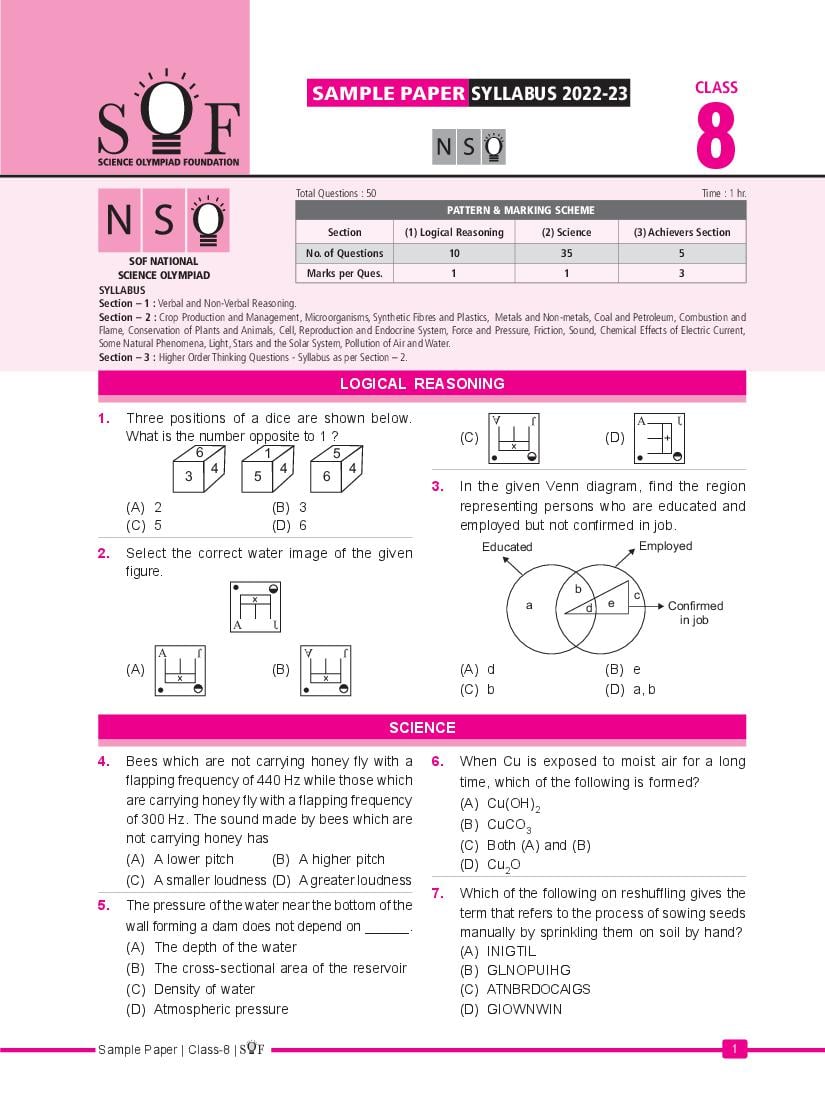
SAMPLE PAPER SYLLABUS 2022-23 CLASS Total Questions : 50 8 Time : 1 hr. PATTERN & MARKING SCHEME Section (1) Logical Reasoning (2) Science (3) Achievers Section No. of Questions 10 35 5 SOF NATIONAL SCIENCE OLYMPIAD Marks per Ques. 1 1 3 SYLLABUS Section – 1 : Verbal and Non-Verbal Reasoning. Section – 2 : Crop Production and Management, Microorganisms, Synthetic Fibres and Plastics, Metals and Non-metals, Coal and Petroleum, Combustion and Flame, Conservation of Plants and Animals, Cell, Reproduction and Endocrine System, Force and Pressure, Friction, Sound, Chemical Effects of Electric Current, Some Natural Phenomena, Light, Stars and the Solar System, Pollution of Air and Water. Section – 3 : Higher Order Thinking Questions - Syllabus as per Section – 2. LOGICAL REASONING 1. Three positions of a dice are shown below. A J J A What is the number opposite to 1 ? (C) × (D) + 6 1 5 4 4 4 3 5 6 3. In the given Venn diagram, find the region (A) 2 (B) 3 representing persons who are educated and (C) 5 (D) 6 employed but not confirmed in job. Educated Employed 2. Select the correct water image of the given figure. b c × a e d Confirmed A J in job A A J J (A) × (B) × (A) d (B) e (C) b (D) a, b SCIENCE 4. Bees which are not carrying honey fly with a 6. When Cu is exposed to moist air for a long flapping frequency of 440 Hz while those which time, which of the following is formed? are carrying honey fly with a flapping frequency (A) Cu(OH)2 of 300 Hz. The sound made by bees which are (B) CuCO3 not carrying honey has (C) Both (A) and (B) (A) A lower pitch (B) A higher pitch (D) Cu2O (C) A smaller loudness (D) A greater loudness 7. Which of the following on reshuffling gives the 5. The pressure of the water near the bottom of the term that refers to the process of sowing seeds wall forming a dam does not depend on ______. manually by sprinkling them on soil by hand? (A) The depth of the water (A) INIGTIL (B) The cross-sectional area of the reservoir (B) GLNOPUIHG (C) Density of water (C) ATNBRDOCAIGS (D) Atmospheric pressure (D) GIOWNWIN Sample Paper | Class-8 | 1
Page 2
8. Which of the following groups represents the (B) Small pox, Tuberculosis, Malaria, Typhoid bacterial diseases? (C) Cholera, Tuberculosis, Typhoid, Measles (A) Cholera, Tuberculosis, Malaria, Measles (D) Cholera, Anthrax, Tuberculosis, Typhoid ACHIEVERS SECTION 9. Anuj performed an experiment to Hook compare the strength Threads of same length and thickness of different fibres. He were taken X Y Z arranged the set-up as (i) Bacterium X can be causal organism of shown in the figure : Weight were put typhoid. Arrange the threads one by one till the thread broke (ii) �Bacterium Y can cause a disease which in order of their disrupts proper exchange of gases. increasing strength. (iii) Bacterium Z can convert lactose sugar of (A) Nylon < Silk < Cotton milk into lactic acid. (B) Silk < Cotton < Nylon (iv) Bacterium X can be the causal organism of cholera. (C) Cotton < Nylon < Silk Which of these statements are incorrect? (D) Cotton < Silk < Nylon (A) (i) only 10. Refer to the given figures of bacteria X, Y and (B) (i) and (ii) only Z and read the statements (i), (ii), (iii) and (iv) (C) (ii), (iii) and (iv) only regarding them. (D) (i), (ii), (iii) and (iv) SPACE FOR ROUGH WORK ANSWERS 1. (D) 2. (B) 3. (C) 4. (B) 5. (B) 6. (C) 7. (C) 8. (D) 9. (D) 10. (A) 2 | Sample Paper | Class-8