Page 1
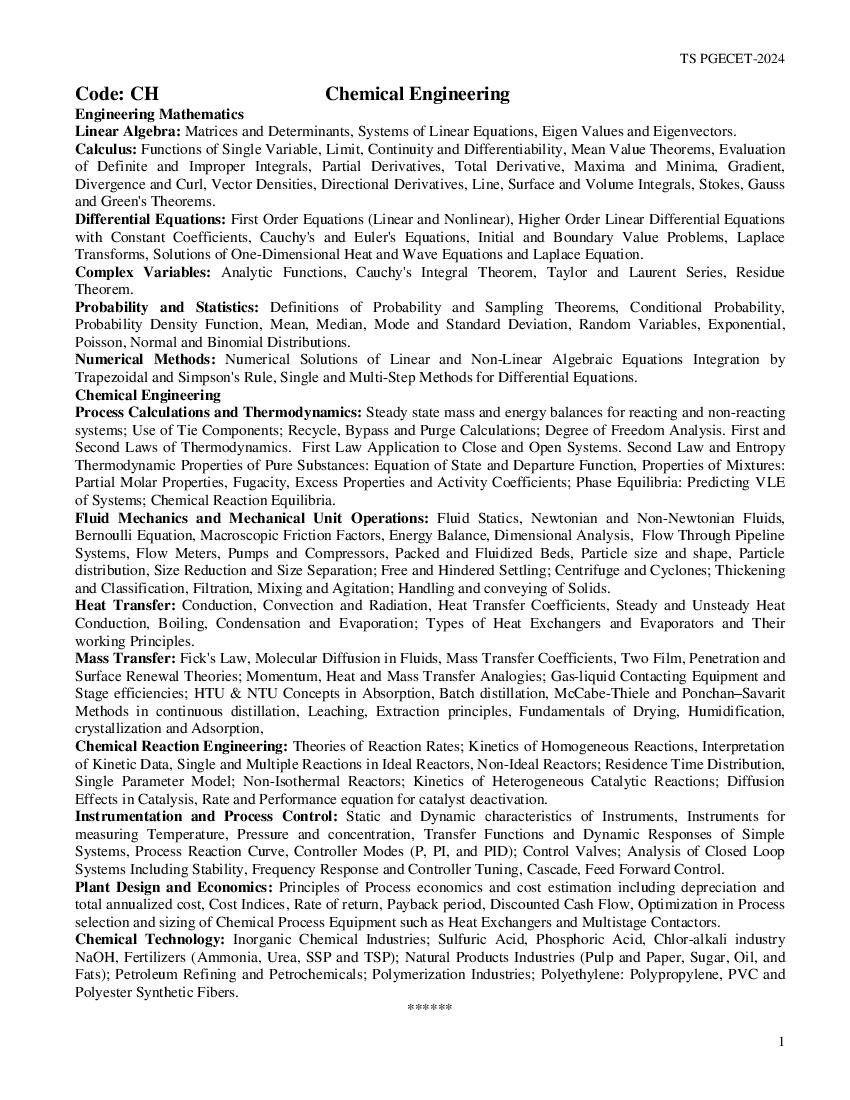
TS PGECET-2024 Code: CH Chemical Engineering Engineering Mathematics Linear Algebra: Matrices and Determinants, Systems of Linear Equations, Eigen Values and Eigenvectors. Calculus: Functions of Single Variable, Limit, Continuity and Differentiability, Mean Value Theorems, Evaluation of Definite and Improper Integrals, Partial Derivatives, Total Derivative, Maxima and Minima, Gradient, Divergence and Curl, Vector Densities, Directional Derivatives, Line, Surface and Volume Integrals, Stokes, Gauss and Green's Theorems. Differential Equations: First Order Equations (Linear and Nonlinear), Higher Order Linear Differential Equations with Constant Coefficients, Cauchy's and Euler's Equations, Initial and Boundary Value Problems, Laplace Transforms, Solutions of One-Dimensional Heat and Wave Equations and Laplace Equation. Complex Variables: Analytic Functions, Cauchy's Integral Theorem, Taylor and Laurent Series, Residue Theorem. Probability and Statistics: Definitions of Probability and Sampling Theorems, Conditional Probability, Probability Density Function, Mean, Median, Mode and Standard Deviation, Random Variables, Exponential, Poisson, Normal and Binomial Distributions. Numerical Methods: Numerical Solutions of Linear and Non-Linear Algebraic Equations Integration by Trapezoidal and Simpson's Rule, Single and Multi-Step Methods for Differential Equations. Chemical Engineering Process Calculations and Thermodynamics: Steady state mass and energy balances for reacting and non-reacting systems; Use of Tie Components; Recycle, Bypass and Purge Calculations; Degree of Freedom Analysis. First and Second Laws of Thermodynamics. First Law Application to Close and Open Systems. Second Law and Entropy Thermodynamic Properties of Pure Substances: Equation of State and Departure Function, Properties of Mixtures: Partial Molar Properties, Fugacity, Excess Properties and Activity Coefficients; Phase Equilibria: Predicting VLE of Systems; Chemical Reaction Equilibria. Fluid Mechanics and Mechanical Unit Operations: Fluid Statics, Newtonian and Non-Newtonian Fluids, Bernoulli Equation, Macroscopic Friction Factors, Energy Balance, Dimensional Analysis, Flow Through Pipeline Systems, Flow Meters, Pumps and Compressors, Packed and Fluidized Beds, Particle size and shape, Particle distribution, Size Reduction and Size Separation; Free and Hindered Settling; Centrifuge and Cyclones; Thickening and Classification, Filtration, Mixing and Agitation; Handling and conveying of Solids. Heat Transfer: Conduction, Convection and Radiation, Heat Transfer Coefficients, Steady and Unsteady Heat Conduction, Boiling, Condensation and Evaporation; Types of Heat Exchangers and Evaporators and Their working Principles. Mass Transfer: Fick's Law, Molecular Diffusion in Fluids, Mass Transfer Coefficients, Two Film, Penetration and Surface Renewal Theories; Momentum, Heat and Mass Transfer Analogies; Gas-liquid Contacting Equipment and Stage efficiencies; HTU & NTU Concepts in Absorption, Batch distillation, McCabe-Thiele and Ponchan–Savarit Methods in continuous distillation, Leaching, Extraction principles, Fundamentals of Drying, Humidification, crystallization and Adsorption, Chemical Reaction Engineering: Theories of Reaction Rates; Kinetics of Homogeneous Reactions, Interpretation of Kinetic Data, Single and Multiple Reactions in Ideal Reactors, Non-Ideal Reactors; Residence Time Distribution, Single Parameter Model; Non-Isothermal Reactors; Kinetics of Heterogeneous Catalytic Reactions; Diffusion Effects in Catalysis, Rate and Performance equation for catalyst deactivation. Instrumentation and Process Control: Static and Dynamic characteristics of Instruments, Instruments for measuring Temperature, Pressure and concentration, Transfer Functions and Dynamic Responses of Simple Systems, Process Reaction Curve, Controller Modes (P, PI, and PID); Control Valves; Analysis of Closed Loop Systems Including Stability, Frequency Response and Controller Tuning, Cascade, Feed Forward Control. Plant Design and Economics: Principles of Process economics and cost estimation including depreciation and total annualized cost, Cost Indices, Rate of return, Payback period, Discounted Cash Flow, Optimization in Process selection and sizing of Chemical Process Equipment such as Heat Exchangers and Multistage Contactors. Chemical Technology: Inorganic Chemical Industries; Sulfuric Acid, Phosphoric Acid, Chlor-alkali industry NaOH, Fertilizers (Ammonia, Urea, SSP and TSP); Natural Products Industries (Pulp and Paper, Sugar, Oil, and Fats); Petroleum Refining and Petrochemicals; Polymerization Industries; Polyethylene: Polypropylene, PVC and Polyester Synthetic Fibers. ****** 1