JNUEE 2021 Question Paper MA International Relations N Area Studies
Finished viewing? Save it for later —
Download JNUEE 2021 Question Paper MA International Relations N Area Studies (PDF · 32 pages)About JNUEE 2021 Question Paper MA International Relations N Area Studies
JNUEE 2021 Question Paper MA International Relations N Area Studies is available here for free download. Published by NTA for JNUEE, this question paper can be viewed online or downloaded as a PDF (32 pages). Candidates preparing for JNUEE can use JNUEE 2021 Question Paper MA International Relations N Area Studies to understand the exam pattern, the type of questions asked, and the overall difficulty level.
Frequently Asked Questions
How can I download JNUEE 2021 Question Paper MA International Relations N Area Studies?
Open this page and click the Download button to save JNUEE 2021 Question Paper MA International Relations N Area Studies as a PDF. It is completely free on AglaSem Docs.
Is JNUEE 2021 Question Paper MA International Relations N Area Studies free to download?
Yes. JNUEE 2021 Question Paper MA International Relations N Area Studies can be viewed online and downloaded as a PDF free of cost on AglaSem Docs.
How many pages does JNUEE 2021 Question Paper MA International Relations N Area Studies have?
JNUEE 2021 Question Paper MA International Relations N Area Studies contains 32 pages, which you can read online or download together as a single PDF.
Where can I find more JNUEE study material?
You can find more JNUEE question papers, sample papers, syllabus, and answer keys on AglaSem Docs.
JNUEE 2021 Question Paper MA International Relations N Area Studies – Text
Read the full text of this question paper below — useful to quickly search, copy and reference the content online without downloading the PDF.
📄 View text version (32 pages)
Page 1
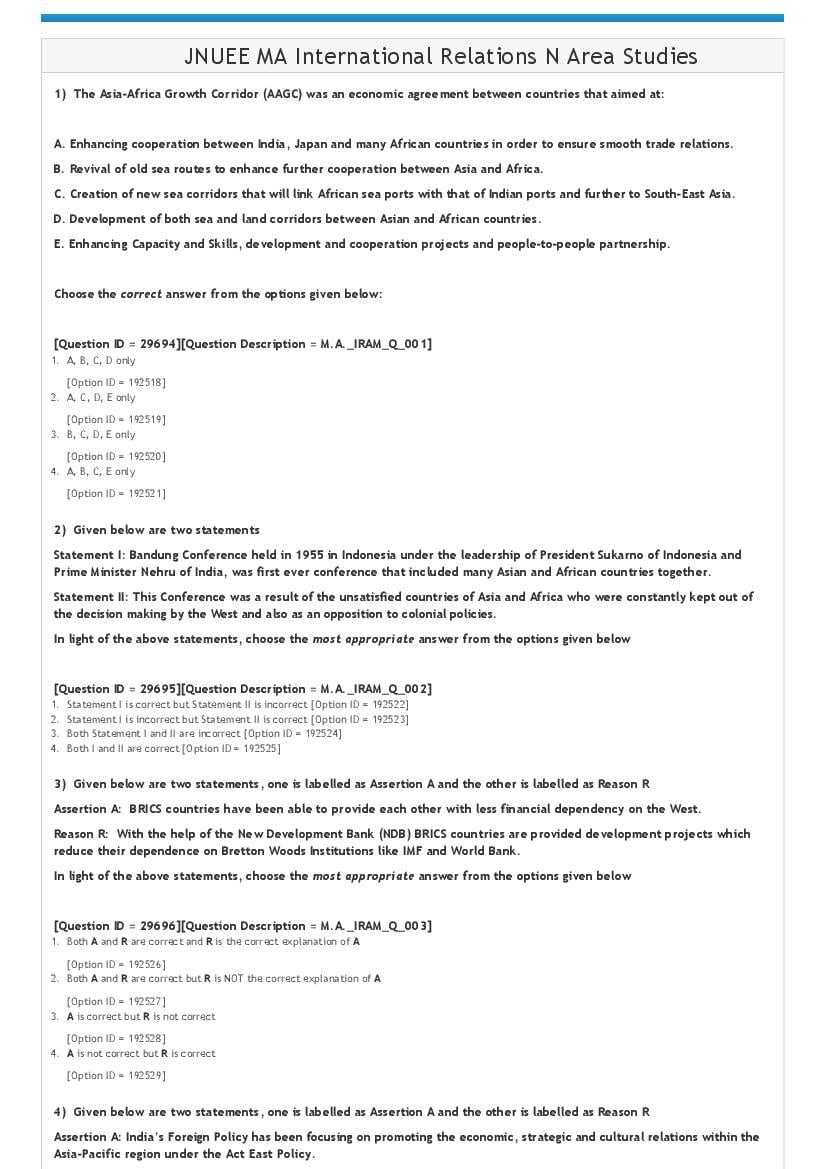
1) The Asia‐Africa Growth Corridor (AAGC) was an economic agreement between countries that aimed at:
A. Enhancing cooperation between India, Japan and many African countries in order to ensure smooth trade relations.
B. Revival of old sea routes to enhance further cooperation between Asia and Africa.
C. Creation of new sea corridors that will link African sea ports with that of Indian ports and further to South‐East Asia.
D. Development of both sea and land corridors between Asian and African countries.
E. Enhancing Capacity and Skills, development and cooperation projects and people‐to‐people partnership.
[Question ID = 29694][Question Description = M.A._IRAM_Q_001]
1. A, B, C, D only
[Option ID = 192518]
2. A, C, D, E only
[Option ID = 192519]
3. B, C, D, E only
[Option ID = 192520]
4. A, B, C, E only
[Option ID = 192521]
2) Given below are two statements
Statement I: Bandung Conference held in 1955 in Indonesia under the leadership of President Sukarno of Indonesia and
Prime Minister Nehru of India, was first ever conference that included many Asian and African countries together.
Statement II: This Conference was a result of the unsatisfied countries of Asia and Africa who were constantly kept out of
the decision making by the West and also as an opposition to colonial policies.
In light of the above statements, choose the most appropriate answer from the options given below
[Question ID = 29695][Question Description = M.A._IRAM_Q_002]
1. Statement I is correct but Statement II is incorrect [Option ID = 192522]
2. Statement I is incorrect but Statement II is correct [Option ID = 192523]
3. Both Statement I and II are incorrect [Option ID = 192524]
4. Both I and II are correct [Option ID = 192525]
3) Given below are two statements, one is labelled as Assertion A and the other is labelled as Reason R
Assertion A: BRICS countries have been able to provide each other with less financial dependency on the West.
Reason R: With the help of the New Development Bank (NDB) BRICS countries are provided development projects which
reduce their dependence on Bretton Woods Institutions like IMF and World Bank.
In light of the above statements, choose the most appropriate answer from the options given below
[Question ID = 29696][Question Description = M.A._IRAM_Q_003]
1. Both A and R are correct and R is the correct explanation of A
[Option ID = 192526]
2. Both A and R are correct but R is NOT the correct explanation of A
[Option ID = 192527]
3. A is correct but R is not correct
[Option ID = 192528]
4. A is not correct but R is correct
[Option ID = 192529]
4) Given below are two statements, one is labelled as Assertion A and the other is labelled as Reason R
Assertion A: India’s Foreign Policy has been focusing on promoting the economic, strategic and cultural relations within the
Asia‐Pacific region under the Act East Policy.
Page 2
vaccines.
In light of the above statements, choose the most appropriate answer from the options given below.
[Question ID = 29697][Question Description = M.A._IRAM_Q_004]
1. Both A and R are correct and R is the correct explanation of A
[Option ID = 192530]
2. Both A and R are correct but R is NOT the correct explanation of A
[Option ID = 192531]
3. A is correct but R is not correct
[Option ID = 192532]
4. A is not correct but R is correct
[Option ID = 192533]
5) Quadrilateral Security (QUAD) is a strategic dialogue between which of the following countries:
1. India
2. Japan
3. Philippines
4. Australia
5. USA
[Question ID = 29698][Question Description = M.A._IRAM_Q_005]
1. A, B, C, D only [Option ID = 192534]
2. B, C, D, E only [Option ID = 192535]
3. A, C, D, E only [Option ID = 192536]
4. A, B, D, E only [Option ID = 192537]
6) Match List I with List II
List I List II
National Movement Year
I. Non‐Cooperation Movement A. 1920
II. Kheda Satyagraha B. 1917
III. Champaran Satyagraha C. 1918
IV. Civil Disobedience Movement D. 1930
[Question ID = 29699][Question Description = M.A._IRAM_Q_006]
1. I‐A, II‐B, III‐D, IV‐C [Option ID = 192538]
2. I‐A, II‐ C, III‐B, IV‐D [Option ID = 192539]
3. I‐D, II‐C, III‐B, IV‐A [Option ID = 192540]
4. I‐A, II‐B, III‐C, IV‐D [Option ID = 192541]
7) The “Belt and Road Initiative” is an initiative by the Chinese government aimed at:
A. Connecting China with nearly 70 countries through land route.
B. Enhancing regional development through connectivity between nations.
C. Promoting economic development through trade.
D. Disregarding the presence of USA throughout this region.
[Question ID = 29700][Question Description = M.A._IRAM_Q_007]
1. A, B, C only [Option ID = 192542]
Page 3
3. A, C, D only [Option ID = 192544]
4. A, B, D only [Option ID = 192545]
8) Given below are two statements
Statement I: ‘String of Pearls’ is a term used to refer to Chinese military presence and development of sea lines of
communications along the Indian Ocean, starting from China towards the Horn of Africa.
Statement II: Experts believe that if clubbed with China‐Pakistan Economic Corridor and Belt and Road Initiative, String of
Pearls is a huge threat to Indian power in the Indian Ocean.
In light of the above statements, choose the most appropriate answer from the options given below
[Question ID = 29701][Question Description = M.A._IRAM_Q_008]
1. Statement I is correct but Statement II is incorrect [Option ID = 192546]
2. Both Statement I and II are correct [Option ID = 192547]
3. Both Statement I and II are incorrect [Option ID = 192548]
4. Statement I is incorrect but Statement II is correct [Option ID = 192549]
9) Which of these is correct about the Galwan Valley Skirmishes between Indian and Chinese troops in 2020‐21:
A. Galwan Valley face off took place near the disputed area of Pangong lake in Ladakh and Tibet Autonomous Region.
B. The skirmishes took place in the night which resulted in death of atleast 20 Indian soldiers of the Bihar Regiment.
C. Post‐Galwan Conflict, China has agreed to amicably resolve the dispute, promising no construction in the region and
withdrawal of its troops from the disputed territory for good.
D. As a result of Galwan, Indian government banned atleast 200 Chinese apps in India.
E. The construction of the Darbuk‐Shyok‐DBO Road which is a strategic all‐weather road in Eastern Ladakh has also led to
disputes between India and China on the disputed territory of Raki Nala and Depsang Nala.
Choose the correct answer from the options below:
[Question ID = 29702][Question Description = M.A._IRAM_Q_009]
1. A, B, C, D only
[Option ID = 192550]
2. B, C, D, E only
[Option ID = 192551]
3. A, C, D, E only
[Option ID = 192552]
4. A, B, D, E only
[Option ID = 192553]
10) Where are the headquarters of International Solar Alliance (ISA) located:[Question ID = 29703][Question Description =
M.A._IRAM_Q_010]
1. Johannesburg, South Africa [Option ID = 192554]
2. Gurugram, India [Option ID = 192555]
3. Berlin, Germany [Option ID = 192556]
4. Tokyo, Japan [Option ID = 192557]
11) In which of the following months, Pravasi Bharatiya Diwas (PBD) is celebrated every year to mark the contribution of
overseas Indians?[Question ID = 29704][Question Description = M.A._IRAM_Q_011]
1. December [Option ID = 192558]
2. March [Option ID = 192559]
3. January [Option ID = 192560]
4. August [Option ID = 192561]
12) The Government of India has made several attempts to engage its Diaspora around the world. Which one of these are
the initiatives taken up by Indian Government:
A. Granting of Overseas Citizenship of India (OCI) card
B. ‘Tracing the Home’ programme
C. ‘Know India Programme’
D. Granting of Dual Citizenship
[Question ID = 29734][Question Description = M.A._IRAM_Q_012]
Page 4
[Option ID = 192834]
2. B, C, D only
[Option ID = 192835]
3. A, C, D only
[Option ID = 192836]
4. A, B, D only
[Option ID = 192837]
13) Given below are two statements, one is labelled as Assertion A and the other is labelled as Reason R
Assertion A: The concept of Global South developed as a result of the ‘New International Economic Order’, which saw the
coming together of Southern hemisphere nations to work on political, economic, social and environmental cooperation.
Reason R: Many of the low‐income economies of the ‘Global South’ were burdened by conditionalities of the International
Financial Institutions which provided loans on certain conditions of liberalising reforms, thus making them unable to repay
the debts.
In light of the above statements, choose the most appropriate answer from the options given below
[Question ID = 29705][Question Description = M.A._IRAM_Q_013]
1. Both A and R are correct and R is the correct explanation of A
[Option ID = 192562]
2. Both A and R are correct but R is NOT the correct explanation of A
[Option ID = 192563]
3. A is correct but R is not correct
[Option ID = 192564]
4. A is not correct but R is correct
[Option ID = 192565]
14) India is a member of which of the following organisations:[Question ID = 29706][Question Description =
M.A._IRAM_Q_014]
1. Association of South‐East Asian Nations (ASEAN) [Option ID = 192566]
2. Asia‐Pacific Economic Cooperation (APEC) [Option ID = 192567]
3. Economic Community of West African States (ECOWAS) [Option ID = 192568]
4. Shanghai Cooperation Organisation (SCO) [Option ID = 192569]
15) The South‐China Sea conflict involves which of the following countries:
A. Brunei
B. Malaysia
C. Thailand
D. Vietnam
E. Taiwan
[Question ID = 29707][Question Description = M.A._IRAM_Q_015]
1. A, B, C, D only [Option ID = 192570]
2. B, C, D, E only [Option ID = 192571]
3. A, C, D, E only [Option ID = 192572]
4. A, B, D, E only [Option ID = 192573]
16) The 1980s and 1990s, a methodological revolution that influenced International Relations and other subjects by
challenging whether objective, value‐free enquiry into human behaviour was really possible, was known as:[Question ID =
29708][Question Description = M.A._IRAM_Q_016]
1. Behaviouralism [Option ID = 192574]
2. Postmodernism [Option ID = 192575]
3. Historicism [Option ID = 192576]
4. Social Science Approach [Option ID = 192577]
17) Given below are two statements, one is labelled as Assertion A and the other is labelled as Reason R
Assertion A: Rights without duties is a licence
Reason R: Gandhi redefined the liberal notion of rights
In light of the above statements, choose the correct answer from the options given below
Page 5
1. Both A and R are true and R is the correct explanation of A
[Option ID = 192578]
2. Both A and R are true but R is NOT the correct explanation of A
[Option ID = 192579]
3. A is true but R is false
[Option ID = 192580]
4. A is false but R is true
[Option ID = 192581]
18) Who coined the term ‘Print Capitalism’?
[Question ID = 29710][Question Description = M.A._IRAM_Q_018]
1. William Anderson [Option ID = 192582]
2. Benedict Anderson [Option ID = 192583]
3. Adil Khan [Option ID = 192584]
4. Craig Calhoun [Option ID = 192585]
19) Which among the following were considered by Hugo Grotius as causes of a Just War?
A. self‐defence
B. to enforce duties
C. to seek reparation of injury
D. to punish a wrongdoer
[Question ID = 29711][Question Description = M.A._IRAM_Q_019]
1. A, B, D only
[Option ID = 192586]
2. A, C, D only
[Option ID = 192587]
3. B, C, D only
[Option ID = 192588]
4. A, B, C only
[Option ID = 192589]
20) Who among the following argued that ‘the indigenous, educated individuals staffing far flung colonial empires were
often the originators of nationalistic ideologies'?
[Question ID = 29712][Question Description = M.A._IRAM_Q_020]
1. Partha Chatterjee
[Option ID = 192590]
2. Christopher Jafferlot
[Option ID = 192591]
3. Ashis Nandy
[Option ID = 192592]
4. Benedict Anderson
[Option ID = 192593]
21) Which of the following ideas was posited by Samuel Huntington?[Question ID = 29713][Question Description =
M.A._IRAM_Q_021]
1. Dialogue between civilizations [Option ID = 192594]
2. Clash of civilizations [Option ID = 192595]
3. End of history [Option ID = 192596]
4. Deconstruction [Option ID = 192597]
22) Name four persons, from the following, who are attributed mainly to the origin, usages, and popularization of the term
Cold War: [Question ID = 33530][Question Description = M.A._IRAM_Q_022]
1. George Orwell, Bernard Baruch, Winston Churchill, and Walter Lippmann [Option ID = 192598]
2. Winston Churchill, Mikhail Gorbachev, David Cameron, and Walter Lippmann [Option ID = 192599]
3. George Orwell, Bernard Baruch, Winston Churchill, and Bill Clinton [Option ID = 192600]
4. Bernard Baruch, George Orwell, Margaret Thatcher, and George W. Bush Jr. [Option ID = 192601]
23) Which one of the following events is/are associated with the Cold War confrontation?
A. Korean crisis
B. Vietnam war
C. Cuban Missile crisis
Page 6
[Question ID = 33531][Question Description = M.A._IRAM_Q_023]
1. A, B, C only
[Option ID = 192602]
2. B, C, D only
[Option ID = 192603]
3. A, C, D only
[Option ID = 192604]
4. A, B, C, D
[Option ID = 192605]
24) Kenichi Ohmae is credited with the popular usage of the term globalization in which of the following books?
[Question ID = 33532][Question Description = M.A._IRAM_Q_024]
1. The End of the History
[Option ID = 192606]
2. The Shock Doctrine
[Option ID = 192607]
3. Borderless World
[Option ID = 192608]
4. The World is Flat
[Option ID = 192609]
25) Given below are two statements:
Statement I: The traditionalists are very sceptical about the very existence or specificity of globalization as a process.
Therefore, they are popularly known as Globalisation Sceptics.
Statement II: Globalisation Sceptics see globalization largely as a myth or as propaganda of the neo‐liberals.
In light of the above statements, choose the most appropriate answer from the options given below
[Question ID = 33533][Question Description = M.A._IRAM_Q_025]
1. Both Statement I and Statement II are correct
[Option ID = 192610]
2. Both Statement I and Statement II are incorrect
[Option ID = 192611]
3. Statement I is correct but Statement II is incorrect
[Option ID = 192612]
4. Statement I is incorrect but Statement II is correct
[Option ID = 192613]
26) Given below are two statements:
Statement I: Schism was recognized at the first Buddhist Council held in Kashmir in the early second century A.D.
Statement II: The Mahayana doctrine is believed to have originated in about the first century A.D. in Andhra, and was later
propounded by a group of Buddhist philosophers.
In light of the above statements, choose the most appropriate answer from the options given below
[Question ID = 33534][Question Description = M.A._IRAM_Q_026]
1. Both Statement I and Statement II are correct
[Option ID = 192614]
2. Both Statement I and Statement II are incorrect
[Option ID = 192615]
3. Statement I is correct but Statement II is incorrect
[Option ID = 192616]
4. Statement I is incorrect but Statement II is correct
[Option ID = 192617]
27) Who among the following taught the doctrine of the Void (Shunyata)?
[Question ID = 33535][Question Description = M.A._IRAM_Q_027]
1. Amoghavarsha
[Option ID = 192618]
2. Nagarjuna
[Option ID = 192619]
3. Kumarajiva
Page 7
4. Mahavira
[Option ID = 192621]
28) Match List I with List II
List I List II
Author Book
A. Shudraka I. Meghaduta
B. Kalidasa II. Mrichchakatika
C. Varamihira III. Dashakumaracharita
D. Dandin IV. Panchsiddhantika
[Question ID = 33536][Question Description = M.A._IRAM_Q_028]
1. A ‐ III, B ‐ I, C ‐ IV, D ‐ II
[Option ID = 192622]
2. A ‐ II, B ‐ I, C ‐ III, D ‐ IV
[Option ID = 192623]
3. A ‐ II, B ‐ I, C ‐ IV, D ‐ III
[Option ID = 192624]
4. A ‐ I, B ‐ II, C ‐ III, D ‐ IV
[Option ID = 192625]
29) Match List I with List II
List I List II
Author Work
A. Udayaraja I. Prabandha chintamani
B. Merutunga II. Hammira Mahakavya
C. Rajashekhara III. Rajavinoda
D. Nayachandra Suri IV. Prabandhakosha
[Question ID = 33537][Question Description = M.A._IRAM_Q_029]
1. A ‐ III, B ‐ I, C ‐ IV, D ‐ II
[Option ID = 192626]
2. A ‐ II, B ‐ I, C ‐ III, D ‐ IV
[Option ID = 192627]
3. A ‐ II, B ‐ I, C ‐ IV, D ‐ III
[Option ID = 192628]
4. A ‐ I, B ‐ IV, C ‐ III, D ‐ II
[Option ID = 192629]
30) Match List I with List II
List I List II
Author Work
A. Vakpati I. Gita Govinda
B. Jayadeva II. Gauaavadha
C. Vishakhadatta III. Mudrarakshasa
D. Bilhana IV. Chaurapanchashika
[Question ID = 33538][Question Description = M.A._IRAM_Q_030]
1. A ‐ III, B ‐ I, C ‐ IV, D ‐ II
Page 8
2. A ‐ II, B ‐ I, C ‐ III, D ‐ IV
[Option ID = 192631]
3. A ‐ II, B ‐ I, C ‐ IV, D ‐ III
[Option ID = 192632]
4. A ‐ I, B ‐ IV, C ‐ III, D ‐ II
[Option ID = 192633]
31) Who among the following, established a kingdom for the Hoysala dynasty?[Question ID = 33539][Question Description =
M.A._IRAM_Q_031]
1. Amoghvarsha [Option ID = 192634]
2. Harshavardhana [Option ID = 192635]
3. Vishnuvardhana [Option ID = 192636]
4. Yashovarman [Option ID = 192637]
32) Given below are two statements
Statement I: The earliest records of the Pallavas are inscriptions written in Prakrit followed by inscriptions in Sanskrit.
Statement II: The Prakrit inscriptions were made when the Pallavas were still a local dynasty ruling at Kanchipuram.
In light of the above statements, choose the most appropriate answer from the options given below
[Question ID = 33540][Question Description = M.A._IRAM_Q_032]
1. Both Statement I and Statement II are correct
[Option ID = 192638]
2. Both Statement I and Statement II are incorrect
[Option ID = 192639]
3. Statement I is correct but Statement II is incorrect
[Option ID = 192640]
4. Statement I is incorrect but Statement II is correct
[Option ID = 192641]
33) Which of the following dynasties in China was founded by the Mongols?[Question ID = 33541][Question Description =
M.A._IRAM_Q_033]
1. Tang dynasty [Option ID = 192642]
2. Yuan dynasty [Option ID = 192643]
3. Ming dynasty [Option ID = 192644]
4. Ching dynasty [Option ID = 192645]
34) Given below are two statements
Statement I: The battle of Panipat (1526) fought between the Mughals and Lodis marked the defeat of the titular Sultan of
Delhi, who had ceased to command sovereign authority.
Statement II: The battle of Khanwa (1527) fought between the Mughals and Rajputs resulted in the defeat of the powerful
Rajput confederacy.
In light of the above statements, choose the most appropriate answer from the options given below
[Question ID = 33542][Question Description = M.A._IRAM_Q_034]
1. Both Statement I and Statement II are correct
[Option ID = 192646]
2. Both Statement I and Statement II are incorrect
[Option ID = 192647]
3. Statement I is correct but Statement II is incorrect
[Option ID = 192648]
4. Statement I is incorrect but Statement II is correct
[Option ID = 192649]
35) Match List I with List II
List I List II
Event Year
A. First Anglo‐Afghan war I. 1775‐1782
B. First Anglo‐Burmese war II. 1824‐1826
C. First Anglo‐Maratha war III. 1845‐1846
D. First Anglo‐Sikh War IV. 1839‐1842
Page 9
1. A ‐ I, B ‐ II, C ‐ III, D ‐ IV
[Option ID = 192650]
2. A ‐ II, B ‐ I, C ‐ IV, D ‐ III
[Option ID = 192651]
3. A ‐ III, B ‐ IV, C ‐ II, D ‐ I
[Option ID = 192652]
4. A ‐ IV, B ‐ II, C ‐ I, D ‐ III
[Option ID = 192653]
36) Given below are two statements, one is labelled as Assertion A and the other is labelled as Reason R
Assertion A: Realism as a theory of International Relations was subjected to scathing criticism in the post‐Cold War era.
Reason R: Realism failed to explain the structural changes in the international system and comprehend emerging security
challenges.
In light of the above statements, choose the correct answer from the options given below.
[Question ID = 33544][Question Description = M.A._IRAM_Q_036]
1. Both A and R are correct and R is the correct explanation of A
[Option ID = 192654]
2. Both A and R are correct but R is not the correct explanation of A
[Option ID = 192655]
3. A is correct but R is incorrect
[Option ID = 192656]
4. A is incorrect but R is correct
[Option ID = 192657]
37) E. H. Carr disapproved of idealism for its claim to:[Question ID = 33545][Question Description = M.A._IRAM_Q_037]
1. Pragmatic strategy [Option ID = 192658]
2. Moral universalism [Option ID = 192659]
3. Desire for power [Option ID = 192660]
4. Discord of interests [Option ID = 192661]
38) Kautilya recommended few pragmatic strategies to deal with neighbouring powers:
A. Sanman (Appeasement, non‐aggression pact)
B. Danda (Strength, punishment)
C. Bheda (Divide, split, separating opposition)
D. Upeksha (Ignoring the enemy)
[Question ID = 33546][Question Description = M.A._IRAM_Q_038]
1. B, C, D only
[Option ID = 192662]
2. A, B, D only
[Option ID = 192663]
3. A, B, C only
[Option ID = 192664]
4. A, B, C, and D
[Option ID = 192665]
39) The Melian Dialogue is associated with:
[Question ID = 33547][Question Description = M.A._IRAM_Q_039]
1. Socrates
[Option ID = 192666]
2. Plato
[Option ID = 192667]
3. Aristotle
[Option ID = 192668]
4. Thucydides
[Option ID = 192669]
40) The 73rd Amendment Act of 1992 has added which of the following Schedule in the Constitution of India:
Page 10
1. IXth Schedule
[Option ID = 192670]
2. Xth Schedule
[Option ID = 192671]
3. XIth Schedule
[Option ID = 192672]
4. XIIth Schedule
[Option ID = 192673]
41) Match List I with List II
List I List II
Theory proposed Thinker
A. Offense‐defense theory I. Barry Posen
B. Domestic mobilization theory II. Robert Jervis
C. Security dilemma III. John Hertz
D. Balance‐of‐power theory IV. Jack Snyder
[Question ID = 29714][Question Description = M.A._IRAM_Q_041]
1. A ‐ I, B ‐ II, C ‐ III, D ‐ IV
[Option ID = 192674]
2. A ‐ II, B ‐ I, C ‐ IV, D ‐ III
[Option ID = 192675]
3. A ‐ II, B ‐ IV, C ‐ III, D ‐ I
[Option ID = 192676]
4. A ‐ III, B ‐ II, C ‐ IV, D ‐ I
[Option ID = 192677]
42) The key difference between structural realists and rational choice realists turns on:[Question ID = 29715][Question
Description = M.A._IRAM_Q_042]
1. The role of international institutions [Option ID = 192678]
2. Universal morality [Option ID = 192679]
3. Economic aid [Option ID = 192680]
4. Balance of power [Option ID = 192681]
43) The famous Concert of Europe began with the Vienna Congress (1815) that lasted unto:[Question ID = 29716][Question
Description = M.A._IRAM_Q_043]
1. The beginning of the WW I [Option ID = 192682]
2. The end of the WW II [Option ID = 192683]
3. The end of the Cold War [Option ID = 192684]
4. The September 11, 2001 [Option ID = 192685]
44) The Non‐Aligned Movement (NAM) was kicked off by India’s first Prime Minister Jawaharlal Nehru along with which of
the following leaders?
[Question ID = 29717][Question Description = M.A._IRAM_Q_044]
1. Gamal Abdel Nasser and Josip Tito
[Option ID = 192686]
2. Harry Truman and Nikita Khrushchev
[Option ID = 192687]
3. Chou En‐Lai and Brezhnev
[Option ID = 192688]
4. Willy Brandt and Winston Churchill
[Option ID = 192689]
45) Match List I with List II
List I List II
Treaty/Agreement/Forum Year
A. PTBT I. 1961
B. NPT II. 1963
C. NAM III. 1972
Page 11
[Question ID = 29718][Question Description = M.A._IRAM_Q_045]
1. A ‐ I, B ‐ II, C ‐ III, D ‐ IV
[Option ID = 192690]
2. A ‐ II, B ‐ IV, C ‐ I, D ‐ III
[Option ID = 192691]
3. A ‐ II, B ‐ IV, C ‐ III, D ‐ I
[Option ID = 192692]
4. A ‐ III, B ‐ I, C ‐ II, D ‐ IV
[Option ID = 192693]
46) Which among the following three Southeast Asian Countries were under French Possession before their independence?
[Question ID = 29719][Question Description = M.A._IRAM_Q_046]
1. Indonesia, Malaysia, Brunei [Option ID = 192694]
2. Myanmar, Thailand, Laos [Option ID = 192695]
3. Vietnam, Cambodia, Thailand [Option ID = 192696]
4. Vietnam, Cambodia, Laos [Option ID = 192697]
47) Match List I with List II
List I List II
Theory proposed Thinker
A. Neo Liberalism I. Nicholas Onuf
B. Pluralism II.Kenneth Waltz
C. Neo‐ Realism III. John Rawls
D. Constructivism IV. Robert A. Dahl
[Question ID = 29720][Question Description = M.A._IRAM_Q_047]
1. A ‐ III, B ‐I, C ‐II, D ‐ IV
[Option ID = 192698]
2. A ‐III , B ‐ IV, C ‐II , D ‐I
[Option ID = 192699]
3. A ‐II, B ‐IV , C ‐ III, D ‐ I
[Option ID = 192700]
4. A ‐ II, B ‐III , C ‐I , D ‐ IV
[Option ID = 192701]
48) Given below are two statements
Statement I: Feminism in International Relations raised the issue that globalisation has not been able to alter the plight of
women.
Statement II: Globalisation can be found in the significant growth of ‘ sex‐ tourism’, and in trafficking of women and girls for
transnational prostitution.
In light of the above statements, choose the most appropriate answer from the options given below
[Question ID = 29721][Question Description = M.A._IRAM_Q_048]
1. Both Statement I and Statement II are correct
[Option ID = 192702]
2. Both Statement I and Statement II are incorrect
[Option ID = 192703]
3. Statement I is correct but Statement II is incorrect
[Option ID = 192704]
4. Statement I is incorrect but Statement II is correct
[Option ID = 192705]
49) Given below are two statements, one is labelled as Assertion A and the other is labelled as Reason R
Page 12
Reason R: Different powers in the international system alter their relative power position in relation to their economic
growth.
In light of the above statements, choose the most appropriate answer from the options given below
[Question ID = 29722][Question Description = M.A._IRAM_Q_049]
1. Both A and R are correct and R is the correct explanation of A
[Option ID = 192706]
2. Both A and R are correct but R is NOT the correct explanation of A
[Option ID = 192707]
3. A is correct but R is not correct
[Option ID = 192708]
4. A is not correct but R is correct
[Option ID = 192709]
50) Given below are two statements
Statement I: Diplomacy is an instrument of foreign policy in fulfilling national interest.
Statement II: Diplomacy should never assess the national interest of other states and power available to fulfill their national
interest.
In light of the above statements, choose the most appropriate answer from the options given below
[Question ID = 29723][Question Description = M.A._IRAM_Q_050]
1. Both Statement I and Statement II are correct
[Option ID = 192710]
2. Both Statement I and Statement II are incorrect
[Option ID = 192711]
3. Statement I is correct but Statement II is incorrect
[Option ID = 192712]
4. Statement I is incorrect but Statement II is correct
[Option ID = 192713]
51) Which among the following statements does not reflect the objective of NIEO?[Question ID = 29724][Question
Description = M.A._IRAM_Q_051]
1. To protect Least Developed Countries (LDCs) in controlling their natural resources [Option ID = 192714]
2. To Prevent LDCs in accessing to western markets [Option ID = 192715]
3. To reduce the cost of technology for LDCs [Option ID = 192716]
4. To promote LDCs to play an important role in international economic institutions [Option ID = 192717]
52) Given below are two statements
Statement I: The U.N. Commission on Sustainable Development (UNCSD) was created in December 1991.
Statement II: The 1992 Earth Summit challenged humanity to reduce its impact on the Earth.
In light of the above statements, choose the most appropriate answer from the options given below
[Question ID = 29725][Question Description = M.A._IRAM_Q_052]
1. Both Statement I and Statement II are correct
[Option ID = 192718]
2. Both Statement I and Statement II are incorrect
[Option ID = 192719]
3. Statement I is correct but Statement II is incorrect
[Option ID = 192720]
4. Statement I is incorrect but Statement II is correct
[Option ID = 192721]
53) Match List I with List II
List I List II
Measures Definition
A. Confidence Building Measures I. Giving up certain types of weapons
B. Arms Control II. A process of exchanging information on defense matters between nations on a regular basis
C. Alliance III. A coalition of nations meant to deter or defend against military attacks
Page 13
[Question ID = 29726][Question Description = M.A._IRAM_Q_053]
1. A ‐III , B ‐IV , C ‐ I, D ‐ II
[Option ID = 192722]
2. A ‐II , B ‐III , C ‐I , D ‐IV
[Option ID = 192723]
3. A ‐III , B ‐ II, C ‐I, D ‐ IV
[Option ID = 192724]
4. A ‐ II, B ‐IV , C ‐III , D ‐I
[Option ID = 192725]
54) Which of the following is not a valid cause for social change?
[Question ID = 29727][Question Description = M.A._IRAM_Q_054]
1. Social Conflict
[Option ID = 192726]
2. Cultural Change
[Option ID = 192727]
3. Ignorance
[Option ID = 192728]
4. Social Problems
[Option ID = 192729]
55) Given below are two statements
Statement I: Social mobility refers to the movement of people of groups from one status to another.
Statement II: The nature, form, intensity and magnitude of social mobility depend on the nature and the type of
stratification.
In light of the above statements, choose the most appropriate answer from the options given below
[Question ID = 29728][Question Description = M.A._IRAM_Q_055]
1. Both Statement I and Statement II are correct
[Option ID = 192730]
2. Both Statement I and Statement II are incorrect
[Option ID = 192731]
3. Statement I is correct but Statement II is incorrect
[Option ID = 192732]
4. Statement I is incorrect but Statement II is correct
[Option ID = 192733]
56) Which of the following is the principal judicial organ of the United Nations? [Question ID = 29729][Question Description
= M.A._IRAM_Q_056]
1. Permanent Court of International Justice (PCIJ) [Option ID = 192734]
2. International Criminal Court (ICC) [Option ID = 192735]
3. European Court of Justice (ECJ) [Option ID = 192736]
4. International Court of Justice (ICJ) [Option ID = 192737]
57) The US interest in Asia (also known as the ‘Pivot to Asia’) is reflective of which of the following?[Question ID = 29730]
[Question Description = M.A._IRAM_Q_057]
1. Assumption that counties such as Indonesia and Vietnam will become major military powers in the region [Option ID = 192738]
2. Belief that many states in Asia (especially China and India) have become a major economic, political and military focal point in the 21st Century
[Option ID = 192739]
3. Realisation that in the face of increasingly hostile Asian states, the US feels compelled to protect its traditional allies in the region including
Australia and New Zealand [Option ID = 192740]
4. An obsession with the Middle East, democratization, and terrorism [Option ID = 192741]
58) Which historical diplomatic treaty is often applied to characterize the present international political system?[Question ID
= 29731][Question Description = M.A._IRAM_Q_058]
1. Congress of Vienna 1815 [Option ID = 192742]
2. Versailles Treaty 1919 [Option ID = 192743]
3. Charter of Paris 1990 [Option ID = 192744]
4. Treaty of Westphalia 1648 [Option ID = 192745]
Page 14
= 33914][Question Description = M.A._IRAM_Q_059]
1. Realism [Option ID = 192746]
2. Liberalism [Option ID = 192747]
3. Marxism [Option ID = 192748]
4. Critical Theory [Option ID = 192749]
60) Which of these great thinkers is generally held to have been most influential in the later emergence of Social
Constructivism thought?[Question ID = 33915][Question Description = M.A._IRAM_Q_060]
1. Karl Marx [Option ID = 192750]
2. Thomas Hobbes [Option ID = 192751]
3. Max Weber [Option ID = 192752]
4. Hugo Grotius [Option ID = 192753]
61) Given below are two statements
Statement I: International Political Economy (IPE) has been described as a ‘true inter‐discipline’.
Statement II: IPE does not successfully integrate conceptual, theoretical and methodological frameworks from the fields of
Economics, International Relations, Comparative Politics, Sociology and Social Theory.
In light of the above statements, choose the most appropriate answer from the options given
[Question ID = 33916][Question Description = M.A._IRAM_Q_061]
1. Both Statement I and Statement II are correct
[Option ID = 192754]
2. Both Statement I and Statement II are incorrect
[Option ID = 192755]
3. Statement I is correct but Statement II is incorrect
[Option ID = 192756]
4. Statement I is incorrect but Statement II is correct
[Option ID = 192757]
62) How do Mercantilist states seek to achieve economic power?
A. Through partial or full state ownership of industries that are considered critical.
B. With the strong use of tariffs, nontariff barriers and other regulations.
C. By limiting social expenditures and thereby keeping taxation to a minimum.
D. With low interest rates set by the central bank to encourage borrowing and investment.
[Question ID = 33917][Question Description = M.A._IRAM_Q_062]
1. A only
[Option ID = 192758]
2. A and B only
[Option ID = 192759]
3. A, B and C only
[Option ID = 192760]
4. A, B, C and D
[Option ID = 192761]
63) Which of the following resulted from the Great Depression?[Question ID = 33918][Question Description =
M.A._IRAM_Q_063]
1. A stable exchange rate system. [Option ID = 192762]
2. Promotion of intellectual property rights. [Option ID = 192763]
3. Increased trade barriers and devalued currencies. [Option ID = 192764]
4. Increased free trade. [Option ID = 192765]
64) What is the main function of the World Bank?[Question ID = 33919][Question Description = M.A._IRAM_Q_064]
1. To be a forum for trade liberalization. [Option ID = 192766]
2. To assist countries in development. [Option ID = 192767]
3. To facilitate public investment around the world. [Option ID = 192768]
4. To promote democracy. [Option ID = 192769]
65) Match List I with List II
List I List II
Author Book
A. Robert O'Brien and Marc Williams I. Global Political Economy: Evolution and Dynamics
Page 15
C. Thomas D. Lairson and
David Skidmore III. International Political Economy: The Struggle for Power and Wealth in a Globalizing World
D. Theodore H. Cohn IV. Global Political Economy: Theory and Practice
[Question ID = 33920][Question Description = M.A._IRAM_Q_065]
1. A ‐ IV, B ‐ III, C ‐ II, D ‐ I
[Option ID = 192770]
2. A ‐ I, B ‐ III, C ‐ II, D ‐ IV
[Option ID = 192771]
3. A ‐ IV, B ‐ II, C ‐ I, D ‐ III
[Option ID = 192772]
4. A ‐ I, B ‐ II, C ‐ III, D ‐ IV
[Option ID = 192773]
66) Given below are two statements
Statement I: Public goods are those goods, provided or secured by the state, that are available for society and indivisible,
meaning that no one private person or organisation can own them.
Statement II: Social expenditures refer to the state’s provision of public benefits, such as education, health care and
transportation, is commonly called as ‘welfare’ or the ‘welfare state’.
In light of the above statements, choose the most appropriate answer from the options given below
[Question ID = 33921][Question Description = M.A._IRAM_Q_066]
1. Both Statement I and Statement II are correct
[Option ID = 192774]
2. Both Statement I and Statement II are incorrect
[Option ID = 192775]
3. Statement I is correct but Statement II is incorrect
[Option ID = 192776]
4. Statement I is incorrect but Statement II is correct
[Option ID = 192777]
67) Given below are two statements
Statement I: Inflation can be defined as an increase in the overall prices in the economy when supply outstrips demand.
Statement II: Hyperinflation is defined as inflation that is less than 50 percent a month for more than two months in a row.
In light of the above statements, choose the most appropriate answer from the options given below
[Question ID = 33922][Question Description = M.A._IRAM_Q_067]
1. Both Statement I and Statement II are correct
[Option ID = 192778]
2. Both Statement I and Statement II are incorrect
[Option ID = 192779]
3. Statement I is correct but Statement II is incorrect
[Option ID = 192780]
4. Statement I is incorrect but Statement II is correct
[Option ID = 192781]
68) What does structural adjustment involve?
A. Deregulation.
B. Measures to reduce inflation.
C. Measures to curb government expenditure.
D. Measures to reduce private investment.
Page 16
1. A, B and D only
[Option ID = 192782]
2. A, C and D only
[Option ID = 192783]
3. B, C and D only
[Option ID = 192784]
4. A, B and C only
[Option ID = 192785]
69) Given below are two statements
Statement I: Tariffs are basically taxes on goods produced within the country.
Statement II: Quotas limit the quantity of a good coming into the country.
In light of the above statements, choose the most appropriate answer from the options given below
[Question ID = 33924][Question Description = M.A._IRAM_Q_069]
1. Both Statement I and Statement II are correct
[Option ID = 192786]
2. Both Statement I and Statement II are incorrect
[Option ID = 192787]
3. Statement I is correct but Statement II is incorrect
[Option ID = 192788]
4. Statement I is incorrect but Statement II is correct
[Option ID = 192789]
70) Match List I with List II
List I List II
A. Gini Index I. Takes cost of living and buying power into account.
B. Human Development Index (HDI) II. Assesses inequality.
C. Purchasing‐Power Parity (PPP) III. Measures total production within a country.
D. Gross Domestic Product (GDP) IV. Assesses health, education and wealth of population.
[Question ID = 33925][Question Description = M.A._IRAM_Q_070]
1. A ‐ I, B ‐ II, C ‐ III, D ‐ IV
[Option ID = 192790]
2. A ‐ I, B ‐ II, C ‐ IV, D ‐ III
[Option ID = 192791]
3. A ‐ IV, B ‐ I, C ‐ II, D ‐ III
[Option ID = 192792]
4. A ‐ II, B ‐ IV, C ‐ I, D ‐ III
[Option ID = 192793]
71) The Basque ethnonationalism is related to which one of the following countries?[Question ID = 33926][Question
Description = M.A._IRAM_Q_071]
1. Czechoslovakia [Option ID = 192794]
2. Yugoslavia [Option ID = 192795]
3. Armenia [Option ID = 192796]
4. Spain [Option ID = 192797]
72) Match List I with List II
List I List II
(Organisation/Institution) (Area of Work)
A. Amnesty International I. Education, peace building
B. Ashoka II. Health
C. Breaking the Smile III. Human rights, social justice
D. Help Age India IV. Capacity building, youth
Page 17
1. A ‐I , B ‐ II, C ‐ III, D ‐IV
[Option ID = 192798]
2. A ‐ II, B ‐ IV, C ‐ I, D ‐ III
[Option ID = 192799]
3. A ‐ III, B ‐ II, C ‐ I, D ‐ IV
[Option ID = 192800]
4. A ‐ III, B ‐ IV, C ‐ I, D ‐ II
[Option ID = 192801]
73) Identify the incorrect match between the terror outfit and its area of operation:
[Question ID = 33928][Question Description = M.A._IRAM_Q_073]
1. ISIS: Iraq, Syria
[Option ID = 192802]
2. Lashkar‐e‐Taiba: India
[Option ID = 192803]
3. Al‐Qaeda: Sri Lanka
[Option ID = 192804]
4. Boko Haram: Nigeria
[Option ID = 192805]
74) Abdulla Shahid is elected as the 76th President of the United Nations General Assembly of the UN in June 2021. Which
of the following country does he belong to?[Question ID = 33929][Question Description = M.A._IRAM_Q_074]
1. Yemen [Option ID = 192806]
2. Saudi Arabia [Option ID = 192807]
3. Maldives [Option ID = 192808]
4. Pakistan [Option ID = 192809]
75) Given below are two statements
Statement I: Globalization means increasing integration between different economies and reducing economic gap between
different nations in the world.
Statement II: This is achieved by enhancing all restrictions between nations on the movement of goods, services, capital
and technology.
In light of the above statements, choose the most appropriate answer from the options given below
[Question ID = 33930][Question Description = M.A._IRAM_Q_075]
1. Both Statement I and Statement II are correct
[Option ID = 192810]
2. Both Statement I and Statement II are incorrect
[Option ID = 192811]
3. Statement I is correct but Statement II is incorrect
[Option ID = 192812]
4. Statement I is incorrect but Statement II is correct
[Option ID = 192813]
76) Match List I with List II
List I List II
(Book/Theory proposed) (Author/Thinker)
A. Liberalism I. Karl Marx
B.Mercantilism II. Adam Smith
C. Communism III. Edward Bernstein
D. Social Democracy IV. Friedrich List
[Question ID = 33931][Question Description = M.A._IRAM_Q_076]
1. A ‐ II, B ‐ III, C ‐ I, D ‐ IV
[Option ID = 192814]
2. A ‐ III, B ‐ II, C ‐ I, D ‐ IV
Page 18
3. A ‐ IV, B ‐ II, C ‐ I, D ‐ III
[Option ID = 192816]
4. A ‐ II, B ‐ IV, C ‐ I, D ‐ III
[Option ID = 192817]
77) How do social democracies seek to achieve greater equality?
A. Through taxes, which make high levels of social expenditure possible while redistributing wealth from rich to poor.
B. Through trade, which is promoted but balanced with preserving domestic industry and jobs.
c. Through Government regulation and even ownership of important sectors of the economy.
D. Through huge international borrowings.
[Question ID = 33932][Question Description = M.A._IRAM_Q_077]
1. A, B, C only
[Option ID = 192818]
2. A, B, D only
[Option ID = 192819]
3. A, C, D only
[Option ID = 192820]
4. B, C, D only
[Option ID = 192821]
78) Given below are two statements
Statement I: Laissez‐faire holds that the economy should not be allowed to do what it wishes.
Statement II: Capitalism is a system of private property and free markets.
In light of the above statements, choose the most appropriate answer from the options given below
[Question ID = 33933][Question Description = M.A._IRAM_Q_078]
1. Both Statement I and Statement II are correct
[Option ID = 192822]
2. Both Statement I and Statement II are incorrect
[Option ID = 192823]
3. Statement I is correct but Statement II is incorrect
[Option ID = 192824]
4. Statement I is incorrect but Statement II is correct
[Option ID = 192825]
79) Which one of the following is not related to Parochial political culture?
[Question ID = 29732][Question Description = M.A._IRAM_Q_079]
1. No specialized political role, only diffused politico‐economic‐religious roles
[Option ID = 192826]
2. Comparative absence of expectations of political system‐ initiated change
[Option ID = 192827]
3. A high frequency of orientation to the differentiated political system
[Option ID = 192828]
4. Individuals being affectively or normatively oriented to political system
[Option ID = 192829]
80) "One is not born, but rather becomes women", who made the statement?[Question ID = 29733][Question Description =
M.A._IRAM_Q_080]
1. Simone de Beauvoir [Option ID = 192830]
2. Mary Wollstonecraft [Option ID = 192831]
3. Susan B. Anthony [Option ID = 192832]
4. Malala Yousafzai [Option ID = 192833]
81) Read the following comprehension passage carefully and answer the question.
While ascending India is positively perceived by several countries, it is true that afew major and medium powers view the
development with a degree of unease. Some of the South Asian countries apparently are concerned about the unwelcome
consequences of the “big brother” becoming bigger for the already complicated geopolitical realities. Many of them are
already looking for ways to balance India’s rise by establishing close military and economic ties with outside powers.
Page 19
neighborhood policy has faced more setbacks than success. The big neighbor in the north, China perceives India’s attempt
to counter the pre‐eminence of the former in the region by entering into strategic relationship with the United States,
Europe, Vietnam, Japan, Australia, etc with a sense of unease. Conversely, India too perceives the Chinese initiatives as
inauspicious to its interests, which is why India refuses to take part in the Chinese OBOR initiative. Not long ago, the Doklam
stand‐off has shown how tenuous is the peace along the Sino‐Indian border. There is also emerging China‐Russia partnership
aimed at countering the hegemonic role of the United States – a move with undertones of their displeasure against India’s
proximity with the United States. Ironically, the United States, too, is not fully satisfied with India’s conservative positions
vis‐à‐vis Libya, Syria, Iran, Myanmar, Palestine, multilateral trade regime questions. At the same time, India’s desire to
secure enhanced presence in key economic, security decision making bodies is stuck because of objections from one
quarter or another. The reference here is to the stalemate in the efforts to get IMF quotas revised in India’s favour, the
addition of new permanent members in the UN Security Council, and the country’s much delayed entry into the Nuclear
Supplier Group.
India’s ascendance is equally, if not more, pronounced in the domain of its soft power. On the diplomatic front, the soft
power is showcased by the numerous visits of foreign dignitaries to the country, the entry of the country into global
regulatory mechanisms like G‐20, BRICS, Missile Technology Control Regime, the increasingly assertive role in the World
Trade Organization either individually or as part of the group of emerging economies. That India is most favoured for various
prestigious positions in global organizations is clearly evident in the diligent and determined electoral battle fought against
the United Kingdom for securing a prestigious seat in the World Court. Further, India has always stood out for rule‐based
world order and is acknowledged as a law‐abiding country.
India’s ascendency in South Asia has been received with a suspicion; how have some of the South Asian neighbours
responded to it?
A. By coming together vis‐à‐vis India
B. By forming economic alliance with the extra‐regional powers
C. By entering into military alliance with the major powers
D. By expressing their unease.
[Question ID = 29735][Question Description = M.A._IRAM_Q_081]
1. A, B, C, D only
[Option ID = 192838]
2. A, C, D only
[Option ID = 192839]
3. B only
[Option ID = 192840]
4. B, C only
[Option ID = 192841]
82) Read the following comprehension passage carefully and answer the question.
While ascending India is positively perceived by several countries, it is true that a few major and medium powers view the
development with a degree of unease. Some of the South Asian countries apparently are concerned about the unwelcome
consequences of the “big brother” becoming bigger for the already complicated geopolitical realities. Many of them are
already looking for ways to balance India’s rise by establishing close military and economic ties with outside powers.
Pakistan, Nepal, Sri Lanka and even Maldives are said to be exploring such policy options. In the past decade or so, India’s
neighborhood policy has faced more setbacks than success. The big neighbor in the north, China perceives India’s attempt
to counter the pre‐eminence of the former in the region by entering into strategic relationship with the United States,
Europe, Vietnam, Japan, Australia, etc with a sense of unease. Conversely, India too perceives the Chinese initiatives as
inauspicious to its interests, which is why India refuses to take part in the Chinese OBOR initiative. Not long ago, the Doklam
stand‐off has shown how tenuous is the peace along the Sino‐Indian border. There is also emerging China‐Russia partnership
aimed at countering the hegemonic role of the United States – a move with undertones of their displeasure against India’s
proximity with the United States. Ironically, the United States, too, is not fully satisfied with India’s conservative positions
vis‐à‐vis Libya, Syria, Iran, Myanmar, Palestine, multilateral trade regime questions. At the same time, India’s desire to
secure enhanced presence in key economic, security decision making bodies is stuck because of objections from one
quarter or another. The reference here is to the stalemate in the efforts to get IMF quotas revised in India’s favour, the
addition of new permanent members in the UN Security Council, and the country’s much delayed entry into the Nuclear
Supplier Group.
India’s ascendance is equally, if not more, pronounced in the domain of its soft power. On the diplomatic front, the soft
power is showcased by the numerous visits of foreign dignitaries to the country, the entry of the country into global
regulatory mechanisms like G‐20, BRICS, Missile Technology Control Regime, the increasingly assertive role in the World
Trade Organization either individually or as part of the group of emerging economies. That India is most favoured for various
prestigious positions in global organizations is clearly evident in the diligent and determined electoral battle fought against
the United Kingdom for securing a prestigious seat in the World Court. Further, India has always stood out for rule‐based
world order and is acknowledged as a law‐abiding country.
Page 20
A. All the neighbors have problems with the rising India
B. Some of the neighbors have problems with the rising India
C. In recent past India’s neighborhood policy has not been that successful
D. South Asia has a complicated geo‐political configuration
E. Maldives and India enjoy a confident relationship
[Question ID = 29736][Question Description = M.A._IRAM_Q_082]
1. A, B, C, D, E only
[Option ID = 192842]
2. B, C, D only
[Option ID = 192843]
3. E, D, C only
[Option ID = 192844]
4. A, B, C only
[Option ID = 192845]
83) Read the following comprehension passage carefully and answer the question.
While ascending India is positively perceived by several countries, it is true that a few major and medium powers view the
development with a degree of unease. Some of the South Asian countries apparently are concerned about the unwelcome
consequences of the “big brother” becoming bigger for the already complicated geopolitical realities. Many of them are
already looking for ways to balance India’s rise by establishing close military and economic ties with outside powers.
Pakistan, Nepal, Sri Lanka and even Maldives are said to be exploring such policy options. In the past decade or so, India’s
neighborhood policy has faced more setbacks than success. The big neighbor in the north, China perceives India’s attempt
to counter the pre‐eminence of the former in the region by entering into strategic relationship with the United States,
Europe, Vietnam, Japan, Australia, etc with a sense of unease. Conversely, India too perceives the Chinese initiatives as
inauspicious to its interests, which is why India refuses to take part in the Chinese OBOR initiative. Not long ago, the Doklam
stand‐off has shown how tenuous is the peace along the Sino‐Indian border. There is also emerging China‐Russia partnership
aimed at countering the hegemonic role of the United States – a move with undertones of their displeasure against India’s
proximity with the United States. Ironically, the United States, too, is not fully satisfied with India’s conservative positions
vis‐à‐vis Libya, Syria, Iran, Myanmar, Palestine, multilateral trade regime questions. At the same time, India’s desire to
secure enhanced presence in key economic, security decision making bodies is stuck because of objections from one
quarter or another. The reference here is to the stalemate in the efforts to get IMF quotas revised in India’s favour, the
addition of new permanent members in the UN Security Council, and the country’s much delayed entry into the Nuclear
Supplier Group.
India’s ascendance is equally, if not more, pronounced in the domain of its soft power. On the diplomatic front, the soft
power is showcased by the numerous visits of foreign dignitaries to the country, the entry of the country into global
regulatory mechanisms like G‐20, BRICS, Missile Technology Control Regime, the increasingly assertive role in the World
Trade Organization either individually or as part of the group of emerging economies. That India is most favoured for various
prestigious positions in global organizations is clearly evident in the diligent and determined electoral battle fought against
the United Kingdom for securing a prestigious seat in the World Court. Further, India has always stood out for rule‐based
world order and is acknowledged as a law‐abiding country.
On which of the following issues, US and India are not comfortable with each other?
A.Trade negotiations
B. Nuclear non‐proliferation
C. Doklam
D. Syria
E. Indian Ocean militarization
Choose the correct answer from the options given below
[Question ID = 29737][Question Description = M.A._IRAM_Q_083]
1. A, D, E Only
[Option ID = 192846]
2. A, D only
[Option ID = 192847]
3. A, B, C, D, E only
[Option ID = 192848]
4. C, D, E only
[Option ID = 192849]
Page 21
While ascending India is positively perceived by several countries, it is true that a few major and medium powers view the
development with a degree of unease. Some of the South Asian countries apparently are concerned about the unwelcome
consequences of the “big brother” becoming bigger for the already complicated geopolitical realities. Many of them are
already looking for ways to balance India’s rise by establishing close military and economic ties with outside powers.
Pakistan, Nepal, Sri Lanka and even Maldives are said to be exploring such policy options. In the past decade or so, India’s
neighborhood policy has faced more setbacks than success. The big neighbor in the north, China perceives India’s attempt
to counter the pre‐eminence of the former in the region by entering into strategic relationship with the United States,
Europe, Vietnam, Japan, Australia, etc with a sense of unease. Conversely, India too perceives the Chinese initiatives as
inauspicious to its interests, which is why India refuses to take part in the Chinese OBOR initiative. Not long ago, the Doklam
stand‐off has shown how tenuous is the peace along the Sino‐Indian border. There is also emerging China‐Russia partnership
aimed at countering the hegemonic role of the United States – a move with undertones of their displeasure against India’s
proximity with the United States. Ironically, the United States, too, is not fully satisfied with India’s conservative positions
vis‐à‐vis Libya, Syria, Iran, Myanmar, Palestine, multilateral trade regime questions. At the same time, India’s desire to
secure enhanced presence in key economic, security decision making bodies is stuck because of objections from one
quarter or another. The reference here is to the stalemate in the efforts to get IMF quotas revised in India’s favour, the
addition of new permanent members in the UN Security Council, and the country’s much delayed entry into the Nuclear
Supplier Group.
India’s ascendance is equally, if not more, pronounced in the domain of its soft power. On the diplomatic front, the soft
power is showcased by the numerous visits of foreign dignitaries to the country, the entry of the country into global
regulatory mechanisms like G‐20, BRICS, Missile Technology Control Regime, the increasingly assertive role in the World
Trade Organization either individually or as part of the group of emerging economies. That India is most favoured for various
prestigious positions in global organizations is clearly evident in the diligent and determined electoral battle fought against
the United Kingdom for securing a prestigious seat in the World Court. Further, India has always stood out for rule‐based
world order and is acknowledged as a law‐abiding country.
Sino‐India relationship can be described as that of:
A. Mutual unease
B. Competition and confrontation
C. Historical baggage
D. Border disputes
[Question ID = 29738][Question Description = M.A._IRAM_Q_084]
1. A, B, C, D only
[Option ID = 192850]
2. A, C, D only
[Option ID = 192851]
3. C, D only
[Option ID = 192852]
4. A, B, D only
[Option ID = 192853]
85) Read the following comprehension passage carefully and answer the question.
While ascending India is positively perceived by several countries, it is true that a few major and medium powers view the
development with a degree of unease. Some of the South Asian countries apparently are concerned about the unwelcome
consequences of the “big brother” becoming bigger for the already complicated geopolitical realities. Many of them are
already looking for ways to balance India’s rise by establishing close military and economic ties with outside powers.
Pakistan, Nepal, Sri Lanka and even Maldives are said to be exploring such policy options. In the past decade or so, India’s
neighborhood policy has faced more setbacks than success. The big neighbor in the north, China perceives India’s attempt
to counter the pre‐eminence of the former in the region by entering into strategic relationship with the United States,
Europe, Vietnam, Japan, Australia, etc with a sense of unease. Conversely, India too perceives the Chinese initiatives as
inauspicious to its interests, which is why India refuses to take part in the Chinese OBOR initiative. Not long ago, the Doklam
stand‐off has shown how tenuous is the peace along the Sino‐Indian border. There is also emerging China‐Russia partnership
aimed at countering the hegemonic role of the United States – a move with undertones of their displeasure against India’s
proximity with the United States. Ironically, the United States, too, is not fully satisfied with India’s conservative positions
vis‐à‐vis Libya, Syria, Iran, Myanmar, Palestine, multilateral trade regime questions. At the same time, India’s desire to
secure enhanced presence in key economic, security decision making bodies is stuck because of objections from one
quarter or another. The reference here is to the stalemate in the efforts to get IMF quotas revised in India’s favour, the
addition of new permanent members in the UN Security Council, and the country’s much delayed entry into the Nuclear
Supplier Group.
India’s ascendance is equally, if not more, pronounced in the domain of its soft power. On the diplomatic front, the soft
power is showcased by the numerous visits of foreign dignitaries to the country, the entry of the country into global
regulatory mechanisms like G‐20, BRICS, Missile Technology Control Regime, the increasingly assertive role in the World
Page 22
prestigious positions in global organizations is clearly evident in the diligent and determined electoral battle fought against
the United Kingdom for securing a prestigious seat in the World Court. Further, India has always stood out for rule‐based
world order and is acknowledged as a law‐abiding country.
In order to balance growing India‐US relations, China has been trying to create a friendship axis with:
[Question ID = 29739][Question Description = M.A._IRAM_Q_085]
1. Moscow
[Option ID = 192854]
2. Warsaw
[Option ID = 192855]
3. Kyiv
[Option ID = 192856]
4. Islamabad
[Option ID = 192857]
86) Read the following comprehension passage carefully and answer the question.
While ascending India is positively perceived by several countries, it is true that a few major and medium powers view the
development with a degree of unease. Some of the South Asian countries apparently are concerned about the unwelcome
consequences of the “big brother” becoming bigger for the already complicated geopolitical realities. Many of them are
already looking for ways to balance India’s rise by establishing close military and economic ties with outside powers.
Pakistan, Nepal, Sri Lanka and even Maldives are said to be exploring such policy options. In the past decade or so, India’s
neighborhood policy has faced more setbacks than success. The big neighbor in the north, China perceives India’s attempt
to counter the pre‐eminence of the former in the region by entering into strategic relationship with the United States,
Europe, Vietnam, Japan, Australia, etc with a sense of unease. Conversely, India too perceives the Chinese initiatives as
inauspicious to its interests, which is why India refuses to take part in the Chinese OBOR initiative. Not long ago, the Doklam
stand‐off has shown how tenuous is the peace along the Sino‐Indian border. There is also emerging China‐Russia partnership
aimed at countering the hegemonic role of the United States – a move with undertones of their displeasure against India’s
proximity with the United States. Ironically, the United States, too, is not fully satisfied with India’s conservative positions
vis‐à‐vis Libya, Syria, Iran, Myanmar, Palestine, multilateral trade regime questions. At the same time, India’s desire to
secure enhanced presence in key economic, security decision making bodies is stuck because of objections from one
quarter or another. The reference here is to the stalemate in the efforts to get IMF quotas revised in India’s favour, the
addition of new permanent members in the UN Security Council, and the country’s much delayed entry into the Nuclear
Supplier Group.
India’s ascendance is equally, if not more, pronounced in the domain of its soft power. On the diplomatic front, the soft
power is showcased by the numerous visits of foreign dignitaries to the country, the entry of the country into global
regulatory mechanisms like G‐20, BRICS, Missile Technology Control Regime, the increasingly assertive role in the World
Trade Organization either individually or as part of the group of emerging economies. That India is most favoured for various
prestigious positions in global organizations is clearly evident in the diligent and determined electoral battle fought against
the United Kingdom for securing a prestigious seat in the World Court. Further, India has always stood out for rule‐based
world order and is acknowledged as a law‐abiding country.
Major irritants of Sino‐India relations are:
A. The OBOR
B. Doklam stand ‐off
C. India‐US relations
D. India‐Russia relations
[Question ID = 29740][Question Description = M.A._IRAM_Q_086]
1. A, B, C, D only
[Option ID = 192858]
2. A, B, C only
[Option ID = 192859]
3. B, C, D only
[Option ID = 192860]
4. A, B only
[Option ID = 192861]
87) Read the following comprehension passage carefully and answer the question.
While ascending India is positively perceived by several countries, it is true that a few major and medium powers view the
development with a degree of unease. Some of the South Asian countries apparently are concerned about the unwelcome
consequences of the “big brother” becoming bigger for the already complicated geopolitical realities. Many of them are
Page 23
Pakistan, Nepal, Sri Lanka and even Maldives are said to be exploring such policy options. In the past decade or so, India’s
neighborhood policy has faced more setbacks than success. The big neighbor in the north, China perceives India’s attempt
to counter the pre‐eminence of the former in the region by entering into strategic relationship with the United States,
Europe, Vietnam, Japan, Australia, etc with a sense of unease. Conversely, India too perceives the Chinese initiatives as
inauspicious to its interests, which is why India refuses to take part in the Chinese OBOR initiative. Not long ago, the Doklam
stand‐off has shown how tenuous is the peace along the Sino‐Indian border. There is also emerging China‐Russia partnership
aimed at countering the hegemonic role of the United States – a move with undertones of their displeasure against India’s
proximity with the United States. Ironically, the United States, too, is not fully satisfied with India’s conservative positions
vis‐à‐vis Libya, Syria, Iran, Myanmar, Palestine, multilateral trade regime questions. At the same time, India’s desire to
secure enhanced presence in key economic, security decision making bodies is stuck because of objections from one
quarter or another. The reference here is to the stalemate in the efforts to get IMF quotas revised in India’s favour, the
addition of new permanent members in the UN Security Council, and the country’s much delayed entry into the Nuclear
Supplier Group.
India’s ascendance is equally, if not more, pronounced in the domain of its soft power. On the diplomatic front, the soft
power is showcased by the numerous visits of foreign dignitaries to the country, the entry of the country into global
regulatory mechanisms like G‐20, BRICS, Missile Technology Control Regime, the increasingly assertive role in the World
Trade Organization either individually or as part of the group of emerging economies. That India is most favoured for various
prestigious positions in global organizations is clearly evident in the diligent and determined electoral battle fought against
the United Kingdom for securing a prestigious seat in the World Court. Further, India has always stood out for rule‐based
world order and is acknowledged as a law‐abiding country.
Recently, India has been successful in:
A. Coming closer to the major democratic countries
B. Winning the confidence of the neighbors
C. Getting closer to a permanent seat in the UNSC
D. Getting IMF quota revised to its favour
[Question ID = 29741][Question Description = M.A._IRAM_Q_087]
1. A only
[Option ID = 192862]
2. A, B, C only
[Option ID = 192863]
3. A, B only
[Option ID = 192864]
4. A, C only
[Option ID = 192865]
88) Read the following comprehension passage carefully and answer the question.
While ascending India is positively perceived by several countries, it is true that a few major and medium powers view the
development with a degree of unease. Some of the South Asian countries apparently are concerned about the unwelcome
consequences of the “big brother” becoming bigger for the already complicated geopolitical realities. Many of them are
already looking for ways to balance India’s rise by establishing close military and economic ties with outside powers.
Pakistan, Nepal, Sri Lanka and even Maldives are said to be exploring such policy options. In the past decade or so, India’s
neighborhood policy has faced more setbacks than success. The big neighbor in the north, China perceives India’s attempt
to counter the pre‐eminence of the former in the region by entering into strategic relationship with the United States,
Europe, Vietnam, Japan, Australia, etc with a sense of unease. Conversely, India too perceives the Chinese initiatives as
inauspicious to its interests, which is why India refuses to take part in the Chinese OBOR initiative. Not long ago, the Doklam
stand‐off has shown how tenuous is the peace along the Sino‐Indian border. There is also emerging China‐Russia partnership
aimed at countering the hegemonic role of the United States – a move with undertones of their displeasure against India’s
proximity with the United States. Ironically, the United States, too, is not fully satisfied with India’s conservative positions
vis‐à‐vis Libya, Syria, Iran, Myanmar, Palestine, multilateral trade regime questions. At the same time, India’s desire to
secure enhanced presence in key economic, security decision making bodies is stuck because of objections from one
quarter or another. The reference here is to the stalemate in the efforts to get IMF quotas revised in India’s favour, the
addition of new permanent members in the UN Security Council, and the country’s much delayed entry into the Nuclear
Supplier Group.
India’s ascendance is equally, if not more, pronounced in the domain of its soft power. On the diplomatic front, the soft
power is showcased by the numerous visits of foreign dignitaries to the country, the entry of the country into global
regulatory mechanisms like G‐20, BRICS, Missile Technology Control Regime, the increasingly assertive role in the World
Trade Organization either individually or as part of the group of emerging economies. That India is most favoured for various
prestigious positions in global organizations is clearly evident in the diligent and determined electoral battle fought against
the United Kingdom for securing a prestigious seat in the World Court. Further, India has always stood out for rule‐based
world order and is acknowledged as a law‐abiding country.
Page 24
[Question ID = 29742][Question Description = M.A._IRAM_Q_088]
1. India coming closer to Vietnam
[Option ID = 192866]
2. India’s stand on Palestine
[Option ID = 192867]
3. India‐Maldives ties
[Option ID = 192868]
4. India‐Bangladesh ties
[Option ID = 192869]
89) Read the following comprehension passage carefully and answer the question.
While ascending India is positively perceived by several countries, it is true that a few major and medium powers view the
development with a degree of unease. Some of the South Asian countries apparently are concerned about the unwelcome
consequences of the “big brother” becoming bigger for the already complicated geopolitical realities. Many of them are
already looking for ways to balance India’s rise by establishing close military and economic ties with outside powers.
Pakistan, Nepal, Sri Lanka and even Maldives are said to be exploring such policy options. In the past decade or so, India’s
neighborhood policy has faced more setbacks than success. The big neighbor in the north, China perceives India’s attempt
to counter the pre‐eminence of the former in the region by entering into strategic relationship with the United States,
Europe, Vietnam, Japan, Australia, etc with a sense of unease. Conversely, India too perceives the Chinese initiatives as
inauspicious to its interests, which is why India refuses to take part in the Chinese OBOR initiative. Not long ago, the Doklam
stand‐off has shown how tenuous is the peace along the Sino‐Indian border. There is also emerging China‐Russia partnership
aimed at countering the hegemonic role of the United States – a move with undertones of their displeasure against India’s
proximity with the United States. Ironically, the United States, too, is not fully satisfied with India’s conservative positions
vis‐à‐vis Libya, Syria, Iran, Myanmar, Palestine, multilateral trade regime questions. At the same time, India’s desire to
secure enhanced presence in key economic, security decision making bodies is stuck because of objections from one
quarter or another. The reference here is to the stalemate in the efforts to get IMF quotas revised in India’s favour, the
addition of new permanent members in the UN Security Council, and the country’s much delayed entry into the Nuclear
Supplier Group.
India’s ascendance is equally, if not more, pronounced in the domain of its soft power. On the diplomatic front, the soft
power is showcased by the numerous visits of foreign dignitaries to the country, the entry of the country into global
regulatory mechanisms like G‐20, BRICS, Missile Technology Control Regime, the increasingly assertive role in the World
Trade Organization either individually or as part of the group of emerging economies. That India is most favoured for various
prestigious positions in global organizations is clearly evident in the diligent and determined electoral battle fought against
the United Kingdom for securing a prestigious seat in the World Court. Further, India has always stood out for rule‐based
world order and is acknowledged as a law‐abiding country.
India’s soft power emanates out of its:
A. Quest for a rule‐based world order
B. Law abiding dispositions
C. Bollywood music
D. Emerging economy
[Question ID = 29743][Question Description = M.A._IRAM_Q_089]
1. A, B, C, D only
[Option ID = 192870]
2. C only
[Option ID = 192871]
3. D only
[Option ID = 192872]
4. B, C, D only
[Option ID = 192873]
90) Read the following comprehension passage carefully and answer the question.
While ascending India is positively perceived by several countries, it is true that a few major and medium powers view the
development with a degree of unease. Some of the South Asian countries apparently are concerned about the unwelcome
consequences of the “big brother” becoming bigger for the already complicated geopolitical realities. Many of them are
already looking for ways to balance India’s rise by establishing close military and economic ties with outside powers.
Pakistan, Nepal, Sri Lanka and even Maldives are said to be exploring such policy options. In the past decade or so, India’s
neighborhood policy has faced more setbacks than success. The big neighbor in the north, China perceives India’s attempt
to counter the pre‐eminence of the former in the region by entering into strategic relationship with the United States,
Page 25
inauspicious to its interests, which is why India refuses to take part in the Chinese OBOR initiative. Not long ago, the Doklam
stand‐off has shown how tenuous is the peace along the Sino‐Indian border. There is also emerging China‐Russia partnership
aimed at countering the hegemonic role of the United States – a move with undertones of their displeasure against India’s
proximity with the United States. Ironically, the United States, too, is not fully satisfied with India’s conservative positions
vis‐à‐vis Libya, Syria, Iran, Myanmar, Palestine, multilateral trade regime questions. At the same time, India’s desire to
secure enhanced presence in key economic, security decision making bodies is stuck because of objections from one
quarter or another. The reference here is to the stalemate in the efforts to get IMF quotas revised in India’s favour, the
addition of new permanent members in the UN Security Council, and the country’s much delayed entry into the Nuclear
Supplier Group.
India’s ascendance is equally, if not more, pronounced in the domain of its soft power. On the diplomatic front, the soft
power is showcased by the numerous visits of foreign dignitaries to the country, the entry of the country into global
regulatory mechanisms like G‐20, BRICS, Missile Technology Control Regime, the increasingly assertive role in the World
Trade Organization either individually or as part of the group of emerging economies. That India is most favoured for various
prestigious positions in global organizations is clearly evident in the diligent and determined electoral battle fought against
the United Kingdom for securing a prestigious seat in the World Court. Further, India has always stood out for rule‐based
world order and is acknowledged as a law‐abiding country.
India's soft power is well demonstrated in India as:
A. Being included into G‐20
B.Being able to come closer to Austalia
C.Being included in the BRICS
D.Rejecting the OBER
E.Being able to come closer to Vietnam
[Question ID = 29744][Question Description = M.A._IRAM_Q_090]
1. A, B, C, D only
[Option ID = 192874]
2. A, C only
[Option ID = 192875]
3. A, B, C only
[Option ID = 192876]
4. C, D, E only
[Option ID = 192877]
91) Read the following comprehension passage carefully and answer the question.
The geopolitics of energy supply route dominates the energy security complex across regions. As Kaplan mentioned,
“Geopolitics is the battle for space and power played out in a geographical setting. Just as there are military geopolitics,
diplomatic geopolitics and economic geopolitics, there is also energy geopolitics. For natural resources and the trade routes
that bring those resources to consumers is central to the study of geography.” Perhaps the increasing role of the transit
states for energy trading has become another important dimension in energy trade, configuring in the global network of
energy supplies. The control over energy supply routes and transit states are now at the core of BRI (Belt and Road
Initiative) agenda. Most of the oil and LNG projects are dependent on the maritime route, which causes new geopolitical
problems directly linked with energy transport, logistics, and storage. Hence, political and foreign policy risks are
exacerbated by the chokepoints for energy transit routes. According to OPEC estimates, “79.4 per cent of the world’s
proven oil reserves are located in OPEC member countries with the bulk of OPEC oil reserves in the Middle East amounting
to 64.5 per cent of the OPEC total”. Nearly 2/3rd of the world’s oil trade is made through maritime routes, whereas there
are four global chokepoints for the trade of this commodity.
The Strait of Hormuz is highly linked with India’s energy supply. This Strait is a 21‐ mile wide passage between Oman and
Iran, connecting the Persian Gulf, the Gulf of Oman, and the Arabian Sea, and predominantly used for oil and LNG exports
from Iraq, Kuwait, Bahrain, Qatar, UAE and Saudi Arabia. India is politically linked with these countries for human resources
export which earns a significant amount of remittances and energy trade. The Strait of Malacca is considered as the second
most crucial oil trading chokepoint, located between Indonesia and Malaysia, through which 30 per cent of global maritime
crude oil trade, equivalent to 15 million barrels per day, is done. This Strait is of China’s vital interest since 90 per cent of
crude oil volumes flowing through the South China Sea is transited through the Strait of Malacca. This Strait is located
between Africa and the Persian Gulf to connect the Asian markets with the Middle Eastern and African oil producers. This is
the shortest sea route for the East Asian energy importers. Even the Suez Canal, combined with the SUMED Pipeline, is a
strategic trade route that connects the Mediterranean to the Red Sea for oil, petroleum products and LNG shipments to
Europe and North America. The southbound crude oil shipments through the Canal connects Singapore, China and India with
the Middle Eastern, Russian and African oil producers. The Strait of Bab el‐Mandeb is increasingly becoming a geostrategic
chokepoint for the U.S. and China as it is a narrow passage located between the Horn of Africa and the Middle East,
precisely between Djibouti and Yemen. China’s first overseas military base, costing USD 590 million, was set up in Djibouti
which significantly demonstrates the Chinese People’s Liberation Army’s (PLA) power projection capabilities in the Horn of
Page 26
Geopolitics of Energy determines:
A. The distribution of common resources
B. The routes through which the resources are transported
C. Power play between the stake holders
D. Non‐ Conventional Energy Strategies
[Question ID = 29745][Question Description = M.A._IRAM_Q_091]
1. A, B only
[Option ID = 192878]
2. A, B, C only
[Option ID = 192879]
3. B, C, D only
[Option ID = 192880]
4. A, B, C, D only
[Option ID = 192881]
92) Read the following comprehension passage carefully and answer the question.
The geopolitics of energy supply route dominates the energy security complex across regions. As Kaplan mentioned,
“Geopolitics is the battle for space and power played out in a geographical setting. Just as there are military geopolitics,
diplomatic geopolitics and economic geopolitics, there is also energy geopolitics. For natural resources and the trade routes
that bring those resources to consumers is central to the study of geography.” Perhaps the increasing role of the transit
states for energy trading has become another important dimension in energy trade, configuring in the global network of
energy supplies. The control over energy supply routes and transit states are now at the core of BRI (Belt and Road
Initiative) agenda. Most of the oil and LNG projects are dependent on the maritime route, which causes new geopolitical
problems directly linked with energy transport, logistics, and storage. Hence, political and foreign policy risks are
exacerbated by the chokepoints for energy transit routes. According to OPEC estimates, “79.4 per cent of the world’s
proven oil reserves are located in OPEC member countries with the bulk of OPEC oil reserves in the Middle East amounting
to 64.5 per cent of the OPEC total”. Nearly 2/3rd of the world’s oil trade is made through maritime routes, whereas there
are four global chokepoints for the trade of this commodity.
The Strait of Hormuz is highly linked with India’s energy supply. This Strait is a 21‐ mile wide passage between Oman and
Iran, connecting the Persian Gulf, the Gulf of Oman, and the Arabian Sea, and predominantly used for oil and LNG exports
from Iraq, Kuwait, Bahrain, Qatar, UAE and Saudi Arabia. India is politically linked with these countries for human resources
export which earns a significant amount of remittances and energy trade. The Strait of Malacca is considered as the second
most crucial oil trading chokepoint, located between Indonesia and Malaysia, through which 30 per cent of global maritime
crude oil trade, equivalent to 15 million barrels per day, is done. This Strait is of China’s vital interest since 90 per cent of
crude oil volumes flowing through the South China Sea is transited through the Strait of Malacca. This Strait is located
between Africa and the Persian Gulf to connect the Asian markets with the Middle Eastern and African oil producers. This is
the shortest sea route for the East Asian energy importers. Even the Suez Canal, combined with the SUMED Pipeline, is a
strategic trade route that connects the Mediterranean to the Red Sea for oil, petroleum products and LNG shipments to
Europe and North America. The southbound crude oil shipments through the Canal connects Singapore, China and India with
the Middle Eastern, Russian and African oil producers. The Strait of Bab el‐Mandeb is increasingly becoming a geostrategic
chokepoint for the U.S. and China as it is a narrow passage located between the Horn of Africa and the Middle East,
precisely between Djibouti and Yemen. China’s first overseas military base, costing USD 590 million, was set up in Djibouti
which significantly demonstrates the Chinese People’s Liberation Army’s (PLA) power projection capabilities in the Horn of
Africa and the Indian Ocean.
The Strait(s) highly linked with India’s Energy Supply is:
[Question ID = 29746][Question Description = M.A._IRAM_Q_092]
1. Hormuz
[Option ID = 192882]
2. Malacca
[Option ID = 192883]
3. Hormuz and Malacca both
[Option ID = 192884]
4. Strait of Bab el‐Mandeb
[Option ID = 192885]
93) Read the following comprehension passage carefully and answer the question.
The geopolitics of energy supply route dominates the energy security complex across regions. As Kaplan mentioned,
“Geopolitics is the battle for space and power played out in a geographical setting. Just as there are military geopolitics,
Page 27
that bring those resources to consumers is central to the study of geography.” Perhaps the increasing role of the transit
states for energy trading has become another important dimension in energy trade, configuring in the global network of
energy supplies. The control over energy supply routes and transit states are now at the core of BRI (Belt and Road
Initiative) agenda. Most of the oil and LNG projects are dependent on the maritime route, which causes new geopolitical
problems directly linked with energy transport, logistics, and storage. Hence, political and foreign policy risks are
exacerbated by the chokepoints for energy transit routes. According to OPEC estimates, “79.4 per cent of the world’s
proven oil reserves are located in OPEC member countries with the bulk of OPEC oil reserves in the Middle East amounting
to 64.5 per cent of the OPEC total”. Nearly 2/3rd of the world’s oil trade is made through maritime routes, whereas there
are four global chokepoints for the trade of this commodity.
The Strait of Hormuz is highly linked with India’s energy supply. This Strait is a 21‐ mile wide passage between Oman and
Iran, connecting the Persian Gulf, the Gulf of Oman, and the Arabian Sea, and predominantly used for oil and LNG exports
from Iraq, Kuwait, Bahrain, Qatar, UAE and Saudi Arabia. India is politically linked with these countries for human resources
export which earns a significant amount of remittances and energy trade. The Strait of Malacca is considered as the second
most crucial oil trading chokepoint, located between Indonesia and Malaysia, through which 30 per cent of global maritime
crude oil trade, equivalent to 15 million barrels per day, is done. This Strait is of China’s vital interest since 90 per cent of
crude oil volumes flowing through the South China Sea is transited through the Strait of Malacca. This Strait is located
between Africa and the Persian Gulf to connect the Asian markets with the Middle Eastern and African oil producers. This is
the shortest sea route for the East Asian energy importers. Even the Suez Canal, combined with the SUMED Pipeline, is a
strategic trade route that connects the Mediterranean to the Red Sea for oil, petroleum products and LNG shipments to
Europe and North America. The southbound crude oil shipments through the Canal connects Singapore, China and India with
the Middle Eastern, Russian and African oil producers. The Strait of Bab el‐Mandeb is increasingly becoming a geostrategic
chokepoint for the U.S. and China as it is a narrow passage located between the Horn of Africa and the Middle East,
precisely between Djibouti and Yemen. China’s first overseas military base, costing USD 590 million, was set up in Djibouti
which significantly demonstrates the Chinese People’s Liberation Army’s (PLA) power projection capabilities in the Horn of
Africa and the Indian Ocean.
The strait located between Horn of Africa and the Middle East is:
[Question ID = 33976][Question Description = M.A._IRAM_Q_093]
1. Strait of Malacca
[Option ID = 192914]
2. Strait of Bab el‐Mandeb
[Option ID = 192915]
3. Suez Canal
[Option ID = 192916]
4. Strait of Hormuz
[Option ID = 192917]
94) Read the following comprehension passage carefully and answer the question.
The geopolitics of energy supply route dominates the energy security complex across regions. As Kaplan mentioned,
“Geopolitics is the battle for space and power played out in a geographical setting. Just as there are military geopolitics,
diplomatic geopolitics and economic geopolitics, there is also energy geopolitics. For natural resources and the trade routes
that bring those resources to consumers is central to the study of geography.” Perhaps the increasing role of the transit
states for energy trading has become another important dimension in energy trade, configuring in the global network of
energy supplies. The control over energy supply routes and transit states are now at the core of BRI (Belt and Road
Initiative) agenda. Most of the oil and LNG projects are dependent on the maritime route, which causes new geopolitical
problems directly linked with energy transport, logistics, and storage. Hence, political and foreign policy risks are
exacerbated by the chokepoints for energy transit routes. According to OPEC estimates, “79.4 per cent of the world’s
proven oil reserves are located in OPEC member countries with the bulk of OPEC oil reserves in the Middle East amounting
to 64.5 per cent of the OPEC total”. Nearly 2/3rd of the world’s oil trade is made through maritime routes, whereas there
are four global chokepoints for the trade of this commodity.
The Strait of Hormuz is highly linked with India’s energy supply. This Strait is a 21‐ mile wide passage between Oman and
Iran, connecting the Persian Gulf, the Gulf of Oman, and the Arabian Sea, and predominantly used for oil and LNG exports
from Iraq, Kuwait, Bahrain, Qatar, UAE and Saudi Arabia. India is politically linked with these countries for human resources
export which earns a significant amount of remittances and energy trade. The Strait of Malacca is considered as the second
most crucial oil trading chokepoint, located between Indonesia and Malaysia, through which 30 per cent of global maritime
crude oil trade, equivalent to 15 million barrels per day, is done. This Strait is of China’s vital interest since 90 per cent of
crude oil volumes flowing through the South China Sea is transited through the Strait of Malacca. This Strait is located
between Africa and the Persian Gulf to connect the Asian markets with the Middle Eastern and African oil producers. This is
the shortest sea route for the East Asian energy importers. Even the Suez Canal, combined with the SUMED Pipeline, is a
strategic trade route that connects the Mediterranean to the Red Sea for oil, petroleum products and LNG shipments to
Europe and North America. The southbound crude oil shipments through the Canal connects Singapore, China and India with
the Middle Eastern, Russian and African oil producers. The Strait of Bab el‐Mandeb is increasingly becoming a geostrategic
chokepoint for the U.S. and China as it is a narrow passage located between the Horn of Africa and the Middle East,
precisely between Djibouti and Yemen. China’s first overseas military base, costing USD 590 million, was set up in Djibouti
Page 28
Africa and the Indian Ocean.
Which of these is China’s first overseas military base in Africa?
[Question ID = 29747][Question Description = M.A._IRAM_Q_094]
1. Egypt
[Option ID = 192888]
2. Horn of Africa
[Option ID = 192889]
3. Djibouti
[Option ID = 192886]
4. Yemen
[Option ID = 192887]
95) Read the following comprehension passage carefully and answer the question.
The geopolitics of energy supply route dominates the energy security complex across regions. As Kaplan mentioned,
“Geopolitics is the battle for space and power played out in a geographical setting. Just as there are military geopolitics,
diplomatic geopolitics and economic geopolitics, there is also energy geopolitics. For natural resources and the trade routes
that bring those resources to consumers is central to the study of geography.” Perhaps the increasing role of the transit
states for energy trading has become another important dimension in energy trade, configuring in the global network of
energy supplies. The control over energy supply routes and transit states are now at the core of BRI (Belt and Road
Initiative) agenda. Most of the oil and LNG projects are dependent on the maritime route, which causes new geopolitical
problems directly linked with energy transport, logistics, and storage. Hence, political and foreign policy risks are
exacerbated by the chokepoints for energy transit routes. According to OPEC estimates, “79.4 per cent of the world’s
proven oil reserves are located in OPEC member countries with the bulk of OPEC oil reserves in the Middle East amounting
to 64.5 per cent of the OPEC total”. Nearly 2/3rd of the world’s oil trade is made through maritime routes, whereas there
are four global chokepoints for the trade of this commodity.
The Strait of Hormuz is highly linked with India’s energy supply. This Strait is a 21‐ mile wide passage between Oman and
Iran, connecting the Persian Gulf, the Gulf of Oman, and the Arabian Sea, and predominantly used for oil and LNG exports
from Iraq, Kuwait, Bahrain, Qatar, UAE and Saudi Arabia. India is politically linked with these countries for human resources
export which earns a significant amount of remittances and energy trade. The Strait of Malacca is considered as the second
most crucial oil trading chokepoint, located between Indonesia and Malaysia, through which 30 per cent of global maritime
crude oil trade, equivalent to 15 million barrels per day, is done. This Strait is of China’s vital interest since 90 per cent of
crude oil volumes flowing through the South China Sea is transited through the Strait of Malacca. This Strait is located
between Africa and the Persian Gulf to connect the Asian markets with the Middle Eastern and African oil producers. This is
the shortest sea route for the East Asian energy importers. Even the Suez Canal, combined with the SUMED Pipeline, is a
strategic trade route that connects the Mediterranean to the Red Sea for oil, petroleum products and LNG shipments to
Europe and North America. The southbound crude oil shipments through the Canal connects Singapore, China and India with
the Middle Eastern, Russian and African oil producers. The Strait of Bab el‐Mandeb is increasingly becoming a geostrategic
chokepoint for the U.S. and China as it is a narrow passage located between the Horn of Africa and the Middle East,
precisely between Djibouti and Yemen. China’s first overseas military base, costing USD 590 million, was set up in Djibouti
which significantly demonstrates the Chinese People’s Liberation Army’s (PLA) power projection capabilities in the Horn of
Africa and the Indian Ocean.
India is significantly linked to Iraq, Kuwait, Bahrain, Qatar, UAE and Saudi Arabia for supply of:
[Question ID = 29748][Question Description = M.A._IRAM_Q_095]
1. Food
[Option ID = 192890]
2. Human Resource
[Option ID = 192891]
3. Defense
[Option ID = 192892]
4. Coal
[Option ID = 192893]
96) Read the following comprehension passage carefully and answer the question.
The geopolitics of energy supply route dominates the energy security complex across regions. As Kaplan mentioned,
“Geopolitics is the battle for space and power played out in a geographical setting. Just as there are military geopolitics,
diplomatic geopolitics and economic geopolitics, there is also energy geopolitics. For natural resources and the trade routes
that bring those resources to consumers is central to the study of geography.” Perhaps the increasing role of the transit
states for energy trading has become another important dimension in energy trade, configuring in the global network of
energy supplies. The control over energy supply routes and transit states are now at the core of BRI (Belt and Road
Page 29
problems directly linked with energy transport, logistics, and storage. Hence, political and foreign policy risks are
exacerbated by the chokepoints for energy transit routes. According to OPEC estimates, “79.4 per cent of the world’s
proven oil reserves are located in OPEC member countries with the bulk of OPEC oil reserves in the Middle East amounting
to 64.5 per cent of the OPEC total”. Nearly 2/3rd of the world’s oil trade is made through maritime routes, whereas there
are four global chokepoints for the trade of this commodity.
The Strait of Hormuz is highly linked with India’s energy supply. This Strait is a 21‐ mile wide passage between Oman and
Iran, connecting the Persian Gulf, the Gulf of Oman, and the Arabian Sea, and predominantly used for oil and LNG exports
from Iraq, Kuwait, Bahrain, Qatar, UAE and Saudi Arabia. India is politically linked with these countries for human resources
export which earns a significant amount of remittances and energy trade. The Strait of Malacca is considered as the second
most crucial oil trading chokepoint, located between Indonesia and Malaysia, through which 30 per cent of global maritime
crude oil trade, equivalent to 15 million barrels per day, is done. This Strait is of China’s vital interest since 90 per cent of
crude oil volumes flowing through the South China Sea is transited through the Strait of Malacca. This Strait is located
between Africa and the Persian Gulf to connect the Asian markets with the Middle Eastern and African oil producers. This is
the shortest sea route for the East Asian energy importers. Even the Suez Canal, combined with the SUMED Pipeline, is a
strategic trade route that connects the Mediterranean to the Red Sea for oil, petroleum products and LNG shipments to
Europe and North America. The southbound crude oil shipments through the Canal connects Singapore, China and India with
the Middle Eastern, Russian and African oil producers. The Strait of Bab el‐Mandeb is increasingly becoming a geostrategic
chokepoint for the U.S. and China as it is a narrow passage located between the Horn of Africa and the Middle East,
precisely between Djibouti and Yemen. China’s first overseas military base, costing USD 590 million, was set up in Djibouti
which significantly demonstrates the Chinese People’s Liberation Army’s (PLA) power projection capabilities in the Horn of
Africa and the Indian Ocean.
For most LNG projects the main cause of problems in energy transport, logistics, and storage is:
[Question ID = 29749][Question Description = M.A._IRAM_Q_096]
1. Dependency on maritime routes
[Option ID = 192894]
2. Only four chokepoints
[Option ID = 192895]
3. Concentration of oil reserves in the middle east
[Option ID = 192896]
4. Poor network of energy suppliers
[Option ID = 192897]
97) Read the following comprehension passage carefully and answer the question.
The geopolitics of energy supply route dominates the energy security complex across regions. As Kaplan mentioned,
“Geopolitics is the battle for space and power played out in a geographical setting. Just as there are military geopolitics,
diplomatic geopolitics and economic geopolitics, there is also energy geopolitics. For natural resources and the trade routes
that bring those resources to consumers is central to the study of geography.” Perhaps the increasing role of the transit
states for energy trading has become another important dimension in energy trade, configuring in the global network of
energy supplies. The control over energy supply routes and transit states are now at the core of BRI (Belt and Road
Initiative) agenda. Most of the oil and LNG projects are dependent on the maritime route, which causes new geopolitical
problems directly linked with energy transport, logistics, and storage. Hence, political and foreign policy risks are
exacerbated by the chokepoints for energy transit routes. According to OPEC estimates, “79.4 per cent of the world’s
proven oil reserves are located in OPEC member countries with the bulk of OPEC oil reserves in the Middle East amounting
to 64.5 per cent of the OPEC total”. Nearly 2/3rd of the world’s oil trade is made through maritime routes, whereas there
are four global chokepoints for the trade of this commodity.
The Strait of Hormuz is highly linked with India’s energy supply. This Strait is a 21‐ mile wide passage between Oman and
Iran, connecting the Persian Gulf, the Gulf of Oman, and the Arabian Sea, and predominantly used for oil and LNG exports
from Iraq, Kuwait, Bahrain, Qatar, UAE and Saudi Arabia. India is politically linked with these countries for human resources
export which earns a significant amount of remittances and energy trade. The Strait of Malacca is considered as the second
most crucial oil trading chokepoint, located between Indonesia and Malaysia, through which 30 per cent of global maritime
crude oil trade, equivalent to 15 million barrels per day, is done. This Strait is of China’s vital interest since 90 per cent of
crude oil volumes flowing through the South China Sea is transited through the Strait of Malacca. This Strait is located
between Africa and the Persian Gulf to connect the Asian markets with the Middle Eastern and African oil producers. This is
the shortest sea route for the East Asian energy importers. Even the Suez Canal, combined with the SUMED Pipeline, is a
strategic trade route that connects the Mediterranean to the Red Sea for oil, petroleum products and LNG shipments to
Europe and North America. The southbound crude oil shipments through the Canal connects Singapore, China and India with
the Middle Eastern, Russian and African oil producers. The Strait of Bab el‐Mandeb is increasingly becoming a geostrategic
chokepoint for the U.S. and China as it is a narrow passage located between the Horn of Africa and the Middle East,
precisely between Djibouti and Yemen. China’s first overseas military base, costing USD 590 million, was set up in Djibouti
which significantly demonstrates the Chinese People’s Liberation Army’s (PLA) power projection capabilities in the Horn of
Africa and the Indian Ocean.
Page 30
[Question ID = 33972][Question Description = M.A._IRAM_Q_097]
1. Strait of Malacca
[Option ID = 192898]
2. Strait of Bab el‐Mandeb
[Option ID = 192899]
3. Suez Canal
[Option ID = 192900]
4. Strait of Hormuz
[Option ID = 192901]
98) Read the following comprehension passage carefully and answer the question.
The geopolitics of energy supply route dominates the energy security complex across regions. As Kaplan mentioned,
“Geopolitics is the battle for space and power played out in a geographical setting. Just as there are military geopolitics,
diplomatic geopolitics and economic geopolitics, there is also energy geopolitics. For natural resources and the trade routes
that bring those resources to consumers is central to the study of geography.” Perhaps the increasing role of the transit
states for energy trading has become another important dimension in energy trade, configuring in the global network of
energy supplies. The control over energy supply routes and transit states are now at the core of BRI (Belt and Road
Initiative) agenda. Most of the oil and LNG projects are dependent on the maritime route, which causes new geopolitical
problems directly linked with energy transport, logistics, and storage. Hence, political and foreign policy risks are
exacerbated by the chokepoints for energy transit routes. According to OPEC estimates, “79.4 per cent of the world’s
proven oil reserves are located in OPEC member countries with the bulk of OPEC oil reserves in the Middle East amounting
to 64.5 per cent of the OPEC total”. Nearly 2/3rd of the world’s oil trade is made through maritime routes, whereas there
are four global chokepoints for the trade of this commodity.
The Strait of Hormuz is highly linked with India’s energy supply. This Strait is a 21‐ mile wide passage between Oman and
Iran, connecting the Persian Gulf, the Gulf of Oman, and the Arabian Sea, and predominantly used for oil and LNG exports
from Iraq, Kuwait, Bahrain, Qatar, UAE and Saudi Arabia. India is politically linked with these countries for human resources
export which earns a significant amount of remittances and energy trade. The Strait of Malacca is considered as the second
most crucial oil trading chokepoint, located between Indonesia and Malaysia, through which 30 per cent of global maritime
crude oil trade, equivalent to 15 million barrels per day, is done. This Strait is of China’s vital interest since 90 per cent of
crude oil volumes flowing through the South China Sea is transited through the Strait of Malacca. This Strait is located
between Africa and the Persian Gulf to connect the Asian markets with the Middle Eastern and African oil producers. This is
the shortest sea route for the East Asian energy importers. Even the Suez Canal, combined with the SUMED Pipeline, is a
strategic trade route that connects the Mediterranean to the Red Sea for oil, petroleum products and LNG shipments to
Europe and North America. The southbound crude oil shipments through the Canal connects Singapore, China and India with
the Middle Eastern, Russian and African oil producers. The Strait of Bab el‐Mandeb is increasingly becoming a geostrategic
chokepoint for the U.S. and China as it is a narrow passage located between the Horn of Africa and the Middle East,
precisely between Djibouti and Yemen. China’s first overseas military base, costing USD 590 million, was set up in Djibouti
which significantly demonstrates the Chinese People’s Liberation Army’s (PLA) power projection capabilities in the Horn of
Africa and the Indian Ocean.
How has China tried to project its power in the Indian Ocean?
[Question ID = 33973][Question Description = M.A._IRAM_Q_098]
1. By building a new chokepoint
[Option ID = 192902]
2. By creating an overseas military base
[Option ID = 192903]
3. By claiming the waterways
[Option ID = 192904]
4. By building roads
[Option ID = 192905]
99) Read the following comprehension passage carefully and answer the question.
The geopolitics of energy supply route dominates the energy security complex across regions. As Kaplan mentioned,
“Geopolitics is the battle for space and power played out in a geographical setting. Just as there are military geopolitics,
diplomatic geopolitics and economic geopolitics, there is also energy geopolitics. For natural resources and the trade routes
that bring those resources to consumers is central to the study of geography.” Perhaps the increasing role of the transit
states for energy trading has become another important dimension in energy trade, configuring in the global network of
energy supplies. The control over energy supply routes and transit states are now at the core of BRI (Belt and Road
Initiative) agenda. Most of the oil and LNG projects are dependent on the maritime route, which causes new geopolitical
problems directly linked with energy transport, logistics, and storage. Hence, political and foreign policy risks are
exacerbated by the chokepoints for energy transit routes. According to OPEC estimates, “79.4 per cent of the world’s
proven oil reserves are located in OPEC member countries with the bulk of OPEC oil reserves in the Middle East amounting
Page 31
are four global chokepoints for the trade of this commodity.
The Strait of Hormuz is highly linked with India’s energy supply. This Strait is a 21‐ mile wide passage between Oman and
Iran, connecting the Persian Gulf, the Gulf of Oman, and the Arabian Sea, and predominantly used for oil and LNG exports
from Iraq, Kuwait, Bahrain, Qatar, UAE and Saudi Arabia. India is politically linked with these countries for human resources
export which earns a significant amount of remittances and energy trade. The Strait of Malacca is considered as the second
most crucial oil trading chokepoint, located between Indonesia and Malaysia, through which 30 per cent of global maritime
crude oil trade, equivalent to 15 million barrels per day, is done. This Strait is of China’s vital interest since 90 per cent of
crude oil volumes flowing through the South China Sea is transited through the Strait of Malacca. This Strait is located
between Africa and the Persian Gulf to connect the Asian markets with the Middle Eastern and African oil producers. This is
the shortest sea route for the East Asian energy importers. Even the Suez Canal, combined with the SUMED Pipeline, is a
strategic trade route that connects the Mediterranean to the Red Sea for oil, petroleum products and LNG shipments to
Europe and North America. The southbound crude oil shipments through the Canal connects Singapore, China and India with
the Middle Eastern, Russian and African oil producers. The Strait of Bab el‐Mandeb is increasingly becoming a geostrategic
chokepoint for the U.S. and China as it is a narrow passage located between the Horn of Africa and the Middle East,
precisely between Djibouti and Yemen. China’s first overseas military base, costing USD 590 million, was set up in Djibouti
which significantly demonstrates the Chinese People’s Liberation Army’s (PLA) power projection capabilities in the Horn of
Africa and the Indian Ocean.
Choose the most appropriate title for the above passage:
[Question ID = 33974][Question Description = M.A._IRAM_Q_099]
1. India’s Energy Security Discourse
[Option ID = 192906]
2. Geopolitics of Energy Supply Routes
[Option ID = 192907]
3. Transnational energy Cooperation
[Option ID = 192908]
4. Chinese Energy Strategy
[Option ID = 192909]
100) Read the following comprehension passage carefully and answer the question.
The geopolitics of energy supply route dominates the energy security complex across regions. As Kaplan mentioned,
“Geopolitics is the battle for space and power played out in a geographical setting. Just as there are military geopolitics,
diplomatic geopolitics and economic geopolitics, there is also energy geopolitics. For natural resources and the trade routes
that bring those resources to consumers is central to the study of geography.” Perhaps the increasing role of the transit
states for energy trading has become another important dimension in energy trade, configuring in the global network of
energy supplies. The control over energy supply routes and transit states are now at the core of BRI (Belt and Road
Initiative) agenda. Most of the oil and LNG projects are dependent on the maritime route, which causes new geopolitical
problems directly linked with energy transport, logistics, and storage. Hence, political and foreign policy risks are
exacerbated by the chokepoints for energy transit routes. According to OPEC estimates, “79.4 per cent of the world’s
proven oil reserves are located in OPEC member countries with the bulk of OPEC oil reserves in the Middle East amounting
to 64.5 per cent of the OPEC total”. Nearly 2/3rd of the world’s oil trade is made through maritime routes, whereas there
are four global chokepoints for the trade of this commodity.
The Strait of Hormuz is highly linked with India’s energy supply. This Strait is a 21‐ mile wide passage between Oman and
Iran, connecting the Persian Gulf, the Gulf of Oman, and the Arabian Sea, and predominantly used for oil and LNG exports
from Iraq, Kuwait, Bahrain, Qatar, UAE and Saudi Arabia. India is politically linked with these countries for human resources
export which earns a significant amount of remittances and energy trade. The Strait of Malacca is considered as the second
most crucial oil trading chokepoint, located between Indonesia and Malaysia, through which 30 per cent of global maritime
crude oil trade, equivalent to 15 million barrels per day, is done. This Strait is of China’s vital interest since 90 per cent of
crude oil volumes flowing through the South China Sea is transited through the Strait of Malacca. This Strait is located
between Africa and the Persian Gulf to connect the Asian markets with the Middle Eastern and African oil producers. This is
the shortest sea route for the East Asian energy importers. Even the Suez Canal, combined with the SUMED Pipeline, is a
strategic trade route that connects the Mediterranean to the Red Sea for oil, petroleum products and LNG shipments to
Europe and North America. The southbound crude oil shipments through the Canal connects Singapore, China and India with
the Middle Eastern, Russian and African oil producers. The Strait of Bab el‐Mandeb is increasingly becoming a geostrategic
chokepoint for the U.S. and China as it is a narrow passage located between the Horn of Africa and the Middle East,
precisely between Djibouti and Yemen. China’s first overseas military base, costing USD 590 million, was set up in Djibouti
which significantly demonstrates the Chinese People’s Liberation Army’s (PLA) power projection capabilities in the Horn of
Africa and the Indian Ocean.
Which of the following is NOT a reason for keen interest of China in the Strait of Malacca?
[Question ID = 33975][Question Description = M.A._IRAM_Q_100]
1. It is the shortest route
Page 32
2. It is linked with India’s Energy Supply
[Option ID = 192911]
3. Highest volumes of crude oil are transited through this strait
[Option ID = 192912]
4. It is connecting South China Sea to the Indian Ocean
[Option ID = 192913]