JNUEE 2021 Question Paper MA Linguistics
Finished viewing? Save it for later —
Download JNUEE 2021 Question Paper MA Linguistics (PDF · 22 pages)About JNUEE 2021 Question Paper MA Linguistics
JNUEE 2021 Question Paper MA Linguistics is available here for free download. Published by NTA for JNUEE, this question paper can be viewed online or downloaded as a PDF (22 pages). Candidates preparing for JNUEE can use JNUEE 2021 Question Paper MA Linguistics to understand the exam pattern, the type of questions asked, and the overall difficulty level.
Frequently Asked Questions
How can I download JNUEE 2021 Question Paper MA Linguistics?
Open this page and click the Download button to save JNUEE 2021 Question Paper MA Linguistics as a PDF. It is completely free on AglaSem Docs.
Is JNUEE 2021 Question Paper MA Linguistics free to download?
Yes. JNUEE 2021 Question Paper MA Linguistics can be viewed online and downloaded as a PDF free of cost on AglaSem Docs.
How many pages does JNUEE 2021 Question Paper MA Linguistics have?
JNUEE 2021 Question Paper MA Linguistics contains 22 pages, which you can read online or download together as a single PDF.
Where can I find more JNUEE study material?
You can find more JNUEE question papers, sample papers, syllabus, and answer keys on AglaSem Docs.
JNUEE 2021 Question Paper MA Linguistics – Text
Read the full text of this question paper below — useful to quickly search, copy and reference the content online without downloading the PDF.
📄 View text version (21 pages)
Page 1
Topic:‐ LINM214 JNUS21
1) Given below are two statements
Statement I: Egressive refers to sounds produced using an outwards‐moving airstream mechanism.
Statement II: Implosive consonants such as [ ɠ ], [ ʠ ], and [ ɓ ] are examples of egressive sounds.
In light of the above statements, choose the correct answer from the options given below
[Question ID = 12381][Question Description = M.A.LINM_Q_001]
1. Both Statement I and Statement II are true
[Option ID = 113747]
2. Both Statement I and Statement II are false
[Option ID = 113748]
3. Statement I is true but Statement II is false
[Option ID = 113749]
4. Statement I is false but Statement II is true
[Option ID = 113750]
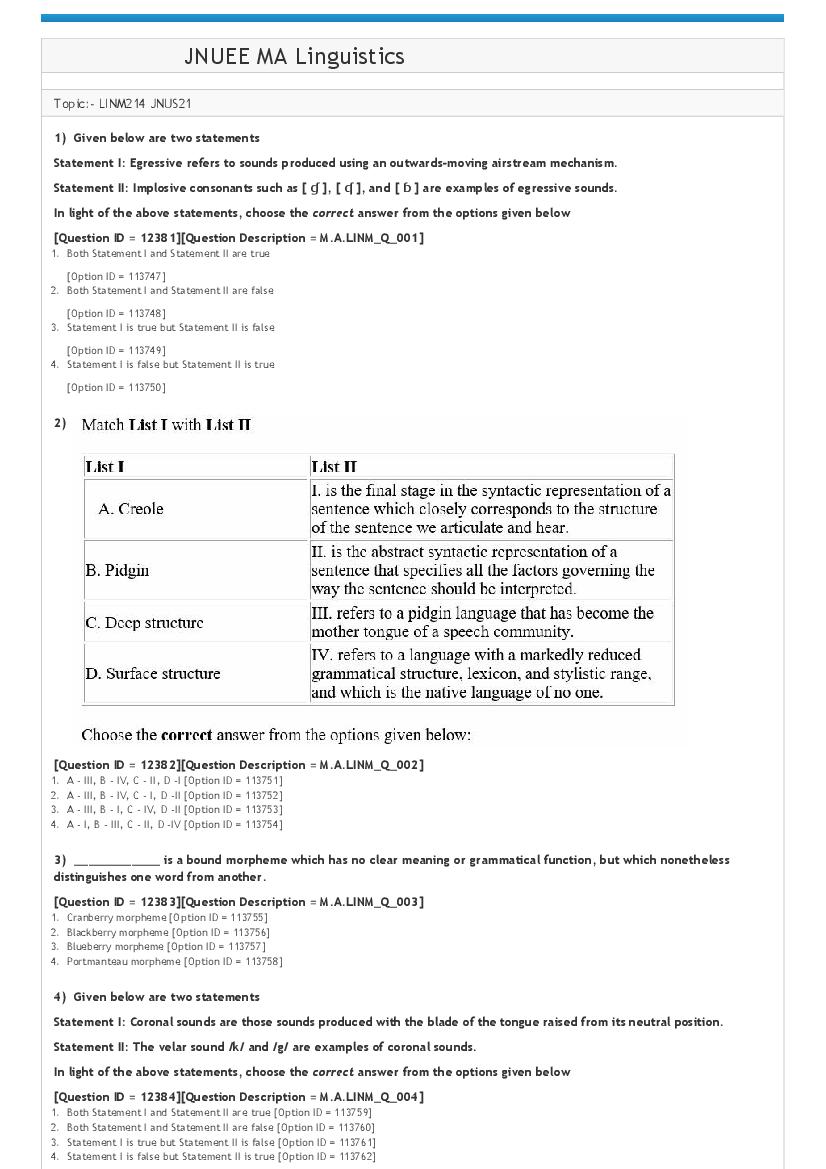
2)
[Question ID = 12382][Question Description = M.A.LINM_Q_002]
1. A ‐ III, B ‐ IV, C ‐ II, D ‐I [Option ID = 113751]
2. A ‐ III, B ‐ IV, C ‐ I, D ‐II [Option ID = 113752]
3. A ‐ III, B ‐ I, C ‐ IV, D ‐II [Option ID = 113753]
4. A ‐ I, B ‐ III, C ‐ II, D ‐IV [Option ID = 113754]
3) ____________ is a bound morpheme which has no clear meaning or grammatical function, but which nonetheless
distinguishes one word from another.
[Question ID = 12383][Question Description = M.A.LINM_Q_003]
1. Cranberry morpheme [Option ID = 113755]
2. Blackberry morpheme [Option ID = 113756]
3. Blueberry morpheme [Option ID = 113757]
4. Portmanteau morpheme [Option ID = 113758]
4) Given below are two statements
Statement I: Coronal sounds are those sounds produced with the blade of the tongue raised from its neutral position.
Statement II: The velar sound /k/ and /g/ are examples of coronal sounds.
In light of the above statements, choose the correct answer from the options given below
[Question ID = 12384][Question Description = M.A.LINM_Q_004]
1. Both Statement I and Statement II are true [Option ID = 113759]
2. Both Statement I and Statement II are false [Option ID = 113760]
3. Statement I is true but Statement II is false [Option ID = 113761]
4. Statement I is false but Statement II is true [Option ID = 113762]
Page 2
[Question ID = 12385][Question Description = M.A.LINM_Q_005]
1. A ‐ IV, B ‐ III, C ‐ I, D ‐II [Option ID = 113763]
2. A ‐ IV, B ‐ III, C ‐ II, D ‐I [Option ID = 113764]
3. A ‐ IV, B ‐ I, C ‐ III, D ‐II [Option ID = 113765]
4. A ‐ I, B ‐ IV, C ‐ II, D ‐III [Option ID = 113766]
6)
[Question ID = 12386][Question Description = M.A.LINM_Q_006]
1. A ‐ I, B ‐ II, C ‐ III, D ‐IV [Option ID = 113767]
2. A ‐ I, B ‐ II, C ‐ IV, D ‐III [Option ID = 113768]
3. A ‐ I, B ‐ III, C ‐ II, D ‐ IV [Option ID = 113769]
4. A‐II, B ‐ I, C ‐ IV, D ‐III [Option ID = 113770]
7)
[Question ID = 12387][Question Description = M.A.LINM_Q_007]
1. A‐II, B ‐ IV, C ‐ III, D ‐I [Option ID = 113771]
2. A ‐ II, B ‐ IV, C ‐ I, D ‐III [Option ID = 113772]
3. A ‐ II, B ‐ I, C ‐ IV, D ‐III [Option ID = 113773]
4. A ‐ I, B ‐ II, C ‐ III, D ‐IV [Option ID = 113774]
8)
Page 3
1. A ‐ IV, B ‐ II, C ‐ I, D ‐III [Option ID = 113775]
2. A ‐ IV, B ‐ I, C ‐ III, D ‐II [Option ID = 113776]
3. A ‐ IV, B ‐ III, C ‐ I, D ‐II [Option ID = 113777]
4. A ‐ IV, B ‐ III, C ‐ II, D ‐I [Option ID = 113778]
9)
[Question ID = 12389][Question Description = M.A.LINM_Q_009]
1. A ‐ III, B ‐ IV, C ‐ I, D ‐II [Option ID = 113779]
2. A ‐ III, B ‐ I, C ‐ IV, D ‐II [Option ID = 113780]
3. A ‐ III, B ‐ IV, C ‐ II, D ‐I [Option ID = 113781]
4. A ‐ III, B ‐ II, C ‐ I, D ‐IV [Option ID = 113782]
10) Given below are two statements
Statement I: Parrots can make a great many kinds of noises, but do not make different responses to different sounds.
Statement II: In a parrot's speech, different sounds have different meanings.
In light of the above statements, choose the correct answer from the options given below
[Question ID = 12390][Question Description = M.A.LINM_Q_010]
1. Both Statement I and Statement II are true [Option ID = 113783]
2. Both Statement I and Statement II are false [Option ID = 113784]
3. Statement I is true but Statement II is false [Option ID = 113785]
4. Statement I is false but Statement II is true [Option ID = 113786]
11) Given below are two statements, one is labelled as Assertion A and the other is labelled as Reason R
Assertion A: A language is the same no matter what system of writing may be used to record it.
Reason R: Languages tend to become different if different systems of writing are used to record them.
In light of the above statements, choose the correct answer from the options given below
[Question ID = 12391][Question Description = M.A.LINM_Q_011]
1. Both A and R are true and R is the correct explanation of A
[Option ID = 113787]
2. Both A and R are true but R is NOT the correct explanation of A
[Option ID = 113788]
3. A is true but R is false
[Option ID = 113789]
4. A is false but R is true
[Option ID = 113790]
12) Given below are two statements, one is labelled as Assertion A and the other is labelled as Reason R
Assertion A: If a language is spoken over a large area, say due to migration in several separate areas, it will change
Page 4
Reason R: Language does not change even if it is spoken over a large area in separate locations
In light of the above statements, choose the correct answer from the options given below
[Question ID = 12392][Question Description = M.A.LINM_Q_012]
1. Both A and R are true and R is the correct explanation of A
[Option ID = 113791]
2. Both A and R are true but R is NOT the correct explanation of A
[Option ID = 113792]
3. A is true but R is false
[Option ID = 113793]
4. A is false but R is true
[Option ID = 113794]
13) __________is reported to have said that etymology is a science in which the vowels count for nothing and the
consonants for very little.
A. Panini
B. Voltaire
C. Cratylus
D. Plato
Choose the correct answer from the options given below:
[Question ID = 12393][Question Description = M.A.LINM_Q_013]
1. A only [Option ID = 113795]
2. B only [Option ID = 113796]
3. C only [Option ID = 113797]
4. D only [Option ID = 113798]
14) The prosodic features of speech can be related to three basic components of speech
A. Initiation, phonation, and articulation
B. Initiation, phonation, and stress
C. Initiation, articulation, and syllable
D. Initiation, phonation, and pitch
Choose the correct answer from the options given below:
[Question ID = 12394][Question Description = M.A.LINM_Q_014]
1. B and D only [Option ID = 113799]
2. A only [Option ID = 113800]
3. B only [Option ID = 113801]
4. C only [Option ID = 113802]
15) Stress and syllabification refer to
A. Phonatory prosody
B. Initiatory prosody
C. Articulatory prosody
D. Aspiratory prosody
Choose the correct answer from the options given below:
[Question ID = 12395][Question Description = M.A.LINM_Q_015]
1. A only [Option ID = 113803]
2. B only [Option ID = 113804]
3. C only [Option ID = 113805]
4. C and D only [Option ID = 113806]
16) Proto‐Dravidian vowels include
A. Four short vowels and four long vowels
B. Five short vowels and five long vowels
C. Six short vowels and six long vowels
Page 5
Choose the correct answer from the options given below:
[Question ID = 12396][Question Description = M.A.LINM_Q_016]
1. A only [Option ID = 113807]
2. B only [Option ID = 113808]
3. C only [Option ID = 113809]
4. D only [Option ID = 113810]
17) Agglutinative morphology with no prefixes or infixes are a feature of which of the language families
A. Austro‐Asiatic
B. Tibeto‐Burman
C. Indo‐Aryan
D. Dravidian
Choose the correct answer from the options given below:
[Question ID = 12397][Question Description = M.A.LINM_Q_017]
1. A only [Option ID = 113811]
2. B only [Option ID = 113812]
3. C only [Option ID = 113813]
4. D only [Option ID = 113814]
18) _________ is the only Austro‐Asiatic language spoken in North East India
A. Khelma
B. Khasi
C. Kokborok
D. Ruga
Choose the correct answer from the options given below:
[Question ID = 12398][Question Description = M.A.LINM_Q_018]
1. A only [Option ID = 113815]
2. B only [Option ID = 113816]
3. C only [Option ID = 113817]
4. D only [Option ID = 113818]
19) In terms of areal influence which one of the following Austro‐Asiatic language groups forms the so‐called "Indospheric"
A. Munda
B. Nicobarese
C. Vietnamese
D. Khmer
Choose the correct answer from the options given below:
[Question ID = 12399][Question Description = M.A.LINM_Q_019]
1. A only [Option ID = 113819]
2. B only [Option ID = 113820]
3. C only [Option ID = 113821]
4. D only [Option ID = 113822]
20) In which one of the following language families, sesquisyllabic structures dominate in almost all branches.
A. Indo‐Aryan
B. Austro‐Asiatic
C. Dravidian
D. Tibeto‐Burman
Choose the correct answer from the options given below:
Page 6
1. A only [Option ID = 113823]
2. B only [Option ID = 113824]
3. C only [Option ID = 113825]
4. D only [Option ID = 113826]
21) Which one is concerned with Phonetics among the following?[Question ID = 12401][Question Description =
M.A.LINM_Q_021]
1. Shikshaa [Option ID = 113827]
2. Jyotisha [Option ID = 113828]
3. Kalpa [Option ID = 113829]
4. Nirukta [Option ID = 113830]
22) Which one among the following is the classical method of language teaching?[Question ID = 12402][Question Description
= M.A.LINM_Q_022]
1. Direct Method [Option ID = 113831]
2. Grammar Translation Method [Option ID = 113832]
3. Audio‐lingual Method [Option ID = 113833]
4. The Silent Way [Option ID = 113834]
23) Which of the following is correct with reference to acquiring first language?[Question ID = 12403][Question Description
= M.A.LINM_Q_023]
1. Unconscious and effortless [Option ID = 113835]
2. Requires formal training [Option ID = 113836]
3. Proceeds relatively slowly [Option ID = 113837]
4. Effortful [Option ID = 113838]
24) Who did propose the concept of language acquisition device (LAD) among the following renowned linguists?[Question ID
= 12404][Question Description = M.A.LINM_Q_024]
1. B.F. Skinner [Option ID = 113839]
2. Eric Lenneberg [Option ID = 113840]
3. Noam Chomsky [Option ID = 113841]
4. Jean Piaget [Option ID = 113842]
25) How many speech sounds are there in the aṇ (अण्) pratyāhāra/māheśvara sūtra as enumerated by the great Indian
grammarian, Pāṇini?[Question ID = 12405][Question Description = M.A.LINM_Q_025]
1. Two [Option ID = 113843]
2. Three [Option ID = 113844]
3. One [Option ID = 113845]
4. Five [Option ID = 113846]
26) Which of the following pratyāhāras/māheśvara‐sūtras is associated exclusively with the bunch of consonant speech
sounds?[Question ID = 12406][Question Description = M.A.LINM_Q_026]
1. aC (अच्) [Option ID = 113847]
2. ṛK (ऋक्) [Option ID = 113848]
3. hL (हल्) [Option ID = 113849]
4. aK (अक्) [Option ID = 113850]
27) Given below are two statements
Statement I:
Two Hindi words, [pәl] 'moment' and [bәl] 'force' are different from each other in terms of place
of articulation and manner of articulation in the oral cavity (mouth).
Statement II:
Two Hindi words, [pәl] 'moment' and [bәl] 'force' are different from each other in terms of
voicing of vocal cords only.
In light of the above statements, choose the correct answer from the options given below
[Question ID = 12407][Question Description = M.A.LINM_Q_027]
1. Both Statement I and Statement II are true [Option ID = 113851]
2. Both Statement I and Statement II are false [Option ID = 113852]
3. Statement I is true but Statement II is false [Option ID = 113853]
4. Statement I is false but Statement II is true [Option ID = 113854]
28) Given below are two statements
Statement I:
Language is specific to human beings.
Statement II:
Page 7
In light of the above statements, choose the correct answer from the options given below
[Question ID = 12408][Question Description = M.A.LINM_Q_028]
1. Both Statement I and Statement II are true
[Option ID = 113855]
2. Both Statement I and Statement II are false
[Option ID = 113856]
3. Statement I is true but Statement II is false
[Option ID = 113857]
4. Statement I is false but Statement II is true
[Option ID = 113858]
29) Given below are two statements
Statement I:
The statement "Speech is preferred to Writing" is used by linguists to explain the holistic and
scientific approach for the universal understanding of a human Language.
Statement II:
The statement "Writing is preferred to Speech" is used by linguists to explain the holistic and
scientific approach for the universal understanding of a human Language.
In light of the above statements, choose the correct answer from the options given below
[Question ID = 12409][Question Description = M.A.LINM_Q_029]
1. Both Statement I and Statement II are true [Option ID = 113859]
2. Both Statement I and Statement II are false [Option ID = 113860]
3. Statement I is true but Statement II is false [Option ID = 113861]
4. Statement I is false but Statement II is true [Option ID = 113862]
30) Given below are two statements
Statement I:
The famous linguist, Noam Chomsky is a Generativist.
Statement II:
The famous linguist, Noam Chomsky is a political scientist.
In light of the above statements, choose the correct answer from the options given below
[Question ID = 12410][Question Description = M.A.LINM_Q_030]
1. Both Statement I and Statement II are true
[Option ID = 113863]
2. Both Statement I and Statement II are false
[Option ID = 113864]
3. Statement I is true but Statement II is false
[Option ID = 113865]
4. Statement I is false but Statement II is true
[Option ID = 113866]
31)
[Question ID = 12411][Question Description = M.A.LINM_Q_031]
1. A ‐I, B ‐ II, C ‐ III, D ‐ IV [Option ID = 113867]
2. A ‐ III, B ‐ IV, C ‐ I, D ‐ II [Option ID = 113868]
Page 8
4. A ‐ III, B ‐ II, C ‐ IV, D ‐ I [Option ID = 113870]
32) Vowels are different from consonants, consonants different from pitch, tone and prosody etc. Which one of the
following concept conveys this difference?
[Question ID = 12412][Question Description = M.A.LINM_Q_032]
1. Segmental Frequency
[Option ID = 113871]
2. Fundamental Frequency
[Option ID = 113872]
3. Augmental Frequency
[Option ID = 113873]
4. Integrational Frequency
[Option ID = 113874]
33) Which one of the following speech sound covers the longest air column in the vocal tract?
[Question ID = 12413][Question Description = M.A.LINM_Q_033]
1. [k]
[Option ID = 113875]
2. [n]
[Option ID = 113876]
3. [m]
[Option ID = 113877]
4. [h]
[Option ID = 113878]
34) Read the paragraphs carefully and attempt the question and select the right answer out of the given choices:
There are 7102 living languages in the world and as per 2015 study by the British Council, 3 out of the 5 top languages in
the world are Indian: Hindi, Bengali, and Urdu. Interestingly, India, as per the 1961 count, has more than 1652 mother
tongues. However, English and Hindi are the two main languages which are recognized by the central government as official
languages of communication. With a huge number of 551 million speakers, Hindi is the most common language in India. On
the other hand, only 12 % of India’s population speaks English even if we consider people who speak English as a second
language. Hence, translating the available research and knowledge content into Hindi will make it accessible to half or 53%
of the population.
In addition to that, nearly 70% of the population (Rural – Urban distribution: 68.84% ‐ 31.16%) lives in villages wherein, as
Gandhi Ji remarked, lives the soul of India (Census of India, 2011). Of the total 121 crore Indian population, 83.3 crore
Indians reside in rural regions whereas 37.7 crore of the population resides in urban regions, as per the Census of India
(2011). With the estimated population of India at about 1.3 billion, over 720 million people live in villages, which is about
three times the population of the United States and 12 times the population of Britain. Given the multiplicity of languages
and dialects spoken and varying levels of literacy in India, translation becomes the most important tool to reach out to the
masses in India.
Which Indian language/s is/are among the top 5 languages in the world according to the discourse given in the passage?
A. Hindi
B. Punjabi
C. Bengali
D. Urdu
Choose the correct answer from the options given below:
[Question ID = 12414][Question Description = M.A.LINM_Q_034]
1. A, C and D only
[Option ID = 113879]
2. A and B only
[Option ID = 113880]
3. B and D only
[Option ID = 113881]
4. B, C and D only
[Option ID = 113882]
35) Read the paragraphs carefully and attempt the question and select the right answer out of the given choices:
There are 7102 living languages in the world and as per 2015 study by the British Council, 3 out of the 5 top languages in
Page 9
tongues. However, English and Hindi are the two main languages which are recognized by the central government as official
languages of communication. With a huge number of 551 million speakers, Hindi is the most common language in India. On
the other hand, only 12 % of India’s population speaks English even if we consider people who speak English as a second
language. Hence, translating the available research and knowledge content into Hindi will make it accessible to half or 53%
of the population.
In addition to that, nearly 70% of the population (Rural – Urban distribution: 68.84% ‐ 31.16%) lives in villages wherein, as
Gandhi Ji remarked, lives the soul of India (Census of India, 2011). Of the total 121 crore Indian population, 83.3 crore
Indians reside in rural regions whereas 37.7 crore of the population resides in urban regions, as per the Census of India
(2011). With the estimated population of India at about 1.3 billion, over 720 million people live in villages, which is about
three times the population of the United States and 12 times the population of Britain. Given the multiplicity of languages
and dialects spoken and varying levels of literacy in India, translation becomes the most important tool to reach out to the
masses in India.
As per the passage, In India, English is spoken as _________.
[Question ID = 12415][Question Description = M.A.LINM_Q_035]
1. First language
[Option ID = 113883]
2. Second language
[Option ID = 113884]
3. Foreign language
[Option ID = 113885]
4. Native language
[Option ID = 113886]
36) Read the paragraphs carefully and attempt the question and select the right answer out of the given choices:
There are 7102 living languages in the world and as per 2015 study by the British Council, 3 out of the 5 top languages in
the world are Indian: Hindi, Bengali, and Urdu. Interestingly, India, as per the 1961 count, has more than 1652 mother
tongues. However, English and Hindi are the two main languages which are recognized by the central government as official
languages of communication. With a huge number of 551 million speakers, Hindi is the most common language in India. On
the other hand, only 12 % of India’s population speaks English even if we consider people who speak English as a second
language. Hence, translating the available research and knowledge content into Hindi will make it accessible to half or 53%
of the population.
In addition to that, nearly 70% of the population (Rural – Urban distribution: 68.84% ‐ 31.16%) lives in villages wherein, as
Gandhi Ji remarked, lives the soul of India (Census of India, 2011). Of the total 121 crore Indian population, 83.3 crore
Indians reside in rural regions whereas 37.7 crore of the population resides in urban regions, as per the Census of India
(2011). With the estimated population of India at about 1.3 billion, over 720 million people live in villages, which is about
three times the population of the United States and 12 times the population of Britain. Given the multiplicity of languages
and dialects spoken and varying levels of literacy in India, translation becomes the most important tool to reach out to the
masses in India.
Which two languages are recognized as official languages of communication by the central government of India?
[Question ID = 12416][Question Description = M.A.LINM_Q_036]
1. Bengali and Hindi
[Option ID = 113887]
2. Hindi and Urdu
[Option ID = 113888]
3. Bengali and Urdu
[Option ID = 113889]
4. Hindi and English
[Option ID = 113890]
37) Read the paragraphs carefully and attempt the question and select the right answer out of the given choices:
There are 7102 living languages in the world and as per 2015 study by the British Council, 3 out of the 5 top languages in
the world are Indian: Hindi, Bengali, and Urdu. Interestingly, India, as per the 1961 count, has more than 1652 mother
tongues. However, English and Hindi are the two main languages which are recognized by the central government as official
languages of communication. With a huge number of 551 million speakers, Hindi is the most common language in India. On
the other hand, only 12 % of India’s population speaks English even if we consider people who speak English as a second
language. Hence, translating the available research and knowledge content into Hindi will make it accessible to half or 53%
of the population.
Page 10
Gandhi Ji remarked, lives the soul of India (Census of India, 2011). Of the total 121 crore Indian population, 83.3 crore
Indians reside in rural regions whereas 37.7 crore of the population resides in urban regions, as per the Census of India
(2011). With the estimated population of India at about 1.3 billion, over 720 million people live in villages, which is about
three times the population of the United States and 12 times the population of Britain. Given the multiplicity of languages
and dialects spoken and varying levels of literacy in India, translation becomes the most important tool to reach out to the
masses in India.
Which language is most commonly spoken in India?
[Question ID = 12417][Question Description = M.A.LINM_Q_037]
1. English
[Option ID = 113891]
2. Hindi
[Option ID = 113892]
3. Bengali
[Option ID = 113893]
4. Urdu
[Option ID = 113894]
38) Read the paragraphs carefully and attempt the question and select the right answer out of the given choices:
There are 7102 living languages in the world and as per 2015 study by the British Council, 3 out of the 5 top languages in
the world are Indian: Hindi, Bengali, and Urdu. Interestingly, India, as per the 1961 count, has more than 1652 mother
tongues. However, English and Hindi are the two main languages which are recognized by the central government as official
languages of communication. With a huge number of 551 million speakers, Hindi is the most common language in India. On
the other hand, only 12 % of India’s population speaks English even if we consider people who speak English as a second
language. Hence, translating the available research and knowledge content into Hindi will make it accessible to half or 53%
of the population.
In addition to that, nearly 70% of the population (Rural – Urban distribution: 68.84% ‐ 31.16%) lives in villages wherein, as
Gandhi Ji remarked, lives the soul of India (Census of India, 2011). Of the total 121 crore Indian population, 83.3 crore
Indians reside in rural regions whereas 37.7 crore of the population resides in urban regions, as per the Census of India
(2011). With the estimated population of India at about 1.3 billion, over 720 million people live in villages, which is about
three times the population of the United States and 12 times the population of Britain. Given the multiplicity of languages
and dialects spoken and varying levels of literacy in India, translation becomes the most important tool to reach out to the
masses in India.
What is the major theme of the paragraphs?
[Question ID = 12418][Question Description = M.A.LINM_Q_038]
1. Population
[Option ID = 113895]
2. Rural‐Urban‐divide
[Option ID = 113896]
3. India is a multilingual country
[Option ID = 113897]
4. Poverty
[Option ID = 113898]
39)
Page 11
1. A ‐ III, B ‐ I, C ‐ II, D ‐ V, E – IV [Option ID = 113899]
2. A ‐ II, B ‐ IV, C ‐ V, D ‐ I, E – III [Option ID = 113900]
3. A ‐ II, B ‐ III, C ‐ I, D ‐ IV, E‐ V [Option ID = 113901]
4. A ‐ II, B ‐ V, C ‐ III, D ‐ I, E‐ IV [Option ID = 113902]
40) Where are ‘mother‐in‐law’ languages spoken?[Question ID = 16112][Question Description = M.A.LINM_Q_040]
1. In France [Option ID = 113903]
2. In Australia [Option ID = 113904]
3. In Ireland [Option ID = 113905]
4. In Japan [Option ID = 113906]
41) The phenomenon called 'Language Shift' means:
A. A shift in the meaning and context within the language.
B. Maximizing the use of a native language.
C. Using one's own language in a non‐native place.
D. Discarding one's own language and adopting another language.
Now, choose the correct answer from the options given below:
[Question ID = 16113][Question Description = M.A.LINM_Q_041]
1. A and B only [Option ID = 113907]
2. B only [Option ID = 113908]
3. A and C only [Option ID = 113909]
4. D only [Option ID = 113910]
42) Given below are two statements, one is labelled as Assertion A and the other is labelled as Reason R
Assertion A: Reduplication in Indian English is a common phenomenon.
Reason R: Reduplication as a word formation process is extensively used in the Hindi Language.
In light of the above statements, choose the most appropriate answer from the options given below
[Question ID = 16114][Question Description = M.A.LINM_Q_042]
1. Both A and R are correct and R is the correct explanation of A
[Option ID = 113911]
2. Both A and R are correct but R is NOT the correct explanation of A
[Option ID = 113912]
3. A is correct but R is not correct
[Option ID = 113913]
4. A is not correct but R is correct
[Option ID = 113914]
43) Given below are two statements
Statement I: An orthography is a spelling norm which consists of all the standardized and codified graphic representations of
a language.
Statement II: Spelling involves the graphic realizations of all spoken items, whereas orthography is limited to a more or less
binding norm that can lead to criticism in case of non‐compliance.
In light of the above statements, choose the most appropriate answer from the options given below
[Question ID = 16115][Question Description = M.A.LINM_Q_043]
1. Both Statement I and Statement II are correct [Option ID = 113915]
2. Both Statement I and Statement II are incorrect [Option ID = 113916]
3. Statement I is correct but Statement II is incorrect [Option ID = 113917]
4. Statement I is incorrect but Statement II is correct [Option ID = 113918]
44) Given below are two statements, one is labelled as Assertion A and the other is labelled as Reason R
Assertion A: Language purists wish to prevent the language or dialect differentiation.
Reason R: Purists believe (a) some languages/dialects are better than others, (b) the notion of good and bad languages does
exist.
In light of the above statements, choose the most appropriate answer from the options given below
Page 12
1. Both A and R are correct and R is the correct explanation of A
[Option ID = 113919]
2. Both A and R are correct but R is NOT the correct explanation of A
[Option ID = 113920]
3. A is correct but R is not correct
[Option ID = 113921]
4. A is not correct but R is correct
[Option ID = 113922]
45) Given below are two statements
Statement I: There are no "primitive" languages‐‐all languages are equally complex and equally capable of expressing any
idea.
Statement II: The notion that minority languages have lesser linguistic value is theoretically a flawed one.
In light of the above statements, choose the most appropriate answer from the options given below
[Question ID = 16117][Question Description = M.A.LINM_Q_045]
1. Both Statement I and Statement II are correct [Option ID = 113923]
2. Both Statement I and Statement II are incorrect [Option ID = 113924]
3. Statement I is correct but Statement II is incorrect [Option ID = 113925]
4. Statement I is incorrect but Statement II is correct [Option ID = 113926]
46) The New Education Policy 2020 has emphasized upon:[Question ID = 16118][Question Description = M.A.LINM_Q_046]
1. Unilingual Education System [Option ID = 113927]
2. Bilingual Education System [Option ID = 113928]
3. Multilingual Education System [Option ID = 113929]
4. Education through a foreign language like English only [Option ID = 113930]
47) The sentence "The boy killed Deepak with a gun" means:
[Question ID = 16119][Question Description = M.A.LINM_Q_047]
1. Deepak carried a gun.
[Option ID = 113931]
2. The boy used a gun to kill Deepak.
[Option ID = 113932]
3. Deepak carried a gun in his back.
[Option ID = 113933]
4. The boy used a gun to kill Deepak, or Deepak carried a gun when he got killed.
[Option ID = 113934]
48) English has many varieties spoken in different parts of the world. Following are some such varieties. Strike the odd one
out from them:[Question ID = 16120][Question Description = M.A.LINM_Q_048]
1. Indian English [Option ID = 113935]
2. Australian English [Option ID = 113936]
3. Tibetan English [Option ID = 113937]
4. Caribbean English [Option ID = 113938]
49) Linguistic knowledge' is all about knowing:[Question ID = 16121][Question Description = M.A.LINM_Q_049]
1. The morphology and syntax of a language. [Option ID = 113939]
2. The phonology and semantics of a language. [Option ID = 113940]
3. The phonology, morphology, syntax, socio‐pragmatics and semantics of a language. [Option ID = 113941]
4. The morphology, syntax and pragmatics of a language. [Option ID = 113942]
50) "The Mayor was surprised to see the destruction of the city". In this sentence, the word 'destruction' is a/an:
[Question ID = 16122][Question Description = M.A.LINM_Q_050]
1. Noun
[Option ID = 113943]
2. Verb
[Option ID = 113944]
3. Adjective
[Option ID = 113945]
4. Adverb
[Option ID = 113946]
51)
Page 13
1. A ‐ IV , B ‐ II , C ‐ I , D ‐ III [Option ID = 113947]
2. A ‐ I, B ‐ II , C ‐ IV , D ‐ III [Option ID = 113948]
3. A ‐ III, B ‐ II , C ‐ I , D ‐ IV [Option ID = 113949]
4. A ‐ II, B ‐ I , C ‐IV , D ‐ III [Option ID = 113950]
52) The language units such as HTML, IP, OPD etc. are examples of:[Question ID = 16124][Question Description =
M.A.LINM_Q_052]
1. Acronyms [Option ID = 113951]
2. Alphabetism [Option ID = 113952]
3. Blendings [Option ID = 113953]
4. Clippings [Option ID = 113954]
53) Esperanto is an international language which is:
[Question ID = 16125][Question Description = M.A.LINM_Q_053]
1. Artificially constructed [Option ID = 113955]
2. A genetically emerged language [Option ID = 113956]
3. A creole [Option ID = 113957]
4. A pidgin [Option ID = 113958]
54) In the sentence 'The dancing girl is tired', the word 'dancing' is a/an:[Question ID = 16126][Question Description =
M.A.LINM_Q_054]
1. Noun [Option ID = 113959]
2. Verb [Option ID = 113960]
3. Adjective [Option ID = 113961]
4. Adverb [Option ID = 113962]
55) Given below are two statements
Statement I: "The Sanskrit language, whatever be its antiquity, is of a wonderful structure, more
perfect than the Greek, more copious than the Latin and more exquisitely refined than either."‐‐
Sir William Jones.
Statement II: Assamese, Bengali, Tamil and Telugu are sister languages.
In light of the above statements, choose the most appropriate answer from the options given
below
[Question ID = 16127][Question Description = M.A.LINM_Q_055]
1. Both Statement I and Statement II are correct [Option ID = 113963]
2. Both Statement I and Statement II are incorrect [Option ID = 113964]
3. Statement I is correct but Statement II is incorrect [Option ID = 113965]
4. Statement I is incorrect but Statement II is correct [Option ID = 113966]
56) Identify the dead language from the following list.[Question ID = 16128][Question Description = M.A.LINM_Q_056]
1. Tai Phake [Option ID = 113967]
2. Kui [Option ID = 113968]
3. Aka‐Bo [Option ID = 113969]
4. Tiwa [Option ID = 113970]
57) The terms 'synchronic' and 'diachronic' are associated with:[Question ID = 16129][Question Description =
M.A.LINM_Q_057]
1. Noam Chomsky [Option ID = 113971]
2. Panini [Option ID = 113972]
3. George Lakoff [Option ID = 113973]
4. Ferdinand de Saussure [Option ID = 113974]
58)
Page 14
1. no, mes, pelo [Option ID = 113975]
2. mo, i, kali [Option ID = 113976]
3. no, mo, i [Option ID = 113977]
4. kali, pelo, mes [Option ID = 113978]
59) The sentence, "The consonant is sitting next to a vowelly girl in the bar."
A. is grammatically well‐formed but meaningless.
B. is syntactically ill‐formed but meaningful.
C. is both syntactically and semantically well‐formed.
D. is syntactically ill‐formed but semantically well‐formed.
Choose the correct answer from the options given below:
[Question ID = 12419][Question Description = M.A.LINM_Q_059]
1. B and D only [Option ID = 113979]
2. B and D only [Option ID = 113980]
3. A only [Option ID = 113981]
4. C only [Option ID = 113982]
60) Which of the following statements are correct?
A. Hindi is the National Language of India.
B. Hindi is the Official Language of the Union government.
C. Hindi is the State Official Language of Uttar Pradesh.
D. Hindi is one the National Languages of Nepal.
Choose the correct answer from the options given below
[Question ID = 12420][Question Description = M.A.LINM_Q_060]
1. A and C are correct. [Option ID = 113983]
2. B and C are correct. [Option ID = 113984]
3. C and D are correct. [Option ID = 113985]
4. A and D are correct [Option ID = 113986]
61)
[Question ID = 12421][Question Description = M.A.LINM_Q_061]
1. A ‐ I, B ‐ II, C ‐ III, D ‐ IV [Option ID = 113987]
2. A ‐ IV, B ‐ III, C ‐ II, D ‐ I [Option ID = 113988]
3. A ‐ II, B ‐ I, C ‐ IV, D ‐ III [Option ID = 113989]
4. A ‐ II, B ‐ IV, C ‐ I, D ‐ III [Option ID = 113990]
62) The word ‘nationalisation’ has __________ syllables.[Question ID = 12422][Question Description = M.A.LINM_Q_062]
1. 4 [Option ID = 113991]
2. 5 [Option ID = 113992]
Page 15
4. 7 [Option ID = 113994]
63)
[Question ID = 12423][Question Description = M.A.LINM_Q_063]
1. A ‐ I, B ‐ III, C ‐ IV, D ‐ II [Option ID = 113995]
2. A ‐ III, B ‐ I, C ‐ IV, D ‐ II [Option ID = 113996]
3. A ‐ I, B ‐ II, C ‐ III, D ‐ IV [Option ID = 113997]
4. A ‐ IV, B ‐ III, C ‐ II, D ‐ I [Option ID = 113998]
64) Given below are two statements
Statement I: Homonymy is a term to refer to lexical items which have the same form but differ in meaning.
Statement II: Synonymy is a term to refer to lexical items which have the same meaning.
In light of the above statements, choose the correct answer from the options given below
[Question ID = 12424][Question Description = M.A.LINM_Q_064]
1. Both Statement I and Statement II are true [Option ID = 113999]
2. Both Statement I and Statement II are false [Option ID = 114000]
3. Statement I is true but Statement II is false [Option ID = 114001]
4. Statement I is false but Statement II is true [Option ID = 114002]
65)
[Question ID = 12425][Question Description = M.A.LINM_Q_065]
1. A ‐ I, B ‐ II, C ‐ III, D ‐ IV [Option ID = 114003]
2. A ‐ I, B ‐ II, C ‐ IV, D ‐ III [Option ID = 114004]
3. A ‐ III, B ‐ II, C ‐ IV, D ‐ I [Option ID = 114005]
4. A ‐ III, B ‐ II, C ‐ I, D ‐ IV [Option ID = 114006]
66) Given below are two statements
Statement I: Polysemy is also known as Polygenesis.
Statement II: Monosemy is also known as Univocality.
In light of the above statements, choose the correct answer from the options given below
[Question ID = 12426][Question Description = M.A.LINM_Q_066]
1. Both Statement I and Statement II are true [Option ID = 114007]
2. Both Statement I and Statement II are false [Option ID = 114008]
3. Statement I is true but Statement II is false [Option ID = 114009]
4. Statement I is false but Statement II is true [Option ID = 114010]
67) Given below are two statements
Statement I: Powder room is a euphemism for ‘toilet’.
Statement II: Pig Latin is an example of a dialect.
In light of the above statements, choose the correct answer from the options given below
Page 16
1. Both Statement I and Statement II are true [Option ID = 114011]
2. Both Statement I and Statement II are false [Option ID = 114012]
3. Statement I is true but Statement II is false [Option ID = 114013]
4. Statement I is false but Statement II is true [Option ID = 114014]
68) Indian Sign Language is generally classified into _______________.
A. One Handed
B. Non Manual
C. Two Handed
D. Lip reading
Choose the correct answer from the options given below
[Question ID = 12428][Question Description = M.A.LINM_Q_068]
1. D only [Option ID = 114015]
2. C only [Option ID = 114016]
3. B only [Option ID = 114017]
4. A, B and C only [Option ID = 114018]
69) Given below are two statements
Statement I: ‘Blending’ is a process in the analysis of grammatical and lexical constructions, in which two elements that do
not normally co‐occur come together within a single linguistic unit.
Statement II: The combination of online and offline mode of learning and teaching is known as ‘blended’ mode of learning
and teaching.
In light of the above statements, choose the correct answer from the options given below
[Question ID = 12429][Question Description = M.A.LINM_Q_069]
1. Both Statement I and Statement II are true [Option ID = 114019]
2. Both Statement I and Statement II are false [Option ID = 114020]
3. Statement I is true but Statement II is false [Option ID = 114021]
4. Statement I is false but Statement II is true [Option ID = 114022]
70)
[Question ID = 12430][Question Description = M.A.LINM_Q_070]
1. A ‐ I, B ‐ II, C ‐ III, D ‐ IV [Option ID = 114023]
2. A ‐ IV, B ‐ III, C ‐ I, D ‐ II [Option ID = 114024]
3. A ‐ IV, B ‐ III, C ‐ II, D ‐ I [Option ID = 114025]
4. A ‐ IV, B ‐ I, C ‐ III, D ‐ II [Option ID = 114026]
71) Given below are two statements, one is labelled as Assertion A and the other is labelled as Reason R
Assertion A : Without the corpus callosum, the two hemispheres of the brain would operate independently.
Reason R : The network of more than 200 million fibres known as the corpus callosum allows the two hemispheres of the
brain to communicate with each other.
In light of the above statements, choose the correct answer from the options given below
[Question ID = 12431][Question Description = M.A.LINM_Q_071]
1. Both A and R are true and R is the correct explanation of A
[Option ID = 114027]
2. Both A and R are true but R is NOT the correct explanation of A
[Option ID = 114028]
3. A is true but R is false
[Option ID = 114029]
4. A is false but R is true
[Option ID = 114030]
Page 17
[Question ID = 12432][Question Description = M.A.LINM_Q_072]
1. A ‐ I, B ‐ II, C ‐ III, D ‐ IV [Option ID = 114031]
2. A ‐ III, B ‐ II, C ‐ IV, D ‐ I [Option ID = 114032]
3. A ‐ IV, B ‐ II, C ‐ III, D ‐ I [Option ID = 114033]
4. A ‐ I, B ‐ IV, C ‐ II, D ‐ III [Option ID = 114034]
73) The syllabic structure of the words 'speak' and 'stump' are ___________ and ________ respectively.
A. CCVVC and CCVCC
B. CVC and CCVCC
C. CCVC and CVCC
D. CCVC and CCVCC
E. CVC and CCVC
Choose the correct answer from the options given below:
[Question ID = 12433][Question Description = M.A.LINM_Q_073]
1. A only [Option ID = 114035]
2. B only [Option ID = 114036]
3. C only [Option ID = 114037]
4. D only [Option ID = 114038]
74) The word ‘omelette’ in English is an example of ______________.
A. Etymology
B. Neo‐logism
C. Portmanteau
D. Borrowing
Choose the correct answer from the options given below
[Question ID = 12434][Question Description = M.A.LINM_Q_074]
1. D [Option ID = 114039]
2. C [Option ID = 114040]
3. B [Option ID = 114041]
4. A [Option ID = 114042]
75) _________ was the year declared as the International Year of Indigenous Languages by the United Nations.[Question ID
= 12435][Question Description = M.A.LINM_Q_075]
1. 2016 [Option ID = 114043]
2. 2017 [Option ID = 114044]
3. 2018 [Option ID = 114045]
4. 2019 [Option ID = 114046]
76) One of the following does not fit in the same category of Indian languages?[Question ID = 12436][Question Description
= M.A.LINM_Q_076]
1. Tamil [Option ID = 114047]
2. Tulu [Option ID = 114048]
3. Malayalam [Option ID = 114049]
4. Marathi [Option ID = 114050]
77) Given below are two statements, one is labelled as Assertion A and the other is labelled as
Reason R
Assertion A : Iraqi head allows arms.
Reason R : The ambiguity in this sentence makes it impactful.
Page 18
[Question ID = 12437][Question Description = M.A.LINM_Q_077]
1. Both A and R are true and R is the correct explanation of A
[Option ID = 114051]
2. Both A and R are true but R is NOT the correct explanation of A
[Option ID = 114052]
3. A is true but R is false
[Option ID = 114053]
4. A is false but R is true
[Option ID = 114054]
78) The wind howled in the night and She's going through a rollercoaster of emotions are examples of ___________ and
__________ respectively.
A. Personification
B. Metaphor
C. Simile
D. Hyperbole
E. Oxymoron
Choose the correct answer from the options given below:
[Question ID = 12438][Question Description = M.A.LINM_Q_078]
1. B and C only [Option ID = 114055]
2. A and C only [Option ID = 114056]
3. A and B only [Option ID = 114057]
4. A and D only [Option ID = 114058]
79)
[Question ID = 12439][Question Description = M.A.LINM_Q_079]
1. A ‐ I, B ‐ II, C ‐ III, D ‐ IV [Option ID = 114059]
2. A ‐ III, B ‐ II, C ‐ IV, D ‐ I [Option ID = 114060]
3. A ‐ IV, B ‐ III, C ‐ II, D ‐ I [Option ID = 114061]
4. A ‐ III, B ‐ II, C ‐ I, D ‐ IV [Option ID = 114062]
80) In linguistics, what does 'register' mean?
A. a type of informal language
B. a book or volume in which information of any kind is regularly and accurately recorded
C. the way a speaker uses language differently in different circumstances
D. a pair of successive lines of verse, typically rhyming and of the same length
Choose the correct answer from the options given below
[Question ID = 12440][Question Description = M.A.LINM_Q_080]
1. D only [Option ID = 114063]
2. C only [Option ID = 114064]
3. B and C only [Option ID = 114065]
4. A, B and C only [Option ID = 114066]
81) Which of the following languages is an official language of Nagaland?
[Question ID = 12441][Question Description = M.A.LINM_Q_081]
1. Nishi
Page 19
2. Meitei
[Option ID = 114068]
3. English
[Option ID = 114069]
4. Khasi
[Option ID = 114070]
82)
[Question ID = 12442][Question Description = M.A.LINM_Q_082]
1. A‐I , B‐III, C‐II, D‐IV [Option ID = 114071]
2. A‐III, B‐I, C‐IV, D‐II [Option ID = 114072]
3. A‐II, B‐I, C‐IV, D‐III [Option ID = 114073]
4. A‐III, B‐II, C‐I, D‐IV [Option ID = 114074]
83) Given below are two statements:
Statement I : Sociolinguistics studies language in relation to Sociology society
Statement II : stammerting is due to sociolinguistics factors
In the light of the above statements, choose the correct answer from the options given below
[Question ID = 12443][Question Description = M.A.LINM_Q_083]
1. Both Statement I and Statement II are true.
[Option ID = 114075]
2. Both Statement I and Statement II are false.
[Option ID = 114076]
3. Statement I is true but Statement II is false
[Option ID = 114077]
4. Statement I is false but Statement II is true
[Option ID = 114078]
84) Given below are two statements:
Statement I: An encyclopaedic dictionary provides detailed information about a field of
knowledge.
Statement II: All comprehensive dictionaries are encyclopedic dicitionaries.
In the light of the above statements, choose the most appropriate answer from the options given
below
[Question ID = 12444][Question Description = M.A.LINM_Q_084]
1. Statement I is false but Statement II is true
[Option ID = 114079]
2. Both Statement I and Statement II are true
[Option ID = 114080]
3. Both Statement I and Statement II are false
[Option ID = 114081]
4. Statement I is true but Statement II is false
[Option ID = 114082]
85) Which one of the following is a classical language? [Question ID = 12445][Question Description = M.A.LINM_Q_085]
1. Maithili [Option ID = 114083]
2. Hindi [Option ID = 114084]
3. Malayalam [Option ID = 114085]
4. Tulu [Option ID = 114086]
Page 20
M.A.LINM_Q_086]
1. Loan blends [Option ID = 114087]
2. Loan shifts [Option ID = 114088]
3. Loan words [Option ID = 114089]
4. Calques [Option ID = 114090]
87)
[Question ID = 12447][Question Description = M.A.LINM_Q_087]
1. A‐I, B‐III, C‐II, D‐IV [Option ID = 114091]
2. A‐III, B‐IV, C‐I, D‐II [Option ID = 114092]
3. A‐II, B‐I, C‐IV, D‐III [Option ID = 114093]
4. A‐III, B‐II, C‐I, D‐IV [Option ID = 114094]
88) "International Mother Language Day" is celebrated on which of the following day?[Question ID = 12448][Question
Description = M.A.LINM_Q_088]
1. 1st of March [Option ID = 114095]
2. 21st of February [Option ID = 114096]
3. 21st of January [Option ID = 114097]
4. 1st of November [Option ID = 114098]
89) Khasi language belongs to which language family?
[Question ID = 12449][Question Description = M.A.LINM_Q_089]
1. Indo‐Aryan
[Option ID = 114099]
2. Dravidian
[Option ID = 114100]
3. Tibeto‐Burman
[Option ID = 114101]
4. Austro‐Asiatic
[Option ID = 114102]
90) Which of the following is the second largest language family spoken in India?
[Question ID = 12450][Question Description = M.A.LINM_Q_090]
1. Dravidian
[Option ID = 114103]
2. Indo‐Aryan
[Option ID = 114104]
3. Austro‐Asiatic
[Option ID = 114105]
4. Great Andamanese
[Option ID = 114106]
91) Suggestopedia is a ?
[Question ID = 12451][Question Description = M.A.LINM_Q_091]
1. Major type of encyclopaedia [Option ID = 114107]
2. Method suggesting ways of practice drills in pronunciation [Option ID = 114108]
3. Method of language teaching [Option ID = 114109]
4. Method of achieving concentration and focus for learning a foreign or second language [Option ID = 114110]
92) The only language found in the Indian mainland and considered as a language isolate is?[Question ID = 12452][Question
Page 21
1. Burushaski [Option ID = 114111]
2. Nahali [Option ID = 114112]
3. Kusunda [Option ID = 114113]
4. Yedda [Option ID = 114114]
93) Which of the following Indian language is known as 'Italian of the east'?[Question ID = 12453][Question Description =
M.A.LINM_Q_093]
1. Kannada [Option ID = 114115]
2. Sanskrit [Option ID = 114116]
3. Marathi [Option ID = 114117]
4. Telugu [Option ID = 114118]
94) What are the official languages of Afghanistan?[Question ID = 12454][Question Description = M.A.LINM_Q_094]
1. English and Afgani [Option ID = 114119]
2. Dari and Pashto [Option ID = 114120]
3. Hebrew and Arabic [Option ID = 114121]
4. Balochi and Arabic [Option ID = 114122]
95) Tolkappiyam' is an?[Question ID = 12455][Question Description = M.A.LINM_Q_095]
1. An Ancient Sankrit grammar text [Option ID = 114123]
2. An Ancient Tamil grammar text [Option ID = 114124]
3. A Script [Option ID = 114125]
4. A Tamil grammarian [Option ID = 114126]
96) In which Schedule the Constitution of India lists the official languages?[Question ID = 12456][Question Description =
M.A.LINM_Q_096]
1. Eight [Option ID = 114127]
2. Ninth [Option ID = 114128]
3. Tenth [Option ID = 114129]
4. Eleventh [Option ID = 114130]
97) Which one of the following is not true of Konkani Language?
[Question ID = 12457][Question Description = M.A.LINM_Q_097]
1. Konkani is spoken in the Western coast of India
[Option ID = 114131]
2. It is the official language of Maharashtra
[Option ID = 114132]
3. It is an Indo‐Aryan language
[Option ID = 114133]
4. It is a scheduled language
[Option ID = 114134]
98) The 1st official survey of language diversity in the Indian sub‐continent titled "The linguistic survey of India" was
carried out by?[Question ID = 12458][Question Description = M.A.LINM_Q_098]
1. Sir G.A. Grierson [Option ID = 114135]
2. CIIL, Mysore [Option ID = 114136]
3. Deccan College, Pune [Option ID = 114137]
4. Ashok Kelkar [Option ID = 114138]
99) Languages that do not have any other genetically related member are usually known as?[Question ID = 12459][Question
Description = M.A.LINM_Q_099]
1. Unique languages [Option ID = 114139]
2. Unitary languages [Option ID = 114140]
3. Language Isolates [Option ID = 114141]
4. Synthetic languages [Option ID = 114142]
100) The word "family" in American english has____ .
[Question ID = 12460][Question Description = M.A.LINM_Q_100]
1. 5 syllables
[Option ID = 114143]
2. 4 syllables
[Option ID = 114144]
3. 3 syllables
[Option ID = 114145]
4. 2 syllables
[Option ID = 114146]