CMI Entrance Exam 2022 Question Paper Solution B.Sc Maths & Computer 22 May
Finished viewing? Save it for later —
Download CMI Entrance Exam 2022 Question Paper Solution B.Sc Maths & Computer 22 May (PDF · 7 pages)About CMI Entrance Exam 2022 Question Paper Solution B.Sc Maths & Computer 22 May
CMI Entrance Exam 2022 Question Paper Solution B.Sc Maths & Computer 22 May is available here for free download. Published by CMI for CMI Entrance Exam, this solution can be viewed online or downloaded as a PDF (7 pages). Candidates preparing for CMI Entrance Exam can use CMI Entrance Exam 2022 Question Paper Solution B.Sc Maths & Computer 22 May to understand the exam pattern, the type of questions asked, and the overall difficulty level.
Frequently Asked Questions
How can I download CMI Entrance Exam 2022 Question Paper Solution B.Sc Maths & Computer 22 May?
Open this page and click the Download button to save CMI Entrance Exam 2022 Question Paper Solution B.Sc Maths & Computer 22 May as a PDF. It is completely free on AglaSem Docs.
Is CMI Entrance Exam 2022 Question Paper Solution B.Sc Maths & Computer 22 May free to download?
Yes. CMI Entrance Exam 2022 Question Paper Solution B.Sc Maths & Computer 22 May can be viewed online and downloaded as a PDF free of cost on AglaSem Docs.
How many pages does CMI Entrance Exam 2022 Question Paper Solution B.Sc Maths & Computer 22 May have?
CMI Entrance Exam 2022 Question Paper Solution B.Sc Maths & Computer 22 May contains 7 pages, which you can read online or download together as a single PDF.
Where can I find more CMI Entrance Exam study material?
You can find more CMI Entrance Exam question papers, sample papers, syllabus, and answer keys on AglaSem Docs.
CMI Entrance Exam 2022 Question Paper Solution B.Sc Maths & Computer 22 May – Text
Read the full text of this solution below — useful to quickly search, copy and reference the content online without downloading the PDF.
📄 View text version (7 pages)
Page 1
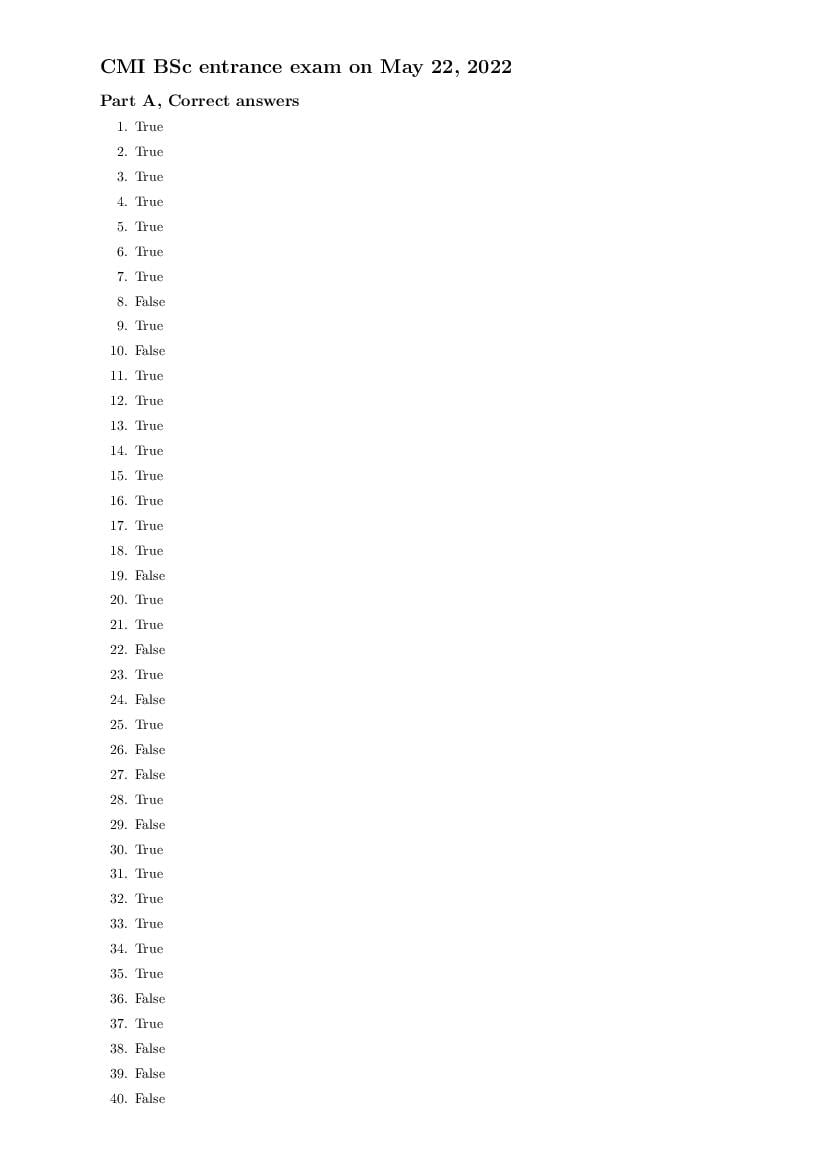
Part A, Correct answers
1. True
2. True
3. True
4. True
5. True
6. True
7. True
8. False
9. True
10. False
11. True
12. True
13. True
14. True
15. True
16. True
17. True
18. True
19. False
20. True
21. True
22. False
23. True
24. False
25. True
26. False
27. False
28. True
29. False
30. True
31. True
32. True
33. True
34. True
35. True
36. False
37. True
38. False
39. False
40. False
Page 2
Undergraduate Programme in Mathematics and Computer Science/Physics
Solutions of the 22nd May 2022 exam
Note: The solutions below consist only of main steps and strategies and do not contain all
the details expected in the exam.
B1. [11 points] Given △XY Z, the following constructions are made: mark point W on
segment XZ, point P on segment XW and point Q on segment Y Z such that
WZ PW QZ
= = = k.
YX XP YQ
See the schematic figure (not to scale). Extend segments QP and Y X to meet at the point
R as shown. Prove that XR = XP .
R
X
P W
Y Z
Q
Solution: First a construction - mark V on XZ such that QV is parallel to Y R. There are
two cases here depending on whether V is between P W or W Z, however, the arguments are
the same. We assume here that V is between P W . The aim is to show that △V P Q is isosceles
k
and then show that it is similar to △XP R. Use BPT to conclude that V Q = k+1 (XY ).
Using the given ratios find an expression for V Z and substitute it in P V = P Z − V Z to
conclude that P V = V Q.
One can also extend ZX to ZX ′ such that Y X ′ is parallel to P Q. One can then show that
△Y XX ′ is isosceles and similar to △RXP .
Another strategy is to use Menalaus theorem for △XY Z with segment QR as the transversal.
We have:
XR Y Q ZP
= −1.
RY QZ P X
This leads to the following implications leading to the equality we want:
XR · P Z = RY · P W
XY + XR PW + WZ
=
XR PW
XY WZ
=
XR PZ
PW PW
= .
XR XP
1
Page 3
both axes so as to get a grid of small 1 × 1 squares whose vertices have integer coordinates.
1. Consider the line segment D joining (0, 0) with (m, n). Find the number of small 1 × 1
squares that D cuts through, i.e., squares whose interiors D intersect. For example,
the line segment joining (0, 0) and (2, 3) cuts through 4 small squares.
2. Now let L be an arbitrary line. Find the maximum number of small 1 × 1 squares in
an n × n grid that L can cut through.
Solution: Assume gcd(m, n) = 1. The line D has to cross m−1 vertical as well as horizontal
lines. Moreover, D doesn’t pass through any grid points. Hence, together with the starting
square, we see that D cuts through m + n − 1 squares.
Let gcd(m, n) = d. The above argument is valid from (0, 0) to (m/d, n/d) and so on for d
many sections of D. Therefore the total number of squares D cuts is m + n − d.
Note that in order for L to cut through maximum number of squares it should not pass
through any internal grid point. This is possible for a line joining (0, 0) with (x, n) where
n − 1 < x < n. The required answer is 2n − 1.
2
Page 4
of local maxima of f (x). Find the number of local minima of f (x). For each maximum/
minimum (c, f (c)), find the integer k such that k ≤ c < k + 1.
Solution: We have f ′ (x) = 1 + 2x + · · · + nxn−1 . For x ≥ 0 the derivative is strictly positive,
hence f (x) is strictly increasing. Therefore, we should only analyze negative values of x.
Write the derivative as the following rational function
nxn+1 − (n + 1)xn + 1
f ′ (x) = .
(x − 1)2
Note that there is no problem in the expression since we are assuming x < 0. Denote by
D(x) the denominator of the derivative.
The case when n is odd. For x < 0 the polynomial D(x) is strictly positive. Hence there
can’t be any critical point.
The case when n is even. Observe that there could be only one critical point c ∈ (−1, 0).
Since D(x) < 0 for x ≤ −1 and D(0) = 1. Moreover, D′ (x) > 0 for x < 0 so f ′ (x)
is increasing on (−∞, 0) hence it vanishes exactly once. As the derivative changes sign
from −ve to +ve passing through c, so there is exactly one global minimum at c (where,
−1 < c < 0).
3
Page 5
• Ar = the area bounded by the graph of f , X-axis, x = 1 and x = r.
• Br = the area bounded by the graph of f , X-axis, x = r and x = r2 .
Find all continuous functions f for which Ar = Br for every positive number r.
Solution: We are given
Z r Z r2
f (x)dx = f (x)dx.
1 r
Applying d/dr, fundamental theorem of calculus and the chain rule to above equality we get
f (x) = xf (x2 ) ∀x ∈ R+ .
1
Letting g(x) = xf (x) we see that g(x) = g(x2 ) for all x in the domain. Hence g(x) = g(x 2n )
1
for all x and positive integers n. However, as n goes to infinity x 2n tends to 1 we have that
g(x) converges to f (1). Hence xf (x) = f (1) for all values of x ∈ R+ .
4
Page 6
r 3 + s2 = s3 + r 2 .
1. Find a good pair (a, l) with the largest possible value of l. Find a good pair (s, b) with
the smallest value of s. For every good pair (c, d) other than the two you found, show
that there is a third real number e such that (d, e) and (c, e) are good pairs.
2. Show that there are infinitely many good pairs of rational numbers.
Solution: Consider the function f (x) = x3 − x2 . Therefore (r, s) is a good pair iff f (r) =
f (s).
Observe that x = 0, 32 are the only critical points of f . The local maximum occurs at x = 0.
The line y = 0 intersects the graph of f (x) at (0, 0) and (1, 0). Hence the required good pair
(a, l) with the largest l value is (0, 1).
Note that the local minimum occurs at x = 32 . The line y = f ( 23 ) = −427
intersects the graph
−1 −4 2 −4 −1 2
at ( 3 , 27 ) and ( 3 , 27 ). Hence the required good pair is ( 3 , 3 ).
For k ∈ ( −427
, 0) the line y = k intersects the graph at 3 points. Hence the last statement of
the first part follows.
For the second part we need to show that there for every rational number q ∈ ( −4 27
, 0) the
equation
x3 − x2 − q = 0
has infinitely many rational solutions. However, this is true because there are infinitely many
rationals satisfying c + d + e = 1, cd + de + ce = 0, cde = q.
5
Page 7
1. Let p be a prime. Show that x2 + x − 1 has at most two roots modulo p. Find all
primes p for which there is exactly one root.
2. Find all positive integers n ≤ 121 such that n2 + n − 1 is divisible by 121.
3. What can you say about the number of roots of this equation modulo p2 .
Solution: Let a, b be two distinct roots of the equation modulo p. Therefore, p divides
a2 + a − 1 − (b2 + b − 1), which is equivalent to saying that p divides either a − b or a + b + 1.
In the former case we will have a = b, which is not allowed. Since both a, b are between 1
and p we have 3 ≤ a + b + 1 ≤ 2p − 3 which implies a + b + 1 = p. Thus b = p − a − 1 is
uniquely determined.
Suppose a is the only root. Then p − a − 1 = a, i.e., p = 2a + 1. Therefore, 2a + 1 divides
4(a+ a − 1) and (2a + 1)2 . Subtracting we get that 2a + 1 divides 5.
Part 2: Since 121 divides n+ n − 1, 11 also divides it. Note that n2 + n − 1 and n2 + n − 12
are congruent modulo 11. So the roots of the equation are 7, 3 modulo 11.
Consider n = 3 + 11k. Then n2 + n − 1 is congruent to 77k + 11 modulo 121. Then k = 3
works giving us n = 36. Now consider n = 7 + 11k. In that case, n+ n − 1 is congruent to
165k + 55 modulo 121. Which gives us k = 7 and n = 84.
For part (3), let a be a root modulo p. Then n is of the form kp + a for some k between 0
and p − 1. We would like to solve for k the following equation
(kp + a)2 + (kp + a) − 1
modulo p2 . This is equivalent to finding k such that p divides k(2a + 1) + a2 + a − 1. If
2a + 1 is not a multiple of p then k = −(2a + 1)−1 (a2 + a − 1). If p divides (2a + 1) then it
is 5 and there is no such n.
6
Document Details
| Board / Org | CMI |
| Exam | CMI Entrance Exam |
| Type | Solution |
| Pages | 7 |
| Updated | 23 Oct 2026 |