NCERT Book Class 12 History Chapter 3 Kinship, caste and Class
Finished viewing? Save it for later —
Download NCERT Book Class 12 History Chapter 3 Kinship, caste and Class (PDF · 29 pages)About NCERT Book Class 12 History Chapter 3 Kinship, caste and Class
NCERT Book Class 12 History Chapter 3 Kinship, caste and Class is available here for free download. Published by NCERT for Class 12, this books can be viewed online or downloaded as a PDF (29 pages). Candidates preparing for Class 12 can use NCERT Book Class 12 History Chapter 3 Kinship, caste and Class to understand the exam pattern, the type of questions asked, and the overall difficulty level.
Frequently Asked Questions
How can I download NCERT Book Class 12 History Chapter 3 Kinship, caste and Class?
Open this page and click the Download button to save NCERT Book Class 12 History Chapter 3 Kinship, caste and Class as a PDF. It is completely free on AglaSem Docs.
Is NCERT Book Class 12 History Chapter 3 Kinship, caste and Class free to download?
Yes. NCERT Book Class 12 History Chapter 3 Kinship, caste and Class can be viewed online and downloaded as a PDF free of cost on AglaSem Docs.
How many pages does NCERT Book Class 12 History Chapter 3 Kinship, caste and Class have?
NCERT Book Class 12 History Chapter 3 Kinship, caste and Class contains 29 pages, which you can read online or download together as a single PDF.
Where can I find more Class 12 study material?
You can find more Class 12 question papers, sample papers, syllabus, and answer keys on AglaSem Docs.
NCERT Book Class 12 History Chapter 3 Kinship, caste and Class – Text
Read the full text of this books below — useful to quickly search, copy and reference the content online without downloading the PDF.
📄 View text version (1 page)
Page 1
THEME
THEME TWO Kinship, Caste and Class
THREE Earl
Ear ly Socie ties
Societies
( C . 600 BCE - 600 CE )
In the previous chapter we saw that there were several
changes in economic and political life between c. 600
BCE and 600 CE . Some of these changes influenced societies
as well. For instance, the extension of agriculture into
forested areas transformed the lives of forest dwellers;
craft specialists often emerged as distinct social groups;
the unequal distribution of wealth sharpened social
differences.
Historians often use textual
traditions to understand these
processes. Some texts lay down
norms of social behaviour; others
describe and occasionally comment
on a wide range of social situations
and practices. We can also catch a
glimpse of some social actors from
inscriptions. As we will see, each
text (and inscription) was written
from the perspective of specific
social categories. So we need to
keep in mind who composed what
and for whom. We also need to
consider the language used, and
the ways in which the text
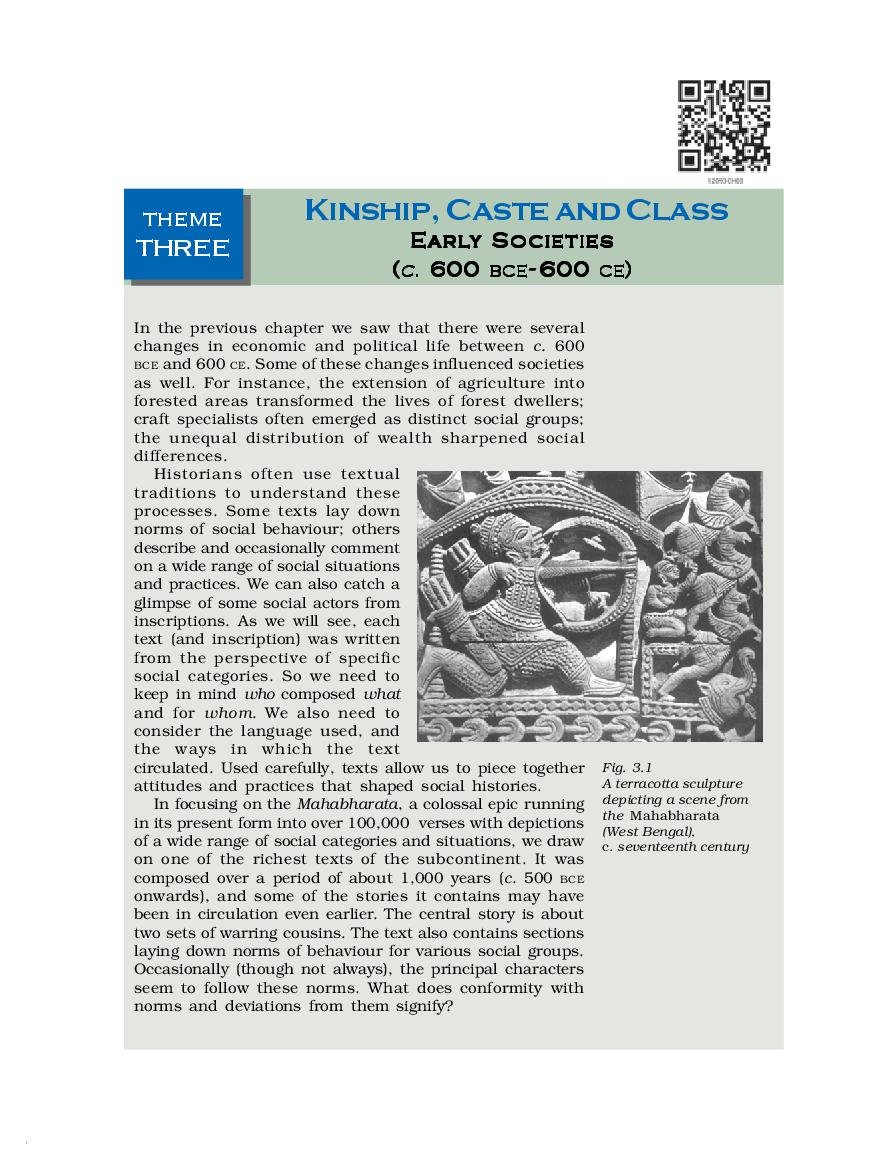
circulated. Used carefully, texts allow us to piece together Fig. 3.1
attitudes and practices that shaped social histories. A terracotta sculpture
In focusing on the Mahabharata, a colossal epic running depicting a scene from
the Mahabharata
in its present form into over 100,000 verses with depictions
(West Bengal),
of a wide range of social categories and situations, we draw c. seventeenth century
on one of the richest texts of the subcontinent. It was
composed over a period of about 1,000 years (c. 500 BCE
onwards), and some of the stories it contains may have
been in circulation even earlier. The central story is about
two sets of warring cousins. The text also contains sections
laying down norms of behaviour for various social groups.
Occasionally (though not always), the principal characters
seem to follow these norms. What does conformity with
norms and deviations from them signify?
Showing the first page only. Download the PDF above for the complete document.
Document Details
| Board / Org | NCERT |
| Exam | Class 12 |
| Type | Books |
| Pages | 29 |
| Updated | 29 Aug 2026 |