NCERT Book Class 12 Chemistry Chapter 4 The d-and f-Block Elements
Finished viewing? Save it for later —
Download NCERT Book Class 12 Chemistry Chapter 4 The d-and f-Block Elements (PDF · 29 pages)About NCERT Book Class 12 Chemistry Chapter 4 The d-and f-Block Elements
NCERT Book Class 12 Chemistry Chapter 4 The d-and f-Block Elements is available here for free download. Published by NCERT for Class 12, this books can be viewed online or downloaded as a PDF (29 pages). Candidates preparing for Class 12 can use NCERT Book Class 12 Chemistry Chapter 4 The d-and f-Block Elements to understand the exam pattern, the type of questions asked, and the overall difficulty level.
Frequently Asked Questions
How can I download NCERT Book Class 12 Chemistry Chapter 4 The d-and f-Block Elements?
Open this page and click the Download button to save NCERT Book Class 12 Chemistry Chapter 4 The d-and f-Block Elements as a PDF. It is completely free on AglaSem Docs.
Is NCERT Book Class 12 Chemistry Chapter 4 The d-and f-Block Elements free to download?
Yes. NCERT Book Class 12 Chemistry Chapter 4 The d-and f-Block Elements can be viewed online and downloaded as a PDF free of cost on AglaSem Docs.
How many pages does NCERT Book Class 12 Chemistry Chapter 4 The d-and f-Block Elements have?
NCERT Book Class 12 Chemistry Chapter 4 The d-and f-Block Elements contains 29 pages, which you can read online or download together as a single PDF.
Where can I find more Class 12 study material?
You can find more Class 12 question papers, sample papers, syllabus, and answer keys on AglaSem Docs.
NCERT Book Class 12 Chemistry Chapter 4 The d-and f-Block Elements – Text
Read the full text of this books below — useful to quickly search, copy and reference the content online without downloading the PDF.
📄 View text version (1 page)
Page 1
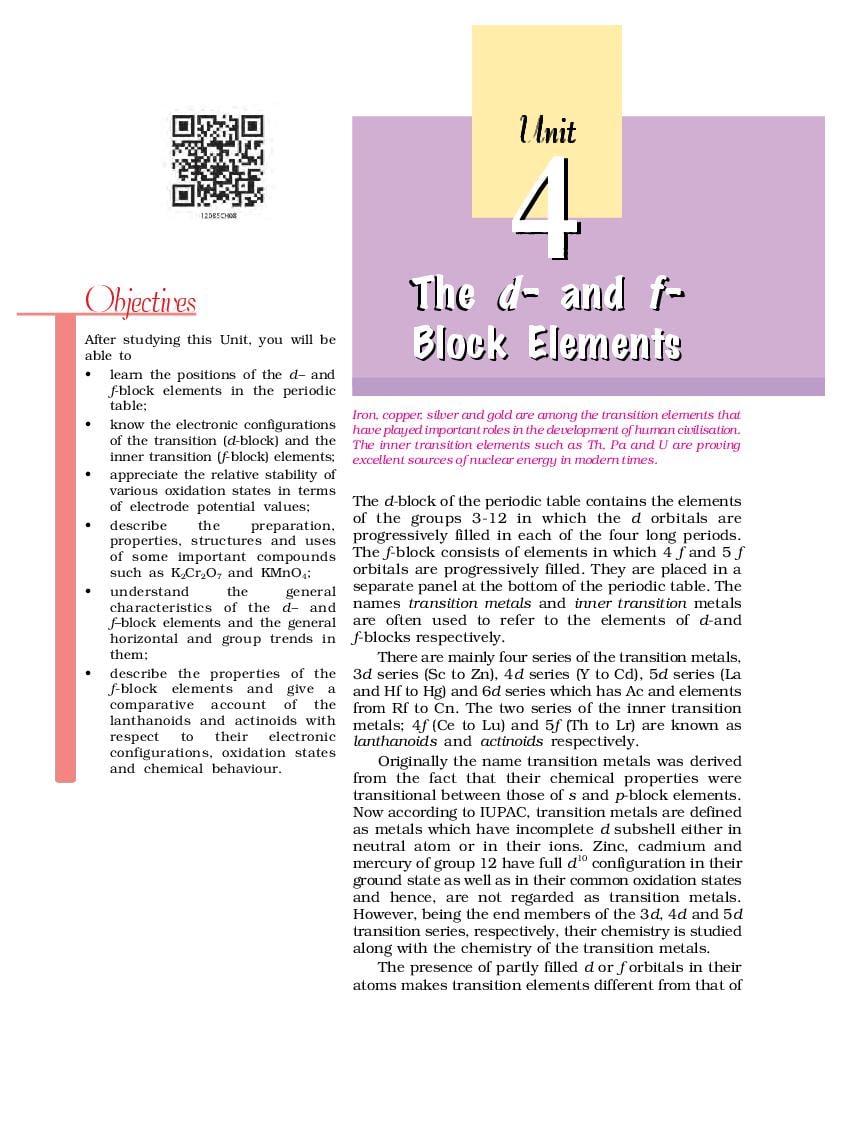
Objectives The dd-- and f-
f-
4
After studying this Unit, you will be
able to Block Elements
• learn the positions of the d– and
f-block elements in the periodic
table;
Iron, copper, silver and gold are among the transition elements that
• know the electronic configurations have played important roles in the development of human civilisation.
of the transition (d-block) and the The inner transition elements such as Th, Pa and U are proving
inner transition (f-block) elements; excellent sources of nuclear energy in modern times.
• appreciate the relative stability of
various oxidation states in terms
of electrode potential values; The d-block of the periodic table contains the elements
• describe the preparation, of the groups 3-12 in which the d orbitals are
properties, structures and uses progressively filled in each of the four long periods.
of some important compounds The f-block consists of elements in which 4 f and 5 f
such as K2Cr2O7 and KMnO4; orbitals are progressively filled. They are placed in a
• understand the general separate panel at the bottom of the periodic table. The
characteristics of the d– and names transition metals and inner transition metals
f–block elements and the general are often used to refer to the elements of d-and
horizontal and group trends in f-blocks respectively.
them; There are mainly four series of the transition metals,
• describe the properties of the 3d series (Sc to Zn), 4d series (Y to Cd), 5d series (La
f-block elements and give a and Hf to Hg) and 6d series which has Ac and elements
comparative account of the from Rf to Cn. The two series of the inner transition
lanthanoids and actinoids with metals; 4f (Ce to Lu) and 5f (Th to Lr) are known as
respect to their electronic lanthanoids and actinoids respectively.
configurations, oxidation states
and chemical behaviour. Originally the name transition metals was derived
from the fact that their chemical properties were
transitional between those of s and p-block elements.
Now according to IUPAC, transition metals are defined
as metals which have incomplete d subshell either in
neutral atom or in their ions. Zinc, cadmium and
10
mercury of group 12 have full d configuration in their
ground state as well as in their common oxidation states
and hence, are not regarded as transition metals.
However, being the end members of the 3d, 4d and 5d
transition series, respectively, their chemistry is studied
along with the chemistry of the transition metals.
The presence of partly filled d or f orbitals in their
atoms makes transition elements different from that of
Showing the first page only. Download the PDF above for the complete document.
Document Details
| Board / Org | NCERT |
| Exam | Class 12 |
| Type | Books |
| Pages | 29 |
| Updated | 29 Aug 2026 |