JNUEE 2021 Question Paper MA Philosophy
Finished viewing? Save it for later —
Download JNUEE 2021 Question Paper MA Philosophy (PDF · 24 pages)About JNUEE 2021 Question Paper MA Philosophy
JNUEE 2021 Question Paper MA Philosophy is available here for free download. Published by NTA for Jawaharlal Nehru University Entrance Examination, this question paper can be viewed online or downloaded as a PDF (24 pages). Candidates preparing for Jawaharlal Nehru University Entrance Examination can use JNUEE 2021 Question Paper MA Philosophy to understand the exam pattern, the type of questions asked, and the overall difficulty level.
Frequently Asked Questions
How can I download JNUEE 2021 Question Paper MA Philosophy?
Open this page and click the Download button to save JNUEE 2021 Question Paper MA Philosophy as a PDF. It is completely free on AglaSem Docs.
Is JNUEE 2021 Question Paper MA Philosophy free to download?
Yes. JNUEE 2021 Question Paper MA Philosophy can be viewed online and downloaded as a PDF free of cost on AglaSem Docs.
How many pages does JNUEE 2021 Question Paper MA Philosophy have?
JNUEE 2021 Question Paper MA Philosophy contains 24 pages, which you can read online or download together as a single PDF.
Where can I find more Jawaharlal Nehru University Entrance Examination study material?
You can find more Jawaharlal Nehru University Entrance Examination question papers, sample papers, syllabus, and answer keys on AglaSem Docs.
JNUEE 2021 Question Paper MA Philosophy – Text
Read the full text of this question paper below — useful to quickly search, copy and reference the content online without downloading the PDF.
📄 View text version (24 pages)
Page 1
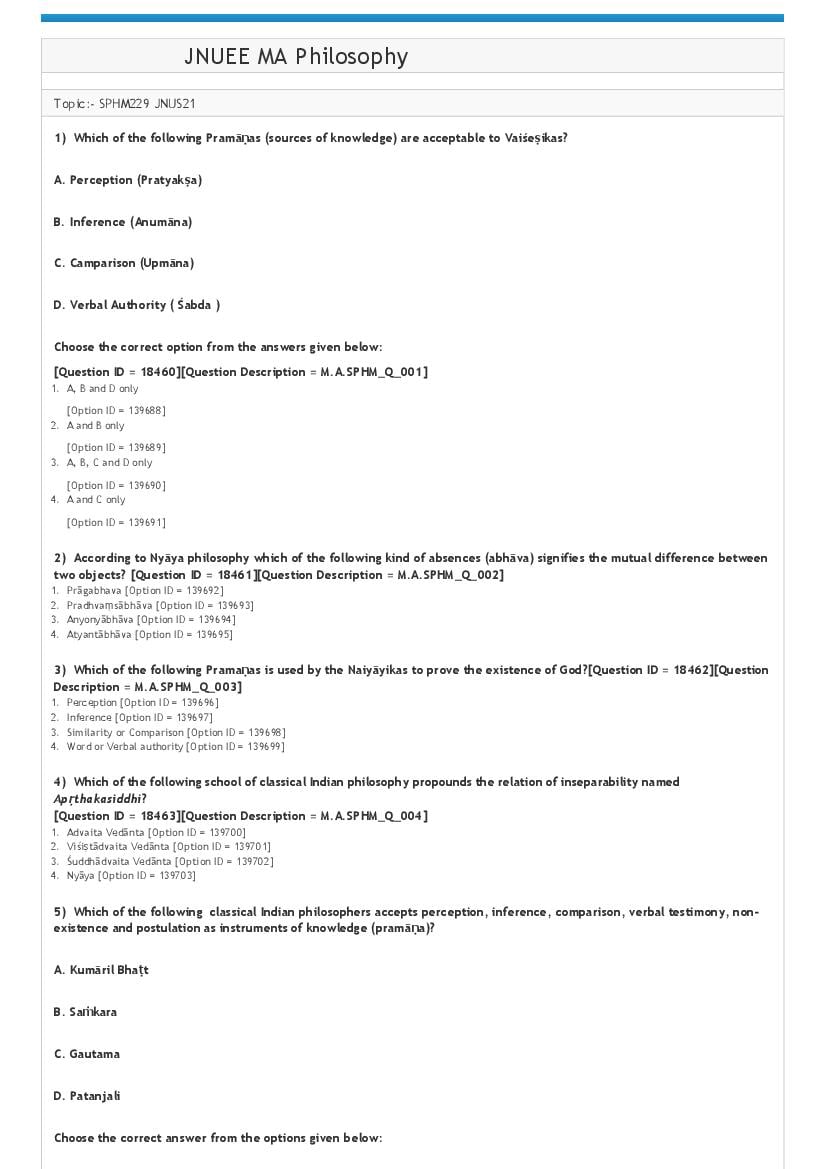
Topic:‐ SPHM229 JNUS21
1) Which of the following Pramāṇas (sources of knowledge) are acceptable to Vaiśeṣikas?
A. Perception (Pratyakṣa)
B. Inference (Anumāna)
C. Camparison (Upmāna)
D. Verbal Authority ( Śabda )
Choose the correct option from the answers given below:
[Question ID = 18460][Question Description = M.A.SPHM_Q_001]
1. A, B and D only
[Option ID = 139688]
2. A and B only
[Option ID = 139689]
3. A, B, C and D only
[Option ID = 139690]
4. A and C only
[Option ID = 139691]
2) According to Nyāya philosophy which of the following kind of absences (abhāva) signifies the mutual difference between
two objects? [Question ID = 18461][Question Description = M.A.SPHM_Q_002]
1. Prāgabhava [Option ID = 139692]
2. Pradhvaṃsābhāva [Option ID = 139693]
3. Anyonyābhāva [Option ID = 139694]
4. Atyantābhāva [Option ID = 139695]
3) Which of the following Pramaṇas is used by the Naiyāyikas to prove the existence of God?[Question ID = 18462][Question
Description = M.A.SPHM_Q_003]
1. Perception [Option ID = 139696]
2. Inference [Option ID = 139697]
3. Similarity or Comparison [Option ID = 139698]
4. Word or Verbal authority [Option ID = 139699]
4) Which of the following school of classical Indian philosophy propounds the relation of inseparability named
Apṛ thakasiddhi?
[Question ID = 18463][Question Description = M.A.SPHM_Q_004]
1. Advaita Vedānta [Option ID = 139700]
2. Viśiṣtādvaita Vedānta [Option ID = 139701]
3. Śuddhādvaita Vedānta [Option ID = 139702]
4. Nyāya [Option ID = 139703]
5) Which of the following classical Indian philosophers accepts perception, inference, comparison, verbal testimony, non‐
existence and postulation as instruments of knowledge (pramāṇa)?
A. Kumāril Bhaṭt
B. Saṁkara
C. Gautama
D. Patanjali
Page 2
1. A, B and D only
[Option ID = 139704]
2. A, C and D only
[Option ID = 139705]
3. A and B only
[Option ID = 139706]
4. B and C only
[Option ID = 139707]
6) Match List I with List II
List I List II
Name of the Philosopher Text
A. Akṣpāda Gautam I. Mūlamadhyamakakārikā
B. Iśvarakṛṣṇa II. Vaiśeṣika sutras
C. Kaṇād III. Nyāya sutras
D. Nāgārjuna IV. Sāṃkhya kārikā
[Question ID = 18465][Question Description = M.A.SPHM_Q_006]
1. A ‐ III , B ‐ IV , C ‐ II, D ‐I
[Option ID = 139708]
2. A ‐ III, B ‐II , C ‐ IV , D ‐ I
[Option ID = 139709]
3. A ‐II , B ‐III , C ‐ I, D ‐ IV
[Option ID = 139710]
4. A ‐ IV, B ‐ III , C ‐ II , D ‐ I
[Option ID = 139711]
7) Given below are two statements
Statement I: According to Naiyāyikas manas (internal sense organ) is a dravya (substance).
Statement II: According to Naiyāyikas manas is atomic, subtle and singular in nature.
In light of the above statements, choose the most appropriate answer from the options given below
[Question ID = 18066][Question Description = M.A.SPHM_Q_007]
1. Both Statement I and Statement II are correct
[Option ID = 139712]
2. Both Statement I and Statement II are incorrect
[Option ID = 139713]
3. Statement I is correct but Statement II is incorrect
[Option ID = 139714]
4. Statement I is incorrect but Statement II is correct
[Option ID = 139715]
8) Which of the following statements is/are true regarding the nature of puruṣa according to Sāṁkhya philosophy?
A. Puruṣa is enjoyer (bhoktṛ )
B. Puruṣa is agent (kartṛ )
C. Puruṣa is mere onlooker/pure witness (sākṣin)
D. There is multiplicity of Puruṣas.
Page 3
1. A, C and D only
[Option ID = 139716]
2. A, B and C only
[Option ID = 139717]
3. B, C and D only
[Option ID = 139718]
4. A, B, C and D
[Option ID = 139719]
9) In Yoga thought system God is conceptualized as:
A. One of the puruṣas
B. Eternal
C. Creator of the world
D. Omnipresent
[Question ID = 18068][Question Description = M.A.SPHM_Q_009]
1. A, B and D only
[Option ID = 139720]
2. A, B and C only
[Option ID = 139721]
3. B, C and D only
[Option ID = 139722]
4. A and D only
[Option ID = 139723]
10) Which of the following categories are accepted by the Mīmāṁsā school of classical Indian philosophy?
A. Dravya (substance)
B. Guṇa (quality/property)
C. Samavāya (inherence)
D. Viśeṣa (particularity)
[Question ID = 18069][Question Description = M.A.SPHM_Q_010]
1. A, B and D only
[Option ID = 139724]
2. A, B and C only
[Option ID = 139725]
3. A and B only
[Option ID = 139726]
4. A and C only
[Option ID = 139727]
11) Which of the following school of classical Indian philosophy believes in Anyathākhyātivāda theory of error?[Question ID =
18070][Question Description = M.A.SPHM_Q_011]
1. Nyāya [Option ID = 139728]
2. Sāṃkhya [Option ID = 139729]
3. Prabhākara Mīmāṁsā [Option ID = 139730]
4. Bhaṭṭa Mīmāṁsā [Option ID = 139731]
Page 4
substances (dravya)?
[Question ID = 18071][Question Description = M.A.SPHM_Q_012]
1. Mīmāṁsā [Option ID = 139732]
2. Nyāya [Option ID = 139733]
3. Vaiśeṣika [Option ID = 139734]
4. Sāṃkhya [Option ID = 139735]
13) According to which of the following system of classical Indian philosophy consciousness (in the body) is produced by
earth, water, fire, and air?[Question ID = 18072][Question Description = M.A.SPHM_Q_013]
1. Vaiśeṣika [Option ID = 139736]
2. Cārvāka [Option ID = 139737]
3. Bhaṭṭa Mīmāṁsā [Option ID = 139738]
4. Prabhākara Mīmāṁsā [Option ID = 139739]
14) Which of the following terms refer to theories of causation as propounded by different schools of classical Indian
philosophy?
A. Satkāryāvāda
B. Asatkāryāvāda
C. Pratītyasamutpāda
D. Vivartavāda
[Question ID = 18073][Question Description = M.A.SPHM_Q_014]
1. A, B and D only
[Option ID = 139740]
2. A, B and C only
[Option ID = 139741]
3. A and B only
[Option ID = 139742]
4. B and C only
[Option ID = 139743]
15) Given below are two statements, one is labelled as Assertion A and the other is labelled as Reason R
Assertion A: Cārvāka reject inference as it is founded upon the relationship of Vyāpti.
Reason R: According to Cārvākas the relationship of vyāpti cannot be determined by perception nor can it be determined by
inference since anumāna itself is dependent upon vyāpti.
In light of the above statements, choose the most appropriate answer from the options given below
[Question ID = 18074][Question Description = M.A.SPHM_Q_015]
1. Both A and R are correct and R is the correct explanation of A
[Option ID = 139744]
2. Both A and R are correct but R is NOT the correct explanation of A
[Option ID = 139745]
3. A is correct but R is not correct
[Option ID = 139746]
4. A is not correct but R is correct
[Option ID = 139747]
16) Which among the following are characteristics of the middle term according to Nyāya Philosophy?
Page 5
B. Sapakṣasattva
C. Vipakṣasattva
D. Asamānattva
E. Pakṣadharmatā
[Question ID = 18075][Question Description = M.A.SPHM_Q_016]
1. A, D and E only
[Option ID = 139748]
2. B, C and E only
[Option ID = 139749]
3. A, C, D and E only
[Option ID = 139750]
4. A, B, C and D only
[Option ID = 139751]
17) An inference is called Kevalanvayi based on the occurrence of which one of the following conditions?
[Question ID = 18076][Question Description = M.A.SPHM_Q_017]
1. When the middle term is both positively and negatively related to the major term [Option ID = 139752]
2. When the middle term is only positively related to the major term [Option ID = 139753]
3. When the middle term is only negatively related to the major term [Option ID = 139754]
4. When the middle term is neither positively nor negatively related to the major term [Option ID = 139755]
18) Given below are two statements, one is labelled as Assertion A and the other is labelled as Reason R
Assertion A: In the Savyābhicāra inferential fallacy, the middle term leads to different opposite conclusions.
Reason R: An irregular middle term is related to both the existence and non‐existence of major term.
In light of the above statements, choose the most appropriate answer from the options given below
[Question ID = 18077][Question Description = M.A.SPHM_Q_018]
1. Both A and R are correct and R is the correct explanation of A
[Option ID = 139756]
2. Both A and R are correct but R is NOT the correct explanation of A
[Option ID = 139757]
3. A is correct but R is not correct
[Option ID = 139758]
4. A is not correct but R is correct
[Option ID = 139759]
19) Which one of the following options can be characterized as Pūrvavata anumāna?[Question ID = 18078][Question
Description = M.A.SPHM_Q_019]
1. To infer the past rainfall from mud on the streets [Option ID = 139760]
2. To infer future rainfall from presence of dark clouds [Option ID = 139761]
3. To infer cows’ hooves from seeing cows’ horns [Option ID = 139762]
4. To infer the future rainfall from cloudless sky [Option ID = 139763]
20) Which one of the following options presents the correct sequence of different steps involved in the process of anumāna
according to Nyāya Philosophy?
A. Hetu
B. Udāharaṇa
Page 6
D. Pratijñā
E. Upanaya
Choose the correct answer from the options given below
[Question ID = 18079][Question Description = M.A.SPHM_Q_020]
1. D, C, A, B, E
[Option ID = 139764]
2. E, B, C, A, D
[Option ID = 139765]
3. E, C, B, A, D
[Option ID = 139766]
4. D, A, B, E, C
[Option ID = 139767]
21) Match List I with List II
List I List II
Book Author
A. A Treatise Concerning the Principles of Human KnowledgeI. Kant
B. An Essay Concerning Human Understanding II. Spinoza
C. The Principles of Cartesian Philosophy III. Berkeley
D. Critique of Practical Reason IV. Locke
[Question ID = 18080][Question Description = M.A.SPHM_Q_021]
1. A ‐ III , B ‐ IV, C ‐ II, D ‐ I
[Option ID = 139768]
2. A ‐ I, B ‐ II, C ‐ IV, D ‐ III
[Option ID = 139769]
3. A ‐ II, B ‐ I, C ‐ III , D ‐ IV
[Option ID = 139770]
4. A ‐ IV, B ‐ III, C ‐ II, D ‐ I
[Option ID = 139771]
22) Who amongst the following philosophers argued that the mind of an infant is akin to a blank slate, devoid of any idea, a
tabula rasa, until experience imprints it with ideas, which are necessary for thinking? [Question ID = 18081][Question
Description = M.A.SPHM_Q_022]
1. Descartes [Option ID = 139772]
2. Hume [Option ID = 139773]
3. Berkeley [Option ID = 139774]
4. Locke [Option ID = 139775]
23) Who amongst the following philosophers made this argument against the notion of self –
“There are some philosophers who imagine we are every moment intimately conscious of what we call our self; that we feel
its existence and its continuance in existence. […] For my part, when I enter more intimately into what I call myself I always
stumble on some particular perception or other, of heat or cold, light or shade, love or hatred, pain or pleasure. I never can
catch myself at any time without a perception, and never can observe anything but the perception.”
[Question ID = 18082][Question Description = M.A.SPHM_Q_023]
1. Hobbes
[Option ID = 139776]
2. Locke
[Option ID = 139777]
3. Hume
[Option ID = 139778]
4. Mill
[Option ID = 139779]
24) Who amongst the following Greek philosophers posited that the ultimate reality is water?[Question ID = 18083][Question
Description = M.A.SPHM_Q_024]
Page 7
2. Thales [Option ID = 139781]
3. Anaximenes [Option ID = 139782]
4. Heraclitus [Option ID = 139783]
25) Match List I with List II
List I List II
Concepts Philosophers
A. Kingdom of Ends I. Ryle
B. Principle of Identity of IndiscerniblesII. Russell
C. Knowledge by Acquaintance III. Kant
D. Category Mistake IV. Leibniz
[Question ID = 18271][Question Description = M.A.SPHM_Q_025]
1. A ‐ I, B ‐ III , C ‐ II, D ‐ IV
[Option ID = 139784]
2. A ‐ III, B ‐ IV, C ‐ II, D ‐ I
[Option ID = 139785]
3. A ‐ II, B ‐ III, C ‐ I, D ‐ IV
[Option ID = 139786]
4. A ‐ IV, B ‐ II, C ‐ I, D ‐ III
[Option ID = 139787]
26) Who amongst the following philosophers took as his model of objective rational enquiry the geometry of Euclid that
began with axioms (the truth of which is necessary) and from definitions, which clarified the concepts used to formulate
them?[Question ID = 18272][Question Description = M.A.SPHM_Q_026]
1. Spinoza [Option ID = 139788]
2. Berkeley [Option ID = 139789]
3. Neitzsche [Option ID = 139790]
4. Popper [Option ID = 139791]
27) Who said the following: “Thus it becomes evident that the real table, if there is one, is not the same as what we
immediately experience by sight or touch or hearing. The real table, if there is one, is not immediately known to us at all,
but must be an inference from what is immediately known. Hence, two very difficult questions at once arise; namely, (1) Is
there a real table at all? (2) If so, what sort of object can it be?”[Question ID = 18273][Question Description =
M.A.SPHM_Q_027]
1. Wittgenstein in ‘Philosophical Investigations’ [Option ID = 139792]
2. Quine in ‘Two Dogmas of Empiricism’ [Option ID = 139793]
3. Plato in ‘The Republic’ [Option ID = 139794]
4. Russell in ‘The Problems of Philosophy’ [Option ID = 139795]
28) Who said the following: “We may begin by criticizing the metaphysical thesis that philosophy affords us knowledge of a
reality transcending the world of science and common sense. Later on, when we come to define metaphysics and account
for its existence, we shall find that it is possible to be a metaphysician without believing in a transcendent reality; for we
shall see that many metaphysical utterances are due to the commission of logical errors, rather than to a conscious desire on
the part of their authors to go beyond the limits of experience.”[Question ID = 18274][Question Description =
M.A.SPHM_Q_028]
1. Aristotle in ‘The Metaphysics’ [Option ID = 139796]
2. Ayer in ‘The Elimination of Metaphysics’ [Option ID = 139797]
3. Strawson in ‘Individuals: An Essay in Descriptive Metaphysics’ [Option ID = 139798]
4. Leibniz in ‘Discourse on Metaphysics and Other Essays’ [Option ID = 139799]
29) Given below are two statements
Statement I: Leibniz rejected the Principle of Contradiction ‘by virtue of which we judge that what involves a contradiction
to be false, and that which is opposed or contradictory to the false to be true’.
Statement II: Leibniz followed the principle of The Identity of Indiscernibles which holds that ‘if A has all its properties in
common with B, then A and B are one and the same’. Hence, if A and B are not identical, then there must be some
difference between them.
In light of the above statements, choose the most appropriate answer from the options given below
[Question ID = 18275][Question Description = M.A.SPHM_Q_029]
1. Both Statement I and Statement II are correct
Page 8
2. Both Statement I and Statement II are incorrect
[Option ID = 139801]
3. Statement I is correct but Statement II is incorrect
[Option ID = 139802]
4. Statement I is incorrect but Statement II is correct
[Option ID = 139803]
30) Given below are two statements
Statement I: Ayer’s main concern was to show the meaninglessness of metaphysical theories about a reality, which is
beyond empirical; and to establish the meaninglessness of all such metaphysical statements he gave us the verification
principle.
Statement II: Ayer rejected the distinction between weak and strong verification.
In light of the above statements, choose the most appropriate answer from the options given below
[Question ID = 18276][Question Description = M.A.SPHM_Q_030]
1. Both Statement I and Statement II are correct
[Option ID = 139804]
2. Both Statement I and Statement II are incorrect
[Option ID = 139805]
3. Statement I is correct but Statement II is incorrect
[Option ID = 139806]
4. Statement I is incorrect but Statement II is correct
[Option ID = 139807]
31) Given below are two statements
Statement I: Frege was opposed to psychologistic explanations of concepts, that is, of the senses of linguistic expressions, as
he rejected explanations in terms of the inner mental operations by which we acquire such concepts.
Statement II: For Frege, the sense of any expression is to be explained subjectively, and not objectively.
In light of the above statements, choose the most appropriate answer from the options given below
[Question ID = 18277][Question Description = M.A.SPHM_Q_031]
1. Both Statement I and Statement II are correct
[Option ID = 139808]
2. Both Statement I and Statement II are incorrect
[Option ID = 139809]
3. Statement I is correct but Statement II is incorrect
[Option ID = 139810]
4. Statement I is incorrect but Statement II is correct
[Option ID = 139811]
32) In which of Russell’s writings do we find this following quote – “One of the first difficulties that confront us, when we
adopt the view that denoting phrases express a meaning and denote a denotation, concerns the cases in which the
denotation appears to be absent. If we say “the King of England is bald,” that is, it would seem, not a statement about the
complex meaning “the King of England,” but about the actual man denoted by the meaning. But now consider “the King of
France is bald”. By parity of form, this also ought to be about the denotation of the phrase “the King of France”. But this
phrase, though it has a meaning provided “the King of England” has a meaning, has certainly no denotation, at least in any
obvious sense.”[Question ID = 18278][Question Description = M.A.SPHM_Q_032]
1. On Denoting [Option ID = 139812]
2. The Analysis of Matter [Option ID = 139813]
3. Our Knowledge of the External World [Option ID = 139814]
4. Principia Mathematica [Option ID = 139815]
33) In which of Frege’s writings do we find this following quote – “It is natural, now, to think of there being connected
with a sign (name, combination of words, letter), besides that to which the sign refers, which may be called the reference
of the sign, also what I should like to call the sense of the sign, wherein the mode of presentation is contained. […] The
reference of ‘evening star’ would be the same as that of ‘morning star,’ but not the sense.”[Question ID = 18279][Question
Description = M.A.SPHM_Q_033]
1. On Sense and Reference (1892) [Option ID = 139816]
Page 9
3. Concept and Object (1892) [Option ID = 139818]
4. What is a Function? (1904) [Option ID = 139819]
34) Given below are two statements
Statement I: For Descartes, the results of all speculations are to be suspended, until clear and indubitable principles could
be established against which to measure them.
Statement II: Descartes provided both cosmological and ontological arguments for the existence of God.
In light of the above statements, choose the most appropriate answer from the options given below
[Question ID = 18280][Question Description = M.A.SPHM_Q_034]
1. Both Statement I and Statement II are correct
[Option ID = 139820]
2. Both Statement I and Statement II are incorrect
[Option ID = 139821]
3. Statement I is correct but Statement II is incorrect
[Option ID = 139822]
4. Statement I is incorrect but Statement II is correct
[Option ID = 139823]
35) Match List I with List II
List I List II
Book Philosopher
A. The Logical Structure of the WorldI. Frege
B. The Nature of Judgement II. Popper
C. The Logic of Scientific Discovery III. Carnap
D. Begriffsschrift IV. Moore
[Question ID = 18281][Question Description = M.A.SPHM_Q_035]
1. A ‐ II, B ‐ IV, C ‐ III, D ‐ I
[Option ID = 139824]
2. A ‐ I, B ‐ III, C ‐ IV, D ‐ II
[Option ID = 139825]
3. A ‐ III, B ‐ II, C ‐ IV, D ‐ I
[Option ID = 139826]
4. A ‐ III, B ‐ IV, C ‐ II, D ‐ I
[Option ID = 139827]
36) Who amongst the following philosophers distinguished among the contents of the mind as ‘impressions’ and ‘ideas’,
where the former corresponds to what we consider as sensations and perceptions, while the latter corresponds to
‘concepts’.[Question ID = 18282][Question Description = M.A.SPHM_Q_036]
1. Berkeley [Option ID = 139828]
2. Comte [Option ID = 139829]
3. Bacon [Option ID = 139830]
4. Hume [Option ID = 139831]
37) Given below are two statements
Statement I: Frege is considered as one of the prominent thinkers who lay the foundations for the modern philosophy of
language.
Statement II: Frege showed a deep continuity between logic and mathematics.
In light of the above statements, choose the most appropriate answer from the options given below
[Question ID = 18283][Question Description = M.A.SPHM_Q_037]
1. Both Statement I and Statement II are correct
[Option ID = 139832]
2. Both Statement I and Statement II are incorrect
Page 10
3. Statement I is correct but Statement II is incorrect
[Option ID = 139834]
4. Statement I is incorrect but Statement II is correct
[Option ID = 139835]
38) Given below are two statements
Statement I: In Tractatus, Wittgenstein proposed that all sentences can be divided into the complex and the atomic, where
the complex sentences are built out of the atomic ones, by the application of rules of formation.
Statement II: He also proposed in Tractatus that atomic sentences are those, which employ the primitives of the language,
the elementary names and predicates, which are themselves indefinable.
In light of the above statements, choose the most appropriate answer from the options given below
[Question ID = 18284][Question Description = M.A.SPHM_Q_038]
1. Both Statement I and Statement II are correct
[Option ID = 139836]
2. Both Statement I and Statement II are incorrect
[Option ID = 139837]
3. Statement I is correct but Statement II is incorrect
[Option ID = 139838]
4. Statement I is incorrect but Statement II is correct
[Option ID = 139839]
39) Given below are two statements
Statement I: The Platonic view is often called ‘anti‐realism’ as he denied the thesis that universals in some sense really
exists.
Statement II: Aristotle was dissatisfied with Plato’s two‐world theory, as he accepted the presence of a second realm apart
from the particulars inhabited wholly by universals.
In light of the above statements, choose the most appropriate answer from the options given below
[Question ID = 18285][Question Description = M.A.SPHM_Q_039]
1. Both Statement I and Statement II are correct
[Option ID = 139840]
2. Both Statement I and Statement II are incorrect
[Option ID = 139841]
3. Statement I is correct but Statement II is incorrect
[Option ID = 139842]
4. Statement I is incorrect but Statement II is correct
[Option ID = 139843]
40) Given below are two statements
Statement I: Epiphenomenalism is a kind of property dualism.
Statement II: Epiphenomenalism accepts causal efficacy of mental events.
In light of the above statements, choose the most appropriate answer from the options given below
[Question ID = 18286][Question Description = M.A.SPHM_Q_040]
1. Both Statement I and Statement II are correct
[Option ID = 139844]
2. Both Statement I and Statement II are incorrect
[Option ID = 139845]
3. Statement I is correct but Statement II is incorrect
[Option ID = 139846]
4. Statement I is incorrect but Statement II is correct
[Option ID = 139847]
Page 11
Whose statement is this?[Question ID = 18287][Question Description = M.A.SPHM_Q_041]
1. Rabindranath Tagore [Option ID = 139848]
2. Sri Aurobindo [Option ID = 139849]
3. Swami Vivekananda [Option ID = 139850]
4. J. Krishnamurti [Option ID = 139851]
42) ‘Satyagraha’, according M.K. Gandhi, reflects the idea that ___[Question ID = 18288][Question Description =
M.A.SPHM_Q_042]
1. One comprehends truth as it manifests itself through the law of nature. [Option ID = 139852]
2. One achieves truth by clinging on to it. [Option ID = 139853]
3. One realizes truth through logical analysis. [Option ID = 139854]
4. One realizes truth through mystical intuition. [Option ID = 139855]
43) Which one among the following falls outside the possible explanation of Sri Aurobindo’s idea of Integral Yoga?[Question
ID = 18289][Question Description = M.A.SPHM_Q_043]
1. Supermind is the mediatory principle between the Absolute and the finite world. [Option ID = 139856]
2. There is no opposition between the Absolute and its creative force. [Option ID = 139857]
3. The world is an illusion (maya) that blinds our vision for existence. [Option ID = 139858]
4. Integral Yoga reconciles all apparently different aspects of existence. [Option ID = 139859]
44) Read the following statements carefully:
A. Ambedkar was deeply influenced by modernist values.
B. Ambedkar was also influenced by the Buddhist religious worldviews.
C. Gandhi and Ambedkar agreed on the worldview of Varnashram dharma.
D. Ambedkar believed that Hindu caste system was structurally evil.
E. Ambedkar attempted to demolish the existing Hindu caste hierarchy and wanted to create an alternate one based on
Buddhism.
[Question ID = 18290][Question Description = M.A.SPHM_Q_044]
1. A, B and D only
[Option ID = 139860]
2. A, B, and E only
[Option ID = 139861]
3. B, D, and E only
[Option ID = 139862]
4. A, C, and E only
[Option ID = 139863]
45) Match List I with List II
List I List II
Philosophical Concept Philosopher
A. Integral Yoga I. Swami Vivekananda
B. Ahimsa II. Sri Aurobindo
C. Religion of Man III. M.K. Gandhi
D. Practical Vedanta IV. Rabindranath Tagore
[Question ID = 18235][Question Description = M.A.SPHM_Q_045]
1. A ‐ I, B ‐ II, C ‐ III, D ‐ IV
[Option ID = 139864]
2. A ‐ III, B ‐ I, C ‐ IV, D ‐ II
[Option ID = 139865]
3. A ‐ II, B ‐ IV, C ‐ I, D ‐ III
[Option ID = 139866]
Page 12
[Option ID = 139867]
46) Which of the following statements are true regarding the agreement that takes place when people in Locke's state of
nature are imagined to congregate to create a civil society?
(A) There is an initial decision together as a society at all.
(B) This agreement must be unanimous to be binding an all participants.
(C) An agreement to form a particular governmental structure takes place.
(D) The agreement to form a governtment must also be unanimous for Locke and cannot proceed simply by majority rule.
choose the correct answer from the options given below:
[Question ID = 18236][Question Description = M.A.SPHM_Q_046]
1. A,B,C and D
[Option ID = 139868]
2. A,B, and C only
[Option ID = 139869]
3. A,C and D only
[Option ID = 139870]
4. A and B only
[Option ID = 139871]
47) Given below are two statements
Statement I: According to Gandhi, non‐violence is the greatest force at the disposal of mankind that is mightier than
mightiest weapon of destruction.
Statement II: Gandhi was of the opinion that if one cannot protect oneself and one's dear ones by non‐violently facing
death, one ought to do so by violently dealing with the oppressor.
In light of the above statements, choose the most appropriate answer from the options given below
[Question ID = 18237][Question Description = M.A.SPHM_Q_047]
1. Both Statement I and Statement II are correct
[Option ID = 139872]
2. Both Statement I and Statement II are incorrect
[Option ID = 139873]
3. Statement I is correct but Statement II is incorrect
[Option ID = 139874]
4. Statement I is incorrect but Statement II is correct
[Option ID = 139875]
48) Given below are two statements
Statement I: Tagore was critical of nationalism.
Statement II: He was equally critical of universal humanism.
In light of the above statements, choose the most appropriate answer from the options given below
[Question ID = 18238][Question Description = M.A.SPHM_Q_048]
1. Both Statement I and Statement II are correct
[Option ID = 139876]
2. Both Statement I and Statement II are incorrect
[Option ID = 139877]
3. Statement I is correct but Statement II is incorrect
[Option ID = 139878]
4. Statement I is incorrect but Statement II is correct
[Option ID = 139879]
Page 13
1. Development of all [Option ID = 139880]
2. Equality of all living beings [Option ID = 139881]
3. Welfare of all through the weakest in the society [Option ID = 139882]
4. Freedom for children and women [Option ID = 139883]
50) Given below are two statements, one is labelled as Assertion A and the other is labelled as Reason R
Assertion A : Ambedkar considered Doctrine of Karma and Rebirth in Buddhism as superstitions.
Reason R : These philosophical doctrines are impediment to bringing about social equality and justice.
In light of the above statements, choose the correct answer from the options given below
[Question ID = 18240][Question Description = M.A.SPHM_Q_050]
1. Both A and R are true and R is the correct explanation of A
[Option ID = 139884]
2. Both A and R are true but R is NOT the correct explanation of A
[Option ID = 139885]
3. A is true but R is false
[Option ID = 139886]
4. A is false but R is true
[Option ID = 139887]
51) “Existence precedes essence.” Whose statement is this?[Question ID = 18241][Question Description =
M.A.SPHM_Q_051]
1. Martin Heidegger [Option ID = 139888]
2. Jean‐Paul Sartre [Option ID = 139889]
3. Albert Camus [Option ID = 139890]
4. Simone de Beauvoir [Option ID = 139891]
52) What was the main agenda of phenomenology according to Husserl?[Question ID = 18242][Question Description =
M.A.SPHM_Q_052]
1. To introduce a scientific study of philosophy [Option ID = 139892]
2. To capture the meaning of existence [Option ID = 139893]
3. To develop a naturalistic study of the world [Option ID = 139894]
4. To bridge the gap between transcendental and existential studies in phenomenology [Option ID = 139895]
53) ‘Différance’ is a term associated with _______[Question ID = 18243][Question Description = M.A.SPHM_Q_053]
1. Nietzsche [Option ID = 139896]
2. Heidegger [Option ID = 139897]
3. Levinas [Option ID = 139898]
4. Derrida [Option ID = 139899]
54) Match List I with List II
List I List II
Philosophical concept Philosopher
A. Freedom I. Nietzsche
B. Leap of faith II. Heidegger
C. Dasein III. Sartre
D. Nihilism IV. Kierkegaard
[Question ID = 18244][Question Description = M.A.SPHM_Q_054]
1. A ‐ III, B ‐ I, C ‐ IV, D ‐ II
[Option ID = 139900]
2. A ‐ III, B ‐ IV, C ‐ II, D ‐ I
[Option ID = 139901]
3. A ‐ I, B ‐ III, C ‐ II, D ‐ IV
[Option ID = 139902]
4. A ‐ IV, B ‐ III, C ‐ II, D ‐ I
[Option ID = 139903]
55) Given below are two statements
Page 14
freedom.
Statement II: Existentialism attempts to deconstruct metaphysical truths, and highlights the significance of meta‐ethical
narrative.
In light of the above statements, choose the correct answer from the options given below
[Question ID = 18245][Question Description = M.A.SPHM_Q_055]
1. Both Statement I and Statement II are true.
[Option ID = 139904]
2. Both Statement I and Statement II are false.
[Option ID = 139905]
3. Statement I is true but Statement II is false.
[Option ID = 139906]
4. Statement I is false but Statement II is true.
[Option ID = 139907]
56) Who among the following is outside the circle of existentialist movement in France?[Question ID = 18246][Question
Description = M.A.SPHM_Q_056]
1. Sartre [Option ID = 139908]
2. Simone de Beauvoir [Option ID = 139909]
3. Merleau‐Ponty [Option ID = 139910]
4. Bergson [Option ID = 139911]
57) ‘Facticity’ is a term used by the existentialists to represent ________[Question ID = 18247][Question Description =
M.A.SPHM_Q_057]
1. Inalienable characteristic of freedom [Option ID = 139912]
2. Freedom to act [Option ID = 139913]
3. Givenness of one's existence in the world [Option ID = 139914]
4. Human interconnectedness [Option ID = 139915]
58) “Man is condemned to be free.” Whose statement is this?[Question ID = 18248][Question Description =
M.A.SPHM_Q_058]
1. Levnas [Option ID = 139916]
2. Sartre [Option ID = 139917]
3. Merleau‐Ponty [Option ID = 139918]
4. Jasper [Option ID = 139919]
59) Simone de Beauvoir belonged to the ____________[Question ID = 18249][Question Description = M.A.SPHM_Q_059]
1. First wave feminism [Option ID = 139920]
2. Second wave feminism [Option ID = 139921]
3. Third wave feminism [Option ID = 139922]
4. Fourth wave feminism [Option ID = 139923]
60) "One is not born, but rather becomes, a woman.
One is not born a genius, one becomes a genius.
I tore myself away from the safe comfort of certainties through my love for truth ‐ and truth rewarded me.”
Whose statement is this?
[Question ID = 18250][Question Description = M.A.SPHM_Q_060]
1. Julia Kristeva
[Option ID = 139924]
2. Luice Irigaray
[Option ID = 139925]
3. Simone de Beauvoir
[Option ID = 139926]
4. Judith Butler
[Option ID = 139927]
61) Which of the following statements are true?
Page 15
B. It is possible for an invalid argument to contain only true premises and a true conclusion
C. It is possible for a valid argument to contain only true premises and a false conclusion
D. It is possible for an invalid argument to contain only false premises and a true conclusion
[Question ID = 18251][Question Description = M.A.SPHM_Q_061]
1. A, B and C only
[Option ID = 139928]
2. A, B and D only
[Option ID = 139929]
3. B, C and D only
[Option ID = 139930]
4. A, C and D only
[Option ID = 139931]
62) Given below are two statements, one is labelled as Assertion A and the other is labelled as Reason R
Assertion A : Deductive argument is either valid or invalid
Reason R : Deductive argument claims that its conclusion follows from its premises with absolute necessity.
In light of the above statements, choose the correct answer from the options given below
[Question ID = 18252][Question Description = M.A.SPHM_Q_062]
1. Both A and R are true and R is the correct explanation of A
[Option ID = 139932]
2. Both A and R are true but R is NOT the correct explanation of A
[Option ID = 139933]
3. A is true but R is false
[Option ID = 139934]
4. A is true but R is falseA is false but R is true
[Option ID = 139935]
63) Given below are two statements
Statement I: Denotative meaning of a term consists of the class of objects to which the term may be applied.
Statement II: Connotative meaning of a term consists of the collection of attributes shared by all and only objects to which
the term may be applied.
In light of the above statements, choose the correct answer from the options given below
[Question ID = 18291][Question Description = M.A.SPHM_Q_063]
1. Both Statement I and Statement II are true
[Option ID = 139936]
2. Both Statement I and Statement II are false
[Option ID = 139937]
3. Statement I is true but Statement II is false
[Option ID = 139938]
4. Statement I is false but Statement II is true
[Option ID = 139939]
64) Given below are two statements, one is labelled as Assertion A and the other is labelled as Reason R
Assertion A : In a valid categorical syllogism, a term which is distributed in the conclusion must be distributed in the
premises
Reason R : In a valid categorical syllogism, the conclusion cannot imply beyond what is already expressed in the premises.
Page 16
[Question ID = 18292][Question Description = M.A.SPHM_Q_064]
1. Both A and R are true and R is the correct explanation of A
[Option ID = 139940]
2. Both A and R are true but R is NOT the correct explanation of A
[Option ID = 139941]
3. A is true but R is false
[Option ID = 139942]
4. A is false but R is true
[Option ID = 139943]
65) According to the traditional square of opposition, which of the following statements are true about sub‐alternation?
A. If the subaltern proposition is true, then its superaltern proposition must be true
B. If the subaltern proposition is false, then its superaltern proposition must be false
C. If the superaltern proposition is true, then its subaltern proposition must be true
D. If the superaltern proposition is false, then its subaltern proposition must be true
[Question ID = 18293][Question Description = M.A.SPHM_Q_065]
1. A and C only
[Option ID = 139944]
2. A and D only
[Option ID = 139945]
3. B and D only
[Option ID = 139946]
4. B and C only
[Option ID = 139947]
66) The introduction of the concept of Existential Import strikes out which of the following relations from the traditional
square of opposition?
A. Contrary Relation
B. Contradictory Relations
C. Subalternation Relations
D. Subcontrary Relation
[Question ID = 18294][Question Description = M.A.SPHM_Q_066]
1. A, B and C only
[Option ID = 139948]
2. A, B and D only
[Option ID = 139949]
3. A, C and D only
[Option ID = 139950]
4. B, C and D only
[Option ID = 139951]
67) Which one of the following is the correct standard form proposition for the sentence ‘Only poets are idealist’? [Question
ID = 18295][Question Description = M.A.SPHM_Q_067]
1. All poets are idealists [Option ID = 139952]
Page 17
3. Some poets are idealists [Option ID = 139954]
4. Some idealists are poets [Option ID = 139955]
68) Given below are two statements, one is labelled as Assertion A and the other is labelled as Reason R
Assertion A : Singular Affirmative Propositions are A type propositions in the traditional logic.
Reason R : The single member in the subject class of a singular proposition completes the entire subject class.
In light of the above statements, choose the correct answer from the options given below
[Question ID = 18296][Question Description = M.A.SPHM_Q_068]
1. Both A and R are true and R is the correct explanation of A
[Option ID = 139956]
2. Both A and R are true but R is NOT the correct explanation of A
[Option ID = 139957]
3. A is true but R is false
[Option ID = 139958]
4. A is false but R is true
[Option ID = 139959]
69) Which of the following statements are True about Conversion?
A. It is a truth retaining immediate inference
B. It is a truth retaining mediate inference
C. The subject of the convertend becomes the predicate of the converse and the predicate of the convertend becomes
the subject of the converse.
D. The quality of the converse must be opposite of the quality of the convertend.
E. The rule of distribution must prevail in the process
[Question ID = 18297][Question Description = M.A.SPHM_Q_069]
1. A, C and D only
[Option ID = 139960]
2. B, C and D only
[Option ID = 139961]
3. A, C and E only
[Option ID = 139962]
4. B, D and E only
[Option ID = 139963]
70) Given below are two statements, one is labelled as Assertion A and the other is labelled as Reason R
Assertion A : Middle term must be distributed in at least one of the premises of a valid categorical syllogism.
Reason R : The premises can justify asserting the relation between both the terms of the conclusion through the middle
term only if at least one term of the conclusion must be related to the whole class designated by the middle term.
In light of the above statements, choose the correct answer from the options given below
[Question ID = 18298][Question Description = M.A.SPHM_Q_070]
1. Both A and R are true and R is the correct explanation of A
[Option ID = 139964]
2. Both A and R are true but R is NOT the correct explanation of A
[Option ID = 139965]
3. A is true but R is false
[Option ID = 139966]
Page 18
[Option ID = 139967]
71) Which one of the following forms of categorical syllogisms is valid in the second figure? [Question ID = 18299][Question
Description = M.A.SPHM_Q_071]
1. AAA [Option ID = 139968]
2. AII [Option ID = 139969]
3. EIO [Option ID = 139970]
4. EOA [Option ID = 139971]
72) Match List I with List II
List I List II
Name of the Rule Form of the Rule
A. Hypothetical Syllogism I. p q ∴ p.q
B. Disjunctive Syllogism II. p ∴ p∨ q
C. Conjunction III. p∨q ~p ∴ q
D. Addition IV. p⊃ q q⊃r ∴ p⊃r
[Question ID = 18300][Question Description = M.A.SPHM_Q_072]
1. A‐III, B‐I, C‐II, D‐IV
[Option ID = 139972]
2. A‐IV, B‐III, C‐I, D‐II
[Option ID = 139973]
3. A‐III, B‐IV, C‐I, D‐II
[Option ID = 139974]
4. A‐IV, B‐I, C‐III, D‐II
[Option ID = 139975]
73) Which of the following remains unaffected by the Boolean interpretation of propositions?
A. Testing validity of syllogism through Venn Diagrams
B. Contrary relation between propositions
C. Contradictory relation between propositions
D. Existential Fallacy
E. Conversion by limitation
[Question ID = 18301][Question Description = M.A.SPHM_Q_073]
1. A, C and D only
[Option ID = 139976]
2. B, C and D only
[Option ID = 139977]
3. A, C and E only
[Option ID = 139978]
4. B, D and E only
[Option ID = 139979]
74) Which one of the following principles asserts that no statement can be both true and false? [Question ID = 18302]
[Question Description = M.A.SPHM_Q_074]
1. Principle of Contradiction [Option ID = 139980]
2. Principle of Double Negation [Option ID = 139981]
3. Principle of Identity [Option ID = 139982]
4. Principle of Excluded Middle [Option ID = 139983]
Page 19
A. The disjunction between two propositions is true when either of the disjuncts is true.
B. The disjunction between two propositions is true when both the disjuncts are true.
C. The disjunction between two propositions is false when either of the disjuncts is false.
D. The disjunction between two propositions is false when both the disjuncts are false.
[Question ID = 18303][Question Description = M.A.SPHM_Q_075]
1. A, B and C only
[Option ID = 139984]
2. B, C and D only
[Option ID = 139985]
3. A, B and D only
[Option ID = 139986]
4. A, C and D only
[Option ID = 139987]
76) Which one of the following statements determines the status of a logical statement as contradictory? [Question ID =
18304][Question Description = M.A.SPHM_Q_076]
1. All possible substitution instances of that statement are true [Option ID = 139988]
2. All possible substitution instances of that statement are false [Option ID = 139989]
3. Some of the possible substitution instances of that statement are true while the remaining possible substitution instances of that statement are
false [Option ID = 139990]
4. Only one substitution instance of that statement is true while the remaining possible substitution instances of that statement are false [Option ID =
139991]
77) Which of the following exemplify the performative use of language?
A. New Delhi is the capital of India.
B. I offer to show you the main attractions of the city.
C. Carry your mobile phone with you.
D. I advise you to be careful of the pickpockets.
[Question ID = 18305][Question Description = M.A.SPHM_Q_077]
1. A, B and C only
[Option ID = 139992]
2. B, C and D only
[Option ID = 139993]
3. A and C only
[Option ID = 139994]
4. B and D only
[Option ID = 139995]
78) Which one of the fallacies is committed in applying a general rule to a particular case whose special circumstances
render the rule inapplicable?[Question ID = 18306][Question Description = M.A.SPHM_Q_078]
1. Fallacy of Composition [Option ID = 139996]
2. Fallacy of Division [Option ID = 139997]
3. Fallacy of Accident [Option ID = 139998]
4. Fallacy of Converse Accident [Option ID = 139999]
79) Which one of the following expressions is equivalent to "q is a necessary condition for p"?
A. It is not the case that p, or q
Page 20
C. p if q
D. p entails q
[Question ID = 18307][Question Description = M.A.SPHM_Q_079]
1. A, B and C only
[Option ID = 140000]
2. A, B and D only
[Option ID = 140001]
3. A, C and D only
[Option ID = 140002]
4. B, C and D only
[Option ID = 140003]
80) The fulfilment of which one of the following conditions renders an argument valid?[Question ID = 18308][Question
Description = M.A.SPHM_Q_080]
1. In every one of their substitution instances, all the premises jointly are equivalent to the conclusion [Option ID = 140004]
2. In even one of the substitution instances, all the premises jointly imply the conclusion [Option ID = 140005]
3. In every one of their substitution instances, all the premises jointly imply the conclusion [Option ID = 140006]
4. In every one of their substitution instances, all the premises are jointly implied by the conclusion [Option ID = 140007]
81) Match List I with List II
List I (Books) List II (Authors)
A. Nicomachean Ethics I. John Stuart Mill
B.The Metaphysics of MoralsII. Aristotle
C. Beyond Good and Evil III. Immanuel Kant
D. Utilitarianism IV.Freidrich Nietzsche
[Question ID = 18309][Question Description = M.A.SPHM_Q_081]
1. A ‐II , B ‐ III, C ‐IV , D ‐ I
[Option ID = 140008]
2. A ‐I , B ‐II , C ‐III , D ‐IV
[Option ID = 140009]
3. A ‐II , B ‐IV , C ‐III , D ‐I
[Option ID = 140010]
4. A ‐II , B ‐IV , C ‐I , D ‐ III
[Option ID = 140011]
82) Which of the following are theories of normative ethics?
A.Utilitarianism
B.Deontological Ethics
C.Virtue Ethics
D.Prescriptivism
[Question ID = 18310][Question Description = M.A.SPHM_Q_082]
1. A, B and C only [Option ID = 140012]
2. A, B and D only [Option ID = 140013]
3. A and B only [Option ID = 140014]
4. B and C only [Option ID = 140015]
83) According to Cultural Relativism :
A. Different societies have different moral codes.
B.There are no universal truth in ethics.
C. The moral code of society determines what is right within that society.
Page 21
[Question ID = 18253][Question Description = M.A.SPHM_Q_083]
1. A, B and D only
[Option ID = 140016]
2. A, B and C only
[Option ID = 140017]
3. A, C and D only
[Option ID = 140018]
4. B only
[Option ID = 140019]
84) The statement "X is right means I (the speaker) approve of X" is an example of :[Question ID = 18254][Question
Description = M.A.SPHM_Q_084]
1. Subjectivism [Option ID = 140020]
2. Hedonism [Option ID = 140021]
3. Utilitarianism [Option ID = 140022]
4. Emotivism [Option ID = 140023]
85) Which of the following statement can be associated with ethical egoism:[Question ID = 18255][Question Description =
M.A.SPHM_Q_085]
1. Each person ought to perform actions that maximises his or her own self interest exclusively. [Option ID = 140024]
2. People are motivated by their self interests. [Option ID = 140025]
3. People are motivated by altruistic motives [Option ID = 140026]
4. Each human action is motivated by pleasure [Option ID = 140027]
86) According to Kant, the only thing which can be called as good without qualification is:[Question ID = 18256][Question
Description = M.A.SPHM_Q_086]
1. intelligence [Option ID = 140028]
2. courage [Option ID = 140029]
3. a good will [Option ID = 140030]
4. good health [Option ID = 140031]
87) According to Aristotle, moral virtues are :
A. character traits that enable us to behave in the right manner.
B. acquired through habit
C. innate
D. acquired through philosophical reflection.
[Question ID = 18257][Question Description = M.A.SPHM_Q_087]
1. A, B and D only
[Option ID = 140032]
2. C only
[Option ID = 140033]
3. D only
[Option ID = 140034]
4. A and B only
[Option ID = 140035]
88) According to Immanuel Kant,‐“Donate to an international charity because it is morally good to do" is a :[Question ID =
18258][Question Description = M.A.SPHM_Q_088]
1. Categorical Imperative [Option ID = 140036]
2. Hypothetical Imperative [Option ID = 140037]
3. Moral Imperative [Option ID = 140038]
4. Putative Imperative [Option ID = 140039]
89) Who among the following introduced the method of calculating the value of pleasure and pain? [Question ID = 18259]
[Question Description = M.A.SPHM_Q_089]
Page 22
2. John Stuart Mill [Option ID = 140041]
3. Epicurus [Option ID = 140042]
4. Protagoras [Option ID = 140043]
90) Which of the following is included in the 'Triratna' of Jainism
A.Right Knowledge
B.Right Purpose
C.Right Conduct
D.Right Faith
[Question ID = 18260][Question Description = M.A.SPHM_Q_090]
1. A, B and D only
[Option ID = 140044]
2. A, C and D only
[Option ID = 140045]
3. A, B and C only
[Option ID = 140046]
4. B, C and D only
[Option ID = 140047]
91) Which of the following statements are true about Early Buddhism?
A. God is the standard of right and wrong action.
B. Intentional action has the power to lead to inescapable consequences.
C. The actions that are done under force or fear are excluded from moral evaluation.
D. The Eightfoldpath serves as a blueprint of moral action and ensures a righteous life.
[Question ID = 18261][Question Description = M.A.SPHM_Q_091]
1. A, B and D only
[Option ID = 140048]
2. A and C only
[Option ID = 140049]
3. B. C and D only
[Option ID = 140050]
4. A, B and C only
[Option ID = 140051]
92) Which of the following are types of virtues according to Aristotle? [Question ID = 18262][Question Description =
M.A.SPHM_Q_092]
1. reliable virtues and responsible virtues [Option ID = 140052]
2. intellectual virtues and moral virtues [Option ID = 140053]
3. divine virtues and human virtues [Option ID = 140054]
4. moral virtues and practical virtues [Option ID = 140055]
93) The concept of Niṣkāmakarma in Bhagavad Gita refers to:[Question ID = 18263][Question Description =
M.A.SPHM_Q_093]
1. Selfish action [Option ID = 140056]
2. renunciation of action [Option ID = 140057]
3. an action performed without any expectation of results [Option ID = 140058]
4. skilful action [Option ID = 140059]
94) John Stuart Mill wrote , "The creed which accepts as the foundation of morals, Utility, or the Greatest Happiness
Principle, holds that actions are right in proportion as they tend to promote happiness, wrong as they tend to produce the
Page 23
of pleasure." The moral theory introduced in this passage insists that: [Question ID = 18264][Question Description =
M.A.SPHM_Q_094]
1. the highest good is maximum pleasure of individual [Option ID = 140060]
2. lower pleasures leads to pain. [Option ID = 140061]
3. the ultimate end that the virtues promote is altruism. [Option ID = 140062]
4. actions are morally good when they promote general happiness. [Option ID = 140063]
95) Given below are two statements, one is labelled as Assertion A and the other is labelled as
Reason R
Assertion A : Ethics is a descriptive inquiry.
Reason R : Ethics is concerned with what ought to be done.
In light of the above statements, choose the correct answer from the options given below
[Question ID = 18265][Question Description = M.A.SPHM_Q_095]
1. Both A and R are true and R is the correct explanation of A
[Option ID = 140064]
2. Both A and R are true but R is NOT the correct explanation of A
[Option ID = 140065]
3. A is true but R is false
[Option ID = 140066]
4. A is false but R is true
[Option ID = 140067]
96) Given below are two statements
Statement I: Euthanasia is the practice of deliberately ending life to relieve pain and suffering.
Statement II:The notion of 'living will' is related to Euthanasia
In light of the above statements, choose the most appropriate answer from the options given below
[Question ID = 18266][Question Description = M.A.SPHM_Q_096]
1. Both Statement I and Statement II are correct
[Option ID = 140068]
2. Both Statement I and Statement II are incorrect
[Option ID = 140069]
3. Statement I is correct but Statement II is incorrect
[Option ID = 140070]
4. Statement I is incorrect but Statement II is correct
[Option ID = 140071]
97) According to Immanuel Kant, morality requires us:
[Question ID = 18267][Question Description = M.A.SPHM_Q_097]
1. to perform those actions which lead to greatest happiness of greatest number of people.
[Option ID = 140072]
2. to act on those maxims which have their origin in our emotions.
[Option ID = 140073]
3. to act on those maxims that we can will to become universal law.
[Option ID = 140074]
4. to perform those actions which serves the interests of others before our own interests.
[Option ID = 140075]
98) "You are not being punished for committing burglary but in order that burglary may not take place again" is an example
of: [Question ID = 18268][Question Description = M.A.SPHM_Q_098]
1. Deterrent theory of punishment [Option ID = 140076]
2. Retributive theory of punishment [Option ID = 140077]
3. Reformative theory of punishment [Option ID = 140078]
4. Compensatory theory of punishment [Option ID = 140079]
99) Which of the following statements is correct about 'pro‐life' movement?
Page 24
B. Pro‐life advocates oppose abortion
C. Pro‐life advocates consider abortion to be morally wrong because it kills innocent life.
D.Pro‐life advocates believe that woman's right to control her body extends to birth control as well as abortion.
E.Pro‐life advocates believe that the foetus has the same right to life as any individual
[Question ID = 18269][Question Description = M.A.SPHM_Q_099]
1. B,C and E only
[Option ID = 140080]
2. A and D only
[Option ID = 140081]
3. D and E only
[Option ID = 140082]
4. B, C, D, E only
[Option ID = 140083]
100) Which of the following ideas is associated with consequentialism?[Question ID = 18270][Question Description =
M.A.SPHM_Q_100]
1. The end justifies the means [Option ID = 140084]
2. Many moral rules are absolute and must not be broken. [Option ID = 140085]
3. Following moral rules is harmful and ought to be shunned. [Option ID = 140086]
4. The moral worth of an action depends upon the intention of the agent who performs it. [Option ID = 140087]
Document Details
| Board / Org | NTA |
| Exam | Jawaharlal Nehru University Entrance Examination |
| Type | Question Paper |
| Pages | 24 |
| Updated | 09 Jun 2026 |