MBOSE Class 10 Question Paper 2021 for Social Science
Finished viewing? Save it for later —
Download MBOSE Class 10 Question Paper 2021 for Social Science (PDF · 16 pages)About MBOSE Class 10 Question Paper 2021 for Social Science
MBOSE Class 10 Question Paper 2021 for Social Science is available here for free download. Published by Meghalaya Board for Class 10, this question paper can be viewed online or downloaded as a PDF (16 pages). Candidates preparing for Class 10 can use MBOSE Class 10 Question Paper 2021 for Social Science to understand the exam pattern, the type of questions asked, and the overall difficulty level.
Frequently Asked Questions
How can I download MBOSE Class 10 Question Paper 2021 for Social Science?
Open this page and click the Download button to save MBOSE Class 10 Question Paper 2021 for Social Science as a PDF. It is completely free on AglaSem Docs.
Is MBOSE Class 10 Question Paper 2021 for Social Science free to download?
Yes. MBOSE Class 10 Question Paper 2021 for Social Science can be viewed online and downloaded as a PDF free of cost on AglaSem Docs.
How many pages does MBOSE Class 10 Question Paper 2021 for Social Science have?
MBOSE Class 10 Question Paper 2021 for Social Science contains 16 pages, which you can read online or download together as a single PDF.
Where can I find more Class 10 study material?
You can find more Class 10 question papers, sample papers, syllabus, and answer keys on AglaSem Docs.
MBOSE Class 10 Question Paper 2021 for Social Science – Text
Read the full text of this question paper below — useful to quickly search, copy and reference the content online without downloading the PDF.
📄 View text version (16 pages)
Page 1
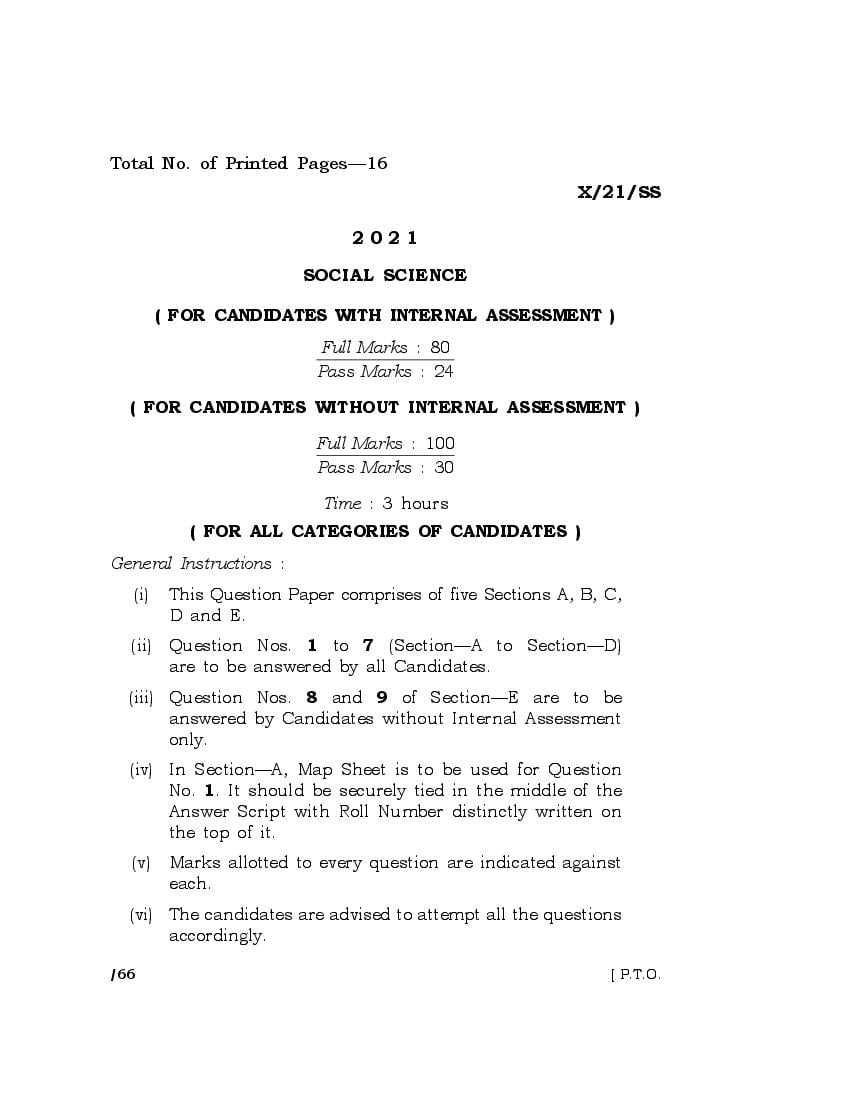
X/21/SS
2021
SOCIAL SCIENCE
( FOR CANDIDATES WITH INTERNAL ASSESSMENT )
Full Marks : 80
Pass Marks : 24
( FOR CANDIDATES WITHOUT INTERNAL ASSESSMENT )
Full Marks : 100
Pass Marks : 30
Time : 3 hours
( FOR ALL CATEGORIES OF CANDIDATES )
General Instructions :
(i) This Question Paper comprises of five Sections A, B, C,
D and E.
(ii) Question Nos. 1 to 7 (Section—A to Section—D)
are to be answered by all Candidates.
(iii) Question Nos. 8 and 9 of Section—E are to be
answered by Candidates without Internal Assessment
only.
(iv) In Section—A, Map Sheet is to be used for Question
No. 1. It should be securely tied in the middle of the
Answer Script with Roll Number distinctly written on
the top of it.
(v) Marks allotted to every question are indicated against
each.
(vi) The candidates are advised to attempt all the questions
accordingly.
/66 [ P.T.O.
Page 2
SECTION—A
( Marks : 4 )
1. In the same outline map of India supplied to you, locate
and label the following (choose any two each from
Group—I and Group—II) :
GROUP—I 1×2=2
(a) The place where Gandhiji organised his first
Satyagraha in 1917
(b) The place where Gandhiji violated the Salt Law
(c) The first Indian city to get smoke nuisance (1863)
(d) The place where the first cotton industry was started
(1853)
GROUP—II 1×2=2
(a) One leading cotton producing State in India
(b) One nuclear power plant in South India
(c) One major port in the West Coast
(d) One National Park in Meghalaya
[ For Visually Handicapped (Blind) Students
only in lieu of the above questions ]
GROUP—I
Answer any two of the following : 1×2=2
(a) Name the place where Gandhiji organised his first
Satyagraha in India in 1917.
(b) Name the place where Gandhiji violated the Salt
Law.
X/21/SS/66 [ Contd.
Page 3
(c) Which is the first Indian city to get smoke nuisance
legislation in 1863?
(d) Name the place where the first cotton industry was
started in 1853.
GROUP—II
Answer any two of the following : 1×2=2
(a) Name one leading cotton producing State in India.
(b) Name one nuclear power plant in South India.
(c) Name one major port in the West Coast of India.
(d) Name one National Park in Meghalaya.
SECTION—B
( Marks : 12 )
2. Rewrite the following statements by choosing the most
appropriate answer from the given options (any twelve) :
1×12=12
(a) Among the following, who introduced the policy of
‘Blood and Iron’ for the Unification of Germany?
(i) Giuseppe Garibaldi
(ii) Giuseppe Mazzini
(iii) Otto von Bismarck
(iv) Metternich
X/21/SS/66 [ P.T.O.
Page 4
(b) Who invented the first steam engine and who
improved upon it?
(i) James Watt invented the first steam engine and
Newcomen improved it.
(ii) Richard Arkwright produced the first steam
engine and Newcomen improved it in 1782.
(iii) James Watt improved the steam engine
produced by Newcomen in 1781.
(iv) None of them
(c) Which of the following was not a part of Gandhiji’s
Satyagraha?
(i) Emphasis on the power of truth
(ii) Satyagraha was a pure soul-force
(iii) A physical force which sought destruction of the
enemy
(iv) A way of actively resisting the oppressor
(d) Which of the following industries did not exist in
London before the First World War?
(i) Clothing and footwear
(ii) Printing and stationery
(iii) Surgical instruments, objects of precious metals
(iv) Motorcars and electrical goods
(e) Those resources that can be utilised with the help of
technical knowhow but being postponed for future
use are called
(i) potential resources
(ii) developed resources
(iii) stock resources
(iv) reserve resources
X/21/SS/66 [ Contd.
Page 5
(f) Which soils are known as ‘regur’?
(i) Laterite soils
(ii) Black soils
(iii) Alluvial soils
(iv) Red soils
(g) In which of the following States is jhum and terrace
cultivation predominantly practised?
(i) Punjab
(ii) Haryana
(iii) Meghalaya
(iv) Maharashtra
(h) Which of the following developments usually follows
industrial activity?
(i) Agriculture
(ii) Urbanisation
(iii) Electrification
(iv) Mining
(i) Which form of power sharing is most commonly
referred to as federalism?
(i) Horizontal division of power
(ii) Vertical division of power
(iii) Division of power among various communities
(iv) Sharing of power among political parties
X/21/SS/66 [ P.T.O.
Page 6
(j) Which of the following is not a sectional interest
group?
(i) Trade Union
(ii) Business Association
(iii) Professional Group
(iv) BAMCEF
(k) The Women Justice Initiative (WJI) is a
(i) National Level Organisation
(ii) State Level Organisation
(iii) District Level Organisation
(iv) Village Level Organisation
(l) MWCD released a study report on Child Abuse in
2017. What does MWCD stands for?
(i) Ministry of Women and Child Development
(ii) Member of Women and Children Development
(iii) Minister of Welfare and Cultural Development
(iv) Ministry of Welfare and Community
Development
(m) Which of the following economic parameters is not
represented by GDP of a country?
(i) Economic growth
(ii) National income
(iii) Per capita income
(iv) Human Development Index
X/21/SS/66 [ Contd.
Page 7
(n) Which among the following States is placed at the
bottom in literacy rate as well as life expectancy?
(i) Kerala
(ii) Punjab
(iii) Haryana
(iv) Bihar
(o) Currency in India is issued by the
(i) Commercial Banks
(ii) Reserve Bank of India
(iii) Regional Rural Banks
(iv) All of the above
(p) The agencies which look into the complaints of the
consumers are popularly called
(i) consumer courts
(ii) consumer commissions
(iii) consumer forums
(iv) consumer cells
(q) Water becomes a renewable and rechargeable
resource due to which of the following reasons?
(i) Water table
(ii) Hydrological cycle
(iii) Oceans and seas
(iv) Surface run-off
X/21/SS/66 [ P.T.O.
Page 8
(r) When was the Communist Party of India-Marxist
(CPI–M) formed?
(i) 1946
(ii) 1694
(iii) 1649
(iv) 1964
SECTION—C
( Marks : 24 )
(Short Answer-type Questions)
3. Answer any twelve questions : 2×12=24
(a) Define urbanisation. State any two causes for
urbanisation. 1+½+½=2
(b) Mention two reforms of Napoleon that helped for the
growth of nationalism in Europe in the 19th
Century. 1+1=2
(c) What were the conditions of children during the
Industrial Revolution? 2
(d) Why is Chauri Chaura incident so important in the
history of India’s Freedom Movement? 2
(e) Classify the resources on the basis of exhaustibility
(renewability) with one example each. 1+1=2
X/21/SS/66 [ Contd.
Page 9
(f) Which is the dominant food grain crop of
Meghalaya? Name any two horticultural crops of
this State. 1+½+½=2
(g) Why do you think that air transport is preferred in
the North-Eastern Region of India over other modes
of transport? 2
(h) Imagine you are living in a flood-prone area and you
have an emergency kit on hand. List four items that
you have to include in this emergency kit. ½×4=2
(i) Differentiate between a political party and a
pressure group. 1+1=2
(j) Mention any two constitutional rights of women in
India. 1+1=2
(k) Which countries follow ‘coming together’ and
‘holding together’ style of federalism? 1+1=2
(l) What are the various forms of child abuse prevalent
in India? ½×4=2
(m) How is education a key factor behind human
development? Explain. 2
(n) Enlist any four rights that one should know as a
consumer. ½×4=2
(o) Compare and contrast between organised and
unorganised sectors of an economy. 1+1=2
X/21/SS/66 [ P.T.O.
Page 10
(p) Define money. Mention two constituents of money.
1+½+½=2
(q) Why is iron and steel industry termed as ‘basic
industry’? 2
(r) Why do you think MGNREGA, 2005 is referred to as
‘Right to Work’? 2
SECTION—D
( Marks : 40 )
(Long Answer-type Questions)
PART—I
4. Answer any three questions : 4×3=12
(a) Giuseppe Mazzini was considered the ‘Soul’ of
Italian nationalism. Discuss his role in the
Unification of Italy. 4
Or
Count Cavour, the Prime Minister of Sardinia have
played a major role in the Unification of Italy.
Justify the statement. 4
(b) Give an account of the Jallianwala Bagh Tragedy that
became a turning point in the history of India’s
struggle for freedom in 1919. 4
X/21/SS/66 [ Contd.
Page 11
(c) With the growth of cotton textile industries at
Manchester in England in the 19th Century, the
Indian weavers faced several problems. Highlight the
problems faced by the Indian weavers during this
period. 4
(d) “Rapid industrialisation changed the society, its
morals and ethics.” Explain this statement in the
light of 19th Century England. 4
(e) When did Gandhiji start the Non-Cooperation
Movement in India? What role did the town people
play during this Movement? 1+3=4
(f) Analyse all the measures and practices introduced
by the French Revolutionaries to create a sense of
collective identity amongst the French people. 4
PART—II
5. Answer any three questions : 4×3=12
(a) Discuss the reasons of land degradation and
suggest ways to conserve it. 2+2=4
(b) Which is the second most important cereal crop of
India? Explain the geographical conditions required
for the cultivation of this crop. Name two largest
producing States of this crop. 1+2+1=4
X/21/SS/66 [ P.T.O.
Page 12
Or
Name one important beverage crop and specify the
geographical conditions required for its growth.
Name the areas of its production. 1+2+1=4
(c) What is rainwater harvesting? Discuss the various
methods of rainwater harvesting in hilly, flood-
plains and semi-arid regions of Rajasthan. 1+3=4
(d) Why the Chota Nagpur Plateau region has a cluster
of iron and steel industries? Identify the challenges
faced by the iron and steel industries today in India.
2+2=4
(e) Elaborate the facts about coal found in India with
the help of the points mentioned below : 1+1+1+1=4
(i) Its formation
(ii) As a source of energy
(iii) As a source of raw material
(iv) Its main varieties
(f) “Indian road transportation is confronted with
problems.” Give four arguments to justify the
statement. 4
PART—III
6. Answer any two questions : 4×2=8
(a) India is a secular country and the principle of
secularism is one of the basic features of our
Constitution. Justify your answer by giving the
Constitutional provisions laid down under
Articles 25–28 of the Indian Constitution. 4
X/21/SS/66 [ Contd.
Page 13
(b) Discuss the various challenges faced by the political
parties in India. 4
(c) Analyse the special features of Indian federation
which make it differ from other federations of the
world. 4
(d) Evaluate the importance of voting in a democracy. 4
(e) “Pressure groups and movements exert influence on
politics in several ways.” Give four reasons to
support your answer. 4
PART—IV
7. Answer any two questions : 4×2=8
(a) Define public sector. Describe the significance of
public sector. 1+3=4
(b) How are consumers exploited in the marketplace?
Explain. 4
(c) Differentiate between formal and informal sources of
credit. What are the advantages of formal sector
loans? 2+2=4
(d) What is sustainable development? Suggest three
measures to ensure sustainable development. 1+3=4
(e) Define barter system. Explain the ‘double
coincidence of wants’ with the help of an example.
1+3=4
X/21/SS/66 [ P.T.O.
Page 14
SECTION—E
( Marks : 20 )
[ For Candidates without Internal Assessment ]
8. Rewrite the following statements by choosing the right
option from those given in the brackets : 1×12=12
(a) (Liberalism/Conservatism) is a political philosophy
which stresses on the importance of traditions,
established institutions and customs.
(b) Civil Disobedience Movement started under the
leadership of Mahatma Gandhi in (1930/1920).
(c) The earliest factories came up in 1730s in (England/
Mumbai).
(d) Aluminium is obtained from (mica/bauxite).
(e) India is the (second/third) largest producer of
sugarcane in the world.
(f) (Waterways/ Roadways) are the cheapest means of
transport.
(g) Indian society is still (patriarchal/matriarchal).
(h) The subjects like Railways, Post and Telegraph,
Banking, etc., are included in the (Union List/ State
List) of the Constitution.
X/21/SS/66 [ Contd.
Page 15
(i) The Indian Parliament passed the Juvenile Justice
(Care and Protection of Children) Act in the year
(2011/2015).
(j) Human Development Index (HDI) is prepared by
(UNDP/WHO).
(k) The scheme MGNREGA was launched in (2006/
2008).
(l) (Self-Help Groups/Moneylenders) help the borrowers
to overcome the problem of lack of collateral.
9. Answer any eight of the following questions in one word
or in one sentence each : 1×8=8
(a) Who started the Freedom Movement in Italy?
(b) What is Proto-industrialisation?
(c) Which was the first silent feature film of India?
(d) What is soil erosion?
(e) Name two prominent iron-ores found in India.
(f) Why is Mawsynram famous?
(g) Which day is observed as the National Voters’ Day in
India?
X/21/SS/66 [ P.T.O.
Page 16
(h) State any two major issues of concern with women
in India.
(i) What is decentralisation of power?
(j) What do you mean by disguised unemployment?
(k) Define sex ratio.
(l) How are the logos ISI and Hallmark helpful to
consumers?
X/21/SS/66 11–21—66760
Document Details
| Board / Org | Meghalaya Board |
| Exam | Class 10 |
| Type | Question Paper |
| Pages | 16 |
| Updated | 30 Apr 2026 |