MBOSE Class 10 Question Paper 2021 for Science
Finished viewing? Save it for later —
Download MBOSE Class 10 Question Paper 2021 for Science (PDF · 23 pages)About MBOSE Class 10 Question Paper 2021 for Science
MBOSE Class 10 Question Paper 2021 for Science is available here for free download. Published by Meghalaya Board for Class 10, this question paper can be viewed online or downloaded as a PDF (23 pages). Candidates preparing for Class 10 can use MBOSE Class 10 Question Paper 2021 for Science to understand the exam pattern, the type of questions asked, and the overall difficulty level.
Frequently Asked Questions
How can I download MBOSE Class 10 Question Paper 2021 for Science?
Open this page and click the Download button to save MBOSE Class 10 Question Paper 2021 for Science as a PDF. It is completely free on AglaSem Docs.
Is MBOSE Class 10 Question Paper 2021 for Science free to download?
Yes. MBOSE Class 10 Question Paper 2021 for Science can be viewed online and downloaded as a PDF free of cost on AglaSem Docs.
How many pages does MBOSE Class 10 Question Paper 2021 for Science have?
MBOSE Class 10 Question Paper 2021 for Science contains 23 pages, which you can read online or download together as a single PDF.
Where can I find more Class 10 study material?
You can find more Class 10 question papers, sample papers, syllabus, and answer keys on AglaSem Docs.
MBOSE Class 10 Question Paper 2021 for Science – Text
Read the full text of this question paper below — useful to quickly search, copy and reference the content online without downloading the PDF.
📄 View text version (23 pages)
Page 1
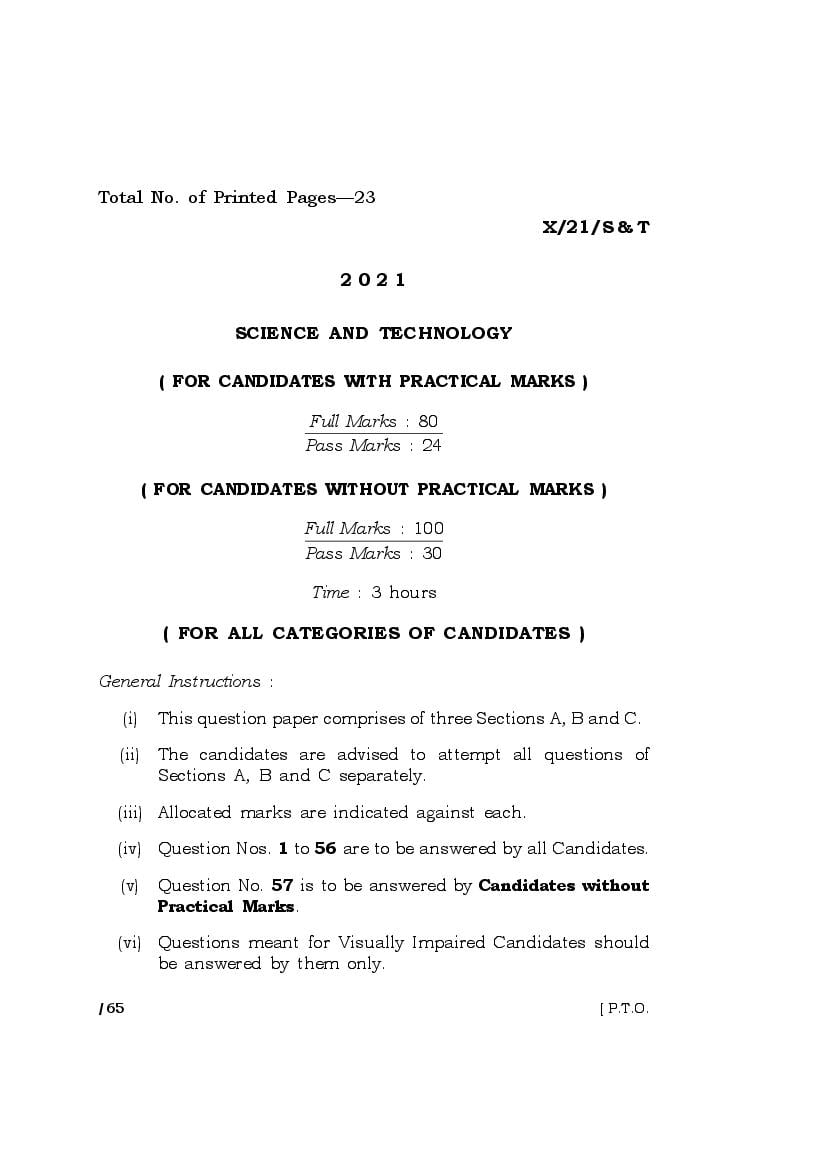
X/21/S & T
2021
SCIENCE AND TECHNOLOGY
( FOR CANDIDATES WITH PRACTICAL MARKS )
Full Marks : 80
Pass Marks : 24
( FOR CANDIDATES WITHOUT PRACTICAL MARKS )
Full Marks : 100
Pass Marks : 30
Time : 3 hours
( FOR ALL CATEGORIES OF CANDIDATES )
General Instructions :
(i) This question paper comprises of three Sections A, B and C.
(ii) The candidates are advised to attempt all questions of
Sections A, B and C separately.
(iii) Allocated marks are indicated against each.
(iv) Question Nos. 1 to 56 are to be answered by all Candidates.
(v) Question No. 57 is to be answered by Candidates without
Practical Marks.
(vi) Questions meant for Visually Impaired Candidates should
be answered by them only.
/65 [ P.T.O.
Page 2
SECTION—A
( PHYSICS )
( Marks : 26 )
Choose and write the correct answer from the following
(any four) : 1×4=4
1. A material medium having the lowest optical density is
(A) water
(B) glass
(C) air
(D) diamond
2. The focal length of the eye lens increases when eye
muscles
(A) are relaxed and lens becomes thinner
(B) contract and lens becomes thicker
(C) are relaxed and lens becomes thicker
(D) contract and lens becomes thinner
3. An instrument is connected in series in an electric circuit
and has a low resistance. Name the instrument.
(A) Voltmeter
(B) Ammeter
(C) Electric meter
(D) Dioptremeter
X/21/S & T/65 [ Contd.
Page 3
4. The curved lines along which iron filings align them-
selves around a bar magnet are called
(A) magnetic field lines
(B) mechanical field lines
(C) electromagnetic field lines
(D) optical field lines
5. The space surrounding a bar magnet in which its
influence in the form of magnetic force can be detected,
is called
(A) magnetic lines
(B) magnetic force
(C) solenoid
(D) magnetic field
6. One watt-hour is equal to
(A) 36 J
(B) 360 J
(C) 3600 J
(D) 36000 J
7. Rainbow is formed due to
(A) diffraction of light
(B) refraction of light
(C) dispersion of light
(D) reflection of light
X/21/S & T/65 [ P.T.O.
Page 4
8. When a newspaper is seen through a lens, its print
appears smaller. The nature of the lens is
(A) convex
(B) concave
(C) double convex
(D) concavo-convex
Answer the following short answer-type questions (any four) :
2×4=8
9. State the relationship between the focal length and the
radius of curvature of a convex mirror. 1+1=2
10. (a) Which defect of vision does an aged person suffer if
he or she cannot see far and near objects clearly? 1
(b) What type of lens should be used by him or her if
he or she cannot read comfortably? 1
11. Name the factors which determine the electric resistance
of a conductor. ½×4=2
12. No two magnetic field lines intersect each other. Why? 2
13. Give the characteristics of the image formed when the
object is placed between the principal focus and the pole
of a concave mirror. ½×4=2
X/21/S & T/65 [ Contd.
Page 5
14. (a) Name two common defects of human eye. 1
(b) Name the kinds of lens used for correcting the above
defects. 1
15. What will be the total resistance of the circuit if four
resistances of 2 each are connected in a series
circuit? 2
16. (a) What do you understand by the term ‘ion current’? 1
(b) Give one application of Magnetic Resonance
Imaging. 1
Answer the following short answer-type questions : 3×3=9
Answer either Part—A or Part—B from each question
Part—A
17. (a) The velocity of light in air is 3 × 10⁸ m/s and in glass
is 2 × 10⁸ m/s. Find the refractive index of glass. 1½
(b) Draw this figure in your answer book and show the
direction of ray of light after reflection : 1½
X/21/S & T/65 [ P.T.O.
Page 6
[ For Visually Impaired Candidates only in lieu
of Question No. 17(b) ]
(b) Define power of a lens. What is its unit? 1½
Part—B
(c) State any six common characteristics of light. ½×6=3
Part—A
18. (a) Give three characteristics of a parallel circuit. 3
Part—B
(b) (i) Derive the mathematical expression of Ohm’s
law. Define SI unit of resistance. 1+1=2
(ii) How is electric current measured? 1
Part—A
19. (a) What is an electric motor? Write the principle on
which electric motor is based. Give the function of
a commutator. 1+1+1=3
Part—B
(b) Enumerate any three characteristics of a permanent
magnet. 3
X/21/S & T/65 [ Contd.
Page 7
Answer the following long answer-type questions : 5
Answer either Part—A or Part—B or Part—C
Part—A
20. (a) What is lateral displacement? 1
(b) State the laws of refraction of light. 2
(c) Why is convex mirror preferred over plane mirror for
rear view? 2
Part—B
(d) Between retina and iris, which acts like a
photographic camera? 1
(e) Name the two types of nerve ending in the retina
and also mention its characteristics. 2
(f) Give two functions of aqueous humour. 2
Part—C
(g) List three characteristics of magnetic field lines. 3
(h) When is a body said to be positively or negatively
charged? ½+½=1
(i) How many electrons constitute one unit of electric
charge? 1
X/21/S & T/65 [ P.T.O.
Page 8
SECTION—B
( CHEMISTRY )
( Marks : 26 )
Choose and write the correct answer from the following
(any three) : 1×3=3
21. Which one of the following can be used as an acid-base
indicator by a visually impaired student?
(A) Litmus
(B) Turmeric
(C) Vanilla essence
(D) Methyl orange
22. Long form of Periodic Table was reconstructed by
(A) Moseley
(B) Niels Bohr
(C) J. J. Thomson
(D) Rutherford
23. Which among the following is double displacement
reaction?
(A) Pb + CuCl2 PbCl2 + Cu
(B) Na2SO4 + BaCl2 BaSO4 + 2NaCl
(C) C + O2 CO2
(D) CH4 + 2O2 CO2 + 2H2O
X/21/S & T/65 [ Contd.
Page 9
24. An element that is an essential constituent of all organic
compounds belongs to
(A) Group 1
(B) Group 14
(C) Group 15
(D) Group 16
25. Oxidation is a process which involves
(A) addition of oxygen
(B) addition of hydrogen
(C) removal of oxygen
(D) removal of hydrogen
26. Which one of the following is a strong acid?
(A) Carbonic acid
(B) Sulphurous acid
(C) Nitrous acid
(D) Hydrochloric acid
Answer the following short answer-type questions (any three) :
2×3=6
27. Balance the following chemical reactions : 1+1=2
(a) FeS2 + O2 Fe2O3 + SO2
(b) C4H10 + O2 CO2+ H2O
X/21/S & T/65 [ P.T.O.
Page 10
28. Identify the following elements whose electronic
configurations are given below : ½×4=2
(He, Li, Na, K, Ca, Mg, Cl)
(a) 2, 8, 2
(b) 2, 8, 1
(c) 2, 8, 7
(d) 2, 1
29. What are isomers? Write the formulas of two isomers of
butane. 1+1=2
30. What change in colour is observed when white silver
chloride is left exposed to sunlight? State the type of
chemical reaction in this change. 1+1=2
31. An element P belongs to Group 2 of the long form of the
Periodic Table.
(a) How many valence electrons are there in P ? 1
(b) What is the valency of P ? Is P a metal or
non-metal? ½+½=1
32. Identify the functional groups in the following : ½×4=2
(a) CH3COOH
(b) CH3CH2CH2OH
(c) CH3COCH3
(d) C2H5CHO
X/21/S & T/65 [ Contd.
Page 11
Answer the following short answer-type questions : 3×4=12
Answer either Part—A or Part—B from each question
Part—A
33. (a) When a shining strip of copper is placed in
colourless silver nitrate solution, then silver metal
and copper nitrate solution are formed.
(i) What type of reaction is this? 1
(ii) What is the colour of the solution after reaction? 1
(iii) Write a balanced chemical equation to represent
the above reaction. 1
Part—B
(b) (i) What is the colour of ferrous sulphate crystals? ½
(ii) What is the change of colour on further heating? ½
(iii) Name the products formed on strongly heating
of ferrous sulphate crystals. What type of
chemical reaction occurs in this change? 1½+½=2
Part—A
34. (a) (i) Write the chemical formula of bleaching powder. 1
(ii) What happens when it is left exposed to air? 1
(iii) Give any two uses of bleaching powder. ½+½=1
X/21/S & T/65 [ P.T.O.
Page 12
Part—B
(b) (i) What do you mean by family of salts? 1
(ii) What is neutralization reaction? 1
(iii) Name two highly malleable metals. ½+½=1
Part—A
35. (a) Name a molecule of an element that has—
(i) one covalent bond;
(ii) two covalent bonds;
(iii) three covalent bonds. 1+1+1=3
Part—B
(b) (i) Give the general name of the class of compounds
having the general formula CnH2n – 2. Write the
name of any member of this homologous
series. 1+1=2
(ii) What is methylated spirit? 1
Part—A
36. (a) (i) A non-metal X exists in two different forms
Y and Z. Y is the hardest natural substance,
whereas Z is a good conductor of electricity.
Identify X, Y and Z. 1½
X/21/S & T/65 [ Contd.
Page 13
(ii) State the reason why sodium and potassium
metals are kept immersed under kerosene oil. 1
(iii) Give an example of a metal which is a liquid at
room temperature. ½
Part—B
(b) State any three differences between calcination and
roasting. 3
Answer the following long answer-type questions : 5
Answer either Part—A or Part—B or Part—C
Part—A
37. (a) Why is pure gold not used to make ornaments? 1
(b) How is gold hardened to make ornaments? What do
you mean by 22 K gold? 1+1=2
(c) Give the composition and use of brass and bronze.
1+1=2
Part—B
(d) What changes do you observe when a strip of iron
metal is placed in copper sulphate solution? 3
(e) Define exothermic reaction with a chemical
equation. 1+1=2
X/21/S & T/65 [ P.T.O.
Page 14
Part—C
(f) Define catenation. 1
(g) Write the names of two alkanes, one having three
carbon atoms and the other having four carbon
atoms. ½+½=1
(h) What are Groups and Periods in the Periodic Table?
½+½=1
(i) What happens when metal carbonate reacts with an
acid? 1
(j) Which gas is evolved when zinc granules are
heated with conc. sodium hydroxide solution? 1
SECTION—C
( BIOLOGY )
( Marks : 28 )
Choose and write the correct answer from the following
(any three) : 1×3=3
38. The inner lining of stomach is protected by which one of
the following from hydrochloric acid?
(A) Pepsin
(B) Mucus
(C) Salivary amylase
(D) Bile
X/21/S & T/65 [ Contd.
Page 15
39. Which of the following endocrine glands is unpaired?
(A) Pituitary
(B) Adrenal
(C) Testis
(D) Ovary
40. Platelets help in
(A) transport of oxygen
(B) transport of carbon dioxide
(C) clotting of blood
(D) pumping of blood
41. The main function of the plant hormone abscisic acid
is to
(A) increase the length of the cells
(B) promote cell division
(C) inhibit growth
(D) promote growth of stem and root
X/21/S & T/65 [ P.T.O.
Page 16
42. The male gamete from pollen tube fuses with egg to form
(A) polar nuclei
(B) embryo
(C) zygote
(D) endosperm
43. An organism which reproduces by the process of binary
fission is
(A) Spirogyra
(B) Hydra
(C) Plasmodium
(D) Amoeba
Answer the following short answer-type questions (any four) :
2×4=8
44. Write any two points of differences between photo-
synthesis and respiration. 2
45. Illustrate with the help of suitable diagram ‘multiple
fission’ in Plasmodium. ½×4=2
X/21/S & T/65 [ Contd.
Page 17
[ For Visually Impaired Candidates only
in lieu of Question No. 45 ]
45. Define regeneration. Give two examples. 1+1=2
46. Name the four whorls of a typical angiospermic
flower. ½×4=2
47. Define the term ‘analogous organs’. Give two examples.
1+½+½=2
48. Write any two functions of blood. 2
49. (a) Name the coverings in brain and the fluid present
in between. 1
(b) Name the two main constituents of the central
nervous system in human beings. ½+½=1
50. (a) Name the technique used for propagating disease-
free variety of plant. 1
(b) Name any two agencies through which cross-
pollination takes place. 1
51. (a) Give the scientific name of the organism Mendel
used for his experiment. 1
(b) Define fossils. 1
X/21/S & T/65 [ P.T.O.
Page 18
Answer the following short answer-type questions : 3×4=12
Answer either Part—A or Part—B from each question
Part—A
52. (a) (i) In the given diagram, name the parts (1), (2),
(3) and (4) : ½×4=2
[ For Visually Impaired Candidates only
in lieu of Question No. 52(a)(i) ]
(i) Name the two types of Nastic movements. Also
explain each. 1+1=2
(a) (ii) Name the two major components of normal
human urine. 1
X/21/S & T/65 [ Contd.
Page 19
Part—B
(b) (i) Name the four main types of heterotrophic
nutrition. ½×4=2
(ii) Name the vestigial part of human alimentary
canal. 1
Part—A
53. (a) Name the animal hormone responsible for—
(i) regulating protein metabolism and body growth;
(ii) lowering blood sugar level;
(iii) regulating calcium and phosphorus metabolism.
1+1+1=3
Part—B
(b) Which endocrine gland is present in males but not
in females? 1
(c) Name the endocrine gland associated with kidneys. 1
(d) Which gland secretes digestive enzymes as well as
hormones? 1
Part—A
54. (a) Write the full forms of the following : 1×3=3
(i) MTP
(ii) IUCD
(iii) STD
X/21/S & T/65 [ P.T.O.
Page 20
Part—B
(b) Distinguish between external fertilization and
internal fertilization giving an example of each.
1½+1½=3
Part—A
55. (a) (i) What do you understand by phenotype and
genotype? 1+1=2
(ii) State the law of purity of gametes. 1
Part—B
(b) (i) Name the three pairs of salivary glands
in humans. Where do they open? 1½+½=2
(ii) Which enzyme present in saliva breaks down
starch? 1
Answer the following long answer-type questions : 5
Answer either Part—A or Part—B or Part—C
Part—A
56. (a) Name the process in plant where water is lost as
water vapour. 1
(b) Give the names of four kinds of phloem elements.
½×4=2
(c) Mention the two important functions of lymph. 2
X/21/S & T/65 [ Contd.
Page 21
Part—B
(d) What is neuron? 1
(e) State the functions of sensory neuron, motor
neuron and connector neuron. 1+1+1=3
(f) What is the directional movement of the plant
in response to (i) light and (ii) chemical stimulus
called? 1
Part—C
(g) Name the process by which the present diversity
of plants and animals arose from the earliest and
primitive organisms. 1
(h) How many pairs of (i) spinal nerves and (ii) cranial
nerves are there in human beings? ½+½=1
(i) Name the instrument used to measure blood
pressure in humans. 1
(j) Name the mechanism for (i) intake of fresh air from
outside to the alveoli of lungs and (ii) removal of
stale air from the alveoli of lungs to outside. ½+½=1
(k) Write two functions of stomata. ½+½=1
[ For Candidates without Practical Marks ]
57. I. Answer any three of the following questions : 2×3=6
(a) What is a lens? Name two broad classes of
lens. 1+1=2
(b) What is dispersion of light? 2
X/21/S & T/65 [ P.T.O.
Page 22
(c) What is potential difference? Also give its
SI unit. 1+1=2
(d) Give two points of differences between electro-
magnet and permanent magnet. 2
(e) What do you understand by accommodation
of the eye? 2
(f) What are the two kinds of reflection of light? 2
II. Answer any three of the following questions : 2×3=6
(a) What is chemical combination reaction? Also
give one chemical equation for the above. 1+1=2
(b) What are acids and bases? 1+1=2
(c) (i) What is meant by water of crystallization? 1
(ii) Name one salt containing five molecules
of water of crystallization. 1
(d) What are hydrocarbons? Give an example. 2
(e) (i) Define ore. 1
(ii) Name any two methods for concentration
of ore. ½+½=1
(f) An element E has atomic number 17. Write the
electronic configuration of E, and find out the
Period and Group to which it belongs in the
Periodic Table. ½+½+1=2
X/21/S & T/65 [ Contd.
Page 23
III. Answer any four of the following questions : 2×4=8
(a) (i) What is nutrition? 1
(ii) Define the term ‘assimilation’. 1
(b) Give any two differences between aerobic
respiration and anaerobic respiration. 2
(c) Name four plant hormones. ½×4=2
(d) Mention two functions of the large intestine. 2
(e) What is double circulation? 2
(f ) Give the differences between variation and
heredity. 2
(g) What are the two hormones secreted by thyroid
gland? 1+1=2
(h) (i) What is dialysis? 1
(ii) Name the blood vessel which carries
oxygenated blood from lungs to heart. 1
X/21/S & T/65 11-21—69750
Document Details
| Board / Org | Meghalaya Board |
| Exam | Class 10 |
| Type | Question Paper |
| Pages | 23 |
| Updated | 30 Apr 2026 |