GATE 2021 Question Paper MA Mathematics
Finished viewing? Save it for later —
Download GATE 2021 Question Paper MA Mathematics (PDF · 29 pages)About GATE 2021 Question Paper MA Mathematics
GATE 2021 Question Paper MA Mathematics is available here for free download. Published by IIT for Graduate Aptitude Test in Engineering, this question paper can be viewed online or downloaded as a PDF (29 pages). Candidates preparing for Graduate Aptitude Test in Engineering can use GATE 2021 Question Paper MA Mathematics to understand the exam pattern, the type of questions asked, and the overall difficulty level.
Frequently Asked Questions
How can I download GATE 2021 Question Paper MA Mathematics?
Open this page and click the Download button to save GATE 2021 Question Paper MA Mathematics as a PDF. It is completely free on AglaSem Docs.
Is GATE 2021 Question Paper MA Mathematics free to download?
Yes. GATE 2021 Question Paper MA Mathematics can be viewed online and downloaded as a PDF free of cost on AglaSem Docs.
How many pages does GATE 2021 Question Paper MA Mathematics have?
GATE 2021 Question Paper MA Mathematics contains 29 pages, which you can read online or download together as a single PDF.
Where can I find more Graduate Aptitude Test in Engineering study material?
You can find more Graduate Aptitude Test in Engineering question papers, sample papers, syllabus, and answer keys on AglaSem Docs.
GATE 2021 Question Paper MA Mathematics – Text
Read the full text of this question paper below — useful to quickly search, copy and reference the content online without downloading the PDF.
📄 View text version (29 pages)
Page 1
Q.1 – Q.5 Multiple Choice Question (MCQ), carry ONE mark each (for each wrong
answer: – 1/3).
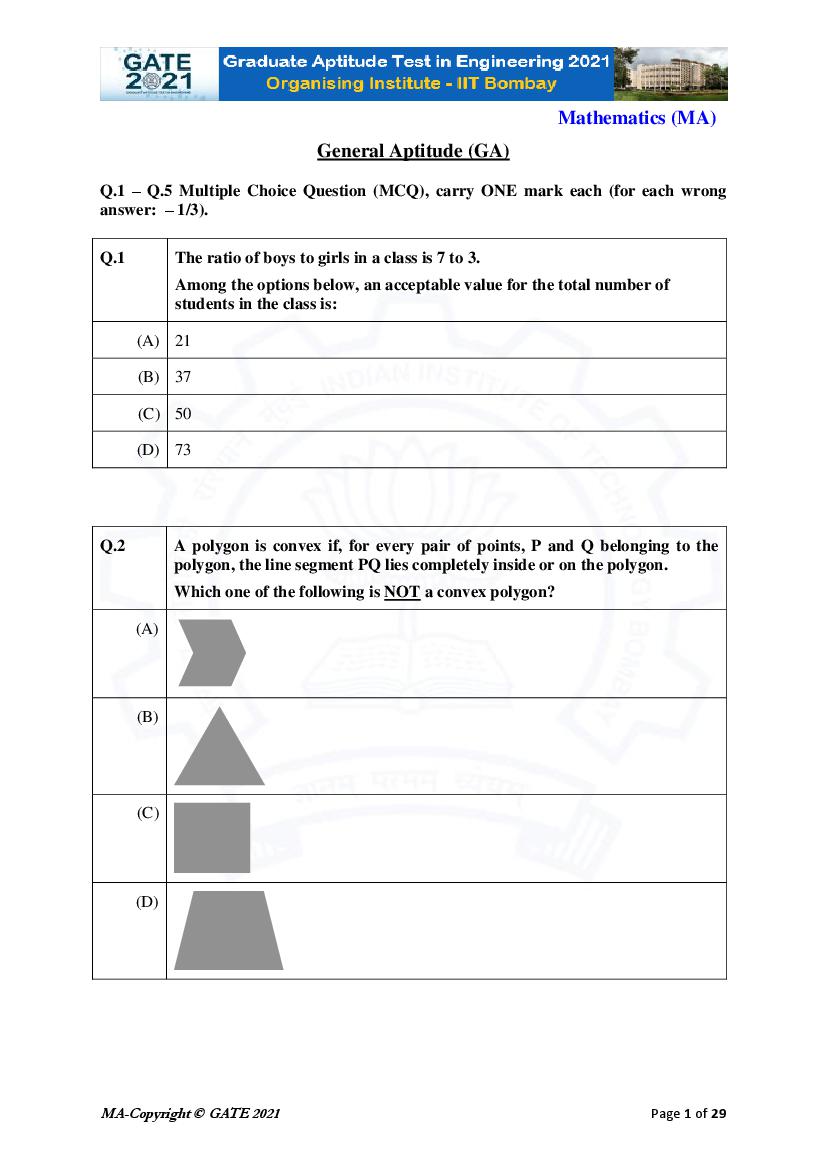
Q.1 The ratio of boys to girls in a class is 7 to 3.
Among the options below, an acceptable value for the total number of
students in the class is:
(A) 21
(B) 37
(C) 50
(D) 73
Q.2 A polygon is convex if, for every pair of points, P and Q belonging to the
polygon, the line segment PQ lies completely inside or on the polygon.
Which one of the following is NOT a convex polygon?
(A)
(B)
(C)
(D)
MA-Copyright © GATE 2021 Page 1 of 29
Page 2
(i) Everybody in the class is prepared for the exam.
(ii) Babu invited Danish to his home because he enjoys playing chess.
Which of the following is the CORRECT observation about the above two
sentences?
(A) (i) is grammatically correct and (ii) is unambiguous
(B) (i) is grammatically incorrect and (ii) is unambiguous
(C) (i) is grammatically correct and (ii) is ambiguous
(D) (i) is grammatically incorrect and (ii) is ambiguous
MA-Copyright © GATE 2021 Page 2 of 29
Page 3
A circular sheet of paper is folded along the lines in the directions shown. The
paper, after being punched in the final folded state as shown and unfolded in
the reverse order of folding, will look like _______.
(A)
(B)
(C)
(D)
MA-Copyright © GATE 2021 Page 3 of 29
Page 4
Which one of the following options maintains a similar logical relation in the
above sentence?
(A) Plan, outline
(B) Hospital, library
(C) Doctor, book
(D) Medicine, grammar
MA-Copyright © GATE 2021 Page 4 of 29
Page 5
answer: – 2/3).
Q.6 We have 2 rectangular sheets of paper, M and N, of dimensions 6 cm x 1 cm
each. Sheet M is rolled to form an open cylinder by bringing the short edges
of the sheet together. Sheet N is cut into equal square patches and assembled
to form the largest possible closed cube. Assuming the ends of the cylinder
are closed, the ratio of the volume of the cylinder to that of the cube is
__________
(A) 𝜋
2
(B) 3
𝜋
(C) 9
𝜋
(D) 3𝜋
MA-Copyright © GATE 2021 Page 5 of 29
Page 6
Items Cost Profit % Marked Price
(₹) (₹)
P 5,400 --- 5,860
Q --- 25 10,000
Details of prices of two items P and Q are presented in the above table. The
ratio of cost of item P to cost of item Q is 3:4. Discount is calculated as the
difference between the marked price and the selling price. The profit
percentage is calculated as the ratio of the difference between selling price
𝐒𝐞𝐥𝐥𝐢𝐧𝐠 𝐩𝐫𝐢𝐜𝐞−𝐂𝐨𝐬𝐭
and cost, to the cost (𝐏𝐫𝐨𝐟𝐢𝐭 % = × 𝟏𝟎𝟎).
𝐂𝐨𝐬𝐭
The discount on item Q, as a percentage of its marked price, is ______
(A) 25
(B) 12.5
(C) 10
(D) 5
Q.8 There are five bags each containing identical sets of ten distinct chocolates.
One chocolate is picked from each bag.
The probability that at least two chocolates are identical is ___________
(A) 0.3024
(B) 0.4235
(C) 0.6976
(D) 0.8125
MA-Copyright © GATE 2021 Page 6 of 29
Page 7
Statement 1: All bacteria are microorganisms.
Statement 2: All pathogens are microorganisms.
Conclusion I: Some pathogens are bacteria.
Conclusion II: All pathogens are not bacteria.
Based on the above statements and conclusions, which one of the following
options is logically CORRECT?
(A) Only conclusion I is correct
(B) Only conclusion II is correct
(C) Either conclusion I or II is correct.
(D) Neither conclusion I nor II is correct.
Q.10 Some people suggest anti-obesity measures (AOM) such as displaying
calorie information in restaurant menus. Such measures sidestep addressing
the core problems that cause obesity: poverty and income inequality.
Which one of the following statements summarizes the passage?
(A) The proposed AOM addresses the core problems that cause obesity.
(B) If obesity reduces, poverty will naturally reduce, since obesity causes poverty.
(C) AOM are addressing the core problems and are likely to succeed.
(D) AOM are addressing the problem superficially.
MA-Copyright © GATE 2021 Page 7 of 29
Page 8
answer: – 1/3).
Q.1 Let 𝑨 be a 𝟑 × 𝟒 matrix and 𝑩 be a 𝟒 × 𝟑 matrix with real entries such that
𝑨𝑩 is non-singular. Consider the following statements:
P: Nullity of 𝑨 is 𝟎.
Q: 𝑩𝑨 is a non-singular matrix.
Then
(A) both P and Q are TRUE
(B) P is TRUE and Q is FALSE
(C) P is FALSE and Q is TRUE
(D) both P and Q are FALSE
MA-Copyright © GATE 2021 Page 8 of 29
Page 9
numbers, be a non-constant analytic function on the complex plane ℂ. Let 𝒖𝒙 ,
𝒗𝒙 and 𝒖𝒚 , 𝒗𝒚 denote the first order partial derivatives of 𝒖(𝒙, 𝒚) = 𝑹𝒆(𝒇(𝒛))
and 𝒗(𝒙, 𝒚) = 𝑰𝒎(𝒇(𝒛)) with respect to real variables 𝒙 and 𝒚, respectively.
Consider the following two functions defined on ℂ:
𝒈𝟏 (𝒛) = 𝒖𝒙 (𝒙, 𝒚) − 𝒊 𝒖𝒚 (𝒙, 𝒚) 𝐟𝐨𝐫 𝒛 = 𝒙 + 𝒊𝒚 ∈ ℂ,
𝒈𝟐 (𝒛) = 𝒗𝒙 (𝒙, 𝒚) + 𝒊 𝒗𝒚 (𝒙, 𝒚) 𝐟𝐨𝐫 𝒛 = 𝒙 + 𝒊𝒚 ∈ ℂ.
Then
(A) both 𝑔1 (𝑧) and 𝑔2 (𝑧) are analytic in ℂ
(B) 𝑔1 (𝑧) is analytic in ℂ and 𝑔2 (𝑧) is NOT analytic in ℂ
(C) 𝑔1 (𝑧) is NOT analytic in ℂ and 𝑔2 (𝑧) is analytic in ℂ
(D) neither 𝑔1 (𝑧) nor 𝑔2 (𝑧) is analytic in ℂ
Q.3 𝒂𝒛+𝒃
Let 𝑻(𝒛) = 𝒄𝒛+𝒅 , 𝒂𝒅 − 𝒃𝒄 ≠ 𝟎, be the Möbius transformation which maps
the points 𝒛𝟏 = 𝟎, 𝒛𝟐 = −𝒊, 𝒛𝟑 = ∞ in the 𝒛-plane onto the points 𝒘𝟏 = 𝟏𝟎,
𝒘𝟐 = 𝟓 − 𝟓𝒊, 𝒘𝟑 = 𝟓 + 𝟓𝒊 in the 𝒘-plane, respectively. Then the image of the
set 𝑺 = {𝒛 ∈ ℂ ∶ 𝑹𝒆(𝒛) < 𝟎} under the map 𝒘 = 𝑻(𝒛) is
(A) {𝑤 ∈ ℂ ∶ |𝑤| < 5}
(B) {𝑤 ∈ ℂ ∶ |𝑤| > 5}
(C) {𝑤 ∈ ℂ ∶ |𝑤 − 5| < 5}
(D) {𝑤 ∈ ℂ ∶ |𝑤 − 5| > 5}
MA-Copyright © GATE 2021 Page 9 of 29
Page 10
𝟎
third column of 𝑹 be [𝟏]. Consider the following statements:
𝟎
𝟎
𝜶
𝜷
P: If [ 𝜸 ] is a solution of 𝑨𝐱 = 𝟎, then 𝜸 = 𝟎.
𝟎
Q: For all 𝐛 ∈ ℝ𝟒 , 𝒓𝒂𝒏𝒌[𝑨| 𝐛] = 𝒓𝒂𝒏𝒌[𝑹| 𝐛].
Then
(A) both P and Q are TRUE
(B) P is TRUE and Q is FALSE
(C) P is FALSE and Q is TRUE
(D) both P and Q are FALSE
Q.5 The eigenvalues of the boundary value problem
𝒅𝟐 𝒚
+ 𝝀𝒚 = 𝟎, 𝒙 ∈ (𝟎, 𝝅), 𝝀 > 𝟎,
𝒅𝒙𝟐
𝒅𝒚
𝒚(𝟎) = 𝟎, 𝒚(𝝅) − 𝒅𝒙 (𝝅) = 𝟎,
are given by
(A) 𝜆 = (𝑛𝜋)2 , 𝑛 = 1,2,3, …
(B) 𝜆 = 𝑛2 , 𝑛 = 1,2,3, …
(C) 𝜆 = 𝑘𝑛2 , where 𝑘𝑛 , 𝑛 = 1,2,3, … are the roots of 𝑘 − tan(𝑘𝜋) = 0
(D) 𝜆 = 𝑘𝑛2 , where 𝑘𝑛 , 𝑛 = 1,2,3, … are the roots of 𝑘 + tan(𝑘𝜋) = 0
MA-Copyright © GATE 2021 Page 10 of 29
Page 11
differentiable function, satisfies
(A) 𝜕𝑢 𝜕𝑢
𝑦 +𝑥 = 𝑥2 + 𝑦2
𝜕𝑥 𝜕𝑦
(B) 𝜕𝑢 𝜕𝑢
𝑥 +𝑦 = 𝑥2 + 𝑦2
𝜕𝑥 𝜕𝑦
(C) 𝜕𝑢 𝜕𝑢
𝑦 +𝑥 = 𝑥2 − 𝑦2
𝜕𝑥 𝜕𝑦
(D) 𝜕𝑢 𝜕𝑢
𝑥 +𝑦 = 𝑥2 − 𝑦2
𝜕𝑥 𝜕𝑦
Q.7 The function 𝒖(𝒙, 𝒕) satisfies the initial value problem
𝝏𝟐 𝒖 𝝏𝟐 𝒖
= 𝝏𝒙𝟐 , 𝒙 ∈ ℝ, 𝒕 > 𝟎,
𝝏𝒕𝟐
𝝏𝒖 𝟐
𝒖(𝒙, 𝟎) = 𝟎, 𝝏𝒕 (𝒙, 𝟎) = 𝟒𝒙𝒆−𝒙 .
Then 𝒖(𝟓, 𝟓) is
(A) 1
1−
𝑒 100
(B) 1 − 𝑒 100
(C) 1
1−
𝑒 10
(D) 1 − 𝑒 10
MA-Copyright © GATE 2021 Page 11 of 29
Page 12
with ,
and the initial approximation
Then, the order of convergence of the fixed-point iteration method is
(A) 1
(B) 2
(C) 3
(D) 4
Q.9 Let {𝒆𝒏 ∶ 𝒏 = 𝟏, 𝟐, 𝟑, … } be an orthonormal basis of a complex Hilbert space
𝑯. Consider the following statements:
𝟏
P: There exists a bounded linear functional 𝒇: 𝑯 → ℂ such that 𝒇(𝒆𝒏 ) = 𝒏
for 𝒏 = 𝟏, 𝟐, 𝟑, … .
𝟏
Q: There exists a bounded linear functional 𝒈: 𝑯 → ℂ such that 𝒈(𝒆𝒏 ) =
√𝒏
for 𝒏 = 𝟏, 𝟐, 𝟑, … .
Then
(A) both P and Q are TRUE
(B) P is TRUE and Q is FALSE
(C) P is FALSE and Q is TRUE
(D) both P and Q are FALSE
MA-Copyright © GATE 2021 Page 12 of 29
Page 13
Let 𝒇: ( 𝟐 , 𝟐 ) → ℝ be given by 𝒇(𝒙) = 𝟐 + 𝒙 − 𝐭𝐚𝐧−𝟏 𝒙. Consider the
following statements:
−𝝅 𝝅
P: |𝒇(𝒙) − 𝒇(𝒚)| < |𝒙 − 𝒚| for all 𝒙, 𝒚 ∈ ( 𝟐 , 𝟐 ).
Q: 𝒇 has a fixed point.
Then
(A) both P and Q are TRUE
(B) P is TRUE and Q is FALSE
(C) P is FALSE and Q is TRUE
(D) both P and Q are FALSE
Q.11 Consider the following statements:
𝒙
P: 𝒅𝟏 (𝒙, 𝒚) = | 𝐥𝐨𝐠 (𝒚) | is a metric on (𝟎, 𝟏).
|𝒙| + |𝒚|, 𝐢𝐟 𝒙 ≠ 𝒚,
Q: 𝒅𝟐 (𝒙, 𝒚) = { is a metric on (𝟎, 𝟏).
𝟎, 𝐢𝐟 𝒙 = 𝒚,
Then
(A) both P and Q are TRUE
(B) P is TRUE and Q is FALSE
(C) P is FALSE and Q is TRUE
(D) both P and Q are FALSE
MA-Copyright © GATE 2021 Page 13 of 29
Page 14
𝒅𝒊𝒗(𝛁𝒇) = 𝟔. Let 𝑺 be the surface 𝒙𝟐 + 𝒚𝟐 + 𝒛𝟐 = 𝟏 and 𝒏 ̂ be unit outward
normal to 𝑺. Then the value of ∬𝑺(𝛁𝒇 ⋅ 𝒏̂ ) 𝒅𝑺 is
(A) 2 𝜋
(B) 4 𝜋
(C) 6 𝜋
(D) 8 𝜋
Q.13 Consider the following statements:
P: Every compact metrizable topological space is separable.
Q: Every Hausdorff topology on a finite set is metrizable.
Then
(A) both P and Q are TRUE
(B) P is TRUE and Q is FALSE
(C) P is FALSE and Q is TRUE
(D) both P and Q are FALSE
Q.14 Consider the following topologies on the set ℝ of all real numbers:
𝟏 = {𝑼 ⊂ ℝ ∶ 𝟎 ∉ 𝑼 𝐨𝐫 𝑼 = ℝ},
𝟐 = {𝑼 ⊂ ℝ ∶ 𝟎 ∈ 𝑼 𝐨𝐫 𝑼 = ∅} ,
𝟑 = 𝟏 ∩ 𝟐 .
Then the closure of the set {𝟏} in (ℝ, 𝟑 ) is
(A) {1}
(B) {0,1}
(C) ℝ
(D) ℝ\{0}
MA-Copyright © GATE 2021 Page 14 of 29
Page 15
Q.15 Let 𝒇: ℝ𝟐 → ℝ be differentiable. Let 𝑫𝒖 𝒇(𝟎, 𝟎) and 𝑫𝒗 𝒇(𝟎, 𝟎) be the
directional derivatives of 𝒇 at (𝟎, 𝟎) in the directions of the unit vectors
𝟏 𝟐 𝟏 −𝟏
𝒖 = ( , ) and 𝒗 = ( , ), respectively. If 𝑫𝒖 𝒇(𝟎, 𝟎) = √𝟓 and
√𝟓 √𝟓 √𝟐 √𝟐
𝝏𝒇 𝝏𝒇
𝑫𝒗 𝒇(𝟎, 𝟎) = √𝟐 , then 𝝏𝒙 (𝟎, 𝟎) + 𝝏𝒚 (𝟎, 𝟎) = ________ .
Q.16 Let ᴦ denote the boundary of the square region 𝑹 with vertices (𝟎, 𝟎), (𝟐, 𝟎),
(𝟐, 𝟐) and (𝟎, 𝟐) oriented in the counter-clockwise direction. Then
∮(𝟏 − 𝒚𝟐 ) 𝒅𝒙 + 𝒙 𝒅𝒚 = _____________.
ᴦ
Q.17 The number of 𝟓-Sylow subgroups in the symmetric group 𝑺𝟓 of degree 𝟓 is
___ .
Q.18 Let 𝑰 be the ideal generated by 𝒙𝟐 + 𝒙 + 𝟏 in the polynomial ring 𝑹 = ℤ𝟑 [𝒙],
where ℤ𝟑 denotes the ring of integers modulo 𝟑. Then the number of units in
the quotient ring 𝑹/𝑰 is ________ .
Q.19 Let 𝑻: ℝ𝟑 → ℝ𝟑 be a linear transformation such that
𝟏 𝟏 𝟏 𝟏 𝟏 𝟏
𝑻 ([𝟏]) = [−𝟏] , 𝑻𝟐 ([𝟏]) = [𝟏] , and 𝑻𝟐 ([𝟏]) = [𝟏] .
𝟏 𝟏 𝟏 𝟏 𝟐 𝟏
Then the rank of 𝑻 is _____ .
MA-Copyright © GATE 2021 Page 15 of 29
Page 16
𝒅𝟐 𝒚 𝒅𝒚
𝒙𝟐 𝒅𝒙𝟐 − 𝟒 𝒙 𝒅𝒙 + 𝟔 𝒚 = 𝟎, 𝒙 > 𝟎,
𝒅𝒚
𝒚(𝟐) = 𝟎, (𝟐) = 𝟒.
𝒅𝒙
Then 𝒚(𝟒) = ______________ .
Q.21 Let
𝒇(𝒙) = 𝒙𝟒 + 𝟐 𝒙𝟑 − 𝟏𝟏 𝒙𝟐 − 𝟏𝟐 𝒙 + 𝟑𝟔 𝐟𝐨𝐫 𝒙 ∈ ℝ.
The order of convergence of the Newton-Raphson method
𝒇(𝒙𝒏 )
𝒙𝒏+𝟏 = 𝒙𝒏 − , 𝒏 ≥ 𝟎,
𝒇′ (𝒙𝒏 )
with 𝒙𝟎 = 𝟐. 𝟏, for finding the root 𝜶 = 𝟐 of the equation 𝒇(𝒙) = 𝟎 is
_______ .
Q.22 If the polynomial
𝒑(𝒙) = 𝜶 + 𝜷 (𝒙 + 𝟐) + 𝜸 (𝒙 + 𝟐)(𝒙 + 𝟏) + 𝜹 (𝒙 + 𝟐)(𝒙 + 𝟏)𝒙
interpolates the data
𝒙 −𝟐 −𝟏 𝟎 𝟏 𝟐
𝒇(𝒙) 𝟐 −𝟏 𝟖 𝟓 −𝟑𝟒
then 𝜶 + 𝜷 + 𝜸 + 𝜹 = ______________ .
MA-Copyright © GATE 2021 Page 16 of 29
Page 17
Maximize 𝟐𝒙𝟏 + 𝟑𝒙𝟐
subject to
𝟐𝒙𝟏 + 𝒙𝟐 ≤ 𝟔,
−𝒙𝟏 + 𝒙𝟐 ≤ 𝟏,
𝒙𝟏 + 𝒙𝟐 ≤ 𝟑,
𝒙𝟏 ≥ 𝟎 and 𝒙𝟐 ≥ 𝟎.
Then the optimal value of the dual of 𝑷 is equal to _________ .
Q.24 Consider the Linear Programming Problem 𝑷:
Minimize 𝟐𝒙𝟏 − 𝟓𝒙𝟐
subject to
𝟐𝒙𝟏 + 𝟑𝒙𝟐 + 𝒔𝟏 = 𝟏𝟐,
−𝒙𝟏 + 𝒙𝟐 + 𝒔𝟐 = 𝟏,
−𝒙𝟏 + 𝟐𝒙𝟐 + 𝒔𝟑 = 𝟑,
𝒙𝟏 ≥ 𝟎, 𝒙𝟐 ≥ 𝟎, 𝒔𝟏 ≥ 𝟎, 𝒔𝟐 ≥ 𝟎, and 𝒔𝟑 ≥ 𝟎.
𝒙𝟏
𝟐
If 𝒔𝟏 is a basic feasible solution of 𝑷, then 𝒙𝟏 + 𝒔𝟏 + 𝒔𝟐 + 𝒔𝟑 =________ .
𝒔𝟐
[ 𝒔𝟑 ]
Q.25 Let 𝑯 be a complex Hilbert space. Let 𝒖, 𝒗 ∈ 𝑯 be such that 〈𝒖, 𝒗〉 = 𝟐. Then
𝟐𝝅
𝟏 𝟐
∫ ‖𝒖 + 𝒆𝒊𝒕 𝒗‖ 𝒆𝒊𝒕 𝒅𝒕 = _____________.
𝟐𝝅
𝟎
MA-Copyright © GATE 2021 Page 17 of 29
Page 18
answer: – 2/3).
Q.26 Let ℤ denote the ring of integers. Consider the subring
𝑹 = {𝒂 + 𝒃 √−𝟏𝟕 ∶ 𝒂, 𝒃 ∈ ℤ} of the field ℂ of complex numbers.
Consider the following statements:
P: 𝟐 + √−𝟏𝟕 is an irreducible element.
Q: 𝟐 + √−𝟏𝟕 is a prime element.
Then
(A) both P and Q are TRUE
(B) P is TRUE and Q is FALSE
(C) P is FALSE and Q is TRUE
(D) both P and Q are FALSE
Q.27 Consider the second-order partial differential equation (PDE)
𝝏𝟐 𝒖 𝝏𝟐 𝒖 𝟐 𝟐)
𝝏𝟐 𝒖
+ 𝟒 + (𝒙 + 𝟒𝒚 = 𝐬𝐢𝐧(𝒙 + 𝒚).
𝝏𝒙𝟐 𝝏𝒙𝝏𝒚 𝝏𝒚𝟐
Consider the following statements:
𝒙𝟐
P: The PDE is parabolic on the ellipse 𝟒 + 𝒚𝟐 = 𝟏.
𝒙𝟐
Q: The PDE is hyperbolic inside the ellipse 𝟒 + 𝒚𝟐 = 𝟏.
Then
(A) both P and Q are TRUE
(B) P is TRUE and Q is FALSE
(C) P is FALSE and Q is TRUE
(D) both P and Q are FALSE
MA-Copyright © GATE 2021 Page 18 of 29
Page 19
𝝏𝒖 𝝏𝒖
𝒙 + = 𝟏, 𝒖(𝒙, 𝟎) = −𝒙𝟐 , 𝒙 > 𝟎,
𝝏𝒙 𝝏𝒚
then 𝒖(𝟐, 𝟏) is equal to
(A) 1 − 2 𝑒 −2
(B) 1 + 4 𝑒 −2
(C) 1 − 4 𝑒 −2
(D) 1 + 2 𝑒 −2
Q.29 Let 𝒚(𝒕) be the solution of the initial value problem
𝒅𝟐 𝒚 𝒅𝒚
+ 𝒂 + 𝒃 𝒚 = 𝒇(𝒕), 𝒂 > 𝟎, 𝒃 > 𝟎, 𝒂 ≠ 𝒃, 𝒂𝟐 − 𝟒𝒃 = 𝟎,
𝒅𝒕𝟐 𝒅𝒕
𝒅𝒚
𝒚(𝟎) = 𝟎, (𝟎) = 𝟎,
𝒅𝒕
obtained by the method of Laplace transform. Then
(A) 𝑡 −𝑎𝜏
𝑦(𝑡) = ∫ 𝜏 𝑒 2 𝑓(𝑡 − 𝜏) 𝑑𝜏
0
(B) 𝑡 −𝑎𝜏
𝑦(𝑡) = ∫ 𝑒 2 𝑓(𝑡 − 𝜏) 𝑑𝜏
0
(C) 𝑡 −𝑏𝜏
𝑦(𝑡) = ∫ 𝜏 𝑒 2 𝑓(𝑡 − 𝜏) 𝑑𝜏
0
(D) 𝑡 −𝑏𝜏
𝑦(𝑡) = ∫ 𝑒 2 𝑓(𝑡 − 𝜏) 𝑑𝜏
0
MA-Copyright © GATE 2021 Page 19 of 29
Page 20
𝒅𝟐 𝒚 𝒅𝒚
+ 𝟐 𝜶 𝒅𝒕 + 𝜷𝟐 𝒚 = 𝟎, 𝜶 > 𝜷 > 𝟎,
𝒅𝒕𝟐
is a
(A) node and is asymptotically stable
(B) spiral point and is asymptotically stable
(C) node and is unstable
(D) saddle point and is unstable
Q.31 The initial value problem
𝒅𝒚
= 𝒇(𝒕, 𝒚), 𝒕 > 𝟎, 𝒚(𝟎) = 𝟏,
𝒅𝒕
where 𝒇(𝒕, 𝒚) = −𝟏𝟎 𝒚, is solved by the following Euler method
𝒚𝒏+𝟏 = 𝒚𝒏 + 𝒉 𝒇(𝒕𝒏 , 𝒚𝒏 ), 𝒏 ≥ 𝟎,
with step-size h. Then 𝒚𝒏 → 𝟎 as 𝒏 → ∞, provided
(A) 0 < ℎ < 0.2
(B) 0.3 < ℎ < 0.4
(C) 0.4 < ℎ < 0.5
(D) 0.5 < ℎ < 0.55
MA-Copyright © GATE 2021 Page 20 of 29
Page 21
Maximize 𝒄𝟏 𝒙𝟏 + 𝒄𝟐 𝒙𝟐
subject to
𝒂𝟏𝟏 𝒙𝟏 + 𝒂𝟏𝟐 𝒙𝟐 ≤ 𝒃𝟏 ,
𝒂𝟐𝟏 𝒙𝟏 + 𝒂𝟐𝟐 𝒙𝟐 ≤ 𝒃𝟐 ,
𝒂𝟑𝟏 𝒙𝟏 + 𝒂𝟑𝟐 𝒙𝟐 ≤ 𝒃𝟑 ,
𝒙𝟏 ≥ 𝟎 and 𝒙𝟐 ≥ 𝟎, where 𝒂𝒊𝒋 , 𝒃𝒊 and 𝒄𝒋 are real numbers (𝒊 = 𝟏, 𝟐, 𝟑; 𝒋 =
𝟏, 𝟐).
𝒑
Let [𝒒] be a feasible solution of 𝑷 such that 𝒑 𝒄𝟏 + 𝒒 𝒄𝟐 = 𝟔 and let all
𝒙𝟏
feasible solutions [𝒙 ] of 𝑷 satisfy −𝟓 ≤ 𝒄𝟏 𝒙𝟏 + 𝒄𝟐 𝒙𝟐 ≤ 𝟏𝟐.
𝟐
Then, which one of the following statements is NOT true?
(A) 𝑃 has an optimal solution
(B) The feasible region of 𝑃 is a bounded set
(C) 𝑦1
If [𝑦2 ] is a feasible solution of the dual of 𝑃, then 𝑏1 𝑦1 + 𝑏2 𝑦2 + 𝑏3 𝑦3 ≥ 6
𝑦3
(D) The dual of 𝑃 has at least one feasible solution
Q.33 Let 𝑳𝟐 [−𝟏, 𝟏] be the Hilbert space of real valued square integrable functions
𝟏 𝟏⁄𝟐
on [−𝟏, 𝟏] equipped with the norm ‖𝒇‖ = (∫−𝟏|𝒇(𝒙)|𝟐 𝒅𝒙) .
𝟏
Consider the subspace 𝑴 = {𝒇 ∈ 𝑳𝟐 [−𝟏, 𝟏] ∶ ∫−𝟏 𝒇(𝒙)𝒅𝒙 = 𝟎}.
For 𝒇(𝒙) = 𝒙𝟐, define 𝒅 = 𝐢𝐧𝐟 {‖𝒇 − 𝒈‖ ∶ 𝒈 ∈ 𝑴 }. Then
(A) √2
𝑑=
3
(B) 2
𝑑=
3
(C) 3
𝑑=
√2
(D) 3
𝑑=
2
MA-Copyright © GATE 2021 Page 21 of 29
Page 22
equipped with the supremum norm. Define 𝑻: 𝑪[𝟎, 𝟏] → 𝑪[𝟎, 𝟏] by
𝒙
(𝑻𝒇)(𝒙) = ∫ 𝒙 𝒇(𝒕) 𝒅𝒕.
𝟎
Let 𝑹(𝑻) denote the range space of 𝑻. Consider the following statements:
P: 𝑻 is a bounded linear operator.
Q: 𝑻−𝟏 : 𝑹(𝑻) → 𝑪[𝟎, 𝟏] exists and is bounded.
Then
(A) both P and Q are TRUE
(B) P is TRUE and Q is FALSE
(C) P is FALSE and Q is TRUE
(D) both P and Q are FALSE
Q.35 Let 𝓵𝟏 = {𝒙 = (𝒙(𝟏), 𝒙(𝟐), … , 𝒙(𝒏), … ) | ∑∞
𝒏=𝟏|𝒙(𝒏)| < ∞} be the sequence
space equipped with the norm ‖𝒙‖ = ∑∞ 𝒏=𝟏|𝒙(𝒏)|. Consider the subspace
∞
𝟏
𝑿 = {𝒙 ∈ 𝓵 ∶ ∑ 𝒏 |𝒙(𝒏)| < ∞} ,
𝒏=𝟏
and the linear transformation 𝑻: 𝑿 → 𝓵𝟏 given by
(𝑻𝒙)(𝒏) = 𝒏 𝒙(𝒏) for 𝒏 = 𝟏, 𝟐, 𝟑, … . Then
(A) 𝑇 is closed but NOT bounded
(B) 𝑇 is bounded
(C) 𝑇 is neither closed nor bounded
(D) 𝑇 −1 exists and is an open map
MA-Copyright © GATE 2021 Page 22 of 29
Page 23
Consider the following statements:
P: (𝒇𝒏 ) is equicontinuous on [𝟎, 𝟏𝟎].
Q: ∑∞
𝒏=𝟏 𝒇𝒏 does NOT converge uniformly on [𝟎, 𝟏𝟎].
Then
(A) both P and Q are TRUE
(B) P is TRUE and Q is FALSE
(C) P is FALSE and Q is TRUE
(D) both P and Q are FALSE
Q.37 Let 𝒇: ℝ𝟐 → ℝ be given by
𝟐 𝟐 𝟐
𝒇(𝒙, 𝒚) = {√𝒙 + 𝒚 𝐬𝐢𝐧(𝒚 ⁄𝒙) 𝐢𝐟 𝒙 ≠ 𝟎,
𝟎 𝐢𝐟 𝒙 = 𝟎.
Consider the following statements:
P: 𝒇 is continuous at (𝟎, 𝟎) but 𝒇 is NOT differentiable at (𝟎, 𝟎).
Q: The directional derivative 𝑫𝒖 𝒇(𝟎, 𝟎) of 𝒇 at (𝟎, 𝟎) exists in the direction of
every unit vector 𝒖 ∈ ℝ𝟐 .
Then
(A) both P and Q are TRUE
(B) P is TRUE and Q is FALSE
(C) P is FALSE and Q is TRUE
(D) both P and Q are FALSE
MA-Copyright © GATE 2021 Page 23 of 29
Page 24
and the plane 𝒚 = 𝟒. Then the value of ∭𝑽 𝟏𝟓 √𝒙𝟐 + 𝒛𝟐 𝒅𝑽 is
(A) 128 𝜋
(B) 64 𝜋
(C) 28 𝜋
(D) 256 𝜋
Q.39 Let 𝒇: ℝ𝟐 → ℝ be given by 𝒇(𝒙, 𝒚) = 𝟒𝒙𝒚 − 𝟐 𝒙𝟐 − 𝒚𝟒 . Then 𝒇 has
(A) a point of local maximum and a saddle point
(B) a point of local minimum and a saddle point
(C) a point of local maximum and a point of local minimum
(D) two saddle points
Q.40 The equation 𝒙𝒚 − 𝒛 𝐥𝐨𝐠 𝒚 + 𝒆𝒙𝒛 = 𝟏 can be solved in a neighborhood of the
point (𝟎, 𝟏, 𝟏) as 𝒚 = 𝒇(𝒙, 𝒛) for some continuously differentiable function 𝒇.
Then
(A) ∇𝑓(0, 1) = (2, 0)
(B) ∇𝑓(0, 1) = (0, 2)
(C) ∇𝑓(0, 1) = (0, 1)
(D) ∇𝑓(0, 1) = (1, 0)
MA-Copyright © GATE 2021 Page 24 of 29
Page 25
𝟏 is the upper limit topology having all sets (𝒂, 𝒃] as basis.
𝟐 = {𝑼 ⊂ ℝ ∶ ℝ\𝑼 𝐢𝐬 𝐟𝐢𝐧𝐢𝐭𝐞} ∪ {∅}.
𝟑 is the standard topology having all sets (𝒂, 𝒃) as basis.
Then
(A) 2 ⊂ 3 ⊂ 1
(B) 1 ⊂ 2 ⊂ 3
(C) 3 ⊂ 2 ⊂ 1
(D) 2 ⊂ 1 ⊂ 3
Q.42 Let ℝ denote the set of all real numbers. Consider the following topological
spaces.
𝑿𝟏 = (ℝ, 𝟏 ), where 𝟏 is the upper limit topology having all sets (𝒂, 𝒃] as
basis.
𝑿𝟐 = (ℝ, 𝟐 ), where 𝟐 = {𝑼 ⊂ ℝ ∶ ℝ\𝑼 𝐢𝐬 𝐟𝐢𝐧𝐢𝐭𝐞} ∪ {∅}.
Then
(A) both 𝑋1 and 𝑋2 are connected
(B) 𝑋1 is connected and 𝑋2 is NOT connected
(C) 𝑋1 is NOT connected and 𝑋2 is connected
(D) neither 𝑋1 nor 𝑋2 is connected
MA-Copyright © GATE 2021 Page 25 of 29
Page 26
Consider the following statements:
𝟏
P: |〈𝒖, 𝒗〉| ≤ 𝟐 (〈𝒖, 𝒖〉 + 〈𝒗, 𝒗〉) for all 𝒖, 𝒗 ∈ ℝ𝒏 .
Q: If 〈𝒖, 𝒗〉 = 〈𝟐𝒖, −𝒗〉 for all 𝒗 ∈ ℝ𝒏 , then 𝒖 = 𝟎.
Then
(A) both P and Q are TRUE
(B) P is TRUE and Q is FALSE
(C) P is FALSE and Q is TRUE
(D) both P and Q are FALSE
MA-Copyright © GATE 2021 Page 26 of 29
Page 27
Q.44 Let 𝑮 be a group of order 𝟓𝟒 with center having 𝟓𝟐 elements. Then the
number of conjugacy classes in 𝑮 is _________ .
Q.45 Let 𝑭 be a finite field and 𝑭× be the group of all nonzero elements of 𝑭 under
multiplication. If 𝑭× has a subgroup of order 𝟏𝟕, then the smallest possible
order of the field 𝑭 is ________ .
Q.46 Let 𝑹 = {𝒛 = 𝒙 + 𝒊𝒚 ∈ ℂ ∶ 𝟎 < 𝒙 < 𝟏 𝐚𝐧𝐝 − 𝟏𝟏 𝝅 < 𝒚 < 𝟏𝟏 𝝅} and ᴦ be
the positively oriented boundary of 𝑹. Then the value of the integral
𝟏 𝒆𝒛 𝒅𝒛
∫ 𝒛
𝟐𝝅𝒊 𝒆 − 𝟐
ᴦ
is ________ .
Q.47 Let 𝑫 = {𝒛 ∈ ℂ ∶ |𝒛| < 𝟐𝝅} and 𝒇: 𝑫 → ℂ be the function defined by
𝟑 𝒛𝟐
𝒇(𝒛) = {(𝟏 − 𝐜𝐨𝐬 𝒛) 𝐢𝐟 𝒛 ≠ 𝟎,
𝟔 𝐢𝐟 𝒛 = 𝟎.
If 𝒇(𝒛) = ∑∞ 𝒏
𝒏=𝟎 𝒂𝒏 𝒛 for 𝒛 ∈ 𝑫, then 𝟔 𝒂𝟐 = _____________.
Q.48 The number of zeroes (counting multiplicity) of 𝑷(𝒛) = 𝟑𝒛𝟓 + 𝟐𝒊 𝒛𝟐 + 𝟕𝒊 𝒛 +
𝟏 in the annular region {𝒛 ∈ ℂ ∶ 𝟏 < |𝒛| < 𝟕} is ________ .
Q.49 Let 𝑨 be a square matrix such that 𝐝𝐞𝐭(𝒙𝑰 − 𝑨) = 𝒙𝟒 (𝒙 − 𝟏)𝟐 (𝒙 − 𝟐)𝟑 ,
where 𝐝𝐞𝐭(𝑴) denotes the determinant of a square matrix 𝑴.
If 𝐫𝐚𝐧𝐤(𝑨𝟐 ) < 𝐫𝐚𝐧𝐤(𝑨𝟑 ) = 𝐫𝐚𝐧𝐤(𝑨𝟒 ), then the geometric multiplicity of
the eigenvalue 𝟎 of 𝑨 is ________ .
MA-Copyright © GATE 2021 Page 27 of 29
Page 28
𝒌=𝟎 𝒂𝒌 𝒙 , (𝒂𝟎 ≠ 𝟎) is the power series solution of the differential
𝒅𝟐 𝒚 𝒂𝟒
equation 𝒅𝒙𝟐 − 𝟐𝟒 𝒙𝟐 𝒚 = 𝟎, then = _________.
𝒂𝟎
Q.51 If 𝒖(𝒙, 𝒕) = 𝑨 𝒆−𝒕 𝐬𝐢𝐧 𝒙 solves the following initial boundary value problem
𝝏𝒖 𝝏𝟐 𝒖
= , 𝟎 < 𝒙 < 𝝅, 𝒕 > 𝟎,
𝝏𝒕 𝝏𝒙𝟐
𝒖(𝟎, 𝒕) = 𝒖(𝝅, 𝒕) = 𝟎, 𝒕 > 𝟎,
𝝅
𝟔𝟎, 𝟎 < 𝒙 ≤ ,
𝒖(𝒙, 𝟎) = { 𝟐
𝝅
𝟒𝟎, < 𝒙 < 𝝅,
𝟐
then 𝝅 𝑨 = _______ .
Q.52 Let 𝑽 = {𝒑 ∶ 𝒑(𝒙) = 𝒂𝟎 + 𝒂𝟏 𝒙 + 𝒂𝟐 𝒙𝟐 , 𝒂𝟎 , 𝒂𝟏 , 𝒂𝟐 ∈ ℝ } be the vector
space of all polynomials of degree at most 𝟐 over the real field ℝ. Let 𝑻: 𝑽 →
𝑽 be the linear operator given by
𝑻(𝒑) = (𝒑(𝟎) − 𝒑(𝟏)) + (𝒑(𝟎) + 𝒑(𝟏)) 𝒙 + 𝒑(𝟎) 𝒙𝟐 .
Then the sum of the eigenvalues of 𝑻 is _____ .
Q.53 The quadrature formula
𝟐
∫ 𝒙 𝒇(𝒙) 𝒅𝒙 ≈ 𝜶 𝒇(𝟎) + 𝜷 𝒇(𝟏) + 𝜸 𝒇(𝟐)
𝟎
is exact for all polynomials of degree ≤ 𝟐. Then 𝟐 𝜷 − 𝜸 = _________ .
Q.54 For each 𝒙 ∈ (𝟎, 𝟏], consider the decimal representation 𝒙 = ∙ 𝒅𝟏 𝒅𝟐 𝒅𝟑 ⋯ 𝒅𝒏 ⋯.
Define 𝒇: [𝟎, 𝟏] → ℝ by 𝒇(𝒙) = 𝟎 if 𝒙 is rational and 𝒇(𝒙) = 𝟏𝟖 𝒏 if 𝒙 is
irrational, where 𝒏 is the number of zeroes immediately after the decimal
point up to the first nonzero digit in the decimal representation of 𝒙. Then
𝟏
the Lebesgue integral ∫𝟎 𝒇(𝒙) 𝒅𝒙 = __________.
MA-Copyright © GATE 2021 Page 28 of 29
Page 29
̃ = [ 𝟐⁄𝟑 ] be an optimal solution of the following Linear Programming
Let 𝒙
𝟎
Problem 𝑷:
Maximize 𝟒𝒙𝟏 + 𝒙𝟐 − 𝟑𝒙𝟑
subject to
𝟐𝒙𝟏 + 𝟒𝒙𝟐 + 𝒂𝒙𝟑 ≤ 𝟏𝟎,
𝒙𝟏 − 𝒙𝟐 + 𝒃𝒙𝟑 ≤ 𝟑,
𝟐𝒙𝟏 + 𝟑𝒙𝟐 + 𝟓𝒙𝟑 ≤ 𝟏𝟏,
𝒙𝟏 ≥ 𝟎, 𝒙𝟐 ≥ 𝟎 and 𝒙𝟑 ≥ 𝟎, where 𝒂, 𝒃 are real numbers.
𝒑
̃ = [𝒒] is an optimal solution of the dual of 𝑷, then 𝒑 + 𝒒 + 𝒓 = ________
If 𝒚
𝒓
(round off to two decimal places).
END OF THE QUESTION PAPER
MA-Copyright © GATE 2021 Page 29 of 29
Document Details
| Board / Org | IIT |
| Exam | Graduate Aptitude Test in Engineering |
| Type | Question Paper |
| Pages | 29 |
| Language | english |
| Updated | 30 Apr 2026 |