AP DEECET 2020 Question Paper Biological Science (Telugu)
Finished viewing? Save it for later —
Download AP DEECET 2020 Question Paper Biological Science (Telugu) (PDF · 48 pages)About AP DEECET 2020 Question Paper Biological Science (Telugu)
AP DEECET 2020 Question Paper Biological Science (Telugu) is available here for free download. Published by APSCHE for Andhra Pradesh Diploma in Elementary Education Common Entrance Test, this question paper can be viewed online or downloaded as a PDF (48 pages). Candidates preparing for Andhra Pradesh Diploma in Elementary Education Common Entrance Test can use AP DEECET 2020 Question Paper Biological Science (Telugu) to understand the exam pattern, the type of questions asked, and the overall difficulty level.
Frequently Asked Questions
How can I download AP DEECET 2020 Question Paper Biological Science (Telugu)?
Open this page and click the Download button to save AP DEECET 2020 Question Paper Biological Science (Telugu) as a PDF. It is completely free on AglaSem Docs.
Is AP DEECET 2020 Question Paper Biological Science (Telugu) free to download?
Yes. AP DEECET 2020 Question Paper Biological Science (Telugu) can be viewed online and downloaded as a PDF free of cost on AglaSem Docs.
How many pages does AP DEECET 2020 Question Paper Biological Science (Telugu) have?
AP DEECET 2020 Question Paper Biological Science (Telugu) contains 48 pages, which you can read online or download together as a single PDF.
Where can I find more Andhra Pradesh Diploma in Elementary Education Common Entrance Test study material?
You can find more Andhra Pradesh Diploma in Elementary Education Common Entrance Test question papers, sample papers, syllabus, and answer keys on AglaSem Docs.
AP DEECET 2020 Question Paper Biological Science (Telugu) – Text
Read the full text of this question paper below — useful to quickly search, copy and reference the content online without downloading the PDF.
📄 View text version (48 pages)
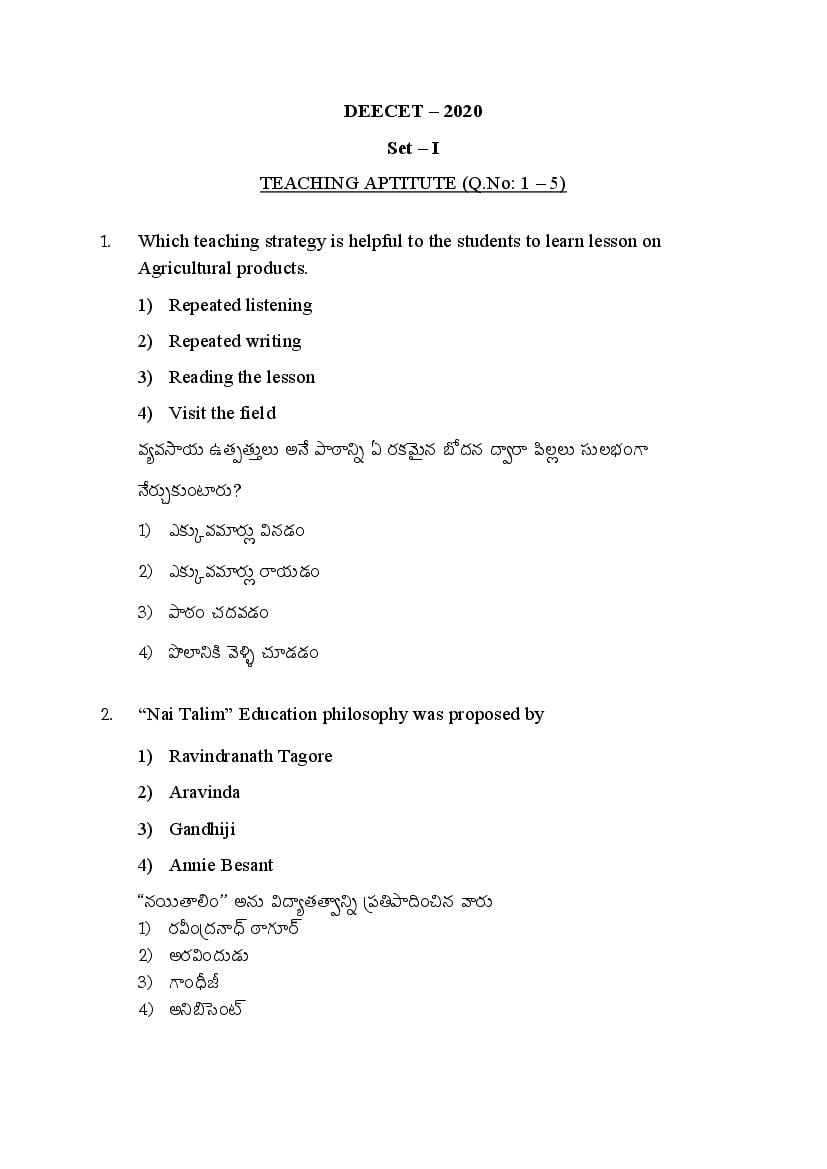
Page 1
Set – I
TEACHING APTITUTE (Q.No: 1 – 5)
1. Which teaching strategy is helpful to the students to learn lesson on
Agricultural products.
1) Repeated listening
2) Repeated writing
3) Reading the lesson
4) Visit the field
e«ekÍjáT ÔáÎÔáTï\T nHû bÍsÄ @ sÁ¿£yîT®q uË<q <Çs |¾\¢\T dT\uó+>±
HûsTÁ ÌÅ£+{²sÁT?
1) mÅ£ØeeÖsÁT¢ $q&+
2) mÅ£ØeeÖsÁT¢ sjáT&+
3) bÍsÄÁ+ #á<e&+
4) bõý²¿ì yî[ß #áÖ&&+
2. “Nai Talim” Education philosophy was proposed by
1) Ravindranath Tagore
2) Aravinda
3) Gandhiji
4) Annie Besant
»»qsTTÔ*+µµ nqT $<«ÔáÔÇ ç|ÜbÍ~+ºq ysÁT
1) sÁM+ç<H<ó sÄ>·ÖsY
2) nsÁ$+<T&T
3) >±+BóJ
4) n_d+{Ù
Page 2
1) Arrange a person to bring him school regularly
2) Complaint to his parents
3) Throw him out from school
4) Identify the reason and provide proper counseling.
bÍsÄXÁ æ\\Å£ Ôás#Á Tá >± uÉà+{Ù njûT« $<«] ¿Ãd+ #ûjTá <Ðq~
1) ç|ÜsÃE bÍsÄXÁ æ\Å£ rdTÅ£e#ûÌ y] @sγT #ûjTá &+
2) Ôá*<¢ + ç&T\Å£ |s¾ «<T#ûjTá &+
3) bÍsÄXÁ æ\ qT+& |+|¾yj
û Tá &+
4) ¿±sÁD² >·T]ï+º $<«]¿ì ¿à*+>´ #ûjTá &+
4. Student’s particulars are entered in this register
1) Admission register
2) Censes register
3) Parent meeting register
4) Stock register.
bÍsÄXÁ æ\ýË ç|yXû +ø bõ+~q|Ú&T $<«] $es\T BýË qyîÖ<T #ûkÍïsTÁ .
1) n&wH ]w¼sÁT
2) dHîàdt ]w¼sÁT
3) Ôá*¢<+ç&T\ deÖyûXø ]w¼sÁT
4) kͼţ ]w¼sÁT
Page 3
1) 0 – 3 years
2) 3 – 5 years
3) 6 – 8 years
4) 6 – 14 years
|PsÁÇ çbÍ<¸$ T¿£ $<« ejáTdT y]¿ì <û¥Ý +|&q~.
1) 0 ` 3 d+öö
2) 3 ` 5 d+öö
3) 6 ` 8 d+öö
4) 6 ` 14 d+öö
Page 4
6. Largest brackish water lagoon in Asia
1) Chilika lake
2) Loktak lake
3) Kolleru lake
4) Pulicat lake
d¾jáÖýË nÜ|<Ý |ðú{ì dsdÁ T à
1) º\¿£ dsÁdT à
2) ýË¿ù³¿ù dsÁdT à
3) ¿= ýñs¢ TÁ dsdÁ T à
4) |Ú*¿±{Ù dsdÁ T à
7. DISA act – 2019 refers to
1) Domestic violence
2) Sexual offence against women
3) Child rights
4) Medical services
~Xø #á³+¼ ` 2019 B¿ì <û¥Ý +|&q~.
1) >·V² V¾²+d
2) eTV¾²Þø|Õ Ô«#s\T
3) u²\\ V²Å£Ø\T
4) yî<Õ « de\T
Page 5
1) 5th September
2) 5th August
3) 5th June
4) 5th October
»ç||+ #á bÍ<ó«jáT ~HÃÔáàe+µ ÈsÁT|ÚÅ£Hû sÃE
1) d|¼+sÁT ` 5
2) >·w§¼ ` 5
3) pH ` 5
4) n¿Ã¼sÁT ` 5
9. The singer who won Bharataratna award for the year 2019 was
1) Bhupen Hazarika
2) Mrinal Sen
3) Hari Prasad chowrasia
4) Priyadas
2019 d+eÔáàs¿ì >±qT uó²sÁÔásÁÔá nysÁT¦ bõ+~q >±jáTÅ£&T
1) uóÖ|H V²C²]¿±
2) eTD²ýÙ dH
3) V²] ç|kÍ< #ûsd¾jáÖ
4) ç|¾jáÖ<dt
Page 6
1) Aarogya sethu
2) Raithu bandu
3) Spandana
4) Bhoodar
ç|C²deTd«\ |]cÍØsÁ yû~¿£>± |jÖî Ð+|&TÔáTq jáÖ|t
1) sÃ>·«dÔáT
2) s Ô
Õ Tá +<T
3) dÎ+<q
4) uóÖ<sY
Page 7
11. Raghu is a fatalist. He believes in …………..
Choose the word / phrase to complete the sentence.
1) history.
2) wealth
3) fate
4) God
12. After she ………………………………. her teeth, she took her breakfast.
Choose the correct form of verb to complete the sentence.
1) will brush
2) had brushed
3) would brush
4) brushes
13. Choose the compound sentence from the following.
1) We like songs but they like games.
2) We like songs which are melodious.
3) We like songs if they are composed by Rehaman.
4) We like songs at the time of our breakfast.
Page 8
1) courage
2) courageous
3) courageously
4) encourage
15. Rip Van Winkle helped the short man.
Choose the passive voice of the sentence above.
1) The short man helped Rip Van Winkle.
2) The short man has helped by Rip Van Winkle
3) The short man was helped Rip Van Winkle
4) The short man was helped by Rip Van Winkle.
Page 9
16. ¿ì+~ y{ìýË »»¿£µµ esZ¿s£ +Á
1) eT
2) sÁ
3) È
4) >·
17. »»|¾\¢\T nsÁTdTïHsÁTµµ y¿±«¿ì e«Ü¹s¿£ nsÁ+ e#ûÌ y¿£«+
1) |¾\\¢ T nsÁesÁT
2) |¾\\¢ T nsÁe&+ ýñ<T
3) |¾\\¢ T nsÁTkÍïsTÁ
4) |¾\\¢ T nsÁeýñ<T
18. ¿ì+~ y{ìýË »»q|Ú+d¿*£ +>·+µµ
1) seTT&T
2) \¿¡ë
3) e¿£e TT
4) kÍ$çÜ
Page 10
1) yîÞ²¢sTÁ
2) bõ+<sÁT
3) bÍ&sÁT
4) #ûXæsÁT
20. ¿ì+~ y{ìýË »»eTVäçbÍD²¿£sÁ+µµ Ôà @sÁÎ&q |<+
1) >·sÞÁ +ø
2) ÈeTTq
3) nsÁ¿£
4) |TqeTT
Page 11
21. »»<ûXøuó¿ìïµµ - |<¿ì dÂsÕq $ç>·V² y¿£«+
1) <ûXeø TT e\q uó¿ïì
2) <ûXeø TT q+<T uó¿ ïì
3) <ûXeø TT #ûÔá uó¿ ïì
4) <ûX+ø ýË|\ uó¿ ïì
22. »»|ÚsD |+& dÖsÁ« ç|¿±Xø B¿ìÔ
Tá \Tµµ ¿£$ jîTT¿£Ø ¿£\+ |sÁT
1) ¿£sTÁ D l
2) <jTá l
3) w l
4) nsÁTD l
23. »»¿£³¿£³! <ósD
Á ¡ ¿£{Ô
ì ³
á |³µµ - y¿£«+ýË Xøu²Ý\+¿±sÁ+
1) ý²{²qTçbÍd
2) #ó¿û ±qTçbÍd
3) jáTeT¿£eTT
4) eÔá«ï qT çbÍd
24. »»dÇ#áÌÛ, >·sÁT&jáÖq+µµ |Úd￱\qT sÁº+ºq~
1) |Î\ \¿£ DseÚ
2) &T¦ ¿£weTÖ]ï
3) |¾\¿± >·D|ÜXæd¾ï
4) <d] neT¹s+ç<
Page 12
1) H#û #á<e&q HûÔ J$Ôá #á]çÔá
2) HûqT #á~$q HûÔ J$Ôá #á]çÔá
3) H#û HûÔ J$Ôá #á]çÔá #á<e&ýñ<T
4) HûqT, HûÔ J$Ôá #á]çÔáqT #á~yeTT
26. »»\µµ - |<¿ì nsÁ+
1) >·TV²
2) uóÖ$T
3) HÃsÁT
4) $<ó+
27. »»¿±Þ²ß yûÞ²ß |&Tµµ - C²rjáÖ¿ì nsÁ+
1) mesÁÖ |{+¼ì #áT¿Ã¿£ bþe&+
2) u²>± nuó²«d+ >·\
3) çÜeTý²&T
4) <T:Ï+#áT
28. »»|<¸+µµ - |s«jáT|<\T
1) eÖ³, |\TÅ£
2) uójáT|&T, È+Å£
3) Ò+~, eÖsÁZ+
4) <], eÖsÁZ+
Page 13
1) ç|ÔáT« G ÔáïsÁ+
2) ç|Ôû«¿£ G ÔáïsÁ+
3) ç|Ü G ÔáïsÁ+
4) ç|Ü G ÔáïsÁTÇ
30. »»Xø+uóT <dT&T, ç|u+<ó| s yÁ Tû XøÇsÁT&Tµµ nHû$ ¿£$ _sÁT<T\T
1) miÀq
2) qqjáT
3) Ü¿£Øq
4) kþeTq
Page 14
31. Value of (1 + 2 + 3 )
1) 2
2) 6
3)
4) -
(1 + 2 + 3 ) $\Te
1) 2
2) 6
3)
4) -
32. If x+y = 10 and xy = 20 then the value of x3 + y3 is
1) 400
2) 600
3) 1000
4) 1600
x+y = 10 eT]jáTT xy = 20 nsTTq x3 + y3 $\Te
1) 400
2) 600
3) 1000
4) 1600
Page 15
1) -2
2) -6
3) 2
4) 6
x = -1 e<Ý VQ|~ 5x-4x2+3 $\Te
1) `2
2) -6
3) 2
4) 6
34. The are a of a circle, if its circumference is 88cm is (in sqcm)
1) 154
2) 176
3) 576
4) 616
eÔá|ï ] ~ó 88 d+.MT. nsTTq|Ú&T < yîXÕ æ\«eTT (ºööd+.$T)
1) 154
2) 176
3) 576
4) 616
Page 16
1) 20º
2) 40º
3) 70º
4) 140º
Âs+&T d+|PsÁ¿£ ¿ÃD²\ wÎÜï 2:7 nsTTq n+<* º ¿ÃD+
1) 20º
2) 40º
3) 70º
4) 140º
36. If the mean of the observations x, x+3, x+5, x+7, x+10 is 9 then the mean
of last three observations is
1) 10
2) 10
3) 11
4) 11
x, x+3, x+5, x+7, x+10 |]o\q\ n+¿£eT<«eTeTT 9 nsTTq ºe]
eTÖ&T |]o\q\ n+¿£eT<ó« eTeTT
1) 10
2) 10
3) 11
4) 11
Page 17
taken in order is
1) rhombus
2) rectangle
3) square
4) any parallelogram
s+dt jîTT¿£Ø uóT C²\ eT<ó« _+<óT eÚ\qT ç¿£eT+ýË ¿£\T|>± @sÁÎ&û |³+
1) s+dt (deT#áÔTá sÁTÒÛÈ+)
2) BsÁé #áÔáTsÁçd+
3) #áÔáTsÁçd+
4) @<îÕH deÖ+ÔásÁ #áÔáTsÁTÒÛÈ+
38. The Price of an article rises 20% and then falls 20% then the net rise of
fall present in the price of an article is
1) 4%
2) 6.25%
3) 20%
4) no change
ÿ¿£ edTeï Ú yî\ eTT+<T 20% |]Ð ÔásÇÔá 20% ÔáÐqZ edTeï Ú yî\ýË |sÁT>·T<\ ýñ
ÔásTÁ >·T<\ XæÔá+ýË
1) 4%
2) 6.25%
3) 20%
4) @ eÖsÁTÎýñ<T
Page 18
1)
2) 1
3) 2
4) 3
sinA + sin2A= 1 nsTTq cos2A + cos4A $\Te
1)
2) 1
3) 2
4) 3
40. Which term of the A.P. 21, 42, 63, 84, ..... is 210
1) 9th
2) 10th
3) 11th
4) 12th
21, 42, 63, 84, .... nHû n+¿£çXâDìýË 210
1) 9th
2) 10th
3) 11th
4) 12th
Page 19
41. Fragrant material is
1) carrot
2) cabbage
3) pepper
4) peanuts
~ dT>·+<ó |<sÁ+
1) ¿±sÁ{Ù
2) ¿±uñ
3) $T]jáÖ\T
4) sÄD¡\T
42. In bulb the part which gives us light
1) metal base
2) glass chamber
3) filament
4) terminals
\TÒýË yî*>¹ uó²>·+
1) yîT³ýÙ uñdt
2) >±¢dt #ó+sY
3) |¾\yîT+{Ù
4) ³]qýÙà
Page 20
1) carbon dioxide
2) water
3) sunlight
4) above all
¿ìsÁDÈq«d+jîÖ>·ç¿ìjáTýË bÍý¤ZHû eTT&|<s\T
1) ¿±sÁÒH &îÕjáÖ¿Õà&
2) úsÁT
3) ¿±+Ü
4) |Õeú
44. Lemon contains this acid
1) Acetic acid
2) Citric acid
3) Oleic acid
4) Oxalic acid
eT|+&T ¿£*ÐjáTTq eT¢+
1) nd¾{ì¿ù eT¢+
2) d¾ç{ì¿ù eT¢+
3) z*¿ù eT¢+
4) ¿±à*¿ù eT¢+
Page 21
1) small pox
2) swine flu
3) typhoid
4) pellagra
n+³T y«~ó ¿±~
1) eTXøSº
2) dÕÇH |P¢
3) fÉ®bÍsTT&
4) |ý²¢ç>±
46. This vitamin is essential for the health of eye
1) Vitamin-A
2) Vitamin-B
3) Vitamin-C
4) Vitamin-D
¿£+{ì sÃ>·«eTTqÅ£ nedsyÁ Tî q® $³$TH
1) $³$TH - A
2) $³$TH - B
3) $³$TH - C
4) $³$TH - D
Page 22
1) nucleus
2) mitochondria
3) ribosomes
4) cell wall
¿£D²\ýË Xø¿ïì \Te +&û ç|<Xû +ø
1) ¿¹ +ç<¿+£
2) yîT®{Ë¿±+ç&jáÖ
3) ÂsÕuËkþyT\T
4) ¿£D¿£e#á+
48. These are lives in aquatic habitat
1) Leech, hydrilla
2) may fly and dragon fly
3) fish and crabs
4) above all
$ Èý²ykÍ\ýË ed¾kÍïsTT
1) È\>· eT]jáTT VÕ²ç&ý²¢
2) yûT |í¢ eT]jáTT ç&>·H |í¢
3) #û| eT]jáTT qÔáï
4) |Õeú
Page 23
1) m2
2) m
3) mm2
4) cm2
#á<s |Á Ú d+{¡MT³sYÅ£ d+¿¹ Ôá+
1) m2
2) m
3) mm2
4) cm2
50. The respiratory organs in Fish are
1) lungs
2) spiracles
3) lenticles
4) gills
u¤~Ý+¿£ýË XæÇd nejáTy\T
1) }|¾]ÜÔáTï\T
2) dÕÎsÁ¿ýì àÙ
3) ýÉ+{ìdýÙà
4) yîTT|Î\T
Page 24
51. Bison hills are spread along the river bank of
1) Ganga
2) Godavari
3) Indus
4) Kaveri
uÉdÕ H ¿= +&\T qB rsÁ+ýË y«|¾+º HsTT
1) >·+>·
2) >Ã<e]
3) d¾+<óT
4) ¿±yû]
52. The powerful kingdom among Mahajanapadas
1) Vajji
2) Kosala
3) Magadha
4) Asmaka
eTVäÈq|<\ýË Xø¿ìïe+ÔáyîT®q sÈ«+
1) e¨
2) ¿Ãd\
3) eT>·<ó
4) d¿£
Page 25
water are called
1) pervious rocks
2) impervious rocks
3) aquifer
4) sedimentary rocks
|>T· Þøß, dq sÁ+ç<ó\T +& ú{ìÔà ţL& qsÜ bõsÁqT ý² n+{²sÁT.
1) eT<TyîÕq sÜbõsÁ
2) ¿£]ÄqyîT®q sÜbõsÁ
3) È\dsÁ+
4) ne¹¿| ¥\\T
54. ‘shalabhoga’- is a category of land used for the purpose of
1) land gifted to temples
2) land for the maintenance of a school
3) land donated to Jaina institutions
4) land gifted to Brahmins
»Xæ\uóË>·µ nHû sÁ¿±¿ì #î+~q uóÖ $T B $TÔá+ï |jÖî Ð+#á&û~
1) <ûy\jáÖ\Å£ ºÌq uóÖ$T
2) bÍsÄÁXæ\\T sÁÇV²DÅ£ ºÌq uóÖ$T
3) CÉÕq <ûy\jáÖ\Å£ VQ¿£]+ºq uóÖ$T
4) çu²V²DT\Å£ ºÌq uóÖ $T
Page 26
1) Sumerians
2) Romans
3) Indians
4) Chinese
|Î{ì¿¡ n+<Tu²³TýË q nÜ |ÚsÔáq |{²\qT eT{ì¼ |\¿£\|Õ ÔájTá sÁT#ûdq¾ ysÁT
1) dTyûT]jáTqT¢
2) sÃeTqT¢
3) uó²sÁrjáTT\T
4) #îúÕ jáTT\T
56. Bhoodan means donating land to the landless. Who started this
movement?
1) Rabindranath Tagore
2) Vinoba Bhave
3) Raja Ramamohan Roy
4) Dayananda Saraswathi
uóÖ <H nq>± uóÖ $Týñ |<\Å£ uóÖ $T <q+ #ûjTá &+. <«eÖ mesÁT
çbÍsÁ+_ó+#sÁT?
1) sÁM+ç<H<¸ sÄ>·ÖsY
2) $HÃu²uó²yû
3) sC² seTyîÖV²H sjYT
4) <jÖá q+< dsdÁ Ç Ü
Page 27
1) hot and dry winds
2) cool local winds
3) cold dry winds
4) cold polar winds
»\Öµ |eH\T
1) yî#Ìá {ì eT]jáTT bõ& >±\T\T
2) kÍ¿£ oÔá\ |eH\T
3) #á\{
¢ ì bõ& >±\T\T
4) oÔá\ <ó e |eH\T
58. ‘Liberty, equality and fraternity’ are the slogans related to
1) American revolution
2) England revolution
3) French revolution
4) Russian revolution
»dÇ#áÌ,Û deÖqÔáÇ+, kåçuó²ÔáÔáÇ+µ nHû H<+ B¿ì d++~ó+ºq~
1) nyîT]¿± $|e¢ +
2) +>±¢+& $|¢e+
3) ç|+#Y $|e¢ +
4) sÁcÍ« $|e¢ +
Page 28
1) proximity to the markets
2) availability of skilled and unskilled labour.
3) pollution free environment
4) availability of other factors of production
VQÞ²sÁÆ kÍ<ó¿£ d+d\ T | ç|<Xû æ m+#áT¿Ãe&¿ì B |]>·DqýË¿ì rdT¿ÃeÚ
1) eÖÂsس¢¿ì n+<Tu²³TýË +&&+
2) HîÕ|ÚD«+ ¿£\ eT]jáTT HîÕ|ÚD«+ ýñ ¿±]Å£\ \uó«Ôá
3) ¿±\Tw« sÁV¾²Ôá yÔesÁD+
4) ÔásÁ ÔáÎÜ￱sÁ¿±\ \uó« Ôá
60. The curtain raiser of economic liberalization policy is
1) Rajiv Gandhi
2) PV Narasimha Rao
3) IK Gujral
4) VP Singh
]¿£ dsÁ°¿£Ôá $<óH¿ì ÔîsÁ ýñ|¾qysÁT
1) sJy >±+Bó
2) |¾.$. qsÁd+¾ VäseÚ
3) ×.¹¿. >·TçC²ýÙ
4) $.|¾. d¾+>´
Page 29
PART- B
BOTANY (Q. No. 61-80)
61. All prokaryotic organisms are grouped under
1) Monera
2) Protesta
3) Plantae
4) Animalia
n ¹¿+ç<¿£|PsÁÇ JeÚ\qT ¿£*|¾ q sÈ«+
1) yîTTús
2) çbõ{ìkͼ
3) yîTT¿£Ø\T
4) È+ÔáTeÚ\T
62. Identify the correct sequence of taxonomical categories
1) speices, order, division, kingdom
2) Genus, species, order, kingdom
3) species, genus, order, kingdom
4) kingdom, genus, species, order
e¯Z¿£sÁD kÍsTT\ dÂsÕq ç¿£eÖ >·T]ï+#á+&
1) C²Ü, ç¿£eT+, $uó²>·+, sÈ«+
2) ç|C²Ü, C²Ü, ç¿£eT+, sÈ«+
3) C²Ü, ç|C²Ü, ç¿£eT+, sÈ«+
4) sÈ«+, ç|C²Ü, C²Ü, ç¿£eT+
Page 30
1) Vacuoles
2) Lysosomes
3) Golgi apparatus
4) Ribosomes
¿£DeTT dÇjáT+ $ºÌÛÜ¿ï ì ¿±sÁDeT>·T ¿£D²+>·eTT
1) ]¿ìï¿£\T
2) ýÉÕkþkþeTT\T
3) >±*¨ |]¿£seÁ TT
4) ÂsÕuËkþeTT\T
64. The stored food material of Phaeophyceae members is
1) fats
2) floridean starch
3) Mannitol & Laminarin
4) Cellulose
|j
¾ Öî |dÕ Ó C²ÔáT\ýË \Te VäsÁ |<sÁeÆ TT
1) ç¿= eÚÇ\T
2) bþ¢¯&jáTH kͼsYÌ
3) eÖ³ýÙ Ê ý²$TH]H
4) d\T«ýËCÙ
Page 31
1) Chilli
2) Ashwagandha
3) Belladona
4) Tobacco
¿Ã{ìH nHû \Øý²sTT&qT ¿£*Ð q yîTT¿£Ø
1) $TsÁ|
2) nXøÇ>·+<¸
3) uÉ\¢&ÃH
4) bõ>±Å£
66. Persistent pappus type of calyx is seen in the fruit of
1) Cypsela
2) Nut
3) Caryopsis
4) Legume
BsÁ鿱*¿£yTî q® ¿¹ Xø>T· #áÌ+ ý²+{ì sÁ¿£¿£ |çÔe[ ¿£*Ð q |\ eTT
1) d¾|àý²
2) |+Å£ >·\ |\ eTT
3) ¿£e#á;È¿£eTT
4) ~Ç$<sÁ¿£ |\ eTT
Page 32
1) saccharides
2) nucleucides
3) nucleosomes
4) nucleotides
¿¹ +ç<¿±eT¢eTTýË sD ç|eÖD+
1) XæKÂsÕ&\T
2) qÖ«¿ì¢jîÖdÕ&\T
3) qÖ«¿ì¢jîÖkþyT\T
4) qÖ«¿ì¢jîÖfÉ®&\T
68. Pollinating agent in grasses
1) insects
2) wind
3) water
4) birds
>·&y¦ Tî T¿£Ø\ýË |s>·d+ |sØ¿ì ÔÃ&Î&û dV² ¿±sÁT\T
1) ¿¡³¿±\T
2) >±*
3) úsÁT
4) |Å£ \T
Page 33
1) haploid
2) diploid
3) triploid
4) tetraploid
çbÍ<¸$ T¿£ n+Å£sÁ#Ìá <Û ¿¹ +ç<¿£eTT jîTT¿£Ø d¾Ü
1) @¿£dÜ ¾
2) <ÇjáTd¾Ü
3) çÔájáTd¾Ü
4) #áÔTá : d¾Ü
70. In monocot stem vascular bundles are
1) large number arranged in a single ring
2) large number irregular scattered
3) limited number arranged in a single ring
4) Specific number irregularly scattered
@¿£<Þ ø;È¿±+&eTTýË H[¿±|Ú+C²\T
1) nHû¿£ d+K«ýË ÿ¿£ e\jáTeTT>± neT] +&TqT
2) nHû¿£ d+K«ýË #îý²¢ #î<T sÁT>± neT] +&TqT
3) ÔáÅ£ Øe d+K«ýË ÿ¿£ e\jáTeTTý²>± neT] +&TqT
4) ]Ýw¼ d+K«ýË #îý²¢ #î<T sÁT>± neT] +&TqT
Page 34
1) oxalo acetic acid
2) Pyruvic acid
3) Malic acid
4) Phosphoenol pyruvate
C4 yîTT¿£Ø\ýË CO2 çbÍ<¸$T¿£ dÓÇ¿£sÁï
1) ¿±àýË nd¾{ì¿ù eT¢eTT
2) |ÕsTÁ $¿ù eT¢eTT
3) eÖ*¿ù eT¢eTT
4) bÍkþÎÛ HýÙ |ÕsTÁ yû{Ù
72. The possibility of formation of gametes from a tall pea plant having ‘Tt’ as its
genotype are
1) ‘T’ type = 3/4, ‘t’ type = 1/4
2) ‘T’ type = 1/2, ‘t’ type = 1/2
3) all are of ‘T’ type
4) all are of ‘t’ type
‘Tt’ÈqT«sÁÖ|eTT>± ¿£\ ÿ¿£ bõ&eÚ sÄD¡ yîTT¿£Ø qT+& @sÁÎ&û ne¿±XøeTT q
d+jîÖ>·;C²\T
1) ‘T’ sÁ¿e£ TT = 3/4, ‘t’ sÁ¿e£ TT = 1/4
2) ‘T’ sÁ¿e£ TT = 1/2, ‘t’ sÁ¿e£ TT = 1/2
3) njáTT ‘T’ sÁ¿±¿ì #î+~q$
4) njáTT ‘t’ sÁ¿±¿ì #î+~q$
Page 35
1) DNA fingerprinting
2) PCR
3) Gel electrophoresis
4) Annealing
DNA K+&\qT yûsTÁ #ûjTá {²¿ì |jÖ
î Ð+#áT |<Ü
Æ
1) DNA yû*eTTç<
2) PCR
3) CÉýÙ m\¿Ã¼bþ s d¾dt
4) eT+< XæÔá©¿£sD Á eTT
74. These are used to kill the dicotyledonous weeds
1) Ethylene
2) Cytokinins
3) Auxins
4) Gibberellins
~Ç<Þ;ø È ¿£\T|Ú yîTT¿£Ø\qT HXøqeTT #ûjTá {²¿ì M{ì $]$>± y&ÔsÁT
1) m~¸©H
2) dÕ{ËÂ¿Õ H\T
3) ¿ìàH\T
4) ÒÂs*¢H\T
Page 36
1) hypertonic solution
2) hypotonic solution
3) isotonic solution
4) pure water
¿£D² @ ç<eDeTTýË +ºq|ð&T ¿£Dç<e« d+¿Ã#áeTT ÈsÁT>·TqT
1) n~ó¿£ >±&ó ç<eDeTT
2) n\Î>±&ó ç<eDeTT
3) deT>±&ó ç<eDeTT
4) dÇ#áÌÛyîT®q úsÁT
76. Sonalika and kalyan sona are hybrid varieties of
1) Wheat
2) Rice
3) Sugarcane
4) Maize
kõH*¿£, ¿£Þ²«DY kþH, nqTq$ @ yîTT¿£Ø\ d+¿£sÁ sÁ¿±\T ?
1) >Ã<óT eT
2) e]
3) #îsTÁ Å£
4) yîTT¿£ØC¤q
Page 37
1) UAA
2) AUG
3) UAG
4) UGA
ÈqT« d+¿¹ ÔáeTTýË çbÍsÁ+uóç Ü¿£eTT
1) UAA
2) AUG
3) UAG
4) UGA
78. Using biological agents, in order to spread fear and causing death upon large
population in the society is called
1) Bioterrorism
2) Bioremediation
3) Biofortification
4) Biopiracy
Je dV²¿±sÁT\qT $jîÖÐdÖï, deÖÈ+ýË uójáÖ ¿£\T>·CñdÖï, Ôá<Çs mÅ£Øe
ÈHuó #ábþjûTý² #ûjTá T³qT
1) jîÖfÉçsÁ]ÈyT
2) jîÖÂs$T&ûwH
3) jîÖbþ]¼|¾¹¿wH
4) jîÖ|ÕsÁdÓ
Page 38
1) product molecules
2) substrate molecules
3) enzyme molecules
4) enzyme – substrate complex
bþ{¡|&û sÃ<ó¿±\T <û¿ì sD²Ôá¿£eTT>± <>·ZsÁ bþ*¿£\qT ¿£*Ð +{²sTT?
1) ÔÎ~Ôá|Ú nDTeÚ\T
2) n<ód |<sÁÆ|Ú nDTeÚ\T
3) m+CÉyÕ T nDTeÚ\T
4) m+CÉyÕ T - n<d|Æ <sÁÆ d+¿ìw¢ e¼ TT
80. Which microbes have genome, that is surrounded by protein coat?
1) Virus
2) Bacteria
3) Protozoans
4) Fungi
ÈqT« |<sÁ+Æ #áT³Ö¼ çbþ{¡H Ô= &T>·T +&û dÖ¿£ JeÚ\T
1) yîsÕ Ád\t T
2) u²«¿¡¼]jáÖ\T
3) çbþ{ËCËeH\T
4) ¥©+ç<\T
Page 39
PART- B
ZOOLOGY (Q. No. 81-100)
81. The study of functioning of various organs in human body is
1) External Morphology
2) Anatomy
3) Physiology
4) Genetics
eÖqe Xø¯sÁ+ýË $$<ó nejáTy\T |#ûd $<óH >·T]+º n<ó« jáTq+ #ûd Xædeï TT
1) u²V²«dÇsÁÖ| XædïeTT
2) n+Ôá]sD XædïeTT
3) Xø¯sÁ<ósÁ XædïeTT
4) ÈqT«XædïeTT
82. The life span of RBC in humans is
1) 30 Days
2) 60 Days
3) 100 Days
4) 120 Days
eÖqeÚ\ýË mçsÁ sÁ¿ï£ ¿£DeTT\ J$Ôá ¿±\eTT
1) 30 sÃE\T
2) 60 sÃE\T
3) 100 sÃE\T
4) 120 sÃE\T
Page 40
1) Reticular
2) Glandural
3) Muscle
4) Adipose
ç¿= eÚÇqT \ÇjáTT+#áT ¿£DC²\eTT
1) C²\¿£
2) ç>·+~ó
3) ¿£+&sÁ
4) m&bþCÙ
84. The excretory structures in Earthworm are
1) Kidneys
2) Nephredia
3) Green glands
4) Flame cells
yqbÍeTTýË $ds¿Á̈ £ nejáTeTT\T
1) eTÖçÔá|+¾ &\T
2) e¿±Ø\T
3) V²]Ôáç>·+<óT \T
4) C²Çý² ¿£D²\T
Page 41
1) Echinodermata
2) Pisces
3) Mollusca
4) Annelida
q¿£ç Ôá|Ú #û| esZ¿ì #î+~q~
1) <î̧HÕ Ã&¹s³
2) #û|\T
3) eT\dØ
4) nHî*&
86. The animal that can respire through skin is
1) Fish
2) Frog
3) Snake
4) Crocodile
#ásÁ eTT <Çs XæÇd¾+#á >·\ J$
1) #û|
2) ¿£|Î
3) bÍeTT
4) yîTTd*
Page 42
1) Longitudinal binary fission
2) Horizontal binary fission
3) Anisogamy
4) Amphimixis
jáTÖТHýË ç|ÔTá «ÔáÎÜï ÈsÁT>·T $<óqeTT
1) jáTÔá~Ç<ó $ºÌÛÜï
2) n&T¦~Ç<ó $ºÌÛÜï
3) mHîÕkþ>·$T
4) m+|$¾ T¿ìàdt
88. The type of locomotion in amoeba is
1) Swimming
2) Gliding
3) Ciliary
4) Amoeboid
nMTu² #á*+#áT $<óqeTT
1) <T&T>·eTqeTT
2) Â>¢í&+>´
3) dÓ*jáT]
4) nMTu²sTT&
Page 43
1) Housefly
2) Culex mosquito
3) Anophelous mosquito
4) Man
bÍ¢kþ&jTá + J$Ôá#]á çÔáýË çbÍ<¸$ T¿£ nÜ<û̧sTT
1) >·
2) Å£L«ýÉ¿ùà <ÃeT
3) mH|\¾ dt <ÃeT
4) eÖqeÚ&T
90. The respiratory structures in cockroach are
1) Trachea
2) Gills
3) Skin
4) Lungs
u¤~Ý+¿£ýË XæÇd nejáTeTT\T @$
1) yjáTTHÞ²\T
2) yîTT|Î\T
3) #ásÁ eTT
4) }|¾]ÜÔáTï\T
Page 44
1) Dentine
2) Bone
3) Enamel
4) Cartilage
eÖqe Xø¯sÁ+ýË nÔá«+Ôá <ó&óyîT®q |<sÁeTT
1) &î+{ìH
2) meTT¿£
3) mH$TýÙ
4) eT<Tý²d¾
92. The Sex-linked gene in humans causes
1) Colour Blindness
2) Turner’s Syndrome
3) Colour of skin
4) Colour of eyes
eÖqeÚýË *+>· dV² \>· ÈqT«eÚ e\q ¿£\T>·T d¾Ü
1) es+<óÔ Çá eTT
2) ³sÁsYd+¾ ç&ÃyT
3) #ásÁ + sÁ+>·T
4) ¿£Þßø sÁ+>·T
Page 45
1) 10 pairs
2) 12 pairs
3) 14 pairs
4) 8 pairs
eÖqeÚ #óÜýË |sTÁ à¿£\ d+K«
1) 10 ÈÔá\T
2) 12 ÈÔá\T
3) 14 ÈÔá\T
4) 8 ÈÔá\T
94. The nerve band that connects right and left halves of cerebral hemisphere is
1) Carpus Callosm
2) Cerebral Cortex
3) Longitudinal fissures
4) Meninges
eTd¾cï ÍØsÁ>Æ ÃÞøeTT\ Å£&, m&eT uó²>·eTT\qT ¿£\T|Ú H&|{
¼¡
1) ¿±sÁÎdt¿Â ýË¢dy T
2) eTd¾wï Ø e\Ø\eTT
3) jáTÔá $<sÁ+
4) yîT+CÉdt
Page 46
1) Adrenal
2) Thymus
3) Pancreas
4) Pituitory
bþs³, |ý²jáTq VäsÃqTqT çd$+#áT ç>·+~¸
1) n~óe¿£Ø ç>·+~¸
2) u²\ç>·+~¸
3) ¿Ã¢eTeTT
4) |ÓjáTTwç>·+~¸
96. Identify the one that is not an extra embryonic membrane
1) Amnion
2) Umbilical Cord
3) Chorion
4) Yolksac
ç¿ì+~ yýË |¾+&u²V²«ÔáÇ#áeTT ¿±~
1) \ÒeTT
2) H_ósÁE¨eÚ
3) |sjáTTeÚ
4) kõqd+º
Page 47
1) Periodic abstinence
2) Male and female condoms
3) Intra uterine devices
4) Oral contraceptive pills
dV² È >·sÒÁ Û sÃ<ó¿ £ |<Ü
Æ >·T]ï+#á+&
1) esÁqï +>± d+|]Ø+#áÅ£ +&T³
2) dÓ,ï |ÚsÁTw§\T |jÖî Ð+#û Ô= &T>·T\T
3) >·sÒÛXøjáÖ+ÔásÁ kÍ<óH\T ( IUDS )
4) >·sÒÁ Û sÃ<ó¿ £ HÃ{ìeÖçÔá\T
98. The wing of an insect and wing of bird are
1) Homologous organs
2) Analogous organs
3) Vestigeal organs
4) Connecting links
¿¡³¿£eTT s ¿£Ø, |¿sÂì ¿£Ø\T
1) sDkÍeT« nejáTeeTT\T
2) ç¿ìjÖá kÍeT« nejáTeeTT\T
3) neXâcÍejáTeeTT\T
4) d+<óqdÔáTeÚ\T
Page 48
1) Fishes
2) Chicken
3) Honeybees
4) Sheep
yûÐýÙ qÔ« (}>·T&T qÔá«+) ç|<] ô+#û JeÚ\T
1) #û|\T
2) ¿ÃÞøß
3) ÔûHî{¡>·\T
4) >=iÉ\À T
100. Identify the method that is not used to diagnose disease
1) MRI
2) Vaccine
3) X-Ray
4) CAT
y«~ó sÆ]+#á&¿ì |jÖî Ð+#á |<Ü
Æ >·T]ï+#á+&
1) MRI
2) y«¿ìàH
3) X-Ray
4) CAT
Document Details
| Board / Org | APSCHE |
| Exam | Andhra Pradesh Diploma in Elementary Education Common Entrance Test |
| Type | Question Paper |
| Pages | 48 |
| Updated | 22 Jul 2026 |