ISC Class 12 Question Paper 2020 for History
Finished viewing? Save it for later —
Download ISC Class 12 Question Paper 2020 for History (PDF · 3 pages)About ISC Class 12 Question Paper 2020 for History
ISC Class 12 Question Paper 2020 for History is available here for free download. Published by CISCE for Class 12, this question paper can be viewed online or downloaded as a PDF (3 pages). Candidates preparing for Class 12 can use ISC Class 12 Question Paper 2020 for History to understand the exam pattern, the type of questions asked, and the overall difficulty level.
Frequently Asked Questions
How can I download ISC Class 12 Question Paper 2020 for History?
Open this page and click the Download button to save ISC Class 12 Question Paper 2020 for History as a PDF. It is completely free on AglaSem Docs.
Is ISC Class 12 Question Paper 2020 for History free to download?
Yes. ISC Class 12 Question Paper 2020 for History can be viewed online and downloaded as a PDF free of cost on AglaSem Docs.
How many pages does ISC Class 12 Question Paper 2020 for History have?
ISC Class 12 Question Paper 2020 for History contains 3 pages, which you can read online or download together as a single PDF.
Where can I find more Class 12 study material?
You can find more Class 12 question papers, sample papers, syllabus, and answer keys on AglaSem Docs.
ISC Class 12 Question Paper 2020 for History – Text
Read the full text of this question paper below — useful to quickly search, copy and reference the content online without downloading the PDF.
📄 View text version (3 pages)
Page 1
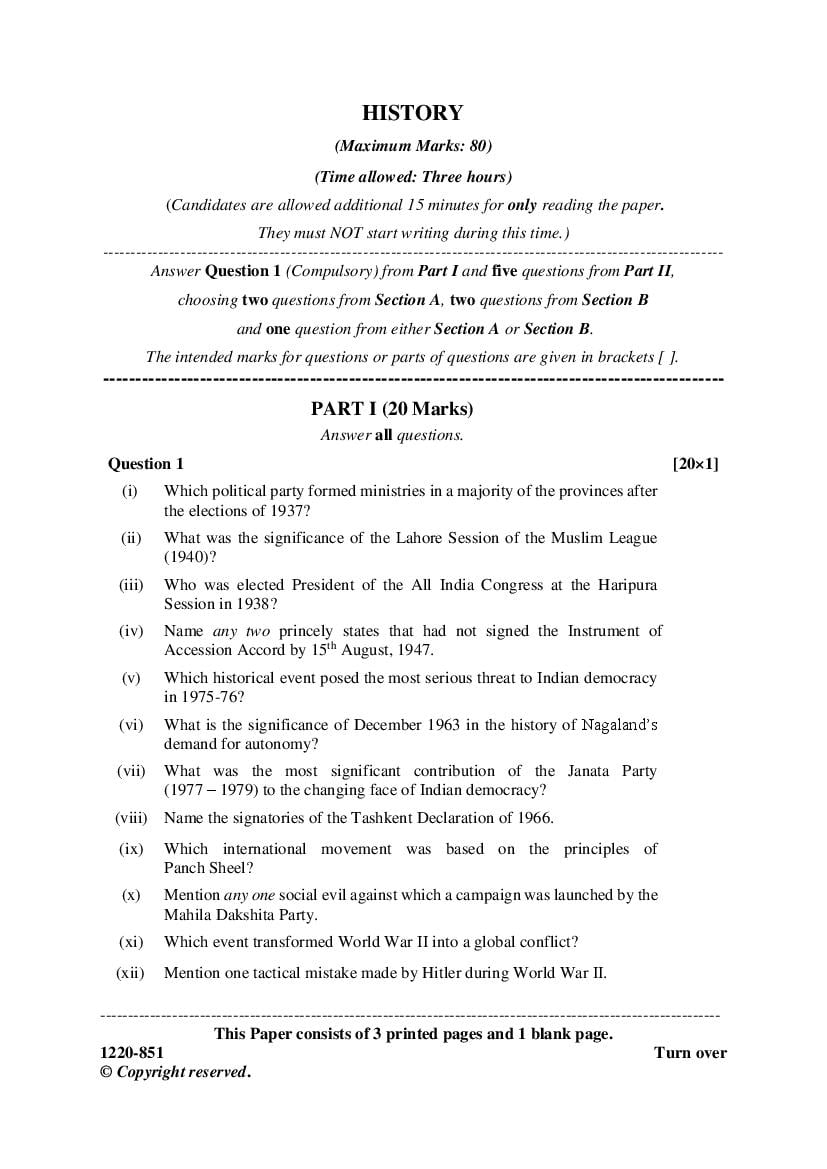
(Maximum Marks: 80)
(Time allowed: Three hours)
(Candidates are allowed additional 15 minutes for only reading the paper.
They must NOT start writing during this time.)
Answer Question 1 (Compulsory) from Part I and five questions from Part II,
choosing two questions from Section A, two questions from Section B
and one question from either Section A or Section B.
The intended marks for questions or parts of questions are given in brackets [ ].
------------------------------------------------------------------------------------------------
PART I (20 Marks)
Answer all questions.
Question 1 [20×1]
(i) Which political party formed ministries in a majority of the provinces after
the elections of 1937?
(ii) What was the significance of the Lahore Session of the Muslim League
(1940)?
(iii) Who was elected President of the All India Congress at the Haripura
Session in 1938?
(iv) Name any two princely states that had not signed the Instrument of
Accession Accord by 15th August, 1947.
(v) Which historical event posed the most serious threat to Indian democracy
in 1975-76?
(vi) What is the significance of December 1963 in the history of Nagaland’s
demand for autonomy?
(vii) What was the most significant contribution of the Janata Party
(1977 – 1979) to the changing face of Indian democracy?
(viii) Name the signatories of the Tashkent Declaration of 1966.
(ix) Which international movement was based on the principles of
Panch Sheel?
(x) Mention any one social evil against which a campaign was launched by the
Mahila Dakshita Party.
(xi) Which event transformed World War II into a global conflict?
(xii) Mention one tactical mistake made by Hitler during World War II.
This Paper consists of 3 printed pages and 1 blank page.
1220-851 Turn over
© Copyright reserved.
Page 2
(xiv) Name the first Prime Minister of independent Kenya.
(xv) Why was the Berlin wall erected?
(xvi) What is meant by the term détente?
(xvii) Name the policies introduced in the USSR by Gorbachev.
(xviii) Why is the Civil Rights Act of 1964 considered a landmark in US
legislation?
(xix) Name the book written by Betty Friedan that sparked off the second wave
of American Feminism in the 20th century.
(xx) Explain the meaning of the term Intifada.
PART II (60 Marks)
Answer five questions in all, choosing two questions from Section A, two questions from
Section B and one question from either Section A or Section B.
SECTION A
Question 2
(a) Give an account of the revival of the INA and its contribution to India’s struggle [6]
for freedom under the leadership of Subhash Chandra Bose.
(b) State the main provisions of the Indian Independence Act. [6]
Question 3
Discuss the linguistic reorganisation of states with reference to:
(a) Andhra [6]
(b) Bombay [6]
Question 4
With reference to India’s foreign policy, discuss the following:
(a) The Kashmir problem and the outbreak of the Indo-Pak war of 1948-49. [6]
(b) The consequences of the Indo-Pak war of 1971. [6]
Question 5
Review the achievements and failures of the Janata Government (1977 – 1979). [12]
2
Page 3
(a) What were the main features of the Towards Equality Report (1974)? [6]
(b) Briefly discuss the efforts made by various Women’s Movements in India to root [6]
out the social evils of dowry and domestic violence.
SECTION B
Question 7
(a) Discuss the significant changes in Mussolini’s foreign policy after 1935, till the [6]
outbreak of World War II.
(b) Why did Britain and France follow a policy of appeasement towards Germany [6]
and Italy?
Question 8
In the context of the civil war and the establishment of the People’s Republic in China,
answer the following questions:
(a) State the causes of the victory of the Communists in the civil war in China in [6]
1949.
(b) What important economic changes were introduced by Mao Tse Tung under the [6]
Great Leap Forward?
Question 9
The Cuban missile crisis led to an escalation of international tensions and pushed the [12]
world to brink of a nuclear war. Discuss.
Question 10
In the context of protest movements in the USA, discuss the following:
(a) The significant change in the attitude of the government towards racial [6]
discrimination in USA.
(b) The impact of the Presidential Commission on the Feminist Movement in USA [6]
(1960s – 1980s).
Question 11
(a) To what extent was Nasser responsible for the Suez War of 1956? [6]
(b) State the consequences of Suez War of 1956. [6]
3
Document Details
| Board / Org | CISCE |
| Exam | Class 12 |
| Type | Question Paper |
| Pages | 3 |
| Language | english |
| Updated | 22 Jul 2026 |