JNUEE 2021 Question Paper MA Sociology
Finished viewing? Save it for later —
Download JNUEE 2021 Question Paper MA Sociology (PDF · 20 pages)About JNUEE 2021 Question Paper MA Sociology
JNUEE 2021 Question Paper MA Sociology is available here for free download. Published by NTA for Jawaharlal Nehru University Entrance Examination, this question paper can be viewed online or downloaded as a PDF (20 pages). Candidates preparing for Jawaharlal Nehru University Entrance Examination can use JNUEE 2021 Question Paper MA Sociology to understand the exam pattern, the type of questions asked, and the overall difficulty level.
Frequently Asked Questions
How can I download JNUEE 2021 Question Paper MA Sociology?
Open this page and click the Download button to save JNUEE 2021 Question Paper MA Sociology as a PDF. It is completely free on AglaSem Docs.
Is JNUEE 2021 Question Paper MA Sociology free to download?
Yes. JNUEE 2021 Question Paper MA Sociology can be viewed online and downloaded as a PDF free of cost on AglaSem Docs.
How many pages does JNUEE 2021 Question Paper MA Sociology have?
JNUEE 2021 Question Paper MA Sociology contains 20 pages, which you can read online or download together as a single PDF.
Where can I find more Jawaharlal Nehru University Entrance Examination study material?
You can find more Jawaharlal Nehru University Entrance Examination question papers, sample papers, syllabus, and answer keys on AglaSem Docs.
JNUEE 2021 Question Paper MA Sociology – Text
Read the full text of this question paper below — useful to quickly search, copy and reference the content online without downloading the PDF.
📄 View text version (20 pages)
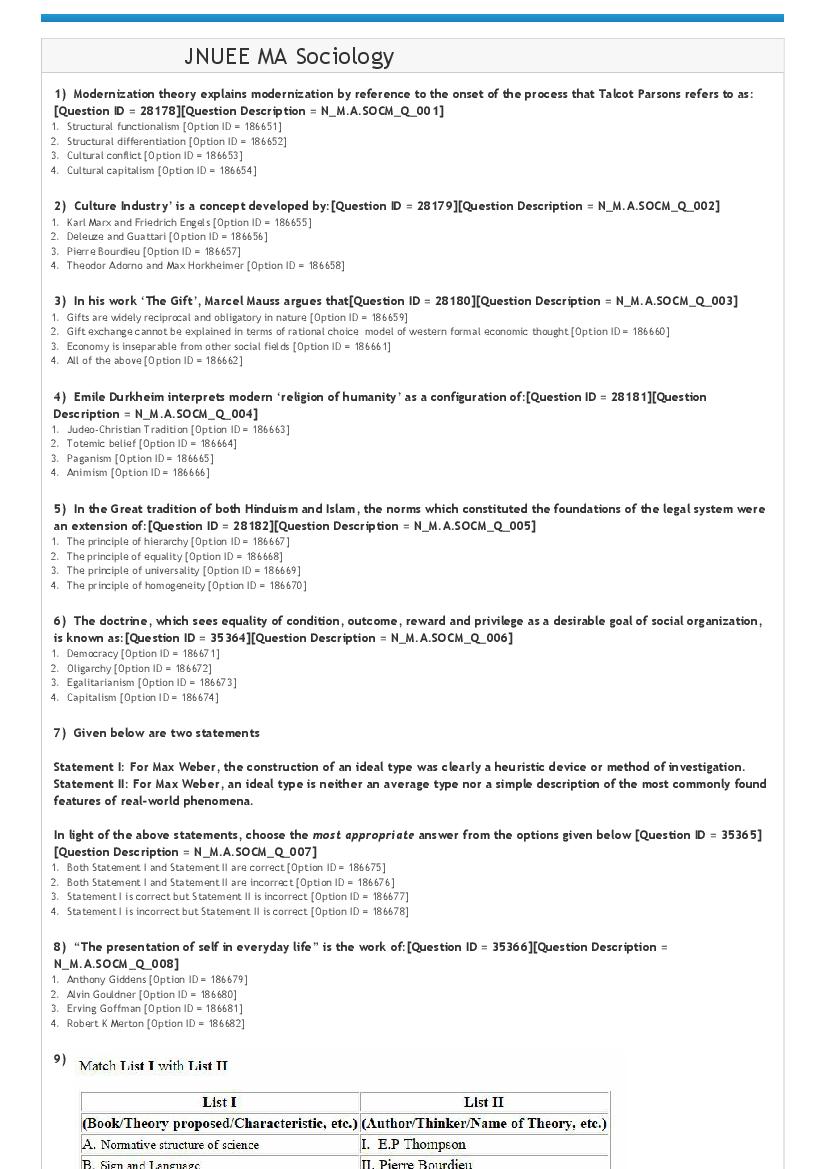
Page 1
1) Modernization theory explains modernization by reference to the onset of the process that Talcot Parsons refers to as:
[Question ID = 28178][Question Description = N_M.A.SOCM_Q_001]
1. Structural functionalism [Option ID = 186651]
2. Structural differentiation [Option ID = 186652]
3. Cultural conflict [Option ID = 186653]
4. Cultural capitalism [Option ID = 186654]
2) Culture Industry’ is a concept developed by:[Question ID = 28179][Question Description = N_M.A.SOCM_Q_002]
1. Karl Marx and Friedrich Engels [Option ID = 186655]
2. Deleuze and Guattari [Option ID = 186656]
3. Pierre Bourdieu [Option ID = 186657]
4. Theodor Adorno and Max Horkheimer [Option ID = 186658]
3) In his work ‘The Gift’, Marcel Mauss argues that[Question ID = 28180][Question Description = N_M.A.SOCM_Q_003]
1. Gifts are widely reciprocal and obligatory in nature [Option ID = 186659]
2. Gift exchange cannot be explained in terms of rational choice model of western formal economic thought [Option ID = 186660]
3. Economy is inseparable from other social fields [Option ID = 186661]
4. All of the above [Option ID = 186662]
4) Emile Durkheim interprets modern ‘religion of humanity’ as a configuration of:[Question ID = 28181][Question
Description = N_M.A.SOCM_Q_004]
1. Judeo‐Christian Tradition [Option ID = 186663]
2. Totemic belief [Option ID = 186664]
3. Paganism [Option ID = 186665]
4. Animism [Option ID = 186666]
5) In the Great tradition of both Hinduism and Islam, the norms which constituted the foundations of the legal system were
an extension of:[Question ID = 28182][Question Description = N_M.A.SOCM_Q_005]
1. The principle of hierarchy [Option ID = 186667]
2. The principle of equality [Option ID = 186668]
3. The principle of universality [Option ID = 186669]
4. The principle of homogeneity [Option ID = 186670]
6) The doctrine, which sees equality of condition, outcome, reward and privilege as a desirable goal of social organization,
is known as:[Question ID = 35364][Question Description = N_M.A.SOCM_Q_006]
1. Democracy [Option ID = 186671]
2. Oligarchy [Option ID = 186672]
3. Egalitarianism [Option ID = 186673]
4. Capitalism [Option ID = 186674]
7) Given below are two statements
Statement I: For Max Weber, the construction of an ideal type was clearly a heuristic device or method of investigation.
Statement II: For Max Weber, an ideal type is neither an average type nor a simple description of the most commonly found
features of real‐world phenomena.
In light of the above statements, choose the most appropriate answer from the options given below [Question ID = 35365]
[Question Description = N_M.A.SOCM_Q_007]
1. Both Statement I and Statement II are correct [Option ID = 186675]
2. Both Statement I and Statement II are incorrect [Option ID = 186676]
3. Statement I is correct but Statement II is incorrect [Option ID = 186677]
4. Statement I is incorrect but Statement II is correct [Option ID = 186678]
8) “The presentation of self in everyday life” is the work of:[Question ID = 35366][Question Description =
N_M.A.SOCM_Q_008]
1. Anthony Giddens [Option ID = 186679]
2. Alvin Gouldner [Option ID = 186680]
3. Erving Goffman [Option ID = 186681]
4. Robert K Merton [Option ID = 186682]
9)
Page 2
1. A ‐IV , B ‐V , C ‐II , D ‐I, E ‐III
[Option ID = 186695]
2. A ‐III , B ‐IV , C ‐I , D ‐V, E ‐II
[Option ID = 186696]
3. A ‐V , B ‐IV , C ‐I , D ‐II, E‐III
[Option ID = 186697]
4. A ‐IV , B ‐V , C ‐ I, D ‐II, E ‐III
[Option ID = 186698]
10) Given below are two statements
Statement I: Ethnography is predominantly a qualitative inquiry based on direct and sustained interaction with human
agents.
Statement II: Ethnography does not involve the production of a descriptive account of culture.
In light of the above statements, choose the most appropriate answer from the options given below
[Question ID = 35367][Question Description = N_M.A.SOCM_Q_010]
1. Both Statement I and Statement II are correct
[Option ID = 186683]
2. Both Statement I and Statement II are incorrect
[Option ID = 186684]
3. Statement I is correct but Statement II is incorrect
[Option ID = 186685]
4. Statement I is incorrect but Statement II is correct
[Option ID = 186686]
11) In a capitalist economy:
A. The use value of a commodity will be always higher than its exchange value
B. The exchange value of a commodity will be always higher than its use value
C. Both exchange value and use value will be the same
D. The surplus value will be higher and retained by the capitalist to add on to the stock of capital [Question ID = 35368]
[Question Description = N_M.A.SOCM_Q_011]
1. Only A is correct [Option ID = 186687]
2. Only B is correct [Option ID = 186688]
3. Both A and D are correct [Option ID = 186689]
4. Both B and D are correct [Option ID = 186690]
12) "A fundamental feature of social structure in the ‘Information Age’ is its reliance on networks as the key feature of
social morphology”. This statement corresponds to:
[Question ID = 35369][Question Description = N_M.A.SOCM_Q_012]
1. Marshal McLuhan’s theory of media and internet
[Option ID = 186691]
2. Manual Castells’ theory of the network society
[Option ID = 186692]
3. Michel Foucault’s theory of governmentality and power
[Option ID = 186693]
4. Anthony Gidden’s theory of structuration
[Option ID = 186694]
13) Read the passage below and answer the following questions
Mass media and digital technologies increasingly frame our understanding of the world we live in. Religious progressives,
indigenous organisations, governments, corporations and many others are determined to take advantage of new
technologies. Their actions are often framed by a world audience of news agencies, newspapers, media outlets, websites,
Page 3
a powerful political role in setting the terms of the debate. There are many who see new information technologies and the
media – and in particular film and television – as responsible for the death of culture, as eroding distinctiveness and leading
to homogenisation, if not Americanisation by the back door. There is little evidence for such a view, and the presumption
that ‘media’, ‘modernity’, or ‘western culture’ as unspecified and monolithic entities are dissolving ‘cultures’ and
‘traditions’ around the world is clearly based on a reified notion of cultures as static traditions that cannot respond with
innovation and creativity to new challenges, new economic and political circumstances, changed aspirations. What media
technologies do offer is an expanded domain of symbolic production, new forms and powers of representation and
transmission that have an impact on how we envision ourselves, our connections and our communities. New technologies of
representation create new structures, institutions and subjects. The process is not itself new.
One consequence was the emergence of a distinction between the public and the private which was to have a profound
effect on political cultures and institutions, and on the development of the nation as a form of imagined community. The
internet is clearly having an impact of a comparable scale, allowing diverse individuals to bind together around shared and
specific interests, linking diasporic communities, re‐forging the bonds of allegiance and faith in established religions and
newly established communities of observance, recentring communities around cities and regions, and connecting the
members of popular movements and civil society organizations. It is arguable that the old distinction between public and
private is shifting its ground, if not dissolving under the influence of new technologies of representation and
communication. Our private pleasures are still matters of public concern, but in new ways. The kinds of communities we
make are linked to the manner in which we imagine them, and in the world of mediated connection the imagination
expands to generate new forms of connection, solidarity and dependency: new forms of belonging that are made possible
by and through the material mechanisms we use to forge and imagine them.
What do/does media technologies offer?
[Question ID = 35371][Question Description = N_M.A.SOCM_Q_013]
1. The creation of new structures and institutions
[Option ID = 186699]
2. New forms and powers of representation
[Option ID = 186700]
3. An expanded domain of symbolic production
[Option ID = 186701]
4. All of the above
[Option ID = 186702]
14) Read the passage below and answer the following questions
Mass media and digital technologies increasingly frame our understanding of the world we live in. Religious progressives,
indigenous organisations, governments, corporations and many others are determined to take advantage of new
technologies. Their actions are often framed by a world audience of news agencies, newspapers, media outlets, websites,
weblogs and so on. Image and information management are the new arbiters of truth and authenticity, and the media plays
a powerful political role in setting the terms of the debate. There are many who see new information technologies and the
media – and in particular film and television – as responsible for the death of culture, as eroding distinctiveness and leading
to homogenisation, if not Americanisation by the back door. There is little evidence for such a view, and the presumption
that ‘media’, ‘modernity’, or ‘Western culture’ as unspecified and monolithic entities are dissolving ‘cultures’ and
‘traditions’ around the world is clearly based on a reified notion of cultures as static traditions that cannot respond with
innovation and creativity to new challenges, new economic and political circumstances, changed aspirations. What media
technologies do offer is an expanded domain of symbolic production, new forms and powers of representation and
transmission that have an impact on how we envision ourselves, our connections and our communities. New technologies of
representation create new structures, institutions and subjects. The process is not itself new.
One consequence was the emergence of a distinction between the public and the private which was to have a profound
effect on political cultures and institutions, and on the development of the nation as a form of imagined community. The
internet is clearly having an impact of a comparable scale, allowing diverse individuals to bind together around shared and
specific interests, linking diasporic communities, re‐forging the bonds of allegiance and faith in established religions and
newly established communities of observance, recentring communities around cities and regions, and connecting the
members of popular movements and civil society organizations. It is arguable that the old distinction between public and
private is shifting its ground, if not dissolving under the influence of new technologies of representation and
communication. Our private pleasures are still matters of public concern, but in new ways. The kinds of communities we
make are linked to the manner in which we imagine them, and in the world of mediated connection the imagination
expands to generate new forms of connection, solidarity and dependency: new forms of belonging that are made possible
by and through the material mechanisms we use to forge and imagine them.
Given below are statements related to the passage above:
Statement I: The view that new information technologies and the media unconditionally operate in such a way that
distinctiveness of culture is dissolved and homogenization of culture is imposed holds strong empirical evidences.
Page 4
connecting the members of popular movements and civil society organizations.
In light of the above statements, choose the most appropriateanswer from the options given below:
[Question ID = 35372][Question Description = N_M.A.SOCM_Q_014]
1. Both Statement I and Statement II are correct
[Option ID = 186703]
2. Both Statement I and Statement II are incorrect
[Option ID = 186704]
3. Statement I is correct but Statement II is incorrect
[Option ID = 186705]
4. Statement I is incorrect but Statement II is correct
[Option ID = 186706]
15) Read the passage below and answer the following question:
Mass media and digital technologies increasingly frame our understanding of the world we live in. Religious progressives,
indigenous organisations, governments, corporations and many others are determined to take advantage of new
technologies. Their actions are often framed by a world audience of news agencies, newspapers, media outlets, websites,
weblogs and so on. Image and information management are the new arbiters of truth and authenticity, and the media plays
a powerful political role in setting the terms of the debate. There are many who see new information technologies and the
media – and in particular film and television – as responsible for the death of culture, as eroding distinctiveness and leading
to homogenisation, if not Americanisation by the back door. There is little evidence for such a view, and the presumption
that ‘media’, ‘modernity’, or ‘Western culture’ as unspecified and monolithic entities are dissolving ‘cultures’ and
‘traditions’ around the world is clearly based on a reified notion of cultures as static traditions that cannot respond with
innovation and creativity to new challenges, new economic and political circumstances, changed aspirations. What media
technologies do offer is an expanded domain of symbolic production, new forms and powers of representation and
transmission that have an impact on how we envision ourselves, our connections and our communities. New technologies of
representation create new structures, institutions and subjects. The process is not itself new.
One consequence was the emergence of a distinction between the public and the private which was to have a profound
effect on political cultures and institutions, and on the development of the nation as a form of imagined community. The
internet is clearly having an impact of a comparable scale, allowing diverse individuals to bind together around shared and
specific interests, linking diasporic communities, re‐forging the bonds of allegiance and faith in established religions and
newly established communities of observance, recentring communities around cities and regions, and connecting the
members of popular movements and civil society organizations. It is arguable that the old distinction between public and
private is shifting its ground, if not dissolving under the influence of new technologies of representation and
communication. Our private pleasures are still matters of public concern, but in new ways. The kinds of communities we
make are linked to the manner in which we imagine them, and in the world of mediated connection the imagination
expands to generate new forms of connection, solidarity and dependency: new forms of belonging that are made possible
by and through the material mechanisms we use to forge and imagine them.
The above passage clearly states that:
[Question ID = 35373][Question Description = N_M.A.SOCM_Q_015]
1. In the time of technologically enhanced mediations, the new ways of imagination expands to generate new forms of connection, solidarity and
dependency among individuals and communities.
[Option ID = 186707]
2. The culture of new media technologies amounts to the processes of homogenization and Americanization, which are established with solid empirical
evidences.
[Option ID = 186708]
3. The old distinction between the private and the public continues to remain stable.
[Option ID = 186709]
4. It is inadequate to hold the view that image and information management are the new negotiators of truth and authenticity.
[Option ID = 186710]
16) Read the passage below and answer the following question:
Mass media and digital technologies increasingly frame our understanding of the world we live in. Religious progressives,
indigenous organisations, governments, corporations and many others are determined to take advantage of new
technologies. Their actions are often framed by a world audience of news agencies, newspapers, media outlets, websites,
weblogs and so on. Image and information management are the new arbiters of truth and authenticity, and the media plays
a powerful political role in setting the terms of the debate. There are many who see new information technologies and the
media – and in particular film and television – as responsible for the death of culture, as eroding distinctiveness and leading
to homogenisation, if not Americanisation by the back door. There is little evidence for such a view, and the presumption
that ‘media’, ‘modernity’, or ‘Western culture’ as unspecified and monolithic entities are dissolving ‘cultures’ and
‘traditions’ around the world is clearly based on a reified notion of cultures as static traditions that cannot respond with
innovation and creativity to new challenges, new economic and political circumstances, changed aspirations. What media
Page 5
transmission that have an impact on how we envision ourselves, our connections and our communities. New technologies of
representation create new structures, institutions and subjects. The process is not itself new.
One consequence was the emergence of a distinction between the public and the private which was to have a profound
effect on political cultures and institutions, and on the development of the nation as a form of imagined community. The
internet is clearly having an impact of a comparable scale, allowing diverse individuals to bind together around shared and
specific interests, linking diasporic communities, re‐forging the bonds of allegiance and faith in established religions and
newly established communities of observance, recentring communities around cities and regions, and connecting the
members of popular movements and civil society organizations. It is arguable that the old distinction between public and
private is shifting its ground, if not dissolving under the influence of new technologies of representation and
communication. Our private pleasures are still matters of public concern, but in new ways. The kinds of communities we
make are linked to the manner in which we imagine them, and in the world of mediated connection the imagination
expands to generate new forms of connection, solidarity and dependency: new forms of belonging that are made possible
by and through the material mechanisms we use to forge and imagine them.
On which of the following ideas the passage does not make any direct reference?
[Question ID = 35374][Question Description = N_M.A.SOCM_Q_016]
1. Political cultures and institutions
[Option ID = 186711]
2. Diasporic communities
[Option ID = 186712]
3. Civil society organizations
[Option ID = 186713]
4. Social and cultural capital
[Option ID = 186714]
17) Who among the following belongs to the school of ‘Structuralism’?[Question ID = 35375][Question Description =
N_M.A.SOCM_Q_017]
1. Claude Levi‐Strauss [Option ID = 186715]
2. E E Evans‐Prichard [Option ID = 186716]
3. A R Radcliffe‐Brown [Option ID = 186717]
4. George Herbert Mead [Option ID = 186718]
18) Identify the thinker about whom the following passage mentions:
“In some of his works, especially in The Philosophy of Money, there is a more general social theory of modernity and
sociology of modern life, especially metropolitan life. There are also in his works an astonishing array of sensitive analyses of
the seemingly most insignificant aspects of everyday life (mealtimes, writing a letter) as well as of some apparently marginal
but illuminating social types”. [Question ID = 35376][Question Description = N_M.A.SOCM_Q_018]
1. Karl Marx [Option ID = 186719]
2. Max Weber [Option ID = 186720]
3. Emile Durkheim [Option ID = 186721]
4. Georg Simmel [Option ID = 186722]
19) “Commodity Fetishism” as a concept provides the scope for:[Question ID = 35377][Question Description =
N_M.A.SOCM_Q_019]
1. Critiquing the bourgeois economists’ viewpoint of economic value as an intrinsic property of commodities [Option ID = 186723]
2. Analyzing ‘ideology’ in capitalist societies [Option ID = 186724]
3. Understanding the relationship between use value and exchange value [Option ID = 186725]
4. All of the above [Option ID = 186726]
20)
[Question ID = 28231][Question Description = N_M.A.SOCM_Q_020]
1. A ‐V , B ‐III , C ‐I, D ‐ II, E ‐IV [Option ID = 187395]
2. A ‐ II, B ‐V , C ‐I , D ‐III, E ‐IV [Option ID = 187396]
3. A ‐ III, B ‐IV , C ‐I , D ‐V, E ‐II [Option ID = 187397]
4. A ‐II , B ‐III , C ‐IV , D ‐V, E ‐I [Option ID = 187398]
Page 6
1. Structure and superstructure [Option ID = 186727]
2. Structure and agency [Option ID = 186728]
3. Structure and civilization [Option ID = 186729]
4. Structure and nation [Option ID = 186730]
22)
[Question ID = 28232][Question Description = N_M.A.SOCM_Q_022]
1. 1 ‐ A, 2 ‐ B, 3 ‐ C, 4 ‐ D [Option ID = 187399]
2. 1 ‐ C, 2 ‐ B, 3 ‐ A, 4 ‐ D [Option ID = 187400]
3. 1 ‐ D, 2 ‐ C, 3 ‐ B, 4 ‐ A [Option ID = 187401]
4. 1 ‐ B, 2 ‐ A, 3 ‐ D, 4 ‐ C [Option ID = 187402]
23) Which of the following are central issues in social movements that occurred in India?
A. Save trees by embracing them
B. Land donation
C. Anti‐Apartheid
D. Save Narmada valley
[Question ID = 35379][Question Description = N_M.A.SOCM_Q_023]
1. A and B only [Option ID = 186731]
2. C and D only [Option ID = 186732]
3. A, B and D only [Option ID = 186733]
4. B, C and D only [Option ID = 186734]
24) The book ‘Annihilation of Caste’ was authored by :[Question ID = 35380][Question Description = N_M.A.SOCM_Q_024]
1. Ramakrishna Mukherjee [Option ID = 186735]
2. Andre Beteille [Option ID = 186736]
3. T.K. Oommen [Option ID = 186737]
4. B.R. Ambedkar [Option ID = 186738]
25) The term ‘Grand theory’ is coined by :[Question ID = 35381][Question Description = N_M.A.SOCM_Q_025]
1. Talcott Parsons [Option ID = 186739]
2. C. Wright Mills [Option ID = 186740]
3. Herbert Blumer [Option ID = 186741]
4. Robert K. Merton [Option ID = 186742]
26) The use of variety of methods in a single research study is known as :[Question ID = 35382][Question Description =
N_M.A.SOCM_Q_026]
1. Mixed Methods research [Option ID = 186743]
2. Ethnomethodology [Option ID = 186744]
3. Case study [Option ID = 186745]
4. Methodological bias [Option ID = 186746]
27) Which of the following is NOT an example of ‘gender gap’ in India?[Question ID = 28183][Question Description =
N_M.A.SOCM_Q_027]
1. Wage disparity [Option ID = 186747]
2. Female mortality [Option ID = 186748]
3. Sexual assault [Option ID = 186749]
4. Equality before law [Option ID = 186750]
28) The status inequality between male and female is an indication of :[Question ID = 28184][Question Description =
N_M.A.SOCM_Q_028]
1. Gender equality [Option ID = 186751]
2. Gender discrimination [Option ID = 186752]
3. Gender neutrality [Option ID = 186753]
4. Gender justice [Option ID = 186754]
29) The phenomenon of ‘class conflict’ is central to which of the following theories?[Question ID = 28185][Question
Description = N_M.A.SOCM_Q_029]
1. Functionalism [Option ID = 186755]
2. Feminism [Option ID = 186756]
3. Marxism [Option ID = 186757]
4. Symbolic Interactionism [Option ID = 186758]
30) Which of the following is NOT an example of a movement for statehood in India?[Question ID = 28186][Question
Page 7
1. Gorkhaland movement [Option ID = 186759]
2. Jharkhand movement [Option ID = 186760]
3. Telangana movement [Option ID = 186761]
4. Dravida Kazhagam movement [Option ID = 186762]
31) Which of the following is the author of the book “The Methodology of Social Sciences”?[Question ID = 28187][Question
Description = N_M.A.SOCM_Q_031]
1. Herbert Blumer [Option ID = 186763]
2. Max Weber [Option ID = 186764]
3. Anthony Giddens [Option ID = 186765]
4. Pitirim A. Sorokin [Option ID = 186766]
32) Arrange the following stages/steps of social research process in sequential order:
A. Data processing and analysis
B. Finalizing research instruments
C. Selection of research design
D. Data collection
E. Report preparation [Question ID = 28188][Question Description = N_M.A.SOCM_Q_032]
1. C, B, D, A, E [Option ID = 186767]
2. A, D, B, C, E [Option ID = 186768]
3. D, B, A, E, C [Option ID = 186769]
4. B, C, D, A, E [Option ID = 186770]
33) Variables that allow the researcher ‘to rank order the items that are measured, quantify and compare the sizes of
differences between them, and feature an identifiable zero point’ are called[Question ID = 28189][Question Description =
N_M.A.SOCM_Q_033]
1. Nominal variables [Option ID = 186771]
2. Ordinal variables [Option ID = 186772]
3. Interval variables [Option ID = 186773]
4. Ratio variables [Option ID = 186774]
34) With which of the following social scientist you will relate the statement, "But in reality there is in every society a
certain group of phenomena which may be differentiated from those studied by the other natural sciences".[Question ID =
28190][Question Description = N_M.A.SOCM_Q_034]
1. Max Weber [Option ID = 186775]
2. Thomas Kuhn [Option ID = 186776]
3. Karl Popper [Option ID = 186777]
4. Emile Durkheim [Option ID = 186778]
35) Which Sociologist tried to demonstrate the internal coherence that can be discerned in the writings of Karl Marx, Emile
Durkheim and Max Weber?[Question ID = 28191][Question Description = N_M.A.SOCM_Q_035]
1. C. Wright Mills [Option ID = 186779]
2. Anthony Giddens [Option ID = 186780]
3. Raymond Aron [Option ID = 186781]
4. Alex Inkeles [Option ID = 186782]
36) Which of following Muslim communities are officially not considered as 'backward classes' in India?
[Question ID = 28192][Question Description = N_M.A.SOCM_Q_036]
1. Dudekula Laddaf
[Option ID = 186783]
2. Pinjari
[Option ID = 186784]
3. Ashraf
[Option ID = 186785]
4. Ghosi
[Option ID = 186786]
37) Identify the correct statement/s :
A. A theoretical system is a way of organizing problems.
B. The importance of a fact depends upon the frame of reference.
C. The same fact may have relevance for both scientific and practical problems.
D. The scientific method goes beyond the solution of the practical problem. [Question ID = 28193][Question Description =
N_M.A.SOCM_Q_037]
1. Only A is correct [Option ID = 186787]
2. All of them are correct [Option ID = 186788]
3. Only B and C are correct [Option ID = 186789]
4. Only A, B, and C are correct [Option ID = 186790]
Page 8
A. Characterized mainly by an insistence that science can only deal with an observable entity.
B. About the construction of general laws or theories which express relationships between phenomena.
C. Well suited to show that observation and experiment will show that the phenomena do or do not fit the theory.
D. The view that Sociology cannot be scientific.
[Question ID = 28194][Question Description = N_M.A.SOCM_Q_038]
1. All the statements explain Positivism [Option ID = 186791]
2. Only A, B, and C explain Positivism [Option ID = 186792]
3. Only A and C explain Positivism [Option ID = 186793]
4. Only A, and B explain Positivism [Option ID = 186794]
39) The notion that ‘the mind could comprehend the universe and subordinate to human needs, and accepted reason and
observation to be the twin pillars of truth’ was prevalent in which era?[Question ID = 28195][Question Description =
N_M.A.SOCM_Q_039]
1. Romanticism [Option ID = 186795]
2. Napoleonic Imperialism [Option ID = 186796]
3. Enlightenment [Option ID = 186797]
4. Prussian revolution [Option ID = 186798]
40)
[Question ID = 28233][Question Description = N_M.A.SOCM_Q_040]
1. 1 ‐ A, 2 ‐ B, 3 ‐ C, 4 ‐ D [Option ID = 187403]
2. 1 ‐ C, 2 ‐ D, 3 ‐ B, 4 ‐ A [Option ID = 187404]
3. 1 ‐ D, 2 ‐ C, 3 ‐ B, 4 ‐ A [Option ID = 187405]
4. 1 ‐ B, 2 ‐ A, 3 ‐ D, 4 ‐ C [Option ID = 187406]
41) ‘Male’ & ‘Female’ are the constitutes of 'Gender'. If ‘Gender’ is a ‘variable’, then which of the following qualifies for
‘Male’ & ‘Female’?
A. Attributes
B. Characteristics
C. Qualities
D. Facilitators
Choose the correct answer from the options given below: [Question ID = 28196][Question Description =
N_M.A.SOCM_Q_041]
1. A and B only [Option ID = 186799]
2. A, B and C only [Option ID = 186800]
3. B, C and D only [Option ID = 186801]
4. A, B, C and D only [Option ID = 186802]
42) At the Millennium Summit in September 2000, the largest gathering of world leaders in history adopted the United
Nations Millennium Declaration, committing their nations to a new global partnership to reduce extreme poverty and setting
out a series of targets, with a deadline of 2015. These have become known as the Millennium Development Goals (MDGs).
The goal number seven was to “Ensure environmental sustainability”.
Which of the following is not a target of goal number seven?
[Question ID = 28197][Question Description = N_M.A.SOCM_Q_042]
1. Integrate the principles of sustainable development into country policies and programmes and reverse the loss of environmental resources.
[Option ID = 186803]
2. Doubling the forest cover by 2020 in all hill/mountain and costal tracts along with enhancing dry‐land forestry in arid zones.
[Option ID = 186804]
3. Halve, by 2015, the proportion of people without sustainable access to safe drinking water and basic sanitation
[Option ID = 186805]
4. By 2020, to have achieved a significant improvement in the lives of at least 100 million slum dwellers
[Option ID = 186806]
43) According to the Census of India, it was found that, the proportion of people having higher level of educational
qualification (Graduation and above) among Scheduled Caste population is lower than the Other Caste population in India.
Given below are two statements with relation to the above sentence.
Statement I: Social Category by 'Caste' is an independent variable
Page 9
In light of the above statements, choose the most appropriate answer from the options given below
[Question ID = 28198][Question Description = N_M.A.SOCM_Q_043]
1. Both Statement I and Statement II are correct
[Option ID = 186807]
2. Both Statement I and Statement II are incorrect
[Option ID = 186808]
3. Statement I is correct but Statement II is incorrect
[Option ID = 186809]
4. Statement I is incorrect but Statement II is correct
[Option ID = 186810]
44) The ‘Environmental Possibilism’ school of thought maintains that the environment is restrictive, but provides a range of
possible choices and culture is the determining factor in selection process. Who among the following scholars first advocated
‘Environmental Possibilism’?[Question ID = 28199][Question Description = N_M.A.SOCM_Q_044]
1. Friedrich Ratzel [Option ID = 186811]
2. Paul Vidal de la Blache [Option ID = 186812]
3. Alfred Hettner [Option ID = 186813]
4. Carl Sauer [Option ID = 186814]
45) Imagine a researcher who decides to study risk‐taking behavior in a randomly selected sample of male undergraduates
at a state university. The researcher administers a standardized test designed to assess this type of behavior. Based on this
study the researcher would like to make inferences about other male undergraduates at the college.
The average test score of undergraduates in this sample constitutes which of the following [Question ID = 28200][Question
Description = N_M.A.SOCM_Q_045]
1. Statistics [Option ID = 186815]
2. Variable [Option ID = 186816]
3. Parameter [Option ID = 186817]
4. Sample [Option ID = 186818]
46)
[Question ID = 28234][Question Description = N_M.A.SOCM_Q_046]
1. A ‐ I , B ‐ II , C ‐ IV , D ‐ III
[Option ID = 187407]
2. A ‐ III , B ‐ IV , C ‐ I , D ‐ II
[Option ID = 187408]
3. A ‐ II , B ‐ III, C ‐ IV, D ‐ I
[Option ID = 187409]
4. A ‐ II , B ‐ I, C ‐ IV, D – III
[Option ID = 187410]
47) There are several Mantras (Hymns) in the ‘Vedas’ are dedicated and devoted to the Deities/Gods related to the nature
and natural phenomena. For which of the following Deities/Gods the hymns are dedicated?
A. Indra
B. Varuna
C. Savitri
D. Mitra
Choose the correct answer from the options given below: [Question ID = 28201][Question Description =
N_M.A.SOCM_Q_047]
1. A and B only [Option ID = 186819]
2. A, B and C Only [Option ID = 186820]
3. B, C and D Only [Option ID = 186821]
4. A, B, C and D Only [Option ID = 186822]
Page 10
Statement I: Carrying capacity is the maximum population size within a given area that can sustain itself indefinitely without
damaging its existing resources, given its technology and consumption patterns.
Statement II: Carrying capacity is the average population size within a given area at given point of time that can sustain
itself indefinitely without damaging its existing resources, given its technology and consumption patterns.
In light of the above statements, choose the most appropriate answer from the options given below
[Question ID = 28202][Question Description = N_M.A.SOCM_Q_048]
1. Both Statement I and Statement II are correct
[Option ID = 186823]
2. Both Statement I and Statement II are incorrect
[Option ID = 186824]
3. Statement I is correct but Statement II is incorrect
[Option ID = 186825]
4. Statement I is incorrect but Statement II is correct
[Option ID = 186826]
49) The Book ‘The Limits to Growth’ is related to which project?[Question ID = 28203][Question Description =
N_M.A.SOCM_Q_049]
1. The Club of London [Option ID = 186827]
2. The Club of Rome [Option ID = 186828]
3. The Club Paris [Option ID = 186829]
4. The Club of New York [Option ID = 186830]
50)
[Question ID = 28235][Question Description = N_M.A.SOCM_Q_050]
1. A ‐ I , B ‐ II , C ‐ IV , D – III
[Option ID = 187411]
2. A ‐ III , B ‐ IV , C ‐ II , D ‐ I
[Option ID = 187412]
3. A ‐ II , B ‐ III, C ‐ IV, D ‐ I
[Option ID = 187413]
4. A ‐ III , B ‐ I, C ‐ IV, D – II
[Option ID = 187414]
51) Given below are two statements :
Statement I: Frequency data have a characteristic form or shape.
Statement II: Frequency data cluster around a central value that lies between two extreme values of the variable under
study.
In light of the above statements, choose the most appropriateanswer from the options given below [Question ID = 28204]
[Question Description = N_M.A.SOCM_Q_051]
1. Both Statement I and Statement II are correct [Option ID = 186831]
2. Both Statement I and Statement II are incorrect [Option ID = 186832]
3. Statement I is correct but Statement II is incorrect [Option ID = 186833]
4. Statement I is incorrect but Statement II is correct [Option ID = 186834]
52) Which of the following type of household is not defined in the Census household types?[Question ID = 28205][Question
Description = N_M.A.SOCM_Q_052]
1. Normal Household [Option ID = 186835]
2. Institutional household [Option ID = 186836]
3. Houseless household [Option ID = 186837]
4. Occupied household [Option ID = 186838]
Page 11
Panchayats and Gram Sabhas (for Scheduled Areas) and directed State Legislature shall ensure that the Panchayats at the
appropriate level and the Gram Sabha are endowed specifically with which of the following
A. The ownership of minor forest produce.
B. The power to enforce prohibition or to regulate or restrict the sale and consumption of any intoxicant.
C. The power to prevent alienation of land in the Scheduled Areas and to take appropriate action to restore any unlawfully
alienated land of a Scheduled Tribe.
D. The power to exercise control over money lending to the Scheduled Tribes.
Choose the correct answer from the options given below: [Question ID = 28206][Question Description =
N_M.A.SOCM_Q_053]
1. A and B only [Option ID = 186839]
2. A, B and C only [Option ID = 186840]
3. B, C and D only [Option ID = 187297]
4. A, B, C and D only [Option ID = 187298]
54) Civil Registration System (India) registers data on which of the following demographic events?
A. Birth
B. Death
C. Marriage
D. Migration
Choose the correct answer from the options given below: [Question ID = 28207][Question Description =
N_M.A.SOCM_Q_054]
1. A and B only [Option ID = 187299]
2. A, B and C only [Option ID = 187300]
3. B, C and D only [Option ID = 187301]
4. C, D and A only [Option ID = 187302]
55) Through which of the following acts/orders, the term “Schedule Caste” first introduced in India?[Question ID = 28208]
[Question Description = N_M.A.SOCM_Q_055]
1. Government of India Act 1919 [Option ID = 187303]
2. Government of India Act 1935 [Option ID = 187304]
3. Constitution Order 1950 [Option ID = 187305]
4. Untouchability Practice Act 1955 [Option ID = 187306]
56) Which among the following is not a criteria for inclusion in the Scheduled Tribe (ST) list according to the constitutional
order of the Schedule Tribes, Government of India[Question ID = 28209][Question Description = N_M.A.SOCM_Q_056]
1. Primitive Traits [Option ID = 187307]
2. Distinctive Culture [Option ID = 187308]
3. Primitive Language [Option ID = 187309]
4. Geographical Isolation [Option ID = 187310]
57) Which of the following Sociologists declares that "No social study that does not come back to the problems of biography
of history and of their interactions within a society, has completed its intellectual journey".[Question ID = 28210][Question
Description = N_M.A.SOCM_Q_057]
1. Anthony Giddens [Option ID = 187311]
2. Herbert Spencer [Option ID = 187312]
3. C. Wright Mills [Option ID = 187313]
4. Emile Durkheim [Option ID = 187314]
58) ‐‐‐‐‐‐‐‐ are thought of as comprising the specific procedures by which the Sociologist gathers and orders his data prior to
their logical or statistical manipulation.
[Question ID = 28211][Question Description = N_M.A.SOCM_Q_058]
1. Techniques
[Option ID = 187315]
2. Hypotheses
[Option ID = 187316]
3. Theories
[Option ID = 187317]
4. Facts
[Option ID = 187318]
59) The ‘Purusha Suktam’ of ‘ The Rig Veda’ describes the origin of four ‘Varna’. Which of the following words is not used
in the Suktam while describing about the origin of Varna?[Question ID = 28212][Question Description =
N_M.A.SOCM_Q_059]
1. Brahmana [Option ID = 187319]
2. Kshatriya [Option ID = 187320]
Page 12
4. Sudra [Option ID = 187322]
60) Different style of ‘Chhau’ dance is associated with the name of different places of India. Which of the following places
is not associated with any style of ‘Chhau’ dance?[Question ID = 28213][Question Description = N_M.A.SOCM_Q_060]
1. Purulia [Option ID = 187323]
2. Seraikela [Option ID = 187324]
3. Singhbhum [Option ID = 187325]
4. Mayurbhanj [Option ID = 187326]
61) Who among the following conceptualizes 'civil society' as an intermediate institution between the family and the
political relations of the state?[Question ID = 28214][Question Description = N_M.A.SOCM_Q_061]
1. Karl Marx [Option ID = 187327]
2. Thomas Paine [Option ID = 187328]
3. G. W. F. Hegel [Option ID = 187329]
4. David Held [Option ID = 187330]
62) Which of the following terms is used to describe both the process of contacts between different cultures and also the
outcome of such contacts?[Question ID = 28215][Question Description = N_M.A.SOCM_Q_062]
1. Assimilation [Option ID = 187331]
2. Acculturation [Option ID = 187332]
3. Cultural Spread [Option ID = 187333]
4. Hybridization [Option ID = 187334]
63) In which type of pattern of residence the husband moves to live with his wife or wife’s family?[Question ID = 28216]
[Question Description = N_M.A.SOCM_Q_063]
1. Matrilocal [Option ID = 187335]
2. Virilocal [Option ID = 187336]
3. Patrilocal [Option ID = 187337]
4. Avunculocal [Option ID = 187338]
64) Which among the following is used to describe prejudical attitudes between in‐groups and out‐groups by which our
attitudes, customs and behaviour are unquestionably and uncritically treated as superior to their social arrangements?
[Question ID = 28217][Question Description = N_M.A.SOCM_Q_064]
1. Ethnocentrism [Option ID = 187339]
2. Anti‐Semitism [Option ID = 187340]
3. Cultural Relativism [Option ID = 187341]
4. Cultural Supremacy [Option ID = 187342]
65) Who among the following has conceptualized the idea of 'Public Sphere'?[Question ID = 28218][Question Description =
N_M.A.SOCM_Q_065]
1. Pierre Bourdieu [Option ID = 187343]
2. Herbert Marcuse [Option ID = 187344]
3. Jürgen Habermas [Option ID = 187345]
4. Charles Wright Mills [Option ID = 187346]
66) Who among the following defines state as "a human community that (successfully) claims the monopoly of the
legitimate use of physical force within a given territory."?[Question ID = 28219][Question Description =
N_M.A.SOCM_Q_066]
1. Karl Marx [Option ID = 187347]
2. Max Weber [Option ID = 187348]
3. Michael Mann [Option ID = 187349]
4. Emile Durkheim [Option ID = 187350]
67) Who among the following is associated with the concept of 'Repressive State Apparatus'?[Question ID = 28220][Question
Description = N_M.A.SOCM_Q_067]
1. Martin Heidegger [Option ID = 187351]
2. Louis Althusser [Option ID = 187352]
3. Friedrich Engels [Option ID = 187353]
4. Antonio Gramsci [Option ID = 187354]
68) Who among the following is one of the authors of the book ‘Brotherhood in Saffron’?[Question ID = 28221][Question
Description = N_M.A.SOCM_Q_068]
1. A. G. Noorani [Option ID = 187355]
2. Christophe Jaffrelot [Option ID = 187356]
3. Walter K. Anderson [Option ID = 187357]
4. Vikram Sampath [Option ID = 187358]
69) After independence of India, the State Reorganisation Commission was appointed in 1953. Which one of the following
was not a member of the commission?[Question ID = 28222][Question Description = N_M.A.SOCM_Q_069]
1. Fazal Ali [Option ID = 187359]
2. H. N. Kunzru [Option ID = 187360]
3. B. R. Ambedkar [Option ID = 187361]
Page 13
70) Who among the following is known for studying the political institutions of the Nuers?[Question ID = 28223][Question
Description = N_M.A.SOCM_Q_070]
1. Bronislaw Malinowski [Option ID = 187363]
2. E. E. Evans Pritchard [Option ID = 187364]
3. A. R. Radcliffe‐Brown [Option ID = 187365]
4. Max Gluckman [Option ID = 187366]
71) Supplemented Nuclear Family refers to:[Question ID = 28224][Question Description = N_M.A.SOCM_Q_071]
1. A group of relatives, members of a formerly complete nuclear family along with some other unmarried, divorced or widowed relatives who was not a
member of the nuclear family. [Option ID = 187367]
2. A couple with or without their children. [Option ID = 187368]
3. A nuclear family plus one or more unmarried, separated, or widowed relatives of the parents, other than their unmarried children. [Option ID =
187369]
4. A fragment of former nuclear family for instance a widow/widower with her/his unmarried children or siblings (unmarried or widowed or separated
or divorced) living together. [Option ID = 187370]
72) Which of the following constitutes the jointness of the family?[Question ID = 28225][Question Description =
N_M.A.SOCM_Q_072]
1. Commensality [Option ID = 187371]
2. Joint Ownership of Property [Option ID = 187372]
3. Ritual Bonds [Option ID = 187373]
4. All of the above [Option ID = 187374]
73) "In this type of family three or more couples are linked lineally and collaterally. For instance we can have a family
consisting of parents and their two or more married sons together with the unmarried children of the couples."
According to Pauline Kolenda, which of the following types of family is defined in above‐mentioned statement? [Question ID
= 28226][Question Description = N_M.A.SOCM_Q_073]
1. Collateral Joint Family [Option ID = 187375]
2. Supplemented Collateral Joint Family [Option ID = 187376]
3. Lineal Joint Family [Option ID = 187377]
4. Lineal Collateral Joint Family [Option ID = 187378]
74) According to the Census of 2001 which of the following criteria is/are incorrect about definition of a town or a city?
I. At least 75 per cent of the main male working population are employed outside the agricultural sector.
II. It consists minimum of 5000 persons.
III. A place should have certain pronounced urban characteristics and amenities such as newly found industrial areas, large
housing settlements, places of tourist importance and civic amenities.
IV. A density of not less than 1000 persons per square kilometre. [Question ID = 28227][Question Description =
N_M.A.SOCM_Q_074]
1. Only I [Option ID = 187379]
2. Only II and III [Option ID = 187380]
3. Only IV [Option ID = 187381]
4. III and IV [Option ID = 187382]
75) Who among the following distinguished the labour force as Malik, Mazdoor and Kisan as part of agrarian class structure
in India?[Question ID = 28228][Question Description = N_M.A.SOCM_Q_075]
1. M. N. Ray [Option ID = 187383]
2. Daniel Thorner [Option ID = 187384]
3. A. R. Desai [Option ID = 187385]
4. David Mandelbaum [Option ID = 187386]
76) Which of the following is/are correct?
1. All changes are development.
2. Early Sociological theories by Auguste Comte, Herbert Spencer and Émile Durkheim viewed development and change as
interchangeable and/or logically related terms.
3. Development refers to unplanned process of social change in modern times.
4. According to modernization theorists the end result of development is prosperity and political stability.
[Question ID = 28229][Question Description = N_M.A.SOCM_Q_076]
1. Only 4
[Option ID = 187387]
2. Only 2
[Option ID = 187388]
3. Only 2 and 4
[Option ID = 187389]
4. Only 1 and 4
Page 14
77) Who among the following studied the post‐war affluence in Britain in 1960s and argued that it led to the
embourgeoisement of the manual working class and distinguished the traditional‐proletarian and the affluent workers?
[Question ID = 28230][Question Description = N_M.A.SOCM_Q_077]
1. Thomas Bottomore [Option ID = 187391]
2. Martin Albrow [Option ID = 187392]
3. J. H. Goldthorpe [Option ID = 187393]
4. John Scott [Option ID = 187394]
78) Read the passage given below and answer the question that follows:
Before the 1970s, social scientists had tended to discuss the world's societies in terms of those within the First, Second and
Third worlds, based on their levels of capitalist enterprise, industrialization and urbanization. The solution to Third World
'underdevelopment' was therefore thought to be more capitalism, industry, or urbanization. Wallerstein rejected this
dominant way of categorizing societies, arguing instead that there is only one world and that all societies are connected
together within it via capitalist economic relationships. He described this complex intertwining of economies as the 'modern
world‐system', which was a pioneer of globalization theories. His main arguments about how this world‐system emerged
were outlined in a three‐volume work, The Modern World‐System (1974; 1980; 1989), which sets out his macro‐sociological
perspective.
The origins of the modern world‐system lie in sixteenth‐ and seventeenth‐century Europe, where colonialism enabled
countries like Britain, Holland and France to exploit the resources of the countries they colonized. This allowed them to
accumulate capital, which was ploughed back into the economy; thus driving forward production even further. This global
division of labour created a group of rich countries, but also impoverished many others, thus preventing their development.
Wallerstein argues that the process produced a world‐system made up of a core, a semi‐periphery, and a periphery. And
although it is clearly possible for individual countries to move 'up' into the core ‐ as have some newly industrialized
societies– or to drop 'down' into the semi‐periphery and periphery; the structure of the modern world‐system remains
constant.
Wallerstein's theory tries to explain why developing countries have found it so difficult to improve their position, but it also
extends Marx's class‐based conflict theory to the global level. In global terms, the world's periphery becomes the working
class, while the core forms the exploitative capitalist class. In Marxist theory, this means any future socialist revolution is
now more likely to occur in the developing countries, rather than the wealthy core as forecast by Marx. This is one reason
why Wallerstein's ideas have been well received by political activists in the anti‐capitalist and anti‐globalization movements.
With its origins in the work of Karl Marx and Marxism, world‐systems theory has faced some similar criticisms. First, world‐
systems theory tends to emphasize the economic dimension of social life and underplays the role of culture in explanations
of social change. It has been argued, for example, that one reason why Australia and New Zealand were able to move out of
the economic periphery more easily than others was due to their close ties with British industrialization, which enabled an
industrial culture to take root more quickly. Second, the theory underplays the role of ethnicity, which is seen as merely a
defensive reaction against the globalizing forces of the world‐system. Therefore, major differences of religion and language
are not seen as particularly important. Finally, it has been argued that Wallerstein uses his world‐systems perspective to
explain current events but is never prepared to consider that such events may falsify the theory or that alternative theories
may provide a better explanation.
Wallerstein's work has been important in alerting sociologists to the interconnected character of the modern capitalist world
economy and its globalizing effects. He therefore has to be given credit for early recognition of the significance of
globalization, even though his emphasis on economic activity is widely seen as somewhat limited. Wallerstein's approach has
attracted many scholars, and with an institutional base in the Femand Braudel Center and an academic journal devoted to
its extension‐ The journal of World‐Systems Research (since 1995)– world systems analysis now seems to be an established
research tradition.
In the above paragraphs the author is referring to the process of:
[Question ID = 28236][Question Description = N_M.A.SOCM_Q_078]
1. Globalization
[Option ID = 187415]
2. Modernization
[Option ID = 187416]
3. Colonization
[Option ID = 187417]
4. Imperialism
[Option ID = 187418]
79) Read the passage given below and answer the question that follows:
Before the 1970s, social scientists had tended to discuss the world's societies in terms of those within the First, Second and
Third worlds, based on their levels of capitalist enterprise, industrialization and urbanization. The solution to Third World
Page 15
dominant way of categorizing societies, arguing instead that there is only one world and that all societies are connected
together within it via capitalist economic relationships. He described this complex intertwining of economies as the 'modern
world‐system', which was a pioneer of globalization theories. His main arguments about how this world‐system emerged
were outlined in a three‐volume work, The Modern World‐System (1974; 1980; 1989), which sets out his macro‐sociological
perspective.
The origins of the modern world‐system lie in sixteenth‐ and seventeenth‐century Europe, where colonialism enabled
countries like Britain, Holland and France to exploit the resources of the countries they colonized. This allowed them to
accumulate capital, which was ploughed back into the economy; thus driving forward production even further. This global
division of labour created a group of rich countries, but also impoverished many others, thus preventing their development.
Wallerstein argues that the process produced a world‐system made up of a core, a semi‐periphery, and a periphery. And
although it is clearly possible for individual countries to move 'up' into the core ‐ as have some newly industrialized
societies– or to drop 'down' into the semi‐periphery and periphery; the structure of the modern world‐system remains
constant.
Wallerstein's theory tries to explain why developing countries have found it so difficult to improve their position, but it also
extends Marx's class‐based conflict theory to the global level. In global terms, the world's periphery becomes the working
class, while the core forms the exploitative capitalist class. In Marxist theory, this means any future socialist revolution is
now more likely to occur in the developing countries, rather than the wealthy core as forecast by Marx. This is one reason
why Wallerstein's ideas have been well received by political activists in the anti‐capitalist and anti‐globalization movements.
With its origins in the work of Karl Marx and Marxism, world‐systems theory has faced some similar criticisms. First, world‐
systems theory tends to emphasize the economic dimension of social life and underplays the role of culture in explanations
of social change. It has been argued, for example, that one reason why Australia and New Zealand were able to move out of
the economic periphery more easily than others was due to their close ties with British industrialization, which enabled an
industrial culture to take root more quickly. Second, the theory underplays the role of ethnicity, which is seen as merely a
defensive reaction against the globalizing forces of the world‐system. Therefore, major differences of religion and language
are not seen as particularly important. Finally, it has been argued that Wallerstein uses his world‐systems perspective to
explain current events but is never prepared to consider that such events may falsify the theory or that alternative theories
may provide a better explanation.
Wallerstein's work has been important in alerting sociologists to the interconnected character of the modern capitalist world
economy and its globalizing effects. He therefore has to be given credit for early recognition of the significance of
globalization, even though his emphasis on economic activity is widely seen as somewhat limited. Wallerstein's approach has
attracted many scholars, and with an institutional base in the Femand Braudel Center and an academic journal devoted to
its extension‐ The journal of World‐Systems Research (since 1995)– world systems analysis now seems to be an established
research tradition.
Immanuel Wallerstein's approach can be termed as:
[Question ID = 28237][Question Description = N_M.A.SOCM_Q_079]
1. Weberian
[Option ID = 187419]
2. Marxist
[Option ID = 187420]
3. Post‐Colonial
[Option ID = 187421]
4. Post‐Modernist
[Option ID = 187422]
80) Read the passage given below and answer the question that follows:
Before the 1970s, social scientists had tended to discuss the world's societies in terms of those within the First, Second and
Third worlds, based on their levels of capitalist enterprise, industrialization and urbanization. The solution to Third World
'underdevelopment' was therefore thought to be more capitalism, industry, or urbanization. Wallerstein rejected this
dominant way of categorizing societies, arguing instead that there is only one world and that all societies are connected
together within it via capitalist economic relationships. He described this complex intertwining of economies as the 'modern
world‐system', which was a pioneer of globalization theories. His main arguments about how this world‐system emerged
were outlined in a three‐volume work, The Modern World‐System (1974; 1980; 1989), which sets out his macro‐sociological
perspective.
The origins of the modern world‐system lie in sixteenth‐ and seventeenth‐century Europe, where colonialism enabled
countries like Britain, Holland and France to exploit the resources of the countries they colonized. This allowed them to
accumulate capital, which was ploughed back into the economy; thus driving forward production even further. This global
division of labour created a group of rich countries, but also impoverished many others, thus preventing their development.
Wallerstein argues that the process produced a world‐system made up of a core, a semi‐periphery, and a periphery. And
although it is clearly possible for individual countries to move 'up' into the core ‐ as have some newly industrialized
societies– or to drop 'down' into the semi‐periphery and periphery; the structure of the modern world‐system remains
constant.
Page 16
extends Marx's class‐based conflict theory to the global level. In global terms, the world's periphery becomes the working
class, while the core forms the exploitative capitalist class. In Marxist theory, this means any future socialist revolution is
now more likely to occur in the developing countries, rather than the wealthy core as forecast by Marx. This is one reason
why Wallerstein's ideas have been well received by political activists in the anti‐capitalist and anti‐globalization movements.
With its origins in the work of Karl Marx and Marxism, world‐systems theory has faced some similar criticisms. First, world‐
systems theory tends to emphasize the economic dimension of social life and underplays the role of culture in explanations
of social change. It has been argued, for example, that one reason why Australia and New Zealand were able to move out of
the economic periphery more easily than others was due to their close ties with British industrialization, which enabled an
industrial culture to take root more quickly. Second, the theory underplays the role of ethnicity, which is seen as merely a
defensive reaction against the globalizing forces of the world‐system. Therefore, major differences of religion and language
are not seen as particularly important. Finally, it has been argued that Wallerstein uses his world‐systems perspective to
explain current events but is never prepared to consider that such events may falsify the theory or that alternative theories
may provide a better explanation.
Wallerstein's work has been important in alerting sociologists to the interconnected character of the modern capitalist world
economy and its globalizing effects. He therefore has to be given credit for early recognition of the significance of
globalization, even though his emphasis on economic activity is widely seen as somewhat limited. Wallerstein's approach has
attracted many scholars, and with an institutional base in the Femand Braudel Center and an academic journal devoted to
its extension‐ The journal of World‐Systems Research (since 1995)– world systems analysis now seems to be an established
research tradition.
What could be considered as critique of Immanuel Wallerstein's world‐systems analysis?
[Question ID = 28238][Question Description = N_M.A.SOCM_Q_080]
1. It focuses too much on class conflict.
[Option ID = 187423]
2. It leaves out other factors such as ethnicity.
[Option ID = 187424]
3. It disregards the possibility of alternative theories.
[Option ID = 187425]
4. All of the above
[Option ID = 187426]
81) Which of the following statements is/are correct:
A. Structural isolated nuclear family is the typical family form in modern industrial society because it does not form an
integral part of a wider system of kinship relationships.
B. With the transfer of the production of goods to factories, specialised economic instituions became differentiated from the
family and the family ceases to be an economic unit of production.
C. The family need not be functional pre‐requsites that must be met if society is to survive and operate efficinetly, rather
it must be disnintegrated with the economic system from functionalist view.
D. The monogamous nuclear family developed with the emergence of private property, in particular the private ownership
of the forces of production, and the advent of the state.
E. Primary socialization refers to socialization during the early years of childhood involved basic process which is the
externalization of society's culture.
Choose thecorrect answer from the options given below:
[Question ID = 35606][Question Description = N_M.A.SOCM_Q_081]
1. A, B and D only
[Option ID = 187427]
2. B, C and D only
[Option ID = 187428]
3. A, C and E only
[Option ID = 187429]
4. C, D and E only
[Option ID = 187430]
82) Who is the author of “The Symmetrical Family (1970)”?[Question ID = 35607][Question Description =
N_M.A.SOCM_Q_082]
1. Michael Young and Peter Willmott [Option ID = 187431]
Page 17
3. Graham Allan and Graham Crow [Option ID = 187433]
4. F. McGlone [Option ID = 187434]
83) Whose view is this ?
Significant changes have taken place in politics in contemporary societies and these changes are part of developments in
modernity and as modernity developed it is moved into a phase which is high modernity . [Question ID = 35608][Question
Description = N_M.A.SOCM_Q_083]
1. Ulrich Beck [Option ID = 187435]
2. Anthony Giddens [Option ID = 187436]
3. Judith Stacey [Option ID = 187437]
4. George Peter Murdock [Option ID = 187438]
84) Which of the following statements is/are correct:
A. In modern industrial society, the nuclear family is largely associate to kin and wider community.
B. Primary socialization refers to socialization during the early years of childhood which is mainly takes place within the
family
C. Secondary socialization occurs during the early years when the family is more involved.
D. The family is seen as a ‘multi‐functional’ institution which is indispensable to society.
E. The conjugal families are not transitory in character and continue for a very long time even with the death of the
parents.
Choose the correct answer from the options given below:
[Question ID = 35609][Question Description = N_M.A.SOCM_Q_084]
1. B and D only
[Option ID = 187439]
2. A and C only
[Option ID = 187440]
3. C and D only
[Option ID = 187441]
4. A and E only
[Option ID = 187442]
85)
[Question ID = 35610][Question Description = N_M.A.SOCM_Q_085]
1. A ‐ V, B ‐IV , C ‐ II, D ‐ III, E‐I
[Option ID = 187443]
2. A ‐ IV, B ‐V , C ‐I , D ‐ II, E‐III
[Option ID = 187444]
3. A ‐ III, B ‐ II, C ‐I , D ‐IV, E‐V
[Option ID = 187445]
4. A ‐ II, B ‐ I, C ‐ IV, D ‐ III, E‐V
[Option ID = 187446]
86) The Domestic group called the gara or chulah is associated to which community?[Question ID = 35611][Question
Description = N_M.A.SOCM_Q_086]
1. Rajput [Option ID = 187447]
2. Kashmiri Pandit [Option ID = 187448]
3. Assamese [Option ID = 187449]
4. Marathi [Option ID = 187450]
87) Who among the following Sociologist defined personality as “the sum total of the individual’s characteristic mode of
adjustment at different dimensions: (i) biological, (ii) social, and (iii) ideal, cosmic or transcendent" ?[Question ID = 35612]
[Question Description = N_M.A.SOCM_Q_087]
1. D.N. Mazumder [Option ID = 187451]
2. G.S.Ghurey [Option ID = 187452]
3. Radhakamal Mukerjee [Option ID = 187453]
4. K.M.Kapadia [Option ID = 187454]
Page 18
[Question ID = 35613][Question Description = N_M.A.SOCM_Q_088]
1. D.P.Mukerji [Option ID = 187455]
2. Yogendra Singh [Option ID = 187456]
3. David Hardiman [Option ID = 187457]
4. M.N.Srinivas [Option ID = 187458]
89) Who among the following Sociologist took the sample of 250 societies to evolve the concept that family as a universal
social instituion ?[Question ID = 35614][Question Description = N_M.A.SOCM_Q_089]
1. G.P. Murdock [Option ID = 187459]
2. Levi Strauss [Option ID = 187460]
3. Iravati Karve [Option ID = 187461]
4. Louis Dumont [Option ID = 187462]
90) Which of the following statements is/are correct:
A. Civilizational perspective stresses on the complex structure of great and little tradition and believes that a social system
has to be understood in a historical‐civilizational frame
B. N.K. Bose emphasized the need to bring phenomenology and functional approach together to understand the Indian
society and to reconstruct the structure of Indian civilization.
C. Surajit Sinha demonstrated the possibility of orthogenetic development of civilization from a primitive cultural level,
comparable to cultures of less acultured tribes of peninsular India.
D. M.N. Srinivas studies of caste and religion highlighted the rigid and complex feature of the caste system in rural settings.
E.David Hardiman carried out a deatiled examination of the Indian nationalist movement bringing out the disjuncture
between the aims and agendas of Gandhian leadership.
Choose the correct answer from the options given below:
[Question ID = 35615][Question Description = N_M.A.SOCM_Q_090]
1. A, C and E only
[Option ID = 187463]
2. B, C and D only
[Option ID = 187464]
3. A, C and D only
[Option ID = 187465]
4. B, D and E only
[Option ID = 187466]
91) Who among the following said that ?
“The way social science researchers view and study social phenomena is shaped by two fundamental sets of philosophical
assumptions, ontology and epistemology” [Question ID = 35616][Question Description = N_M.A.SOCM_Q_091]
1. G. Burrel and Gareth Morgan [Option ID = 187467]
2. William J Goode and Paul K. Hatt [Option ID = 187468]
3. P. V. Young [Option ID = 187469]
4. T. B. Bottomore [Option ID = 187470]
92)
[Question ID = 35617][Question Description = N_M.A.SOCM_Q_092]
1. A ‐II , B ‐ IV, C ‐ I , D ‐ III [Option ID = 187471]
2. A ‐ III , B ‐ I, C ‐ IV, D ‐ II [Option ID = 187472]
3. A ‐ II, B ‐ IV , C ‐ III , D ‐ I [Option ID = 187473]
4. A ‐ IV , B ‐ I, C ‐II , D ‐ III [Option ID = 187474]
93) Who among the following Sociologist is associated with statement below.
“Cultural changes must be transmitted, learned, and shared quite as definitely as must cultural continuities. Sacred and
secular value‐systems, then, are both products and producers of culture, particularly when viewed as embodied in
evaluative actions leading subsequent actors to evaluate similarly”
[Question ID = 35618][Question Description = N_M.A.SOCM_Q_093]
Page 19
[Option ID = 187475]
2. Daniel Lerner
[Option ID = 187476]
3. N.J. Smelser
[Option ID = 187477]
4. M. Weiner
[Option ID = 187478]
94) Phenomenology is associated with the process of …….[Question ID = 35619][Question Description =
N_M.A.SOCM_Q_094]
1. Quantitative Research [Option ID = 187479]
2. Inductive Reasoning [Option ID = 187480]
3. Qualitative Research [Option ID = 187481]
4. Deductive Reasoning [Option ID = 187482]
95)
[Question ID = 35620][Question Description = N_M.A.SOCM_Q_095]
1. A ‐ III, B ‐ IV , C ‐ I , D ‐ II, E‐V [Option ID = 187483]
2. A ‐ II , B ‐ III, C ‐ IV, D ‐ V, E‐I [Option ID = 187484]
3. A ‐ I, B ‐ IV, C ‐ II, D ‐ III, E‐V [Option ID = 187485]
4. A ‐ V, B ‐ II , C ‐ III , D ‐ IV, E‐I [Option ID = 187486]
96) Whose theory of marriage alliance was applied by Louis Dumont in his work on "Hierarchy and Marriage alliance in South
Indian Kinship (1957a)" ?[Question ID = 35621][Question Description = N_M.A.SOCM_Q_096]
1. Iravati Karve [Option ID = 187487]
2. Levi‐Strauss [Option ID = 187488]
3. E. Katheleen Gough [Option ID = 187489]
4. Paul Hershman [Option ID = 187490]
97) Which of the following statements is/are correct:
A.The matrilineal descent system of the Khasi formed on the ground that the mother, who nurtures the child during its
cubation, should have rights over her child.
B. Among Khasi, the youngest daughter's position in the religious domain is not similar to her position in the economic
domain.
C. The Khasi definitons of gender roles provide the ideological support for the domestication of women and their exclusion
from the political domain.
D. In Khasi society, the daughter in the family does not inherit the family property and ancestral home other than
heirlooms.
E. According to Khasi ideology, just as the woman's role in reproduction and nurturance favours the mother, a man's
physiological strength gives him authority over women.
Choose the correct answer from the options given below:
[Question ID = 35622][Question Description = N_M.A.SOCM_Q_097]
1. C, D and E only
[Option ID = 187491]
2. A, C and E only
[Option ID = 187492]
3. B, D and E only
[Option ID = 187493]
4. A, C and D only
[Option ID = 187494]
98) L.T Hobhouse assumed which development includes the development of moral ideas leading to a rational ethic which
transforms the major social institution and thus leads to social progress?[Question ID = 35623][Question Description =
N_M.A.SOCM_Q_098]
Page 20
2. Physical [Option ID = 187496]
3. Spiritual [Option ID = 187497]
4. Material [Option ID = 187498]
99) Given below are two statements, one is labelled as Statement I and the other is labelled as Statement II
Statement I : Thomas Kuhn examined the history of natural sciences to identify the pattern of activities that shape the
progress of science and popularised the term 'paradigm' shaped by our mental models or frames of reference and which we
use to organise our reasoing and obervations.
Statement II : In Social Science, a social reality can be viewed by different people in different ways, which may constarint
their thinking and reasoning about the observed phenomena.
In light of the above statements, choose the correct answer from the options given below [Question ID = 35624][Question
Description = N_M.A.SOCM_Q_099]
1. Both Statement I and Statement II are correct [Option ID = 187499]
2. Both Statement I and Statement II are incorrect [Option ID = 187500]
3. Statement I is correct but Statement II is incorrect [Option ID = 187501]
4. Statement I is incorrect but Statement II is correct [Option ID = 187502]
100) Given below are two statements Statement I: Positivists claim that science uses established methods and procedures
and that these methods and procedures can be applied to social sciences. They believe that social facts can be observed
objectively, measured and quantified.
Statement II: To phenomenologists, objective observation and measurements of the social world are not possible. it is
classified by memebers of society in terms of their own stereotypes and taken‐for‐granted assumptions.
In light of the above statements, choose the correct answer from the options given below [Question ID = 35625][Question
Description = N_M.A.SOCM_Q_100]
1. Both Statement I and Statement II are correct [Option ID = 187503]
2. Both Statement I and Statement II are incorrect [Option ID = 187504]
3. Statement I is correct but Statement II is incorrect [Option ID = 187505]
4. Statement I is incorrect but Statement II is correct [Option ID = 187506]
Document Details
| Board / Org | NTA |
| Exam | Jawaharlal Nehru University Entrance Examination |
| Type | Question Paper |
| Pages | 20 |
| Updated | 09 Jun 2026 |