NCERT Book Class 12 Chemistry Chapter 7 Alcohols, Phenols and Ethers
Finished viewing? Save it for later —
Download NCERT Book Class 12 Chemistry Chapter 7 Alcohols, Phenols and Ethers (PDF · 34 pages)About NCERT Book Class 12 Chemistry Chapter 7 Alcohols, Phenols and Ethers
NCERT Book Class 12 Chemistry Chapter 7 Alcohols, Phenols and Ethers is available here for free download. Published by NCERT for Class 12, this books can be viewed online or downloaded as a PDF (34 pages). Candidates preparing for Class 12 can use NCERT Book Class 12 Chemistry Chapter 7 Alcohols, Phenols and Ethers to understand the exam pattern, the type of questions asked, and the overall difficulty level.
Frequently Asked Questions
How can I download NCERT Book Class 12 Chemistry Chapter 7 Alcohols, Phenols and Ethers?
Open this page and click the Download button to save NCERT Book Class 12 Chemistry Chapter 7 Alcohols, Phenols and Ethers as a PDF. It is completely free on AglaSem Docs.
Is NCERT Book Class 12 Chemistry Chapter 7 Alcohols, Phenols and Ethers free to download?
Yes. NCERT Book Class 12 Chemistry Chapter 7 Alcohols, Phenols and Ethers can be viewed online and downloaded as a PDF free of cost on AglaSem Docs.
How many pages does NCERT Book Class 12 Chemistry Chapter 7 Alcohols, Phenols and Ethers have?
NCERT Book Class 12 Chemistry Chapter 7 Alcohols, Phenols and Ethers contains 34 pages, which you can read online or download together as a single PDF.
Where can I find more Class 12 study material?
You can find more Class 12 question papers, sample papers, syllabus, and answer keys on AglaSem Docs.
NCERT Book Class 12 Chemistry Chapter 7 Alcohols, Phenols and Ethers – Text
Read the full text of this books below — useful to quickly search, copy and reference the content online without downloading the PDF.
📄 View text version (1 page)
Page 1
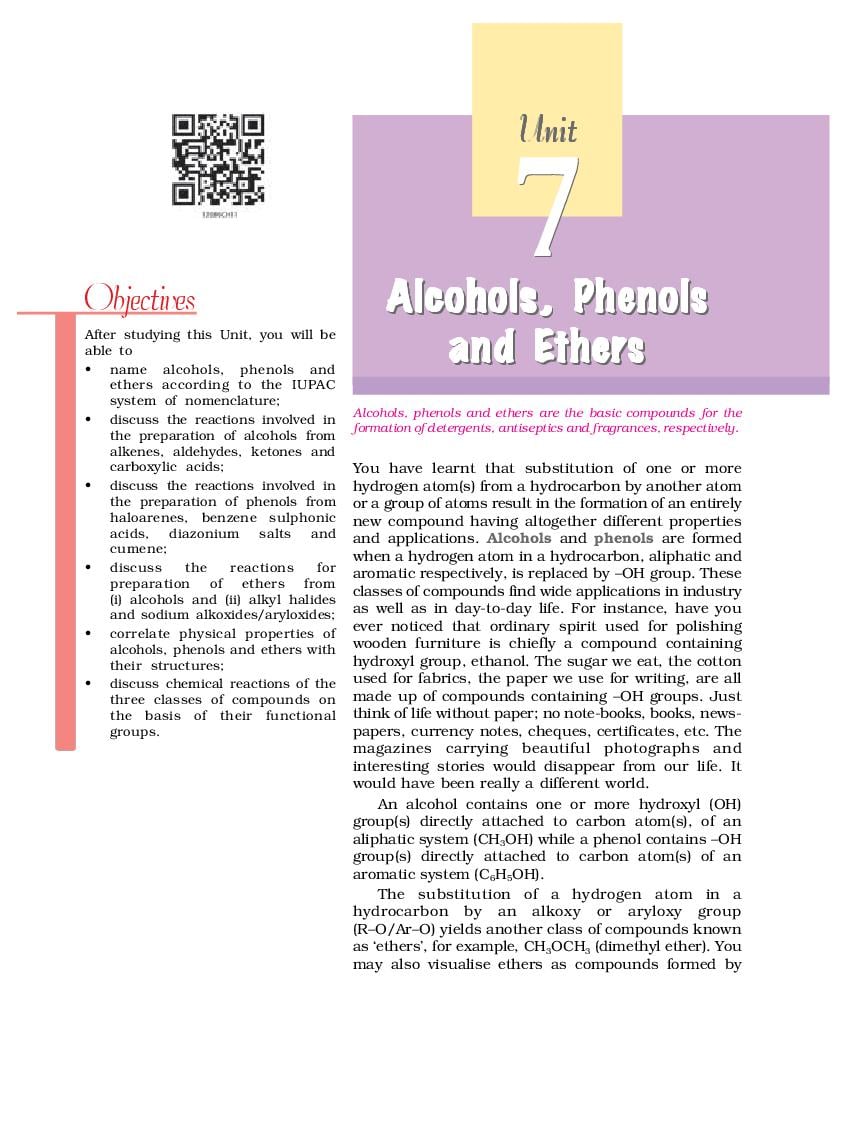
Objectives Alcohols
Alcohols,, Phenols
7
After studying this Unit, you will be
able to
• name alcohols, phenols and
and Ether
therss
ethers according to the IUPAC
system of nomenclature;
Alcohols, phenols and ethers are the basic compounds for the
• discuss the reactions involved in
formation of detergents, antiseptics and fragrances, respectively.
the preparation of alcohols from
alkenes, aldehydes, ketones and
carboxylic acids; You have learnt that substitution of one or more
• discuss the reactions involved in hydrogen atom(s) from a hydrocarbon by another atom
the preparation of phenols from or a group of atoms result in the formation of an entirely
haloarenes, benzene sulphonic new compound having altogether different properties
acids, diazonium salts and and applications. Alcohols and phenols are formed
cumene;
when a hydrogen atom in a hydrocarbon, aliphatic and
• discuss the reactions for aromatic respectively, is replaced by –OH group. These
preparation of ethers from
classes of compounds find wide applications in industry
(i) alcohols and (ii) alkyl halides
and sodium alkoxides/aryloxides; as well as in day-to-day life. For instance, have you
• correlate physical properties of
ever noticed that ordinary spirit used for polishing
alcohols, phenols and ethers with wooden furniture is chiefly a compound containing
their structures; hydroxyl group, ethanol. The sugar we eat, the cotton
• discuss chemical reactions of the used for fabrics, the paper we use for writing, are all
three classes of compounds on made up of compounds containing –OH groups. Just
the basis of their functional think of life without paper; no note-books, books, news-
groups. papers, currency notes, cheques, certificates, etc. The
magazines carrying beautiful photographs and
interesting stories would disappear from our life. It
would have been really a different world.
An alcohol contains one or more hydroxyl (OH)
group(s) directly attached to carbon atom(s), of an
aliphatic system (CH3OH) while a phenol contains –OH
group(s) directly attached to carbon atom(s) of an
aromatic system (C6H5OH).
The substitution of a hydrogen atom in a
hydrocarbon by an alkoxy or aryloxy group
(R–O/Ar–O) yields another class of compounds known
as ‘ethers’, for example, CH3OCH3 (dimethyl ether). You
may also visualise ethers as compounds formed by
Showing the first page only. Download the PDF above for the complete document.
Document Details
| Board / Org | NCERT |
| Exam | Class 12 |
| Type | Books |
| Pages | 34 |
| Updated | 29 Aug 2026 |