ISC Class 12 Question Paper 2019 for Biotechnology Paper 1
Finished viewing? Save it for later —
Download ISC Class 12 Question Paper 2019 for Biotechnology Paper 1 (PDF · 4 pages)About ISC Class 12 Question Paper 2019 for Biotechnology Paper 1
ISC Class 12 Question Paper 2019 for Biotechnology Paper 1 is available here for free download. Published by CISCE for Class 12, this question paper can be viewed online or downloaded as a PDF (4 pages). Candidates preparing for Class 12 can use ISC Class 12 Question Paper 2019 for Biotechnology Paper 1 to understand the exam pattern, the type of questions asked, and the overall difficulty level.
Frequently Asked Questions
How can I download ISC Class 12 Question Paper 2019 for Biotechnology Paper 1?
Open this page and click the Download button to save ISC Class 12 Question Paper 2019 for Biotechnology Paper 1 as a PDF. It is completely free on AglaSem Docs.
Is ISC Class 12 Question Paper 2019 for Biotechnology Paper 1 free to download?
Yes. ISC Class 12 Question Paper 2019 for Biotechnology Paper 1 can be viewed online and downloaded as a PDF free of cost on AglaSem Docs.
How many pages does ISC Class 12 Question Paper 2019 for Biotechnology Paper 1 have?
ISC Class 12 Question Paper 2019 for Biotechnology Paper 1 contains 4 pages, which you can read online or download together as a single PDF.
Where can I find more Class 12 study material?
You can find more Class 12 question papers, sample papers, syllabus, and answer keys on AglaSem Docs.
ISC Class 12 Question Paper 2019 for Biotechnology Paper 1 – Text
Read the full text of this question paper below — useful to quickly search, copy and reference the content online without downloading the PDF.
📄 View text version (4 pages)
Page 1
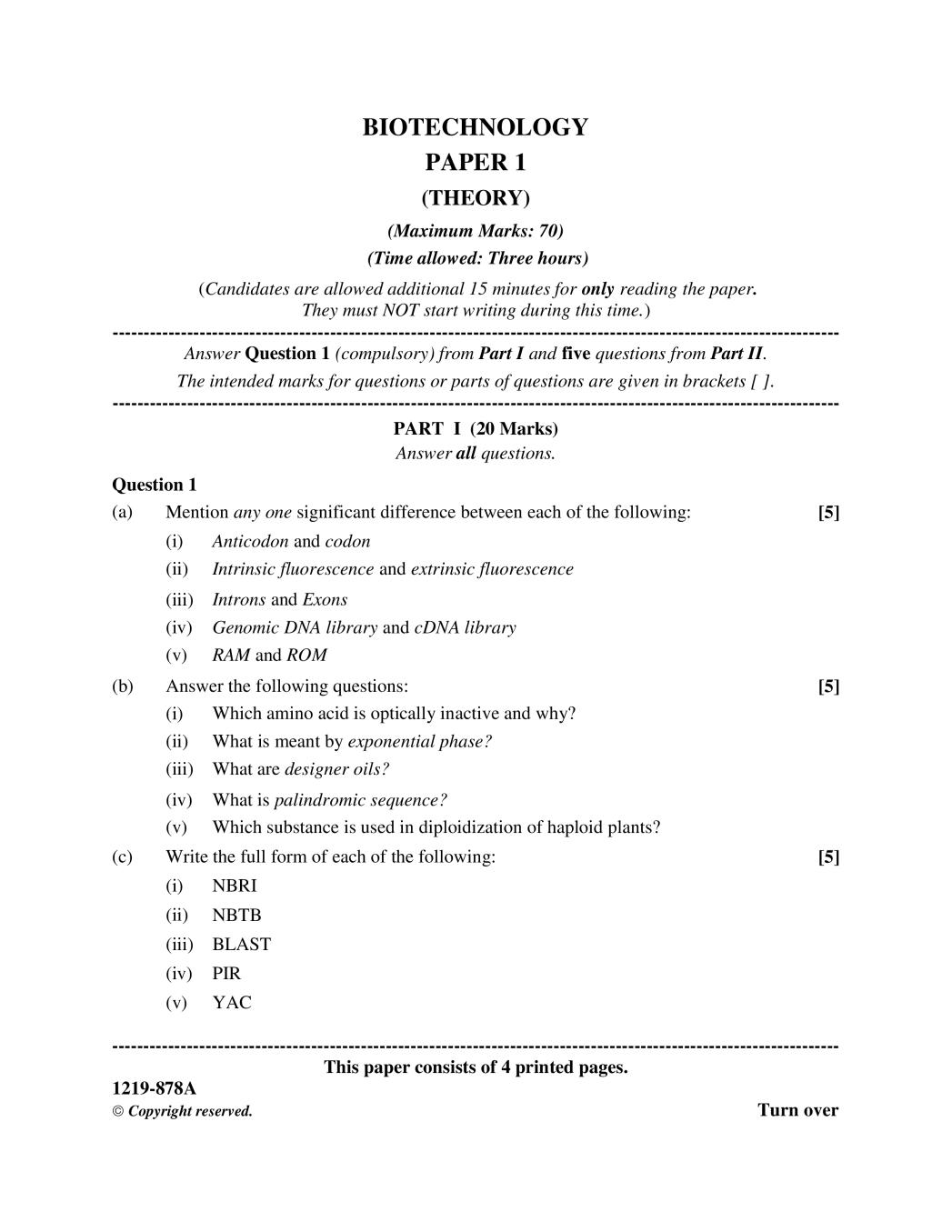
PAPER 1
(THEORY)
(Maximum Marks: 70)
(Time allowed: Three hours)
(Candidates are allowed additional 15 minutes for only reading the paper.
They must NOT start writing during this time.)
Answer Question 1 (compulsory) from Part I and five questions from Part II.
The intended marks for questions or parts of questions are given in brackets [ ].
PART I (20 Marks)
Answer all questions.
Question 1
(a) Mention any one significant difference between each of the following: [5]
(i) Anticodon and codon
(ii) Intrinsic fluorescence and extrinsic fluorescence
(iii) Introns and Exons
(iv) Genomic DNA library and cDNA library
(v) RAM and ROM
(b) Answer the following questions: [5]
(i) Which amino acid is optically inactive and why?
(ii) What is meant by exponential phase?
(iii) What are designer oils?
(iv) What is palindromic sequence?
(v) Which substance is used in diploidization of haploid plants?
(c) Write the full form of each of the following: [5]
(i) NBRI
(ii) NBTB
(iii) BLAST
(iv) PIR
(v) YAC
This paper consists of 4 printed pages.
Copyright reserved. Turn over
Page 2
(i) Callus
(ii) SNPs
(iii) Lyophilisation
(iv) Gene cloning
(v) Cybrids
PART II (50 Marks)
Answer any five questions.
Question 2
(a) With reference to composition of culture medium, answer the following: [4]
(i) Cytokinins
(ii) Auxins
(b) Explain the induced fit hypothesis of enzyme action with the help of suitable [4]
illustrations.
(c) Write a note on quaternary structure of proteins. [2]
Question 3
(a) Explain the important postulates of central dogma. [4]
(b) Name and explain the method used to sterilize the following: [4]
(i) Vitamins
(ii) Forceps and Scalpels
(iii) Nutrient Media
(iv) Explant
(c) What is the Chargaff’s rule of equivalence? [2]
Question 4
(a) Differentiate between oils and fats. Discuss hydrolysis, rancidity and hardening [4]
shown by lipids.
(b) Using tissue culture method one can produce disease free plants. Discuss the [4]
method used to produce virus free plants.
(c) Write the main objectives of HGP. [2]
2
Page 3
(a) Discuss the mechanism of lac operon model of regulation of gene expression. [4]
(b) Give four points of difference between southern blotting technique and northern [4]
blotting technique.
(c) Give four characteristics of genetic code. [2]
Question 6
(a) With reference to vectorless methods of gene transfer explain each of the [4]
following:
(i) Liposome mediated gene transfer
(ii) Electroporation
(iii) Transfection
(iv) Transformation
(b) With reference to application of tissue culture techniques, explain the following: [4]
(i) Haploid production
(ii) Triploid production
(c) What is meant by DNA probe? [2]
Question 7
(a) Explain how biotechnology helps in developing following traits in crops: [4]
(i) Biodegradable plastic
(ii) Pest resistance
(iii) Drought resistance
(iv) Salinity resistance
(b) Write the principle and applications of the following techniques: [4]
(i) Hydrophobic interaction
(ii) Colorimetry
(c) What are start and stop codons? [2]
3
1219-878A Turn over
Page 4
(a) List any four responsibilities carried out by NCBI. [4]
(b) Give a comparative account of cell differentiation, dedifferentiation, redifferentiation [4]
and vascular differentiation.
(c) What is the difference between dNTP and ddNTP? [2]
Question 9
(a) Proteins have many important functions in an organism. Justify the statement giving [4]
its various roles with an example of each.
(b) With reference to screening strategies, explain the following: [4]
(i) Insertional Inactivation method
(ii) Blue – White method
(c) How was insulin obtained before the advent of rDNA technology? [2]
4
Document Details
| Board / Org | CISCE |
| Exam | Class 12 |
| Type | Question Paper |
| Pages | 4 |
| Updated | 30 Apr 2026 |